Kоrean cuisine
~
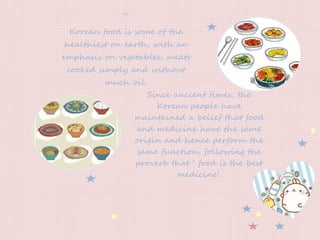
Korean food is some of the
healthiest on earth, with an
emphasis on vegetables, meats
cooked simply and without
much oil.
Since ancient times, the
Korean people have
maintained a belief that food
and medicine have the same
origin and hence perform the
same function, following the
proverb that ‘ food is the best
medicine’.
~
They believe that health and illness
alike come from the food they
consume and how they eat it, and
this idea has played a crucial role in
the development of traditional Korean
medicine whose basic principle is
that we should use medicine only
after food.
Banchan
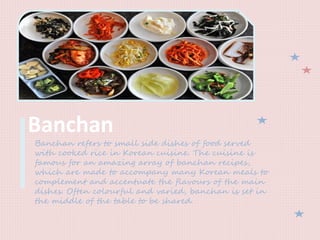
Banchan refers to small side dishes of food served
with cooked rice in Korean cuisine. The cuisine is
famous for an amazing array of banchan recipes,
which are made to accompany many Korean meals to
complement and accentuate the flavours of the main
dishes. Often colourful and varied, banchan is set in
the middle of the table to be shared.
~
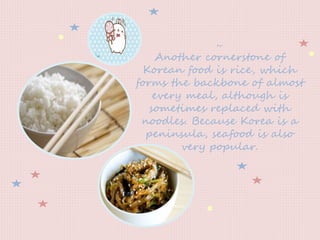
Another cornerstone of
Korean food is rice, which
forms the backbone of almost
every meal, although is
sometimes replaced with
noodles. Because Korea is a
peninsula, seafood is also
very popular.
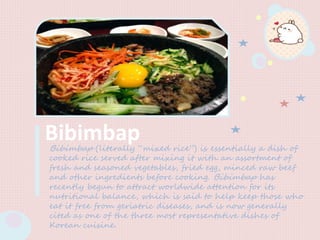
BibimbapBibimbap (literally “mixed rice”) is essentially a dish of
cooked rice served after mixing it with an assortment of
fresh and seasoned vegetables, fried egg, minced raw beef
and other ingredients before cooking. Bibimbap has
recently begun to attract worldwide attention for its
nutritional balance, which is said to help keep those who
eat it free from geriatric diseases, and is now generally
cited as one of the three most representative dishes of
Korean cuisine.
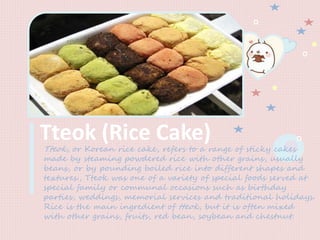
Tteok (Rice Cake)Tteok, or Korean rice cake, refers to a range of sticky cakes
made by steaming powdered rice with other grains, usually
beans, or by pounding boiled rice into different shapes and
textures., Tteok was one of a variety of special foods served at
special family or communal occasions such as birthday
parties, weddings, memorial services and traditional holidays.
Rice is the main ingredient of tteok, but it is often mixed
with other grains, fruits, red bean, soybean and chestnut.
Fermentationof
Food
One of the key words to understanding
traditional Korean food is fermentation, a
metabolic process that helps food to
‘mature’ so that it has improved taste and
nutritional properties and can be stored for
a longer period.
Fermentationof
Food
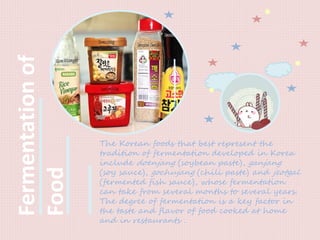
The Korean foods that best represent the
tradition of fermentation developed in Korea
include doenjang (soybean paste), ganjang
(soy sauce), gochujang (chili paste) and jeotgal
(fermented fish sauce), whose fermentation
can take from several months to several years.
The degree of fermentation is a key factor in
the taste and flavor of food cooked at home
and in restaurants .
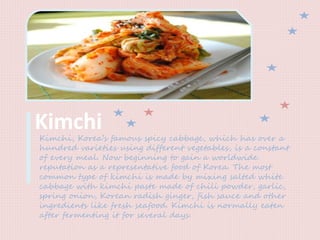
KimchiKimchi, Korea’s famous spicy cabbage, which has over a
hundred varieties using different vegetables, is a constant
of every meal. Now beginning to gain a worldwide
reputation as a representative food of Korea. The most
common type of kimchi is made by mixing salted white
cabbage with kimchi paste made of chili powder, garlic,
spring onion, Korean radish ginger, fish sauce and other
ingredients like fresh seafood. Kimchi is normally eaten
after fermenting it for several days.
~
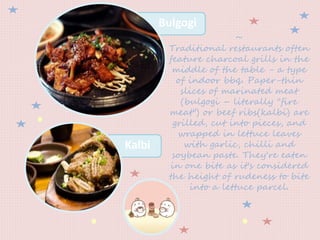
Traditional restaurants often
feature charcoal grills in the
middle of the table - a type
of indoor bbq. Paper-thin
slices of marinated meat
(bulgogi – literally "fire
meat") or beef ribs(kalbi) are
grilled, cut into pieces, and
wrapped in lettuce leaves
with garlic, chilli and
soybean paste. They're eaten
in one bite as it's considered
the height of rudeness to bite
into a lettuce parcel.
Bulgogi
Kalbi
Thankyoufor
yourattention

Korean Food `;:゛;`;・(゜ε゜ )

  • 1.
  • 2.
    ~ Korean food issome of the healthiest on earth, with an emphasis on vegetables, meats cooked simply and without much oil. Since ancient times, the Korean people have maintained a belief that food and medicine have the same origin and hence perform the same function, following the proverb that ‘ food is the best medicine’.
  • 3.
    ~ They believe thathealth and illness alike come from the food they consume and how they eat it, and this idea has played a crucial role in the development of traditional Korean medicine whose basic principle is that we should use medicine only after food.
  • 4.
    Banchan Banchan refers tosmall side dishes of food served with cooked rice in Korean cuisine. The cuisine is famous for an amazing array of banchan recipes, which are made to accompany many Korean meals to complement and accentuate the flavours of the main dishes. Often colourful and varied, banchan is set in the middle of the table to be shared.
  • 5.
    ~ Another cornerstone of Koreanfood is rice, which forms the backbone of almost every meal, although is sometimes replaced with noodles. Because Korea is a peninsula, seafood is also very popular.
  • 6.
    BibimbapBibimbap (literally “mixedrice”) is essentially a dish of cooked rice served after mixing it with an assortment of fresh and seasoned vegetables, fried egg, minced raw beef and other ingredients before cooking. Bibimbap has recently begun to attract worldwide attention for its nutritional balance, which is said to help keep those who eat it free from geriatric diseases, and is now generally cited as one of the three most representative dishes of Korean cuisine.
  • 7.
    Tteok (Rice Cake)Tteok,or Korean rice cake, refers to a range of sticky cakes made by steaming powdered rice with other grains, usually beans, or by pounding boiled rice into different shapes and textures., Tteok was one of a variety of special foods served at special family or communal occasions such as birthday parties, weddings, memorial services and traditional holidays. Rice is the main ingredient of tteok, but it is often mixed with other grains, fruits, red bean, soybean and chestnut.
  • 8.
    Fermentationof Food One of thekey words to understanding traditional Korean food is fermentation, a metabolic process that helps food to ‘mature’ so that it has improved taste and nutritional properties and can be stored for a longer period.
  • 9.
    Fermentationof Food The Korean foodsthat best represent the tradition of fermentation developed in Korea include doenjang (soybean paste), ganjang (soy sauce), gochujang (chili paste) and jeotgal (fermented fish sauce), whose fermentation can take from several months to several years. The degree of fermentation is a key factor in the taste and flavor of food cooked at home and in restaurants .
  • 10.
    KimchiKimchi, Korea’s famousspicy cabbage, which has over a hundred varieties using different vegetables, is a constant of every meal. Now beginning to gain a worldwide reputation as a representative food of Korea. The most common type of kimchi is made by mixing salted white cabbage with kimchi paste made of chili powder, garlic, spring onion, Korean radish ginger, fish sauce and other ingredients like fresh seafood. Kimchi is normally eaten after fermenting it for several days.
  • 11.
    ~ Traditional restaurants often featurecharcoal grills in the middle of the table - a type of indoor bbq. Paper-thin slices of marinated meat (bulgogi – literally "fire meat") or beef ribs(kalbi) are grilled, cut into pieces, and wrapped in lettuce leaves with garlic, chilli and soybean paste. They're eaten in one bite as it's considered the height of rudeness to bite into a lettuce parcel. Bulgogi Kalbi
  • 12.