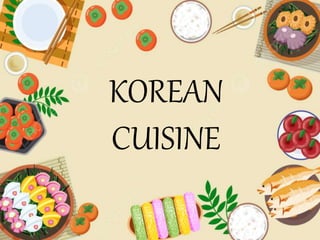
KOREAN
CUISINE
INTRODUCTION
Korean is blessed with a large friendly subtemperate
climate that yields abundant produce. They have eaten
the produce of the sea, the land and mountains or
many many years. Similar to the Vietnam there are two
distinct types of cooking – the home cooking of the
traditional family and the elaborate court cuisine.
HISTORICAL INFLUENCES
1. Korean cuisine originated from
prehistoric traditions in the korean
peninsula evolving through a complex
interaction of environmental, political
and cultural trends.
2. Korean food has been heavily influenced
by that of its neighboring countries,
China and Japan but its distinct culinary
traditions and native ingredients have
converged to create a unique cuisine.
3. Buddhist traditions have strongly
influenced korean cuisine.
4. Vegetarian cookery may be linked to the
Buddhist traditions as well.
5. Chinese influences would include root
ginger, chili,mustard, spring onions, garlic,
soy sauce, vinegar and sesame seeds.
6. Japaness cooking mirrored in
korea include raw fish ‘’sushi’’
dishes. Korean cuisine is largely
based upon rice,vegetables and
meat. Traditional korean meals
are noted for the number of side
dishes (banchan) that company
steamed-cooked short-grain
rice.
Characteristics of Korean Cuisine
• Korean cuisine is largely based on rice, vegetable
and meats.
• Traditional Korean meals are noted for the
number of side dishes (banchan) that accompany
steam-cooked short-grain rice.
• Fermented foods play a key role in Korean
cuisine. Pickles, soy sauce, hot chilie paste and
soy bean paste are used extensively in cooking
these intensely flavored dishes.
• Kimchi a pickled and fermented cabbage dish is
usually served at every meal.
• Other flavoring ingredients that
characterize Korean cuisine include
red chilies, garlic, soy, sesame, ginger
and green onions.
• A large portion of the Korean diet is
compromised of starchy foods like
rice, noodles and pancakes.
• The country’s ample coastline provide
fish and seafood while chicken, beef
and pork are also featured.
• Meals are organized and presented based on
the occasion the main dish being served and
the number of side dishes offered.
• Each diner given a bowl of rice and side dishes
are typically offered in the center of the table.
• Koreans traditionally use metal
chopsticks that are longer than the
wooden ones found in Japan and
accompanied by spoon used for eating
rice and soups. Korean meals often
feature soups (“kuk” or “guk”)
barbecued items like bulgogi (beef)
grilled over a “hware” or hot brazier
and fermented sauces and pastes.
• Barbecued items are often served with
lettuce leaves and condiments for
wrapping and eating.
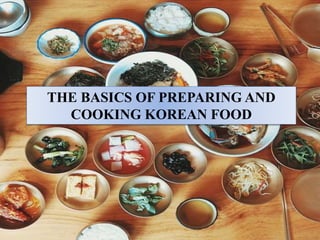
THE BASICS OF PREPARING AND
COOKING KOREAN FOOD
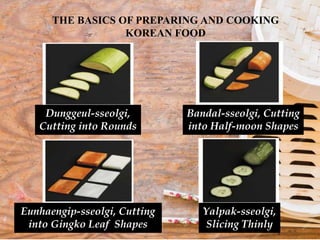
Dunggeul-sseolgi,
Cutting into Rounds
Bandal-sseolgi, Cutting
into Half-moon Shapes
Eunhaengip-sseolgi, Cutting
into Gingko Leaf Shapes
Yalpak-sseolgi,
Slicing Thinly
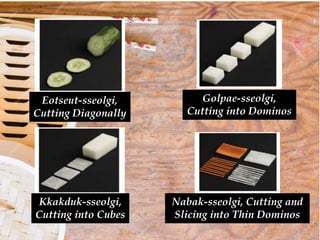
THE BASICS OF PREPARING AND COOKING
KOREAN FOOD
Eotseut-sseolgi,
Cutting Diagonally
Golpae-sseolgi,
Cutting into Dominos
Nabak-sseolgi, Cutting and
Slicing into Thin Dominos
Kkakduk-sseolgi,
Cutting into Cubes
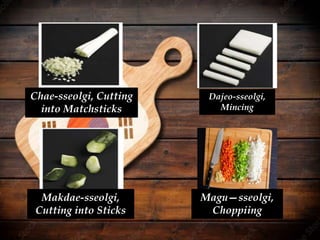
Chae-sseolgi, Cutting
into Matchsticks
Dajeo-sseolgi,
Mincing
Makdae-sseolgi,
Cutting into Sticks
Magu—sseolgi,
Choppiing
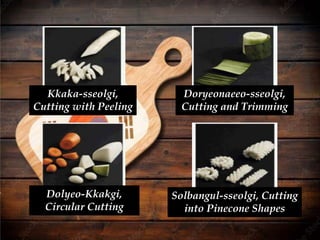
Kkaka-sseolgi,
Cutting with Peeling
Doryeonaeeo-sseolgi,
Cutting and Trimming
Dolyeo-Kkakgi,
Circular Cutting
Solbangul-sseolgi, Cutting
into Pinecone Shapes
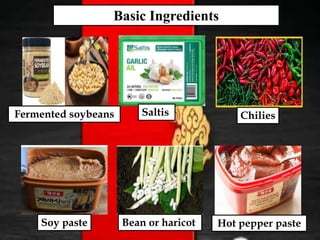
BASIC INGREDIENTS
Basic Ingredients
Bean or haricot Hot pepper paste
Fermented soybeans
Soy paste
Saltis Chilies
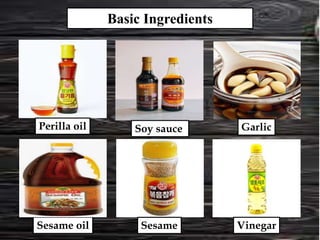
Basic Ingredients
Sesame oil
Soy sauce
Perilla oil Garlic
Sesame Vinegar
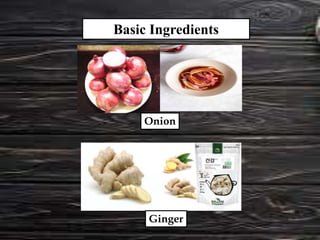
Basic Ingredients
Onion
Ginger
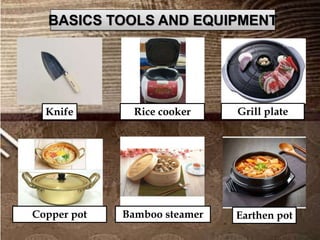
TOOLS AND EQUIPMENT
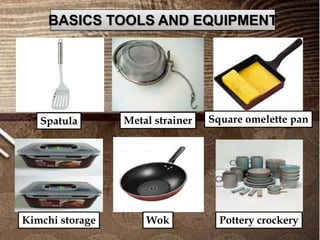
BASICS TOOLS AND EQUIPMENT
Knife Rice cooker Grill plate
Copper pot Bamboo steamer Earthen pot
BASICS TOOLS AND EQUIPMENT
Spatula Metal strainer Square omelette pan
Kimchi storage Wok Pottery crockery
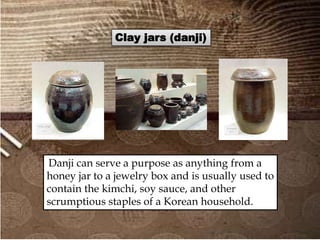
Clay jars (danji)
Danji can serve a purpose as anything from a
honey jar to a jewelry box and is usually used to
contain the kimchi, soy sauce, and other
scrumptious staples of a Korean household.
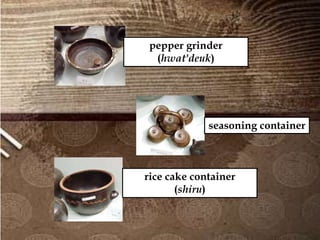
pepper grinder
(hwat'deuk)
seasoning container
rice cake container
(shiru)
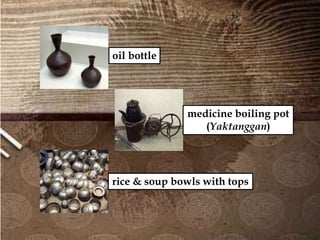
oil bottle
medicine boiling pot
(Yaktanggan)
rice & soup bowls with tops
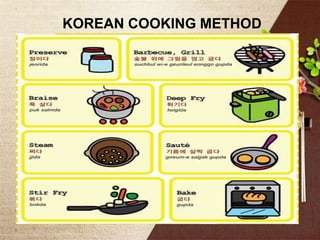
KOREAN COOKING METHOD
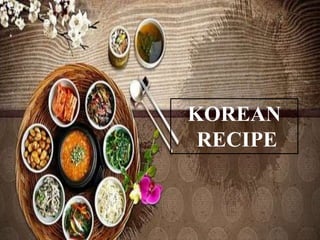
KOREAN
RECIPE
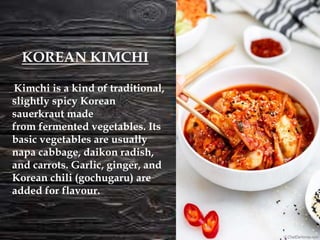
Kimchi is a kind of traditional,
slightly spicy Korean
sauerkraut made
from fermented vegetables. Its
basic vegetables are usually
napa cabbage, daikon radish,
and carrots. Garlic, ginger, and
Korean chili (gochugaru) are
added for flavour.
KOREAN KIMCHI
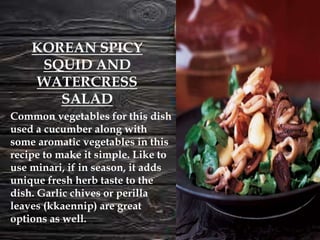
Common vegetables for this dish
used a cucumber along with
some aromatic vegetables in this
recipe to make it simple. Like to
use minari, if in season, it adds
unique fresh herb taste to the
dish. Garlic chives or perilla
leaves (kkaennip) are great
options as well.
KOREAN SPICY
SQUID AND
WATERCRESS
SALAD
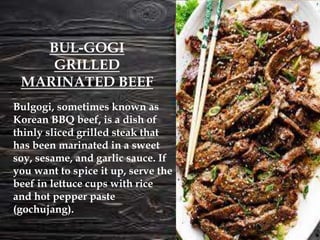
Bulgogi, sometimes known as
Korean BBQ beef, is a dish of
thinly sliced grilled steak that
has been marinated in a sweet
soy, sesame, and garlic sauce. If
you want to spice it up, serve the
beef in lettuce cups with rice
and hot pepper paste
(gochujang).
BUL-GOGI
GRILLED
MARINATED BEEF
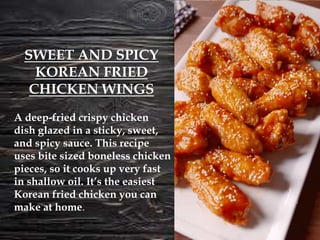
A deep-fried crispy chicken
dish glazed in a sticky, sweet,
and spicy sauce. This recipe
uses bite sized boneless chicken
pieces, so it cooks up very fast
in shallow oil. It’s the easiest
Korean fried chicken you can
make at home.
SWEET AND SPICY
KOREAN FRIED
CHICKEN WINGS
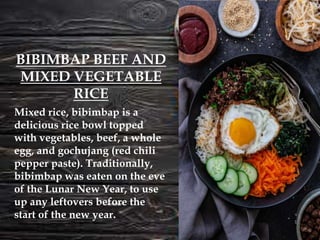
Mixed rice, bibimbap is a
delicious rice bowl topped
with vegetables, beef, a whole
egg, and gochujang (red chili
pepper paste). Traditionally,
bibimbap was eaten on the eve
of the Lunar New Year, to use
up any leftovers before the
start of the new year.
BIBIMBAP BEEF AND
MIXED VEGETABLE
RICE
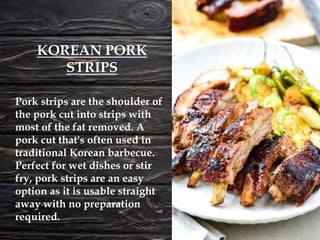
Pork strips are the shoulder of
the pork cut into strips with
most of the fat removed. A
pork cut that's often used in
traditional Korean barbecue.
Perfect for wet dishes or stir
fry, pork strips are an easy
option as it is usable straight
away with no preparation
required.
KOREAN PORK
STRIPS
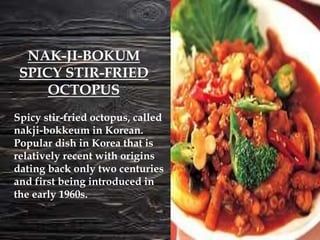
Spicy stir-fried octopus, called
nakji-bokkeum in Korean.
Popular dish in Korea that is
relatively recent with origins
dating back only two centuries
and first being introduced in
the early 1960s.
NAK-JI-BOKUM
SPICY STIR-FRIED
OCTOPUS
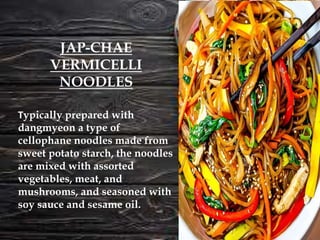
Typically prepared with
dangmyeon a type of
cellophane noodles made from
sweet potato starch, the noodles
are mixed with assorted
vegetables, meat, and
mushrooms, and seasoned with
soy sauce and sesame oil.
JAP-CHAE
VERMICELLI
NOODLES
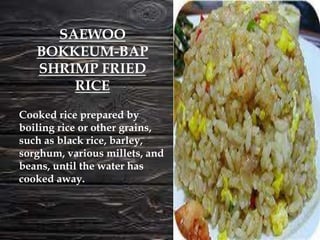
Cooked rice prepared by
boiling rice or other grains,
such as black rice, barley,
sorghum, various millets, and
beans, until the water has
cooked away.
SAEWOO
BOKKEUM-BAP
SHRIMP FRIED
RICE
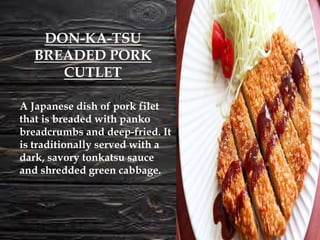
A Japanese dish of pork filet
that is breaded with panko
breadcrumbs and deep-fried. It
is traditionally served with a
dark, savory tonkatsu sauce
and shredded green cabbage.
DON-KA-TSU
BREADED PORK
CUTLET
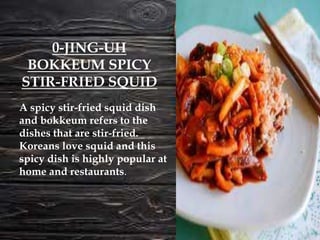
A spicy stir-fried squid dish
and bokkeum refers to the
dishes that are stir-fried.
Koreans love squid and this
spicy dish is highly popular at
home and restaurants.
0-JING-UH
BOKKEUM SPICY
STIR-FRIED SQUID
THANK YOU
Kamsahamnida – 감사합니다

01KOREAN-CUISINE-REport.pptx

  • 1.
  • 2.
    INTRODUCTION Korean is blessedwith a large friendly subtemperate climate that yields abundant produce. They have eaten the produce of the sea, the land and mountains or many many years. Similar to the Vietnam there are two distinct types of cooking – the home cooking of the traditional family and the elaborate court cuisine.
  • 3.
    HISTORICAL INFLUENCES 1. Koreancuisine originated from prehistoric traditions in the korean peninsula evolving through a complex interaction of environmental, political and cultural trends. 2. Korean food has been heavily influenced by that of its neighboring countries, China and Japan but its distinct culinary traditions and native ingredients have converged to create a unique cuisine. 3. Buddhist traditions have strongly influenced korean cuisine.
  • 4.
    4. Vegetarian cookerymay be linked to the Buddhist traditions as well. 5. Chinese influences would include root ginger, chili,mustard, spring onions, garlic, soy sauce, vinegar and sesame seeds. 6. Japaness cooking mirrored in korea include raw fish ‘’sushi’’ dishes. Korean cuisine is largely based upon rice,vegetables and meat. Traditional korean meals are noted for the number of side dishes (banchan) that company steamed-cooked short-grain rice.
  • 5.
    Characteristics of KoreanCuisine • Korean cuisine is largely based on rice, vegetable and meats. • Traditional Korean meals are noted for the number of side dishes (banchan) that accompany steam-cooked short-grain rice. • Fermented foods play a key role in Korean cuisine. Pickles, soy sauce, hot chilie paste and soy bean paste are used extensively in cooking these intensely flavored dishes. • Kimchi a pickled and fermented cabbage dish is usually served at every meal.
  • 6.
    • Other flavoringingredients that characterize Korean cuisine include red chilies, garlic, soy, sesame, ginger and green onions. • A large portion of the Korean diet is compromised of starchy foods like rice, noodles and pancakes. • The country’s ample coastline provide fish and seafood while chicken, beef and pork are also featured. • Meals are organized and presented based on the occasion the main dish being served and the number of side dishes offered. • Each diner given a bowl of rice and side dishes are typically offered in the center of the table.
  • 7.
    • Koreans traditionallyuse metal chopsticks that are longer than the wooden ones found in Japan and accompanied by spoon used for eating rice and soups. Korean meals often feature soups (“kuk” or “guk”) barbecued items like bulgogi (beef) grilled over a “hware” or hot brazier and fermented sauces and pastes. • Barbecued items are often served with lettuce leaves and condiments for wrapping and eating.
  • 8.
    THE BASICS OFPREPARING AND COOKING KOREAN FOOD
  • 9.
    Dunggeul-sseolgi, Cutting into Rounds Bandal-sseolgi,Cutting into Half-moon Shapes Eunhaengip-sseolgi, Cutting into Gingko Leaf Shapes Yalpak-sseolgi, Slicing Thinly THE BASICS OF PREPARING AND COOKING KOREAN FOOD
  • 10.
    Eotseut-sseolgi, Cutting Diagonally Golpae-sseolgi, Cutting intoDominos Nabak-sseolgi, Cutting and Slicing into Thin Dominos Kkakduk-sseolgi, Cutting into Cubes
  • 11.
  • 12.
    Kkaka-sseolgi, Cutting with Peeling Doryeonaeeo-sseolgi, Cuttingand Trimming Dolyeo-Kkakgi, Circular Cutting Solbangul-sseolgi, Cutting into Pinecone Shapes
  • 13.
  • 14.
    Basic Ingredients Bean orharicot Hot pepper paste Fermented soybeans Soy paste Saltis Chilies
  • 15.
    Basic Ingredients Sesame oil Soysauce Perilla oil Garlic Sesame Vinegar
  • 16.
  • 17.
  • 18.
    BASICS TOOLS ANDEQUIPMENT Knife Rice cooker Grill plate Copper pot Bamboo steamer Earthen pot
  • 19.
    BASICS TOOLS ANDEQUIPMENT Spatula Metal strainer Square omelette pan Kimchi storage Wok Pottery crockery
  • 20.
    Clay jars (danji) Danjican serve a purpose as anything from a honey jar to a jewelry box and is usually used to contain the kimchi, soy sauce, and other scrumptious staples of a Korean household.
  • 21.
  • 22.
    oil bottle medicine boilingpot (Yaktanggan) rice & soup bowls with tops
  • 23.
  • 24.
  • 25.
    Kimchi is akind of traditional, slightly spicy Korean sauerkraut made from fermented vegetables. Its basic vegetables are usually napa cabbage, daikon radish, and carrots. Garlic, ginger, and Korean chili (gochugaru) are added for flavour. KOREAN KIMCHI
  • 26.
    Common vegetables forthis dish used a cucumber along with some aromatic vegetables in this recipe to make it simple. Like to use minari, if in season, it adds unique fresh herb taste to the dish. Garlic chives or perilla leaves (kkaennip) are great options as well. KOREAN SPICY SQUID AND WATERCRESS SALAD
  • 27.
    Bulgogi, sometimes knownas Korean BBQ beef, is a dish of thinly sliced grilled steak that has been marinated in a sweet soy, sesame, and garlic sauce. If you want to spice it up, serve the beef in lettuce cups with rice and hot pepper paste (gochujang). BUL-GOGI GRILLED MARINATED BEEF
  • 28.
    A deep-fried crispychicken dish glazed in a sticky, sweet, and spicy sauce. This recipe uses bite sized boneless chicken pieces, so it cooks up very fast in shallow oil. It’s the easiest Korean fried chicken you can make at home. SWEET AND SPICY KOREAN FRIED CHICKEN WINGS
  • 29.
    Mixed rice, bibimbapis a delicious rice bowl topped with vegetables, beef, a whole egg, and gochujang (red chili pepper paste). Traditionally, bibimbap was eaten on the eve of the Lunar New Year, to use up any leftovers before the start of the new year. BIBIMBAP BEEF AND MIXED VEGETABLE RICE
  • 30.
    Pork strips arethe shoulder of the pork cut into strips with most of the fat removed. A pork cut that's often used in traditional Korean barbecue. Perfect for wet dishes or stir fry, pork strips are an easy option as it is usable straight away with no preparation required. KOREAN PORK STRIPS
  • 31.
    Spicy stir-fried octopus,called nakji-bokkeum in Korean. Popular dish in Korea that is relatively recent with origins dating back only two centuries and first being introduced in the early 1960s. NAK-JI-BOKUM SPICY STIR-FRIED OCTOPUS
  • 32.
    Typically prepared with dangmyeona type of cellophane noodles made from sweet potato starch, the noodles are mixed with assorted vegetables, meat, and mushrooms, and seasoned with soy sauce and sesame oil. JAP-CHAE VERMICELLI NOODLES
  • 33.
    Cooked rice preparedby boiling rice or other grains, such as black rice, barley, sorghum, various millets, and beans, until the water has cooked away. SAEWOO BOKKEUM-BAP SHRIMP FRIED RICE
  • 34.
    A Japanese dishof pork filet that is breaded with panko breadcrumbs and deep-fried. It is traditionally served with a dark, savory tonkatsu sauce and shredded green cabbage. DON-KA-TSU BREADED PORK CUTLET
  • 35.
    A spicy stir-friedsquid dish and bokkeum refers to the dishes that are stir-fried. Koreans love squid and this spicy dish is highly popular at home and restaurants. 0-JING-UH BOKKEUM SPICY STIR-FRIED SQUID
  • 36.