Name: Aditi Ranjan
Roll no.: 2041117015
Batch: 2020-23
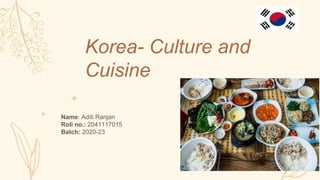
Korea- Culture and
Cuisine
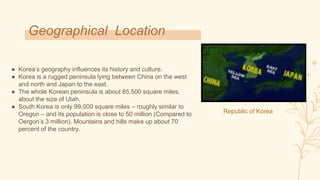
Geographical Location
● Korea’s geography influences its history and culture.
● Korea is a rugged peninsula lying between China on the west
and north and Japan to the east.
● The whole Korean peninsula is about 85,500 square miles,
about the size of Utah.
● South Korea is only 99,000 square miles – roughly similar to
Oregon – and its population is close to 50 million (Compared to
Oergon’s 3 million). Mountains and hills make up about 70
percent of the country.
Republic of Korea
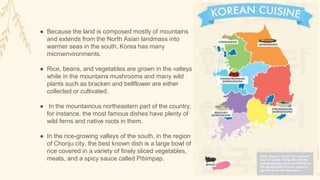
● Because the land is composed mostly of mountains
and extends from the North Asian landmass into
warmer seas in the south, Korea has many
microenvironments.
● Rice, beans, and vegetables are grown in the valleys
while in the mountains mushrooms and many wild
plants such as bracken and bellflower are either
collected or cultivated.
● In the mountainous northeastern part of the country,
for instance, the most famous dishes have plenty of
wild ferns and native roots in them.
● In the rice-growing valleys of the south, in the region
of Chonju city, the best known dish is a large bowl of
rice covered in a variety of finely sliced vegetables,
meats, and a spicy sauce called Pibimpap.
Historical Background and Culture
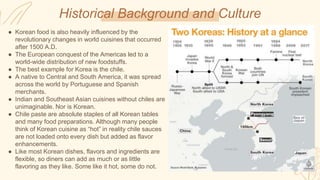
● Korean food is also heavily influenced by the
revolutionary changes in world cuisines that occurred
after 1500 A.D.
● The European conquest of the Americas led to a
world-wide distribution of new foodstuffs.
● The best example for Korea is the chile.
● A native to Central and South America, it was spread
across the world by Portuguese and Spanish
merchants.
● Indian and Southeast Asian cuisines without chiles are
unimaginable. Nor is Korean.
● Chile paste are absolute staples of all Korean tables
and many food preparations. Although many people
think of Korean cuisine as “hot” in reality chile sauces
are not loaded onto every dish but added as flavor
enhancements.
● Like most Korean dishes, flavors and ingredients are
flexible, so diners can add as much or as little
flavoring as they like. Some like it hot, some do not.
Korean Culture
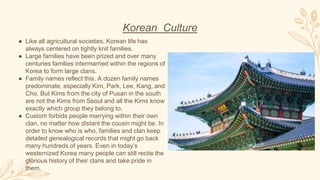
● Like all agricultural societies, Korean life has
always centered on tightly knit families.
● Large families have been prized and over many
centuries families intermarried within the regions of
Korea to form large clans.
● Family names reflect this. A dozen family names
predominate, especially Kim, Park, Lee, Kang, and
Cho. But Kims from the city of Pusan in the south
are not the Kims from Seoul and all the Kims know
exactly which group they belong to.
● Custom forbids people marrying within their own
clan, no matter how distant the cousin might be. In
order to know who is who, families and clan keep
detailed genealogical records that might go back
many hundreds of years. Even in today’s
westernized Korea many people can still recite the
glorious history of their clans and take pride in
them.
Festivals and foods associated with them
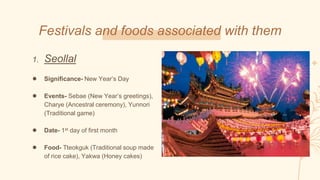
1. Seollal
● Significance- New Year’s Day
● Events- Sebae (New Year’s greetings),
Charye (Ancestral ceremony), Yunnori
(Traditional game)
● Date- 1st day of first month
● Food- Tteokguk (Traditional soup made
of rice cake), Yakwa (Honey cakes)
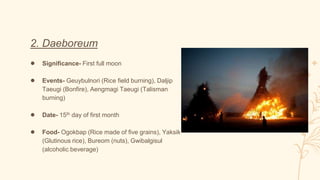
2. Daeboreum
● Significance- First full moon
● Events- Geuybulnori (Rice field burning), Daljip
Taeugi (Bonfire), Aengmagi Taeugi (Talisman
burning)
● Date- 15th day of first month
● Food- Ogokbap (Rice made of five grains), Yaksik
(Glutinous rice), Bureom (nuts), Gwibalgisul
(alcoholic beverage)
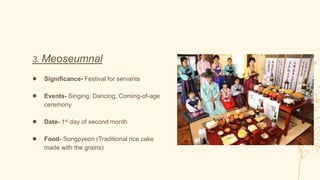
3. Meoseumnal
● Significance- Festival for servants
● Events- Singing, Dancing, Coming-of-age
ceremony
● Date- 1st day of second month
● Food- Songpyeon (Traditional rice cake
made with the grains)
4. Yeongdeungje
● Significance- Celebrating the god of wind Jesa
(Traditional ritual to appease the god of wind)
● Date- First day of second month
● Food- Regular food for Jesa
● Events- Samjinnal Celebrating the coming of spring
Archery, Cockfighting, Fortune telling
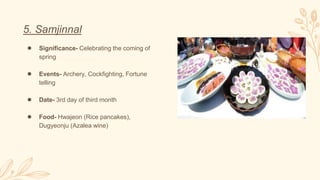
5. Samjinnal
● Significance- Celebrating the coming of
spring
● Events- Archery, Cockfighting, Fortune
telling
● Date- 3rd day of third month
● Food- Hwajeon (Rice pancakes),
Dugyeonju (Azalea wine)
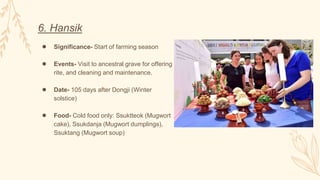
6. Hansik
● Significance- Start of farming season
● Events- Visit to ancestral grave for offering
rite, and cleaning and maintenance.
● Date- 105 days after Dongji (Winter
solstice)
● Food- Cold food only: Ssuktteok (Mugwort
cake), Ssukdanja (Mugwort dumplings),
Ssuktang (Mugwort soup)
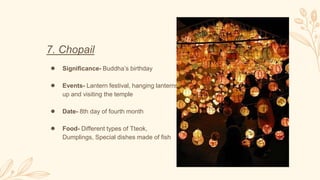
7. Chopail
● Significance- Buddha’s birthday
● Events- Lantern festival, hanging lanterns
up and visiting the temple
● Date- 8th day of fourth month
● Food- Different types of Tteok,
Dumplings, Special dishes made of fish
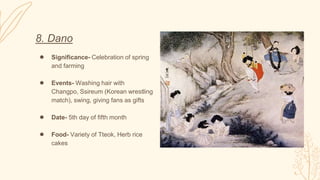
8. Dano
● Significance- Celebration of spring
and farming
● Events- Washing hair with
Changpo, Ssireum (Korean wrestling
match), swing, giving fans as gifts
● Date- 5th day of fifth month
● Food- Variety of Tteok, Herb rice
cakes
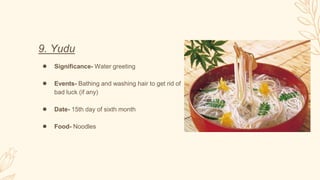
9. Yudu
● Significance- Water greeting
● Events- Bathing and washing hair to get rid of
bad luck (if any)
● Date- 15th day of sixth month
● Food- Noodles
Common Ingredients Used
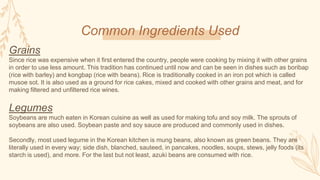
Grains
Since rice was expensive when it first entered the country, people were cooking by mixing it with other grains
in order to use less amount. This tradition has continued until now and can be seen in dishes such as boribap
(rice with barley) and kongbap (rice with beans). Rice is traditionally cooked in an iron pot which is called
musoe sot. It is also used as a ground for rice cakes, mixed and cooked with other grains and meat, and for
making filtered and unfiltered rice wines.
Legumes
Soybeans are much eaten in Korean cuisine as well as used for making tofu and soy milk. The sprouts of
soybeans are also used. Soybean paste and soy sauce are produced and commonly used in dishes.
Secondly, most used legume in the Korean kitchen is mung beans, also known as green beans. They are
literally used in every way; side dish, blanched, sauteed, in pancakes, noodles, soups, stews, jelly foods (its
starch is used), and more. For the last but not least, azuki beans are consumed with rice.
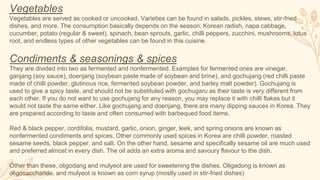
Vegetables
Vegetables are served as cooked or uncooked. Varieties can be found in salads, pickles, stews, stir-fried
dishes, and more. The consumption basically depends on the season. Korean radish, napa cabbage,
cucumber, potato (regular & sweet), spinach, bean sprouts, garlic, chilli peppers, zucchini, mushrooms, lotus
root, and endless types of other vegetables can be found in this cuisine.
Condiments & seasonings & spices
They are divided into two as fermented and nonfermented. Examples for fermented ones are vinegar,
ganjang (soy sauce), doenjang (soybean paste made of soybean and brine), and gochujang (red chilli paste
made of chilli powder, glutinous rice, fermented soybean powder, and barley malt powder). Gochujang is
used to give a spicy taste, and should not be substituted with gochugaru as their taste is very different from
each other. If you do not want to use gochujang for any reason, you may replace it with chilli flakes but it
would not taste the same either. Like gochujang and doenjang, there are many dipping sauces in Korea. They
are prepared according to taste and often consumed with barbequed food items.
Red & black pepper, cordifolia, mustard, garlic, onion, ginger, leek, and spring onions are known as
nonfermented condiments and spices. Other commonly used spices in Korea are chilli powder, roasted
sesame seeds, black pepper, and salt. On the other hand, sesame and specifically sesame oil are much used
and preferred almost in every dish. The oil adds an extra aroma and savoury flavour to the dish.
Other than these, oligodang and mulyeot are used for sweetening the dishes. Oligadong is known as
oligosaccharide, and mulyeot is known as corn syrup (mostly used in stir-fried dishes)
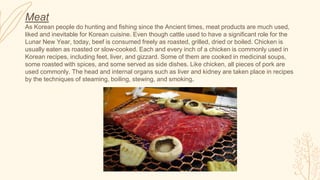
Meat
As Korean people do hunting and fishing since the Ancient times, meat products are much used,
liked and inevitable for Korean cuisine. Even though cattle used to have a significant role for the
Lunar New Year, today, beef is consumed freely as roasted, grilled, dried or boiled. Chicken is
usually eaten as roasted or slow-cooked. Each and every inch of a chicken is commonly used in
Korean recipes, including feet, liver, and gizzard. Some of them are cooked in medicinal soups,
some roasted with spices, and some served as side dishes. Like chicken, all pieces of pork are
used commonly. The head and internal organs such as liver and kidney are taken place in recipes
by the techniques of steaming, boiling, stewing, and smoking.
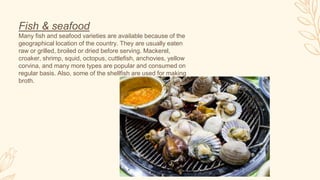
Fish & seafood
Many fish and seafood varieties are available because of the
geographical location of the country. They are usually eaten
raw or grilled, broiled or dried before serving. Mackerel,
croaker, shrimp, squid, octopus, cuttlefish, anchovies, yellow
corvina, and many more types are popular and consumed on
regular basis. Also, some of the shellfish are used for making
broth.
Popular Dishes
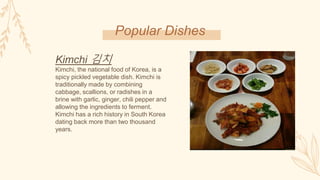
Kimchi 김치
Kimchi, the national food of Korea, is a
spicy pickled vegetable dish. Kimchi is
traditionally made by combining
cabbage, scallions, or radishes in a
brine with garlic, ginger, chili pepper and
allowing the ingredients to ferment.
Kimchi has a rich history in South Korea
dating back more than two thousand
years.
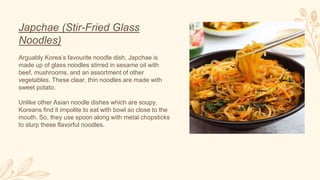
Japchae (Stir-Fried Glass
Noodles)
Arguably Korea’s favourite noodle dish, Japchae is
made up of glass noodles stirred in sesame oil with
beef, mushrooms, and an assortment of other
vegetables. These clear, thin noodles are made with
sweet potato.
Unlike other Asian noodle dishes which are soupy,
Koreans find it impolite to eat with bowl so close to the
mouth. So, they use spoon along with metal chopsticks
to slurp these flavorful noodles.
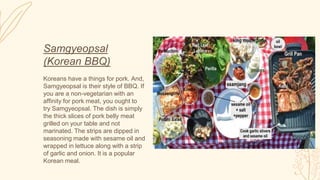
Samgyeopsal
(Korean BBQ)
Koreans have a things for pork. And,
Samgyeopsal is their style of BBQ. If
you are a non-vegetarian with an
affinity for pork meat, you ought to
try Samgyeopsal. The dish is simply
the thick slices of pork belly meat
grilled on your table and not
marinated. The strips are dipped in
seasoning made with sesame oil and
wrapped in lettuce along with a strip
of garlic and onion. It is a popular
Korean meal.
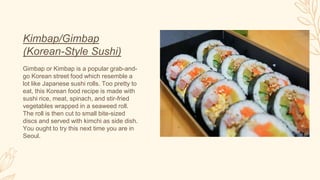
Kimbap/Gimbap
(Korean-Style Sushi)
Gimbap or Kimbap is a popular grab-and-
go Korean street food which resemble a
lot like Japanese sushi rolls. Too pretty to
eat, this Korean food recipe is made with
sushi rice, meat, spinach, and stir-fried
vegetables wrapped in a seaweed roll.
The roll is then cut to small bite-sized
discs and served with kimchi as side dish.
You ought to try this next time you are in
Seoul.
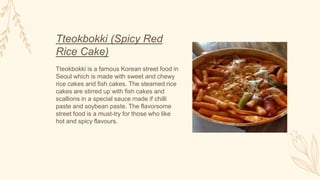
Tteokbokki (Spicy Red
Rice Cake)
Tteokbokki is a famous Korean street food in
Seoul which is made with sweet and chewy
rice cakes and fish cakes. The steamed rice
cakes are stirred up with fish cakes and
scallions in a special sauce made if chilli
paste and soybean paste. The flavorsome
street food is a must-try for those who like
hot and spicy flavours.
Common Kitchen Terminology
B
Banchan: side dishes
Bibimbap: rice mixed with
vegetables and beef
Bokbunjaju: raspberry wine
Bulgogi: grilled marinated beef
C
Cha: tea
S
Samgyeopsal: pork belly
Seolleongtang: ox bone soup
Sikhye: sweet rice punch
Sinseollo: royal casserole
Soju: clear, distilled potato
spirit, like vodka, but weaker
R
Ramyeon: ramen noodles
P
Pajeon: green onion pancakes
N
Naengmyeon: cold noodles,
typically made of buckwheat
J
Jang-eo gui: broiled eel
Japchae: glass noodles with sautéed
vegetables
Jogaetang: clam soup
G
Galbi (kalbi): short ribs
Ganjang: soy sauce
Gejang: shelled crabs salted in
soy sauce
Gochujang: red pepper paste
Guk: soup
I
Insam: ginseng
H
Hanjeongsik: a full-course Korean meal
with an array of savory side dishes
Hobakjuk: pumpkin porridge Hoe: raw fish
sliced and served with soy sauce or
Korean chili paste mixed with vinegar and
sugar
K
Kimchi (kimchee): the most common side
dish in Korea, typically made of
fermented napa cabbage or radishes and
spiced with chiles and garlic
D
Dak: chicken
Doenjang: soybean paste
Doenjang jjigae: soybean paste
stew
Dukkbogki: spicy rice cakes
T
Topokki: stir-fried rice cake
Twigim: fried dishes
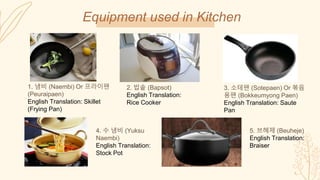
Equipment used in Kitchen
3. 소테팬 (Sotepaen) Or 볶음
용팬 (Bokkeumyong Paen)
English Translation: Saute
Pan
1. 냄비 (Naembi) Or 프라이팬
(Peuraipaen)
English Translation: Skillet
(Frying Pan)
4. 수 냄비 (Yuksu
Naembi)
English Translation:
Stock Pot
2. 밥솥 (Bapsot)
English Translation:
Rice Cooker
5. 브헤제 (Beuheje)
English Translation:
Braiser
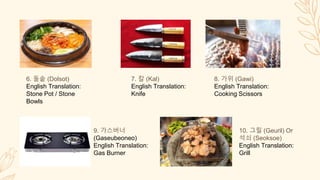
6. 돌솥 (Dolsot)
English Translation:
Stone Pot / Stone
Bowls
7. 칼 (Kal)
English Translation:
Knife
8. 가위 (Gawi)
English Translation:
Cooking Scissors
9. 가스버너
(Gaseubeoneo)
English Translation:
Gas Burner
10. 그릴 (Geuril) Or
석쇠 (Seoksoe)
English Translation:
Grill
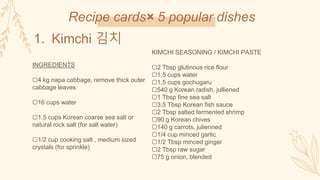
Recipe cards× 5 popular dishes
1. Kimchi 김치
INGREDIENTS
▢4 kg napa cabbage, remove thick outer
cabbage leaves
▢16 cups water
▢1.5 cups Korean coarse sea salt or
natural rock salt (for salt water)
▢1/2 cup cooking salt , medium sized
crystals (for sprinkle)
KIMCHI SEASONING / KIMCHI PASTE
▢2 Tbsp glutinous rice flour
▢1.5 cups water
▢1.5 cups gochugaru
▢540 g Korean radish, julliened
▢1 Tbsp fine sea salt
▢3.5 Tbsp Korean fish sauce
▢2 Tbsp salted fermented shrimp
▢90 g Korean chives
▢140 g carrots, julienned
▢1/4 cup minced garlic
▢1/2 Tbsp minced ginger
▢2 Tbsp raw sugar
▢75 g onion, blended
Instructions
Cut the napa cabbage into quarters. Dip the napa cabbage in
the saltwater and transfer it onto a tray.
Pinch some cooking salt and rub over the thick white part.
Set the cabbage aside for 6 hours to pickle.
Place them in a colander and allow to drain for 1 hour.
While waiting, prepare the glutinous rice paste-
Mix glutinous rice flour with the water boil it over medium heat
for 5-8 minutes. Add Korean chili flakes once it has cooled.
Then, combine them well.
Prepare a large mixing bowl and add radish, fine sea salt,
Korean fish sauce, and salted shrimp. Leave it for 10 minutes
for the radish to salt down. Add Korean chives, carrots,
minced garlic, minced ginger, sugar, blended onion, and the
Korean chili flakes mixture from step 5. Mix them well. Now
the kimchi seasoning / kimchi paste is made, ready for use.
2. Japchae (Stir-Fried Glass Noodles)
INGREDIENTS
½ pound Korean dang myun noodles
1 teaspoon sesame oil
2 tablespoons soy sauce
2 teaspoons white sugar
1 tablespoon vegetable oil
2 cloves garlic, minced
¾ cup thinly sliced onions
2 carrots, cut into match-stick size pieces
½ pound asparagus, thinly sliced
3 green onions cut into 1-inch pieces
½ cup dried shiitake mushrooms,
soaked until soft, then sliced into strips
1 tablespoon sesame seeds
1 ½ teaspoons sesame oil
Method
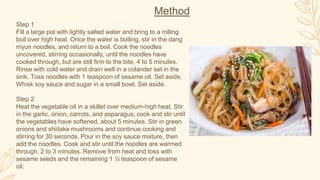
Step 1
Fill a large pot with lightly salted water and bring to a rolling
boil over high heat. Once the water is boiling, stir in the dang
myun noodles, and return to a boil. Cook the noodles
uncovered, stirring occasionally, until the noodles have
cooked through, but are still firm to the bite, 4 to 5 minutes.
Rinse with cold water and drain well in a colander set in the
sink. Toss noodles with 1 teaspoon of sesame oil. Set aside.
Whisk soy sauce and sugar in a small bowl. Set aside.
Step 2
Heat the vegetable oil in a skillet over medium-high heat. Stir
in the garlic, onion, carrots, and asparagus; cook and stir until
the vegetables have softened, about 5 minutes. Stir in green
onions and shiitake mushrooms and continue cooking and
stirring for 30 seconds. Pour in the soy sauce mixture, then
add the noodles. Cook and stir until the noodles are warmed
through, 2 to 3 minutes. Remove from heat and toss with
sesame seeds and the remaining 1 ½ teaspoon of sesame
oil.
3. Samgyeopsal (Korean BBQ)
INGREDIENTS
¼ cup soy sauce
2 tablespoons rice vinegar
1 tablespoon Gochujang sauce
1 teaspoon sesame oil
½ teaspoon freshly grated ginger
¼ teaspoon garlic powder
Kosher salt and freshly ground black pepper, to taste
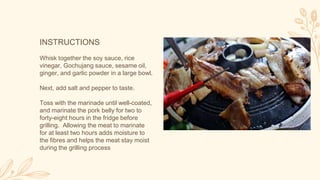
INSTRUCTIONS
Whisk together the soy sauce, rice
vinegar, Gochujang sauce, sesame oil,
ginger, and garlic powder in a large bowl.
Next, add salt and pepper to taste.
Toss with the marinade until well-coated,
and marinate the pork belly for two to
forty-eight hours in the fridge before
grilling. Allowing the meat to marinate
for at least two hours adds moisture to
the fibres and helps the meat stay moist
during the grilling process
4. Kimbap/Gimbap (Korean-Style Sushi)
INGREDIENTS
4 cups steamed white rice
½ pound of beef optional (any preferred cut)
2 eggs
1 large carrot, cut into matchsticks
3 long imitation crab, cut into strips
1 cup blanched spinach
2 tsp soy sauce
1 tbsp sugar
Salt
2 tbsp sesame oil
1 tablespoon minced garlic
5 strips of yellow radish (we get ours from the Korean
market)
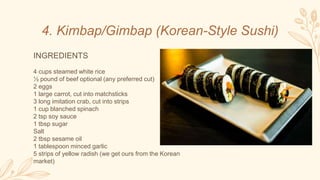
INSTRUCTIONS
Mix the rice with 2 tsp sesame oil and a pinch of salt.
Cook eggs like omelette and cut into ½ inch strips then set aside.
Add a pinch of salt, ½ tablespoon minced garlic, and 2 tsp sesame oil to spinach and mix thoroughly.
Cut beef into thin strips, about ¼ inch thick. Add 1 tbsp soy sauce, ¼ tsp ground black pepper, 2 tsp
sesame oil, ½ tbsp minced garlic, 1 tbsp sugar and mix thoroughly. Set aside to marinate.
Stir fry the carrots for 1 minute then add to a small bowl and set aside.
Cook the beef over medium heat until cooked through, a few minutes, then pour into a bowl.
Now is time to assemble!
Using a bamboo sushi roller place one sheet of seaweed on top of the roller. Add ¾ cup-1 cup of rice to
seaweed and spread thinly across the sheet leaving about an inch of space at the top of the sheet.
Carefully place pieces of the filling in the center of the rice, making a line across horizontally.
Roll the kimbap starting from the bottom. Repeat with the remainder of the ingredients.
When finished, cut the rolls into 1 inch pieces using a sharp knife.
INGREDIENTS
2 ½ cups Korean rice cakes
2 cups water or vegetable stock for
more flavour
1 cup Korean fish cake sliced into
triangles or strips (or sub with Fish
Cake Balls)
4 pieces dried kelp
2 stalks green onion chopped into 1
inch pieces
1 tsp Sesame seeds (optional
5. Tteokbokki (Spicy Red Rice Cake)
Sauce:
½ tbsp gochujang mild type
2 tbsp regular soy sauce or sub with 3
tbsp light soy sauce
3 tbsp white granulated sugar
3 tsp garlic minced
1 tsp gochugaru
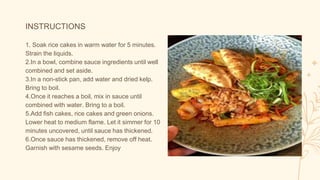
INSTRUCTIONS
1. Soak rice cakes in warm water for 5 minutes.
Strain the liquids.
2.In a bowl, combine sauce ingredients until well
combined and set aside.
3.In a non-stick pan, add water and dried kelp.
Bring to boil.
4.Once it reaches a boil, mix in sauce until
combined with water. Bring to a boil.
5.Add fish cakes, rice cakes and green onions.
Lower heat to medium flame. Let it simmer for 10
minutes uncovered, until sauce has thickened.
6.Once sauce has thickened, remove off heat.
Garnish with sesame seeds. Enjoy
Bibliography
● www.seouleats.com
● www.pbs.org
● https://en.m.wikipedia.org
● www.sciencedirect.com
● www.instagram.com
● https://traveltriangle.com
● https://www.gayot.com
● www.aljazeera.com

Korean cuisine assignment.pptx

  • 1.
    Name: Aditi Ranjan Rollno.: 2041117015 Batch: 2020-23 Korea- Culture and Cuisine
  • 2.
    Geographical Location ● Korea’sgeography influences its history and culture. ● Korea is a rugged peninsula lying between China on the west and north and Japan to the east. ● The whole Korean peninsula is about 85,500 square miles, about the size of Utah. ● South Korea is only 99,000 square miles – roughly similar to Oregon – and its population is close to 50 million (Compared to Oergon’s 3 million). Mountains and hills make up about 70 percent of the country. Republic of Korea
  • 3.
    ● Because theland is composed mostly of mountains and extends from the North Asian landmass into warmer seas in the south, Korea has many microenvironments. ● Rice, beans, and vegetables are grown in the valleys while in the mountains mushrooms and many wild plants such as bracken and bellflower are either collected or cultivated. ● In the mountainous northeastern part of the country, for instance, the most famous dishes have plenty of wild ferns and native roots in them. ● In the rice-growing valleys of the south, in the region of Chonju city, the best known dish is a large bowl of rice covered in a variety of finely sliced vegetables, meats, and a spicy sauce called Pibimpap.
  • 4.
    Historical Background andCulture ● Korean food is also heavily influenced by the revolutionary changes in world cuisines that occurred after 1500 A.D. ● The European conquest of the Americas led to a world-wide distribution of new foodstuffs. ● The best example for Korea is the chile. ● A native to Central and South America, it was spread across the world by Portuguese and Spanish merchants. ● Indian and Southeast Asian cuisines without chiles are unimaginable. Nor is Korean. ● Chile paste are absolute staples of all Korean tables and many food preparations. Although many people think of Korean cuisine as “hot” in reality chile sauces are not loaded onto every dish but added as flavor enhancements. ● Like most Korean dishes, flavors and ingredients are flexible, so diners can add as much or as little flavoring as they like. Some like it hot, some do not.
  • 5.
    Korean Culture ● Likeall agricultural societies, Korean life has always centered on tightly knit families. ● Large families have been prized and over many centuries families intermarried within the regions of Korea to form large clans. ● Family names reflect this. A dozen family names predominate, especially Kim, Park, Lee, Kang, and Cho. But Kims from the city of Pusan in the south are not the Kims from Seoul and all the Kims know exactly which group they belong to. ● Custom forbids people marrying within their own clan, no matter how distant the cousin might be. In order to know who is who, families and clan keep detailed genealogical records that might go back many hundreds of years. Even in today’s westernized Korea many people can still recite the glorious history of their clans and take pride in them.
  • 6.
    Festivals and foodsassociated with them 1. Seollal ● Significance- New Year’s Day ● Events- Sebae (New Year’s greetings), Charye (Ancestral ceremony), Yunnori (Traditional game) ● Date- 1st day of first month ● Food- Tteokguk (Traditional soup made of rice cake), Yakwa (Honey cakes)
  • 7.
    2. Daeboreum ● Significance-First full moon ● Events- Geuybulnori (Rice field burning), Daljip Taeugi (Bonfire), Aengmagi Taeugi (Talisman burning) ● Date- 15th day of first month ● Food- Ogokbap (Rice made of five grains), Yaksik (Glutinous rice), Bureom (nuts), Gwibalgisul (alcoholic beverage)
  • 8.
    3. Meoseumnal ● Significance-Festival for servants ● Events- Singing, Dancing, Coming-of-age ceremony ● Date- 1st day of second month ● Food- Songpyeon (Traditional rice cake made with the grains)
  • 9.
    4. Yeongdeungje ● Significance-Celebrating the god of wind Jesa (Traditional ritual to appease the god of wind) ● Date- First day of second month ● Food- Regular food for Jesa ● Events- Samjinnal Celebrating the coming of spring Archery, Cockfighting, Fortune telling
  • 10.
    5. Samjinnal ● Significance-Celebrating the coming of spring ● Events- Archery, Cockfighting, Fortune telling ● Date- 3rd day of third month ● Food- Hwajeon (Rice pancakes), Dugyeonju (Azalea wine)
  • 11.
    6. Hansik ● Significance-Start of farming season ● Events- Visit to ancestral grave for offering rite, and cleaning and maintenance. ● Date- 105 days after Dongji (Winter solstice) ● Food- Cold food only: Ssuktteok (Mugwort cake), Ssukdanja (Mugwort dumplings), Ssuktang (Mugwort soup)
  • 12.
    7. Chopail ● Significance-Buddha’s birthday ● Events- Lantern festival, hanging lanterns up and visiting the temple ● Date- 8th day of fourth month ● Food- Different types of Tteok, Dumplings, Special dishes made of fish
  • 13.
    8. Dano ● Significance-Celebration of spring and farming ● Events- Washing hair with Changpo, Ssireum (Korean wrestling match), swing, giving fans as gifts ● Date- 5th day of fifth month ● Food- Variety of Tteok, Herb rice cakes
  • 14.
    9. Yudu ● Significance-Water greeting ● Events- Bathing and washing hair to get rid of bad luck (if any) ● Date- 15th day of sixth month ● Food- Noodles
  • 15.
    Common Ingredients Used Grains Sincerice was expensive when it first entered the country, people were cooking by mixing it with other grains in order to use less amount. This tradition has continued until now and can be seen in dishes such as boribap (rice with barley) and kongbap (rice with beans). Rice is traditionally cooked in an iron pot which is called musoe sot. It is also used as a ground for rice cakes, mixed and cooked with other grains and meat, and for making filtered and unfiltered rice wines. Legumes Soybeans are much eaten in Korean cuisine as well as used for making tofu and soy milk. The sprouts of soybeans are also used. Soybean paste and soy sauce are produced and commonly used in dishes. Secondly, most used legume in the Korean kitchen is mung beans, also known as green beans. They are literally used in every way; side dish, blanched, sauteed, in pancakes, noodles, soups, stews, jelly foods (its starch is used), and more. For the last but not least, azuki beans are consumed with rice.
  • 16.
    Vegetables Vegetables are servedas cooked or uncooked. Varieties can be found in salads, pickles, stews, stir-fried dishes, and more. The consumption basically depends on the season. Korean radish, napa cabbage, cucumber, potato (regular & sweet), spinach, bean sprouts, garlic, chilli peppers, zucchini, mushrooms, lotus root, and endless types of other vegetables can be found in this cuisine. Condiments & seasonings & spices They are divided into two as fermented and nonfermented. Examples for fermented ones are vinegar, ganjang (soy sauce), doenjang (soybean paste made of soybean and brine), and gochujang (red chilli paste made of chilli powder, glutinous rice, fermented soybean powder, and barley malt powder). Gochujang is used to give a spicy taste, and should not be substituted with gochugaru as their taste is very different from each other. If you do not want to use gochujang for any reason, you may replace it with chilli flakes but it would not taste the same either. Like gochujang and doenjang, there are many dipping sauces in Korea. They are prepared according to taste and often consumed with barbequed food items. Red & black pepper, cordifolia, mustard, garlic, onion, ginger, leek, and spring onions are known as nonfermented condiments and spices. Other commonly used spices in Korea are chilli powder, roasted sesame seeds, black pepper, and salt. On the other hand, sesame and specifically sesame oil are much used and preferred almost in every dish. The oil adds an extra aroma and savoury flavour to the dish. Other than these, oligodang and mulyeot are used for sweetening the dishes. Oligadong is known as oligosaccharide, and mulyeot is known as corn syrup (mostly used in stir-fried dishes)
  • 17.
    Meat As Korean peopledo hunting and fishing since the Ancient times, meat products are much used, liked and inevitable for Korean cuisine. Even though cattle used to have a significant role for the Lunar New Year, today, beef is consumed freely as roasted, grilled, dried or boiled. Chicken is usually eaten as roasted or slow-cooked. Each and every inch of a chicken is commonly used in Korean recipes, including feet, liver, and gizzard. Some of them are cooked in medicinal soups, some roasted with spices, and some served as side dishes. Like chicken, all pieces of pork are used commonly. The head and internal organs such as liver and kidney are taken place in recipes by the techniques of steaming, boiling, stewing, and smoking.
  • 18.
    Fish & seafood Manyfish and seafood varieties are available because of the geographical location of the country. They are usually eaten raw or grilled, broiled or dried before serving. Mackerel, croaker, shrimp, squid, octopus, cuttlefish, anchovies, yellow corvina, and many more types are popular and consumed on regular basis. Also, some of the shellfish are used for making broth.
  • 19.
    Popular Dishes Kimchi 김치 Kimchi,the national food of Korea, is a spicy pickled vegetable dish. Kimchi is traditionally made by combining cabbage, scallions, or radishes in a brine with garlic, ginger, chili pepper and allowing the ingredients to ferment. Kimchi has a rich history in South Korea dating back more than two thousand years.
  • 20.
    Japchae (Stir-Fried Glass Noodles) ArguablyKorea’s favourite noodle dish, Japchae is made up of glass noodles stirred in sesame oil with beef, mushrooms, and an assortment of other vegetables. These clear, thin noodles are made with sweet potato. Unlike other Asian noodle dishes which are soupy, Koreans find it impolite to eat with bowl so close to the mouth. So, they use spoon along with metal chopsticks to slurp these flavorful noodles.
  • 21.
    Samgyeopsal (Korean BBQ) Koreans havea things for pork. And, Samgyeopsal is their style of BBQ. If you are a non-vegetarian with an affinity for pork meat, you ought to try Samgyeopsal. The dish is simply the thick slices of pork belly meat grilled on your table and not marinated. The strips are dipped in seasoning made with sesame oil and wrapped in lettuce along with a strip of garlic and onion. It is a popular Korean meal.
  • 22.
    Kimbap/Gimbap (Korean-Style Sushi) Gimbap orKimbap is a popular grab-and- go Korean street food which resemble a lot like Japanese sushi rolls. Too pretty to eat, this Korean food recipe is made with sushi rice, meat, spinach, and stir-fried vegetables wrapped in a seaweed roll. The roll is then cut to small bite-sized discs and served with kimchi as side dish. You ought to try this next time you are in Seoul.
  • 23.
    Tteokbokki (Spicy Red RiceCake) Tteokbokki is a famous Korean street food in Seoul which is made with sweet and chewy rice cakes and fish cakes. The steamed rice cakes are stirred up with fish cakes and scallions in a special sauce made if chilli paste and soybean paste. The flavorsome street food is a must-try for those who like hot and spicy flavours.
  • 24.
    Common Kitchen Terminology B Banchan:side dishes Bibimbap: rice mixed with vegetables and beef Bokbunjaju: raspberry wine Bulgogi: grilled marinated beef C Cha: tea S Samgyeopsal: pork belly Seolleongtang: ox bone soup Sikhye: sweet rice punch Sinseollo: royal casserole Soju: clear, distilled potato spirit, like vodka, but weaker R Ramyeon: ramen noodles P Pajeon: green onion pancakes N Naengmyeon: cold noodles, typically made of buckwheat J Jang-eo gui: broiled eel Japchae: glass noodles with sautéed vegetables Jogaetang: clam soup G Galbi (kalbi): short ribs Ganjang: soy sauce Gejang: shelled crabs salted in soy sauce Gochujang: red pepper paste Guk: soup I Insam: ginseng H Hanjeongsik: a full-course Korean meal with an array of savory side dishes Hobakjuk: pumpkin porridge Hoe: raw fish sliced and served with soy sauce or Korean chili paste mixed with vinegar and sugar K Kimchi (kimchee): the most common side dish in Korea, typically made of fermented napa cabbage or radishes and spiced with chiles and garlic D Dak: chicken Doenjang: soybean paste Doenjang jjigae: soybean paste stew Dukkbogki: spicy rice cakes T Topokki: stir-fried rice cake Twigim: fried dishes
  • 25.
    Equipment used inKitchen 3. 소테팬 (Sotepaen) Or 볶음 용팬 (Bokkeumyong Paen) English Translation: Saute Pan 1. 냄비 (Naembi) Or 프라이팬 (Peuraipaen) English Translation: Skillet (Frying Pan) 4. 수 냄비 (Yuksu Naembi) English Translation: Stock Pot 2. 밥솥 (Bapsot) English Translation: Rice Cooker 5. 브헤제 (Beuheje) English Translation: Braiser
  • 26.
    6. 돌솥 (Dolsot) EnglishTranslation: Stone Pot / Stone Bowls 7. 칼 (Kal) English Translation: Knife 8. 가위 (Gawi) English Translation: Cooking Scissors 9. 가스버너 (Gaseubeoneo) English Translation: Gas Burner 10. 그릴 (Geuril) Or 석쇠 (Seoksoe) English Translation: Grill
  • 27.
    Recipe cards× 5popular dishes 1. Kimchi 김치 INGREDIENTS ▢4 kg napa cabbage, remove thick outer cabbage leaves ▢16 cups water ▢1.5 cups Korean coarse sea salt or natural rock salt (for salt water) ▢1/2 cup cooking salt , medium sized crystals (for sprinkle) KIMCHI SEASONING / KIMCHI PASTE ▢2 Tbsp glutinous rice flour ▢1.5 cups water ▢1.5 cups gochugaru ▢540 g Korean radish, julliened ▢1 Tbsp fine sea salt ▢3.5 Tbsp Korean fish sauce ▢2 Tbsp salted fermented shrimp ▢90 g Korean chives ▢140 g carrots, julienned ▢1/4 cup minced garlic ▢1/2 Tbsp minced ginger ▢2 Tbsp raw sugar ▢75 g onion, blended
  • 28.
    Instructions Cut the napacabbage into quarters. Dip the napa cabbage in the saltwater and transfer it onto a tray. Pinch some cooking salt and rub over the thick white part. Set the cabbage aside for 6 hours to pickle. Place them in a colander and allow to drain for 1 hour. While waiting, prepare the glutinous rice paste- Mix glutinous rice flour with the water boil it over medium heat for 5-8 minutes. Add Korean chili flakes once it has cooled. Then, combine them well. Prepare a large mixing bowl and add radish, fine sea salt, Korean fish sauce, and salted shrimp. Leave it for 10 minutes for the radish to salt down. Add Korean chives, carrots, minced garlic, minced ginger, sugar, blended onion, and the Korean chili flakes mixture from step 5. Mix them well. Now the kimchi seasoning / kimchi paste is made, ready for use.
  • 29.
    2. Japchae (Stir-FriedGlass Noodles) INGREDIENTS ½ pound Korean dang myun noodles 1 teaspoon sesame oil 2 tablespoons soy sauce 2 teaspoons white sugar 1 tablespoon vegetable oil 2 cloves garlic, minced ¾ cup thinly sliced onions 2 carrots, cut into match-stick size pieces ½ pound asparagus, thinly sliced 3 green onions cut into 1-inch pieces ½ cup dried shiitake mushrooms, soaked until soft, then sliced into strips 1 tablespoon sesame seeds 1 ½ teaspoons sesame oil
  • 30.
    Method Step 1 Fill alarge pot with lightly salted water and bring to a rolling boil over high heat. Once the water is boiling, stir in the dang myun noodles, and return to a boil. Cook the noodles uncovered, stirring occasionally, until the noodles have cooked through, but are still firm to the bite, 4 to 5 minutes. Rinse with cold water and drain well in a colander set in the sink. Toss noodles with 1 teaspoon of sesame oil. Set aside. Whisk soy sauce and sugar in a small bowl. Set aside. Step 2 Heat the vegetable oil in a skillet over medium-high heat. Stir in the garlic, onion, carrots, and asparagus; cook and stir until the vegetables have softened, about 5 minutes. Stir in green onions and shiitake mushrooms and continue cooking and stirring for 30 seconds. Pour in the soy sauce mixture, then add the noodles. Cook and stir until the noodles are warmed through, 2 to 3 minutes. Remove from heat and toss with sesame seeds and the remaining 1 ½ teaspoon of sesame oil.
  • 31.
    3. Samgyeopsal (KoreanBBQ) INGREDIENTS ¼ cup soy sauce 2 tablespoons rice vinegar 1 tablespoon Gochujang sauce 1 teaspoon sesame oil ½ teaspoon freshly grated ginger ¼ teaspoon garlic powder Kosher salt and freshly ground black pepper, to taste
  • 32.
    INSTRUCTIONS Whisk together thesoy sauce, rice vinegar, Gochujang sauce, sesame oil, ginger, and garlic powder in a large bowl. Next, add salt and pepper to taste. Toss with the marinade until well-coated, and marinate the pork belly for two to forty-eight hours in the fridge before grilling. Allowing the meat to marinate for at least two hours adds moisture to the fibres and helps the meat stay moist during the grilling process
  • 33.
    4. Kimbap/Gimbap (Korean-StyleSushi) INGREDIENTS 4 cups steamed white rice ½ pound of beef optional (any preferred cut) 2 eggs 1 large carrot, cut into matchsticks 3 long imitation crab, cut into strips 1 cup blanched spinach 2 tsp soy sauce 1 tbsp sugar Salt 2 tbsp sesame oil 1 tablespoon minced garlic 5 strips of yellow radish (we get ours from the Korean market)
  • 34.
    INSTRUCTIONS Mix the ricewith 2 tsp sesame oil and a pinch of salt. Cook eggs like omelette and cut into ½ inch strips then set aside. Add a pinch of salt, ½ tablespoon minced garlic, and 2 tsp sesame oil to spinach and mix thoroughly. Cut beef into thin strips, about ¼ inch thick. Add 1 tbsp soy sauce, ¼ tsp ground black pepper, 2 tsp sesame oil, ½ tbsp minced garlic, 1 tbsp sugar and mix thoroughly. Set aside to marinate. Stir fry the carrots for 1 minute then add to a small bowl and set aside. Cook the beef over medium heat until cooked through, a few minutes, then pour into a bowl. Now is time to assemble! Using a bamboo sushi roller place one sheet of seaweed on top of the roller. Add ¾ cup-1 cup of rice to seaweed and spread thinly across the sheet leaving about an inch of space at the top of the sheet. Carefully place pieces of the filling in the center of the rice, making a line across horizontally. Roll the kimbap starting from the bottom. Repeat with the remainder of the ingredients. When finished, cut the rolls into 1 inch pieces using a sharp knife.
  • 35.
    INGREDIENTS 2 ½ cupsKorean rice cakes 2 cups water or vegetable stock for more flavour 1 cup Korean fish cake sliced into triangles or strips (or sub with Fish Cake Balls) 4 pieces dried kelp 2 stalks green onion chopped into 1 inch pieces 1 tsp Sesame seeds (optional 5. Tteokbokki (Spicy Red Rice Cake) Sauce: ½ tbsp gochujang mild type 2 tbsp regular soy sauce or sub with 3 tbsp light soy sauce 3 tbsp white granulated sugar 3 tsp garlic minced 1 tsp gochugaru
  • 36.
    INSTRUCTIONS 1. Soak ricecakes in warm water for 5 minutes. Strain the liquids. 2.In a bowl, combine sauce ingredients until well combined and set aside. 3.In a non-stick pan, add water and dried kelp. Bring to boil. 4.Once it reaches a boil, mix in sauce until combined with water. Bring to a boil. 5.Add fish cakes, rice cakes and green onions. Lower heat to medium flame. Let it simmer for 10 minutes uncovered, until sauce has thickened. 6.Once sauce has thickened, remove off heat. Garnish with sesame seeds. Enjoy
  • 37.
    Bibliography ● www.seouleats.com ● www.pbs.org ●https://en.m.wikipedia.org ● www.sciencedirect.com ● www.instagram.com ● https://traveltriangle.com ● https://www.gayot.com ● www.aljazeera.com