HOSPITALITY MANAGEMENT
Module 2: North East Asian Cuisine - CHINA
Learning
Outcomes
1. Understand the various ingredients of Chinese cuisine.
2. Identify regional cuisines of China.
3. Learn the various dishes of China
Food has always been an important aspect of Chinese culture and its delightful
culinary history dates to about 5000 years. It has evolved with its flavor and cooking
methods ever since. And over this vast period, the Chinese have developed and mastered a
complex system of preparing food, such as identifying ingredients that make compatible
combinations; making use of cooking techniques that are multi-phased such as first
steaming and then deep-frying or stir frying, then boiling; and administering multi-phased
flavoring like marinating between the stages of roasting, or after steaming, or before stir
frying. Chinese culture has always considered food as an art, and emphasis has always
been laid on the culinary techniques, preparation, serving and appreciation of food.
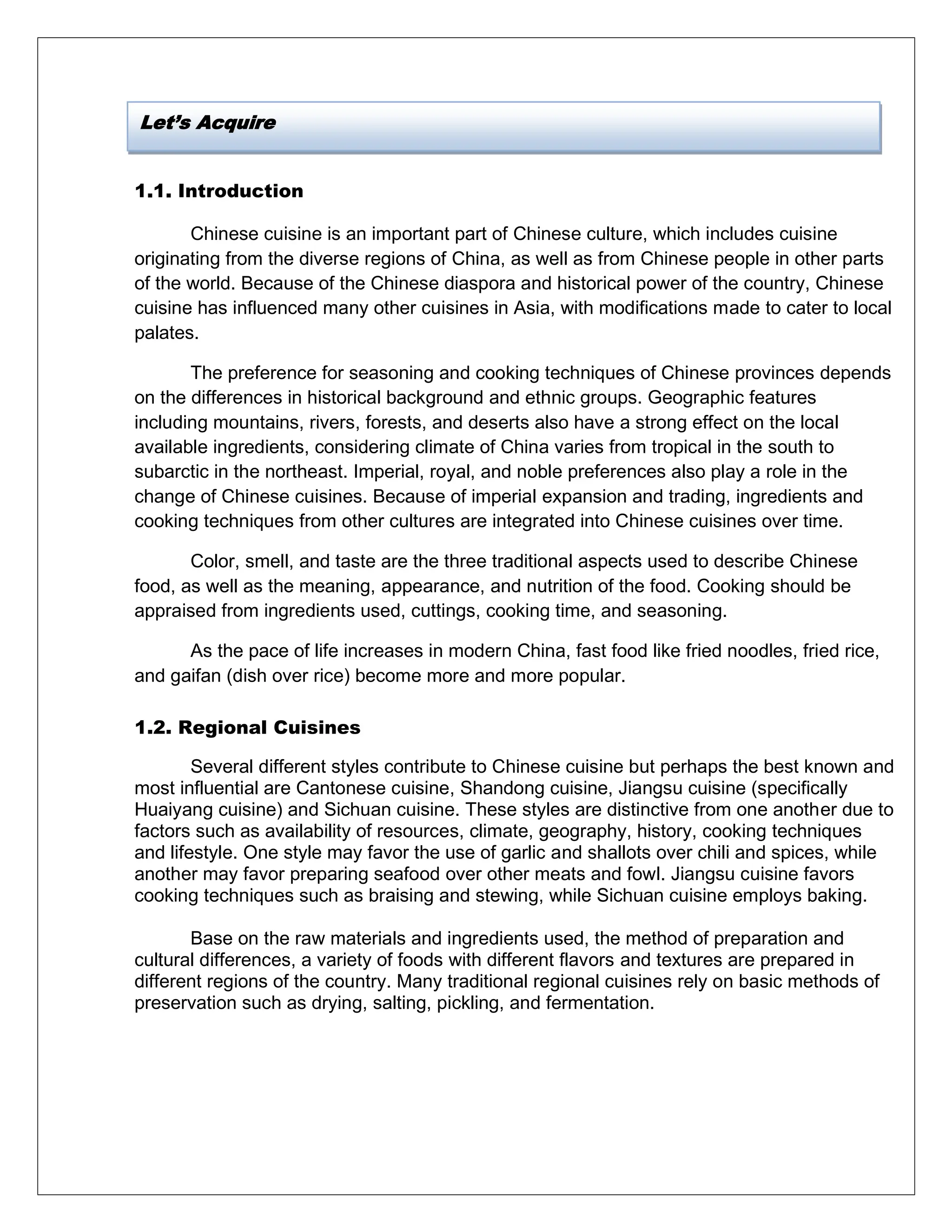
Describe or say something about this picture and how it relates to Chinese cuisine.
Le’s Activate
1.1. Introduction
Chinese cuisine is an important part of Chinese culture, which includes cuisine
originating from the diverse regions of China, as well as from Chinese people in other parts
of the world. Because of the Chinese diaspora and historical power of the country, Chinese
cuisine has influenced many other cuisines in Asia, with modifications made to cater to local
palates.
The preference for seasoning and cooking techniques of Chinese provinces depends
on the differences in historical background and ethnic groups. Geographic features
including mountains, rivers, forests, and deserts also have a strong effect on the local
available ingredients, considering climate of China varies from tropical in the south to
subarctic in the northeast. Imperial, royal, and noble preferences also play a role in the
change of Chinese cuisines. Because of imperial expansion and trading, ingredients and
cooking techniques from other cultures are integrated into Chinese cuisines over time.
Color, smell, and taste are the three traditional aspects used to describe Chinese
food, as well as the meaning, appearance, and nutrition of the food. Cooking should be
appraised from ingredients used, cuttings, cooking time, and seasoning.
As the pace of life increases in modern China, fast food like fried noodles, fried rice,
and gaifan (dish over rice) become more and more popular.
1.2. Regional Cuisines
Several different styles contribute to Chinese cuisine but perhaps the best known and
most influential are Cantonese cuisine, Shandong cuisine, Jiangsu cuisine (specifically
Huaiyang cuisine) and Sichuan cuisine. These styles are distinctive from one another due to
factors such as availability of resources, climate, geography, history, cooking techniques
and lifestyle. One style may favor the use of garlic and shallots over chili and spices, while
another may favor preparing seafood over other meats and fowl. Jiangsu cuisine favors
cooking techniques such as braising and stewing, while Sichuan cuisine employs baking.
Base on the raw materials and ingredients used, the method of preparation and
cultural differences, a variety of foods with different flavors and textures are prepared in
different regions of the country. Many traditional regional cuisines rely on basic methods of
preservation such as drying, salting, pickling, and fermentation.
Let’s Acquire
Staple foods
Rice
Rice is a major staple food for people from rice farming areas in
southern China. Steamed rice, usually white rice, is the most
eaten form. People in southern China also like to use rice to
make rice gruel as breakfast. Rice is also used to produce beer,
baijiu, and vinegars. Glutinous rice (“sticky rice”) is a variety of
rice used in specialty dishes.
Curries are a very common across the region, but less common
in Vietnam where the Chinese influencers is strong. The concept probably came from India
and spread east, but the people of the South East modified the original by substituting
coconut milk for yogurt as the basis for the sauce.
Wheat
In whet-farming areas in Northern China, people
largely rely on flour-based food, such as noodles, bing
(bread), jiaozi (a kind of Chinese dumplings), and mantou (a
type of steamed buns).
Noodles
Chinese noodles come dry or fresh in a variety of sizes, shapes,
and textures and are often served in soups or fried as toppings.
Some varieties, such as Shou Mian (literally noodles oflongevity),
is an avatar of long life and good health according to Chinese
traditions. Noodles can be served hot or cold with different
toppings, with broth, and occasionally dry 9as is the case with mi-
fen). Noodles are commonly made with rice flour or wheat flour,
but other flours such as soybean are also used in minor groups.
Soybean products
Several kinds of soybean products are
sold in a farmer’s market in Haikou, China.
Stir-fried razor shell with douche
(fermented black soybeans) in Jiaodong style.
Tofu is made of soybeans and is another
popular food product that supplies protein. The
production process of tofu varies from region to
region, resulting in different kinds of tofu with a
wide range of texture and taste.
There are many kinds of soybean products, including tofu skin, smoked tofu, dried
tofu, fried tofu, and so on.
Stinky tofu is fermented tofu. It has a very distinct, potent, and strong smell, and is an
acquired taste. Hard stinky tofu is often deep-fried and paired with soy sauce or salty spice.
Soft, stinky tofu are usually used as a spread on steamed buns.
Doufu is another type of fermented tofu that has a salty taste. It can be pickled
together with soybeans, red yeast rice, or chili to create different color and flavor. It can be
used as a spread on steamed buns or paired with rice congee.
Vegetables
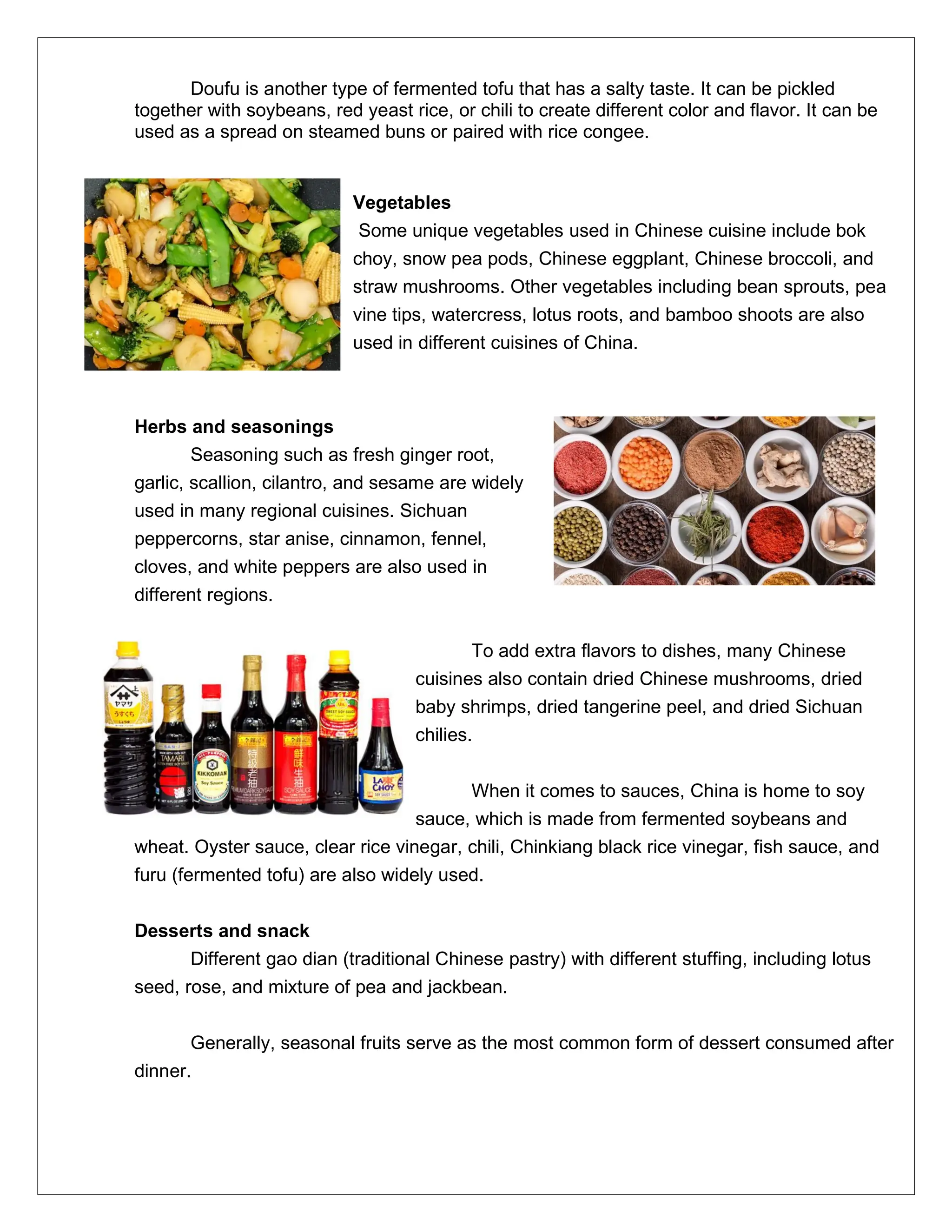
Some unique vegetables used in Chinese cuisine include bok
choy, snow pea pods, Chinese eggplant, Chinese broccoli, and
straw mushrooms. Other vegetables including bean sprouts, pea
vine tips, watercress, lotus roots, and bamboo shoots are also
used in different cuisines of China.
Herbs and seasonings
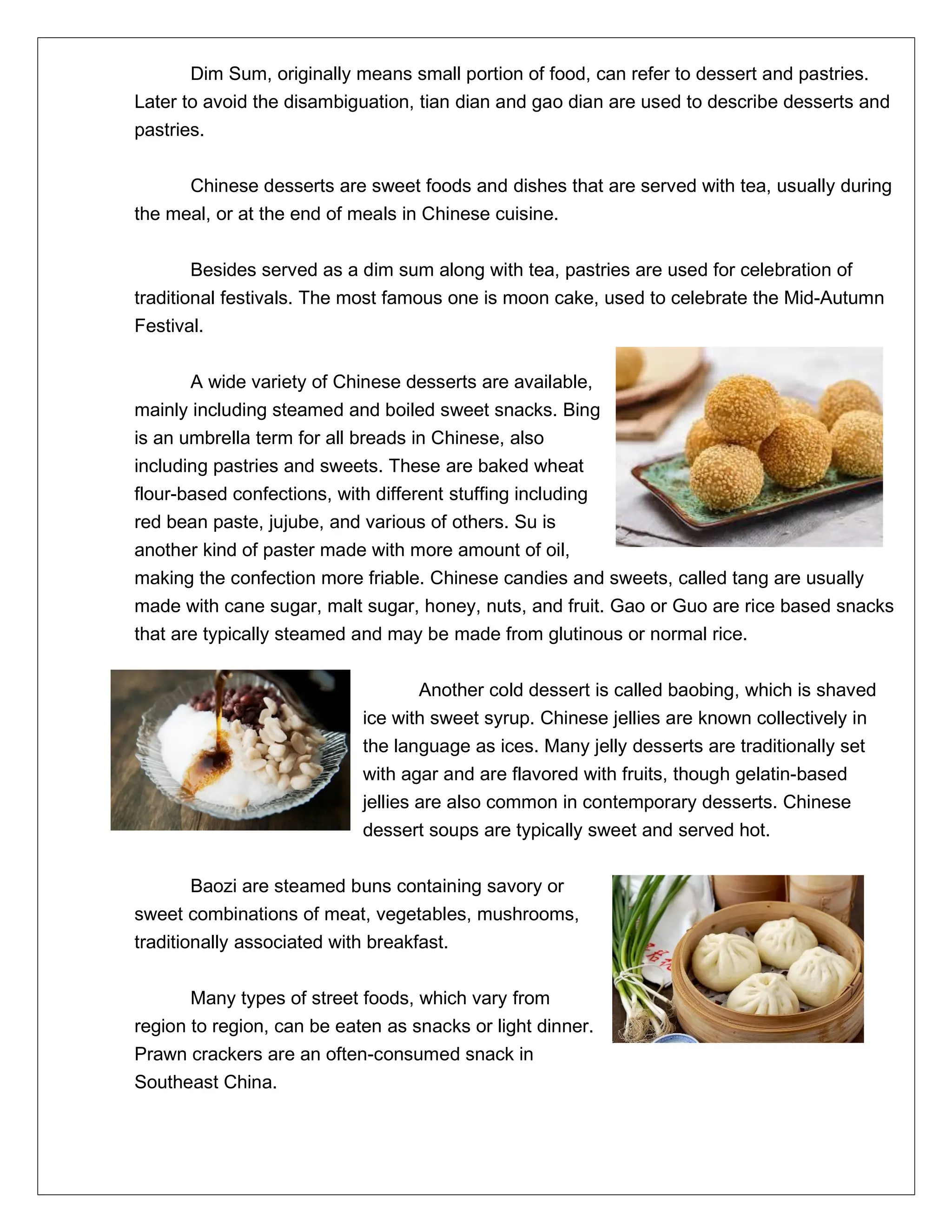
Seasoning such as fresh ginger root,
garlic, scallion, cilantro, and sesame are widely
used in many regional cuisines. Sichuan
peppercorns, star anise, cinnamon, fennel,
cloves, and white peppers are also used in
different regions.
To add extra flavors to dishes, many Chinese
cuisines also contain dried Chinese mushrooms, dried
baby shrimps, dried tangerine peel, and dried Sichuan
chilies.
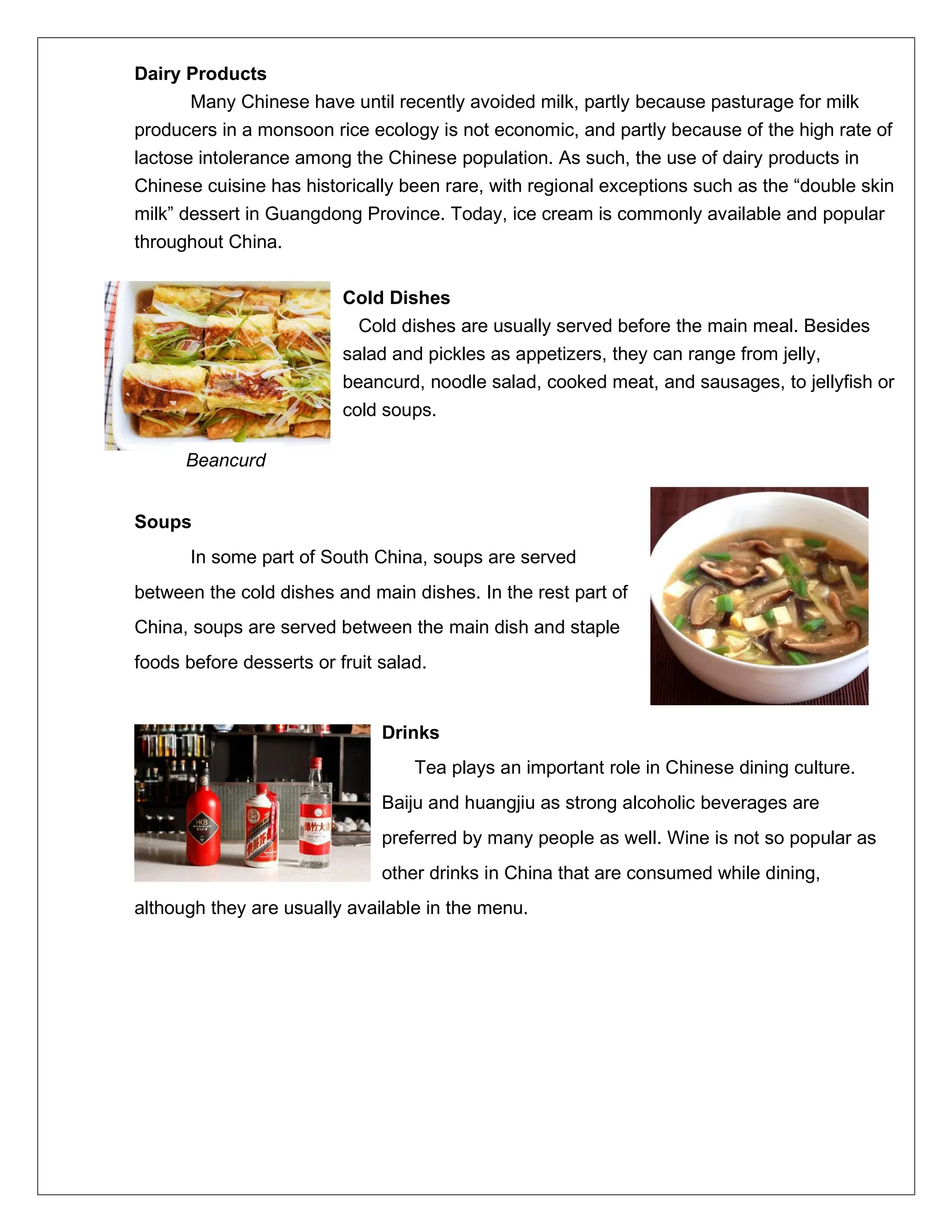
When it comes to sauces, China is home to soy
sauce, which is made from fermented soybeans and
wheat. Oyster sauce, clear rice vinegar, chili, Chinkiang black rice vinegar, fish sauce, and
furu (fermented tofu) are also widely used.
Desserts and snack
Different gao dian (traditional Chinese pastry) with different stuffing, including lotus
seed, rose, and mixture of pea and jackbean.
Generally, seasonal fruits serve as the most common form of dessert consumed after
dinner.
Dim Sum, originally means small portion of food, can refer to dessert and pastries.
Later to avoid the disambiguation, tian dian and gao dian are used to describe desserts and
pastries.
Chinese desserts are sweet foods and dishes that are served with tea, usually during
the meal, or at the end of meals in Chinese cuisine.
Besides served as a dim sum along with tea, pastries are used for celebration of
traditional festivals. The most famous one is moon cake, used to celebrate the Mid-Autumn
Festival.
A wide variety of Chinese desserts are available,
mainly including steamed and boiled sweet snacks. Bing
is an umbrella term for all breads in Chinese, also
including pastries and sweets. These are baked wheat
flour-based confections, with different stuffing including
red bean paste, jujube, and various of others. Su is
another kind of paster made with more amount of oil,
making the confection more friable. Chinese candies and sweets, called tang are usually
made with cane sugar, malt sugar, honey, nuts, and fruit. Gao or Guo are rice based snacks
that are typically steamed and may be made from glutinous or normal rice.
Another cold dessert is called baobing, which is shaved
ice with sweet syrup. Chinese jellies are known collectively in
the language as ices. Many jelly desserts are traditionally set
with agar and are flavored with fruits, though gelatin-based
jellies are also common in contemporary desserts. Chinese
dessert soups are typically sweet and served hot.
Baozi are steamed buns containing savory or
sweet combinations of meat, vegetables, mushrooms,
traditionally associated with breakfast.
Many types of street foods, which vary from
region to region, can be eaten as snacks or light dinner.
Prawn crackers are an often-consumed snack in
Southeast China.
Dairy Products
Many Chinese have until recently avoided milk, partly because pasturage for milk
producers in a monsoon rice ecology is not economic, and partly because of the high rate of
lactose intolerance among the Chinese population. As such, the use of dairy products in
Chinese cuisine has historically been rare, with regional exceptions such as the “double skin
milk” dessert in Guangdong Province. Today, ice cream is commonly available and popular
throughout China.
Cold Dishes
Cold dishes are usually served before the main meal. Besides
salad and pickles as appetizers, they can range from jelly,
beancurd, noodle salad, cooked meat, and sausages, to jellyfish or
cold soups.
Soups
In some part of South China, soups are served
between the cold dishes and main dishes. In the rest part of
China, soups are served between the main dish and staple
foods before desserts or fruit salad.
Drinks
Tea plays an important role in Chinese dining culture.
Baiju and huangjiu as strong alcoholic beverages are
preferred by many people as well. Wine is not so popular as
other drinks in China that are consumed while dining,
although they are usually available in the menu.
Beancurd
Tea
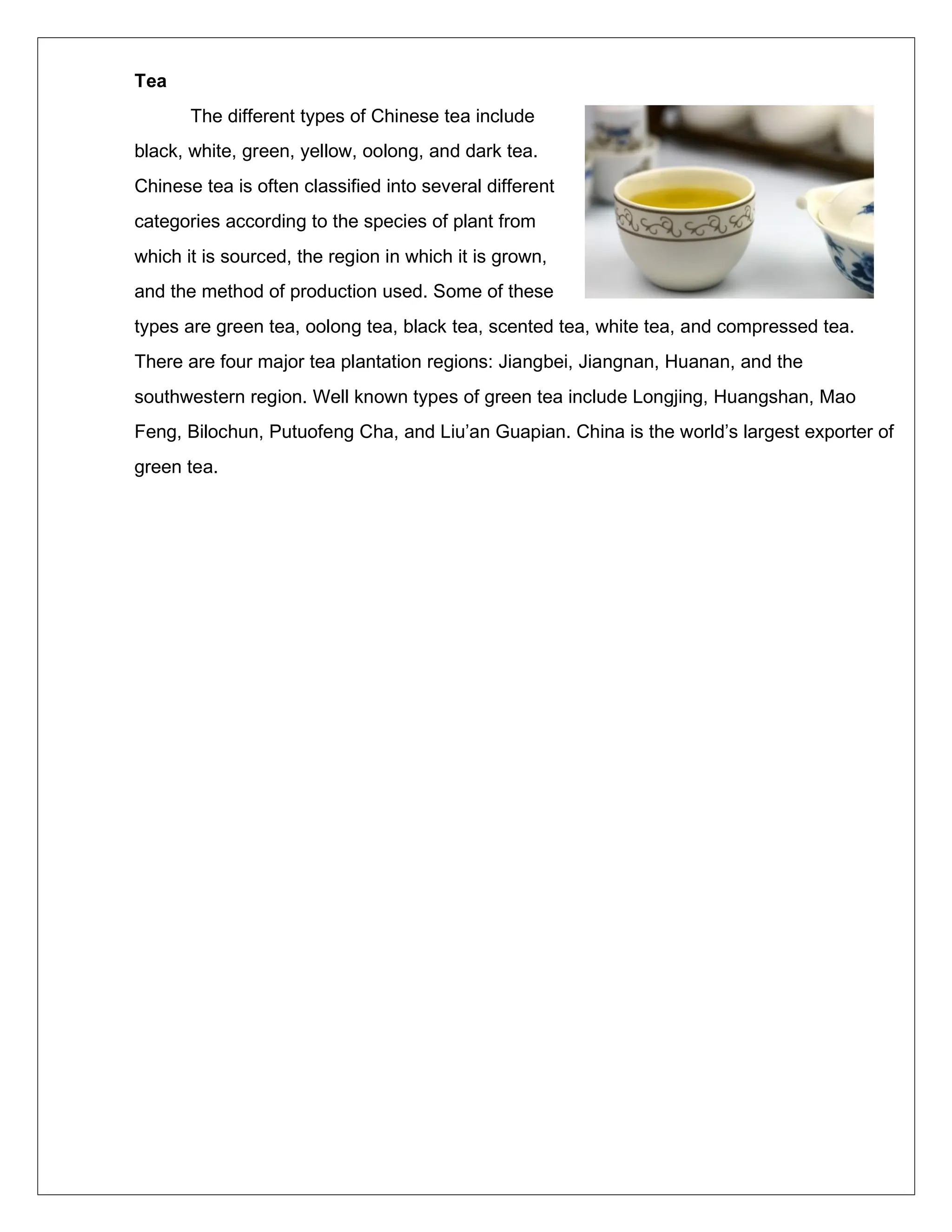
The different types of Chinese tea include
black, white, green, yellow, oolong, and dark tea.
Chinese tea is often classified into several different
categories according to the species of plant from
which it is sourced, the region in which it is grown,
and the method of production used. Some of these
types are green tea, oolong tea, black tea, scented tea, white tea, and compressed tea.
There are four major tea plantation regions: Jiangbei, Jiangnan, Huanan, and the
southwestern region. Well known types of green tea include Longjing, Huangshan, Mao
Feng, Bilochun, Putuofeng Cha, and Liu’an Guapian. China is the world’s largest exporter of
green tea.
Activity 1.
Check Your Understanding
Answer the following questions below to see how well you understand the topics
covered in the previous section.
1. Identify the various ingredients of Chinese cuisine.
___________________________________________________________________
___________________________________________________________________
___________________________________________________________________
___________________________________________________________________
2. Discuss the regional cuisines of China.
___________________________________________________________________
___________________________________________________________________
___________________________________________________________________
___________________________________________________________________
3. Enumerate the various dishes of China.
___________________________________________________________________
___________________________________________________________________
___________________________________________________________________
___________________________________________________________________
___________________________________________________________________
___________________________________________________________________
Le’s Apply
Objectives:
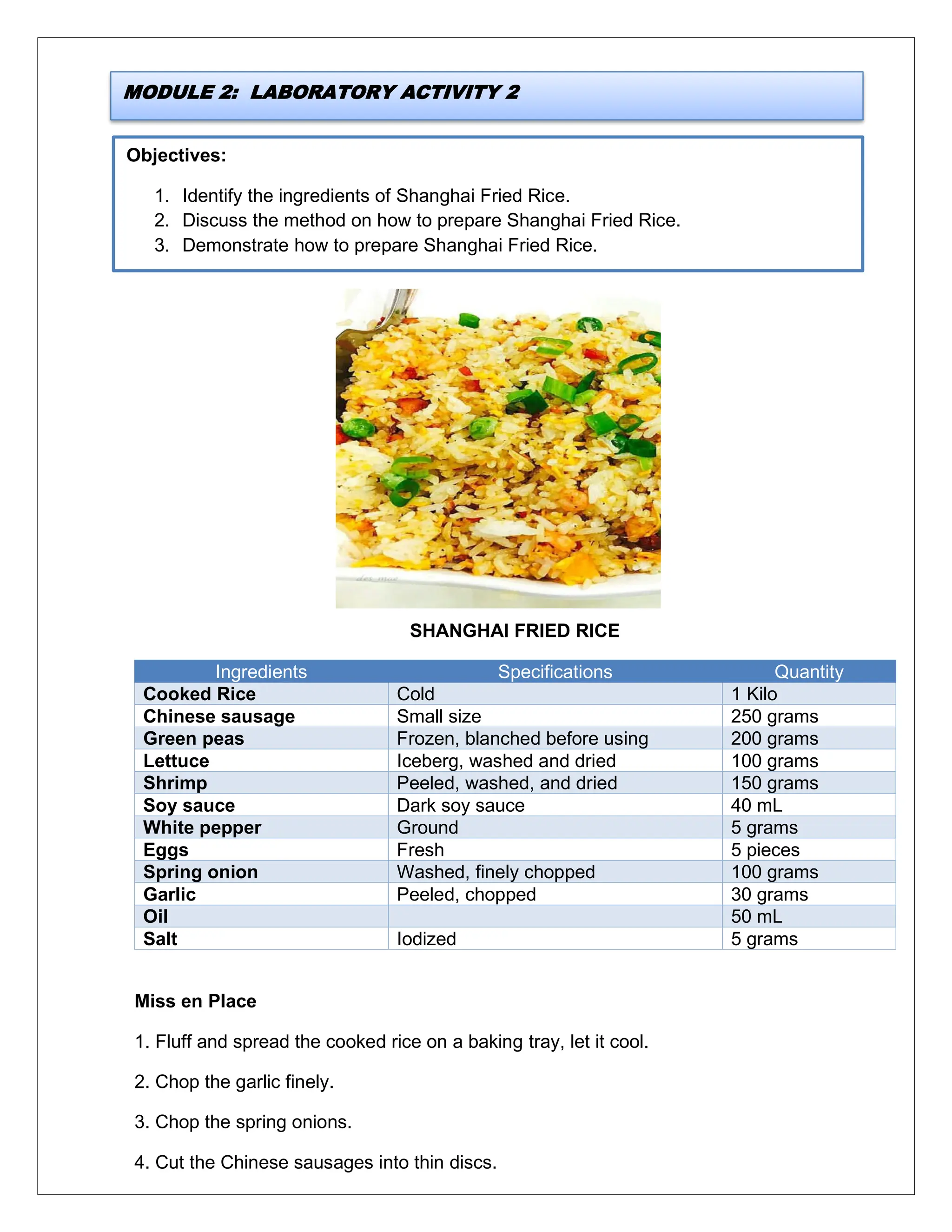
1. Identify the ingredients of Shanghai Fried Rice.
2. Discuss the method on how to prepare Shanghai Fried Rice.
3. Demonstrate how to prepare Shanghai Fried Rice.
SHANGHAI FRIED RICE
Ingredients Specifications Quantity
Cooked Rice Cold 1 Kilo
Chinese sausage Small size 250 grams
Green peas Frozen, blanched before using 200 grams
Lettuce Iceberg, washed and dried 100 grams
Shrimp Peeled, washed, and dried 150 grams
Soy sauce Dark soy sauce 40 mL
White pepper Ground 5 grams
Eggs Fresh 5 pieces
Spring onion Washed, finely chopped 100 grams
Garlic Peeled, chopped 30 grams
Oil 50 mL
Salt Iodized 5 grams
Miss en Place
1. Fluff and spread the cooked rice on a baking tray, let it cool.
2. Chop the garlic finely.
3. Chop the spring onions.
4. Cut the Chinese sausages into thin discs.
MODULE 2: LABORATORY ACTIVITY 2
5. beat the eggs lightly.
6. Slice the lettuce
Method:
1. Using a Chinese wok, heat the oil.
2. Add garlic and sauté.
3. Add the beaten eggs and stir well. Add the shrimp.
4. Add the Chinese sausage and stir well.
5. Mix the cooked rice into the eggs and sausages in the wok.
6. Add the green peas, lettuce, salt, and white pepper.
Add soy sauce and the spring onions. Stir well to evenly distribute the ingredients.
Instruction: Make a video clip on how to prepare Shanghai Fried Rice.
1. Introduce the ingredients, its specifications, and quantity.
2. Show the Mis en Place
3. Then, the method.
Objectives:
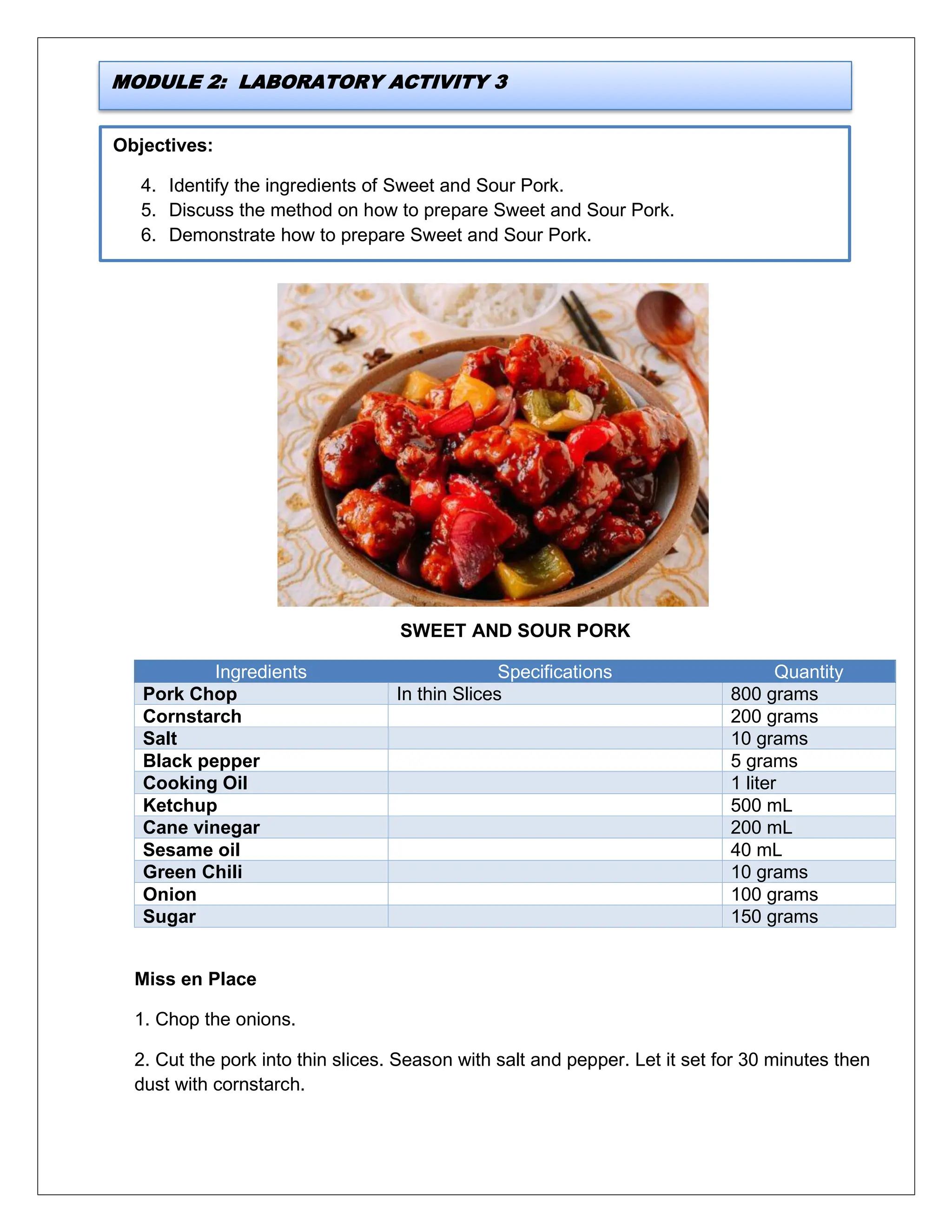
4. Identify the ingredients of Sweet and Sour Pork.
5. Discuss the method on how to prepare Sweet and Sour Pork.
6. Demonstrate how to prepare Sweet and Sour Pork.
SWEET AND SOUR PORK
Ingredients Specifications Quantity
Pork Chop In thin Slices 800 grams
Cornstarch 200 grams
Salt 10 grams
Black pepper 5 grams
Cooking Oil 1 liter
Ketchup 500 mL
Cane vinegar 200 mL
Sesame oil 40 mL
Green Chili 10 grams
Onion 100 grams
Sugar 150 grams
Miss en Place
1. Chop the onions.
2. Cut the pork into thin slices. Season with salt and pepper. Let it set for 30 minutes then
dust with cornstarch.
MODULE 2: LABORATORY ACTIVITY 3
Method:
1. Deep fry the pork in oil till light brown.
2. To make the sweet and sour sauce, put the vinegar into the pan and heat up under low
heat.
3. Add onion and green chilies. Simmer for 2 minutes.
4. Add ketchup, sugar, and sesame oil then stir well to combine.
Add the deep fried pork, into the sauce just before serving.
Instruction: Make a video clip on how to prepare Sweet and Sour Pork.
1. Introduce the ingredients, its specifications, and quantity.
2. Show the Mis en Place
3. Then, the method.
RUBRICS
Points Total Points Earned Comments
Student Name, Date, and
Recipe
Mis en Place
• All ingredients
measured correctly.
• All necessary
equipment gathered
and ready.
Safety and Sanitation
• All equipment and
surfaces cleaned and
sanitized, hands
washed, hair secured,
appropriate shoes and
attire.
Final Product
• Final appearance of
product demonstrates
correct preparation.
Module-2-cue-314.pdf hospitality management

  • 1.
    HOSPITALITY MANAGEMENT Module 2:North East Asian Cuisine - CHINA Learning Outcomes 1. Understand the various ingredients of Chinese cuisine. 2. Identify regional cuisines of China. 3. Learn the various dishes of China Food has always been an important aspect of Chinese culture and its delightful culinary history dates to about 5000 years. It has evolved with its flavor and cooking methods ever since. And over this vast period, the Chinese have developed and mastered a complex system of preparing food, such as identifying ingredients that make compatible combinations; making use of cooking techniques that are multi-phased such as first steaming and then deep-frying or stir frying, then boiling; and administering multi-phased flavoring like marinating between the stages of roasting, or after steaming, or before stir frying. Chinese culture has always considered food as an art, and emphasis has always been laid on the culinary techniques, preparation, serving and appreciation of food. Describe or say something about this picture and how it relates to Chinese cuisine. Le’s Activate
  • 2.
    1.1. Introduction Chinese cuisineis an important part of Chinese culture, which includes cuisine originating from the diverse regions of China, as well as from Chinese people in other parts of the world. Because of the Chinese diaspora and historical power of the country, Chinese cuisine has influenced many other cuisines in Asia, with modifications made to cater to local palates. The preference for seasoning and cooking techniques of Chinese provinces depends on the differences in historical background and ethnic groups. Geographic features including mountains, rivers, forests, and deserts also have a strong effect on the local available ingredients, considering climate of China varies from tropical in the south to subarctic in the northeast. Imperial, royal, and noble preferences also play a role in the change of Chinese cuisines. Because of imperial expansion and trading, ingredients and cooking techniques from other cultures are integrated into Chinese cuisines over time. Color, smell, and taste are the three traditional aspects used to describe Chinese food, as well as the meaning, appearance, and nutrition of the food. Cooking should be appraised from ingredients used, cuttings, cooking time, and seasoning. As the pace of life increases in modern China, fast food like fried noodles, fried rice, and gaifan (dish over rice) become more and more popular. 1.2. Regional Cuisines Several different styles contribute to Chinese cuisine but perhaps the best known and most influential are Cantonese cuisine, Shandong cuisine, Jiangsu cuisine (specifically Huaiyang cuisine) and Sichuan cuisine. These styles are distinctive from one another due to factors such as availability of resources, climate, geography, history, cooking techniques and lifestyle. One style may favor the use of garlic and shallots over chili and spices, while another may favor preparing seafood over other meats and fowl. Jiangsu cuisine favors cooking techniques such as braising and stewing, while Sichuan cuisine employs baking. Base on the raw materials and ingredients used, the method of preparation and cultural differences, a variety of foods with different flavors and textures are prepared in different regions of the country. Many traditional regional cuisines rely on basic methods of preservation such as drying, salting, pickling, and fermentation. Let’s Acquire
  • 3.
    Staple foods Rice Rice isa major staple food for people from rice farming areas in southern China. Steamed rice, usually white rice, is the most eaten form. People in southern China also like to use rice to make rice gruel as breakfast. Rice is also used to produce beer, baijiu, and vinegars. Glutinous rice (“sticky rice”) is a variety of rice used in specialty dishes. Curries are a very common across the region, but less common in Vietnam where the Chinese influencers is strong. The concept probably came from India and spread east, but the people of the South East modified the original by substituting coconut milk for yogurt as the basis for the sauce. Wheat In whet-farming areas in Northern China, people largely rely on flour-based food, such as noodles, bing (bread), jiaozi (a kind of Chinese dumplings), and mantou (a type of steamed buns). Noodles Chinese noodles come dry or fresh in a variety of sizes, shapes, and textures and are often served in soups or fried as toppings. Some varieties, such as Shou Mian (literally noodles oflongevity), is an avatar of long life and good health according to Chinese traditions. Noodles can be served hot or cold with different toppings, with broth, and occasionally dry 9as is the case with mi- fen). Noodles are commonly made with rice flour or wheat flour, but other flours such as soybean are also used in minor groups. Soybean products Several kinds of soybean products are sold in a farmer’s market in Haikou, China. Stir-fried razor shell with douche (fermented black soybeans) in Jiaodong style. Tofu is made of soybeans and is another popular food product that supplies protein. The production process of tofu varies from region to region, resulting in different kinds of tofu with a wide range of texture and taste. There are many kinds of soybean products, including tofu skin, smoked tofu, dried tofu, fried tofu, and so on. Stinky tofu is fermented tofu. It has a very distinct, potent, and strong smell, and is an acquired taste. Hard stinky tofu is often deep-fried and paired with soy sauce or salty spice. Soft, stinky tofu are usually used as a spread on steamed buns.
  • 4.
    Doufu is anothertype of fermented tofu that has a salty taste. It can be pickled together with soybeans, red yeast rice, or chili to create different color and flavor. It can be used as a spread on steamed buns or paired with rice congee. Vegetables Some unique vegetables used in Chinese cuisine include bok choy, snow pea pods, Chinese eggplant, Chinese broccoli, and straw mushrooms. Other vegetables including bean sprouts, pea vine tips, watercress, lotus roots, and bamboo shoots are also used in different cuisines of China. Herbs and seasonings Seasoning such as fresh ginger root, garlic, scallion, cilantro, and sesame are widely used in many regional cuisines. Sichuan peppercorns, star anise, cinnamon, fennel, cloves, and white peppers are also used in different regions. To add extra flavors to dishes, many Chinese cuisines also contain dried Chinese mushrooms, dried baby shrimps, dried tangerine peel, and dried Sichuan chilies. When it comes to sauces, China is home to soy sauce, which is made from fermented soybeans and wheat. Oyster sauce, clear rice vinegar, chili, Chinkiang black rice vinegar, fish sauce, and furu (fermented tofu) are also widely used. Desserts and snack Different gao dian (traditional Chinese pastry) with different stuffing, including lotus seed, rose, and mixture of pea and jackbean. Generally, seasonal fruits serve as the most common form of dessert consumed after dinner.
  • 5.
    Dim Sum, originallymeans small portion of food, can refer to dessert and pastries. Later to avoid the disambiguation, tian dian and gao dian are used to describe desserts and pastries. Chinese desserts are sweet foods and dishes that are served with tea, usually during the meal, or at the end of meals in Chinese cuisine. Besides served as a dim sum along with tea, pastries are used for celebration of traditional festivals. The most famous one is moon cake, used to celebrate the Mid-Autumn Festival. A wide variety of Chinese desserts are available, mainly including steamed and boiled sweet snacks. Bing is an umbrella term for all breads in Chinese, also including pastries and sweets. These are baked wheat flour-based confections, with different stuffing including red bean paste, jujube, and various of others. Su is another kind of paster made with more amount of oil, making the confection more friable. Chinese candies and sweets, called tang are usually made with cane sugar, malt sugar, honey, nuts, and fruit. Gao or Guo are rice based snacks that are typically steamed and may be made from glutinous or normal rice. Another cold dessert is called baobing, which is shaved ice with sweet syrup. Chinese jellies are known collectively in the language as ices. Many jelly desserts are traditionally set with agar and are flavored with fruits, though gelatin-based jellies are also common in contemporary desserts. Chinese dessert soups are typically sweet and served hot. Baozi are steamed buns containing savory or sweet combinations of meat, vegetables, mushrooms, traditionally associated with breakfast. Many types of street foods, which vary from region to region, can be eaten as snacks or light dinner. Prawn crackers are an often-consumed snack in Southeast China.
  • 6.
    Dairy Products Many Chinesehave until recently avoided milk, partly because pasturage for milk producers in a monsoon rice ecology is not economic, and partly because of the high rate of lactose intolerance among the Chinese population. As such, the use of dairy products in Chinese cuisine has historically been rare, with regional exceptions such as the “double skin milk” dessert in Guangdong Province. Today, ice cream is commonly available and popular throughout China. Cold Dishes Cold dishes are usually served before the main meal. Besides salad and pickles as appetizers, they can range from jelly, beancurd, noodle salad, cooked meat, and sausages, to jellyfish or cold soups. Soups In some part of South China, soups are served between the cold dishes and main dishes. In the rest part of China, soups are served between the main dish and staple foods before desserts or fruit salad. Drinks Tea plays an important role in Chinese dining culture. Baiju and huangjiu as strong alcoholic beverages are preferred by many people as well. Wine is not so popular as other drinks in China that are consumed while dining, although they are usually available in the menu. Beancurd
  • 7.
    Tea The different typesof Chinese tea include black, white, green, yellow, oolong, and dark tea. Chinese tea is often classified into several different categories according to the species of plant from which it is sourced, the region in which it is grown, and the method of production used. Some of these types are green tea, oolong tea, black tea, scented tea, white tea, and compressed tea. There are four major tea plantation regions: Jiangbei, Jiangnan, Huanan, and the southwestern region. Well known types of green tea include Longjing, Huangshan, Mao Feng, Bilochun, Putuofeng Cha, and Liu’an Guapian. China is the world’s largest exporter of green tea.
  • 8.
    Activity 1. Check YourUnderstanding Answer the following questions below to see how well you understand the topics covered in the previous section. 1. Identify the various ingredients of Chinese cuisine. ___________________________________________________________________ ___________________________________________________________________ ___________________________________________________________________ ___________________________________________________________________ 2. Discuss the regional cuisines of China. ___________________________________________________________________ ___________________________________________________________________ ___________________________________________________________________ ___________________________________________________________________ 3. Enumerate the various dishes of China. ___________________________________________________________________ ___________________________________________________________________ ___________________________________________________________________ ___________________________________________________________________ ___________________________________________________________________ ___________________________________________________________________ Le’s Apply
  • 9.
    Objectives: 1. Identify theingredients of Shanghai Fried Rice. 2. Discuss the method on how to prepare Shanghai Fried Rice. 3. Demonstrate how to prepare Shanghai Fried Rice. SHANGHAI FRIED RICE Ingredients Specifications Quantity Cooked Rice Cold 1 Kilo Chinese sausage Small size 250 grams Green peas Frozen, blanched before using 200 grams Lettuce Iceberg, washed and dried 100 grams Shrimp Peeled, washed, and dried 150 grams Soy sauce Dark soy sauce 40 mL White pepper Ground 5 grams Eggs Fresh 5 pieces Spring onion Washed, finely chopped 100 grams Garlic Peeled, chopped 30 grams Oil 50 mL Salt Iodized 5 grams Miss en Place 1. Fluff and spread the cooked rice on a baking tray, let it cool. 2. Chop the garlic finely. 3. Chop the spring onions. 4. Cut the Chinese sausages into thin discs. MODULE 2: LABORATORY ACTIVITY 2
  • 10.
    5. beat theeggs lightly. 6. Slice the lettuce Method: 1. Using a Chinese wok, heat the oil. 2. Add garlic and sauté. 3. Add the beaten eggs and stir well. Add the shrimp. 4. Add the Chinese sausage and stir well. 5. Mix the cooked rice into the eggs and sausages in the wok. 6. Add the green peas, lettuce, salt, and white pepper. Add soy sauce and the spring onions. Stir well to evenly distribute the ingredients. Instruction: Make a video clip on how to prepare Shanghai Fried Rice. 1. Introduce the ingredients, its specifications, and quantity. 2. Show the Mis en Place 3. Then, the method.
  • 11.
    Objectives: 4. Identify theingredients of Sweet and Sour Pork. 5. Discuss the method on how to prepare Sweet and Sour Pork. 6. Demonstrate how to prepare Sweet and Sour Pork. SWEET AND SOUR PORK Ingredients Specifications Quantity Pork Chop In thin Slices 800 grams Cornstarch 200 grams Salt 10 grams Black pepper 5 grams Cooking Oil 1 liter Ketchup 500 mL Cane vinegar 200 mL Sesame oil 40 mL Green Chili 10 grams Onion 100 grams Sugar 150 grams Miss en Place 1. Chop the onions. 2. Cut the pork into thin slices. Season with salt and pepper. Let it set for 30 minutes then dust with cornstarch. MODULE 2: LABORATORY ACTIVITY 3
  • 12.
    Method: 1. Deep frythe pork in oil till light brown. 2. To make the sweet and sour sauce, put the vinegar into the pan and heat up under low heat. 3. Add onion and green chilies. Simmer for 2 minutes. 4. Add ketchup, sugar, and sesame oil then stir well to combine. Add the deep fried pork, into the sauce just before serving. Instruction: Make a video clip on how to prepare Sweet and Sour Pork. 1. Introduce the ingredients, its specifications, and quantity. 2. Show the Mis en Place 3. Then, the method. RUBRICS Points Total Points Earned Comments Student Name, Date, and Recipe Mis en Place • All ingredients measured correctly. • All necessary equipment gathered and ready. Safety and Sanitation • All equipment and surfaces cleaned and sanitized, hands washed, hair secured, appropriate shoes and attire. Final Product • Final appearance of product demonstrates correct preparation.