Kumar Organic Products Limited
          Product Data For
Antidandruff Active Ingredient Kopirox

Contents

•   Product Data
•   Activities
•   General Properties
•   Toxicological & Dermatological Properties
•   End use / Formulations


                          Kumar Organic Products Limited
                          Plot # 36, “ Usha Krishna Tower”, Road No 3 & 5. |Jigani Industrial Area
                          Anekal Taluk, Bangalore – 562 106. India.
                          Ph : 00 91 80 – 7825376, 7826081 Fax : 91 80 7825439
                          Email : sales@kumarorganic.net
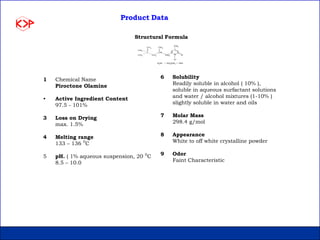
Product Data

                                Structural Formula


1   Chemical Name                        6   Solubility
    Piroctone Olamine                        Readily soluble in alcohol ( 10% ),
                                             soluble in aqueous surfactant solutions
•   Active Ingredient Content                and water / alcohol mixtures (1-10% )
    97.5 - 101%                              slightly soluble in water and oils

3   Loss on Drying                       7   Molar Mass
    max. 1.5%                                298.4 g/mol

4   Melting range                        8   Appearance
    133 – 136 0C                             White to off white crystalline powder

5   pH. ( 1% aqueous suspension, 20 0C   9   Odor
    8.5 – 10.0                               Faint Characteristic
Antidandruff activity

Kopirox is an effective, practically nontoxic antidandruff active ingredient, which
is particularly suitable for the manufacture of antidandruff shampoos and hair
care products such as hair tonics and cream rinses with an antidandruff action.

The concentrations used should be between 0.1 and 1.0%, depending on the
type of finished product.The concentration can be reduced even further for
preparation that remain on the hair or the scalp. In these case A concentration
between o.05 and 0.1% is sufficient. Because of its solubility in aqueous
surfactant solutions and alcohol –water mixtures Kopirox is highly suitable for
the manufacture of clear finished products.

The effectiveness of antidandruff preparations containing Kopirox, especially
antidandruff shampoos and hair tonics, has been investigated and described in
numerous studies. Their excellent efficacy has also been substantiated in
various clinical trials
Antibacterial spectrum of action of Kopirox


                                             No. of Strains   Minimum inhibitory concentration (μg / ml )
                  Bacteria                   Investigated
                                                              4    8    16    31   63 125 250 500 1000
gram-positive     Staph aureus                                               ■     ■

                  Micrococcus luteus               1                               ■

                  Streptoc pyogenes                2                               ■

                  Bac subtillis                    1                               ■

                  Eschenchia coli                  9                               ■     ■

                  salmonella var. species          6                                     ■     ■

                  proteus var species              9                                     ■     ■     ■
Gram - negative


                  Klebsiella var species           3                                     ■     ■

                  enterobacter var species         4                                           ■     ■

                  shigella flexnen                 1                               ■

                  pseudomonas aeruginosa           8                               ■     ■     ■     ■

                  haeudomonas airuginosa           1                               ■

                  corynebact var species           2                               ■

                  past multocida                   1
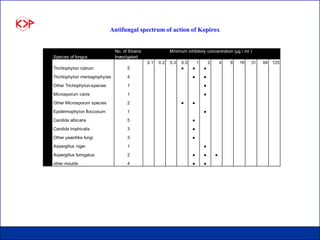
Antifungal spectrum of action of Kopirox


                               No. of Strains               Minimum inhibitory concentration (μg / ml )
Species of fungus              Investigated
                                                0.1   0.2   0.3   0.5       1       2       4   8   16   31   64   125
Trichlophyton rubrum                 5                            ■     ■       ■

Trichlophyton mentagrophytes         4                                  ■       ■

Other Trichophyton-species           1                                          ■

Microsporum canis                    1                                          ■

Other Microsporum species            2                            ■     ■

Epidermophyton floccosum             1                                          ■

Candida albicans                     5                                  ■

Candida trophicalis                  3                                  ■

Other yeastlike fungi                3                                  ■

Aspergillus niger                    1                                          ■

Aspergillus fumigatus                2                                  ■       ■       ■

other moulds                         4                                  ■       ■
General Properties
1.   Solubility.
     The solubility of Kopirox is greatly dependent on the pH. Normally it’s solubility in aqueous formulations is greater in
     the neutral and weakly alkaline ranges than in the acid range.

     However, Kopirox have adequate solubility in the usual pH range ( pH 5 – 8 ) in commercial surfactant solutions and
     alcohol-water mixtures.

2.   Influence of the pH Value
     At a neutral pH a substantial part of the Kopirox exists in the form of free acid. The pKa value is about 7.4 Kopirox is
     chemically stable over a wide pH range. In the range that is important for practical purposes, namely between pH 3 and
     9, neither deterioration of the active ingredient nor impairment of its efficacy was observed even after prolonged storage

3.   Thermal stability
     Kopirox is noted for good thermal stability. The high temperatures ( up to 80 0C ) occasionally occurring in the
     manufacture of cosmetic preparations do not cause deterioration of the product or loss of efficacy. Still, prolonged
     heating to high temperatures should be avoided if possible No decrease in the active ingredient content of an Kopirox
     shampoo was observed after storage for 12 months at + 40 0C

4.   Light stability.
     Storage of Kopirox – containing preparations in daylight can cause a deterioration of the active ingredient, depending on
     the amount of UV light. It is therefore advisable to use colored or opaque packaging materials. Stability tests should be
     carried out if transparent packaging materials are used.

5.   Compatibility with cosmetic raw materials.
     Kopirox is compatible with most surfactants, additives and active ingredients used in cosmetics. Concerning
     compatibility with perfume oils, those with aldehyde and keto groups may cause problems.

     Despite the anionic character of the active ingredient molecule, Kopirox can be combined without any problems with
     most cationic surfactants ( quaternary ammonium compounds ) and cationic active ingredients. In some cases the
     solubility of Kopirox in water is increased even further.
Toxicological and Dermatological Properties

Acute Toxicity
1.   Oral administration .
     The acute oral toxicity tests were carried out on rats, mice and dogs. The following results were
     obtained :
•    Rat
     LD50 = 8100 mg/kg body weight.
•    Mouse
     LD50 = 4300 mg/kg body weight.
     Doses up to 1000 mg / kg body weight were tolerated by all test animals, which showed normal
     behavior.
•    Dog :
     LD50 = >4000 mg / kg body weight.

     Thus Kopirox possesses no significant potential regarding acute oral toxicity.

2] Dermal administration.
     The percutaneous toxicity was tested with an almost saturated solution in 1,2 propylene glycol by
    means of a covered patch test for 24 hours on rats. Doses of 2000 mg/kg body weight ( pH 9.3 –
    unadjusted ) and 750 mg / kg ( pH 7.0 – adjusted ) gave no indication of a toxic reaction. The
    dermal LD50 of the undiluted substance, tested on rates, is >2000 mg/ kg body weight.

     Therefore Kopirox provides no significant risk concerning acute dermal toxicity.
3] Skin Compatibility

Primary skin irritation was tested in the patch test on rabbits over 24 hours. The test substance
used was a solution of 0.5% Kopirox and 5% of a lauryl polyglycol ether sulphosuccinate
disodium salt in water ( pH 7 adjusted with citric acid ) The test was carried out on intact and
abraded skin. Only slight irritation was observed. A 5% solution of the same surfactant without
the addition of Kopirox showed the same degree of irritation. Thus, under the test conditions
described Kopirox does not cause an increase in the irritation potential. 1% solution in 1,2 –
propylene glycol or PEG 400 adjusted to pH 7 proved to be slightly irritant. The irritation
symptoms had largely disappeared after 72 hours

4] Mucous membrane compatibility

The acute eye irritation was carried out on rabbits. The test substance used was a 1:1 shampoo
formulation diluted with water, consisting of 15% of a sodium lauryl ether sulphate and 1%
Kopirox ( pH 7 adjusted with citric acid ), the control used was a corresponding formulation
without Kopirox . Both preparations proved to be moderately irritant. In similar trials commercial
shampoo formulations with 0.3% or 0.5% Kopirox, hair tonics based on isopropanol/ water with
0.2 % Kopirox and the corresponding placebo preparations proved to be slightly irritant.

5] Sensitisation

Studies on guinea pigs using the methods of Buehler and Tanaka et al and the methods of
Monkawa gave no indication of a sensitising or Photosensitising effect.
Subacute and subchronic toxicity

•Rate
When Kopirox was administered in daily doses of up to 800 g/ kg body weight by
means of a stomach tube for 30 and 90 days the maximum nontoxic dose was 100 mg/
kg weight. No organic damage was observed with any dose.

•Dog
When Kopirox was administered in daily doses of up to 100 mg/ kg body weight with
the food for 30 and 90 days no toxic findings were recorded

•Rabbit
The epidermal application to 30 rabbits of a shampoo with 0.5% Kopirox ( dose : 0.5
mg Kopirox per animal ) or of a hair tonic with 0.1 % Kopirox ( dose : 0.1mg Kopirox
per animal ) caused no toxic reactions or substance – induced changes in organs,
including the skin


Chronic toxicity
The daily epidermal application of 0.5 and 1.0% Kopirox in 1,2 – propylene glycol to
rats ( dose : 0.1 or 2 mg per animal ) for six and 12 months caused rapidly reversible
changes to the area of skin affected. A systemic effect was not observed.
Pharmacokinetics
The pharmacokinetic studies were carried out after dermal, oral subcutaneous,
intraperitoneal and intravenous administration of C14 labelled Kopirox to rats
and dogs.

The active ingredient administered was eliminated in unchanged form largely
in the faces and in small amount in urine. The blood values reached their
maximum between three and eight hours after oral administration of Kopirox. (
Dose : 0.24 mg / kg body weight )

Only very low values were recorded in the cellular tissue. The maximum values
were determined in the liver six hours after administration. After topical
application of a 1% solution of Kopirox ( Dose : 15.4 mg / kg body weight )
without rinsing ( under occlusive conditions ) a concentration of 0.32µg/ ml in
the blood was reached after six hours. With the same test procedure, but after
rinsing the treated skin after five minutes, greatly reduced concentrations in
the blood were recorded with a maximum after one hour ( 0.02 µg / ml ).

The skin penetration of Kopirox depends on the treatment time. A significant
increase in penetration was determined between 2.5 and 10 minutes contact
time. No further increase in the penetration rate was recorded with a longer
contact time of up to 20 minutes. The pharmacokinetic studies and subchornic
tests ( 90 – days test 0 carried out indicate a safety factor of about 30,000.
Pharmacological studies
Studies of the effect of Kopirox in a dose of 5 mg/ kg body weight on the central
nervous system and vegetative functions ( isolated organs, cardiovascular
parameters and specific metabolic functions ) of mice, guinea pigs cats and rats
gave no indication of acute pharmacological effect.

Reproductive toxicology study
Kopirox proved to be neither embryotoxic nor teratogenic in studies on rabbits after
oral administration of up to 63 mg/ kg body weight and on rats after subcutaneous
administration of up to 2000 mg / kg body weight whilst the animals were pregnant.
Even after subcutaneous application of up to 500 mg/ kg body weight to rats before
mating and until the early stage of pregnancy or during the last stage of pregnancy
and the lactation period no impairment of the fertility of the test animals or their
progeny or teratogenic effects on the foetuses of the first and second generation were
observed.
Mutagenicity testing
  The mutagenicity was investigated in several in – vitro and in-vivo studies such as
  point mutation test ( AMES test, mouse lymphoma test.), chromosome aberration
  tests ( micronucleus test, cytogenetic in –vivo test ) and a DNA binding study on the
  rat with a very low detection limit.

  None of the in-vivo studies gave any indication of a mutagenic effect. Kopirox was not
  mutagenic in the AMES test


Skin compatibility on humans
   The application of a 20% aqueous lauryl polyglycol ether
   sulphosuccinate disodium salt solution with 0.5% Kopirox caused
   no primary skin irritation in the repeated shelansky & Shelansky
   patch test on 50 test subjects and gave no indication of a
   sensitising effect.
End use / Formulation

            • Formulation                  % of Kopirox

            • Antidandruff Shampoo         0.3 to 1.0%
            •Hair Conditioner              0.1 to 0.3%
            •Antidandruff Cream rinse
            •Antidandruff Hair Treatment
            •Antidandruff setting lotion   0.05 to 0.2%
            •Antidandruff Hair tonic       0.05 to 0.1 %
            •Antidandruff Hair gel         0.05 to 0.2%
            •Antidandruff Hair Cream       0.1 to 0.3%
            •Antidandruff Hair Oil
            •Anti acne products
Kumar Organic Products Limited
  Plot # 36, “ Usha Krishna Tower”, Road No 3 & 5.
        Jigani Industrial Area. Anekal Taluk,
             Bangalore – 562 106. India.
Ph : 00 91 80 – 7825376, 7826081 Fax : 91 80 7825439
           email : sales@kumarorganic.net

Kopirox n ppt

  • 1.
    Kumar Organic ProductsLimited Product Data For Antidandruff Active Ingredient Kopirox Contents • Product Data • Activities • General Properties • Toxicological & Dermatological Properties • End use / Formulations Kumar Organic Products Limited Plot # 36, “ Usha Krishna Tower”, Road No 3 & 5. |Jigani Industrial Area Anekal Taluk, Bangalore – 562 106. India. Ph : 00 91 80 – 7825376, 7826081 Fax : 91 80 7825439 Email : sales@kumarorganic.net
  • 2.
    Product Data Structural Formula 1 Chemical Name 6 Solubility Piroctone Olamine Readily soluble in alcohol ( 10% ), soluble in aqueous surfactant solutions • Active Ingredient Content and water / alcohol mixtures (1-10% ) 97.5 - 101% slightly soluble in water and oils 3 Loss on Drying 7 Molar Mass max. 1.5% 298.4 g/mol 4 Melting range 8 Appearance 133 – 136 0C White to off white crystalline powder 5 pH. ( 1% aqueous suspension, 20 0C 9 Odor 8.5 – 10.0 Faint Characteristic
  • 3.
    Antidandruff activity Kopirox isan effective, practically nontoxic antidandruff active ingredient, which is particularly suitable for the manufacture of antidandruff shampoos and hair care products such as hair tonics and cream rinses with an antidandruff action. The concentrations used should be between 0.1 and 1.0%, depending on the type of finished product.The concentration can be reduced even further for preparation that remain on the hair or the scalp. In these case A concentration between o.05 and 0.1% is sufficient. Because of its solubility in aqueous surfactant solutions and alcohol –water mixtures Kopirox is highly suitable for the manufacture of clear finished products. The effectiveness of antidandruff preparations containing Kopirox, especially antidandruff shampoos and hair tonics, has been investigated and described in numerous studies. Their excellent efficacy has also been substantiated in various clinical trials
  • 4.
    Antibacterial spectrum ofaction of Kopirox No. of Strains Minimum inhibitory concentration (μg / ml ) Bacteria Investigated 4 8 16 31 63 125 250 500 1000 gram-positive Staph aureus ■ ■ Micrococcus luteus 1 ■ Streptoc pyogenes 2 ■ Bac subtillis 1 ■ Eschenchia coli 9 ■ ■ salmonella var. species 6 ■ ■ proteus var species 9 ■ ■ ■ Gram - negative Klebsiella var species 3 ■ ■ enterobacter var species 4 ■ ■ shigella flexnen 1 ■ pseudomonas aeruginosa 8 ■ ■ ■ ■ haeudomonas airuginosa 1 ■ corynebact var species 2 ■ past multocida 1
  • 5.
    Antifungal spectrum ofaction of Kopirox No. of Strains Minimum inhibitory concentration (μg / ml ) Species of fungus Investigated 0.1 0.2 0.3 0.5 1 2 4 8 16 31 64 125 Trichlophyton rubrum 5 ■ ■ ■ Trichlophyton mentagrophytes 4 ■ ■ Other Trichophyton-species 1 ■ Microsporum canis 1 ■ Other Microsporum species 2 ■ ■ Epidermophyton floccosum 1 ■ Candida albicans 5 ■ Candida trophicalis 3 ■ Other yeastlike fungi 3 ■ Aspergillus niger 1 ■ Aspergillus fumigatus 2 ■ ■ ■ other moulds 4 ■ ■
  • 6.
    General Properties 1. Solubility. The solubility of Kopirox is greatly dependent on the pH. Normally it’s solubility in aqueous formulations is greater in the neutral and weakly alkaline ranges than in the acid range. However, Kopirox have adequate solubility in the usual pH range ( pH 5 – 8 ) in commercial surfactant solutions and alcohol-water mixtures. 2. Influence of the pH Value At a neutral pH a substantial part of the Kopirox exists in the form of free acid. The pKa value is about 7.4 Kopirox is chemically stable over a wide pH range. In the range that is important for practical purposes, namely between pH 3 and 9, neither deterioration of the active ingredient nor impairment of its efficacy was observed even after prolonged storage 3. Thermal stability Kopirox is noted for good thermal stability. The high temperatures ( up to 80 0C ) occasionally occurring in the manufacture of cosmetic preparations do not cause deterioration of the product or loss of efficacy. Still, prolonged heating to high temperatures should be avoided if possible No decrease in the active ingredient content of an Kopirox shampoo was observed after storage for 12 months at + 40 0C 4. Light stability. Storage of Kopirox – containing preparations in daylight can cause a deterioration of the active ingredient, depending on the amount of UV light. It is therefore advisable to use colored or opaque packaging materials. Stability tests should be carried out if transparent packaging materials are used. 5. Compatibility with cosmetic raw materials. Kopirox is compatible with most surfactants, additives and active ingredients used in cosmetics. Concerning compatibility with perfume oils, those with aldehyde and keto groups may cause problems. Despite the anionic character of the active ingredient molecule, Kopirox can be combined without any problems with most cationic surfactants ( quaternary ammonium compounds ) and cationic active ingredients. In some cases the solubility of Kopirox in water is increased even further.
  • 7.
    Toxicological and DermatologicalProperties Acute Toxicity 1. Oral administration . The acute oral toxicity tests were carried out on rats, mice and dogs. The following results were obtained : • Rat LD50 = 8100 mg/kg body weight. • Mouse LD50 = 4300 mg/kg body weight. Doses up to 1000 mg / kg body weight were tolerated by all test animals, which showed normal behavior. • Dog : LD50 = >4000 mg / kg body weight. Thus Kopirox possesses no significant potential regarding acute oral toxicity. 2] Dermal administration. The percutaneous toxicity was tested with an almost saturated solution in 1,2 propylene glycol by means of a covered patch test for 24 hours on rats. Doses of 2000 mg/kg body weight ( pH 9.3 – unadjusted ) and 750 mg / kg ( pH 7.0 – adjusted ) gave no indication of a toxic reaction. The dermal LD50 of the undiluted substance, tested on rates, is >2000 mg/ kg body weight. Therefore Kopirox provides no significant risk concerning acute dermal toxicity.
  • 8.
    3] Skin Compatibility Primaryskin irritation was tested in the patch test on rabbits over 24 hours. The test substance used was a solution of 0.5% Kopirox and 5% of a lauryl polyglycol ether sulphosuccinate disodium salt in water ( pH 7 adjusted with citric acid ) The test was carried out on intact and abraded skin. Only slight irritation was observed. A 5% solution of the same surfactant without the addition of Kopirox showed the same degree of irritation. Thus, under the test conditions described Kopirox does not cause an increase in the irritation potential. 1% solution in 1,2 – propylene glycol or PEG 400 adjusted to pH 7 proved to be slightly irritant. The irritation symptoms had largely disappeared after 72 hours 4] Mucous membrane compatibility The acute eye irritation was carried out on rabbits. The test substance used was a 1:1 shampoo formulation diluted with water, consisting of 15% of a sodium lauryl ether sulphate and 1% Kopirox ( pH 7 adjusted with citric acid ), the control used was a corresponding formulation without Kopirox . Both preparations proved to be moderately irritant. In similar trials commercial shampoo formulations with 0.3% or 0.5% Kopirox, hair tonics based on isopropanol/ water with 0.2 % Kopirox and the corresponding placebo preparations proved to be slightly irritant. 5] Sensitisation Studies on guinea pigs using the methods of Buehler and Tanaka et al and the methods of Monkawa gave no indication of a sensitising or Photosensitising effect.
  • 9.
    Subacute and subchronictoxicity •Rate When Kopirox was administered in daily doses of up to 800 g/ kg body weight by means of a stomach tube for 30 and 90 days the maximum nontoxic dose was 100 mg/ kg weight. No organic damage was observed with any dose. •Dog When Kopirox was administered in daily doses of up to 100 mg/ kg body weight with the food for 30 and 90 days no toxic findings were recorded •Rabbit The epidermal application to 30 rabbits of a shampoo with 0.5% Kopirox ( dose : 0.5 mg Kopirox per animal ) or of a hair tonic with 0.1 % Kopirox ( dose : 0.1mg Kopirox per animal ) caused no toxic reactions or substance – induced changes in organs, including the skin Chronic toxicity The daily epidermal application of 0.5 and 1.0% Kopirox in 1,2 – propylene glycol to rats ( dose : 0.1 or 2 mg per animal ) for six and 12 months caused rapidly reversible changes to the area of skin affected. A systemic effect was not observed.
  • 10.
    Pharmacokinetics The pharmacokinetic studieswere carried out after dermal, oral subcutaneous, intraperitoneal and intravenous administration of C14 labelled Kopirox to rats and dogs. The active ingredient administered was eliminated in unchanged form largely in the faces and in small amount in urine. The blood values reached their maximum between three and eight hours after oral administration of Kopirox. ( Dose : 0.24 mg / kg body weight ) Only very low values were recorded in the cellular tissue. The maximum values were determined in the liver six hours after administration. After topical application of a 1% solution of Kopirox ( Dose : 15.4 mg / kg body weight ) without rinsing ( under occlusive conditions ) a concentration of 0.32µg/ ml in the blood was reached after six hours. With the same test procedure, but after rinsing the treated skin after five minutes, greatly reduced concentrations in the blood were recorded with a maximum after one hour ( 0.02 µg / ml ). The skin penetration of Kopirox depends on the treatment time. A significant increase in penetration was determined between 2.5 and 10 minutes contact time. No further increase in the penetration rate was recorded with a longer contact time of up to 20 minutes. The pharmacokinetic studies and subchornic tests ( 90 – days test 0 carried out indicate a safety factor of about 30,000.
  • 11.
    Pharmacological studies Studies ofthe effect of Kopirox in a dose of 5 mg/ kg body weight on the central nervous system and vegetative functions ( isolated organs, cardiovascular parameters and specific metabolic functions ) of mice, guinea pigs cats and rats gave no indication of acute pharmacological effect. Reproductive toxicology study Kopirox proved to be neither embryotoxic nor teratogenic in studies on rabbits after oral administration of up to 63 mg/ kg body weight and on rats after subcutaneous administration of up to 2000 mg / kg body weight whilst the animals were pregnant. Even after subcutaneous application of up to 500 mg/ kg body weight to rats before mating and until the early stage of pregnancy or during the last stage of pregnancy and the lactation period no impairment of the fertility of the test animals or their progeny or teratogenic effects on the foetuses of the first and second generation were observed.
  • 12.
    Mutagenicity testing The mutagenicity was investigated in several in – vitro and in-vivo studies such as point mutation test ( AMES test, mouse lymphoma test.), chromosome aberration tests ( micronucleus test, cytogenetic in –vivo test ) and a DNA binding study on the rat with a very low detection limit. None of the in-vivo studies gave any indication of a mutagenic effect. Kopirox was not mutagenic in the AMES test Skin compatibility on humans The application of a 20% aqueous lauryl polyglycol ether sulphosuccinate disodium salt solution with 0.5% Kopirox caused no primary skin irritation in the repeated shelansky & Shelansky patch test on 50 test subjects and gave no indication of a sensitising effect.
  • 13.
    End use /Formulation • Formulation % of Kopirox • Antidandruff Shampoo 0.3 to 1.0% •Hair Conditioner 0.1 to 0.3% •Antidandruff Cream rinse •Antidandruff Hair Treatment •Antidandruff setting lotion 0.05 to 0.2% •Antidandruff Hair tonic 0.05 to 0.1 % •Antidandruff Hair gel 0.05 to 0.2% •Antidandruff Hair Cream 0.1 to 0.3% •Antidandruff Hair Oil •Anti acne products
  • 14.
    Kumar Organic ProductsLimited Plot # 36, “ Usha Krishna Tower”, Road No 3 & 5. Jigani Industrial Area. Anekal Taluk, Bangalore – 562 106. India. Ph : 00 91 80 – 7825376, 7826081 Fax : 91 80 7825439 email : sales@kumarorganic.net