PRESETED BY
MANISH KUMAR LAL
KNOWLEDGE MANAGEMENT
 Knowledge management is the systematic management of
an organisations knowledge assets for creating value and
meeting tactical&strategic requirements
 Knowledge management is defined in terms of its own
business objectives
 Knowledge management is all about applying knowledge
in new previously overburdened or novel situations
Key Areas Of KnowledgeManagement
 Globalisation of business
 Leaner organisation
 Corporate amnesia
 Technological advances
Knowledge hierarchy
Knowledge Management models
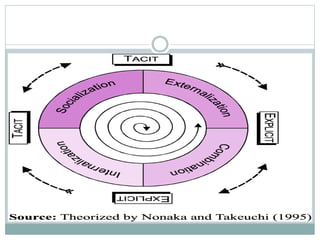
 Nonaka and Takeuchi model(1995)
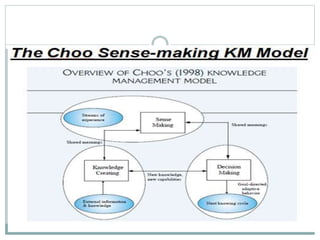
 Choo sense-Making KM model(1998)
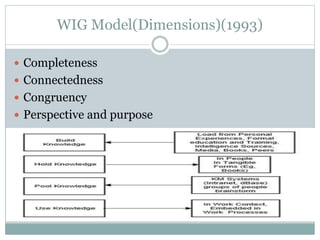
 WIG model(1998)
WIG Model(Dimensions)(1993)
 Completeness
 Connectedness
 Congruency
 Perspective and purpose
 Knowledge management strategy is a general issue
based approach to define operational strategy and
objectives with specialised KM principles and
approaches.
A good KM Strategy
stated business strategy and objectives
 A description of knowledge-based business issues
 An inventory of available knowledge resources
 An analysis of recommended knowledge leverage
Knowledge management

Knowledge management

  • 1.
    PRESETED BY MANISH KUMARLAL KNOWLEDGE MANAGEMENT
  • 2.
     Knowledge managementis the systematic management of an organisations knowledge assets for creating value and meeting tactical&strategic requirements  Knowledge management is defined in terms of its own business objectives  Knowledge management is all about applying knowledge in new previously overburdened or novel situations
  • 3.
    Key Areas OfKnowledgeManagement  Globalisation of business  Leaner organisation  Corporate amnesia  Technological advances
  • 4.
  • 5.
    Knowledge Management models Nonaka and Takeuchi model(1995)  Choo sense-Making KM model(1998)  WIG model(1998)
  • 8.
    WIG Model(Dimensions)(1993)  Completeness Connectedness  Congruency  Perspective and purpose
  • 9.
     Knowledge managementstrategy is a general issue based approach to define operational strategy and objectives with specialised KM principles and approaches.
  • 10.
    A good KMStrategy stated business strategy and objectives  A description of knowledge-based business issues  An inventory of available knowledge resources  An analysis of recommended knowledge leverage