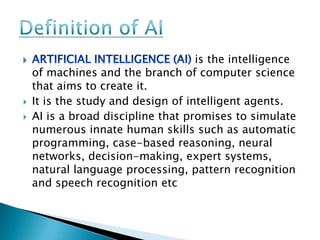

is the intelligence
    of machines and the branch of computer science
    that aims to create it.
   It is the study and design of intelligent agents.
   AI is a broad discipline that promises to simulate
    numerous innate human skills such as automatic
    programming, case-based reasoning, neural
    networks, decision-making, expert systems,
    natural language processing, pattern recognition
    and speech recognition etc
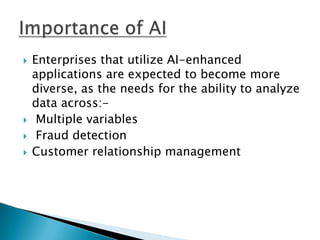
   Enterprises that utilize AI-enhanced
    applications are expected to become more
    diverse, as the needs for the ability to analyze
    data across:-
    Multiple variables
    Fraud detection
   Customer relationship management
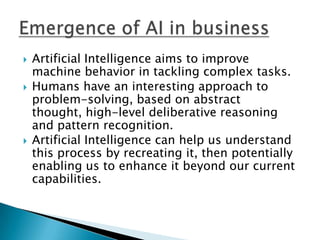
   Artificial Intelligence aims to improve
    machine behavior in tackling complex tasks.
   Humans have an interesting approach to
    problem-solving, based on abstract
    thought, high-level deliberative reasoning
    and pattern recognition.
   Artificial Intelligence can help us understand
    this process by recreating it, then potentially
    enabling us to enhance it beyond our current
    capabilities.
Business applications such as:-
 Unknown patterns/relationships in sales data
 Customer buying habits
 Complex problem-solving and decision-
  support techniques in real-time business
  applications.
 AI techniques are spread across functions
  ranging from finance management to
  forecasting and product
   An artificial neural network (ANN) is a
    mathematical model or computational model
    based on biological neural networks.
    It consists of an interconnected group of
    artificial neurons and processes information
    using a connectionist approach to computation.
   In practical terms neural networks are non-linear
    statistical data modeling tools. They can be used
    to model complex relationships between inputs
    and outputs or to find patterns in data.
   The tasks to which artificial neural networks are
    applied tend to fall within the following broad
    categories:
    • Function approximation, or regression
    analysis, including time series prediction and
    modeling.
    • Classification, including pattern and sequence
    recognition, novelty detection and sequential
    decision making.
    • Data processing, including
    filtering, clustering, blind source separation and
    compression.
    View your best product runs and the
    corresponding settings.
   Increase efficiency and quality by using
    optimal settings from past production.
   Artificial Intelligence can optimize your
    schedule beyond normal human capabilities.
   Increase productivity by eliminating
    downtime due to unpredictable changes in
    the schedule.
 In the field of Finance, artificial intelligence has long
  been used. Some applications of Artificial Intelligence
  are:-
 Credit authorization screening
 Mortgage risk assessment
 Project management and bidding strategy
 Financial and economic forecasting
 Risk rating of exchange-traded, fixed income
  investments
 Detection of regularities in security price movements
 Prediction of default and bankruptcy
 Security/and or Asset Portfolio Management
   In Marketing, Some applications of Artificial
    Intelligence are :-
 Computerized neural networks
 Customer relationship management (CRM).
 High-tech data mining can give companies a
  precise view of how particular segments of the
  customer base react to a product or service
 Buying patterns, analytics could help companies
  react much more quickly to the marketplace.
 Some applications of AI in HR are:-
 Use of neural networks and fuzzy logic in
  human resource information system(HRIS).
 fuzzy neural network, to construct a new
  model for evaluation of managerial
  talent, and accordingly to develop a decision
  support system in human resource selection.
   It is difficult for business to see general relevance
    from AI. AI can have a positive effect for business
    benefit and has lead to some very useful systems
    that have found their way into the heart of
    business activity. Business should not lose sight
    of where AI could go because there are many
    potential benefits to current and new businesses
    of future research. The idea of robotic domestic
    workers is still far fetched but companies are
    making progress even here. There is already a
    Robot Vacuum Cleaner marketed by Electrolux
    and doubtless improved systems with better
    functionality will follow. .
Artificial intelligence in business

Artificial intelligence in business

  • 2.
    is the intelligence of machines and the branch of computer science that aims to create it.  It is the study and design of intelligent agents.  AI is a broad discipline that promises to simulate numerous innate human skills such as automatic programming, case-based reasoning, neural networks, decision-making, expert systems, natural language processing, pattern recognition and speech recognition etc
  • 3.
    Enterprises that utilize AI-enhanced applications are expected to become more diverse, as the needs for the ability to analyze data across:-  Multiple variables  Fraud detection  Customer relationship management
  • 4.
    Artificial Intelligence aims to improve machine behavior in tackling complex tasks.  Humans have an interesting approach to problem-solving, based on abstract thought, high-level deliberative reasoning and pattern recognition.  Artificial Intelligence can help us understand this process by recreating it, then potentially enabling us to enhance it beyond our current capabilities.
  • 5.
    Business applications suchas:-  Unknown patterns/relationships in sales data  Customer buying habits  Complex problem-solving and decision- support techniques in real-time business applications.  AI techniques are spread across functions ranging from finance management to forecasting and product
  • 6.
    An artificial neural network (ANN) is a mathematical model or computational model based on biological neural networks.  It consists of an interconnected group of artificial neurons and processes information using a connectionist approach to computation.  In practical terms neural networks are non-linear statistical data modeling tools. They can be used to model complex relationships between inputs and outputs or to find patterns in data.
  • 7.
    The tasks to which artificial neural networks are applied tend to fall within the following broad categories: • Function approximation, or regression analysis, including time series prediction and modeling. • Classification, including pattern and sequence recognition, novelty detection and sequential decision making. • Data processing, including filtering, clustering, blind source separation and compression.
  • 8.
    View your best product runs and the corresponding settings.  Increase efficiency and quality by using optimal settings from past production.  Artificial Intelligence can optimize your schedule beyond normal human capabilities.  Increase productivity by eliminating downtime due to unpredictable changes in the schedule.
  • 9.
     In thefield of Finance, artificial intelligence has long been used. Some applications of Artificial Intelligence are:-  Credit authorization screening  Mortgage risk assessment  Project management and bidding strategy  Financial and economic forecasting  Risk rating of exchange-traded, fixed income investments  Detection of regularities in security price movements  Prediction of default and bankruptcy  Security/and or Asset Portfolio Management
  • 10.
    In Marketing, Some applications of Artificial Intelligence are :-  Computerized neural networks  Customer relationship management (CRM).  High-tech data mining can give companies a precise view of how particular segments of the customer base react to a product or service  Buying patterns, analytics could help companies react much more quickly to the marketplace.
  • 11.
     Some applicationsof AI in HR are:-  Use of neural networks and fuzzy logic in human resource information system(HRIS).  fuzzy neural network, to construct a new model for evaluation of managerial talent, and accordingly to develop a decision support system in human resource selection.
  • 12.
    It is difficult for business to see general relevance from AI. AI can have a positive effect for business benefit and has lead to some very useful systems that have found their way into the heart of business activity. Business should not lose sight of where AI could go because there are many potential benefits to current and new businesses of future research. The idea of robotic domestic workers is still far fetched but companies are making progress even here. There is already a Robot Vacuum Cleaner marketed by Electrolux and doubtless improved systems with better functionality will follow. .