KNOWLEDGE
CODIFICATION
2
Main Objectives
What Does Knowledge Codification
Involve?
Benefits of Knowledge Codification
Pre Knowledge Codification
Questions
Tools and Procedures
The Role of Planning
3
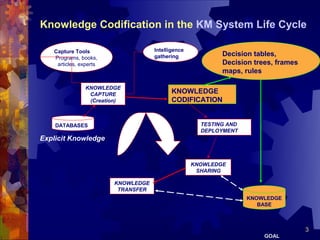
Knowledge Codification in the KM System Life Cycle
KNOWLEDGE
CAPTURE
(Creation)
KNOWLEDGE
TRANSFER
KNOWLEDGE
SHARING
TESTING AND
DEPLOYMENT
KNOWLEDGE
CODIFICATION
KNOWLEDGE
BASE
DATABASES
Decision tables,
Decision trees, frames
maps, rules
Capture Tools
Programs, books,
articles, experts
Intelligence
gathering
GOAL
Explicit Knowledge
4
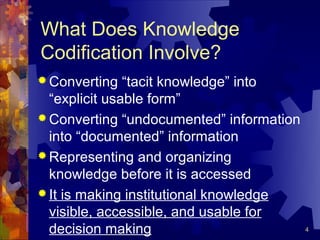
What Does Knowledge
Codification Involve?
Converting “tacit knowledge” into
“explicit usable form”
Converting “undocumented” information
into “documented” information
Representing and organizing
knowledge before it is accessed
It is making institutional knowledge
visible, accessible, and usable for
decision making
5
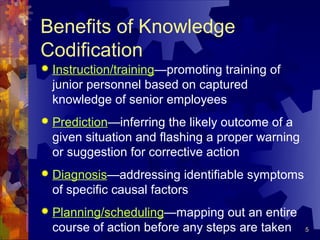
Benefits of Knowledge
Codification
 Instruction/training—promoting training of
junior personnel based on captured
knowledge of senior employees
 Prediction—inferring the likely outcome of a
given situation and flashing a proper warning
or suggestion for corrective action
 Diagnosis—addressing identifiable symptoms
of specific causal factors
 Planning/scheduling—mapping out an entire
course of action before any steps are taken
6
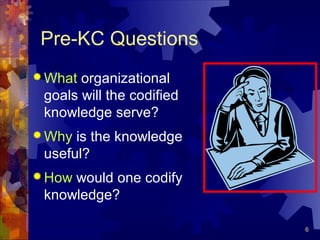
Pre-KC Questions
What organizational
goals will the codified
knowledge serve?
Why is the knowledge
useful?
How would one codify
knowledge?
7
Some Codification Tools
Knowledge Map
Decision Table
Decision Tree
Frames
Production Rules
Case-based Reasoning
8
Knowledge Map
 Visual representation of knowledge, not a
repository
 Identify strengths to exploit and missing
knowledge gaps to fill
 Can be applied in Knowledge Capture
 A straightforward directory that points people
to where they can find certain expertise
 Capture both explicit and tacit knowledge in
documents and in experts’ heads
9
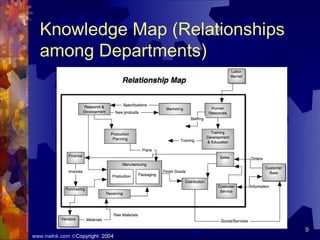
Knowledge Map (Relationships
among Departments)
www.nwlnk.com Copyright 2004
10
The Building Cycle
 Once where knowledge
resides is known, simply
point to it and add
instructions on how to get
there
 An intranet is a common
medium for publishing
knowledge maps
 Main criteria: clarity of
purpose, ease of use,
accuracy and currency of
content
11
Decision Trees
 Composed of nodes representing goals and
links representing decisions or outcomes
 All nodes except the root node are instances
of the primary goal. (See next figure)
 Often a step before actual codification
 Ability to verify logic graphically in problems
involving complex situations that result in a
limited number of actions
12
Discount Policy (A Decision Tree)
Discount
Policy
Customer is
library or
individual
Less than
6 copies
6-19
copies
20-49
copies
50 or
more
copies
Discount
is NIL
Discount
is 5%
Discount
is 10%
Discount
is 15%
Customer is
bookstore
Less
than 6
copies
Discount
is NIL
6 or
more
copies
Discount
is 25%
Discount ?
Discount ?
Discount ?
Discount ?
Discount ?
Discount ?
Order
size ?
Order
size ?
Bookstore
Not a
bookstore
13
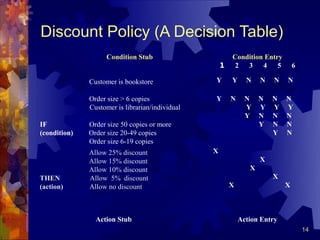
Decision Tables
More like a spreadsheet—divided into a
list of conditions and their respective
values and a list of conclusions
Conditions are matched against
conclusions (See next table)
14
Discount Policy (A Decision Table)
Condition Stub Condition Entry
1 2 3 4 5 6
Customer is bookstore
Order size > 6 copies
Customer is librarian/individual
IF Order size 50 copies or more
(condition) Order size 20-49 copies
Order size 6-19 copies
Y Y N N N N
Y N N N N N
Y Y Y Y
Y N N N
Y N N
Y N
Allow 25% discount
Allow 15% discount
Allow 10% discount
THEN Allow 5% discount
(action) Allow no discount
X
X
X
X
X X
Action Stub Action Entry
15
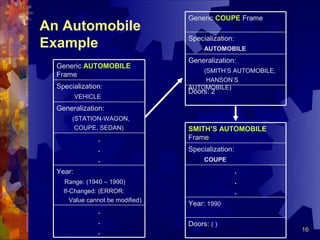
Frames
 Represent knowledge about a particular idea
in a data structure
 Handle a combination of declarative and
operational knowledge, which make it easier
to understand the problem domain
 Have a slot (a specific object or an attribute of
an entity) and a facet (the value of an object
or a slot)
 When all the slots are filled with values, the
frame is considered instantiated
16
.
.
.
Year:
Range: (1940 – 1990)
If-Changed: (ERROR:
Value cannot be modified)
.
.
.
Generalization:
(STATION-WAGON,
COUPE, SEDAN)
Specialization:
VEHICLE
Generic AUTOMOBILE
Frame
Doors: 2
Generalization:
(SMITH’S AUTOMOBILE,
HANSON’S
AUTOMOBILE)
Specialization:
AUTOMOBILE
Generic COUPE Frame
Year: 1990
Doors: ( )
.
.
.
Specialization:
COUPE
SMITH’S AUTOMOBILE
Frame
An Automobile
Example
17
Production Rules
 Tacit knowledge codification in the form of
premise-action pairs
 Rules are conditional statement that specify an
action to be taken if a certain condition is true
 The form is IF… THEN, or IF…THEN…ELSE
 Example:
IF income is “average” and pay_history is “good”
THEN recommendation is “approve loan”
18
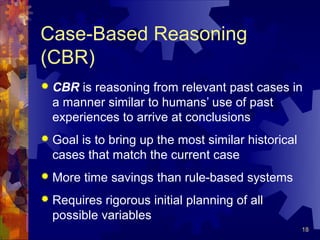
Case-Based Reasoning
(CBR)
 CBR is reasoning from relevant past cases in
a manner similar to humans’ use of past
experiences to arrive at conclusions
 Goal is to bring up the most similar historical
cases that match the current case
 More time savings than rule-based systems
 Requires rigorous initial planning of all
possible variables
19
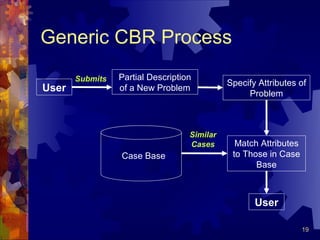
Generic CBR Process
User
Partial Description
of a New Problem
Specify Attributes of
Problem
Match Attributes
to Those in Case
Base
User
Case Base
Submits
Similar
Cases
20
Role of Planning (Earlier
Steps)
Breaking the KM system into modules
Looking at partial solutions
Linking partial solutions via rules and
procedures to arrive at the final solution
Making rules easier to review and
understand
21
Role of Planning (Latter
Steps)
Deciding on the programming language
Selecting the right software package
Developing user interface and
consultation facilities
Arranging for the verification and
validation of the system
22
End of Lecture Six

Knowledge Codification121.pdf

  • 1.
  • 2.
    2 Main Objectives What DoesKnowledge Codification Involve? Benefits of Knowledge Codification Pre Knowledge Codification Questions Tools and Procedures The Role of Planning
  • 3.
    3 Knowledge Codification inthe KM System Life Cycle KNOWLEDGE CAPTURE (Creation) KNOWLEDGE TRANSFER KNOWLEDGE SHARING TESTING AND DEPLOYMENT KNOWLEDGE CODIFICATION KNOWLEDGE BASE DATABASES Decision tables, Decision trees, frames maps, rules Capture Tools Programs, books, articles, experts Intelligence gathering GOAL Explicit Knowledge
  • 4.
    4 What Does Knowledge CodificationInvolve? Converting “tacit knowledge” into “explicit usable form” Converting “undocumented” information into “documented” information Representing and organizing knowledge before it is accessed It is making institutional knowledge visible, accessible, and usable for decision making
  • 5.
    5 Benefits of Knowledge Codification Instruction/training—promoting training of junior personnel based on captured knowledge of senior employees  Prediction—inferring the likely outcome of a given situation and flashing a proper warning or suggestion for corrective action  Diagnosis—addressing identifiable symptoms of specific causal factors  Planning/scheduling—mapping out an entire course of action before any steps are taken
  • 6.
    6 Pre-KC Questions What organizational goalswill the codified knowledge serve? Why is the knowledge useful? How would one codify knowledge?
  • 7.
    7 Some Codification Tools KnowledgeMap Decision Table Decision Tree Frames Production Rules Case-based Reasoning
  • 8.
    8 Knowledge Map  Visualrepresentation of knowledge, not a repository  Identify strengths to exploit and missing knowledge gaps to fill  Can be applied in Knowledge Capture  A straightforward directory that points people to where they can find certain expertise  Capture both explicit and tacit knowledge in documents and in experts’ heads
  • 9.
    9 Knowledge Map (Relationships amongDepartments) www.nwlnk.com Copyright 2004
  • 10.
    10 The Building Cycle Once where knowledge resides is known, simply point to it and add instructions on how to get there  An intranet is a common medium for publishing knowledge maps  Main criteria: clarity of purpose, ease of use, accuracy and currency of content
  • 11.
    11 Decision Trees  Composedof nodes representing goals and links representing decisions or outcomes  All nodes except the root node are instances of the primary goal. (See next figure)  Often a step before actual codification  Ability to verify logic graphically in problems involving complex situations that result in a limited number of actions
  • 12.
    12 Discount Policy (ADecision Tree) Discount Policy Customer is library or individual Less than 6 copies 6-19 copies 20-49 copies 50 or more copies Discount is NIL Discount is 5% Discount is 10% Discount is 15% Customer is bookstore Less than 6 copies Discount is NIL 6 or more copies Discount is 25% Discount ? Discount ? Discount ? Discount ? Discount ? Discount ? Order size ? Order size ? Bookstore Not a bookstore
  • 13.
    13 Decision Tables More likea spreadsheet—divided into a list of conditions and their respective values and a list of conclusions Conditions are matched against conclusions (See next table)
  • 14.
    14 Discount Policy (ADecision Table) Condition Stub Condition Entry 1 2 3 4 5 6 Customer is bookstore Order size > 6 copies Customer is librarian/individual IF Order size 50 copies or more (condition) Order size 20-49 copies Order size 6-19 copies Y Y N N N N Y N N N N N Y Y Y Y Y N N N Y N N Y N Allow 25% discount Allow 15% discount Allow 10% discount THEN Allow 5% discount (action) Allow no discount X X X X X X Action Stub Action Entry
  • 15.
    15 Frames  Represent knowledgeabout a particular idea in a data structure  Handle a combination of declarative and operational knowledge, which make it easier to understand the problem domain  Have a slot (a specific object or an attribute of an entity) and a facet (the value of an object or a slot)  When all the slots are filled with values, the frame is considered instantiated
  • 16.
    16 . . . Year: Range: (1940 –1990) If-Changed: (ERROR: Value cannot be modified) . . . Generalization: (STATION-WAGON, COUPE, SEDAN) Specialization: VEHICLE Generic AUTOMOBILE Frame Doors: 2 Generalization: (SMITH’S AUTOMOBILE, HANSON’S AUTOMOBILE) Specialization: AUTOMOBILE Generic COUPE Frame Year: 1990 Doors: ( ) . . . Specialization: COUPE SMITH’S AUTOMOBILE Frame An Automobile Example
  • 17.
    17 Production Rules  Tacitknowledge codification in the form of premise-action pairs  Rules are conditional statement that specify an action to be taken if a certain condition is true  The form is IF… THEN, or IF…THEN…ELSE  Example: IF income is “average” and pay_history is “good” THEN recommendation is “approve loan”
  • 18.
    18 Case-Based Reasoning (CBR)  CBRis reasoning from relevant past cases in a manner similar to humans’ use of past experiences to arrive at conclusions  Goal is to bring up the most similar historical cases that match the current case  More time savings than rule-based systems  Requires rigorous initial planning of all possible variables
  • 19.
    19 Generic CBR Process User PartialDescription of a New Problem Specify Attributes of Problem Match Attributes to Those in Case Base User Case Base Submits Similar Cases
  • 20.
    20 Role of Planning(Earlier Steps) Breaking the KM system into modules Looking at partial solutions Linking partial solutions via rules and procedures to arrive at the final solution Making rules easier to review and understand
  • 21.
    21 Role of Planning(Latter Steps) Deciding on the programming language Selecting the right software package Developing user interface and consultation facilities Arranging for the verification and validation of the system
  • 22.