Knapsack Algorithm in Information Security
Presented By : Manvi Molpariya and Sameena Khan Mentor : Mr. Hitesh Ninama
Course : MCA 3rd sem (Integrated)
College : SCSIT, DAVV
The Knapsack Algorithm in
Information Security
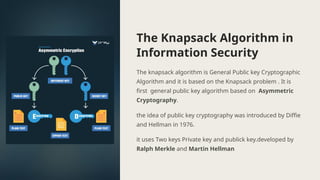
The knapsack algorithm is General Public key Cryptographic
Algorithm and it is based on the Knapsack problem . It is
first general public key algorithm based on Asymmetric
Cryptography.
the idea of public key cryptography was introduced by Diffie
and Hellman in 1976.
it uses Two keys Private key and publick key.developed by
Ralph Merkle and Martin Hellman
•Assymetric Cryptosystem-
An asymmetric cryptosystem requires two keys, one for encryption and the other for decryption,
unlike symmetric cryptosystems which use the same key to encrypt as well as decrypt.
•Public Key-
Public key cryptography refers to a system which is asymmetric, where the private key is based on
a NP-Easy problem which can be solved, whereas the public-key is based on a NP-hard problem.
Introduction to the Knapsack
Problem
The Knapsack Problem
Given a set of items, each with a weight and a value,
determine the number of each item to include in a
collection so that the total weight is less than or equal to
a given limit and the total value is as large as possible.
Example -: suppose we have given certain weight :
1 6 8 15 24
Select above weight in such a way that Total weight should be 30 .?
selection would be - : 1,6,8 and 15
Applications of the Knapsack
Algorithm in Cybersecurity
Network Security
The knapsack algorithm helps
optimize network resource allocation
to defend against attacks and ensure
reliable connectivity.
Cryptography
Knapsack-based cryptographic
schemes provide efficient and secure
data encryption to protect sensitive
information.
Intrusion Detection
The algorithm identifies optimal
subsets of security features to
effectively detect and mitigate cyber
threats.
Malware Analysis
Knapsack techniques help uncover
malicious patterns and behaviors
within complex malware samples.
Practical Considerations in Implementing the
Knapsack Algorithm
Performance Optimization
Leverage approximation algorithms and heuristics to
balance computational complexity with solution quality,
ensuring the knapsack algorithm delivers real-time
decision-making for security-critical applications.
Adaptability to Evolving Threats
Design the knapsack implementation with modular
components that can be quickly updated to address new
vulnerabilities, attack vectors, and security requirements as
the threat landscape rapidly changes.
Strengths and Limitations of the
Knapsack Algorithm
Optimization Efficiency
The knapsack algorithm excels at
rapidly identifying optimal resource
allocation within defined constraints,
making it well-suited for security
applications with real-time decision-
making requirements.
Computational Complexity
As an NP-hard problem, the knapsack
algorithm faces exponential growth in
computational difficulty as problem
sizes increase, requiring innovative
techniques to maintain practical
performance.
Versatility in Modeling
The algorithm's ability to represent
diverse security challenges, from
network defense to cryptography,
allows for broad applicability across the
information security domain.
Sensitivity to Data Quality
The knapsack algorithm's optimal
solutions are highly dependent on the
accuracy and completeness of the input
data, making robust data collection and
preprocessing critical for reliable
security decisions.
Key Generation-
• As we Know that two keyes are use in Knapsack
• Private Key generation is depends on Easy Knapsack.
• Public key generation is depends on Hard Knapsack.
• Initially we select a Easy Knapsack.
• Then we can drive Hard Knapsack from Easy Knapsack.
•Encryption-
To encrypt a message, a subset of the hard knapsack A is chosen by comparing it with a set of bits (the
plaintext) equal in length to the key. Each term in the public key that corresponds to a 1 in the plaintext
is an element of the subset A_m, while terms that corresponding to 0 in the plaintext are ignored when
constructing A_m - they are not elements of the key. The elements of this subset are added together and
the resulting sum is the ciphertext.
•Decryption-
Decryption is possible because the multiplier and modulus used to transform the easy knapsack into
the public key can also be used to transform the number representing the ciphertext into the sum of the
corresponding elements of the superincreasing knapsack. Then, using a simple greedy algorithm, the
easy knapsack can be solved using arithmetic operations, which decrypts the message.
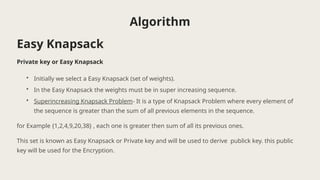
Algorithm
Easy Knapsack
Private key or Easy Knapsack
• Initially we select a Easy Knapsack (set of weights).
• In the Easy Knapsack the weights must be in super increasing sequence.
• Superincreasing Knapsack Problem- It is a type of Knapsack Problem where every element of
the sequence is greater than the sum of all previous elements in the sequence.
for Example {1,2,4,9,20,38} , each one is greater then sum of all its previous ones.
This set is known as Easy Knapsack or Private key and will be used to derive publick key. this public
key will be used for the Encryption.
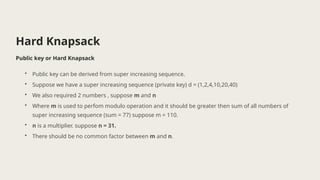
Hard Knapsack
Public key or Hard Knapsack
• Public key can be derived from super increasing sequence.
• Suppose we have a super increasing sequence (private key) d = (1,2,4,10,20,40)
• We also required 2 numbers , suppose m and n
• Where m is used to perfom modulo operation and it should be greater then sum of all numbers of
super increasing sequence (sum = 77) suppose m = 110.
• n is a multiplier. suppose n = 31.
• There should be no common factor between m and n.
Numerical
Let’s consider a superincreasing sequence d =
(1,2,4,10,20,40)
Then, choose a number m that is greater than the sum.
m = 110
Also, choose a number n that is in the rangeand is
coprime to m.
n = 31
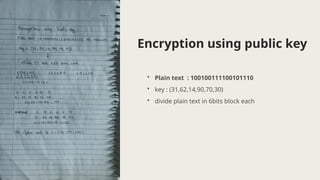
Encryption using public key
• Plain text : 100100111100101110
• key : (31,62,14,90,70,30)
• divide plain text in 6bits block each
Decryption using Private key
• m and n must known at reciever side
• m = 110 n = 31
• (x * (1/n)) mod m
• x : n * x mod m =1
Thank You for you kind attention

Knapsack-Algorithm-in-Information-Security.pptx

  • 1.
    Knapsack Algorithm inInformation Security Presented By : Manvi Molpariya and Sameena Khan Mentor : Mr. Hitesh Ninama Course : MCA 3rd sem (Integrated) College : SCSIT, DAVV
  • 2.
    The Knapsack Algorithmin Information Security The knapsack algorithm is General Public key Cryptographic Algorithm and it is based on the Knapsack problem . It is first general public key algorithm based on Asymmetric Cryptography. the idea of public key cryptography was introduced by Diffie and Hellman in 1976. it uses Two keys Private key and publick key.developed by Ralph Merkle and Martin Hellman
  • 3.
    •Assymetric Cryptosystem- An asymmetriccryptosystem requires two keys, one for encryption and the other for decryption, unlike symmetric cryptosystems which use the same key to encrypt as well as decrypt. •Public Key- Public key cryptography refers to a system which is asymmetric, where the private key is based on a NP-Easy problem which can be solved, whereas the public-key is based on a NP-hard problem.
  • 4.
    Introduction to theKnapsack Problem The Knapsack Problem Given a set of items, each with a weight and a value, determine the number of each item to include in a collection so that the total weight is less than or equal to a given limit and the total value is as large as possible. Example -: suppose we have given certain weight : 1 6 8 15 24 Select above weight in such a way that Total weight should be 30 .? selection would be - : 1,6,8 and 15
  • 5.
    Applications of theKnapsack Algorithm in Cybersecurity Network Security The knapsack algorithm helps optimize network resource allocation to defend against attacks and ensure reliable connectivity. Cryptography Knapsack-based cryptographic schemes provide efficient and secure data encryption to protect sensitive information. Intrusion Detection The algorithm identifies optimal subsets of security features to effectively detect and mitigate cyber threats. Malware Analysis Knapsack techniques help uncover malicious patterns and behaviors within complex malware samples.
  • 6.
    Practical Considerations inImplementing the Knapsack Algorithm Performance Optimization Leverage approximation algorithms and heuristics to balance computational complexity with solution quality, ensuring the knapsack algorithm delivers real-time decision-making for security-critical applications. Adaptability to Evolving Threats Design the knapsack implementation with modular components that can be quickly updated to address new vulnerabilities, attack vectors, and security requirements as the threat landscape rapidly changes.
  • 7.
    Strengths and Limitationsof the Knapsack Algorithm Optimization Efficiency The knapsack algorithm excels at rapidly identifying optimal resource allocation within defined constraints, making it well-suited for security applications with real-time decision- making requirements. Computational Complexity As an NP-hard problem, the knapsack algorithm faces exponential growth in computational difficulty as problem sizes increase, requiring innovative techniques to maintain practical performance. Versatility in Modeling The algorithm's ability to represent diverse security challenges, from network defense to cryptography, allows for broad applicability across the information security domain. Sensitivity to Data Quality The knapsack algorithm's optimal solutions are highly dependent on the accuracy and completeness of the input data, making robust data collection and preprocessing critical for reliable security decisions.
  • 8.
    Key Generation- • Aswe Know that two keyes are use in Knapsack • Private Key generation is depends on Easy Knapsack. • Public key generation is depends on Hard Knapsack. • Initially we select a Easy Knapsack. • Then we can drive Hard Knapsack from Easy Knapsack.
  • 9.
    •Encryption- To encrypt amessage, a subset of the hard knapsack A is chosen by comparing it with a set of bits (the plaintext) equal in length to the key. Each term in the public key that corresponds to a 1 in the plaintext is an element of the subset A_m, while terms that corresponding to 0 in the plaintext are ignored when constructing A_m - they are not elements of the key. The elements of this subset are added together and the resulting sum is the ciphertext. •Decryption- Decryption is possible because the multiplier and modulus used to transform the easy knapsack into the public key can also be used to transform the number representing the ciphertext into the sum of the corresponding elements of the superincreasing knapsack. Then, using a simple greedy algorithm, the easy knapsack can be solved using arithmetic operations, which decrypts the message.
  • 10.
    Algorithm Easy Knapsack Private keyor Easy Knapsack • Initially we select a Easy Knapsack (set of weights). • In the Easy Knapsack the weights must be in super increasing sequence. • Superincreasing Knapsack Problem- It is a type of Knapsack Problem where every element of the sequence is greater than the sum of all previous elements in the sequence. for Example {1,2,4,9,20,38} , each one is greater then sum of all its previous ones. This set is known as Easy Knapsack or Private key and will be used to derive publick key. this public key will be used for the Encryption.
  • 11.
    Hard Knapsack Public keyor Hard Knapsack • Public key can be derived from super increasing sequence. • Suppose we have a super increasing sequence (private key) d = (1,2,4,10,20,40) • We also required 2 numbers , suppose m and n • Where m is used to perfom modulo operation and it should be greater then sum of all numbers of super increasing sequence (sum = 77) suppose m = 110. • n is a multiplier. suppose n = 31. • There should be no common factor between m and n.
  • 12.
    Numerical Let’s consider asuperincreasing sequence d = (1,2,4,10,20,40) Then, choose a number m that is greater than the sum. m = 110 Also, choose a number n that is in the rangeand is coprime to m. n = 31
  • 13.
    Encryption using publickey • Plain text : 100100111100101110 • key : (31,62,14,90,70,30) • divide plain text in 6bits block each
  • 14.
    Decryption using Privatekey • m and n must known at reciever side • m = 110 n = 31 • (x * (1/n)) mod m • x : n * x mod m =1
  • 15.
    Thank You foryou kind attention