A
Submitted in partial fulfilment
for the award of degree of
Master of Science
in Department of Mathematics
2020-2021
CHAUDHARY BANSI LAL UNIVERSITY, BHIWANI, HARYANA
SUPERVISOR SUBMITTED BY
Mr. Vikas Jangra Name: Arti
Assist.Prof of Mathematics Class: M.Sc Previous
Roll No :221172175029
Acknowledgment
I would like to special thanks of gratitude of to my teacher
Mr.Vikas (Assist. Prof.) as well as our head of the department
Mrs. Neena Bansal who gave me the golden opportunity to do
this wonderful project on the topic “Knapsack Problem” which
is also helped me in doing a lot of research and I came to know
about so many new things I am really thankful to them.
Secondly I would also like to thanks my parents and friends who
helped me a lot during this project within the given time frame.
CONTENTS
0-1 Knapsack Problem
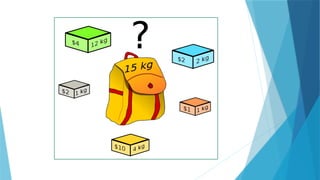
Knapsack Problem
 You are given the following• A knapsack (kind of
shoulder bag) with limited weight capacity.• Few
items each having some weight and value.
The problem states
 Which items should be placed into the knapsack such
that• The value or profit obtained by putting the items
into the knapsack is maximum.• And the weight limit of
the knapsack does not exceed.
Knapsack Problem Variants
 Variants Knapsack problem has the following two
variants1. Fractional Knapsack Problem
 2. 0/1 Knapsack Problem
In this article, we will discuss about
0/1Knapsack Problem
0/1 Knapsack Problem:-
• As the name suggests, items are indivisible here.
. We can not take the fraction of any item.
• We have to either take an item completely or leave
it completely.
• It is solved using dynamic programming approach.
0/1 Knapsack Problem Using Dynamic Programming
Consider
• Knapsack weight capacity = w
• Number of items each having some weight and n
value = n
0/1 knapsack problem is solved using dynamic
programming in the following steps
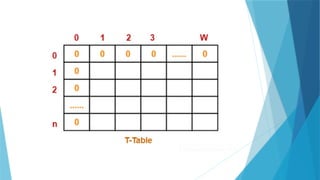
Step-01:-
 • Draw a table say 'T' with (n+1) number o rows
and (w+1) number of columns.
 • Fill all the boxes of 0th row and 0th colum with
zeroes as shown
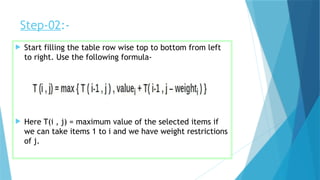
Step-02:-
 Start filling the table row wise top to bottom from left
to right. Use the following formula-
 Here T(i , j) = maximum value of the selected items if
we can take items 1 to i and we have weight restrictions
of j.
Step-03:-
To identify the items that must be put into the knapsack to
obtain that maximum profit,• Consider the last column of
the table.• Start scanning the entries from bottom to top.•
On encountering an entry whose value is not same as the
value stored in the entry immediately above it, mark the row
label of that entry.• After all the entries are scanned, the
marked labels represent the items that must be put into the
knapsack.
Time Complexity:-
 Each entry of the table requires constant time (1)
for its computation.
 It takes (nw) time to fill (n+1)(w+1) table entries.
 It takes e(n) time for tracing the solution since
tracing process traces the n rows.
 Thus, overall e(nw) time is taken to solve 0/1
knapsack problem using dynamic programming.
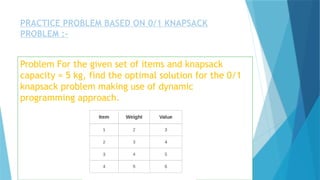
PRACTICE PROBLEM BASED ON 0/1 KNAPSACK
PROBLEM :-
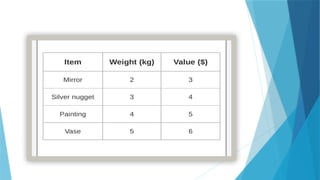
Problem For the given set of items and knapsack
capacity = 5 kg, find the optimal solution for the 0/1
knapsack problem making use of dynamic
programming approach.
 Find the optimal solution for the 0/1 knapsack
problem making use of dynamic programming
approach. Consider
n= 4
W= 5kg
(w1, w2, w3, w4) = (2, 3, 4, 5)
(b1, b2, b3, b4) = (3, 4, 5, 6)
 A thief enters a house for robbing it. He can carry a
maximal weight of 5 kg into his bag. There are 4 items in
the house with the following weights and values. What
items should thief take if he either takes the item
completely or leaves it completely?
Solution:-
Given
• Knapsack capacity (w) = 5 kg
• Number of items (n) = 4
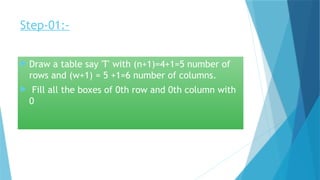
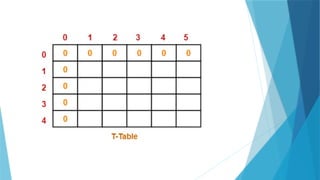
Step-01:-
 Draw a table say 'T' with (n+1)=4+1=5 number of
rows and (w+1) = 5 +1=6 number of columns.
 Fill all the boxes of 0th row and 0th column with
0
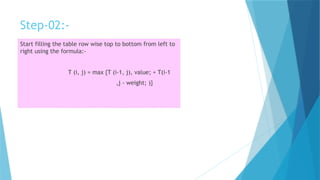
Step-02:-
Start filling the table row wise top to bottom from left to
right using the formula:-
T (i, j) = max {T (i-1, j), value; + T(i-1
,j - weight; )}
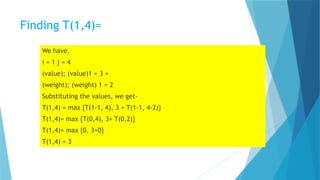
Finding T(1,4)=
We have,
i = 1 j = 4
(value); (value)1 = 3 =
(weight); (weight) 1 = 2
Substituting the values, we get-
T(1,4) = max {T(1-1, 4), 3 + T(1-1, 4-2)}
T(1,4)= max {T(0,4), 3+ T(0,2)}
T(1,4)= max {0, 3+0}
T(1,4) = 3
Finding T(1,2)=
We have,
• i=1
• j = 2
(value); = (value)1 = 3
(weight); = (weight) 1 = 2
Substituting the values, we get-
T(1,2) = max { T(1-1, 2), 3 + T(1-1, 2-2) }
T(1,2) = max {T(0,2), 3 + T(0,0)}
T(1,2) = max {0, 3+0}
T(1,2) = 3
Finding I(1,3):-
We have,
•i=1
j = 3
(value); = (value)1 = 3
(weight); (weight)1 = 2
Substituting the values, we get-
T(1,3) = max { T(1-1, 3), 3 + T(1-1, 3-2)}
T(1,3)= max { T(0,3), 3 + T(0,1)}
T(1,3)= max {0, 3+0}
T(1,3) = 3
Finding I(1,4):-
We have,
i = 1
j = 4
(value); (value)1 = 3
(weight); (weight)1 = 2
Substituting the values, we get-
T(1,4) = max {T(1-1, 4), 3 + T(1-1, 4-2)}
T(1,4)= max {T(0,4), 3+ T(0,2)}
T(1,4)= max {0, 3+0}
T(1,4) = 3
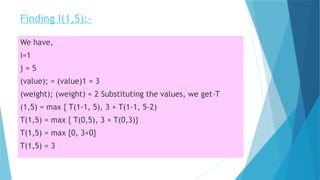
Finding I(1,5):-
We have,
i=1
j = 5
(value); = (value)1 = 3
(weight); (weight) = 2 Substituting the values, we get-T
(1,5) = max { T(1-1, 5), 3 + T(1-1, 5-2)
T(1,5) = max { T(0,5), 3 + T(0,3)}
T(1,5) = max {0, 3+0}
T(1,5) = 3
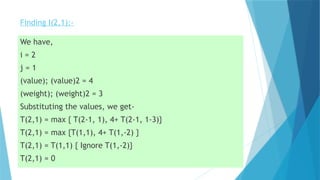
Finding I(2,1):-
We have,
i = 2
j = 1
(value); (value)2 = 4
(weight); (weight)2 = 3
Substituting the values, we get-
T(2,1) = max { T(2-1, 1), 4+ T(2-1, 1-3)}
T(2,1) = max {T(1,1), 4+ T(1,-2) }
T(2,1) = T(1,1) { Ignore T(1,-2)}
T(2,1) = 0
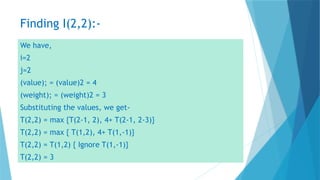
Finding I(2,2):-
We have,
i=2
j=2
(value); = (value)2 = 4
(weight); = (weight)2 = 3
Substituting the values, we get-
T(2,2) = max {T(2-1, 2), 4+ T(2-1, 2-3)}
T(2,2) = max { T(1,2), 4+ T(1,-1)}
T(2,2) = T(1,2) { Ignore T(1,-1)}
T(2,2) = 3
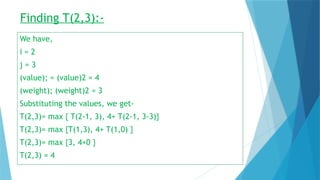
Finding T(2,3):-
We have,
i = 2
j = 3
(value); = (value)2 = 4
(weight); (weight)2 = 3
Substituting the values, we get-
T(2,3)= max { T(2-1, 3), 4+ T(2-1, 3-3)}
T(2,3)= max {T(1,3), 4+ T(1,0) }
T(2,3)= max {3, 4+0 }
T(2,3) = 4
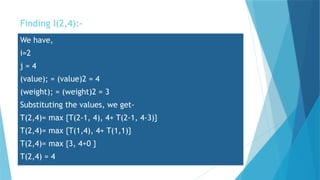
Finding I(2,4):-
We have,
i=2
j = 4
(value); = (value)2 = 4
(weight); = (weight)2 = 3
Substituting the values, we get-
T(2,4)= max {T(2-1, 4), 4+ T(2-1, 4-3)}
T(2,4)= max {T(1,4), 4+ T(1,1)}
T(2,4)= max {3, 4+0 }
T(2,4) = 4
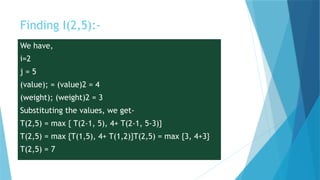
Finding I(2,5):-
We have,
i=2
j = 5
(value); = (value)2 = 4
(weight); (weight)2 = 3
Substituting the values, we get-
T(2,5) = max { T(2-1, 5), 4+ T(2-1, 5-3)}
T(2,5) = max {T(1,5), 4+ T(1,2)}T(2,5) = max {3, 4+3}
T(2,5) = 7
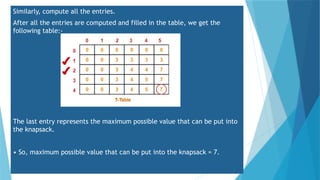
Similarly, compute all the entries.
After all the entries are computed and filled in the table, we get the
following table:-
The last entry represents the maximum possible value that can be put into
the knapsack.
• So, maximum possible value that can be put into the knapsack = 7.
Identifying Items To Be Put Into
Knapsack:-
 Following Step-04,
 We mark the rows labelled "1" and "2".
 Thus, items that must be put into the knapsack
to obtain the maximum value 7 are
Item-1 and Item-2
The knapsack problems have a variety of real life
applications.
 Financial modeling,
 Production and inventory management systems,
 Stratified sampling,
 Design of queuing network models in manufacturing
 Control of traffic overload in telecommunication
systems.
ANY QUERY
PPT  org.pptxxgdfgdfgdfgdfgdfgdffgdffgdfgdf

PPT org.pptxxgdfgdfgdfgdfgdfgdffgdffgdfgdf

  • 1.
    A Submitted in partialfulfilment for the award of degree of Master of Science in Department of Mathematics 2020-2021 CHAUDHARY BANSI LAL UNIVERSITY, BHIWANI, HARYANA SUPERVISOR SUBMITTED BY Mr. Vikas Jangra Name: Arti Assist.Prof of Mathematics Class: M.Sc Previous Roll No :221172175029
  • 2.
    Acknowledgment I would liketo special thanks of gratitude of to my teacher Mr.Vikas (Assist. Prof.) as well as our head of the department Mrs. Neena Bansal who gave me the golden opportunity to do this wonderful project on the topic “Knapsack Problem” which is also helped me in doing a lot of research and I came to know about so many new things I am really thankful to them. Secondly I would also like to thanks my parents and friends who helped me a lot during this project within the given time frame.
  • 3.
  • 4.
    Knapsack Problem  Youare given the following• A knapsack (kind of shoulder bag) with limited weight capacity.• Few items each having some weight and value.
  • 5.
    The problem states Which items should be placed into the knapsack such that• The value or profit obtained by putting the items into the knapsack is maximum.• And the weight limit of the knapsack does not exceed.
  • 7.
    Knapsack Problem Variants Variants Knapsack problem has the following two variants1. Fractional Knapsack Problem  2. 0/1 Knapsack Problem
  • 8.
    In this article,we will discuss about 0/1Knapsack Problem
  • 9.
    0/1 Knapsack Problem:- •As the name suggests, items are indivisible here. . We can not take the fraction of any item. • We have to either take an item completely or leave it completely. • It is solved using dynamic programming approach.
  • 10.
    0/1 Knapsack ProblemUsing Dynamic Programming Consider • Knapsack weight capacity = w • Number of items each having some weight and n value = n 0/1 knapsack problem is solved using dynamic programming in the following steps
  • 11.
    Step-01:-  • Drawa table say 'T' with (n+1) number o rows and (w+1) number of columns.  • Fill all the boxes of 0th row and 0th colum with zeroes as shown
  • 13.
    Step-02:-  Start fillingthe table row wise top to bottom from left to right. Use the following formula-  Here T(i , j) = maximum value of the selected items if we can take items 1 to i and we have weight restrictions of j.
  • 14.
    Step-03:- To identify theitems that must be put into the knapsack to obtain that maximum profit,• Consider the last column of the table.• Start scanning the entries from bottom to top.• On encountering an entry whose value is not same as the value stored in the entry immediately above it, mark the row label of that entry.• After all the entries are scanned, the marked labels represent the items that must be put into the knapsack.
  • 15.
    Time Complexity:-  Eachentry of the table requires constant time (1) for its computation.  It takes (nw) time to fill (n+1)(w+1) table entries.  It takes e(n) time for tracing the solution since tracing process traces the n rows.  Thus, overall e(nw) time is taken to solve 0/1 knapsack problem using dynamic programming.
  • 16.
    PRACTICE PROBLEM BASEDON 0/1 KNAPSACK PROBLEM :- Problem For the given set of items and knapsack capacity = 5 kg, find the optimal solution for the 0/1 knapsack problem making use of dynamic programming approach.
  • 17.
     Find theoptimal solution for the 0/1 knapsack problem making use of dynamic programming approach. Consider n= 4 W= 5kg (w1, w2, w3, w4) = (2, 3, 4, 5) (b1, b2, b3, b4) = (3, 4, 5, 6)
  • 18.
     A thiefenters a house for robbing it. He can carry a maximal weight of 5 kg into his bag. There are 4 items in the house with the following weights and values. What items should thief take if he either takes the item completely or leaves it completely?
  • 20.
    Solution:- Given • Knapsack capacity(w) = 5 kg • Number of items (n) = 4
  • 21.
    Step-01:-  Draw atable say 'T' with (n+1)=4+1=5 number of rows and (w+1) = 5 +1=6 number of columns.  Fill all the boxes of 0th row and 0th column with 0
  • 23.
    Step-02:- Start filling thetable row wise top to bottom from left to right using the formula:- T (i, j) = max {T (i-1, j), value; + T(i-1 ,j - weight; )}
  • 24.
    Finding T(1,4)= We have, i= 1 j = 4 (value); (value)1 = 3 = (weight); (weight) 1 = 2 Substituting the values, we get- T(1,4) = max {T(1-1, 4), 3 + T(1-1, 4-2)} T(1,4)= max {T(0,4), 3+ T(0,2)} T(1,4)= max {0, 3+0} T(1,4) = 3
  • 25.
    Finding T(1,2)= We have, •i=1 • j = 2 (value); = (value)1 = 3 (weight); = (weight) 1 = 2 Substituting the values, we get- T(1,2) = max { T(1-1, 2), 3 + T(1-1, 2-2) } T(1,2) = max {T(0,2), 3 + T(0,0)} T(1,2) = max {0, 3+0} T(1,2) = 3
  • 26.
    Finding I(1,3):- We have, •i=1 j= 3 (value); = (value)1 = 3 (weight); (weight)1 = 2 Substituting the values, we get- T(1,3) = max { T(1-1, 3), 3 + T(1-1, 3-2)} T(1,3)= max { T(0,3), 3 + T(0,1)} T(1,3)= max {0, 3+0} T(1,3) = 3
  • 27.
    Finding I(1,4):- We have, i= 1 j = 4 (value); (value)1 = 3 (weight); (weight)1 = 2 Substituting the values, we get- T(1,4) = max {T(1-1, 4), 3 + T(1-1, 4-2)} T(1,4)= max {T(0,4), 3+ T(0,2)} T(1,4)= max {0, 3+0} T(1,4) = 3
  • 28.
    Finding I(1,5):- We have, i=1 j= 5 (value); = (value)1 = 3 (weight); (weight) = 2 Substituting the values, we get-T (1,5) = max { T(1-1, 5), 3 + T(1-1, 5-2) T(1,5) = max { T(0,5), 3 + T(0,3)} T(1,5) = max {0, 3+0} T(1,5) = 3
  • 29.
    Finding I(2,1):- We have, i= 2 j = 1 (value); (value)2 = 4 (weight); (weight)2 = 3 Substituting the values, we get- T(2,1) = max { T(2-1, 1), 4+ T(2-1, 1-3)} T(2,1) = max {T(1,1), 4+ T(1,-2) } T(2,1) = T(1,1) { Ignore T(1,-2)} T(2,1) = 0
  • 30.
    Finding I(2,2):- We have, i=2 j=2 (value);= (value)2 = 4 (weight); = (weight)2 = 3 Substituting the values, we get- T(2,2) = max {T(2-1, 2), 4+ T(2-1, 2-3)} T(2,2) = max { T(1,2), 4+ T(1,-1)} T(2,2) = T(1,2) { Ignore T(1,-1)} T(2,2) = 3
  • 31.
    Finding T(2,3):- We have, i= 2 j = 3 (value); = (value)2 = 4 (weight); (weight)2 = 3 Substituting the values, we get- T(2,3)= max { T(2-1, 3), 4+ T(2-1, 3-3)} T(2,3)= max {T(1,3), 4+ T(1,0) } T(2,3)= max {3, 4+0 } T(2,3) = 4
  • 32.
    Finding I(2,4):- We have, i=2 j= 4 (value); = (value)2 = 4 (weight); = (weight)2 = 3 Substituting the values, we get- T(2,4)= max {T(2-1, 4), 4+ T(2-1, 4-3)} T(2,4)= max {T(1,4), 4+ T(1,1)} T(2,4)= max {3, 4+0 } T(2,4) = 4
  • 33.
    Finding I(2,5):- We have, i=2 j= 5 (value); = (value)2 = 4 (weight); (weight)2 = 3 Substituting the values, we get- T(2,5) = max { T(2-1, 5), 4+ T(2-1, 5-3)} T(2,5) = max {T(1,5), 4+ T(1,2)}T(2,5) = max {3, 4+3} T(2,5) = 7
  • 34.
    Similarly, compute allthe entries. After all the entries are computed and filled in the table, we get the following table:- The last entry represents the maximum possible value that can be put into the knapsack. • So, maximum possible value that can be put into the knapsack = 7.
  • 35.
    Identifying Items ToBe Put Into Knapsack:-  Following Step-04,  We mark the rows labelled "1" and "2".  Thus, items that must be put into the knapsack to obtain the maximum value 7 are Item-1 and Item-2
  • 36.
    The knapsack problemshave a variety of real life applications.  Financial modeling,  Production and inventory management systems,  Stratified sampling,  Design of queuing network models in manufacturing  Control of traffic overload in telecommunication systems.

  • 37.