Presented by
Kirank
B.Tech (IVth year)
Electronics and communications
 Introduction
 Heliodisplay and screen projector
 History
 Principle and Working
 Models developed
 Positive Aspects
 Negative Aspects
 Applications
 Conclusion
 References
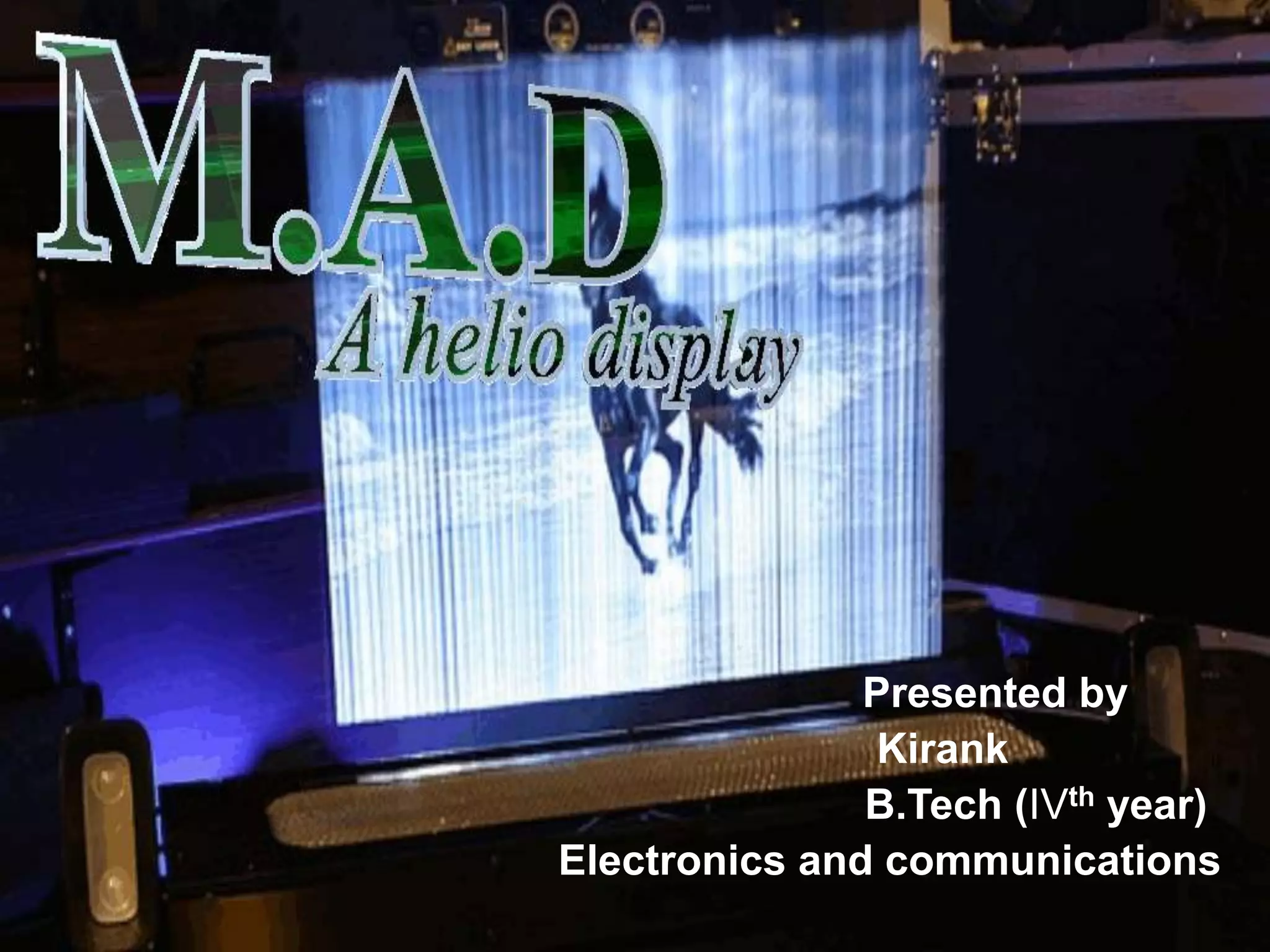
 A technology used for displaying images in thin air is
called Heliodisplay.
 The heliodisplay is an interactive planar display (2-D).
 Although it is also a two-dimensional display that appears
to float (3d when using 3d content).
 work as a free-space touchscreen when connected to a
PC by a USB cable.
 Eco-friendly , low power consuming and various image
and video formats
SCREEN PROJECTOR HELIODISPLAY
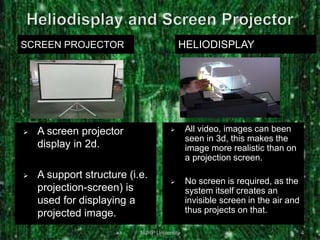
 A screen projector
display in 2d.
 A support structure (i.e.
projection-screen) is
used for displaying a
projected image.
 All video, images can been
seen in 3d, this makes the
image more realistic than on
a projection screen.
 No screen is required, as the
system itself creates an
invisible screen in the air and
thus projects on that.
MJRP University 4
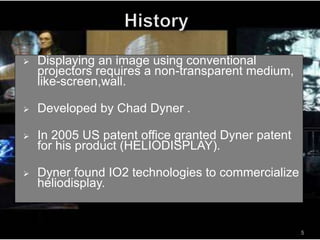
 Displaying an image using conventional
projectors requires a non-transparent medium,
like-screen,wall.
 Developed by Chad Dyner .
 In 2005 US patent office granted Dyner patent
for his product (HELIODISPLAY).
 Dyner found IO2 technologies to commercialize
heliodisplay.
5
6
7
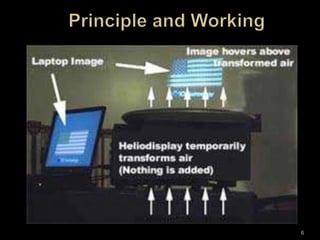
 A heliodisplay runs on particles already present
in the air.
 Particles in the air are converted into nearly
atom-sized particles, and are re-emitted upward
through a dozen metal plates.
 These particles are held together by surface
tension and form a cloud that can act as a
screen.
 By changing the molecular properties of this
cloud, the qualities of the image, like brightness
and sharpness, can also be changed.
8
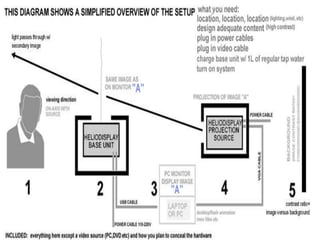
 Heliodisplay transforms water in to a unique
screen of fine vapor, suspended in mid air to
create nearly invisible screen in to which any
image can be projected.
 This vapor curtain(screen) is sandwiched
between layers of clean air to create an
acceptable screen
 The vapour screen is a particle cloud created
by passing the surrounding air through a heat
pump which in turn cools the air to a level
below its dew point.
 These particle cloud consists of individual
micro-droplets ,held together by surface
tension.
9
10
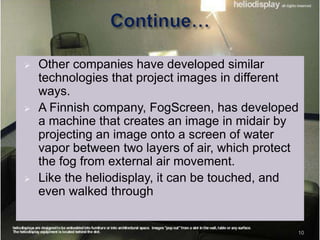
 Other companies have developed similar
technologies that project images in different
ways.
 A Finnish company, FogScreen, has developed
a machine that creates an image in midair by
projecting an image onto a screen of water
vapor between two layers of air, which protect
the fog from external air movement.
 Like the heliodisplay, it can be touched, and
even walked through
 However, the FogScreen has its limitations.
FogScreens use water vapor, so touching the
“screen” feels wet. Heliodisplay screens are air,
and they feel dry. In addition, FogScreens are
not yet interactive, although researchers are
working to implement interactive technology.
11
M1
 The original M1 units produced by IO2 were
advanced prototypes and proof-of-concept, but a
few were sold to early adopters.
M2
 The second-generation M2 Heliodisplay supports a
30" image with 16.7 million. The interactive M2i
version includes virtual touchscreen capability.
12
M3 and M30
 The new third-generation M3 is said to be much
quieter, with improved brightness and clarity and
more stable operation with an improved tri-flow
system.
M50 and M100
 The M50 has a 50" diagonal image, equivalent to
displaying a life-size head-and-shoulders person.
 The M100 has a 100" diagonal image, equivalent to
displaying a large full-body person (about 2 meters
tall)
13
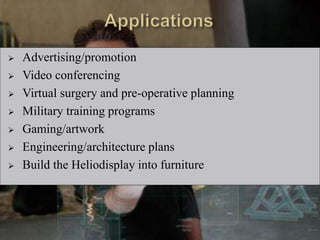
 Advertising/promotion
 Video conferencing
 Virtual surgery and pre-operative planning
 Military training programs
 Gaming/artwork
 Engineering/architecture plans
 Build the Heliodisplay into furniture
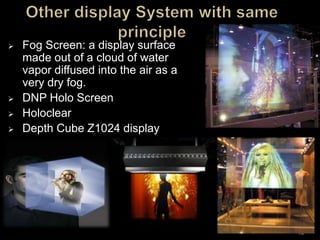
 Fog Screen: a display surface
made out of a cloud of water
vapor diffused into the air as a
very dry fog.
 DNP Holo Screen
 Holoclear
 Depth Cube Z1024 display
15
 Device is light weight and can be converted into a furniture
 Nothing is added to air. Nothing affects air quality projected images
and video are two-dimensional, but appear 3D since there is no
physical depth reference
 Heliodisplay does not create fog, so no electronic devices in the
room are affected
 Heliodisplay can be used in any country since it works on 95-115 or
220-240 VAC
 Heliodisplay, imagery can be seen up to 75 degrees off aspect for a
total viewing area of over 150 degrees
 No special glasses required to see the display
 Needs controlled lighting for best working
conditions.
 Images becomes less visible under bright light.
 Wind and bright light interferes with image
visibility.
 Expensive.
 The helio display is a relatively new technology and is
still being developed. Helio display works as a kind of
floating display and touch screen, making it possible to
manipulate images projected in air with our fingers.
 Though it is currently expensive and unaffordable
heliodisplay technology has a great potential.
 It is the future generation display where we can see
images projected into mid-air without the help of a solid
screen. It could be used for museum or trade-show
displays or for advertisements, and would be ideal for
collaborative work.
 www.google.com
 www.wikipedia.com
 www.heliodisplay.com
 www.seminarprojects.com
 www.Pdf4u.com
 IO2 technology heliodisplay
 Leia Display system
MAD

MAD

  • 1.
    Presented by Kirank B.Tech (IVthyear) Electronics and communications
  • 2.
     Introduction  Heliodisplayand screen projector  History  Principle and Working  Models developed  Positive Aspects  Negative Aspects  Applications  Conclusion  References
  • 3.
     A technologyused for displaying images in thin air is called Heliodisplay.  The heliodisplay is an interactive planar display (2-D).  Although it is also a two-dimensional display that appears to float (3d when using 3d content).  work as a free-space touchscreen when connected to a PC by a USB cable.  Eco-friendly , low power consuming and various image and video formats
  • 4.
    SCREEN PROJECTOR HELIODISPLAY A screen projector display in 2d.  A support structure (i.e. projection-screen) is used for displaying a projected image.  All video, images can been seen in 3d, this makes the image more realistic than on a projection screen.  No screen is required, as the system itself creates an invisible screen in the air and thus projects on that. MJRP University 4
  • 5.
     Displaying animage using conventional projectors requires a non-transparent medium, like-screen,wall.  Developed by Chad Dyner .  In 2005 US patent office granted Dyner patent for his product (HELIODISPLAY).  Dyner found IO2 technologies to commercialize heliodisplay. 5
  • 6.
  • 7.
  • 8.
     A heliodisplayruns on particles already present in the air.  Particles in the air are converted into nearly atom-sized particles, and are re-emitted upward through a dozen metal plates.  These particles are held together by surface tension and form a cloud that can act as a screen.  By changing the molecular properties of this cloud, the qualities of the image, like brightness and sharpness, can also be changed. 8
  • 9.
     Heliodisplay transformswater in to a unique screen of fine vapor, suspended in mid air to create nearly invisible screen in to which any image can be projected.  This vapor curtain(screen) is sandwiched between layers of clean air to create an acceptable screen  The vapour screen is a particle cloud created by passing the surrounding air through a heat pump which in turn cools the air to a level below its dew point.  These particle cloud consists of individual micro-droplets ,held together by surface tension. 9
  • 10.
    10  Other companieshave developed similar technologies that project images in different ways.  A Finnish company, FogScreen, has developed a machine that creates an image in midair by projecting an image onto a screen of water vapor between two layers of air, which protect the fog from external air movement.  Like the heliodisplay, it can be touched, and even walked through
  • 11.
     However, theFogScreen has its limitations. FogScreens use water vapor, so touching the “screen” feels wet. Heliodisplay screens are air, and they feel dry. In addition, FogScreens are not yet interactive, although researchers are working to implement interactive technology. 11
  • 12.
    M1  The originalM1 units produced by IO2 were advanced prototypes and proof-of-concept, but a few were sold to early adopters. M2  The second-generation M2 Heliodisplay supports a 30" image with 16.7 million. The interactive M2i version includes virtual touchscreen capability. 12
  • 13.
    M3 and M30 The new third-generation M3 is said to be much quieter, with improved brightness and clarity and more stable operation with an improved tri-flow system. M50 and M100  The M50 has a 50" diagonal image, equivalent to displaying a life-size head-and-shoulders person.  The M100 has a 100" diagonal image, equivalent to displaying a large full-body person (about 2 meters tall) 13
  • 14.
     Advertising/promotion  Videoconferencing  Virtual surgery and pre-operative planning  Military training programs  Gaming/artwork  Engineering/architecture plans  Build the Heliodisplay into furniture
  • 15.
     Fog Screen:a display surface made out of a cloud of water vapor diffused into the air as a very dry fog.  DNP Holo Screen  Holoclear  Depth Cube Z1024 display 15
  • 16.
     Device islight weight and can be converted into a furniture  Nothing is added to air. Nothing affects air quality projected images and video are two-dimensional, but appear 3D since there is no physical depth reference  Heliodisplay does not create fog, so no electronic devices in the room are affected  Heliodisplay can be used in any country since it works on 95-115 or 220-240 VAC  Heliodisplay, imagery can be seen up to 75 degrees off aspect for a total viewing area of over 150 degrees  No special glasses required to see the display
  • 17.
     Needs controlledlighting for best working conditions.  Images becomes less visible under bright light.  Wind and bright light interferes with image visibility.  Expensive.
  • 18.
     The heliodisplay is a relatively new technology and is still being developed. Helio display works as a kind of floating display and touch screen, making it possible to manipulate images projected in air with our fingers.  Though it is currently expensive and unaffordable heliodisplay technology has a great potential.  It is the future generation display where we can see images projected into mid-air without the help of a solid screen. It could be used for museum or trade-show displays or for advertisements, and would be ideal for collaborative work.
  • 19.
     www.google.com  www.wikipedia.com www.heliodisplay.com  www.seminarprojects.com  www.Pdf4u.com  IO2 technology heliodisplay  Leia Display system