HISTORY
UNIT-02 NEW KINGS
AND KINGDOMS
INTRODUCTION
EMERGENCE OF NEW
DYNASTIES:
The big landlords and warriors
chiefs in different regions of
the Sub-continents were
known as Samantas.
Samantas- Maha Samantas or
Maha mandalaeshvara (the
great lord of a “circle” or
region).
SAMANTAS
 Rashtrakutas were subordinates
with Chalukyas in the Deccan.
 In the mid 8th century Dantidurga
overthrew his Chalukya overload
and performed a ritual called
Hiranya-Garbha.
◦ This ritual was done by
Brahmanas for the rebirth of the
scarifies as Kshatriyas.
Brahmanas to Kshatriyas:
Kadama Mayurasharman
and the Prathihara
Harichandra who were
Brahmans took arms and
successfully established
their kingdoms in Karnataka
and Rajasthan
ADMINISTRATION:
Title: Maharaja, Adhiraja
(great kings, overlord of
kings).
Title: Tribhuvana-
Chakravartin (lord of the
three worlds)
They were associated with the
Samantas, Peasants, Traders
and Brahmanas
TAXES:
Tax: Vetti- taken not in cash
but in the form of forced labor.
Tax: Kadamai or Land
revenue
This taxes were collected by
the King family members or
relatives.
TAXES
Taxes to
◦ Financial
Establishment
◦ Construct temples
◦ Fight wars.
PRASHASTIS:
 Prashastis is a special kind of
inscription meaning “in praise of”.
They were composed in praise of the
rulers. This were not true.
 Rulers wanted to show themselves as
great warriors and often described
themselves as equal to god.
 Prashastis contains information such
as how rulers wanted to depict
themselves such as victorious, valiant
etc.
LAND GRANTS:
 These were composed by learned
Brahmanas, who occasionally helped
in the administration.
 Kings often rewarded Brahmanas by
grants of land.
 These were recorded on copper
plates, which were given to those who
received the land.
WARFARE FOR
WEALTH:
 Rulers belonging to the Gurjara-
Prathiharas, Rashtrakutas and Pala
dynasties fought for control over
Kanauj-Tripartite struggle.
 Rulers also tried to demonstrate their
power and resources by building large
temples.
 So they chosen to target temples,
which were sometimes extremely rich.
GHAZNI:
 One of the best known
rulers is Sultan
Mahmud of Ghazni,
Afghanistan.
 From 997C.E
to1030C.E
 He raided the sub-
continent almost every
year-his target were
wealthy temples,
including that of
KITAB UL-HIND
 Written by Al-Biruni
 In Arabic Language.
 This description based on the
Sanskritic tradition, and the
conclusion with comparison with
other culture.
 He consulted Sanskrit scholars to
prepare this account.
CHAUHANS:
 They ruled over the region around
Delhi and Ajmer.
 They were opposed by Chalukyas
and Gahadavalas.
 Famous ruler- Prithviraja III(1168-
1192C.E).
 He defeated an Afghan ruler named
Sultan Muhammad Ghori in
1191C.E,but lost to him the very next
year, in 1192C.E.
CHOLAS
FROM URAIYUR TO
THANJAVUR:
 Cholas were subordinates to the
Pallava Kings of Kanchipuram.
 A minor chiefly family known as
the Muttaraiyar held power in the
Kaveri delta.
 Vijayalaya, chieftain from Uraiyur
captured the delta region from
Muttaraiyar Chieftain.
CHOLA DYNASTY
 He built the town of Thanjavur
and a temple for goddess
Nishumbhasudhini.
 His successors grew the kingdom
by capturing the Pandyas and
Pallavas territories.
 Rajaraja-1(985C.E) most powerful
Chola ruler.
CHOLA DYNASTY
Rajaraja-I expanded control
over most of these areas.
Rajendra I continued his
policies and even raided the
Ganga valley, Sri Lanka and
Countries of Southeast Asia,
Developing a navy for these
expeditions.
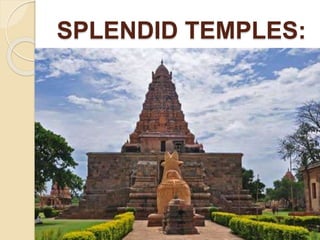
SPLENDID TEMPLES:
SPLENDID TEMPLES:
BRONZE SCULPTURE
AGRICULTURE AND
IRRIGATION:
 Many of the achievement of the
Cholas were made possible through
new development in Agriculture.
 River Kaveri
 Fertile soil(Rice)
 Forest were cleared
 Prevent Flooding
 Canal constructed-Irrigation
 Tanks- Rainwater collection
ADMINISTRATION
Maganam
Mandalam
Nadu
Ur
ADMINISTRATION
 Ur- Settlement of Peasants
 Nadu- Group of villages( Justice and
Tax collection)
 Supervised by Vellala caste(Rich
Peasants)
 Rich landowner titles-
Muvendavelan(a Velan or serving
three kings)
 Araiyur-(chief) in respect
TYPES OF LAND:
 Vellanvagai – Land of non-Brahmanas
Peasant proprietors
 Brahmadeya- Land gifted to
Brahmanas
 Shalabhoga- Land for the
maintenance of a school
 Devadana, Tirunamattukani –Land
gifted to temples.
 Pallichchhandam- Land donated to
Jain Institution.
SABHA:
The Sabha Committees to
look after irrigation works,
Gardens, Temples, etc
Name of those eligible to be
members of these
committees were written on
small tickets of palm leaf.
Requirement of member of
Sabha:
Owners of land,
Own house,
35-70 years of age,
Knowledge of Vedas,
Well-versed in
administrative matters and
honest.
Requirement of member of
Sabha:
If anyone has been a member
of any committee in the last
three years, he cannot
become a member of another
committee.
Anyone who has not submitted
his account, those of his
relatives, cannot contest the
TANG DYNASTY
China –Tang Dynasty(300
years from 7th century to 10th
century)
Capital- Xi’an
Largest cities in the world –
Turks, Iranians, Indians,
Japanese and Koreans.

unit-02newkingsandkingdoms.............................

  • 1.
  • 2.
  • 3.
    EMERGENCE OF NEW DYNASTIES: Thebig landlords and warriors chiefs in different regions of the Sub-continents were known as Samantas. Samantas- Maha Samantas or Maha mandalaeshvara (the great lord of a “circle” or region).
  • 4.
    SAMANTAS  Rashtrakutas weresubordinates with Chalukyas in the Deccan.  In the mid 8th century Dantidurga overthrew his Chalukya overload and performed a ritual called Hiranya-Garbha. ◦ This ritual was done by Brahmanas for the rebirth of the scarifies as Kshatriyas.
  • 5.
    Brahmanas to Kshatriyas: KadamaMayurasharman and the Prathihara Harichandra who were Brahmans took arms and successfully established their kingdoms in Karnataka and Rajasthan
  • 7.
    ADMINISTRATION: Title: Maharaja, Adhiraja (greatkings, overlord of kings). Title: Tribhuvana- Chakravartin (lord of the three worlds) They were associated with the Samantas, Peasants, Traders and Brahmanas
  • 8.
    TAXES: Tax: Vetti- takennot in cash but in the form of forced labor. Tax: Kadamai or Land revenue This taxes were collected by the King family members or relatives.
  • 9.
    TAXES Taxes to ◦ Financial Establishment ◦Construct temples ◦ Fight wars.
  • 10.
    PRASHASTIS:  Prashastis isa special kind of inscription meaning “in praise of”. They were composed in praise of the rulers. This were not true.  Rulers wanted to show themselves as great warriors and often described themselves as equal to god.  Prashastis contains information such as how rulers wanted to depict themselves such as victorious, valiant etc.
  • 11.
    LAND GRANTS:  Thesewere composed by learned Brahmanas, who occasionally helped in the administration.  Kings often rewarded Brahmanas by grants of land.  These were recorded on copper plates, which were given to those who received the land.
  • 13.
    WARFARE FOR WEALTH:  Rulersbelonging to the Gurjara- Prathiharas, Rashtrakutas and Pala dynasties fought for control over Kanauj-Tripartite struggle.  Rulers also tried to demonstrate their power and resources by building large temples.  So they chosen to target temples, which were sometimes extremely rich.
  • 15.
    GHAZNI:  One ofthe best known rulers is Sultan Mahmud of Ghazni, Afghanistan.  From 997C.E to1030C.E  He raided the sub- continent almost every year-his target were wealthy temples, including that of
  • 16.
    KITAB UL-HIND  Writtenby Al-Biruni  In Arabic Language.  This description based on the Sanskritic tradition, and the conclusion with comparison with other culture.  He consulted Sanskrit scholars to prepare this account.
  • 18.
    CHAUHANS:  They ruledover the region around Delhi and Ajmer.  They were opposed by Chalukyas and Gahadavalas.  Famous ruler- Prithviraja III(1168- 1192C.E).  He defeated an Afghan ruler named Sultan Muhammad Ghori in 1191C.E,but lost to him the very next year, in 1192C.E.
  • 20.
  • 21.
    FROM URAIYUR TO THANJAVUR: Cholas were subordinates to the Pallava Kings of Kanchipuram.  A minor chiefly family known as the Muttaraiyar held power in the Kaveri delta.  Vijayalaya, chieftain from Uraiyur captured the delta region from Muttaraiyar Chieftain.
  • 23.
    CHOLA DYNASTY  Hebuilt the town of Thanjavur and a temple for goddess Nishumbhasudhini.  His successors grew the kingdom by capturing the Pandyas and Pallavas territories.  Rajaraja-1(985C.E) most powerful Chola ruler.
  • 26.
    CHOLA DYNASTY Rajaraja-I expandedcontrol over most of these areas. Rajendra I continued his policies and even raided the Ganga valley, Sri Lanka and Countries of Southeast Asia, Developing a navy for these expeditions.
  • 28.
  • 29.
  • 30.
  • 31.
    AGRICULTURE AND IRRIGATION:  Manyof the achievement of the Cholas were made possible through new development in Agriculture.  River Kaveri  Fertile soil(Rice)  Forest were cleared  Prevent Flooding  Canal constructed-Irrigation  Tanks- Rainwater collection
  • 34.
  • 35.
    ADMINISTRATION  Ur- Settlementof Peasants  Nadu- Group of villages( Justice and Tax collection)  Supervised by Vellala caste(Rich Peasants)  Rich landowner titles- Muvendavelan(a Velan or serving three kings)  Araiyur-(chief) in respect
  • 36.
    TYPES OF LAND: Vellanvagai – Land of non-Brahmanas Peasant proprietors  Brahmadeya- Land gifted to Brahmanas  Shalabhoga- Land for the maintenance of a school  Devadana, Tirunamattukani –Land gifted to temples.  Pallichchhandam- Land donated to Jain Institution.
  • 37.
    SABHA: The Sabha Committeesto look after irrigation works, Gardens, Temples, etc Name of those eligible to be members of these committees were written on small tickets of palm leaf.
  • 38.
    Requirement of memberof Sabha: Owners of land, Own house, 35-70 years of age, Knowledge of Vedas, Well-versed in administrative matters and honest.
  • 39.
    Requirement of memberof Sabha: If anyone has been a member of any committee in the last three years, he cannot become a member of another committee. Anyone who has not submitted his account, those of his relatives, cannot contest the
  • 41.
    TANG DYNASTY China –TangDynasty(300 years from 7th century to 10th century) Capital- Xi’an Largest cities in the world – Turks, Iranians, Indians, Japanese and Koreans.