Khadi
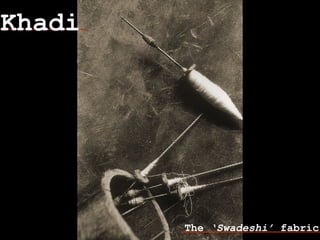
The ‘Swadeshi’ fabric
Khadi
• Khadi is a hand-spun and hand-woven fabric.
• Woven mostly in cotton, the process originates itself
more than 5000 years ago and believed to be from ancient
India.
• This almost forgotten process was revived by Mahatma
Gandhi in 1921, as a part of his movements of non-
violence and non-cooperation against the British.
• It evoked tellingly the fact that in the post-industrial
world,
self worth and self sufficiency was acknowledged as a
compensation for human labour.
Khadi
the process…
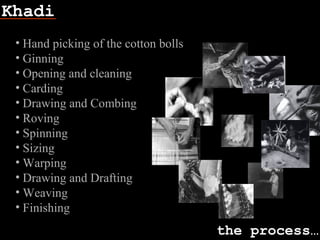
• Hand picking of the cotton bolls
• Ginning
• Opening and cleaning
• Carding
• Drawing and Combing
• Roving
• Spinning
• Sizing
• Warping
• Drawing and Drafting
• Weaving
• Finishing
Khadi
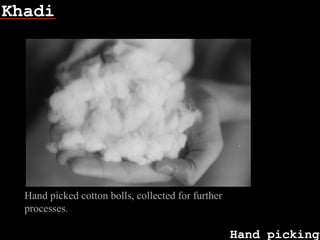
Hand picking
Hand picked cotton bolls, collected for further
processes.
Khadi
Ginning
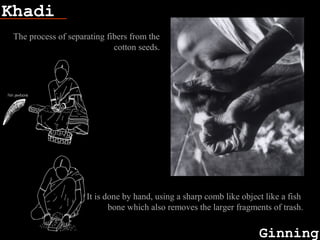
The process of separating fibers from the
cotton seeds.
It is done by hand, using a sharp comb like object like a fish
bone which also removes the larger fragments of trash.
Khadi
Ginning
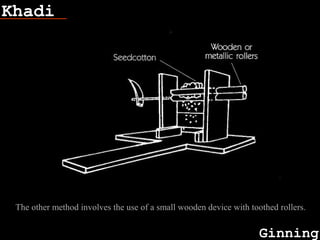
The other method involves the use of a small wooden device with toothed rollers.
Khadi
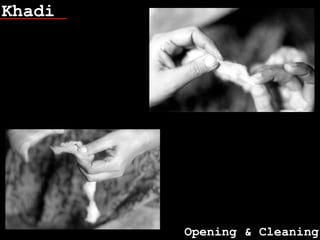
Opening & Cleaning
Khadi
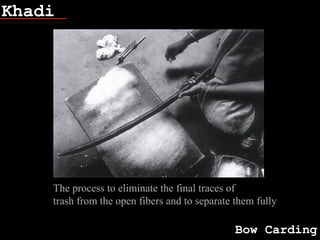
Bow Carding
The process to eliminate the final traces of
trash from the open fibers and to separate them fully
Khadi
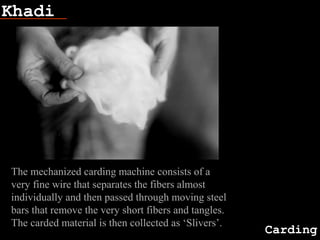
Carding
The mechanized carding machine consists of a
very fine wire that separates the fibers almost
individually and then passed through moving steel
bars that remove the very short fibers and tangles.
The carded material is then collected as ‘Slivers’.
Khadi
Drawing and combing
• It involves the further
parallelization of cotton fibers
and removal of short fibers to
produce finer qualities of
yarn.
• It is the process of
straightening the fibers , prior
to spinning of the yarn and
thus a sliver of cotton is
obtained.
Khadi
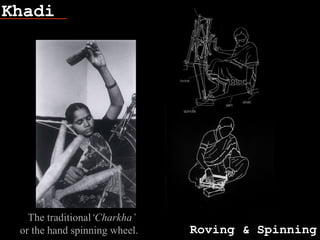
Roving & Spinning
The traditional‘Charkha’
or the hand spinning wheel.
Khadi
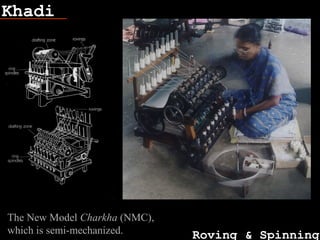
The New Model Charkha (NMC),
which is semi-mechanized. Roving & Spinning
Khadi
Roving & Spinning
Fish bone
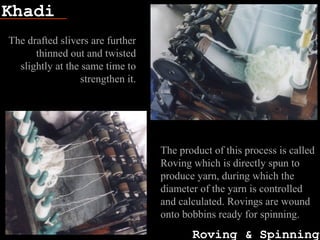
The drafted slivers are further
thinned out and twisted
slightly at the same time to
strengthen it.
The product of this process is called
Roving which is directly spun to
produce yarn, during which the
diameter of the yarn is controlled
and calculated. Rovings are wound
onto bobbins ready for spinning.
Khadi
Roving & Spinning
Fish bone
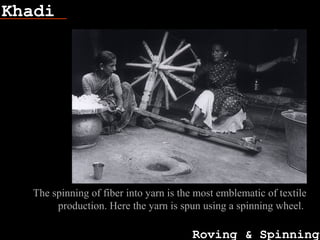
The spinning of fiber into yarn is the most emblematic of textile
production. Here the yarn is spun using a spinning wheel.
Khadi
Spinning
Fish bone
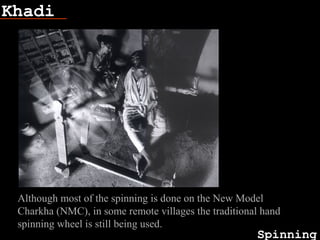
Although most of the spinning is done on the New Model
Charkha (NMC), in some remote villages the traditional hand
spinning wheel is still being used.
Khadi
Spinning
Fish bone
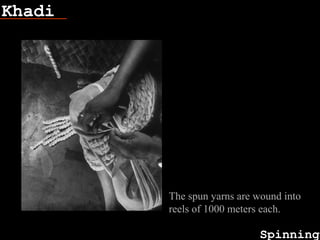
The spun yarns are wound into
reels of 1000 meters each.
Khadi
Spinning Centers
Fish bone
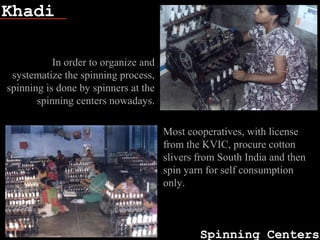
In order to organize and
systematize the spinning process,
spinning is done by spinners at the
spinning centers nowadays.
Most cooperatives, with license
from the KVIC, procure cotton
slivers from South India and then
spin yarn for self consumption
only.
Khadi
Warping
Khadi
Sizing
Fish bone
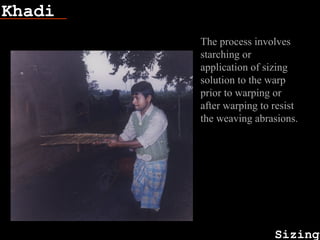
The process involves
starching or
application of sizing
solution to the warp
prior to warping or
after warping to resist
the weaving abrasions.
Khadi
Drawing & Drafting
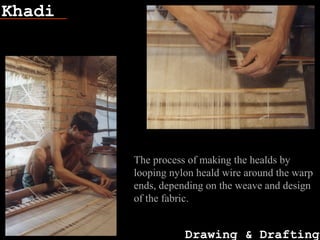
Fish bone The process of making the healds by
looping nylon heald wire around the warp
ends, depending on the weave and design
of the fabric.
Khadi
Fish bone
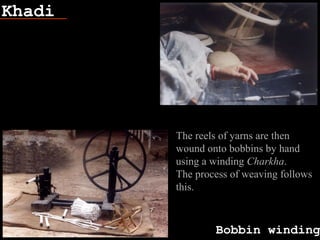
Bobbin winding
The reels of yarns are then
wound onto bobbins by hand
using a winding Charkha.
The process of weaving follows
this.
Khadi
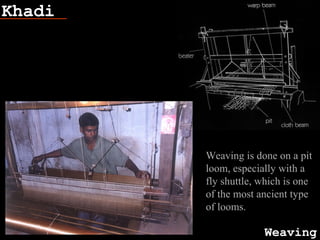
Weaving
Fish bone
Weaving is done on a pit
loom, especially with a
fly shuttle, which is one
of the most ancient type
of looms.
Khadi
Fish bone
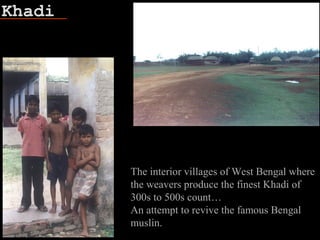
The interior villages of West Bengal where
the weavers produce the finest Khadi of
300s to 500s count…
An attempt to revive the famous Bengal
muslin.
Khadi
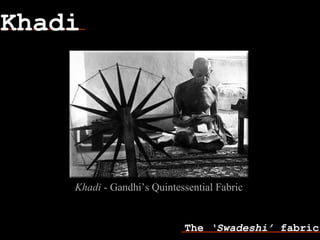
The ‘Swadeshi’ fabric
Khadi - Gandhi’s Quintessential Fabric
Khadi
Salient features of Khadi
• Hand-spun and hand woven
• Hand spun yarn renders a soft character to the fabric that
is comfortable to wear.
• Durable fabric.
• Subtle texture in the fabric owing to hand spinning and hand
weaving .
• Fine fabrics up to 500s count are available…..which are otherwise
impossible to weave in mechanized looms.
Khadi
The Future of Khadi
• It is the only fabric where the play of texture is so unique that no
two fabrics will be absolutely identical, thus lending it exclusivity
and inimitability in terms of feel and texture.
• Khadi is among the most progressively modern of all textiles,
one that not only has desirably material possibilities but also
consonance with the native ecology and sensitivity to the human
condition that sustains it.
• It advocates that fact that even in the post-industrial world, self-
worth and self sufficiency are acknowledged as a compensation for
human labour.
• Today Khadi is being used by Top Fashion Designers in India and
abroad in garments and accessories.
Khadi
Did you know?
70 % of the artisans involved in the process of Khadi production
are women.
Khadi is an eco-fabric. The process involves no environmental
pollution and is extremely eco friendly.
Khadi helps in supporting destitute, helpless rural women folk as
they can work independently and earn their living.
Khadi production is a labour-intensive industry, with a scope of
providing more employment with an investment of a very meager
capital especially in the rural areas.
It enables full development of locally available raw materials and
human resources.
Khadi
We would like to thank the following people for their help, support and
guidance without which this project would not have been a success:
• Mr. G.C. Basak, Joint Director
Directorate of Handlooms and Textiles, Govt. of West Bengal.
• Mr. S.S.Sil, Dy. Director & Mr. U.S. Maiti, Khadi Officer
Khadi & Village Industries Commission, West Bengal.
• Mr S.K. Ghosh, Dy. Director,
Weavers Service Center, Kolkata.
• Dr. B.V. Somashekhar. Director,
National Institute of Fashion Technology, Kolkata.
• Mr. Malay Kumar Das, Technical Officer,
Handloom Development Commission, Murshidabad.
• Bharat Khadi Sevak Sangha, Murshidabad.
• Chandrakanta Lalit Mohan Resham Khadi Samity, Murshidabad.
• Murshidabad Silk Weavers Co-operative Society Ltd., Murshidabad.
• Khadi-o-Kutir, Kalna, Burdwan.
• Nabadwip Kutir Shilpa Prathisthan , Burdwan.
• Ms. Darshan Shah, Director, Weavers Studio, Kolkata.
• Tarang Maheshwari, NIFT, New Delhi.
ACKNOWLEDGEMENTS
Khadi
• Khadi
Volkart Foundation, Switzerland,
Amr Vastra Kosh
2002
• The Khadi Industry
Publication Division, Ministry of Information & Broadcasting
Govt. of India
1962
• Spinning & Khadi
Gandhi, M.K.
•Khadi: How & Why?
Gandhi, M.K.
• The Gandhian Way
Kripalani, J.B., Acharya
Nawjivan Publishing House, Ahmedabad
BIBLIOGRAPHY
Khadi
The ‘Swadeshi’ fabric
WEAVERS STUDIO
5/1, Anil MoitraRoad, Ist Floor, Ballygunj Place,
Kolkata- 700 019
West Bengal India
SPONSORED BY
Khadi
The ‘Swadeshi’ fabric
Nitin Gupta
National Instituteof Fashion Technology New Delhi
Subhabrata Sadhu
National Instituteof Design Ahmedabad
DOCUMENTED BY
PRESENTED BY
Ms. Darshan Shah Director
WeaversStudio
Calcutta, India
Khadi
The ‘Swadeshi’ fabric
THANK YOU

Khadi presentation by sadhu

  • 1.
  • 2.
    Khadi • Khadi isa hand-spun and hand-woven fabric. • Woven mostly in cotton, the process originates itself more than 5000 years ago and believed to be from ancient India. • This almost forgotten process was revived by Mahatma Gandhi in 1921, as a part of his movements of non- violence and non-cooperation against the British. • It evoked tellingly the fact that in the post-industrial world, self worth and self sufficiency was acknowledged as a compensation for human labour.
  • 3.
    Khadi the process… • Handpicking of the cotton bolls • Ginning • Opening and cleaning • Carding • Drawing and Combing • Roving • Spinning • Sizing • Warping • Drawing and Drafting • Weaving • Finishing
  • 4.
    Khadi Hand picking Hand pickedcotton bolls, collected for further processes.
  • 5.
    Khadi Ginning The process ofseparating fibers from the cotton seeds. It is done by hand, using a sharp comb like object like a fish bone which also removes the larger fragments of trash.
  • 6.
    Khadi Ginning The other methodinvolves the use of a small wooden device with toothed rollers.
  • 7.
  • 8.
    Khadi Bow Carding The processto eliminate the final traces of trash from the open fibers and to separate them fully
  • 9.
    Khadi Carding The mechanized cardingmachine consists of a very fine wire that separates the fibers almost individually and then passed through moving steel bars that remove the very short fibers and tangles. The carded material is then collected as ‘Slivers’.
  • 10.
    Khadi Drawing and combing •It involves the further parallelization of cotton fibers and removal of short fibers to produce finer qualities of yarn. • It is the process of straightening the fibers , prior to spinning of the yarn and thus a sliver of cotton is obtained.
  • 11.
    Khadi Roving & Spinning Thetraditional‘Charkha’ or the hand spinning wheel.
  • 12.
    Khadi The New ModelCharkha (NMC), which is semi-mechanized. Roving & Spinning
  • 13.
    Khadi Roving & Spinning Fishbone The drafted slivers are further thinned out and twisted slightly at the same time to strengthen it. The product of this process is called Roving which is directly spun to produce yarn, during which the diameter of the yarn is controlled and calculated. Rovings are wound onto bobbins ready for spinning.
  • 14.
    Khadi Roving & Spinning Fishbone The spinning of fiber into yarn is the most emblematic of textile production. Here the yarn is spun using a spinning wheel.
  • 15.
    Khadi Spinning Fish bone Although mostof the spinning is done on the New Model Charkha (NMC), in some remote villages the traditional hand spinning wheel is still being used.
  • 16.
    Khadi Spinning Fish bone The spunyarns are wound into reels of 1000 meters each.
  • 17.
    Khadi Spinning Centers Fish bone Inorder to organize and systematize the spinning process, spinning is done by spinners at the spinning centers nowadays. Most cooperatives, with license from the KVIC, procure cotton slivers from South India and then spin yarn for self consumption only.
  • 18.
  • 19.
    Khadi Sizing Fish bone The processinvolves starching or application of sizing solution to the warp prior to warping or after warping to resist the weaving abrasions.
  • 20.
    Khadi Drawing & Drafting Fishbone The process of making the healds by looping nylon heald wire around the warp ends, depending on the weave and design of the fabric.
  • 21.
    Khadi Fish bone Bobbin winding Thereels of yarns are then wound onto bobbins by hand using a winding Charkha. The process of weaving follows this.
  • 22.
    Khadi Weaving Fish bone Weaving isdone on a pit loom, especially with a fly shuttle, which is one of the most ancient type of looms.
  • 23.
    Khadi Fish bone The interiorvillages of West Bengal where the weavers produce the finest Khadi of 300s to 500s count… An attempt to revive the famous Bengal muslin.
  • 24.
    Khadi The ‘Swadeshi’ fabric Khadi- Gandhi’s Quintessential Fabric
  • 25.
    Khadi Salient features ofKhadi • Hand-spun and hand woven • Hand spun yarn renders a soft character to the fabric that is comfortable to wear. • Durable fabric. • Subtle texture in the fabric owing to hand spinning and hand weaving . • Fine fabrics up to 500s count are available…..which are otherwise impossible to weave in mechanized looms.
  • 26.
    Khadi The Future ofKhadi • It is the only fabric where the play of texture is so unique that no two fabrics will be absolutely identical, thus lending it exclusivity and inimitability in terms of feel and texture. • Khadi is among the most progressively modern of all textiles, one that not only has desirably material possibilities but also consonance with the native ecology and sensitivity to the human condition that sustains it. • It advocates that fact that even in the post-industrial world, self- worth and self sufficiency are acknowledged as a compensation for human labour. • Today Khadi is being used by Top Fashion Designers in India and abroad in garments and accessories.
  • 27.
    Khadi Did you know? 70% of the artisans involved in the process of Khadi production are women. Khadi is an eco-fabric. The process involves no environmental pollution and is extremely eco friendly. Khadi helps in supporting destitute, helpless rural women folk as they can work independently and earn their living. Khadi production is a labour-intensive industry, with a scope of providing more employment with an investment of a very meager capital especially in the rural areas. It enables full development of locally available raw materials and human resources.
  • 28.
    Khadi We would liketo thank the following people for their help, support and guidance without which this project would not have been a success: • Mr. G.C. Basak, Joint Director Directorate of Handlooms and Textiles, Govt. of West Bengal. • Mr. S.S.Sil, Dy. Director & Mr. U.S. Maiti, Khadi Officer Khadi & Village Industries Commission, West Bengal. • Mr S.K. Ghosh, Dy. Director, Weavers Service Center, Kolkata. • Dr. B.V. Somashekhar. Director, National Institute of Fashion Technology, Kolkata. • Mr. Malay Kumar Das, Technical Officer, Handloom Development Commission, Murshidabad. • Bharat Khadi Sevak Sangha, Murshidabad. • Chandrakanta Lalit Mohan Resham Khadi Samity, Murshidabad. • Murshidabad Silk Weavers Co-operative Society Ltd., Murshidabad. • Khadi-o-Kutir, Kalna, Burdwan. • Nabadwip Kutir Shilpa Prathisthan , Burdwan. • Ms. Darshan Shah, Director, Weavers Studio, Kolkata. • Tarang Maheshwari, NIFT, New Delhi. ACKNOWLEDGEMENTS
  • 29.
    Khadi • Khadi Volkart Foundation,Switzerland, Amr Vastra Kosh 2002 • The Khadi Industry Publication Division, Ministry of Information & Broadcasting Govt. of India 1962 • Spinning & Khadi Gandhi, M.K. •Khadi: How & Why? Gandhi, M.K. • The Gandhian Way Kripalani, J.B., Acharya Nawjivan Publishing House, Ahmedabad BIBLIOGRAPHY
  • 30.
    Khadi The ‘Swadeshi’ fabric WEAVERSSTUDIO 5/1, Anil MoitraRoad, Ist Floor, Ballygunj Place, Kolkata- 700 019 West Bengal India SPONSORED BY
  • 31.
    Khadi The ‘Swadeshi’ fabric NitinGupta National Instituteof Fashion Technology New Delhi Subhabrata Sadhu National Instituteof Design Ahmedabad DOCUMENTED BY PRESENTED BY Ms. Darshan Shah Director WeaversStudio Calcutta, India
  • 32.