Horizon Report Europe > 2014 Schools Edition 
EUR 26673 EN
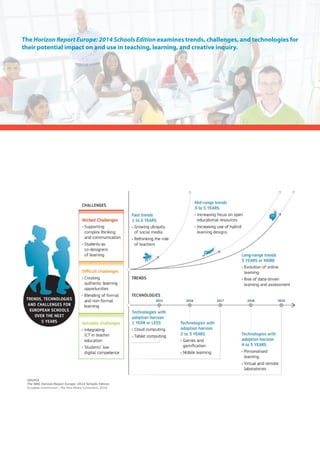
The Horizon Report Europe: 2014 Schools Edition examines trends, challenges, and technologies for 
their potential impact on and use in teaching, learning, and creative inquiry.
The NMC Horizon Report Europe: 2014 Schools Edition 
is a joint publication of European Commission’s Directorate General for 
Education and Culture; European Commission’s Joint Research Centre – Institute 
for Prospective Technological Studies; and the New Media Consortium. 
European Commission 
Directorate General for Education and 
Culture 
A3 - Skills and Qualifications Strategies; 
Multilingualism policy 
Contact information 
Address: 70, Rue Joseph II – 03/125 
B-1049 Bruxelles, Belgique 
Email: EAC-UNITE-A3@ec.europa.eu 
Tel.: +32 229 62 631 
Fax: +32 229 987 151 
http://ec.europa.eu/dgs/education_culture/ 
Legal Notice 
Neither the European Commission nor any person acting on behalf of the Commission is responsible for the use which might be 
made of this publication. 
Additional information on the European Union is available on the Internet through the Europa server http://europa.eu/. 
European Commission 
EUR 26673 EN 
ISBN 978-92-79-38476-9 (pdf) ISBN 978-92-79-38477-6 (print) 
ISSN 1831-9424 (online) ISSN 1018-5593 (print) 
doi:10.2791/83258 
Luxembourg: Publications Office of the European Union 
© European Union 2014 
Austin, Texas: The New Media Consortium, 2014 
© The New Media Consortium 2014 
Permission is granted under a Creative Commons Attribution 4.0 International licence to replicate, copy, distribute, transmit, or 
adapt this report freely provided that attribution is provided as illustrated in the citation below. To view a copy of this licence, visit 
creativecommons.org/licenses/by/4.0/ or send a letter to Creative Commons, 559 Nathan Abbott Way, Stanford, California 94305, 
USA. 
Citation 
Johnson, L., Adams Becker, S., Estrada, V., Freeman, A., Kampylis, P., Vuorikari, R., and Punie, Y. (2014). Horizon Report Europe: 2014 
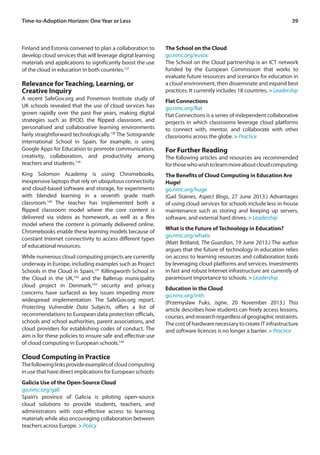
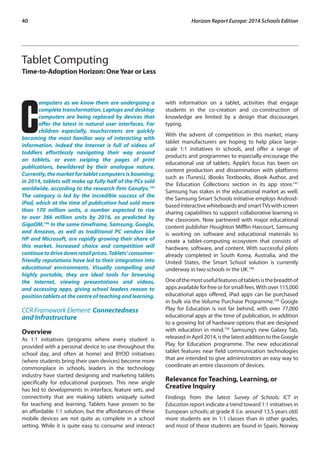
Schools Edition. Luxembourg: Publications Office of the European Union, & Austin, Texas: The New Media Consortium. 
Photography 
Photos via BigStock Photography 
Printed in Luxembourg and USA. 
European Commission 
Joint Research Centre – Institute for 
Prospective Technological Studies 
Contact information 
Address: Edificio Expo. c/ Inca Garcilaso, 
3. E-41092 Seville (Spain) 
Email: jrc-ipts-secretariat@ec.europa.eu 
Tel.: +34 954488318 
Fax: +34 954488300 
https://ec.europa.eu/jrc 
The New Media Consortium 
Sparking innovation, learning and 
creativity 
Contact information 
1250 Capital of Texas Hwy South 
Building 3, Suite 400 
Austin, TX 78746 
Email: communications@nmc.org 
Tel.: 512 445-4200 
Fax: 512 445-4205 
www.nmc.org
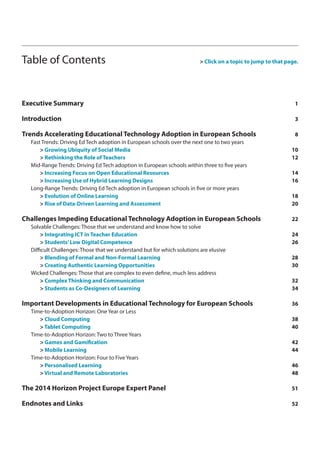
Table of Contents > Click on a topic to jump to that page. 
Executive Summary 1 
Introduction 3 
Trends Accelerating Educational Technology Adoption in European Schools 8 
Fast Trends: Driving Ed Tech adoption in European schools over the next one to two years 
> Growing Ubiquity of Social Media 10 
> Rethinking the Role of Teachers 12 
Mid-Range Trends: Driving Ed Tech adoption in European schools within three to five years 
> Increasing Focus on Open Educational Resources 14 
> Increasing Use of Hybrid Learning Designs 16 
Long-Range Trends: Driving Ed Tech adoption in European schools in five or more years 
> Evolution of Online Learning 18 
> Rise of Data-Driven Learning and Assessment 20 
Challenges Impeding Educational Technology Adoption in European Schools 22 
Solvable Challenges: Those that we understand and know how to solve 
> Integrating ICT in Teacher Education 24 
> Students’ Low Digital Competence 26 
Difficult Challenges: Those that we understand but for which solutions are elusive 
> Blending of Formal and Non-Formal Learning 28 
> Creating Authentic Learning Opportunities 30 
Wicked Challenges: Those that are complex to even define, much less address 
> Complex Thinking and Communication 32 
> Students as Co-Designers of Learning 34 
Important Developments in Educational Technology for European Schools 36 
Time-to-Adoption Horizon: One Year or Less 
> Cloud Computing 38 
> Tablet Computing 40 
Time-to-Adoption Horizon: Two to Three Years 
> Games and Gamification 42 
> Mobile Learning 44 
Time-to-Adoption Horizon: Four to Five Years 
> Personalised Learning 46 
> Virtual and Remote Laboratories 48 
The 2014 Horizon Project Europe Expert Panel 51 
Endnotes and Links 52
1 
Executive Summary 
What is on the five-year horizon for European 
schools? Which trends and technologies 
will drive educational change? What are 
the challenges that we consider as solvable 
or difficult to overcome, and how can 
we strategize effective solutions? These questions 
and similar inquiries regarding technology adoption 
and educational change steered the collaborative 
research and discussions of a body of 53 European 
experts to produce the first-ever Horizon Report Europe: 
2014 Schools Edition, co-authored by the European 
Commission and the New Media Consortium (NMC). 
The NMC Horizon Report series charts the five-year 
horizon for the impact of emerging technologies in 
school communities across the globe. With more than 
12 years of research and publications, it can be regarded 
as the world’s longest-running exploration of emerging 
technology trends and uptake in education. 
Experts agreed on two major imminent trends: the 
changing role of schoolteachers as a result of ICT 
influence, and the impact of social media platforms, 
such as Facebook and Twitter, which are already finding 
their way into classrooms. These are just two of the 
18 topics analysed in the Horizon Report Europe: 2014 
Schools Edition, indicating the key trends, significant 
challenges, and important technological developments 
that are very likely to impact changes in the 28 Member 
States’ primary and secondary schools over the next five 
years. 
Looking in the mid-term period, two to three years 
away, an increasing focus on open educational 
resources (OER) and on the use of both traditional and 
virtual learning methods are expected to have a strong 
impact in Europe. These trends are also identified at the 
global level for having the potential to stimulate new 
models of teaching and learning by tapping the wealth 
of content accessible through the Internet. 
Regarding the challenges in European schools, 
students’ low digital competence is considered one of 
the solvable challenges. It is already being addressed 
by ongoing actions of stakeholders and policy makers 
across the continent, as seen in the Digital Competence 
framework which has been recently endorsed by EU 
Member States representatives in the Education and 
Training Programme Thematic Working Group on ICT 
and Education. On the other hand, having students 
actively participating in the design of learning activities 
is considered to be a more difficult challenge and it 
lacks a clear strategy to solve it. 
In view of the trends and challenges observed, the panel 
also signalled the technological developments that 
could support these drivers of innovation and change. 
Cloud computing and tablet computing are expected 
to be increasingly adopted by schools in one year’s time 
or less to make use of services such as Google Apps for 
Education, Skype, and Dropbox. The time-to-adoption 
for educational games is estimated within two to three 
years, while personalised learning and virtual and 
remote laboratories are expected to be mainstream in 
schools within four to five years. 
To better understand the likely impact of these 18 
topics on the core missions of European schools, further 
analysis was conducted using a JRC-IPTS developed 
framework for mainstreaming ICT-enabled innovation 
for learning. This helped link the analysis to essential 
questions of relevance, policy, leadership, and practice 
that are needed to scale up innovative pedagogical 
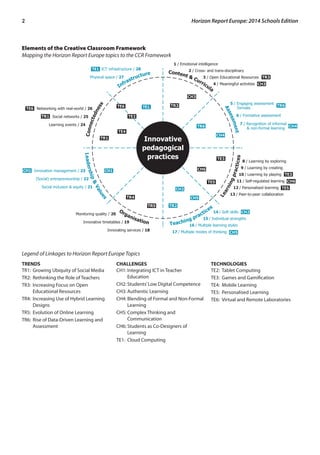
practices in ICT-enabled learning settings (see Chart on 
page 2). While all of the topics can be described relating 
in some way to each of the eight elements of the 
framework, in Chart 1 they are mapped to demonstrate 
the element they impact the most. The framework, 
which was produced on behalf of the EC DG EAC in 
the “Up-Scaling Creative Classrooms in Europe” project 
(go.nmc.org/scaleccr1), sees learning environments, 
wherever they may be found, as “live ecosystems” that 
evolve over time, changing in tune with the context and 
culture in which they reside.
2 Horizon Report Europe: 2014 Schools Edition 
Elements of the Creative Classroom Framework 
Mapping the Horizon Report Europe topics to the CCR Framework 
Physical space Infrastructure 
/ 27 
Connectedness 
Networking with real-world / 26 
Social networks / 25 
Learning events / 24 
Innovation management / 23 
Monitoring quality / 20 
Innovative timetables / 19 
TRENDS 
TR1: Growing Ubiquity of Social Media 
TR2: Rethinking the Role of Teachers 
TR3: Increasing Focus on Open 
Educational Resources 
TR4: Increasing Use of Hybrid Learning 
Designs 
TR5: Evolution of Online Learning 
TR6: Rise of Data-Driven Learning and 
Assessment 
Content & Curricula 
Innovative 
pedagogical 
practices 
CHALLENGES 
CH1: Integrating ICT in Teacher 
Education 
15 / Individual strengths 
16 / Multiple learning styles 
CH2: Students’ Low Digital Competence 
CH3: Authentic Learning 
CH4: Blending of Formal and Non-Formal 
Learning 
CH5: Complex Thinking and 
Communication 
CH6: Students as Co-Designers of 
Learning 
TE1: Cloud Computing 
TECHNOLOGIES 
TE2: Tablet Computing 
TE3: Games and Gamification 
TE4: Mobile Learning 
TE5: Personalised Learning 
TE6: Virtual and Remote Laboratories 
Legend of Linkages to Horizon Report Europe Topics 
Assessment 
Teaching practices Learning practices 
Leadership & Values 
Organisation 
1 / Emotional intelligence 
2 / Cross- and trans-disciplinary 
3 / Open Educational Resources 
4 / Meaningful activities 
5 / Engaging assessment 
formats 
6 / Formative assessment 
7 / Recognition of informal 
& non-formal learning 
8 / Learning by exploring 
9 / Learning by creating 
10 / Learning by playing 
11 / Self-regulated learning 
12 / Personalised learning 
13 / Peer-to-peer collaboration 
14 / Soft skills 
17 / Multiple modes of thinking 
Innovating services / 18 
(Social) entrepreneurship / 22 
Social inclusion & equity / 21 
ICT infrastructure / 28
3 
Introduction 
In the pages that follow, 18 topics carefully selected 
by the Horizon Project Europe Expert Panel related 
to the educational applications of technology are 
examined, all of them areas very likely to impact 
technology planning and decision-making over 
the next five years (2014-2018). Six key trends, six 
significant challenges, and six important developments 
in educational technology are placed directly in the 
context of their likely impact on the core missions 
of European schools, and detailed in succinct, non-technical, 
and unbiased presentations. Each has been 
tied to a framework that links to essential questions of 
relevance, policy, leadership, and practice. 
The Horizon Report Europe: 2014 Schools Edition was 
produced by the New Media Consortium (NMC) 
in collaboration with the European Commission’s 
Directorate General for Education and Culture (EC 
DG EAC), the Joint Research Centre - Institute for 
Prospective Technological Studies (JRC-IPTS), Inholland 
University, QIN AS, and CellCove Ltd. The internationally 
recognised NMC Horizon Report series and regional NMC 
Technology Outlooks are part of the NMC Horizon Project, 
a comprehensive effort established in 2002 by the NMC 
that identifies and describes emerging technologies 
likely to have a large impact over the coming five years 
in education around the globe. 
The partnership’s goal for this major multi-organisational 
collaboration is that the key trends, 
challenges, and technological developments detailed 
here directly inform policy, leadership, and practice at 
all levels impacting European schools. This report aims 
to help ministers, governing boards, and school leaders 
to strategically approach the further evolution of 
teaching, learning, and creative inquiry. Each topic has 
been carefully researched and framed in the context of 
its potential impact on the 28 European Union Member 
States’ primary and secondary schools. Moreover, 
throughout the report, references and links are made to 
more than 150 European publications (reports, articles, 
policy documents, blog posts etc.), projects (both EU-funded 
and national initiatives) and various policy 
initiatives from all over Europe. 
The report’s first two sections focus on an analysis 
of trends driving technology decision-making and 
planning, and the challenges likely to impede the 
adoption of new technologies, respectively. Each 
includes an explicit discussion of the trend or challenge’s 
implications for policy, leadership, and practice in 
European schools, along with examples and relevant 
readings. 
The third section, in which six important developments 
in educational technology are described, is ultimately 
framed by these trends and challenges. The adoption 
or abandonment of these technologies by European 
schools will be very much determined by the responses 
taken across the continent to these drivers of and 
obstacles to innovation and change. 
This report aims to help ministers, 
governing boards, and school 
leaders to strategically approach 
the further evolution of teaching, 
learning, and creative inquiry. 
Findings in the Global Context 
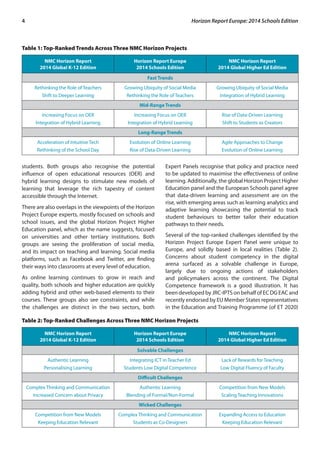
The choices of the European experts overlap in 
interesting ways with those who contributed to the 
globally focused NMC Horizon Report: 2014 K-12 Edition, 
a sector analysis exploring technology adoption across 
primary and secondary education worldwide (Table 
1). The choices also share similarities with the NMC 
Horizon Report: 2014 Higher Education Edition, which 
looked at technology uptake across higher education 
institutions, also from an international perspective. 
These comparisons illuminate key themes not only in 
European schools, but those whose impact is being felt 
globally. 
The global Horizon Project K-12 and the Horizon Project 
Europe experts share a common vision that the role 
of schoolteachers will significantly evolve in the next 
couple of years, largely due to new developments in ICT 
and their effect on shifting pedagogies. Many schools 
in Europe are already reimagining teaching approaches 
to support more creative technology integration as well 
as more collaboration and hands-on learning among
4 Horizon Report Europe: 2014 Schools Edition 
students. Both groups also recognise the potential 
influence of open educational resources (OER) and 
hybrid learning designs to stimulate new models of 
learning that leverage the rich tapestry of content 
accessible through the Internet. 
There are also overlaps in the viewpoints of the Horizon 
Project Europe experts, mostly focused on schools and 
school issues, and the global Horizon Project Higher 
Education panel, which as the name suggests, focused 
on universities and other tertiary institutions. Both 
groups are seeing the proliferation of social media, 
and its impact on teaching and learning. Social media 
platforms, such as Facebook and Twitter, are finding 
their ways into classrooms at every level of education. 
As online learning continues to grow in reach and 
quality, both schools and higher education are quickly 
adding hybrid and other web-based elements to their 
courses. These groups also see constraints, and while 
the challenges are distinct in the two sectors, both 
Expert Panels recognise that policy and practice need 
to be updated to maximise the effectiveness of online 
learning. Additionally, the global Horizon Project Higher 
Education panel and the European Schools panel agree 
that data-driven learning and assessment are on the 
rise, with emerging areas such as learning analytics and 
adaptive learning showcasing the potential to track 
student behaviours to better tailor their education 
pathways to their needs. 
Several of the top-ranked challenges identified by the 
Horizon Project Europe Expert Panel were unique to 
Europe, and solidly based in local realities (Table 2). 
Concerns about student competency in the digital 
arena surfaced as a solvable challenge in Europe, 
largely due to ongoing actions of stakeholders 
and policymakers across the continent. The Digital 
Competence framework is a good illustration. It has 
been developed by JRC-IPTS on behalf of EC DG EAC and 
recently endorsed by EU Member States representatives 
in the Education and Training Programme (of ET 2020) 
NMC Horizon Report 
2014 Global K-12 Edition 
Horizon Report Europe 
2014 Schools Edition 
NMC Horizon Report 
2014 Global Higher Ed Edition 
Fast Trends 
Rethinking the Role of Teachers 
Shift to Deeper Learning 
Growing Ubiquity of Social Media 
Rethinking the Role of Teachers 
Growing Ubiquity of Social Media 
Integration of Hybrid Learning 
Mid-Range Trends 
Increasing Focus on OER 
Integration of Hybrid Learning 
Increasing Focus on OER 
Integration of Hybrid Learning 
Rise of Data-Driven Learning 
Shift to Students as Creators 
Long-Range Trends 
Acceleration of Intuitive Tech 
Rethinking of the School Day 
Evolution of Online Learning 
Rise of Data-Driven Learning 
Agile Approaches to Change 
Evolution of Online Learning 
Table 1: Top-Ranked Trends Across Three NMC Horizon Projects 
NMC Horizon Report 
2014 Global K-12 Edition 
Horizon Report Europe 
2014 Schools Edition 
NMC Horizon Report 
2014 Global Higher Ed Edition 
Solvable Challenges 
Authentic Learning 
Personalising Learning 
Integrating ICT in Teacher Ed 
Students Low Digital Competence 
Lack of Rewards for Teaching 
Low Digital Fluency of Faculty 
Difficult Challenges 
Complex Thinking and Communication 
Increased Concern about Privacy 
Authentic Learning 
Blending of Formal/Non-Formal 
Competition from New Models 
Scaling Teaching Innovations 
Wicked Challenges 
Competition from New Models 
Keeping Education Relevant 
Complex Thinking and Communication 
Students as Co-Designers 
Expanding Access to Education 
Keeping Education Relevant 
Table 2: Top-Ranked Challenges Across Three NMC Horizon Projects
5 
Thematic Working Group on ICT and Education. Several 
Member States are already trying out the framework 
as a comprehensive approach to identify, describe, 
and assess digital competence. The DIGCOMP report2 
illuminates the issues and identifies potential solutions 
— some of which are already underway. Another 
distinctly European challenge is the blending of formal 
and non-formal learning, which conveys the consensus 
from the Expert Panel that the kinds of learning that 
take place at home and elsewhere should be better 
integrated into classrooms. 
Additionally, the Horizon Project Europe Expert Panel 
saw authentic learning and complex thinking and 
communication as needing more time and concerted 
efforts to flourish than indicated by the global Horizon 
Project K-12 group. Both of these topics have unique 
definitions and contexts in Europe as compared to 
other parts of the world, justifying distinctive analyses 
and different kinds of project examples. In the United 
of technologies as more near-term than do schools in 
general. 
Both the Horizon Project Europe and the global Horizon 
Project K-12 groups believe cloud computing is already 
in the agenda of schools, and will be more so over 
the next year. The many concrete project examples of 
schools using cloud-based services such as Google 
Apps for Education, Skype, Dropbox, and others show a 
movement toward leveraging this technology to bolster 
collaboration, digital competence, and productivity. 
The Horizon Project Europe panel saw recurring 
need to increase students’ access to high-calibre lab 
equipment, allowing students to conduct experiments 
from wherever they are, and exposing them to real 
data used by major research and science organisations. 
This choice underscores European school leaders’ focus 
on designing more authentic and frequent learning 
opportunities for students. 
Introduction 
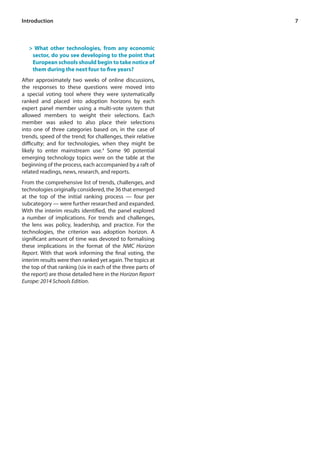
NMC Horizon Report 
2014 Global K-12 Edition 
Horizon Report Europe 
2014 Schools Edition 
NMC Horizon Report 
2014 Global Higher Ed Edition 
Time-to-Adoption Horizon: One Year or Less 
Bring Your Own Device (BYOD) 
Cloud Computing 
Cloud Computing 
Tablet Computing 
Flipped Classroom 
Learning Analytics 
Time-to-Adoption Horizon: Two to Three Years 
Games and Gamification 
Learning Analytics 
Games and Gamification 
Mobile Learning 
3D Printing 
Games and Gamification 
Time-to-Adoption Horizon: Four to Five Years 
The Internet of Things 
Wearable Technology 
Personalised Learning 
Virtual and Remote Laboratories 
Quantified Self 
Virtual Assistants 
Table 3: Comparison of Technologies Across Three NMC Horizon Projects 
States, for example, some Horizon Project Higher 
Education panellists see makerspaces as a fundamental 
incarnation of authentic learning; while there are 
makerspaces in Europe, other activities, including 
vocational education training programmes and citizen 
science initiatives are at the forefront of the European 
panel discussions. 
All three of these projects’ panels share some visions 
for the use of educational technology in schools, as 
evidenced by several overlapping topics (Table 3). 
Games and gamification, for example, are perceived 
to be important developments that are two to three 
years away from widespread use. The three panels also 
recognise the potential impact of learning analytics 
and personalised learning, though the global Horizon 
Project Higher Education group sees this collection 
These points and comparisons provide an important 
context for the main body of the report that follows this 
summary. Its three major sections each highlight six rich 
technology-related topics, providing carefully curated 
examples and additional readings. 
Methodology 
To create the Horizon Report Europe: 2014 Schools Edition, 
a body of 53 experts in European education, technology, 
and other fields was convened in order to make the 
difficult decisions on which of those topics merited 
inclusion in the 2014 report, as well as determining if 
any key areas had been omitted. 
The 2014 Horizon Project Europe Expert Panel 
represented 22 European countries, as well as several 
notable international organisations, including the
6 Horizon Report Europe: 2014 Schools Edition 
European Commission, OECD, and UNESCO, and 
European networks such as European Schoolnet.3 
The names and affiliations of the members are listed 
at the end of this report. Despite their diversity of 
backgrounds and experience, the panel agreed that 
each of the key trends profiled here will impact strategic 
technology planning for schools in Europe; that each 
of the significant challenges are impeding technology 
adoption in European schools; and that each of the 
six profiled technologies will influence the practice of 
primary and secondary education in Europe over the 
next five years. 
Over the course of several months during late 2013 
and early 2014, the European Expert Panel discussed 
and narrowed down the topics that would appear here 
in the Horizon Report Europe: 2014 Schools Edition. The 
examples and readings under each topic are meant 
to provide practical models as well as access to more 
detailed information. 
The process used to research and create the Horizon 
Report Europe: 2014 Schools Edition is rooted in the 
methods used across all the investigations conducted 
under the banner of the NMC Horizon Project. Dozens 
of meaningful trends, critical challenges, and emerging 
technologies are examined for possible inclusion in the 
report for each edition before the list is winnowed down 
to the topics presented in the ultimate report. 
To make those choices, every report draws on the 
considerable expertise of a panel that first considers a 
broad set of important trends, challenges, and emerging 
technologies, adds those they feel are missing, and 
then examines each of them in progressively more 
detail, reducing the set until the final listing of trends, 
challenges, and technologies is selected. This process 
takes place online, where it is captured in the NMC 
Horizon Project wiki. The wiki is intended to be a 
completely transparent window into the work of the 
project, one that not only provides a real-time view 
of the work as it happens, but also contains the entire 
record of the research for each of the various editions 
published since 2006. The wiki used for the Horizon 
Report Europe: 2014 Schools Edition can be found at 
europe.wiki.nmc.org. 
The procedure for selecting the topics in the report is 
based on a modified Delphi process refined over the 
now 12 years of producing the NMC Horizon Report 
series. In late 2013, the Horizon Project Europe began 
with the assembly of a distinguished panel of experts, 
as in every Horizon Project cycle. The 2014 Horizon 
Project Europe Expert Panel represented a wide range 
of backgrounds, disciplines, and interests, and as noted 
previously, 22 European countries. 
The panel’s work began with a systematic review of 
current literature — press clippings, reports, essays, and 
other materials from the past year, or at most two years 
— that pertained to a variety of aspects of emerging 
technology. Panel members were provided with an 
extensive set of carefully curated materials when 
the project began to ensure that each worked from 
a common baseline of knowledge about important 
developments in technology within the past two 
years. Panel members then commented on the timely 
research, identified selections that seemed especially 
germane, and added to the set. Using the Horizon 
Project framework, any topics with potential relevance 
to teaching, learning, and creative inquiry in European 
schools were open for discussion. A carefully selected 
set of RSS feeds from hundreds of relevant publications 
ensured that the library of background resources stayed 
current throughout their work. 
Following this in-depth pass through the most up-to-date 
resources available, the expert panel turned to the 
questions that are at the core of every NMC Horizon 
Project study. These questions were designed to elicit 
a comprehensive dialogue around interesting trends, 
significant challenges, and emerging technologies from 
the panel: 
1What trends do you expect to have a significant 
impact on the ways in which European schools 
approach the core missions of teaching, learning, 
or creative inquiry and how will they impact policy, 
leadership, and practice? 
2What do you see as the key challenges related 
to teaching, learning, or creative inquiry that 
European schools will face during the next five 
years, and how will they impact policy, leadership, 
and practice? 
3Which technologies will be most important to 
teaching, learning, or creative inquiry in European 
schools within the next five years? 
4What technologies might we be missing? Consider 
these related questions: 
> What would you list among the established 
technologies that some European schools are 
using today that arguably all European schools 
should be using broadly to support or enhance 
teaching, learning, or creative inquiry? 
> What technologies that have a solid user base 
in consumer, entertainment, or other industries 
should European schools be actively looking for 
ways to apply?
7 
Introduction 
> What other technologies, from any economic 
sector, do you see developing to the point that 
European schools should begin to take notice of 
them during the next four to five years? 
After approximately two weeks of online discussions, 
the responses to these questions were moved into 
a special voting tool where they were systematically 
ranked and placed into adoption horizons by each 
expert panel member using a multi-vote system that 
allowed members to weight their selections. Each 
member was asked to also place their selections 
into one of three categories based on, in the case of 
trends, speed of the trend; for challenges, their relative 
difficulty; and for technologies, when they might be 
likely to enter mainstream use.4 Some 90 potential 
emerging technology topics were on the table at the 
beginning of the process, each accompanied by a raft of 
related readings, news, research, and reports. 
From the comprehensive list of trends, challenges, and 
technologies originally considered, the 36 that emerged 
at the top of the initial ranking process — four per 
subcategory — were further researched and expanded. 
With the interim results identified, the panel explored 
a number of implications. For trends and challenges, 
the lens was policy, leadership, and practice. For the 
technologies, the criterion was adoption horizon. A 
significant amount of time was devoted to formalising 
these implications in the format of the NMC Horizon 
Report. With that work informing the final voting, the 
interim results were then ranked yet again. The topics at 
the top of that ranking (six in each of the three parts of 
the report) are those detailed here in the Horizon Report 
Europe: 2014 Schools Edition.
8 Horizon Report Europe: 2014 Schools Edition 
Trends Accelerating Educational Technology Adoption in 
European Schools 
The six trends described in the following 
pages were selected by the project’s expert panel 
in a series of Delphi-based voting cycles, each 
accompanied by rounds of desktop research, 
discussions, and further refinements of the topics. 
These trends, which the members of the expert panel 
agreed are very likely to drive technology planning and 
decision-making over the next five years, are sorted into 
three time-related categories — fast-moving trends 
that will realise their impact in the next one to two years, 
and two categories of slower trends that will realise 
their impact within three to five or more years. All of the 
trends listed here were explored for their implications 
for European schools in a series of online discussions 
that can be viewed at europe.wiki.nmc.org/Trends. 
The framework of the “Up-Scaling Creative Classrooms 
in Europe” (CCR) project, developed by the JRC-ITPS on 
behalf of EC DG EAC and illustrated in the executive 
summary, was used to map implications for policy, 
leadership, and practice that are related to each of the 
six trends discussed in this section. The CCR Framework 
places learning environments, wherever they may 
occur, as part of an ecosystem that evolves over time, 
and that is very responsive to the context and culture in 
which they reside. The eight-dimensional framework is 
systemic by nature, and encourages the design of multi-dimensional 
approaches when scaling up innovative 
pedagogical practices, especially in ICT-enabled 
learning settings.5 
The NMC Horizon Project model derived three meta-dimensions 
from the CCR framework that were used to 
focus the discussions of each trend and challenge: policy, 
leadership, and practice. Policy, in this context, refers to 
the formal laws, regulations, rules, and guidelines that 
govern schools; leadership is the product of experts’ 
visions of the future of learning, based on research and 
deep consideration; and practice is where new ideas 
and pedagogies take action, in schools, classrooms, and 
related settings. 
Policy. While all of the identified trends had policy 
implications, two trends in particular are expected to 
have a strong impact on policy decisions over the next 
five years. As social media have pervaded many aspects 
of our informal lives, numerous applications for teaching 
and learning have been developed. Current initiatives 
across Europe seek to formalise the relationship between 
social media platforms and classroom activities, and it 
begins with designing effective policies. One goal of the 
“EU Kids Online,” for instance, is to create guidelines for 
safe and effective use of these sites.6 
While the panel experts also believe that open 
educational resources will reach their maximum impact 
in European schools within three to five years, policy 
makers are already taking actions to make quality 
resources available to teachers, including the Flemish 
Ministry of Education’s KlasCement website, which 
showcases best practice examples of OER in use.7 
The CCR Framework places learning 
environments, wherever they may 
occur, as part of an ecosystem 
that evolves over time, and that is 
very responsive to the context and 
culture in which they reside. 
Leadership. Although there are leadership 
implications highlighted for all the identified trends 
as well, two trends, specifically in the realm of online 
learning, stand out as unique opportunities for vision 
and leadership. First, the rise of digital learning has 
called into question traditional education paradigms 
where learning almost exclusively takes place face-to- 
face. The integration of hybrid learning designs 
— a combination of both the traditional and virtual 
— into education is expected to be commonplace in 
the next two to three years, and is already apparent in 
non-formal learning communities for teachers. After 
researchers at the Eindhoven University of Technology 
in the Netherlands analysed 26 online professional 
development communities, they concluded that both 
virtual learning and face-to-face learning are most 
effective when used together. The study they published
9 
Key Trends 
provides recommendations for scaling these kinds of 
hybrid experiences.8 
Positioned as a long-range trend, online learning 
practices are evolving to incorporate more emerging 
ICT and authentic, interactive learning experiences. 
There is room for leadership in terms of establishing 
best practices and preparing online content. The EU-funded 
“Teachers’ Aids on Creating Content for Learning 
Environments 2” (TACCLE2) offers practical guidance for 
teachers using online environments for their classes, as 
well as discipline-specific content.9 
Practice. Each of the six trends identified by the expert 
panel has numerous implications for teaching and 
learning practice, and in many cases, current examples 
are easy to find. It is widely agreed that expectations for 
teachers are evolving rapidly, especially as models such 
as student-centred learning and hands-on learning are 
increasingly emphasised by ministries of education and 
school administrations. The panel of experts believes 
there will be a major transformation in the role of 
teachers within the next two years, and there is already 
evidence of this in the way technologies are being used 
during class. A European consortium called Innovative 
Technology for Collaborative Learning and Knowledge 
Building, for example, created MapTool, an interactive 
display with which students are collaborating on mind 
maps to help them sort through complex subject 
matter.10 
Finally, the panel perceives the rise of data-driven 
learning and assessment for European schools is at 
least five years away from large-scale use. A number of 
schools are integrating learning analytics in order to get 
an accurate sense of how — and how well — students 
are grasping the subject matter. Flint High School in the 
UK, for example, uses the online “Itslearning” platform 
so that teachers and students can access real-time 
assessments of their knowledge acquisition through 
activities both inside and outside of the classroom.11 
The following pages provide a discussion of each of 
the trends highlighted by this year’s expert panel that 
includes an overview of the trend, its implications, and 
curated recommendations for further reading on the 
topic.
10 Horizon Report Europe: 2014 Schools Edition 
Growing Ubiquity of Social Media 
Fast Trend: Driving Ed Tech adoption in European schools over the next one to two years 
Social media are changing the way people interact, 
present ideas and information, and judge the 
quality of content and contributions. More 
than 1.2 billion people use Facebook regularly 
according to numbers released in October 2013;12 
the top 10 social media platforms worldwide reach more 
than 2.1 billion people, according to eBiz MBA.13 A recent 
report by the firm eMarketer reported social networks 
reach nearly one in four people around the world — 
almost 25% of the world population.14 As of February 
2014, the agency We are Social shared that there were 
around 300 million active social media users in Europe, 
accounting for 40% of the continent’s population.15 
Teachers and students routinely use social media to 
communicate with each other and keep up to date on 
assignments.16 As social networks continue to flourish 
in Europe, educators are also using them as professional 
communities of practice, as learning communities, and 
as a platform to share interesting stories about topics 
students are studying in class. 
CCR Framework Element: Connectedness 
Overview 
In many ways, the increasing use of social media in schools 
is being fuelled by its common use in everyday life across 
Europe. A recent study by Internet World Stats revealed 
that 63% of Europe’s Internet-connected population 
uses Facebook, compared to just over 30% for the rest of 
the world.17 Many of these subscribers (some 175 million 
people) log on daily to catch up on news and share 
content. Millions more use Twitter, which has become 
a major news source with more and more journalists 
and media outlets breaking news stories there. Social 
media have now proliferated to the point where they 
span all ages and demographics. According to the Office 
for National Statistics and Eurostat, the largest groups, 
primarily 6-24 year-old users, are concentrated in the UK, 
the Netherlands, and Sweden.18 
Early use of social networks established them as a place 
to share pictures, video, and stories, but as social media 
have evolved, their long term value has coalesced 
around the ways these platforms make it easy to connect 
to family, friends, and especially for education, people 
of similar interests. When users log in to Facebook and 
Twitter, two of the sites that have the most subscribers 
and daily traffic, they are there to see what their family, 
friends, and favourite organisations are doing and who is 
talking about what.19 For schools, social media provides 
a way to encourage feedback and suggestions, even 
as it enables two-way dialogues between students, 
parents, teachers, and the institution that are less formal 
than other means. Parents, for example, use groups in 
WhatsApp to connect with each other and stay informed 
about school happenings.20 
School-age students commonly use social media to 
connect with their peers for all sorts of reasons, and 
understanding how social media can be leveraged 
for social learning — and how to avoid common 
missteps — has come to be a key skill for teachers. 
Initial teacher education and continuing professional 
development (CPD) programmes are increasingly 
expected to include these topics. Ann Michaelsen, a 
teacher and administrator in Norway, recently showed 
BETT Conference participants in London how to use 
Skype, YouTube, blogs, and Twitter to forge connections 
between students and experts,21 but educators can 
also access professional forms of social media as well. 
Teachers across Europe are creating and participating in 
communities of practice via LinkedIn groups — “Prime 
Teachers Network”22 and “Teaching English in Europe”23 
are two example groups in a growing set. Schools are 
using LinkedIn to announce open teaching positions 
and evaluate potential candidates. 
Implications for Policy, Leadership, or 
Practice 
With social media use rapidly growing across Europe, 
there is a need for schools to develop policies and 
guidelines so that students can better and more safely 
leverage these platforms and tools for learning. In the 
Netherlands, the Kennisnet Foundation launched the 
“Social Media in Education” project to provide example 
applications and protocols. They published Social Media 
in School, which explores tips for teachers that include 
integrating Facebook into homework assignments, 
creating photography lessons around Instagram, 
and using Twitter for regular communications with 
students.24 Several related publications detail guidelines 
for preventing misuse of social media, especially 
cyberbullying. EU Kids Online aims to make social media
11 
use by students safer and more productive, especially 
for the many 9-12 year-olds who use social networks 
underage.25 
The Staff Working Document of the EC’s “Opening 
Up Education” explores the benefits of integrating 
social media into education, including ways that social 
media can be used to make learning environments 
more dynamic, flexible, and open, while extending 
learning beyond the school day and in the home.26 Also 
addressed in the document are potential challenges; 
in the EU, 75% of teachers have been using computers 
and the Internet at school for at least four years, but 
this usage has centred around creating lessons. Many 
teachers have not demonstrated expertise in weaving 
social media into their pedagogies, and as a result, the 
document calls for more education programmes and 
development opportunities. 
For Further Reading 
The following resources are recommended for those who 
wish to learn more about the growing ubiquity of social 
media: 
Media Education in Four EU Countries (PDF) 
go.nmc.org/mediafour 
(Kennisnet Foundation, October 2013.) This report 
explores social media policies in Finland, Sweden, the 
UK, and the Netherlands as it relates to the rise in digital 
competency and safe web usage. > Policy 
3 Reasons Why the School Principal Needs to Tweet 
go.nmc.org/need 
(Mark W. Guay, The Huffington Post, 6 December 2013.) 
Social media such as Twitter are part of the landscape in 
which the important skills of research, content creation, 
and networking are applied, and principals can be 
role models in demonstrating how to navigate social 
networks. > Leadership 
The Facebook Guide for Educators 
go.nmc.org/eduk 
(The Facebook Guide for Educators, The Education 
Foundation, 2013.) The Education Foundation, along 
with Wellington College and London Nautical School, 
developed a social media guide that illustrates how to 
support teaching across multiple subjects. > Leadership 
How Social Media Helps Bridge the Gap Between 
Home and School 
go.nmc.org/home 
(Rebecca Ratcliffe, Guardian Professional, 18 September 
2013.) To keep parents involved, UK teachers at Mereside 
School blog and tweet about what their children do 
in class, using tools like Evernote to share students’ 
portfolios. > Practice 
Social Media Transforms the Textbook Lesson 
go.nmc.org/soctran 
(Carolyn Rice, BBC News, 30 January 2014.) Students at 
Sandvika High School in Norway use Quadblogging 
software, which allows four schools to meet online to 
read and exchange information with students in other 
countries. > Practice 
Why Learning Through Social Networks Is the Future 
go.nmc.org/plns 
(Paul Moss, TechThought, 26 November 2013.) Social 
networks are important for both teachers and students, 
and the author argues that they must become a feature 
of school curriculum. > Practice 
Fast Trend 
For schools, social media provides 
a way to encourage feedback and 
suggestions, even as it enables 
two-way dialogues between 
students, parents, teachers, 
and the institution that are less 
formal than other means. 
There remains considerable room for leadership, 
especially in documenting creative social media 
projects that demonstrate the benefits of social media 
for education, but many schools are making progress, 
and there are some notable successes. In Romania, 
the “eSafety4eTwinners” project at Caransebes School 
aims to decrease dropouts by encouraging students 
to demonstrate knowledge acquisition through social 
media, while also documenting the process on a wiki for 
other teachers looking to implement similar activities.27 
Caransebes students are using Glogster to view and 
create interactive presentations, as well as a Facebook 
Group for easy and private sharing. Learn2Teach 
convened students from vocational training colleges in 
six EU countries to present outcomes of their ICT-based 
social media studies. The presentations demonstrated 
how social media are transforming the way students 
communicate and influencing deeper learning in the 
classroom.28
12 Horizon Report Europe: 2014 Schools Edition 
Rethinking the Role of Teachers 
Fast Trend: Driving Ed Tech adoption in European schools over the next one to two years 
Teachers are increasingly expected to be adept 
at a variety of ICT-based and other approaches 
for content delivery, learner support, and 
assessment; to collaborate with other teachers 
both inside and outside their schools; to routinely 
use digital strategies in their work with students and 
act as guides and mentors; and to organise their own 
work and comply with administrative documentation 
and reporting requirements. Students, along with their 
families, add to these expectations through their own 
use of ICT to socialise, organise, and informally learn 
on a daily basis, and many education thought leaders 
argue that schools should be providing ways for 
students to continue to engage in learning activities, 
formal and non-formal, beyond the traditional school 
day. As this trend gathers steam, many schools across 
Europe are rethinking the primary responsibilities of 
teachers. Related to these evolving expectations are 
changes in the ways teachers engage in their own 
continuing professional development, much of which 
involves social media and online tools and resources. 
While fully online schoolwork is still relatively rare on 
the continent, an increasing number of teachers are 
using more hybrid and experiential learning scenarios, 
and experimenting with social media and other ways 
of building learning communities. 
CCR Framework Element: Teaching Practices 
Overview 
As schools make the shift to more student-centred 
learning, they are also faced, as a matter of course, with 
rethinking the functions of teachers. In ideal scenarios, 
the teacher’s role is becoming that of a mentor, visiting 
with groups and individual learners during class to help 
guide them, while allowing them to have more of a say 
in their own learning. This trend has led to a number 
of Europe-wide efforts to aggregate best practices 
and create new resources for the 21st century teacher. 
For example, eTwinning is an online community and 
collaboration space for schools across Europe.29 Primary 
and secondary students are able to write and share 
ideas, and collaborate on school projects with other 
students through the use of ICT, social media, and more. 
Increasing pressure is being placed on teachers not only 
to understand how to use these types of tools, but also 
to integrate them in ways that foster more authentic 
learning. 
Greater accessibility to the Internet also continues 
to spark profound changes in traditional paradigms. 
Teachers are no longer the primary sources of information 
and knowledge for students when a quick web search is 
at their fingertips. Instead it is up to teachers to reinforce 
the habits and discipline that shape life-long learners 
— to ultimately foster the kind of curiosity that would 
compel their students to continue beyond an Internet 
search and dig deeper into the subject matter. In order 
to be prepared to guide learners in this manner, teachers 
are increasingly expected to be knowledgeable on 
the practices, skills, and resources that will be useful 
to students as they continue their education and seek 
gainful employment. 
One visible example of the transformation of teaching 
is the Education & Training for Entrepreneurship 
initiative, which aims to make youth more employable 
through the inclusion of creativity, business thinking, 
and training in the standard school curriculum.30 As 
part of this effort, the European Commission published 
Entrepreneurship Education: A Guide for Educators, which 
refers to the teacher as a coach, as someone who 
listens to students, helps them harness ideas, incites 
collaboration and interaction, and introduces practical 
knowledge and experience of the working world.31 
Integrating entrepreneurship in education has provided 
the foundation for the kind of training and professional 
development that will be necessary for teachers as 
technology brings new forms of education to the 
forefront and highlights the importance of developing 
life-long learning strategies in the global economy. 
Implications for Policy, Leadership, or 
Practice 
Key to nurturing the new role of teachers is providing 
them with plentiful opportunities for professional 
development. In 2013, the European Commission 
published the report Key Data on Teachers and 
School Leaders,32 which calls for continuous learning 
opportunities for teachers in order for them to 
adapt to the 21st century pedagogies. According to 
the publication, CPD is now mandatory for career 
advancement in some Member States, including
Fast Trend 13 
Romania, Slovenia, and Croatia. Another key European 
Commission document, the Strategic Framework for 
Education and Training,33 hopes to incite forward-thinking 
policy-making, which includes considering 
alternative means of gaining teaching qualifications, 
reassessing the support available to teachers, and 
awarding additional monetary allowances. Several EU 
Member States are already revising their initial teacher 
education and continuing professional development 
programmes in order to prepare them for their new 
roles. Towards this direction, the EC’s Supporting the 
Teaching Professions for Better Learning Outcomes reports 
on the essential steps, for example, emphasising the 
critical need for induction support for new teachers and 
CPD for in-service teachers.34 The publication outlines 
ten key actions to support improved teaching, including 
redefining the qualities required for the position. 
Part of finding success in this changing landscape is 
determining the right balance in how class time is used, 
which is one of the underlying notions of a teaching 
model that is gaining momentum in Europe — the 
flipped classroom. In this model, rather than the teacher 
using class time to instruct and dispense information, 
that work is done by each student before or after class, 
and could take the form of collaborating with their peers 
in online communities, curating online content, watching 
video lectures, listening to podcasts, and more. In 2013, 
the EU-funded project Creative Classrooms Lab held a 
design and implementation workshop that resulted in a 
report called Policy Maker Scenario: Flipped Classroom. It 
promotes a shift in practice to more student-controlled 
learning, which teachers can foster through the use of 
technologies, such as tablets and apps for note-taking 
and content creation, along with the use of virtual 
learning environments.35 
Policy makers at the workshop mentioned above 
envisioned the teacher’s role as discussing with students 
how to take notes properly by sharing successful 
examples, equipping them with presentation skills, 
and assessing their learning through the content they 
have created. Across Norway, several successful flipped 
classroom models are already underway, including those 
at Sandgotna Secondary School,36 Hundsund Lower 
Secondary School,37 and Sandvika High School,38 where 
teachers are assigning video lectures for homework and 
reserve class time for in-depth discussions and active 
problem-solving. 
For Further Reading 
The following resources are recommended for those 
who wish to learn more about rethinking the role of 
teachers: 
Supporting Teacher Competence Development for 
Better Learning Outcomes 
go.nmc.org/support 
(European Commission, July 2013.) The 
recommendations in this report are the result of a peer-learning 
process between experts on teacher education 
nominated by 26 countries and by European bodies of 
stakeholders that drew shared conclusions about how to 
implement effective policies. > Policy 
Is the Traditional Role of a Teacher Outdated? (Video) 
go.nmc.org/isthe 
(Skoll World Forum, 11 April 2014.) In this video from the 
Skoll World Forum, education leaders discuss how recent 
innovations, technological advances, and resource 
scarcity all affect the way students learn, challenging the 
definition of a teacher. > Leadership 
Towards Teacher-Led Design Inquiry of Learning 
go.nmc.org/inqui 
(Valerie Emin-Martinez et al., The Open University, 
2014.) This paper proposes teacher-led design inquiry 
of learning as a new model of educational practice 
and professional development that integrates teacher 
inquiry into student learning, learning design, and 
learning analytics. > Leadership 
How a Radical New Teaching Method Could Unleash 
a Generation of Geniuses 
go.nmc.org/radical 
(Joshua Davis, WIRED, 15 October 2013.) The author 
explores how a primary school teacher in a rural town was 
able to improve student performance by implementing 
inquiry-based instruction techniques learned through 
videos on the Internet. > Practice 
Moving Education into the Digital Age: the 
Contribution of Teachers’ Professional Development 
go.nmc.org/moving 
(P. Twining et al., Journal of Computer Assisted Learning, 
5 August 2013.) Research indicates that effective 
models of teacher education require changes at several 
levels of educational systems, and that ICT presents an 
opportunity to introduce new structures and roles that 
support these changes. > Practice 
The Uncomfortable Truth about Personalised 
Learning 
go.nmc.org/plearn 
(Stephen Laster, Gigaom, 2 September 2013.) The Chief 
Digital Officer at McGraw Hill-Education lists the three 
skills modern teachers should have in order to take 
advantage of personalised learning. > Practice
14 Horizon Report Europe: 2014 Schools Edition 
Increasing Focus on Open Educational Resources 
Mid-Range Trend: Driving Ed Tech adoption in European schools within three to five years 
Open educational resources (OER) are growing 
in breadth and quality, as is the use of these 
materials in classrooms, networks, and school 
communities. The use and adoption of OER 
materials is increasingly a matter of policy in 
schools, especially in the many disciplines in which 
high quality educational content is more abundant 
than ever. Understanding that the term “open” is a 
multifaceted concept is essential to following this 
trend; often mistaken to simply mean “free of charge,” 
advocates of OER have worked towards a common 
vision that defines it more broadly — not just free in 
economic terms, but also in terms of ownership and 
usage rights. The goal is that OER materials are freely 
copiable, freely remixable, culturally sensitive, and 
free of barriers to access, sharing, and educational 
use. The 2012 UNESCO Paris OER Declaration has 
been a crucial document for defining open as it relates 
to the creation, circulation, and standardisation of 
educational resources.39 
CCR Framework Element: Content & Curricula 
Overview 
In 2013, the EU identified the development of OER as 
one of three actions of the “Opening Up Education” 
initiative proposed to bring the digital revolution to 
schools and universities.40 As part of this initiative, a web 
portal called “Open Education Europa” was launched.41 
The portal is an expansion of an existing community that 
has been serving teachers since 2002. Today, it enables 
teachers, students, policy makers, and stakeholders to 
access existing European OER, MOOCs, the eLearning 
Papers journal, transnational projects, and forums where 
members exchange their experiences and ideas on the 
use of OER. 
Together, these multinational efforts are an important 
precursor to the widespread adoption of OER for 
teaching and learning, and reflect a shift in the way 
European leaders are conceptualising education. The 
focus is increasingly moving to the process of learning 
than on the body of information conveyed. Information, 
in this view, is everywhere; the challenge is to make 
effective use of it. OER is seen as a way to do that. New 
licensing and IP schemes, led by efforts such as the 
Creative Commons, encourage not only the easy sharing 
and adaptation of educational materials, but also the 
exchange of pedagogies and instruction techniques. 
Part of the appeal of OER is that they are a response to 
both the rising costs of traditionally published resources 
and the related lack of educational resources in some 
regions. Actively in development in both the private and 
public sectors are business models to ensure that OER 
can be sustainable, credible, and up-to-date resources 
for teaching and learning.42 
As a result, development of OER policy and distribution 
methods has advanced rapidly in Europe, supported by 
a number of high-profile projects dedicated to solving 
the remaining challenges so that the use of OER can 
realistically become widespread. The EU-funded project 
“Policies for OER Uptake” (POERUP) is a collaborative 
effort by institutions in Europe and Canada to compile 
research about existing OER policies throughout the 
world to support policy development.43 In the Report 
on Comparative Analysis of Transversal OER Initiatives, 
it was noted that of the 120 notable initiatives studied 
throughout North America, Europe, and the Gulf States, 
nearly half are related to digital assets, while 20% are for 
open textbooks, and 29% are open courses. 
The goal is that OER materials are 
freely copiable, freely remixable, 
culturally sensitive, and 
free of barriers to access, 
sharing, and educational use. 
Implications for Policy, Leadership, or 
Practice 
A major consideration of OER initiatives lies in resolving 
intellectual property issues to ensure that the resources 
shared are free and adaptable for anyone and for any 
purpose. To this aim, there has been significant progress; 
led by a founding member of the Polish Coalition for 
Open Education, the “Open Educational Resources 
Policy Project in Europe” is an effort by the Creative 
Commons and its European affiliates to ensure that all
15 
educational content that is produced in Europe through 
public funding is licensed for free use.44 The initiative’s 
three main activities are focused on coordinating a 
community of Creative Commons affiliates and OER 
activists, developing a policy position with supporting 
research along with the publication of an informative 
manual about the benefits of open education, and 
conducting meetings with key decision making bodies 
and other stakeholders. 
While there are focused efforts to publicly finance the 
development of streamlined platforms to create and 
distribute open content, much work is yet to be done to 
ensure the quality and completeness of OER. There are 
three ways in which OER quality is commonly verified: by 
the users and/or community; by a peer review process; 
or by adherence to an established quality assurance 
criterion. The Norwegian National Digital Learning Arena 
employs a top-down model using criteria developed by 
Norway’s Centre for ICT to ensure that published OER fall 
within their standards. On the other side of the spectrum, 
a bottom-up approach is used to ensure the quality of 
open textbooks for “Book in Progress,” a web resource 
for Italian secondary schools in which a subject teacher 
works with a subject coordinator to validate the text.45 
To aid teachers with integrating OER into their classroom 
practices, the “OER Commons” is an online hub for 
content curation and training that was developed by 
the Institute for the Study of Knowledge Management 
in Education.46 The “OER Commons” provides teacher 
education on the use and creation of learning materials 
with Open Author, a three-step online publisher that 
licences and shares the content with the “OER Commons” 
community. In addition to offering face-to-face training 
sessions with the “Teachers as Makers Academy,”47 
the project also provides a year-long mentorship 
programme and webinar trainings as part of the “OER 
Fellowship Programme.”48 Other forms of professional 
development for European teachers in the use of OER 
exists, but is typically limited to the OER community 
within the teacher’s home country; “OER Commons” is 
a model for teacher education that transcends national 
boundaries and provides a variety of training options to 
teachers everywhere. 
For Further Reading 
The following resources are recommended for those 
who wish to learn more about the increasing focus on 
open educational resources: 
The Cyfrowa Szkoła Programme in Poland 
go.nmc.org/cyfrow 
(Cyfrowa Szkoła, accessed 17 February 2014.) The 
Cyfrowa Szkoła is a government programme in Poland 
that is implementing technical training and OER 
provisioning pilots to determine the best selection of ICT 
equipment and methods for raising teachers’ technical 
competences in teaching. > Policy 
eQNet Travel Well Criteria 
go.nmc.org/eqn 
(Learning Resources Exchange for Schools, accessed 
6 February 2014.) “eQNet” is a three-year project 
coordinated by European Schoolnet that involves nine 
ministries of education. This EU-funded project has 
published a set of “Travel Well” criteria that any teacher, 
repository owner, publisher, or vendor can use to identify 
and flag digital learning content with high potential for 
re-use. > Leadership 
Open Education Europa 
go.nmc.org/openup 
(European Commission, accessed 16 February 2014.) The 
EC launched “Opening Up Education” to increase the use 
of publicly funded OER in schools and universities and 
promote the acquisition of digital skills. This web portal 
contains regularly updated information about the OER 
and free learning opportunities. > Leadership 
Open Educational Resources InfoKit 
go.nmc.org/infokit 
(JISC, accessed 16 February 2014.) As part of the JISC 
“Open Educational Resources Programme,” a kit of 
resources was compiled to help educators understand 
OER and how they can be integrated into learning 
activities. > Leadership 
KlasCement 
go.nmc.org/klasce 
(KlasCement, accessed, 14 February 2014.) “KlasCement” 
started in 1998 as a resource website for primary 
and secondary teachers in Belgium to share teacher-generated 
content. As of 2014, it is part of the Ministry of 
Education. The site now includes OER suitable for cross-border 
usage and examples of best practices. > Practice 
The Potential of Open Educational Resources (PDF) 
go.nmc.org/pote 
(JRC-IPTS, January 2013.) This presentation highlights 
the major current OER initiatives in Europe and how they 
are affecting educational practices. > Practice 
Mid-Range Trend
16 Horizon Report Europe: 2014 Schools Edition 
Increasing Use of Hybrid Learning Designs 
Mid-Range Trend: Driving Ed Tech adoption in European schools within three to five years 
As teachers and students alike become more 
familiar with and adept at using the Internet, 
traditional classroom pedagogies increasingly 
include online learning components, hybrid 
learning strategies, and increased focus on 
collaboration within the classroom. Schools that are 
making use of hybrid learning models are finding 
that using both the physical and the virtual learning 
environments to their highest potentials allows 
teachers to engage students in a broader variety 
of ways, and even extend the learning day. Hybrid 
models, when designed and implemented effectively, 
enable students to use the school day for group 
work and project-based activities, while using the 
network to access readings, videos, and other learning 
materials on their own time, leveraging the best of 
both environments. 
CCR Framework Element: Organisation 
Overview 
A renewed interest in online learning has taken place 
over the past few years, fuelled in large part by press 
attention to massive open online courses (MOOCs), 
but also by increased access to the Internet and 
broadband services, and a growing recognition that 
online learning can indeed add value to almost any 
learning environment. Hybrid learning models, which 
blend the best of classroom instruction with the best of 
web-based delivery, place a strong emphasis on using 
school time for peer-to-peer collaboration and teacher-student 
interaction, and placing independent learning 
into online environments.49 The flipped classroom is one 
pedagogical example of hybrid learning that requires 
students to engage with web-based content at home, 
usually video lessons, while class time is repurposed 
as an opportunity for teachers to mentor individuals 
and groups, and for students to problem solve and 
work together with classmates. The distinction is in the 
degree to which the Internet components are woven 
into the curricular design. 
The International Association for K-12 Online Learning’s 
(iNACOL) latest survey of global online and blended 
learning initiatives shows that while online learning 
options are commonly available to students in the EU, 
only a handful of countries, such as Denmark, Finland, 
and Romania, have made it part of their national 
agendas to fund hybrid learning initiatives for primary 
and secondary students.50 While not part of national 
agendas yet, other countries are encouraging schools 
to experiment with hybrid models. In the Steve Jobs 
Schools in the Netherlands, for example, students use 
their personal tablet devices to access educational 
resources both inside and outside of school. A host of 
innovative resources have been developed to facilitate 
this blended experience including a virtual campus 
called “sCoolSpace,” which allows children and their 
teachers to meet offsite.51 
In a recent Talking Futures interview, online learning 
experts and authors Gavin Dudeney and Nicky Hockly 
described their vision of European education in 2050 as 
one where hybrid and flipped learning models would 
become more common as collaboration replaces lecture 
as the cornerstone of learning, both in the virtual and 
physical realm. They emphasised the need for policy-makers 
and educators to work together in addressing the 
changing role of teachers and the impact of ubiquitous 
technology in the classroom. While both agree that 
physical learning environments are necessary for 
socialisation and will likely still exist in 2050, they believe 
hybrid learning models will become the mainstream for 
secondary education as digital communication tools 
become more sophisticated.52 
Implications for Policy, Leadership, or 
Practice 
Ministries of education across Europe are examining the 
implications of hybrid learning for policy and practice. 
The “Creative Classrooms Lab” project, for example, is 
designing policies and developing capacity in support of 
hybrid-based teaching and learning for nine ministries 
of education, and plans to implement their ideas in 45 
classrooms. The Policymaker Scenario: Flipped Classroom 
envisions a classroom where teachers are expected 
to guide students to resources, lead discussions, and 
coordinate activities, while students are responsible 
for using ICT tools to seek, organise, and prepare 
information they can share with their peers during class. 
After compiling observations from the pilot and making 
plans for further capacity development, the project 
will begin its second round of school pilots in October 
2014.53
Mid-Range Trend 17 
In many ways, hybrid learning strategies reflect how 
learning takes place in the modern workplace, and EU-funded 
research teams are conceiving of new designs 
for classrooms that reflect this reality. An initiative by 
European Schoolnet has formalised its visions for learning 
spaces in Future Classroom Lab Learning Zones, which 
are designed to optimise physical space, leverage ICT 
resources, and take into account the transformation of the 
student-teacher role and dynamic as well as the different 
learning strategies of students.54 The “Develop” scheme is 
the most informal layout provided, and it is based on the 
idea that independent learning is expected to take place 
at home, while the classroom is used for project work and 
collaborative activities. The new classroom environment 
is informal and relaxed, a place where learners can use 
their personal devices to access online resources and 
virtual learning environments in study corners and 
comfortable places, while tables and other common 
areas encourage face-to-face collaboration. 
Online and Blended Learning (PDF) 
go.nmc.org/obl 
(iNACOL, October 2013.) This publication explores 
online learning policy examples from schools around 
the world, sharing major trends, issues, and challenges. 
Several Ministries of Education in Europe are developing 
programmes to implement blended learning at scale. 
> Policy 
A Framework for Adopting Blended Learning in 
Traditional School Based Learning 
go.nmc.org/frame 
(Othman et. al., International Journal of Digital Information 
and Wireless Communications, 2013.) Researchers from 
the University of Huddersfield in the UK explain how 
the ubiquity of technology is advancing a method 
of learning that combines e-learning with practical, 
laboratory-based learning to compose a pedagogy that 
prepares learners for today’s workplace. > Leadership 
Semi-Autonomous Blended Learning for Intercultural 
Communication in the Euregio Meuse-Rhine 
go.nmc.org/interc 
(M. Verjans and A. Gelan, European Universities’ Network 
on Multilingualism, accessed 6 February 2014.) Project 
“INTERcCOM” seeks to simplify studying and working in 
the Euregio Meuse-Rhine. E-learning modules are being 
developed based on research results from studying 
young Polish and Turkish natives and their language 
habits to be used in either an independent learning 
setting or a blended semi-autonomous setting. 
> Leadership 
Blended Learning in Theory and Practice: Finland 
go.nmc.org/theo 
(Teemu Leinonen, Media Lab Helsinki, 14 December 
2013.) Elaborating on a digital first strategy, this 
researcher highlights the importance of making all 
aspects of a course accessible from anywhere and from 
any device, so that the classroom can be repurposed as a 
laboratory, studio, or workshop. > Practice 
Hybrid Personal Learning Environments 
go.nmc.org/bilandzic 
(Mark Bilandzic, Kavasmlikon, 20 October 2013.) A 
researcher and developer of user-centred methodologies 
and digital media demonstrates what a personalised, 
hybrid ecosystem of learning is through the perspective 
of designer and architect. > Practice 
Hybrid learning models, 
which blend the best of classroom 
instruction with the best of web-based 
delivery, place a strong 
emphasis on using school time 
for peer-to-peer collaboration and 
teacher-student interaction. 
Hybrid learning is not unique to schools, but appears to 
have more of a social component among adult learners. 
A recent study published at the Eindhoven University 
of Technology in the Netherlands analysed 26 informal 
online communities for professional development to 
find out if hybrid forms of teacher education provided 
more practical benefits to teachers than other models. 
Among the initial findings was that the nature of 
blended learning is different with teachers than it is with 
students — while students are obliged to participate 
more in the virtual space, teachers tend to leverage the 
blended platform to establish offline connections with 
other teachers outside of their learning communities.55 
For Further Reading 
The following resources are recommended for those 
who wish to learn more about the increasing use of 
hybrid learning and related instructional designs:
18 Horizon Report Europe: 2014 Schools Edition 
Evolution of Online Learning 
Long-Range Trend: Driving Ed Tech adoption in European schools in five or more years 
The nature of online learning has enjoyed a 
renaissance over the last two years as MOOCs 
have largely silenced questions about the 
relevance of online learning and sparked 
an explosion of development, new ideas, 
and experimentation. The design of these online 
experiences has become the central focus of most 
discussions, and new pedagogical models and new 
tools are proliferating all over the world; in Europe, 
several new initiatives have been put into place 
to stimulate development, notably the European 
Commission’s “Opening Up Education.”56 New distance 
learning offerings across the board feature more 
rich media, more interactive features, better-defined 
objectives and outcomes, and more polished content 
than their earlier prototypes. Modernising online 
learning strategies calls for the consideration of how 
both students and teachers are impacted. Students can 
benefit from supplemental and alternative learning 
experiences and teachers from online professional 
development and communities of practice. 
CCR Framework Element: Organisation 
Overview 
While the previous topic and this one are clearly related, 
the ways in which online learning is evolving are much 
broader than the already well-established notion of 
hybridisation. This trend is expected to remain important 
for some time in Europe, as the ability for schools to 
support fully online learning varies considerably across 
the continent. The European Commission recently 
reported that 63% of the population’s nine year-olds 
and 50% of 16 year-olds attend schools that are 
missing important digital equipment. Twenty percent of 
secondary school students have never — or almost never 
— used a computer in class. Access to online resources 
is especially limited in EU countries such as Croatia and 
Greece, where less than half of schools provide Internet 
connectivity for students.57 
Based on these gaps, the EC is working to support and 
create projects that improve and expand online learning 
opportunities through “Opening Up Education” and 
other initiatives. This trend reflects a growing awareness 
that for online learning to be a realistic option, all 
aspects of school life and the school ecosystem need 
to be considered. Moreover, many see online learning 
as a vehicle for social equality, reaching disadvantaged 
students as well as those in rural areas. The “Bednet” 
in Belgium, for example, is an organisation that serves 
children who are suffering from long-term and/or chronic 
illness.58 Similarly, the Wereldschool in the Netherlands 
provides online, alternative education for students with 
special needs that may not be accommodated by the 
traditional school system.59 
While there have been major developments in online 
learning, much work remains to be done on assessment 
strategies, identity management, ensuring quality, 
promoting deeper student engagement, and managing 
online learning at scale. The EU-funded VISCED project 
has developed an online inventory of 81 virtual 
schools in Europe that are promoting the use of online 
learning to supplement and even replace face-to-face 
schooling.60 VISCED provides case studies that analyse 
the effectiveness of eight virtual schools in the EU, 
detailing existing models that can be emulated, and 
highlighting further work that can be done to maximise 
online learning.61 
These, and many related developments underway in this 
arena, present schools and students with a significantly 
broader range of choices for instructional delivery and 
learning than has been available in the past. Several 
online schools are already aimed at specific groups 
of students, such as “NotSchool” in the UK, which uses 
personalised learning techniques to address individual 
needs.62 
Implications for Policy, Leadership, or 
Practice 
While there are an increasing number of online schools 
and hybrid learning experiences for students, teachers 
can also benefit from online continuing professional 
development. Several new online initiatives expressly 
target teacher education. In Spain, the Ministry of 
Education developed the initiative “Formación en Red” 
in order to provide teachers there with online training in 
critical areas, such as open educational resources.63 The 
recent launch of the European Schoolnet Academy aims 
to provide better professional development for primary 
and secondary school teachers, and piloted its first 
courses in early 2014. These free, online courses include
19 
topics such as “Innovative Practices for Engaging STEM 
Teaching” and “Future Classroom Scenarios.”64 
In addition to the growing array of pan-European efforts, 
individual countries have assumed leadership roles in 
advancing the state of online learning by producing 
high-quality online methodologies and resources. For 
example, the Education Development Centre in Lithuania 
launched the “Development of the Key Competencies in 
Basic School” project, which entailed the designing of 
new online teaching approaches and materials that can 
be used for language, literature, and science curriculum 
for pupils in years five through eight.65 Similar efforts 
are underway through the EU-funded project “Teachers’ 
Aids on Creating Content for Learning Environments 2” 
(TACCLE2), which provides teachers with step-by-step 
guides for integrating more emerging technologies 
into their online learning environments for a wide range 
of subjects including math, science, arts and culture, 
and humanities.66 TACCLE2 also provides ideas that are 
customised for specific ages. 
While initiatives such as the ones mentioned above 
convey a focus on expanding and improving online 
learning offerings across the EU, the trend is still 
perceived by many as long-range. Researchers provided 
a review of online learning policy as it pertains to 
European schools in an article entitled “E-learning Policy 
and the ‘Transformation’ of Schooling: a UK Case Study,” 
published in the European Journal of Open, Distance and 
E-Learning.67 The article explored reasons why current 
online education policies have not yet led to peak 
effectiveness and cited difficulties encountered by more 
rural countries in the EU, including lack of computer 
access and insufficient ICT training for both teachers and 
students necessary for the creation of and participation 
in online classes. 
For Further Reading 
The following resources are recommended for those 
who wish to learn more about the evolution of online 
learning: 
EU Says School Children Lack e-Learning Facilities 
go.nmc.org/eulack 
(Phys Org, 25 September 2013.) Under the “Opening 
Up Education” initiative, the European Commission 
announced plans to fund projects that will improve 
online learning in order to help learners develop more 
advanced digital skills. > Policy 
We Need to Close the Gap that is Swallowing Up 
700,000 Kids 
go.nmc.org/close 
(Holly Seddon, The Huffington Post, 22 January 2014.) 
There are still many students in Europe without Internet 
access at home — sometimes not even in school. “Mind 
the Gap” is a national programme in the UK to get every 
school-age child access to online learning from home. 
> Policy 
How Has the Internet Changed Education? 
go.nmc.org/howhas 
(Sahiba Pahwa, EdTech Review, 29 May 2013.) The author 
explores how the Internet has impacted education, 
providing a sense of where we have been as a precursor 
to how we can move forward. > Leadership 
eLearning: It’s Time for a Reboot 
go.nmc.org/reboo 
(Carol Leaman, WIRED, 24 June 2013.) By combining 
the latest technology with research on how the brain 
works to improve memory and cognition, e-learning 
can be modified to deliver better results. Some of these 
modifications include breaking learning into bite-sized 
segments and providing ongoing reinforcement of 
critical points through spaced repetition. > Practice 
The Impact of Technology on Curiosity 
go.nmc.org/curi 
(Terry Heick, TeachThought, 16 August 2013.) The 
Internet has introduced an environment where students 
can have an infinite number of social groups and 
access large amounts of data, which has changed their 
expectations for online learning experiences. > Practice 
A New Pedagogy is Emerging…And Online Learning 
is a Key Contributing Factor 
go.nmc.org/pedag 
(Contact North, accessed 6 January 2014.) This article 
describes how technology and student expectations 
are driving changes in pedagogy that favour knowledge 
management through digital fluency and lifelong 
learning skills. > Practice 
Long-Range Trend 
Many see online learning as a 
vehicle for social equality, 
reaching disadvantaged students 
as well as those in rural areas.
20 Horizon Report Europe: 2014 Schools Edition 
Rise of Data-Driven Learning and Assessment 
Long-Range Trend: Driving Ed Tech adoption in European schools in five or more years 
There is an increasing interest in using new 
sources of data for personalising the learning 
experience, for ongoing formative assessment 
of learning, and for performance measurement; 
this interest is spurring the development of 
a relatively new field — data-driven learning and 
assessment. Learning analytics is one manifestation 
of it. Learning analytics is an educational application 
of web analytics, a science that is commonly used by 
businesses to analyse commercial activities, identify 
spending trends, and predict consumer behaviour. 
Education is embarking on a similar pursuit into 
data science with the aim of learner profiling, a 
process of gathering and analysing large amounts 
of detail about individual student interactions in 
online learning activities. The goal is to build better 
pedagogies, empower students to take an active part 
in their learning, target at-risk student populations, 
and assess factors affecting completion and student 
success. For learners, educators, and researchers, 
learning analytics is already starting to provide crucial 
insights into student progress and interaction with 
online texts, courseware, and learning environments 
used to deliver instruction. Data-driven learning and 
assessment will build on those early efforts. 
CCR Framework Element: Assessment 
Overview 
Data are routinely collected, measured, and analysed in 
the consumer sector to inform companies about nearly 
every aspect of customer behaviour and preferences. 
A number of researchers and companies are working 
to design similar analytics that can reveal patterns in 
learning-related data that could be used to improve 
learning both for individual students, and across 
institutions and systems. Before entering European 
schools, many challenges will need to be addressed by 
researchers and companies providing such services. 
Researchers and practitioners are just beginning to 
understand which data is useful for advancing learning, 
as well as the scope of privacy and ethics issues. The 
potential of using data to improve services, retention, 
and student success is already becoming evident. 
The Fischer Trust’s independent report68 on the online 
platform “SAM Learning”69 details the potential of 
integrating analytics in learning environments. The site 
monitors student progress so that teachers can identify 
and assist those having difficulty with certain materials. 
The Fischer Trust’s report revealed a positive relationship 
between the use of the SAM Learning platform and 
academic progress in General Certificate of Secondary 
Education (GCSE) exams; students who used the tool 
for ten hours improved their scores by one GCSE grade. 
Data-driven learning can also affect the way learning is 
organised in a classroom. In the Finnish upper secondary 
school Martinlaakson Lukio, students participate in a 
math course autonomously. Using paper materials and 
formative assessment tools embedded in a learning 
management system, they pace their own learning. 
As a result, teachers have more time to concentrate 
on students’ individual needs. This implementation of 
data-driven learning not only assures that students are 
learning the required content, but also teaches them 
self-evaluation skills. 
As the body of knowledge around learning analytics 
from projects and studies continues to grow over the 
next few years, school and government leaders will be 
much more informed about performance measurement 
statistics and how to use them to guide learning 
outcomes and educational policy. Toward this end, the 
EC has funded a number of research and development 
projects on data-driven learning and assessment, and 
adaptive learning in general. One project in this space 
is “Learning Analytics Community Exchange” (LACE), a 
collaborative project involving European partners who 
are passionate about the opportunities afforded by 
learning analytics and educational data mining.70 The 
promise of data-driven learning and assessment is such 
that work in this area will continue until there are easy 
and efficient ways to generate and capture real-time 
learning data in classrooms and schools. 
Implications for Policy, Leadership, or 
Practice 
In online environments especially, students and teachers 
are already generating a large amount of learning-related 
data from their interactions with websites, 
learning software, and communication and sharing 
tools that could be used to inform the learning process. 
A growing number of initiatives aim to formalise 
policies regarding the appropriate gathering and use
Long-Range Trend 21 
of student data. The EU-funded “Learning Analytics 
Community Exchange” seeks to reduce risk and increase 
benefit through unity of research, policy, and practice. 
“Opening Up Education,” an initiative by the European 
Commission, is another effort that will test the impact 
of this technology on business models, and encourage 
the exchange of best practices for learning analytics and 
adaptive learning technologies through the Erasmus+71 
and Horizon 202072 programmes, as well as through the 
European Social Fund.73 
A region-wide report by OECD, titled Synergies for Better 
Learning: An International Perspective on Evaluation 
and Assessment, suggests that data-driven evaluation 
and assessment is expanding and will require more 
technological sophistication at all levels of the education 
system.74 To support this long-range trend, OECD 
concluded that school leaders must build the capacity of 
teachers to experiment with curriculum development, 
improve data collection skills, and understand computer-facilitated 
approaches to assessment through teacher 
education programmes. Additionally, OECD suggests the 
formation of consortia and partnerships at the national 
level, by providing important leadership in modelling 
and disseminating best practices. To advance the use of 
data-driven learning and assessment, European school 
leaders can actively encourage teachers to try new 
methods of assessment and find ways to generate real-time 
data from classroom activities. 
European schools have already started piloting online 
assessment tools in hybrid classes, where teachers are 
gaining experience using new forms of data. Hybrid 
classes, which blend online with traditional face-to-face 
class activities, present the opportunity for automated 
data collection and instructional customisation. By 
combining computer-based instruction with data 
analysis features, teachers can track students’ progress 
in the curriculum and determine how best to meet their 
individual needs. Hundreds of primary and secondary 
schools in Norway, the UK, and the Netherlands are 
currently using the LMS, “Itslearning,”75 to facilitate this 
digital strategy. The “Itslearning” platform, for example, 
provides Flint High School in the UK with course 
dashboards that enable both teachers and students to 
get quick assessments of learning inside and outside of 
the classroom.76 As more schools experiment with online 
assessment tools, leaders and policy makers will have 
more findings to inform the guidelines for the effective 
adoption of these tools. 
For Further Reading 
The following resources are recommended for those 
who wish to learn more about data-driven learning and 
assessment: 
The Use of ICT for the Assessment of Key 
Competences (PDF) 
go.nmc.org/ictkey 
(JRC-IPTS, 2013.) The report illuminates how ICT can en-able 
assessment formats that capture students’ compe-tencies 
and proposes measures needed to encourage 
the development and large-scale implementation of 
innovative assessments in schools. > Policy 
Learning Analytics Context 
go.nmc.org/lace 
(LACE Project, accessed 6 February 2014.) LACE is a 
collaborative project involving European partners who 
are passionate about the opportunities afforded by 
learning analytics and educational data mining. 
> Leadership 
The Potential of Learning Analytics and Big Data 
go.nmc.org/poten 
(Patricia Charlton et al., Ariadne, 8 July 2013.) The UK 
authors believe that gaining access to data is not the 
problem; instead, determining which data are significant 
and why is the challenge. > Leadership 
Assessment Strategy at Martinlaakson Lukio 
go.nmc.org/marti 
(Pekka Peura, Matematiikan Opetuksen Tulevaisuss, 12 
February 2014.) At Finnish upper secondary school 
Martinlaakson Lukio, students use their own learning 
data to self-assess in order to advance through the 
course. The method is based on Bloom’s mastery 
learning model and it bypasses the need for final exams. 
> Practice 
Formative Assessment and Learning Analytics (PDF) 
go.nmc.org/format 
(Dirk T. Tempelaar et al., Universiteit van Amsterdam, April 
2013.) This paper from researchers in the Netherlands 
examines what individualised information feedback can 
look like in a blended learning environment. > Practice 
Khan Academy’s Use of Data to Assess Learning 
(Video) 
go.nmc.org/assess 
(Geddes Munson, YouTube, 25 March 2013.) This video 
entails a description of what comprises Khan Academy’s 
analytics model: thoughtful measurement of learning, 
user goals, game mechanics, and machine learning with 
the support of researchers. > Practice
22 Horizon Report Europe: 2014 Schools Edition 
Challenges Impeding Educational Technology Adoption 
in European Schools 
The six challenges described on the following 
pages were selected by the project’s expert panel 
in a series of Delphi-based cycles of discussion, 
refinement, and voting; the expert panel was 
in consensus that each is very likely to impede 
the adoption of one or more new technologies if 
unresolved. A complete record of the discussions and 
related materials were captured in the online work site 
used by the expert panel and archived at europe.wiki. 
nmc.org/Challenges. 
Because not all challenges are of the same scope, the 
discussions here are sorted into three categories defined 
by the nature of the challenge. The Horizon Project 
defines solvable challenges as those that we both 
understand and know how to solve; difficult challenges 
are ones that are more or less well-understood but for 
which solutions remain elusive; and wicked challenges, 
the most difficult, are categorised as complex to even 
define, and thus require additional data and insights 
before solutions will even be possible. Once the list 
of challenges was identified, the “Upscaling Creative 
Classrooms in Europe” (CCR) framework, detailed in 
the Executive Summary, served as a lens to identify 
implications for policy, leadership, and practice. 
The CCR Framework places learning environments, 
wherever they may occur, as part of an ecosystem 
that evolves over time, and that is very responsive 
to the context and culture in which they reside. The 
eight-dimensional framework is systemic by nature, 
and encourages the design of multi-dimensional 
approaches when scaling up innovative pedagogical 
practices, especially in ICT-enabled learning settings.77 
The NMC Horizon Project model derived three meta-dimensions 
from the CCR framework that were used to 
focus the discussions of each trend and challenge: policy, 
leadership, and practice. Policy, in this context, refers to 
the formal laws, regulations, rules, and guidelines that 
govern schools; leadership is the product of experts’ 
visions of the future of learning, based on research and 
deep consideration; and practice is where new ideas 
and pedagogies take action, in schools, classrooms, and 
related settings. 
Policy. While all of the identified challenges have 
important policy implications, two specific challenges 
are driving policy decisions in European schools at 
the moment. The easiest of these to address is the 
development of and adoption of policies related to 
enhancing the digital competence of students. The 
work to frame such policies is already well underway 
in the European Commission, which published a recent 
report with a digital competence framework that can 
serve as a meta-framework for current frameworks, 
initiatives, curricula and certifications.78 The framework 
has been endorsed by EU Member State representatives 
in the Education and Training Programme (of ET 2020) 
Thematic Working Group on ICT and Education. Several 
Member States are already trying out the framework 
as a comprehensive approach to identify, describe and 
assess digital competence. 
Because not all challenges 
are of the same scope, 
the discussions here are sorted 
into three categories defined 
by the nature of the challenge. 
Still a few years away from being solved is the challenge 
of blending non-formal and formal learning approaches 
into a comprehensive model of learning. Policymakers 
have been relatively quiet in terms of developing 
guidelines that connect this kind of learning with 
formal curriculum, but the Slovenian government has 
been developing standards and criteria. As part of their 
Vocational Education and Training programme, they 
aim to better define informal experiences so they may 
be included as part of special vocational pathways.79 
Leadership. Leadership implications are common 
to all the challenges described in this section, but two 
will require visionary leadership. The first is considered 
by the expert panel as an urgent need to address the 
lack of ICT education for teachers. Fifteen ministries 
of education in Europe have formally recognised this 
challenge and are partnering with European Schoolnet
23 
Challenges 
on their “iTEC: Designing the Future Classroom” project. 
Through this initiative, more in-service and pre-service 
teachers are learning how to effectively apply ICT in their 
classrooms from pedagogical and technical trainers.80 
The second opportunity for extraordinary leadership 
was deemed a wicked challenge by the expert panel. 
Schools are trying to understand how to include 
students in the design of learning experiences, even as 
personalised learning, the flipped classroom, and other 
forward-thinking approaches are already shifting more 
control over learning to students. The inability to define 
this challenge combined with a lack of clear strategies to 
solve it is what makes it wicked. 
Practice. Each of the six challenges identified by 
the expert panel presents numerous impediments for 
advancing teaching and learning, and two are viewed 
as particularly daunting to solve. Incorporating more 
authentic learning in curricula is classified as a difficult 
challenge, but it is already a priority for many schools 
in Europe, including the Marina Laroverket School in 
Sweden. In their immersive learning model, they invite 
students to study aboard a sailboat over the course of a 
month and immerse themselves in practical applications 
of astronomy and marine biology in the field.81 
Many educational leaders and theoreticians feel that 
the research required to understand complex thinking 
and communication is just beginning to produce new 
insights — making it a wicked challenge. Until that 
happens, it will be all but impossible to deploy new 
models that will integrate these skills into classroom 
activities. Nonetheless, the expert panel felt that these 
skills are critical if we are to develop the scientists, 
engineers, and leaders that are needed to address the 
global challenges students will face. 
The following pages provide a discussion of each of 
the challenges highlighted by the expert panel that 
includes an overview of the challenge, its implications, 
and curated recommendations for further reading on 
the topic.
24 Horizon Report Europe: 2014 Schools Edition 
Integrating ICT in Teacher Education 
Solvable Challenge: Those that we understand and know how to solve 
The Survey of Schools: ICT in Education report82 
found that ICT is not being used to its full 
capacity across the European Union. While the 
majority of schools are connected and equipped 
with technology, many teachers lack the skills 
or formal education they need to empower learners 
to pursue their own interests and free class time for 
more experiential forms of learning. There is a need for 
teacher education programmes that integrate digital 
pedagogies and learning in a way that is not merely 
superficial, but founded on the meaningful research 
that shows how students best learn with digital tools 
and methods. Many of these emergent methods 
support environments where the Internet and web-based 
applications offer a way for learners to explore, 
create, and share knowledge with each other. 
CCR Framework Element: Leadership & Values 
Overview 
The lack of adequate teacher education relating to digital 
learning and digital pedagogies is a challenge that is 
widely acknowledged and documented throughout 
Europe. A number of countries are working to update 
their teacher education programmes to include 
techniques and strategies for digital learning, but there 
is still much to be done.83 ICT training comprises a 
component of initial teacher education in just over half 
of EU countries, but implementation varies by institution 
and country. The challenge for pre-service teachers 
is that although ICT is deemed important, it is not a 
compulsory component for all initial teacher education 
programmes. A majority of the training currently 
available to in-service teachers focuses primarily on 
learning software, and much less on integrating ICT into 
instruction in ways that add real value to learning. 
The Survey of Schools: ICT in Education identified 
several obstacles that are all too often present when 
implementing ICT in the classroom, ranging from 
insufficient ICT equipment for digital learning, lack of 
competence and pedagogical models, unclear goals 
for using ICT or lack of consensus about what the 
goals are, and the lack of mandatory teacher training 
in ICT.84 Additionally, the study revealed that although 
there are many online opportunities for teachers, 
they look for professional development online only 
a minority of the time. A recent TALIS survey by OECD 
supports these findings; the research shows that on 
average, 65% of TALIS teachers reported that their 
ICT training used traditional forms of expert-led 
workshops or seminar-style classes.85 The TALIS study 
also illuminated impediments such as conflicts with 
teachers’ work schedules and a general feeling that there 
was no suitable professional development available. 
Professional learning communities could be the key to 
addressing many of these obstacles by providing school-wide, 
ongoing support for teacher ICT education. 
Technology already permeates almost every dimension 
of students’ and teachers’ lives outside of school, and 
both students and their parents expect schools to help 
them to become fully competent digitally. A wide range 
of pedagogies and strategies exist for instilling fluency in 
technology; many are even mapped for use in a range of 
specific disciplines. Further demonstrating the need for 
this dimension of teacher preparation to be enhanced, 
the Norwegian SMILE report86 and Survey of Schools: ICT 
in Education found that the uneven pedagogical use of 
technology in the classroom revolves around a number 
of factors, but the most important finding is that the 
level of a teacher’s digital competence directly correlates 
with students’ learning outcomes when technology is 
used. 
Implications for Policy, Leadership, or 
Practice 
One of the reasons this challenge is perceived as 
solvable is that the challenge is well understood, 
and solutions are available. As Survey of Schools: ICT 
in Education documented, for example, teachers 
are not taking advantage of formal teacher training 
opportunities that exist, and are using ICT primarily to 
prepare their teaching instead of having students use 
technology in their work. The report recommends the 
creation of policies to boost the development of digitally 
supportive schools and teachers by promoting the use 
and integration of ICT in the classroom and investing 
in capacity building for in-service teacher education. 
Many education leaders agree — to ensure schools 
and teachers are able to deliver on the expectations of 
parents, employers, and society, digital learning should 
permeate teacher education at all levels.
25 
University pre-service programs are also beginning to 
see the importance of their leadership and willingness 
to innovate if this challenge is to be met, and some 
are stepping up with new programs aimed directly at 
the issue. The Universidad Pablo de Olavide in Spain, 
for example, has developed the “New Information 
Technologies and Communication” module for 
teachers of secondary education students.87 Among 
the objectives of this training module are to promote 
the active and independent role of students in the 
process of knowledge construction and design, to 
develop interactive concept maps about the strengths 
and weakness of ICT in educational contexts, and to 
encourage multimodal learning. The module is organised 
in several thematic clusters: society, education, and ICT; 
students and teachers of the new millennium; social 
software and example of good practice with ICT; and 
the study of educational platforms and evaluation of 
multimedia network materials. 
In-service teachers looking to learn more about effective 
use of ICT in the classroom can turn to the growing 
array of resources across Europe aimed precisely at 
this need. “Edukata,” for example, enables Finnish in-service 
teachers to turn their innovative ideas into actual 
classroom practice.88 They do so by investigating digital 
scenarios such as BYOD, the flipped classroom, or online 
learning, and creating future classroom learning activities 
that reflect key aspects of the personal interests and 
needs of their students. Similarly, European Schoolnet’s 
Academy provides free online teacher training in key 
ICT concepts and ideas and enables practicing teachers 
to share their experiences with their colleagues across 
Europe. Two pilot courses include “Future Classroom 
Scenarios” and “Innovative Practices for Engaging STEM 
Teaching.”89 
For Further Reading 
The following resources are recommended for those 
who wish to learn more about integrating ICT in teacher 
education: 
The ‘Teacher Effect’ on the Use of ICT 
go.nmc.org/schoolnet 
(European Commission, April 2013.) The Survey of 
Schools: ICT in Education found that about half of 
European students are taught by teachers that are 
confident with using ICT in the classroom, but only a 
fraction of those teachers have access to technology in 
their schools and ICT training. > Policy 
Teachers Need Confidence to Teach Coding Properly 
go.nmc.org/conf 
(Andrew Manches, The Conversation, 24 January 2014.) 
The author argues that there is insufficient research into 
what makes good coding pedagogy and digital literacy 
because it is often not incorporated in teacher training. 
> Policy 
Eduvista 
go.nmc.org/eduvista 
(Eduvista, accessed 6 February 2014.) The “Eduvista” 
toolkit helps teachers organise their educational visions 
through change management and helping stakeholders 
and ICT experts better understand schools’ needs. 
> Leadership 
Hands-On ICT: Learn, Practice, Teach Creativity and 
ICT 
go.nmc.org/handson 
(Hands-On ICT, 25 March 2013.) The “Hands-On ICT” 
project, funded by the Lifelong Learning Programme 
of the EC, facilitates the integration of ICT tools in 
education by employing a learn-by-doing model in 
which teachers learn on their own with the support of 
mentors. > Leadership 
Adopting Digital Skills in an International Project in 
Teacher Education 
go.nmc.org/nordseth 
(Hugo Nordseth, International Journal of Media, 
Technology, and Lifelong Learning, 2012.) An associate 
professor describes a project to train teachers using ICT 
tools and video-based learning resources, as well as to 
coordinate collaborative work. > Practice 
Education Researcher to Teachers: Use Available 
Technology to Improve Student Achievement 
go.nmc.org/learnblend 
(Mark Macdonald, Itslearning, 17 September 2013.) The 
head of Digital Learning Communities at the University 
of Bergen in Norway believes teachers need to adopt 
ICT tools because they offer learners different ways to 
demonstrate content mastery. > Practice 
Solvable Challenge 
In-service teachers looking 
to learn more about effective 
use of ICT in the classroom 
can turn to the growing array 
of resources across Europe 
aimed precisely at this need.
26 Horizon Report Europe: 2014 Schools Edition 
Students’ Low Digital Competence 
Solvable Challenge: Those that we understand and know how to solve 
Despite a range of national and pan-European 
digital competence initiatives, research from 
sources such as the “EU Kids Online”90 project 
shows that the levels of digital competence in 
children and teenagers remain inadequate, 
especially on the dimensions of critical and 
participatory literacy, where students do not just read 
content, but also engage with it and actively create 
their own responses to it. In an age when news often 
spreads virally through social media, most experts feel 
it is critical that young people learn how to analyse and 
evaluate the authenticity of the myriad of messages 
they encounter everyday. 
CCR Framework Element: Teaching Practices 
Overview 
The EU has defined digital competence to be the 
confident, critical, and creative use of ICT to achieve 
goals related to work, employability, learning, leisure, 
inclusion and/or participation in society. All EU Member 
States agree that digital competence education is a 
means for learners to hone their skills for productivity 
and the creation and understanding of media.91 While 
many European countries have established digital 
competence programmes for students in the past 
decade, there is a continuing need to update learning 
outcomes and objectives to adapt to the current 
technological terrain. Education policy is continuously 
challenged to stay abreast of the evolution of media 
and the devices used to access it, and increasingly, 
digital competence of students is not just the focus of 
educators, but also policymakers and regulatory bodies, 
as well as media-oriented NGOs and citizen initiatives. 
Since 2006, the “EU Kids Online” project has been 
actively monitoring research about the benefits and 
risks that youth may encounter while engaging in online 
activities.92 They have charted the understanding of how 
children use online technologies and have identified 
several significant gaps in research around online 
activity. These include uneven coverage by age, an 
overwhelming focus on the fixed Internet (to the neglect 
of mobile, convergent, and emerging technologies), the 
roles of parents and teachers, and safety mediation. 
Improving the abilities of students to interpret and 
create digital media is a problem that is understandable 
and solvable; much is known about the topic, both at the 
policy and practice levels. Teacher education will be at 
the centre of successful solutions. To prepare European 
students for the skills and capacities for 21st century 
citizenship — global awareness, creativity, collaborative 
problem-solving, and self-directed learning — it is clear 
that the core practice of teaching and learning must 
include the tools and resources used commonly by most 
of the population. 
Implications for Policy, Leadership, or 
Practice 
The DIGCOMP project, released in 2013 by the European 
Commission, was part of a multi-year policy effort 
initiated by DG EAC and executed by JRC-IPTS to define 
digital competence in order to establish an umbrella for 
frameworks, curricula, and certifications in this area.93 
The project identified the key components of digital 
competence in terms of knowledge, skills, and attitudes; 
developed descriptors to inform a conceptual framework 
and/or guidelines; and proposed a roadmap for a digital 
competence framework. The authors defined digital 
competence needs as including the following areas: 
information, communication, content-creation, safety, 
and problem solving. Each of these areas was placed 
in a matrix and included a general description of the 
competence; descriptors on three proficiency levels; 
examples of knowledge, attitudes, and skills; and examples 
of applicability for different purposes. The framework has 
been endorsed by EU Member States representatives 
in the Education and Training Programme (of ET 2020) 
Thematic Working Group on ICT and Education and 
several Member States are already using it. 
The European Commission’s “Opening Up Education” 
initiative includes a comprehensive effort to solve 
identified deficiencies in digital competence and 
provide schools with the framework and tools necessary 
to prepare students for jobs in the growing European 
digital economy.94 Indeed, the EC has projected that 
by 2020, 90% of European jobs will require digital 
skills. Three key initiatives have been identified as 
strategies to improve digital competence: encourage 
teachers and educational institutions to test innovative 
digital approaches; ensure open access to educational 
materials; and improve the digital infrastructures of
Solvable Challenge 27 
schools. Support for these initiatives will come from the 
new programmes Erasmus+95 and Horizon 2020,96 as 
well as through the European Social Fund.97 
The EU-funded project iTEC investigates how established 
and emerging technologies can be used effectively 
in classrooms over the next several years.98 As part of 
the initiative, the ORT School in Milan will implement 
iTEC’s “Design of the Future Classroom” model.99 In this 
comprehensive digital competence project, a class of 15 
year-old students will utilise collaborative video-making, 
a flipped classroom methodology, and Edmodo social 
media technology to develop video math tutorials for 
younger students. Findings from the first three years 
of the iTEC project have revealed a positive impact 
on students’ knowledge, skills, and learning practices 
as well as improving teachers’ technology-supported 
pedagogy, digital competence, and motivation. 
DIYLab Do It Yourself in Education: Expanding 
Digital Competence to Foster Student Agency And 
Collaborative Learning 
go.nmc.org/diyl 
(European Commission, Education, Audiovisual and 
Culture Executive Agency, 6 March 2014.) A 3-year 
project called DIYLab, coordinated by the University 
of Barcelona, Charles University in Prague, Escola 
Virolai, and ZŠ Korunovační, explores the educational 
intersection of technology, digital media, and the 
creative DIY culture. > Leadership 
EU Kids Online III: A Thematic Network to Stimulate 
and Coordinate Investigation into the Use of New 
Media by Children (PDF) 
go.nmc.org/euk 
(The London School of Economics and Political Science, 
31 October 2013.) The “EU Kids Online” network provides 
findings and critical analyses of new media applications 
and associated risks among children across Europe in an 
effort to sustain an active dialogue with stakeholders 
about priority areas of concern for child online safety. 
> Leadership 
Vassiliou Calls for More Focus on Media Literacy 
go.nmc.org/vassiliou 
(European Commission, 18 October 2013.) The European 
Commissioner for Education, Culture, Multilingualism, 
and Youth acknowledges the need for children to begin 
studying media and communication, as it is considered 
an essential competence in the European economy. 
> Leadership 
A Journey to Media Literacy (Video) 
go.nmc.org/eavi 
(EAVI, 29 January 2013.) This animation from the 
European Association for Viewers Interests provides an 
explanation of media literacy and why it is important for 
youth to be able to evaluate, understand, and produce 
audio-visual media and communications. > Practice 
Learning to Be: Developing and Understanding 
Digital Competence (PDF) 
go.nmc.org/devel 
(Morten Søby, idunn.no, 2013.) The author argues that 
schools must equip youth with the necessary digital 
skills that will allow them to cope with the challenges 
that fostering connectedness poses, and therefore 
students need digitally competent teachers as role 
models. > Practice 
While many European countries 
have established digital 
competence programmes for 
students in the past decade, 
there is a continuing need to 
update learning outcomes and 
objectives to adapt to the 
current technological terrain. 
For Further Reading 
The following resources are recommended for those 
who wish to learn more about students’ low digital 
competence: 
DIGCOMP: A Framework for Developing and 
Understanding Digital Competence in Europe (PDF) 
go.nmc.org/digc 
(JRC-IPTS, 2013.) This report details the various aspects 
of digital competence by listing 21 competences and 
describing them in terms of knowledge, skills, and 
attitudes. It then proposes a framework for digital 
competence. > Policy
28 Horizon Report Europe: 2014 Schools Edition 
Blending of Formal and Non-Formal Learning 
Difficult Challenge: Those that we understand but for which solutions are elusive 
There is increased focus on the kinds of self-directed, 
curiosity-based learning that can 
happen in non-traditional, non-formal 
educational environments, especially as access to 
ICT tools expands throughout Europe. Museums, 
libraries, and science centres have historically been 
hubs for non-formal learning, and now commonly 
incorporate digital resources into their programming 
and encourage visitors to delve deeper into subject 
matter via their mobile devices. As more Europeans 
are able to connect to the Internet and pursue inquiries 
at their leisure from wherever they choose, there is a 
burgeoning discussion about formalising these types 
of educational experiences. While some EU Member 
States have made significant progress on qualifying 
non-formal learning for adults through VET programs, 
there is mounting effort to recognise the value of non-formal 
and informal learning for European youth 
as well. Many experts believe that the promise of 
blending outside learning experiences into formal 
education will create a dynamic environment that 
fosters experimentation, curiosity, and creativity and, 
perhaps most importantly, a propensity for learning 
that will endure throughout a student’s lifetime. 
CCR Framework Element: Assessment 
Overview 
The blending of non-formal learning into formal 
education is an intriguing notion, but hampered by the 
lack of ways to acknowledge and qualify learning that 
happens beyond the classroom. Adding complexity 
to the matter is a lack of clear ways to quantify the 
kinds of informal learning experiences in which youth 
engage. Some argue that in order to integrate non-formal 
education into the formal system, skills that have 
tangible, transferable value in the real world must be 
identified and promoted as key competences. Much 
work has been done to define and explore those aspects 
of non-formal learning, but the larger frame of possible 
learning — now generally understood as the kinds of 
acquisition of knowledge that occur in everyday life 
but are not usually formally evaluated — is not so well 
understood. 
In 2010, OECD worked with representatives from 22 
countries to compile their experiences in a report 
entitled Recognising Non-Formal and Informal Learning, 
which provides a foundation for countries to begin 
defining learning and skills that are gained outside 
of formal institutions.111 The overall goal of this work 
is a massive undertaking — to be able to accurately 
assess human capital within a nation with the aim of 
strengthening all economies involved. At a time when 
many EU Member States are faced with high levels of 
youth unemployment, the need to continue this effort 
for young people has become a high priority.112 As 
access to ICT tools and the Internet steadily increase, 
there are more opportunities for European youth to have 
profound learning experiences in informal environments 
and to pursue employable skills on their own. 
As other non-formal learning institutions such as 
museums, libraries, and science centres are exploring 
the potential of ICT to engage their patrons, activities 
offered to the public are growing more sophisticated, 
providing opportunities for people to gain real-world 
skills. A recent EU-funded initiative offers European 
youth authentic STEM experiences through “SciCamp,” 
a network of European institutions and organisations 
that provide programming for students to explore 
science and technology using inquiry-based learning 
and ICT.113 “SciCamp” connects learners with role 
models in the field by establishing relationships for 
students with local companies and laboratories, as 
well as regional universities, technical universities, and 
other STEM-focused institutions. In a similar vein, the 
London Science Museum’s “Robot Safari” exhibition 
featured 13 biomimetic robots along with their makers 
who explained how they were used to study plant and 
animal behaviours. As part of the three-day exhibition, 
participants learned to program, build, and race their 
own simple robots through a series of interactive 
workshops.114 
Implications for Policy, Leadership, or 
Practice 
Work is well underway across Europe to develop policies 
to guide the validation of non-formal and informal 
learning. The Council of the European Union recently 
released their official recommendation that by 2018, 
Member States should have arrangements to validate this 
type of learning through the processes of identification, 
documentation, assessment and certification.115 Since
Difficult Challenge 29 
2004, the European Commission has been consulting 
stakeholders, teachers, students, and human resource 
managers for the European Inventory Project, a 
compilation of best practices and relevant legislation 
from over 30 Member States that is updated constantly. 
Slated to release in late 2014, the latest edition of the 
European Inventory Project will inform policymakers of 
systems that have already proven effective as they work 
toward achieving this benchmark.116 
EU-funded initiatives in the museum sector are 
highlighting the array of quality educational experiences 
offered by cultural institutions across the EU with the 
aim of legitimising informal learning. The Learning 
Museum, for example, is a network of 23 partners from 
Europe and the United States that are working on how 
museums can and should play an active role in support 
of lifelong learning. The organisation’s website provides 
a place where museum stakeholders can contribute to 
discussion on the recognition of skills and qualifications 
of learners and workers, as well as share descriptions of 
summer schools, camps, free online courses, and other 
activities that promote non-formal and informal learning 
activities for children and adults.117 
Building frameworks for assessment is a key piece of 
the solution, as schools and teachers will need criteria 
to measure non-formal experiences in ways that are 
transparent and transferable across borders. The Youth 
on the Move programme, Youth Pass, for example, 
legitimises learning outcomes for youth that participate 
in voluntary service, training courses, or work exchanges, 
and awards certificates that list the key competences 
acquired by the participant. While Youth Pass is not 
integrated in the formal education system, it is a method 
that has successfully promoted key Lifelong Learning 
competences, and can serve as one model for assessing 
non-formal experiences for youth.118 
For Further Reading 
The following resources are recommended for those 
who wish to learn more about the blending of formal 
and non-formal learning: 
Council Recommendation on the Validation of Non-formal 
and Informal Learning (PDF) 
go.nmc.org/valid 
(The Council of the European Union, Official Journal of 
the European Union, 20 December 2012.) As a response 
to a proposal from the European Commission, the 
Council of the EU makes recommendations on how to 
proceed with the integration of non-formal learning into 
formal learning scenarios. > Policy 
Potential and Perspective of Non-Formal Education 
for the Future of the Younger Generation 
go.nmc.org/potential 
(Justina Vitkauskaite Bernard, The Baltic Times, 28 
November 2013.) A Lithuanian member of the European 
Parliament describes an innovative approach that 
encourages youth to be lifelong learners who use 
technology to learn non-formally, with the aim of gaining 
the competences and skills they need for employment. 
> Policy 
Informal Learning: Facing the Inevitable and Seizing 
the Advantage 
go.nmc.org/inevitable 
(Terry Heick, Edutopia, 7 March 2014.) The author makes 
the case that educators can no longer afford to resist 
the cultural and technological trends that have already 
disrupted how people access information, connect with 
one another, and publish the events of their lives. 
> Leadership 
Designing Blended Learning Space to the Student 
Experience 
go.nmc.org/space 
(Andrew J. Milne, EDUCAUSE, accessed 1 April 2014.) 
The authors highlight a shift in learning to more social, 
non-formal, and less structured activity. He visualises 
classrooms designed as meeting spaces that facilitate 
interaction and collaboration. > Practice 
Learning Why Ships Float at the Lithuanian Sea 
Museum 
go.nmc.org/ships 
(Creative Classes Laboratory, 13 December 2013.) Year 
seven students visited the Lithuanian Sea Museum to 
get hands-on experience with buoyancy by performing 
their own experiments to learn how vessels float. 
> Practice 
Opportunities via Extended Networks for Teens’ 
Informal Learning (PDF) 
go.nmc.org/exte 
(Peyina Lin and Shelly D. Farnham, ACM 2013.) Interviews 
with secondary school students explore their non-formal 
learning activities, what contributes to their initiation 
and continuation, and the role of technologies for their 
non-formal learning. > Practice
30 Horizon Report Europe: 2014 Schools Edition 
Creating Authentic Learning Opportunities 
Difficult Challenge: Those that we understand but for which solutions are elusive 
Authentic learning, especially that which brings 
real life experiences into the classroom, is 
still all too uncommon in European schools. 
Authentic learning is seen as an important 
pedagogical strategy, with great potential 
to increase the engagement of students who are 
seeking some connection between the world as they 
know it exists outside of school, and their experiences 
in school that are meant to prepare them for that 
world. Use of learning scenarios that incorporate 
real life experiences, technology, and tools that are 
already familiar to students, and interactions from 
community members are examples of approaches 
that can bring authentic learning into the classroom. 
Practices such as these may help retain students 
in school and prepare them for further education, 
careers, and citizenship in a way that traditional 
practices are too often failing to do. 
CCR Framework Element: Content & Curricula 
Overview 
Authentic learning, as defined by the EDUCAUSE 
Learning Initiative, typically focuses on real-world, 
complex problems and their solutions, using role-playing 
exercises, problem-based activities, case 
studies, and participation in virtual communities of 
practice. EDUCAUSE’s report Authentic Learning for 
the 21st Century: An Overview suggests that authentic 
learning prepares students for the skills and knowledge 
demanded by universities and the workplace.100 
Experiential and hands-on learning curricula represent 
early efforts, but much remains to be done, including the 
design of methods to assess these activities. Establishing 
mutually beneficial relationships with businesses, 
organisations, and public entities in the community 
is seen as a promising avenue for development, but 
effective models are rare. Very few schools have forged 
these kinds of relationships. Fewer still are teachers 
who are adept in the design and delivery of authentic 
learning approaches. 
While the concepts inherent in authentic learning 
are appropriate for many disciplines, the need for 
authenticity is expressed most often in science, 
technology, and mathematics education. Across 
Europe, there has been a marked decrease in students 
pursuing science degrees in college, a trend that is 
already creating a shortage of qualified workers for the 
science and technology industries. As a result, there is a 
growing focus on the need for students to experience 
what the work of real scientists is like. Authentic learning 
focuses on involving students in citizen science projects 
and other activities that can bring science to life. 
Online citizen science projects such as “Zooniverse,”101 
“CamClickr,”102 and “Evolution MegaLab”103 allow 
students to participate in authentic scientific discovery. 
In each of these examples, students can contribute real 
data and observations about their surroundings to a 
growing database. “Evolution MegaLab,” for instance, 
encourages students to study the evolution of the 
banded snail by recording observations of snails in their 
community as part of a massive project to understand 
the evolution of snail shell colouring. 
“Virtual Enterprises International” is an example of how 
authentic learning experiences can connect students 
with the world of business and entrepreneurship, 
preparing them for continuing their education and 
entering the workforce.104 This in-school, global 
business simulation offers students project-based and 
collaborative learning, along with the development of 
21st century skills in areas including problem-solving, 
communication, personal finance, and technology. 
Inspired by the Austrian model of apprenticeships, 
this experiential learning model engages students 
by replicating all the functions of real business in 
both structure and practice. Teacher-facilitators and 
business mentors guide students as they create and 
manage all facets of their virtual business from product 
development to marketing in a range of firms. 
Implications for Policy, Leadership, or 
Practice 
While many educators are embracing the concept 
of authentic learning, there is a need for concrete 
policies that will stimulate the interest of schools and 
help guide them throughout the process — from 
standards for defining and evaluating authentic learning 
to establishing safety protocol for offsite learning 
experiences. Many current examples of authentic 
learning in practice involve initial vocational education, 
in which upper secondary students are undertaking 
apprenticeships and shadowing professionals at local
Difficult Challenge 31 
enterprises. The European Commission’s report, Work- 
Based Learning in Europe, assesses the state of these 
programmes and makes education and labour market 
policy recommendations to maximise their safety and 
effectiveness.105 Among other suggestions, the report 
calls for investing in other types of work-based learning, 
including the development of onsite labs and workshops 
in schools that link back to the offsite vocational training. 
In order to facilitate authentic learning in their 
classrooms, teachers will need adequate support 
to update their pedagogies and teaching materials. 
ESTABLISH (“European Science and Technology in Action 
Building Links with Industry, Schools, and Home”) is 
an EU-funded project in which policymakers, parent 
groups, and others are coming together to develop 
authentic learning experiences for secondary students, 
while providing education programmes for teachers 
to help them incorporate this new curriculum in their 
classrooms.106 Similarly, the “Developing Real World 
Authentic Learning” project, co-funded by the Republic 
of Cyprus and the European Regional Development 
Fund, developed its own model of authentic learning, 
based on real-world problem-solving through 
collaborations between schools and enterprises.107 The 
project includes training programmes for teachers as 
well as online instructional materials that support staff 
capacity-building. Standards of assessing authentic 
learning experiences are not yet readily available. 
While projects such as ESTABLISH convey an active 
interest from EU leaders to implement authentic 
learning in STEM areas, more leadership is needed by 
EU Member States and the local educational authorities 
across all primary and secondary school disciplines. 
3D printing is being viewed as a way to achieve more 
hands-on learning in the humanities, allowing students 
to explore cultural history through replicas of real-world 
artefacts. Greek company Museotechniki recently won 
an award from the EU @Diversity Ideas Competition for 
their 3D printing project “Museofabber.”108 The project 
aims to open up access to museums’ digital collections, 
so that schools can print historical objects for teaching 
and learning. Increasingly, leaders are looking to 
facilitate similar activities on school grounds in the 
form of makerspaces. These designated spaces enable 
students to tinker, experiment, and build with tools such 
as 3D printers, laser cutters, and microcontrollers. Most 
schools in Europe do not yet have onsite makerspaces, 
but there is an opportunity for leaders to partner with 
organisations like MakerFaire Rome109 or Barcelona’s 
MADE Makerspace,110 and strategise ways to develop 
them in schools and school libraries. 
For Further Reading 
The following resources are recommended for those 
who wish to learn more about authentic learning: 
Germany’s Unique Key to Success 
go.nmc.org/unique 
(Stefan von Borstel, Press Europ, 8 May 2013.) Germany’s 
dual vocational training system has enabled more real-world 
learning, decreased their unemployment rate 
dramatically, and now supply outweighs demand. 
> Policy 
The inGenious Code: School - Industry Collaboration 
go.nmc.org/inge 
(Jean-Noel Colin et al., European Schoolnet, June 2013.) 
Collaboration between school and industry is becoming 
more common in Europe to help students gain real-life 
perspectives, especially on how STEM subjects are 
applied in research and business. The inGenious code of 
conduct is Europe’s first attempt to guide both schools 
and businesses in forming alliances. > Policy 
Robotics Lessons in New Curriculum 
go.nmc.org/robot 
(Graeme Paton, Education News, 7 July 2013.) Children 
as young as five years-old will be learning about robots, 
programming, 3D printers, and laser cutters after the 
UK government mandated that the national design 
and technology syllabus be revised to teach more 
engineering-related skills. > Policy 
A Hands-On Approach to Physics in the Classroom 
go.nmc.org/phot 
(European Commission: Horizon 2020, 13 December 
2013.) A team of photonics researchers, teachers, and 
experts in pedagogy from 11 EU countries has created 
a new educational kit with equipment for fun classroom 
experiments to be distributed free to schools across 
Europe. > Leadership 
Is it Project-Based Learning, Maker Education or Just 
Projects? 
go.nmc.org/pbledu 
(Jackie Gerstein, User Generated Education, 22 October 
2013.) The author believes that many attempts to 
implement authentic learning experiences fail because 
teachers lack a solid foundation in the concept. She 
shares a list of guiding questions for educators. > Practice 
Why Academic Teaching Doesn’t Help Kids Excel in 
Life 
go.nmc.org/excel 
(Shelley Wright, Mindshift, 14 November 2013.) An 
educator describes how she transformed her instruction 
to move away from its traditional academic focus and 
into a project-based, technology-enhanced pedagogy 
that mimics real world scenarios. > Practice
32 Horizon Report Europe: 2014 Schools Edition 
Complex Thinking and Communication 
Wicked Challenge: Those that are complex to even define, much less address 
It is essential for schoolchildren both to understand 
the networked world in which they are growing up 
and also — through computational thinking — to 
understand the difference between human and 
artificial intelligence, learn how to use abstraction 
and decomposition when tackling complex tasks, and 
deploy heuristic reasoning to complex problems.119 The 
semantic web, big data, modelling technologies, and 
other innovations make new approaches to training 
learners in complex and systems thinking possible. Yet, 
mastering modes of complex thinking does not make 
an impact in isolation; communication skills must 
also be mastered for complex thinking to be applied 
in profound ways. Indeed, the most effective leaders 
are outstanding communicators with a high level of 
social intelligence; their capacity to connect people 
with other people, using technologies to collaborate 
and leveraging data to support their ideas, requires an 
ability to understand the bigger picture and to make 
appeals that are based on logic, data, and instinct. 
CCR Framework Element: Teaching Practices 
Overview 
While some aspects of this topic could be framed as 
similar to or overlapping with what several authors 
have described as “design thinking,” for the purposes of 
this report, the two are considered as distinct concepts. 
The term “complex thinking” refers in this report to the 
ability to understand complexity, a skill that is needed 
to understand how systems work in order to solve 
problems.120 Complex thinking could be described as 
an application of systems thinking, as the ability to 
decipher how individual components work together as 
part of a whole, dynamic unit that creates patterns over 
time is very much a part of this idea.121 
Computational thinking, too, relates to the notion of 
complex thinking. Computational thinking entails 
logical analysis and organisation of data; modelling, 
abstractions, and simulations; and identifying, testing, 
and implementing possible solutions.122 Emphasis 
on these approaches in education helps learners 
understand how the world works and equips them with 
skills deemed essential in solving complex problems. The 
third leg of the stool is the ability to make complex ideas 
understandable, using data visualisation, new forms of 
imagery, succinct narrative, and other communications 
tools. In today’s world, it is not enough to be able to 
conceptualise difficult challenges — one must also be 
able to make those ideas easy to grasp, easy to share, 
and easy to support. 
Companies like Amazon, Google, and Facebook have 
been built on the insights of complex thinkers and 
communicators, who have popularised the use of big 
data to capture user-derived data in real-time, redefined 
the way we conceptualise consumer behaviour, and 
have built entirely new businesses based on this work. 
These skills can be applied across virtually any industry, 
but schools are not yet adept at encouraging greater 
development of complex thinking and communication. 
According to the European Commission’s report, Big 
Data: Analytics & Decision Making, the market demand 
for big data is currently estimated at over €56 billion, 
and it is growing by 10% every year.123 A recent report by 
business analytics provider, SAS, found that demand for 
data specialists is expected to rise by 243% over the next 
five years in the UK alone.124 If data science is expected to 
become a major standard for decision-making, schools 
will be expected to shape learners who have complex 
thinking skills, and can use data and visualisations to 
support their reasoning. 
Implications for Policy, Leadership, or 
Practice 
Policy makers in the EU are aware that big data is rapidly 
becoming the model for productivity and have included 
it in the Digital Agenda of the Europe 2020 Initiative. 
EURYDICE conducted the latest comprehensive survey 
of European national policies, research, and practices in 
science education in 2011.125 Their findings noted that 
although there were many countries with individual 
programmes to promote data science education, few 
operated under the guidance of well-defined national 
strategies. While countries such as Germany, Spain, 
Ireland, the Netherlands, the United Kingdom, and 
Norway have STEM education plans in place, initiatives 
that focus on introducing data science and other 
21st skills to young learners are rare. This is changing, 
however, as countries such as the UK and Estonia have 
made computer programming part of their national 
curricula.126
Wicked Challenge 33 
Leaders seeking to foster complex communication skills 
in schools can refer to programmes that have already 
been scaled and proven effective. A good example is the 
EU-funded “Promoting Social Skills amongst Students” 
(PSS) project.127 This initiative brought together 
institutions from five European countries — Bulgaria, 
Denmark, Italy, Poland, and the UK — with the intention 
of producing educational materials that promote 
effective communication skills such as understanding 
social cues, listening to the thoughts and feelings of 
others, and negotiating with others who have differing 
viewpoints. PSS created a guide with 60 lesson plans that 
reinforce social intelligence through games, discussion, 
and group tasks targeted at students ages 14 and up. 
Practitioners can include more problem-solving and 
collaborative work at the classroom level. In a recent study 
of a post-primary mathematics class in Ireland, teacher 
Caitriona Rooney describes her success with inquiry-based 
learning (IBL) as a catalyst for complex thinking.128 
Rooney concluded that not only does IBL foster higher-order 
thinking, but the model also encouraged her 
students to take responsibility and accountability for 
their work. Rooney’s experience was not without its 
challenges; however, she noted that implementing IBL 
required time and diligent preparation. New models 
like IBL require an investment in teacher education and 
continued professional support. 
Teaching Kids to Think Like Engineers 
go.nmc.org/engi 
(Breanna Draxler, Discover Magazine, December 2013.) A 
new suite of open-ended standards has been developed 
that seeks to give students experience with engineering 
and technology by working together to solve problems. 
> Leadership 
How Computer Science Can Solve Problems in Biology 
go.nmc.org/welsh 
(Julia McWatt, Wales Online, 3 March 2014.) A 
bioinformatics professor explains how learning 
computer science enables children to make discoveries 
in other scientific fields. Computer science is integral to 
store and manage data, leverage data mining algorithms 
to find informative patterns, and to produce statistics to 
interpret results. > Practice 
How Technology Has Changed Our Idea of 
‘Knowledge,’ and What This Means for Schools 
go.nmc.org/knowle 
(Dennis Pierce, eSchool News, 30 July 2013.) The concept 
of knowledge has changed due to Internet innovations. 
The author discusses how organically growing 
online communities such as Reddit have proven that 
knowledge is no longer fixed, but constantly evolving. 
Students must now communicate and network as an 
integral part of the learning process. > Practice 
Systems Thinking 
go.nmc.org/systems 
(Centre for Ecoliteracy, 2013.) This essay emphasises 
the need for children to consider themselves part of a 
larger system and to think in terms of relationships, 
connectedness, and context. > Practice 
It is not enough to be able to 
conceptualise difficult challenges 
— one must also be able to make 
those ideas easy to grasp, easy to 
share, and easy to support. 
For Further Reading 
The following resources are recommended for those 
who wish to learn more about complex thinking and 
communication: 
New National Curriculum to Teach Five Year Olds 
Computer Programming 
go.nmc.org/gove 
(Steve McCaskill, Tech Week Europe, 8 July 2013.) England’s 
Secretary of State for Education has overhauled the 
curriculum to focus on teaching kids to create and 
debug simple programs with the aim of encouraging 
logical thinking, creativity, and interest in STEM. > Policy
34 Horizon Report Europe: 2014 Schools Edition 
Students as Co-Designers of Learning 
Wicked Challenge: Those that are complex to even define, much less address 
The notion that students could be designers and 
architects of their learning environments is 
inherently disruptive, even if the idea is to work 
in collaboration with classmates and teachers 
to co-construct learning. Nonetheless, there 
is considerable evidence substantiating that when 
students are given the tools and responsibility to 
design their own learning environments, they become 
more curious and more engaged. With the resources 
available to the modern learner on the Internet, the 
role of the teacher is shifting to being more of a mentor 
and advisor in the learning journey. The challenge is 
determining how the co-design process is developed. 
Many are concerned that students — especially those 
in primary school — do not have the insight necessary 
to see the larger picture of their long-term learning, 
which is a combination of personal goals and the 
school and administration’s goals. 
CCR Framework Element: Learning Practices 
Overview 
While the expert panel strongly supported the notion 
of co-designed learning, there is little consensus 
on what that actually means in broad practice. The 
European Democratic Education Community states that 
educational science data has proven the benefits of 
the related concept of self-directed learning, citing an 
increase in motivated, innovative, and lifelong learners. 
Their mission is to promote “self-determined” learning 
across European schools and universities in which 
students choose how to spend their time in school 
and pursue their curiosities. They believe integrating 
more independent study, Internet research, games, 
and project-based learning can engage students in 
meaningful ways.129 
Aspects of this challenge fall in the policy arena, others 
in leadership, and some in the very definition of what 
it means to be a teacher. Actually moving to a model 
where a large number of schools routinely involve 
students in the design of their own learning will be 
complex. A concerted effort by political leaders, policy 
makers, schools as well as labour, and local stakeholder 
groups is needed to even begin to understand the scope 
of this undertaking. Health studies, such as the one 
conducted by JAMA Pediatrics, have cited how making 
student-centred changes to the traditional school day 
can impact student response and engagement. The 
study suggests that beginning the school day later can 
impact the sleep, mood, and behaviour of adolescents, 
which ultimately relates to how students learn and how 
well they perform in school.130 This finding offers some 
basis for incorporating student needs in the learning 
process. 
There are few models that focus on how to include 
students in the design of learning. Researchers in several 
universities are exploring this challenge, but most of the 
published work is still quite preliminary. Some of the 
notable current work is that of individual teachers who 
are informally documenting ideas and making the case 
for greater use of multimedia, writing, and other sorts 
of products that can become part of the curriculum, 
assignments, and lectures. For example, Elizabeth 
Allen, the Director of Online Communications at the 
American School in London maintains a blog in which 
one of the main categories is encouraging student-generated 
content. She provides several examples of 
how students can contribute useful materials to the 
education ecosystem, including a book written by a 
team of students on how to navigate career options 
post graduation as well as student produced videos that 
showcase their perspectives on pressing environmental 
issues.131 While there needs to be an ongoing dialogue 
among European education leaders to truly define what 
is meant by student-designed learning, this kind of early 
evidence indicates that students are more engaged 
when they are involved in the development process. 
Implications for Policy, Leadership, or 
Practice 
Part of making sense of this challenge is understanding 
the implications of a shift toward students being the 
creators of resources that can become part of the 
learning ecosystem. In this shift, there are inherent 
opportunities for leaders and policy makers to help 
define what constitutes quality student-produced 
content, as the worry for many is that the quality of 
content could suffer from too much learner input. 
Currently much of this exploration is taking place in 
research efforts within the tertiary education sector. The 
Open University of Catalonia, for example published 
an article in the European Journal of Open, Distance,
Wicked Challenge 35 
and E-Learning that explored quality aspects of student 
content creation for use in online environments.132 
They used three categories to organise the criteria — 
content, format, and process — and each included focal 
points. For example, the content category emphasises 
the importance of consistency across language and 
imagery, the format category encompasses creative and 
accessible design, and the process category includes the 
use of emerging technologies. 
At the Hellerup School in Denmark, students share 
responsibility with teachers for planning their work. 
The school contains several different physical spaces 
that enable children to engage with subject matter as 
they choose, from private and quiet areas for deep and 
critical thinking to playful areas that encourage them 
to act out scenarios and do group work. Students there 
are also constantly challenged to take responsibility for 
their own learning progress; innovative timetables allow 
them to start sorting through material together and 
then work alone, according to their needs.133 
While strategies like the one underway at Hellerup 
show potential for primary and secondary schools, the 
benefits and challenges of incorporating students in 
the learning design process are still being examined 
through research efforts at the tertiary education level. 
For example, in the UK, Durham University’s Institute 
of Physics is exploring the use of student-generated 
content to enhance teaching practices.134 The goal of the 
study is to identify ways to engage students more deeply 
in the learning process by treating them as knowledge 
creators. Approaching students as partners in learning 
design is thought to make complex subjects more 
approachable, and present a pathway to more student-centred 
learning. Furthermore, the skills necessary to 
develop high-quality content are those that have been 
demonstrated to increase employability and success in 
the workforce. In one of Durham University’s examples, 
students helped develop interactive screen experiments 
in physics courses. The study revealed that students’ 
knowledge acquisition was tremendously enriched 
when they had more control over the design process, 
and it is feasible that this approach could have similar 
effects for primary and secondary students. 
For Further Reading 
The following resources are recommended for those 
who wish to learn more about students as co-designers 
of learning: 
When Kids Craft BYOD Policies 
go.nmc.org/kidscraft 
(John Spencer, Education Rethink, 5 March 2013.) A 
teacher discusses how his sixth grade students created 
their own BYOD policy. He found that his students had 
very mature perspectives about mobile devices, equity, 
and responsibility. > Policy 
Students’ Voices 
go.nmc.org/voices 
(Stephen Heppell, Heppell.net, accessed 31 January 
2014.) At the annual BETT Show in 2014, students 
from Norway, Sweden, and Denmark assembled in a 
Scandinavian colloquium where they presented and 
discussed a new learning evolution in which teachers 
are now co-constructing learning with their students. 
> Leadership 
3 Reasons to Encourage Student-Generated Content 
go.nmc.org/three 
(Paul Moss, eLearning Industry, 30 October 2013.) 
Student-generated content is an outcome of the organic 
interaction and research that students participate in 
daily online. The authors believe that teachers who 
understand this concept can harness its power, teach 
students to act responsibly with it, and help shape a new 
learning culture. > Practice 
Denmark to Open World’s First Lego School 
go.nmc.org/lego 
(Helen Russell, The Guardian, 22 April 2013.) The first 
ever Lego school will be centred around inquiry-based 
learning, a pedagogy that is planned to allow time for 
creativity, play, and getting into a “state of flow” for 
students. > Practice 
The Future of Learning Environments 
go.nmc.org/futurele 
(Moa Dickmark, Core 77, 10 February 2014.) An architect 
explains how workshops in which students explore and 
question existing spaces at their school and homes can 
better incorporate student feedback when designing 
their learning spaces and schools. > Practice 
Student Created Content Is an Exciting and Inspiring 
Learning Tool that Teaches Many Skills 
go.nmc.org/studen 
(K. Walsh, Emerging Ed Tech, 19 November 2013.) When 
students create content, they are developing literacy 
skills, communication skills, presentation skills, and the 
confidence to take control of their learning and harness 
their creativity. > Practice
36 Horizon Report Europe: 2014 Schools Edition 
Important Developments in Educational Technology for 
European Schools 
Each of the six developments in educational 
technology detailed in this section were selected 
by the project’s expert panel, using the Horizon 
Project’s Delphi-based process of iterative rounds 
of study, discussion, and voting. In the NMC 
Horizon Project, educational technology is defined 
in a broad sense as tools and resources that are used 
to improve teaching, learning, and creative inquiry. 
While many of the technologies considered were not 
developed for the sole purpose of education, they have 
clear applications in the field. 
The technologies, which the members of the expert 
panel agreed are very likely to drive technology planning 
and decision-making over the next five years, are 
sorted into three time-related categories — near-term 
technologies that are expected to achieve adoption in 
one year or less; mid-term technologies that will take 
two to three years; and far-term technologies, which 
are forecasted to enter the mainstream of education 
within four to five years. Each technology topic opens 
with an overview of the topic and relates to areas of the 
CCR Framework as pictured in the chart in the Executive 
Summary. 
The initial list of topics considered by the expert panel 
was arranged into categories that were based on the 
primary origin and use of the technology. The potential 
applications of the technologies featured, specifically 
in the context of European schools, were considered 
in a series of online discussions that can be viewed at 
europe.wiki.nmc.org/Horizon+Topics. 
The expert panel was provided with an extensive set 
of background materials when the project began 
that identified and documented a range of existing 
technologies used in both education and beyond. 
The panel was also encouraged to consider emerging 
technologies whose applications for schools may still 
be distant. A key criterion for the inclusion of a new 
technology in this edition was its potential relevance 
to teaching, learning, and creative inquiry in European 
schools. 
In the first round of voting, the expert group reduced 
the master list of topics to 12 technologies that were 
researched in-depth by the NMC staff. Each was then 
written up in the format of the Horizon Report and used 
to inform the final round of voting. Technologies that do 
not make the interim results or the final report are often 
thoroughly discussed on the project wiki at europe. 
wiki.nmc.org. Sometimes a candidate technology does 
not get voted in because the expert panel believes it is 
already in widespread use in schools, or, in other cases, 
they believe the technology is more than five years 
away from widespread adoption. Some technologies, 
while intriguing, do not have enough credible project 
examples to substantiate them. 
There are currently seven categories of technologies, 
tools, and strategies for their use that the NMC monitors 
continuously. These are not a closed set, but rather are 
intended to provide a way to illustrate and organise 
emerging technologies into pathways of development 
that are or may be relevant to learning and creative 
inquiry. New technologies are added to this list in almost 
every research cycle; others are merged or updated. 
Collectively, the categories serve as lenses for thinking 
about innovation; each is defined below. 
> Consumer technologies are tools created for 
recreational and professional purposes and were 
not designed, at least initially, for educational use — 
though they may serve well as learning aids and be 
quite adaptable for use in schools. These technologies 
find their ways into schools because people are using 
them. 
> Digital strategies are not so much technologies as 
they are ways of using devices and software to enrich 
teaching and learning, whether inside or outside of 
the classroom. Effective digital strategies can be used 
in both formal and informal learning; what makes 
them interesting is that they transcend conventional 
ideas and learning activities to create something that 
is new, meaningful, and 21st century. 
> Enabling technologies are those technologies that 
have the potential to transform what we expect of our 
devices and tools. The link to learning in this category 
is less easy to make, but this group of technologies 
is where substantive technological innovation begins 
to be visible. Enabling technologies expand the reach 
of our tools, make them more capable and useful, and 
often easier to use as well.
37 
Important Developments in Educational Technology for European Schools 
> Internet technologies include techniques and 
essential infrastructure that help to make the 
technologies underlying how we interact with the 
network more transparent, less obtrusive, and easier 
to use. 
> Learning technologies include both tools and 
resources developed expressly for the education 
sector, as well as pathways of development that 
may include tools adapted from other purposes 
that are matched with strategies to make them 
useful for learning. These include technologies that 
are changing the landscape of learning, whether 
formal or informal, by making it more accessible and 
personalised. 
> Social media technologies could have been 
subsumed under the consumer technology category, 
but they have become so ever-present and so widely 
used in every part of society that they have been 
elevated to their own category. As well established 
as social media are, they continue to evolve at a 
rapid pace, with new ideas, tools, and developments 
coming online constantly. 
> Visualisation technologies run the gamut from 
simple infographics to complex forms of visual data 
analysis. What they have in common is that they tap 
the brain’s inherent ability to rapidly process visual 
information, identify patterns, and sense order in 
complex situations. These technologies are a growing 
cluster of tools and processes for mining large data 
sets, exploring dynamic processes, and generally 
making the complex simple. 
The following pages provide a discussion of the six 
technologies highlighted by the 2014 Horizon Project 
Europe Expert Panel, who agree that they have the 
potential to foster real changes in education, particularly 
in the development of progressive pedagogies and 
learning strategies; the organisation of teachers’ work; 
and the arrangement and delivery of content. As such, 
each section includes an overview of the technology; 
a discussion of its relevance to teaching, learning, or 
creative inquiry; and curated project examples and 
recommendations for further reading. 
Consumer Technologies 
> 3D Video 
> Electronic Publishing 
> Mobile Apps 
> Quantified Self 
> Tablet Computing 
> Telepresence 
> Wearable Technology 
Digital Strategies 
> Bring Your Own Device 
(BYOD) 
> Flipped Classroom 
> Games and Gamification 
> Location Intelligence 
> Makerspaces 
> Preservation/Conservation 
Technologies 
Internet Technologies 
> Cloud Computing 
> The Internet of Things 
> Real-Time Translation 
> Semantic Applications 
> Single Sign-On 
> Syndication Tools 
Learning Technologies 
> Badges/Microcredit 
> Learning Analytics 
> Massive Open Online 
Courses 
> Mobile Learning 
> Online Learning 
> Open Content 
> Open Licencing 
> Virtual and Remote Labo-ratories 
Social Media Technologies 
> Collaborative Environ-ments 
> Collective Intelligence 
> Crowdfunding 
> Crowdsourcing 
> Digital Identity 
> Social Networks 
> Tacit Intelligence 
Visualisation Technologies 
> 3D Printing/Rapid Proto-typing 
> Augmented Reality 
> Information Visualisation 
> Visual Data Analysis 
> Volumetric and Holo-graphic 
Displays 
Enabling Technologies 
> Affective Computing 
> Cellular Networks 
> Electrovibration 
> Flexible Displays 
> Geolocation 
> Location-Based Services 
> Machine Learning 
> Mobile Broadband 
> Natural User Interfaces 
> Near Field Communication 
> Next-Generation Batteries 
> Open Hardware 
> Speech-to-Speech Transla-tion 
> Statistical Machine Transla-tion 
> Virtual Assistants 
> Wireless Power
38 Horizon Report Europe: 2014 Schools Edition 
Cloud Computing 
Time-to-Adoption Horizon: One Year or Less 
Cloud computing refers to expandable, on-demand 
services and tools that are served 
to the user via the Internet from specialised 
data centres, and consume almost no local 
processing or storage resources. According to 
the 2013 MATEL report, enabling technologies such as 
cloud computing are among the key technologies for 
primary and secondary education.135 Cloud computing 
resources support collaboration, file storage, 
virtualisation, and access to computing cycles, and 
the number of available applications that rely on 
cloud technologies have grown to the point that few 
education institutions do not make some use of the 
cloud, whether as a matter of policy or not. Over the 
past few years, cloud computing has been established 
as an efficient way for European businesses to protect 
data, develop applications, deliver software and online 
platforms, and to collaborate, and the Digital Agenda 
for Europe is instrumental in supporting similar cloud-based 
strategies in schools to boost collaboration, 
productivity, and mobility in teaching and learning. 
CCR Framework Element: Infrastructure 
Overview 
Clouds, especially those supported by dedicated data 
centres, can be public, private, or a hybrid of these. Many 
businesses use software as a service (SAAS), and API 
services in the cloud to reduce IT overhead costs. Google 
Apps, for example, has become a popular choice for 
schools, and many have moved their email infrastructure 
to Gmail and adopted Google Drive for document 
sharing and collaboration. Whether learning takes place 
at home, work, school, on the road, or in social spaces, 
nearly every student who uses the network relies in 
some fashion on cloud computing to access or share 
their information and applications. Some are concerned, 
however, that many public cloud services may not meet 
national privacy and data protection standards and 
requirements for schools and students. Private cloud 
computing solves these issues by providing common 
cloud solutions in secure environments, and hybrid 
clouds provide the benefits of both types. 
As part of the official Digital Agenda for Europe, the 
European Commission is currently devising a cloud 
computing strategy for better standards, safer contracts, 
and more overall usage in both the private and public 
sectors.136 There is a consensus that cloud-based services 
provide a range of solutions related to infrastructure, 
software, and security. By means of virtualisation, cloud 
computing providers can deliver fully-enabled virtual 
computing environments of almost any scale that can 
be accessed from any connected device, seamlessly 
and on demand. Cloud services have also proven to cut 
the cost and time required for server maintenance, and 
offer support for new tools that foster best computing 
practices for easy sharing and mobility. They can negate 
the need for specialised IT staff that can be expensive 
and difficult to retain. Additionally, as the mobile 
Internet has expanded, an increasing number of tablets 
and other devices that are designed expressly to operate 
in the cloud have entered the market. These devices 
have price points that make them competitive for 1:1 
computing and BYOD deployments, which refer to the 
practice of students receiving their own school provided 
tablet or computer, and bringing their own laptops, 
tablets, smartphones, or other mobile devices with them 
to class, respectively. 
According to the Horizon Europe Panel, the rapid 
integration of cloud computing into our everyday 
routines — from technology infrastructure to 
communication exchanges to the many apps and 
resources used for informal learning — has accelerated 
the interest of European schools in cloud computing. As 
Cloud computing has become 
widely recognised as a means 
of improving productivity 
and expanding collaboration 
in education. 
more individuals use cloud-based sharing services such 
as Dropbox and Google Drive in their personal lives, cloud 
computing has become widely recognised as a means 
of improving productivity and expanding collaboration 
in education. In early 2014, Ministries of Education in
Time-to-Adoption Horizon: One Year or Less 39 
Finland and Estonia convened to plan a collaboration to 
develop cloud services that will leverage digital learning 
materials and applications to significantly boost the use 
of the cloud in education in both countries.137 
Relevance for Teaching, Learning, or 
Creative Inquiry 
A recent SafeGov.org and Ponemon Institute study of 
UK schools revealed that the use of cloud services has 
grown rapidly over the past five years, making digital 
strategies such as BYOD, the flipped classroom, and 
personalised and collaborative learning environments 
fairly straightforward technologically.138 The Sotogrande 
International School in Spain, for example, is using 
Google Apps for Education to promote communication, 
creativity, collaboration, and productivity among 
teachers and students.139 
King Solomon Academy is using Chromebooks, 
inexpensive laptops that rely on ubiquitous connectivity 
and cloud-based software and storage, for experiments 
with blended learning in a seventh grade math 
classroom.140 The teacher has implemented both a 
flipped classroom model where the core content is 
delivered via videos as homework, as well as a flex 
model where the content is primarily delivered online. 
Chromebooks enable these learning models because of 
constant Internet connectivity to access different types 
of educational resources. 
While numerous cloud computing projects are currently 
underway in Europe, including examples such as Project 
Schools in the Cloud in Spain,141 Killingworth School in 
the Cloud in the UK,142 and the Ballerup municipality 
cloud project in Denmark,143 security and privacy 
concerns have surfaced as key issues impeding more 
widespread implementation. The SafeGov.org report, 
Protecting Vulnerable Data Subjects, offers a list of 
recommendations to European data protection officials, 
schools and school authorities, parent associations, and 
cloud providers for establishing codes of conduct. The 
aim is for these policies to ensure safe and effective use 
of cloud computing in European schools.144 
Cloud Computing in Practice 
The following links provide examples of cloud computing 
in use that have direct implications for European schools: 
Galicia Use of the Open-Source Cloud 
go.nmc.org/gali 
Spain’s province of Galicia is piloting open-source 
cloud solutions to provide students, teachers, and 
administrators with cost-effective access to learning 
materials while also encouraging collaboration between 
teachers across Europe. > Policy 
The School on the Cloud 
go.nmc.org/eusoc 
The School on the Cloud partnership is an ICT network 
funded by the European Commission that works to 
evaluate future resources and scenarios for education in 
a cloud environment, then disseminate and expand best 
practices. It currently includes 18 countries. > Leadership 
Flat Connections 
go.nmc.org/flat 
Flat Connections is a series of independent collaborative 
projects in which classrooms leverage cloud platforms 
to connect with, mentor, and collaborate with other 
classrooms across the globe. > Practice 
For Further Reading 
The following articles and resources are recommended 
for those who wish to learn more about cloud computing: 
The Benefits of Cloud Computing in Education Are 
Huge! 
go.nmc.org/huge 
(Gail Staines, Aspect Blogs, 27 June 2013.) Advantages 
of using cloud services for schools include less in-house 
maintenance such as storing and keeping up servers, 
software, and external hard drives. > Leadership 
What is the Future of Technology in Education? 
go.nmc.org/whatis 
(Matt Britland, The Guardian, 19 June 2013.) The author 
argues that the future of technology in education relies 
on access to learning resources and collaboration tools 
by leveraging cloud platforms and services. Investments 
in fast and robust Internet infrastructure are currently of 
paramount importance to schools. > Leadership 
Education in the Cloud 
go.nmc.org/inth 
(Przemyslaw Fuks, isgtw, 20 November 2013.) This 
article describes how students can freely access lessons, 
courses, and research regardless of geographic restraints. 
The cost of hardware necessary to create IT infrastructure 
and software licences is no longer a barrier. > Practice
40 Horizon Report Europe: 2014 Schools Edition 
Tablet Computing 
Time-to-Adoption Horizon: One Year or Less 
Computers as we know them are undergoing a 
complete transformation. Laptops and desktop 
computers are being replaced by devices that 
offer the latest in natural user interfaces. For 
children especially, touchscreens are quickly 
becoming the most familiar way of interacting with 
information. Indeed the Internet is full of videos of 
toddlers effortlessly navigating their way around 
on tablets, or even swiping the pages of print 
publications, bewildered by their analogue nature. 
Currently, the market for tablet computers is booming; 
in 2014, tablets will make up fully half of the PCs sold 
worldwide, according to the research firm Canalys.145 
The category is led by the incredible success of the 
iPad, which at the time of publication had sold more 
than 170 million units, a number expected to rise 
to over 366 million units by 2016, as predicted by 
GigaOM.146 In the same timeframe, Samsung, Google, 
and Amazon, as well as traditional PC vendors like 
HP and Microsoft, are rapidly growing their share of 
this market. Increased choice and competition will 
continue to drive down retail prices. Tablets’ consumer-friendly 
reputations have led to their integration into 
educational environments. Visually compelling and 
highly portable, they are ideal tools for browsing 
the Internet, viewing presentations and videos, 
and accessing apps, giving school leaders reason to 
position tablets at the centre of teaching and learning. 
CCR Framework Element: Connectedness 
and Infrastructure 
Overview 
As 1:1 initiatives (programs where every student is 
provided with a personal device to use throughout the 
school day, and often at home) and BYOD initiatives 
(where students bring their own devices) become more 
commonplace in schools, leaders in the technology 
industry have started designing and marketing tablets 
specifically for educational purposes. This new angle 
has led to developments in interface, feature sets, and 
connectivity that are making tablets uniquely suited 
for teaching and learning. Tablets have proven to be 
an affordable 1:1 solution, but the affordances of these 
mobile devices are not quite as complete in a school 
setting. While it is quite easy to consume and interact 
with information on a tablet, activities that engage 
students in the co-creation and co-construction of 
knowledge are limited by a design that discourages 
typing. 
With the advent of competition in this market, many 
tablet manufacturers are hoping to help place large-scale 
1:1 initiatives in schools, and offer a range of 
products and programmes to especially encourage the 
educational use of tablets. Apple’s focus has been on 
content production and dissemination with platforms 
such as iTunesU, iBooks Textbooks, iBook Author, and 
the Education Collections section in its app store.147 
Samsung has stakes in the educational market as well; 
the Samsung Smart Schools initiative employs Android-based 
interactive whiteboards and smart TVs with screen 
sharing capabilities to support collaborative learning in 
the classroom. Now partnered with major educational 
content publisher Houghton Mifflin Harcourt, Samsung 
is working on software and educational materials to 
create a tablet-computing ecosystem that consists of 
hardware, software, and content. With successful pilots 
already completed in South Korea, Australia, and the 
United States, the Smart School solution is currently 
underway in two schools in the UK.148 
One of the most useful features of tablets is the breadth of 
apps available for free or for small fees. With over 115,000 
educational apps offered, iPad apps can be purchased 
in bulk via the Volume Purchase Programme.149 Google 
Play for Education is not far behind, with over 77,000 
educational apps at the time of publication, in addition 
to a growing list of hardware options that are designed 
with education in mind.150 Samsung’s new Galaxy Tab, 
released in April 2014, is the latest addition to the Google 
Play for Education programme. The new educational 
tablet features near field communication technologies 
that are intended to give administrators an easy way to 
coordinate an entire classroom of devices. 
Relevance for Teaching, Learning, or 
Creative Inquiry 
Findings from the latest Survey of Schools: ICT in 
Education report indicate a trend toward 1:1 initiatives in 
European schools; at grade 8 (i.e. around 13.5 years old) 
more students are in 1:1 classes than in other grades, 
and most of these students are found in Spain, Norway
41 
and Sweden.151 This trend demonstrates the growing 
interest in understanding how tablets can support 
learning inside and outside of school. A 2013 meta-study 
on European educational pilots surveyed 31 recent 
1:1 initiatives across 47,000 schools and 17,500,000 
students in primary and/or secondary education across 
19 European countries.152 The report found that national 
and/or regional authorities are often the main initiators of 
pilots, and are also often involved in the implementation 
process. Supporting such experimentation in actual 
educational settings provides guidance to students 
and parents, logistical support, and teacher training, 
especially at the school level. 
Indeed, many schools leaders are intrigued by the 
potential of tablets, but to realise this opportunity, 
teachers must know how to use tablets in activity-based 
and project-based learning, according to research on 
1:1 initiatives mentioned above. Ongoing school-based 
support and training is essential to helping practitioners 
use tablets in the classroom; moreover, the study team 
has recommended further investigation into the use 
of hybrid learning models for teacher training; these 
hybrid approaches leverage online components and 
communities of practice reinforce the integration of 
technology into instruction. 
As tablets become more accessible and capable, an 
increasing number of countries are identifying tablet 
computing as a focal point of their national strategies for 
education. Turkey’s FATIH project has plans to introduce 
over ten million tablets into its public education system. 
Its goals are to achieve ICT ubiquity in Turkish classrooms, 
and to reinforce formal and informal learning with 
mobile technology.153 Similarly, Belgium has set forth a 
plan to create a network of innovative schools to be test 
beds for three novel, tech-based approaches to teaching 
and learning; with ten schools in each test bed, the first 
group will explore 1:1 computing and tablets.154 National 
directives and policies are also encouraging schools in 
France to experiment with tablets in the classroom; 
Académie Nantes, for example, has integrated tablets 
into its schools and reported their experiences on the 
affordances of tablets for learning, providing detailed 
notes on user production, ease of mobility, document 
management solutions, and volume purchasing 
programmes among other considerations.155 
Tablet Computing in Practice 
The following links provide examples of tablet 
computing in use that have direct implications for 
European schools: 
The Creative Classrooms Lab 
go.nmc.org/cclp 
The “Creative Classrooms Lab” is a network of 30 
Ministries of Education in Europe that is conducting 
policy experimentations to collect evidence on 
the implementation, impact, and up-scaling of 1:1 
pedagogical approaches with tablets. > Policy 
Boosting Learning through Tablets 
go.nmc.org/boost 
As part of a £3.5m strategy by the Education Endowment 
Foundation, Rosendale Primary in South London is using 
tablets to photograph and tag their work with notes 
about how well they learned so they can analyse their 
learning strategies. > Practice 
French Students Ditch Books for Tablets (Video) 
go.nmc.org/fran 
Students in North Central France who are each given a 
tablet at the age of seven appreciate the organisational 
aspect of tracking their projects and studies without 
needing multiple books and papers. > Practice 
For Further Reading 
The following articles and resources are recommended 
for those who wish to learn more about tablet 
computing: 
Who Owns the Laptops and Tablets Used by 
Students and Teachers, and How Does This Affect 
Their Use? 
go.nmc.org/own 
(Michael Trucano, World Bank Blogs, 25 November 2013.) 
This article discusses some of the different ownership 
models in relation to a device’s usefulness being a 
function of how people are permitted to use it. > Policy 
iPad Research in Schools 
go.nmc.org/hull 
(University of Hull, accessed 28 March 2014.) Based 
on eight schools in Scotland, this study discusses 
management and leadership issues associated with 
tablet deployment and how parental engagement with 
learning is affected by personal devices. > Leadership 
iPads Bring Students with Disabilities New Ways to 
Participate, Excel in Education 
go.nmc.org/concord 
(Kathleen Ronayne, Concord Monitor, 14 August 2013.) 
Using iPads, blind students can now translate written 
words to audio with one touch; students with dyslexia or 
other reading disorders can complete work using only 
their voice; and students with autism can find alternative 
ways to express their ideas. > Practice 
Time-to-Adoption Horizon: One Year or Less
42 Horizon Report Europe: 2014 Schools Edition 
Games and Gamification 
Time-to-Adoption Horizon: Two to Three Years 
The culture around digital games is growing, 
with the age of the average gamer increasing 
every year. The gaming industry is producing a 
steady stream of games that continue to expand 
their nature and impact – they can be artistic, 
social, and collaborative, with many allowing massive 
numbers of people from all over the world to participate 
simultaneously. Now that tablets and smartphones 
are commonplace, game play is a portable activity. 
Once considered purely as entertainment, scientific 
studies are revealing the impact games can have 
on human behaviour, leading to their uptake in the 
worlds of commerce, the military, and education, 
among other areas. Similarly, there has been increased 
attention surrounding gamification — the integration 
of gaming elements, mechanics, and frameworks 
into non-game situations and scenarios for training 
and motivational purposes. Businesses especially 
have embraced gamification as a way to design 
programmes that incentivise productivity through 
rewards, leader boards, and badges — elements that 
are often integrated into mobile platforms. Although 
still in its nascent stages in education, the gamification 
of learning environments is gaining support among 
educators who recognise that effectively designed 
games can stimulate large gains in engagement, 
productivity, creativity, and authentic learning. 
CCR Framework Element: Learning Practices 
Overview 
Aligned with findings of the 2013 MATEL report, games 
and gamification are positioned as key technologies 
for primary and secondary education.156 The roots of 
game-based learning can be traced back to 2003, when 
a burgeoning body of research began exploring the 
impact of game play on cognitive development. Since 
then, games and simulations, digital and otherwise, 
have been developed to help learners build social and 
intellectual skills with greater goals in mind. A recent 
report, The Potential of Digital Games for Empowerment 
and Social Inclusion of Groups at Risk of Social and 
Economic Exclusion, concluded that online and other 
digital games can positively impact employment, 
economic growth, and innovation by increasing socio-economic 
inclusion of at-risk populations, including 
youth who may be struggling academically. The report 
also recommends that serious games and gamification 
be integrated across industry, research, and learning 
sectors. 
When the gaming industry began to incorporate network 
connectivity into game design, they revolutionised 
game-play by creating vast virtual arenas where 
participants from all over the world could connect, 
interact, and compete. The Internet offers gamers 
the opportunity to join massively multiplayer online 
(MMO) role-playing environments and to build online 
reputations based on their skills, accomplishments, and 
abilities. In the last five years, games have converged 
with natural user interfaces to create an experience for 
players that more closely mimics real life, engaging users 
with touch screens and gesture-sensing technologies. 
Gamification applies gaming mechanics to routine 
activities, often with the express purpose of engaging 
and supporting people as they learn new skills. Simple. 
com, for example, is a gamified banking service that 
helps users master their finances. Similar game-like 
environments can transform assignments into 
exciting challenges, reward students for dedication 
and efficiency, and offer a space for leaders to naturally 
emerge. Badges are being increasingly used as a rewards 
system for learners, allowing them, in many cases, 
to publicly display their progress and skill mastery in 
online profiles. In their report, Social Inclusion of Youth 
with Mental Health Conditions, the United Nations also 
suggests that games and gamification may enable 
students with mental disabilities to better grasp learning 
materials and exhibit improved behaviour.159 
Relevance for Teaching, Learning, or 
Creative Inquiry 
Educational games promote social skills that youth need 
to understand and confront complex social dilemmas 
with diplomacy and mutual understanding. The EU-funded 
SIREN project, for instance, aims to design 
games to nurture children’s abilities to identify and 
diffuse conflicts in a culturally sensitive manner, with 
the overarching goal of creating a more harmonious 
European society. In a case study published in 2013, 
SIREN researchers tested the game on a group of 67 
children, ages 9 to 12 years old.160 As the participants
Time-to-Adoption Horizon: Two to Three Years 43 
experimented with their resolution skills in simulated 
scenarios, the study team found the approach effective 
in helping students accurately perceive varying degrees 
of conflicts. 
Games that have gained mainstream popularity outside 
of school are often viewed in a new light when they 
are placed in an educational context. The best-selling 
MMO game, Minecraft, is a good example: the premise 
is equally appealing to children and adults, there are 
no prescribed goals, and players are free to explore 
a seemingly infinite virtual space and construct or 
deconstruct their surroundings with blocks of various 
materials.161 With thousands of children playing in their 
free time, and learning math and design skills along 
the way, school leaders are taking increasing note of 
Minecraft’s potential for learning. BBC Radio 5 identified 
at least 150 schools in the United Kingdom that already 
use Minecraft to reinforce collaboration. The game was 
highlighted as a potential gateway to computer science, 
as players often are required to use programming skills 
to overcome challenges within the virtual world.162 
Researchers at the University of Warwick found that 
gamified learning in online environments motivates 
students to engage in higher order thinking. The 
scientists established a framework to measure the 
quality of a contribution in an online environment. 
They observed that when students were obligated 
to participate in the gamified discussion forum, 
contributions increased, yet not a single person 
achieved the highest level of thinking. On the other 
hand, discussions that took place when students were 
encouraged, rather than forced, to contribute in the 
gamified platform were more productive, and resulted 
in more learners reaching higher levels of thinking. The 
study ultimately acknowledges that the success of a 
gamified learning environment relies on achieving a 
fair balance of external pressure and encouragement to 
participate.163 
Games and Gamification in Practice 
The following links provide examples of games and 
gamification in use that have direct implications for 
European schools: 
MAGICAL 
go.nmc.org/magicaleu 
This EU-funded project is exploring collaborative design 
of educational games by primary and lower secondary 
students. MAGICAL investigates the impact collaborative 
design of educational games can have on learning, and 
especially on support for key transversal skills, such as 
strategic thinking and creativity. > Leadership 
Minecraft at Viktor Rydberg School 
go.nmc.org/minecr 
At the Viktor Rydberg School in Sweden, secondary 
students take a mandatory course on Minecraft in which 
they learn about city planning and environmental issues 
through gameplay. > Practice 
The Research Game 
go.nmc.org/eurg 
This EU-funded Research Game project aims to inspire 
and teach students the value and methodology of 
scientific research. > Practice 
For Further Reading 
The following articles and resources are recommended 
for those who wish to learn more about games and 
gamification: 
The Potential of Digital Games for Empowerment 
and Social Inclusion of Groups at Risk of Social and 
Economic Exclusion: Evidence and Opportunity for 
Policy (PDF) 
go.nmc.org/soci 
(JRC-IPTS, September 2013.) This report includes 
case studies that identify both the opportunities and 
challenges in deploying digital games and gaming 
in education, especially for those experiencing social 
exclusion, by developing systems thinking, creativity, 
and other 21st century skills. > Policy 
Peace, Innovation, and Gamification: Can Games 
Help Resolve Social Conflict? 
go.nmc.org/peac 
(Nilgun Arif and Alexis Franke, Voices from Eurasia, 
27 August 2013.) The United Nations Development 
Programme believes gaming can serve purposes such 
as peace-building, disaster response, engagement of 
youth with mental health disabilities, and farming and 
economic development. > Leadership 
Learning World: The Serious Side of Playing Games 
(Video) 
go.nmc.org/euronews 
(Maha Barada, Euronews, 3 May 2013.) In a short 
documentary, the potential for game and game design 
to teach complex concepts is explained through 
interviews with researchers and developers from MIT’s 
Game Lab and The Consolarium in Scotland. > Practice
44 Horizon Report Europe: 2014 Schools Edition 
Mobile Learning 
Time-to-Adoption Horizon: Two to Three Years 
UNESCO describes mobile learning as “learning 
that occurs in or outside of a classroom or 
formal education setting, is not fixed to a 
particular time or place, and is supported by 
the use of a mobile device.”164 The latest crop 
of mobile devices ranges from tablets to smartphones 
to e-book readers, and other portable electronics. As 
these devices grow more capable and user interfaces 
more natural, combined with their constant Internet 
connectivity, they are becoming increasingly useful 
tools for learning. The unprecedented evolution of 
these devices and the applications that run on them has 
illuminated their vast potential for educational use. 
Learning institutions all over the world are not simply 
adopting apps into their curricula, but developing 
mobile strategies that consider the modification of 
learning arrangements in schools. Many schools across 
Europe are taking advantage of these opportunities 
in the form of 1:1 initiatives — programmes where 
every student is provided with a personal device to use 
throughout the school day, and often at home. 
CCR Framework Element: Connectedness 
Overview 
Mobile learning has profound implications for primary 
and secondary education, where it is seen as facilitating 
both non-formal and self-directed learning. The 
portability of mobile devices, coupled with increasingly 
fast cellular-based broadband connectivity, lead 
naturally to envisioning the devices as a very enticing 
learning tool. Ultimately, one of the biggest appeals 
of mobile learning is that the devices themselves 
naturally encourage exploration — a notion that is easily 
demonstrated by placing a device in the hands of a small 
child. Whether it is connecting with new people via social 
media or discovering local resources recommended by 
an app, mobiles make it easy for people of all ages to 
act upon their curiosities and expand their knowledge. 
In many ways, mobile devices reflect a user’s personal 
learning environment, encompassing their own 
collection of apps and productivity features. 
Additionally, the use of mobile devices can have a 
transformative effect in the organisation of learning 
within schools if students are allowed to use their own 
devices in the classroom, personalise their use of ICT, 
and granted more flexibility and choice. A 2013 report, 
Overview and Analysis of 1:1 Learning Initiatives in Europe, 
analysed a number of 1:1 initiatives and found that the 
mobile learning movement has created a new set of tasks 
for school leaders, including the provision of Internet 
access; organising learning platforms and resources; and 
training and supporting teachers.165 The report calls for 
mobile learning and 1:1 initiatives that are underpinned 
by evolved teaching approaches — the technology 
must be supported by effective pedagogy, cultivated 
through a flexible framework of clear objectives, 
guidelines, and tools. According to the report, up-scaling 
these programs will require evidence and widespread 
sharing of best practices. Successful implementations 
will involve a diverse network of stakeholders, including 
teachers, administrators, parents, commercial suppliers, 
and local sponsors. 
Relevance for Teaching, Learning, or 
Creative Inquiry 
Because of their portability, flexibility, and continuously 
improving interfaces, mobile devices are especially 
enticing to schools, and in many regions of the world, 
students are already accustomed to using mobile 
devices in their daily lives. Research conducted in the 
EU has shown that young people own and use mobiles 
more than ever. In the 2013 Net Children Go Mobile study, 
researchers surveyed youth ages nine to 16 across six 
different countries in the EU — Denmark, Italy, Romania, 
the UK, Ireland, and Portugal.166 The study revealed a 
clear trend that young people are using mobile devices 
to access the Internet in diverse environments. It is 
becoming increasingly clear to schools that mobility is a 
key feature of the digital age, and one that will shape the 
future of education. 
As mobile devices have become commonplace, a 
number of European countries are looking for ways for 
children to use their personal devices to access learning-related 
content. Denmark’s national ICT strategy, for 
example, allocates money specifically for developing 
digital education resources and building streamlined 
online and mobile platforms to distribute them. Their 
goal is to achieve an “app store feel” for educational 
content that allows teachers and students to download 
material related to specific subject areas and learning 
goals. By 2014, all students in Danish public schools
Time-to-Adoption Horizon: Two to Three Years 45 
are expected to have a mobile computing device and 
access to wireless Internet. In order to meet this goal, 
the majority of students are expected to bring their own 
device, while schools will fill in the gaps for students 
whose families lack the economic means to purchase 
the devices on their own.167 
While widespread use of mobile learning by most 
schools is still two to three years away, there are 
a number of EU Member States that are adopting 
mobile-friendly policies and directives. For instance, the 
Austrian Mobile Learning Companions project, which 
encompasses 27 schools and 50 classrooms, encourages 
schools to conduct classroom activities on tablets, 
smartphones, and other portable devices.168 In Sweden, 
Vittra Education has implemented a BYOD approach 
across its 27 international private schools, in addition 
to other measures to modernise education such as 
creating personalised curricula for individual students 
and eliminating classrooms.169 
Innovative Pedagogy 1:1 
go.nmc.org/slov 
This national project in Slovenia provides students in 
multiple schools with mobile devices to help them 
integrate ICT into all subjects and allow their informal 
learning habits to better mesh with the formal classroom 
environment. > Policy 
Mobile Learning in Fredrikstad 
go.nmc.org/fredrikstad 
The municipality of Fredrikstad in Norway launched 
mobile learning projects that range from cross-continent 
collaboration to paperless productivity to e-book pilots 
at four primary and secondary schools. > Leadership 
For Further Reading 
The following articles and resources are recommended 
for those who wish to learn more about mobile learning: 
Policy Guidelines for Mobile Learning (PDF) 
go.nmc.org/guidelines 
(UNESCO, 2013.) This set of guidelines developed in 
consultation with experts in over twenty countries seeks 
to help policy-makers better understand what mobile 
learning is and how it can expand education access in a 
variety of settings. > Policy 
Mobile Devices in Education: Part One 
go.nmc.org/ptone 
(Mark Pearce, Business Review Europe, 1 June 2013.) The 
author analyses the BYOD trend, citing specific lessons 
that education institutions can learn from businesses. He 
believes allowing students to use their own devices in 
class could give them a competitive edge. > Leadership 
Turning on Mobile Learning in Europe (PDF) 
go.nmc.org/nok 
(Jan Hylén, UNESCO Working Paper Series on Mobile 
Learning, 2012). This paper identifies strategies, 
initiatives, and projects for mobile learning in formal 
education across Europe. > Practice 
The use of mobile devices 
can have a transformative effect 
in the organisation of learning 
within schools if students are 
allowed to use their own devices 
in the classroom, personalise 
their use of ICT, and granted more 
flexibility and choice. 
Mobile Learning in Practice 
The following links provide examples of mobile learning 
in use that have direct implications for European schools: 
6,000 High School Students in Catalonia Begin 
Developing Apps in the Classroom 
go.nmc.org/letsm 
“Let’s Mobilise Computer Technology” is part of the 
mSchools program backed by Mobile World Capital 
Barcelona, the Regional Government of Catalonia, 
the City of Barcelona, and GSMA Intelligence. It is an 
initiative to encourage Catalonia’s high school students 
to create and use mobile solutions in the classrooms, 
and enhance their digital skills. > Policy
46 Horizon Report Europe: 2014 Schools Edition 
Personalised Learning 
Time-to-Adoption Horizon: Four to Five Years 
Personalised learning includes a wide variety of 
approaches to support self-directed and group-based 
learning that can be designed around 
each learner’s goals. The idea includes concepts 
like personalised learning environments and 
networks, adaptive learning tools, and more. Using 
a growing set of free and simple resources, such as a 
collection of apps on a tablet, it is already quite easy to 
support one’s on going social and professional learning 
and other activities with a collection of resources and 
tools that is always on hand. There are two paths of 
development for personalised learning: the first is 
organised by and for the learner, which includes apps, 
social media, and related software. School goals and 
interests are driving the other path, primarily in the 
form of adaptive learning. In this pathway, which 
envisions the development of tools and data streams 
that are still some time away from being seen in schools, 
adaptive learning is enabled by intervention-focused 
machine intelligence that interprets data about how 
a student is learning and responds by changing the 
learning environment based on their needs. While the 
concept of personalised learning is fairly fluid, it is 
becoming more and more clear that it is individualised 
by design, different from person to person, and built 
around a vision of life-long learning. 
CCR Framework Element: Learning Practices 
Overview 
The goal of personalised learning is to enable students 
to determine the strategy and pace at which they learn 
while allowing them to demonstrate their knowledge 
acquisition in a manner that is uniquely their own. 
Though effective personalised learning strategies focus 
on the learner and not the technology, personalised 
learning may significantly draw on enabling technologies 
and tools. Free or nearly free cloud computing tools, for 
example, allow users to easily store the content they 
want, share their content with others, gather new and 
relevant items, write personal commentary, complete 
assignments, and more. YouTube, iTunes U, Facebook, 
and other social media provide students with outlets 
to discover new content, disseminate their own, and 
develop digital portfolios they can carry with them and 
build upon throughout their schooling. 
The underlying technologies needed to support 
personalised learning are relatively straightforward 
and readily available now. For example, a person’s 
smartphone or tablet and the collection of apps they 
have chosen to download directly represents their 
assortment of interests. With hundreds of thousands of 
apps available in multiple marketplaces, it is easy to see 
how no two people are likely to share the exact same set. 
Everyone has distinctive preferences and approaches 
learning and exploration differently — the basic premise 
of personalised learning. The European Commission’s 
“Opening Up Education” initiative, which explores this 
premise as part of its mission, is working to strategise 
best practices that incorporate the wide diversity of 
options available to today’s students.170 
Education researchers have emphasised the need 
for learning settings to be adaptable and flexible in 
order for personalised learning to take root. Students’ 
preferences and needs must be understood accurately 
before designing or implementing personalised 
learning scenarios and activities. The goal is to give the 
student the flexibility to make their learning as effective 
and efficient as possible, but adequate mentorship, 
especially at the primary and secondary school level, is 
still a clear necessity. In this model, there is a need for 
teachers to adjust their roles in the classroom to focus 
less on dispensing information through lectures and 
more on being guides 
Relevance for Teaching, Learning, or 
Creative Inquiry 
Personalised learning is, at its core, a way to allow 
students to approach learning in ways best suited to 
their individual needs. Some students, for example, 
may benefit from the practice of keeping track of, and 
curating, their own resource collections. The EU-funded 
Responsive Open Learning Environments (ROLE) project 
took this approach in an effort to study the impact 
of student-created environments for personalised 
learning.171 Resources like YouTube, Wikipedia, and Flickr 
were used to support teachers in developing personal 
learning environments for their students. Over the 
four years of the project, ROLE developed, tested, and 
deployed an operating learning environment and a 
collection of ROLE-designed widgets. However, despite 
the fact that there is a growing range of easy-to-use
Time-to-Adoption Horizon: Four to Five Years 47 
tools that could be used to construct personal learning 
resources, the emerging focus on helping students 
assess and select tools is still somewhat nascent, 
justifying the placement of personalised learning on the 
far-term horizon. 
Adaptive learning software in the form of online learning 
platforms is an emerging area within the personalised 
learning space, but one that shows the potential 
of guiding students’ individual progress through a 
set of material via an analysis of their responses to 
mini-quizzes or prompts in real time. These tools are 
envisioned as providing students and educators with 
highly personalised information about how lessons 
are progressing, with adjustments made on the fly 
as needed. “Realize It” is an online learning platform 
developed in Ireland that uses such data to react and 
adapt to a student’s behaviour and performance.172 
The software indicates the learner’s progress in relation 
to learning objectives, outlines his or her state of 
knowledge at a granular level, and uses the gathered 
evidence to determine the most appropriate next step 
for the student. 
This type of personalisation is seen as central in the 
evolution of learning, and while scalable methods 
and concepts will take some time to refine, there 
is considerable consensus among government, 
policymakers, and school leaders of the importance 
of this work. A partnership between eight European 
countries is currently developing an adaptive learning 
program called TERENCE, targeted to children age 
7-11 who have demonstrated difficulty with text 
comprehension.173 TERENCE aims to stimulate high-level 
cognitive text processing through tailored “smart 
games” that are designed to foster story-reasoning 
skills. Ultimately, teachers will be able to customise the 
types of stories and games for each student. TERENCE 
is envisioned as a cross-disciplinary effort, with future 
plans to build adaptive learning models for art and 
design, computers, engineering, and linguistics. 
Personalised Learning in Practice 
The following links provide examples of personalised 
learning in use that have direct implications for European 
schools: 
WeSPOT 
go.nmc.org/wespot 
weSPOT is a research initiative that aims to strengthen 
scientific inquiry in classrooms and curricula in the EU by 
leveraging students’ personal curiosity and experience 
to deepen their conceptual knowledge. > Leadership 
Colegio Montserrat’s Personalised Learning 
go.nmc.org/cole 
At Colegio Montserrat in Barcelona, Spain, every fourth-year 
student receives their own iPad or laptop, which 
they use with the school’s Moodle learning management 
system. This allows them to choose their own pathways 
through a learning landscape while their progress is 
charted in their personal e-portfolios. > Practice 
Collaboration and Personalisation in Riihimäki, 
Finland (PDF) 
go.nmc.org/collabo 
At Peltosaari School, a learning approach called 
“progressive inquiry” is used to personalise learning. 
Primary school students tackle challenging topics and 
present their own ideas and solutions in group settings. 
> Practice 
For Further Reading 
The following articles and resources are recommended 
for those who wish to learn more about personalised 
learning: 
Future Learning Environments (Video) 
go.nmc.org/wheeler 
(Steve Wheeler, Learning Technologies, 29 January 2013.) 
A media specialist and educator from the UK explores 
ways in which emerging technologies can be used in a 
more participatory, personalised model for education. 
> Leadership 
One Essential Resolution for Educators in 2013 — 
A Personal Learning Environment 
go.nmc.org/insights 
(Debbie Morrison, Online Learning Insights, 1 January 
2013.) This perspective on PLEs includes formal 
and informal learning experiences and a variety of 
educational resources. > Practice 
What Personalised Learning Really Means for 
Modern Teachers 
go.nmc.org/means 
(Jennifer Kelly, Edudemic, 4 August 2013.) Personalised 
learning is not about the technology, but technology 
does help scale the method by empowering a teacher 
to keep a larger number of students at different levels 
moving forward simultaneously. > Practice
48 Horizon Report Europe: 2014 Schools Edition 
Virtual and Remote Laboratories 
Time-to-Adoption Horizon: Four to Five Years 
Virtual and remote laboratories reflect a 
movement among many education institutions 
to make the equipment and elements of 
a working science laboratory more easily 
available to learners, via special software 
running on the Internet. Virtual laboratories are 
web applications that emulate the operation of 
physical laboratories and enable students to practice 
techniques or run common experiments in a “safe” 
environment either before using real instruments and 
equipment, or in place of them. Students can typically 
access virtual labs 24/7, from wherever they are, 
and run the same experiments over and over again, 
varying an array of factors and input values. Remote 
laboratories, on the other hand, provide a virtual 
interface to a real, physical laboratory. Institutions 
that do not have access to high-calibre lab equipment 
can run experiments and perform lab work online, 
accessing the tools from a central location. Users 
are able to manipulate the equipment and watch 
the activities unfold via a webcam on a computer or 
mobile device. This provides students with a realistic 
view of system behaviour and allows them access to 
professional laboratory tools from anywhere. 
CCR Framework Element: Infrastructure 
and Connectedness 
Overview 
Virtual and remote laboratories are not new 
technologies, though they have become the subject 
of many important discussions about improving 
STEM education — especially in schools that cannot 
afford expensive technology and equipment. The EU-funded 
project “UniSchooLabs” is one such project that 
addresses this gap of access.174 By collaborating with 
several universities, primary and secondary schools 
across the continent can use high-quality tools through 
computers and other devices. “UniSchooLabs” leverages 
both virtual and remote labs, which, while often spoken 
of together, are different in significant ways. 
Remote laboratories enable users to conduct 
experiments and participate in activities via the Internet 
using remotely controlled but real laboratory equipment. 
Virtual laboratories are interactive online environments 
for performing experiments with simulated equipment. 
Both, however, offer the promise of authentic laboratory 
experiences regardless of the locale of the user. In both 
cases, students are still accountable for data collection 
and analysis, though some virtual labs have built-in 
tools to aid the lab write-up process. Likewise, both 
approaches are designed to mimic the same interactions 
users experience in a traditional “hands-on” laboratory, 
where users manipulate materials, measure liquids, and 
press buttons. Online users are able to control these 
actions through an interface. The online environment 
allows users to see the consequences of their actions 
as they unfold, whether simulated in virtual labs or with 
real equipment in remote labs. If the user does not get 
the results they desire, there is flexibility to re-do the 
experiment. 
There are several notable hybrid virtual/remote 
laboratories, including the HYPATIA project, which 
enables college students to work with their teachers 
to study the fundamental particles of matter and their 
interactions through the inspection of the graphic 
visualisation of the products of particle collisions. The 
work done by students and teachers through HYPATIA 
directly informs the ATLAS experiment at the world’s 
most powerful particle accelerator, the LHC in the 
European Particle Research Centre (CERN) in Geneva.175 
Relevance for Teaching, Learning, or 
Creative Inquiry 
Virtual and remote laboratories are responses to an 
increasing emphasis in schools on creating more 
authentic learning experiences in online education. 
Though the technology is still at least four to five years 
away from mainstream use in European schools, its 
pedagogical benefits are clear. Virtual and remote labs 
offer flexibility, as students can run experiments both in 
and outside of school. Because these labs are designed 
to allow easy repetition of experiments, there is less 
pressure on students to execute perfectly the first time. 
After learning what did not work, they can easily make 
adjustments to their processes and get different results. 
In the controlled environments of virtual and remote 
laboratories, students’ safety can be ensured, even if 
they make an error. In school settings, this solves a 
number of issues involved with having children exposed 
to potentially dangerous materials and processes. It
Time-to-Adoption Horizon: Four to Five Years 49 
is especially true in scenarios involving chemicals or 
radioactive experiments. Teachers hesitant to engage 
in certain types of inquiry can now engage students 
in significant laboratory work easily, at low cost, and 
from anywhere. Most remote and virtual labs are 
currently either the result of high profile, well-funded 
university-level collaborations or targeted government 
grants. The “UniSchoolLabs” project, mentioned earlier, 
is creating an infrastructure to enable primary and 
secondary schools to remotely access university science 
laboratories through Internet-based services and mobile 
learning devices. Educators have access to a catalogue 
of available online laboratories, an archive of activities 
created by other users, and a tool for creating new 
activities or reusing existing ones. 
For students, one of the most compelling features 
of these online labs is that they can deliver realistic 
scientific experiences that a student may not find even in 
the physical labs at their schools. This is one of the goals 
of the “Go Lab” project, an EU initiative that provides a 
diverse set of online labs for learners.176 Through the 
virtual “International Space Station (ISS) 3D Teaching 
Tool,” for example, students role-play as astronauts, 
navigating a 3D replica of the ISS as it orbits earth.177 
Similarly, the “Discovery Space Portal” gives them 
remote access to six robotic telescopes so they can track 
real astronomy and astrophysics data.178 
Labster 
go.nmc.org/labst 
Labster, a Denmark company, created a virtual lab where 
an interactive molecular 3D animation makes molecular 
processes visible that would normally be obscured 
behind the walls of physical machinery. > Practice 
Real Science in Sweden 
go.nmc.org/mar 
In the Swedish town of Lysekil, secondary students 
used virtual tools to explore the marine environment of 
the Gullmar Fjord on the Swedish west coast, learning 
in the process how scientific knowledge is created. 
The students accessed a virtual ocean acidification 
laboratory to conduct studies on acidification of the 
marine environment. > Practice 
Virtual Physics Lab 
go.nmc.org/virphy 
Kosovo schools are using an online virtual physics lab 
that simulates 30 experiments in which students can 
manipulate variables and observe outcomes. > Practice 
For Further Reading 
The following articles and resources are recommended 
for those who wish to learn more about virtual and 
remote laboratories: 
UniSchooLabs Toolkit: Tools and Methodologies to 
Support the Adoption of Universities’ Remote and 
Virtual Labs in Schools (PDF) 
go.nmc.org/unischool 
(A. Ceregini et al., Consiglio Nazionale delle Ricerche 
and Istituto per le Tecnologie Didattiche, July 2012.) 
This paper describes a project funded by the European 
Commission that aims to improve science education 
across the continent by promoting collaboration 
between universities and schools. > Leadership 
Education Online: The Virtual Lab 
go.nmc.org/eduon 
(M. Mitchell Waldrop, Nature.com, 17 July 2013.) This 
article explores online environments that enable 
students to access real data from remotely controlled 
instruments, allow them to upload and organise their 
personal findings and data, and simulate laboratory 
experiences. > Practice 
Flipping Lab Science with Remote Labs 
go.nmc.org/fliplab 
(Jim Vanides, HP Blog Hub, 18 June 2012.) The author 
explores the role of remote science labs in the flipped 
classroom model. Students have more time to explore 
the material and run more iterations of an experiment. 
> Practice 
Virtual and remote laboratories 
are responses to an increasing 
emphasis in schools on creating 
more authentic learning 
experiences in online education. 
Virtual and Remote Laboratories in Practice 
The following links provide examples of virtual and 
remote laboratories in use that have direct implications 
for European schools: 
LiLa 
go.nmc.org/lila 
The EU-funded Library of Labs project (LiLa) was an 
initiative of eight universities and three companies to 
exchange and provide access to remote experiments. 
It included a scheduling system, connection to library 
resources, a tutoring system, and a 3D environment for 
online collaboration. > Leadership
51 
The 2014 Horizon Project Europe Expert Panel 
Stefania Aceto 
MENON Network 
International Organisation 
Helga Bechmann 
Multimedia Kontor Hamburg 
GmbH 
Germany 
Jean-Pierre Berthet 
École Centrale de Lyon 
France 
Roger Blamire 
European Schoolnet 
International Organisation 
Stefania Bocconi 
Institute for Educational 
Technology of the National 
Research Council of Italy (ITD-CNR) 
Italy 
Charlotte Bosworth 
OCR 
United Kingdom 
Jeroen Bottema 
Inholland University of Applied 
Sciences 
The Netherlands 
Deirdre Butler 
St. Patrick’s College, Dublin 
Ireland 
Nuria De Salvador 
Teacher/Researcher 
Spain 
Simon Drazic 
Secondary School Teacher 
Slovenia 
Lucian Cornel Duma 
Special School Caransebes 
Romania 
Jelmer Evers 
UniC, Utrecht 
The Netherlands 
Elizabeth FitzGerald 
Open University 
United Kingdom 
Mario Franco 
Millennium.edu 
Portugal 
Claus Gregersen 
Herning Gymnasium 
Denmark 
Larry Johnson 
Co-Principal Investigator 
Management/Editorial Board 
New Media Consortium 
International Organisation 
Guus Wijngaards 
Co-Principal Investigator 
Management/Editorial Board 
Inholland University of 
Applied Sciences 
The Netherlands 
Samantha Adams Becker 
Horizon Project Director 
Lead Writer 
New Media Consortium 
International Organisation 
Marta Caceres Piñuel 
Editorial Board 
CSEV 
Spain 
Jim Devine 
Research Team/ Editorial Board 
DEVINE Policy | Projects | Innovation 
Ireland 
Gavin Dykes 
Management/Editorial Board 
Cellcove Ltd 
United Kingdom 
Øystein Johannessen 
Management/Research Team/ 
Editorial Board 
Qin AS 
Norway 
Panagiotis Kampylis 
Management/Editorial Board 
JRC-IPTS 
International Organisation 
Holly Ludgate 
Editorial Board 
New Media Consortium 
International Organisation 
Yves Punie 
Management/Editorial Board 
JRC-IPTS 
International Organisation 
Riina Vuorikari 
Management/Editorial Board 
JRC-IPTS 
International Organisation 
Michele Cummins 
Research Manager 
New Media Consortium 
International Organisation 
Dawn Hallybone 
Oakdale Junior School 
United Kingdom 
Paul Hine 
Hine Consultancy 
United Kingdom 
Anna Hoberg 
Fraunhofer Institut IAO Fraunhofer 
Gesellschaft 
Germany 
Jan Hylén 
Ivar H Konsult 
Sweden 
Neil Ingram 
Bristol University 
United Kingdom 
Ivailo Ivanov 
Lauder - ORT School N134, Sofia 
Bulgaria 
William Jenkins 
Tech Stories 
United Kingdom 
Kiira Kärkkäinen 
FCG International Ltd 
Finland 
Vibeke Kløvstad 
Norwegian Centre for ICT in 
Education 
Norway 
Ioanna Komninou 
First Experimental Upper High 
School of Athens 
Greece 
Harald Kraemer 
Zürcher Hochschule der Künste 
Switzerland 
Anne Looney 
National Council for Curriculum 
and Assessment 
Ireland 
Ann Michaelsen 
Sandvika Upper Secondary School 
Norway 
Tao Papaioannou 
University of Nicosia 
Cyprus 
Serge Ravet 
Learning Agency Network 
France 
Stasele Riskiene 
Kursenu Pavenciu Mokykla 
Lithuania 
Steven Ronsijn 
Sint-Lievenscollege Gent 
Belgium 
Gabriel Rubio Navarro 
Regional Ministry of Education 
of Navarra 
Spain 
Tiina Sarisalmi 
City of Orivesi 
Finland 
Ursula Simmetsberger 
Education Group 
Austria 
Magdalena Sverc 
Martin Slomsek Institute, 
Innovative Classrooms Project 
Slovenia 
Pieter Swager 
Inholland University of Applied 
Sciences 
The Netherlands 
Marta Turcsanyi-Szabo 
Etvos University 
Hungary 
Michael van Wetering 
Kennisnet 
The Netherlands 
Stephan Vincent-Lancrin 
OECD 
International Organisation 
Steven Edwin Vosloo 
UNESCO 
International Organisation 
Barbara Wasson 
University of Bergen 
Norway
52 Horizon Report Europe: 2014 Schools Edition 
Endnotes and Links 
1 http://is.jrc.ec.europa.eu/pages/EAP/SCALECCR.html 
2 http://ftp.jrc.es/EURdoc/JRC83167.pdf (PDF) 
3 http://www.eun.org 
4 Mainstream use is defined for the purpose of the project as when about 20% 
of institutions adopt the technology within the period discussed. This figure, 
based on the research of Geoffrey A. Moore, refers to the critical mass of 
adoptions needed for a technology to have a chance of entering broad use. 
5 http://is.jrc.ec.europa.eu/pages/EAP/SCALECCR.html 
6 http://www.lse.ac.uk/media@lse/research/EUKidsOnline/Home.aspx 
7 http://www.klascement.net 
8 http://umatzat.net/umatzat-Computers-and-Education-pre-print-14-07-2012. 
pdf (PDF) 
9 http://taccle2.eu/ 
10 http://bscl.fit.fraunhofer.de/en/usage_maptool.html 
11 http://www.itslearning.eu/ 
12 http://thenextweb.com/facebook/2013/10/30/facebook-passes-1-19-billion-monthly- 
active-users-874-million-mobile-users-728-million-daily-users 
13 http://www.ebizmba.com/articles/social-networking-websites 
14 http://www.emarketer.com/Article/Social-Networking-Reaches-Nearly-One- 
Four-Around-World/1009976 
15 http://wearesocial.net/blog/2014/02/social-digital-mobile-europe-2014/ 
16 http://mashable.com/2013/08/18/social-media-teachers 
17 http://www.internetworldstats.com/facebook.htm 
18 http://www.ons.gov.uk/ons/rel/rdit2/internet-access---households-and-individuals/ 
social-networking--the-uk-as-a-leader-in-europe/sty-social-networking- 
2012.html 
19 http://www.theatlantic.com/technology/archive/2013/04/why-do-people-use- 
facebook/274721 
20 http://www.straitstimes.com/the-big-story/case-you-missed-it/story/ 
whatsapp-mum-way-too-much-20140129 
21 http://www.bettshow.com/seminar/Connected-Learners-Creating-a-global-classroom 
22 http://www.linkedin.com/groups/Prime-Teachers-Network-4127067 
23 http://www.linkedin.com/groups/Teaching-English-in-Europe-TEFL-4147343 
24 http://www.kennisnet.nl/themas/sociale-media/ 
25 http://www.lse.ac.uk/media%40lse/research/EUKidsOnline/EU%20Kids%20 
II%20(2009-11)/EUKidsOnlineIIReports/Final%20report.pdf (PDF) 
26 http://eur-lex.europa.eu/legal-content/EN/TXT/?uri=celex:52013SC0341 
27 http://e-safety4etwinners.wikispaces.com/ 
28 http://www.learn2teach.eu/ 
29 http://www.etwinning.net/ 
30 http://ec.europa.eu/enterprise/policies/sme/promoting-entrepreneurship/ 
education-training-entrepreneurship/index_en.htm 
31 http://ec.europa.eu/enterprise/policies/sme/promoting-entrepreneurship/ 
files/education/entredu-manual-fv_en.pdf (PDF) 
32 http://eacea.ec.europa.eu/education/eurydice/documents/key_data_ 
series/151EN.pdf (PDF) 
33 http://ec.europa.eu/education/policy/strategic-framework/index_en.htm 
34 http://eur-lex.europa.eu/LexUriServ/LexUriServ. 
do?uri=SWD:2012:0374:FIN:EN:PDF (PDF) 
35 http://creative.eun.org/c/document_library/get_file?uuid=de69cfbe-32c9- 
40ab-ba05-f6a4e92c3151&groupId=96459 
36 http://www.itslearning.eu/flipping-the-classroom-at-sandgotna-school 
37 http://www.hugs.no/om-skolen/flipped-classroom 
38 http://www.euronews.com/2012/11/16/flipped-classrooms-improve-learning/ 
39 http://www.unesco.org/new/fileadmin/MULTIMEDIA/HQ/CI/CI/pdf/Events/ 
English_Paris_OER_Declaration.pdf (PDF) 
40 http://ec.europa.eu/education/policy/strategic-framework/education-technology. 
htm 
41 http://www.openeducationeuropa.eu/en 
42 http://openeducationalresources.pbworks.com/w/page/24838043/ 
Approaches and models 
43 http://www.poerup.info/ 
44 http://oerpolicy.eu/ 
45 http://www.bookinprogress.it/mission.php 
46 http://www.oercommons.org/ 
47 http://www.iskme.org/our-ideas/iskmes-teachers-makers-academy 
48 http://www.iskme.org/our-work/oer-fellowship-program 
49 Blended learning is often used as a synonym for hybrid learning, although 
several authors would distinguish between the two. For our purposes, we are 
using the term hybrid learning to encompass both perspectives. 
50 http://files.eric.ed.gov/fulltext/ED537334.pdf (PDF) 
51 http://blog.wowzers.com/bid/311585/Dutch-Schools-Make-News-with-iPad-only- 
Instruction-Methods 
52 http://ec.europa.eu/digital-agenda/futurium/sites/futurium/files/interviews/ 
GDudeney_NHockly_Synthesis.pdf (PDF) 
53 http://creative.eun.org/c/document_library/get_file?uuid=de69cfbe-32c9- 
40ab-ba05-f6a4e92c3151&groupId=96459 
54 http://fcl.eun.org/c/document_library/get_file?uuid=ee8ceb88-48b8-4435- 
808e-9bb25ff01322&groupId=10163 
55 http://umatzat.net/umatzat-Computers-and-Education-pre-print-14-07-2012. 
pdf (PDF) 
56 http://www.openeducationeuropa.eu/en 
57 https://www.youtube.com/watch?v=3aSgLYgLnSY (Video) 
58 http://european-agency.org/sites/default/files/Belgium-Flemish-_exa-bednet. 
pdf (PDF) 
59 http://www.wereldschool.nl/ 
60 http://www.virtualschoolsandcolleges.info/ 
61 http://www.virtualschoolsandcolleges.info/case-studies 
62 http://www.inclusiontrust.org.uk/notschool/ 
63 http://formacionprofesorado.educacion.es/ 
64 http://www.europeanschoolnetacademy.eu/ 
65 http://geografija6-8.mkp.emokykla.lt/lt/sisteminiai/meniu/teisinis/apie-projekta/ 
66 http://taccle2.eu/ 
67 http://www.eurodl.org/?article=283 
68 http://static.samlearning.com/site/uploads_samlearning.com/2012/09/ 
Impact-layout-V10_T_Cal.pdf (PDF) 
69 http://www.samlearning.com/ 
70 http://go.nmc.org/lace 
71 http://ec.europa.eu/programmes/erasmus-plus/index_en.htm 
72 http://ec.europa.eu/programmes/horizon2020 
73 http://ec.europa.eu/esf/home.jsp?langId=en 
74 http://www.oecd.org/education/school/synergies-for-better-learning.htm 
75 http://www.itslearning.eu/ 
76 http://www.itslearning.eu/flint-high-school-uk 
77 http://is.jrc.ec.europa.eu/pages/EAP/SCALECCR.html 
78 http://ipts.jrc.ec.europa.eu/publications/pub.cfm?id=6359 
79 http://www.nrpslo.org/en/noq/partners/centre_of_the_republic_of_slovenia_ 
for_vocational_education_and_training.aspx 
80 http://itec.eun.org/ 
81 http://keyconet.eun.org/c/document_library/get_file?uuid=947fdee6-6508- 
48dc-8056-8cea02223d1e&groupId=11028 
82 http://ec.europa.eu/digital-agenda/en/news/survey-schools-ict-education 
83 Ibid. 
84 http://essie.eun.org 
85 http://www.oecd.org/education/school/TiF (2013)--N°4 (eng)--v2.pdf (PDF) 
86 http://www.icicte.org/Proceedings2013/Papers 2013/05-1-Krumsvik.pdf (PDF)
53 
87 http://www.ijhssnet.com/journals/Vol_3_No_17_September_2013/2.pdf 
88 http://edukata.fi/ 
89 http://www.europeanschoolnetacademy.eu/ 
90 http://www.lse.ac.uk/media@lse/research/EUKidsOnline/EU%20Kids%20I%20 
(2006-9)/EU%20Kids%20Online%20I%20Reports/EUKidsOnlineFinalReport. 
pdf (PDF) 
91 http://eur-lex.europa.eu/LexUriServ/LexUriServ. 
do?uri=OJ:L:2006:394:0010:0018:en:PDF (PDF) 
92 http://www.lse.ac.uk/media@lse/research/EUKidsOnline/Home.aspx 
93 http://ftp.jrc.es/EURdoc/JRC83167.pdf (PDF) 
94 http://www.openeducationeuropa.eu/en 
95 http://ec.europa.eu/programmes/erasmus-plus/index_en.htm 
96 http://ec.europa.eu/programmes/horizon2020 
97 http://ec.europa.eu/esf/home.jsp?langId=en 
98 http://itec.eun.org 
99 http://www.ortamerica.org/site/News2?page=NewsArticle&id=10247&news_ 
iv_ctrl=0&abbr=news_ 
100 http://net.educause.edu/ir/library/pdf/eli3009.pdf (PDF) 
101 https://www.zooniverse.org 
102 http://watch.birds.cornell.edu/CamClickr 
103 http://www.evolutionmegalab.org 
104 http://veinternational.org 
105 http://ec.europa.eu/education/policy/vocational-policy/doc/alliance/work-based- 
learning-in-europe_en.pdf (PDF) 
106 http://www.establish-fp7.eu 
107 http://www.cardet.org/authentic/index.php/en 
108 http://www.museofabber.com/ 
109 http://www.makerfairerome.eu/en 
110 http://made-bcn.org 
111 http://www.eucen.eu/sites/default/files/OECD_RNFIFL2010_Werquin.pdf(PDF) 
112 http://epp.eurostat.ec.europa.eu/statistics_explained/index.php/ 
Unemployment_statistics 
113 http://sciencecamps.eu/ 
114 http://www.sciencemuseum.org.uk/visitmuseum/Plan_your_visit/events/ 
festivals/robot_safari.aspx 
115 http://eur-lex.europa.eu/LexUriServ/LexUriServ. 
do?uri=OJ:C:2012:398:0001:0005:EN:PDF (PDF) 
116 http://www.cedefop.europa.eu/en/about-cedefop/projects/validation-of-non-formal- 
and-informal-learning/european-inventory.aspx 
117 http://www.lemproject.eu/the-project 
118 https://www.youthpass.eu/en/youthpass/ 
119 http://www.iste.org/docs/ct-documents/computational-thinking-operational-definition- 
flyer.pdf?sfvrsn=2 
120 http://www.slideshare.net/jurgenappelo/complexity-thinking?ref=http:// 
less2011.leanssc.org/program/complexity-and-systems-thinking/ 
121 http://watersfoundation.org/systems-thinking/definitions 
122 http://www.iste.org/docs/ct-documents/computational-thinking-operational-definition- 
flyer.pdf?sfvrsn=2 
123 http://ec.europa.eu/enterprise/policies/innovation/policy/business-innovation- 
observatory/files/case-studies/08-bid-analytics-decision-making_ 
en.pdf (PDF) 
124 http://www.sas.com/offices/europe/uk/downloads/bigdata/eskills/eskills.pdf 
(PDF) 
125 http://eacea.ec.europa.eu/education/eurydice/documents/thematic_ 
reports/133en.pdf (PDF) 
126 http://www.nytimes.com/2014/03/24/world/europe/adding-coding-to-the-curriculum. 
html?_r=1 
127 http://www.pss-comenius.eu 
128 http://ejolts.net/files/journal/5/2/Rooney5%282%29.pdf (PDF) 
129 http://www.eudec.org/Democratic+Education 
130 http://archpedi.jamanetwork.com/article.aspx?articleid=383436 
131 http://adaptivateblog.com/ 
132 http://www.eurodl.org/?article=459 
133 http://ipts.jrc.ec.europa.eu/publications/pub.cfm?id=6362 
134 http://www.iop.org/activity/groups/subject/hed/calendar/info/file_54869.pdf 
(PDF) 
135 http://ipts.jrc.ec.europa.eu/publications/pub.cfm?id=6979 
136 http://ec.europa.eu/digital-agenda/ 
137 http://www.minedu.fi/OPM/Tiedotteet/2014/01/koulutuspilvi_mom. 
html?lang=en 
138 http://safegov.org/2013/5/23/safegovorg-and-ponemon-institute-uk-schools-study- 
released 
139 http://www.sis.ac/page.cfm?p=558 
140 http://www.ictineducation.org/home-page/2014/1/31/review-of-the-google-chromebook. 
html 
141 http://joinup.ec.europa.eu/community/osor/news/spains-galicia-research-open- 
source-cloud-use-schools 
142 http://blog.ted.com/2013/12/16/the-first-school-in-the-cloud-opens/ 
143 https://joinup.ec.europa.eu/community/osor/news/danish-school-switch-open- 
source-based-cloud-pcs 
144 http://www.safegov.org/media/53807/safegov.org_report_on_protection_ 
vulnerable_data_subjects.pdf (PDF) 
145 http://www.canalys.com/newsroom/tablets-make-50-pc-market-2014 
146 http://research.gigaom.com/report/forecasting-the-tablet-market-over-366- 
million-units-by-2016 
147 https://www.apple.com/education/ipad/apps-books-and-more 
148 http://www.zdnet.com/samsung-launches-its-smart-school-system-in-the-uk- 
7000010792/ 
149 http://www.apple.com/education/it/vpp 
150 http://www.appbrain.com/stats/ 
151 http://essie.eun.org/ 
152 http://ftp.jrc.es/EURdoc/JRC81903.pdf (PDF) 
153 http://erg.sabanciuniv.edu/sites/erg.sabanciuniv.edu/files/Fatih.summary.pdf 
(PDF) 
154 http://www.eun.org/c/document_library/get_file?uuid=ff2e0e00-172f-4f52- 
b611-1d7ab271be8b&groupId=43887 
155 http://www.pedagogie.ac-nantes.fr/1369731934531/0/fiche___ 
article/&RH=1176968804625 
156 http://ipts.jrc.ec.europa.eu/publications/pub.cfm?id=6979 
159 http://www.un.org/esa/socdev/documents/youth/youth-mental-health.pdf 
(PDF) 
160 http://sirenproject.eu/bib/towards-validating-game-scenarios-teaching-conflict- 
resolution 
161 http://www.bbc.co.uk/programmes/p01s0tkm 
162 http://www.bbc.com/news/magazine-23572742 
163 http://www.cedma-europe.org/newsletter%20articles/Inside%20Learning%20 
Technologies%20and%20Skills/Is%20Gamification%20Good%20for%20 
Learning%20%28Apr%2013%29.pdf (PDF) 
164 http://unesdoc.unesco.org/images/0021/002161/216165e.pdf (PDF) 
165 http://ftp.jrc.es/EURdoc/JRC81903.pdf (PDF) 
166 http://www.netchildrengomobile.eu/wp-content/plugins/downloads-manager/ 
upload/1stShortReport_web-colori_ultimo.pdf (PDF) 
167 http://unesdoc.unesco.org/images/0021/002161/216165e.pdf (PDF) 
168 http://www.eun.org/c/document_library/get_file?uuid=4a576578-e619-4689- 
84f2-baa468d07396&groupId=43887 
169 http://openeducationeuropa.eu/en/blogs/vittra-schools-sweden-use-personal- 
devices-and-redesigned-learning-spaces-modernise-education 
170 http://www.openeducationeuropa.eu/en 
171 http://www.role-project.eu/ 
172 http://realizeitlearning.com/innovation/adaptive-learning/ 
173 http://www.terenceproject.eu/web/ 
guest;jsessionid=283F2744B1810A35CAA1E5D92BE27FC2 
174 http://unischoolabs.eun.org/ 
175 http://hypatia.phys.uoa.gr/ 
176 http://www.go-lab-project.eu/ 
177 http://www.go-lab-project.eu/lab/international-space-station-3d-teaching-tool 
178 http://www.go-lab-project.eu/lab/discovery-space-portal 
Endnotes and Links
54 Horizon Report Europe: 2014 Schools Edition 
European Commission & The New Media Consortium 
EUR 26673 – Joint Research Centre – Institute for Prospective Technological Studies 
Title: Horizon Report Europe: 2014 Schools Edition 
Authors: Larry Johnson, Samantha Adams-Becker, Victoria Estrada, Alex Freeman, Panagiotis Kampylis, Riina Vuorikari & Yves Punie 
Luxembourg: Publications Office of the European Union, & Austin, Texas: The New Media Consortium, 2014 
2014 – 54 pp. – 17.6 x 25 cm 
EUR – Scientific and Technical Research series – ISSN 1831-9424 (online) ISSN 1018-5593 (print) 
ISBN 978-92-79-38476-9 (pdf) 
ISBN 978-92-79-38477-6 (print) 
doi:10.2791/83258 
Abstract 
The NMC Horizon Project from the New Media Consortium is a long-term investigation launched in 2002 that identifies and 
describes emerging technologies likely to have a large impact over the coming five years in education around the globe. The NMC 
Horizon Report Europe: 2014 Schools Edition, the first of its kind for Europe, examines six key trends, six significant challenges and 
six important developments in educational technology that are very likely to impact educational change processes in European 
schools over the next five years (2014-2018). The topics within each section were carefully selected by the Horizon Project Europe 
Expert Panel, a body of 53 experts in European education, technology, and other fields. They come from 22 European countries, 
as well as international organisations and European networks. Throughout the report, references and links are made to more than 
150 European publications (reports, articles, policy documents, blog posts etc.), projects (both EU-funded and national initiatives) 
and various policy initiatives from all over Europe. The Creative Classrooms multidimensional framework, developed by European 
Commission’s JRC-IPTS on behalf of DG EAC, was used for analysing the trends, challenges and technologies impacting European 
schools over the next five years. The analysis reveals that a systemic approach is needed for integrating new technologies in 
European schools and impacting educational change over the next five years.
Interested in these topics? Learn more about them and other Horizon Project insights by 
“liking” the NMC on Facebook at facebook.com/newmediaconsortium and on Twitter at 
twitter.com/nmcorg. Access the European Commission on Facebook at facebook.com/ 
EuropeanCommission and on Twitter at twitter.com/EU_Commission.
LF-NA-26673-EN-N 
doi:10.2791/83258 
ISBN 978-92-79-38476-9 (pdf)

Horizon Report Europe 2014 Schools Edition

  • 1.
    Horizon Report Europe> 2014 Schools Edition EUR 26673 EN
  • 2.
    The Horizon ReportEurope: 2014 Schools Edition examines trends, challenges, and technologies for their potential impact on and use in teaching, learning, and creative inquiry.
  • 3.
    The NMC HorizonReport Europe: 2014 Schools Edition is a joint publication of European Commission’s Directorate General for Education and Culture; European Commission’s Joint Research Centre – Institute for Prospective Technological Studies; and the New Media Consortium. European Commission Directorate General for Education and Culture A3 - Skills and Qualifications Strategies; Multilingualism policy Contact information Address: 70, Rue Joseph II – 03/125 B-1049 Bruxelles, Belgique Email: EAC-UNITE-A3@ec.europa.eu Tel.: +32 229 62 631 Fax: +32 229 987 151 http://ec.europa.eu/dgs/education_culture/ Legal Notice Neither the European Commission nor any person acting on behalf of the Commission is responsible for the use which might be made of this publication. Additional information on the European Union is available on the Internet through the Europa server http://europa.eu/. European Commission EUR 26673 EN ISBN 978-92-79-38476-9 (pdf) ISBN 978-92-79-38477-6 (print) ISSN 1831-9424 (online) ISSN 1018-5593 (print) doi:10.2791/83258 Luxembourg: Publications Office of the European Union © European Union 2014 Austin, Texas: The New Media Consortium, 2014 © The New Media Consortium 2014 Permission is granted under a Creative Commons Attribution 4.0 International licence to replicate, copy, distribute, transmit, or adapt this report freely provided that attribution is provided as illustrated in the citation below. To view a copy of this licence, visit creativecommons.org/licenses/by/4.0/ or send a letter to Creative Commons, 559 Nathan Abbott Way, Stanford, California 94305, USA. Citation Johnson, L., Adams Becker, S., Estrada, V., Freeman, A., Kampylis, P., Vuorikari, R., and Punie, Y. (2014). Horizon Report Europe: 2014 Schools Edition. Luxembourg: Publications Office of the European Union, & Austin, Texas: The New Media Consortium. Photography Photos via BigStock Photography Printed in Luxembourg and USA. European Commission Joint Research Centre – Institute for Prospective Technological Studies Contact information Address: Edificio Expo. c/ Inca Garcilaso, 3. E-41092 Seville (Spain) Email: jrc-ipts-secretariat@ec.europa.eu Tel.: +34 954488318 Fax: +34 954488300 https://ec.europa.eu/jrc The New Media Consortium Sparking innovation, learning and creativity Contact information 1250 Capital of Texas Hwy South Building 3, Suite 400 Austin, TX 78746 Email: communications@nmc.org Tel.: 512 445-4200 Fax: 512 445-4205 www.nmc.org
  • 4.
    Table of Contents> Click on a topic to jump to that page. Executive Summary 1 Introduction 3 Trends Accelerating Educational Technology Adoption in European Schools 8 Fast Trends: Driving Ed Tech adoption in European schools over the next one to two years > Growing Ubiquity of Social Media 10 > Rethinking the Role of Teachers 12 Mid-Range Trends: Driving Ed Tech adoption in European schools within three to five years > Increasing Focus on Open Educational Resources 14 > Increasing Use of Hybrid Learning Designs 16 Long-Range Trends: Driving Ed Tech adoption in European schools in five or more years > Evolution of Online Learning 18 > Rise of Data-Driven Learning and Assessment 20 Challenges Impeding Educational Technology Adoption in European Schools 22 Solvable Challenges: Those that we understand and know how to solve > Integrating ICT in Teacher Education 24 > Students’ Low Digital Competence 26 Difficult Challenges: Those that we understand but for which solutions are elusive > Blending of Formal and Non-Formal Learning 28 > Creating Authentic Learning Opportunities 30 Wicked Challenges: Those that are complex to even define, much less address > Complex Thinking and Communication 32 > Students as Co-Designers of Learning 34 Important Developments in Educational Technology for European Schools 36 Time-to-Adoption Horizon: One Year or Less > Cloud Computing 38 > Tablet Computing 40 Time-to-Adoption Horizon: Two to Three Years > Games and Gamification 42 > Mobile Learning 44 Time-to-Adoption Horizon: Four to Five Years > Personalised Learning 46 > Virtual and Remote Laboratories 48 The 2014 Horizon Project Europe Expert Panel 51 Endnotes and Links 52
  • 5.
    1 Executive Summary What is on the five-year horizon for European schools? Which trends and technologies will drive educational change? What are the challenges that we consider as solvable or difficult to overcome, and how can we strategize effective solutions? These questions and similar inquiries regarding technology adoption and educational change steered the collaborative research and discussions of a body of 53 European experts to produce the first-ever Horizon Report Europe: 2014 Schools Edition, co-authored by the European Commission and the New Media Consortium (NMC). The NMC Horizon Report series charts the five-year horizon for the impact of emerging technologies in school communities across the globe. With more than 12 years of research and publications, it can be regarded as the world’s longest-running exploration of emerging technology trends and uptake in education. Experts agreed on two major imminent trends: the changing role of schoolteachers as a result of ICT influence, and the impact of social media platforms, such as Facebook and Twitter, which are already finding their way into classrooms. These are just two of the 18 topics analysed in the Horizon Report Europe: 2014 Schools Edition, indicating the key trends, significant challenges, and important technological developments that are very likely to impact changes in the 28 Member States’ primary and secondary schools over the next five years. Looking in the mid-term period, two to three years away, an increasing focus on open educational resources (OER) and on the use of both traditional and virtual learning methods are expected to have a strong impact in Europe. These trends are also identified at the global level for having the potential to stimulate new models of teaching and learning by tapping the wealth of content accessible through the Internet. Regarding the challenges in European schools, students’ low digital competence is considered one of the solvable challenges. It is already being addressed by ongoing actions of stakeholders and policy makers across the continent, as seen in the Digital Competence framework which has been recently endorsed by EU Member States representatives in the Education and Training Programme Thematic Working Group on ICT and Education. On the other hand, having students actively participating in the design of learning activities is considered to be a more difficult challenge and it lacks a clear strategy to solve it. In view of the trends and challenges observed, the panel also signalled the technological developments that could support these drivers of innovation and change. Cloud computing and tablet computing are expected to be increasingly adopted by schools in one year’s time or less to make use of services such as Google Apps for Education, Skype, and Dropbox. The time-to-adoption for educational games is estimated within two to three years, while personalised learning and virtual and remote laboratories are expected to be mainstream in schools within four to five years. To better understand the likely impact of these 18 topics on the core missions of European schools, further analysis was conducted using a JRC-IPTS developed framework for mainstreaming ICT-enabled innovation for learning. This helped link the analysis to essential questions of relevance, policy, leadership, and practice that are needed to scale up innovative pedagogical practices in ICT-enabled learning settings (see Chart on page 2). While all of the topics can be described relating in some way to each of the eight elements of the framework, in Chart 1 they are mapped to demonstrate the element they impact the most. The framework, which was produced on behalf of the EC DG EAC in the “Up-Scaling Creative Classrooms in Europe” project (go.nmc.org/scaleccr1), sees learning environments, wherever they may be found, as “live ecosystems” that evolve over time, changing in tune with the context and culture in which they reside.
  • 6.
    2 Horizon ReportEurope: 2014 Schools Edition Elements of the Creative Classroom Framework Mapping the Horizon Report Europe topics to the CCR Framework Physical space Infrastructure / 27 Connectedness Networking with real-world / 26 Social networks / 25 Learning events / 24 Innovation management / 23 Monitoring quality / 20 Innovative timetables / 19 TRENDS TR1: Growing Ubiquity of Social Media TR2: Rethinking the Role of Teachers TR3: Increasing Focus on Open Educational Resources TR4: Increasing Use of Hybrid Learning Designs TR5: Evolution of Online Learning TR6: Rise of Data-Driven Learning and Assessment Content & Curricula Innovative pedagogical practices CHALLENGES CH1: Integrating ICT in Teacher Education 15 / Individual strengths 16 / Multiple learning styles CH2: Students’ Low Digital Competence CH3: Authentic Learning CH4: Blending of Formal and Non-Formal Learning CH5: Complex Thinking and Communication CH6: Students as Co-Designers of Learning TE1: Cloud Computing TECHNOLOGIES TE2: Tablet Computing TE3: Games and Gamification TE4: Mobile Learning TE5: Personalised Learning TE6: Virtual and Remote Laboratories Legend of Linkages to Horizon Report Europe Topics Assessment Teaching practices Learning practices Leadership & Values Organisation 1 / Emotional intelligence 2 / Cross- and trans-disciplinary 3 / Open Educational Resources 4 / Meaningful activities 5 / Engaging assessment formats 6 / Formative assessment 7 / Recognition of informal & non-formal learning 8 / Learning by exploring 9 / Learning by creating 10 / Learning by playing 11 / Self-regulated learning 12 / Personalised learning 13 / Peer-to-peer collaboration 14 / Soft skills 17 / Multiple modes of thinking Innovating services / 18 (Social) entrepreneurship / 22 Social inclusion & equity / 21 ICT infrastructure / 28
  • 7.
    3 Introduction Inthe pages that follow, 18 topics carefully selected by the Horizon Project Europe Expert Panel related to the educational applications of technology are examined, all of them areas very likely to impact technology planning and decision-making over the next five years (2014-2018). Six key trends, six significant challenges, and six important developments in educational technology are placed directly in the context of their likely impact on the core missions of European schools, and detailed in succinct, non-technical, and unbiased presentations. Each has been tied to a framework that links to essential questions of relevance, policy, leadership, and practice. The Horizon Report Europe: 2014 Schools Edition was produced by the New Media Consortium (NMC) in collaboration with the European Commission’s Directorate General for Education and Culture (EC DG EAC), the Joint Research Centre - Institute for Prospective Technological Studies (JRC-IPTS), Inholland University, QIN AS, and CellCove Ltd. The internationally recognised NMC Horizon Report series and regional NMC Technology Outlooks are part of the NMC Horizon Project, a comprehensive effort established in 2002 by the NMC that identifies and describes emerging technologies likely to have a large impact over the coming five years in education around the globe. The partnership’s goal for this major multi-organisational collaboration is that the key trends, challenges, and technological developments detailed here directly inform policy, leadership, and practice at all levels impacting European schools. This report aims to help ministers, governing boards, and school leaders to strategically approach the further evolution of teaching, learning, and creative inquiry. Each topic has been carefully researched and framed in the context of its potential impact on the 28 European Union Member States’ primary and secondary schools. Moreover, throughout the report, references and links are made to more than 150 European publications (reports, articles, policy documents, blog posts etc.), projects (both EU-funded and national initiatives) and various policy initiatives from all over Europe. The report’s first two sections focus on an analysis of trends driving technology decision-making and planning, and the challenges likely to impede the adoption of new technologies, respectively. Each includes an explicit discussion of the trend or challenge’s implications for policy, leadership, and practice in European schools, along with examples and relevant readings. The third section, in which six important developments in educational technology are described, is ultimately framed by these trends and challenges. The adoption or abandonment of these technologies by European schools will be very much determined by the responses taken across the continent to these drivers of and obstacles to innovation and change. This report aims to help ministers, governing boards, and school leaders to strategically approach the further evolution of teaching, learning, and creative inquiry. Findings in the Global Context The choices of the European experts overlap in interesting ways with those who contributed to the globally focused NMC Horizon Report: 2014 K-12 Edition, a sector analysis exploring technology adoption across primary and secondary education worldwide (Table 1). The choices also share similarities with the NMC Horizon Report: 2014 Higher Education Edition, which looked at technology uptake across higher education institutions, also from an international perspective. These comparisons illuminate key themes not only in European schools, but those whose impact is being felt globally. The global Horizon Project K-12 and the Horizon Project Europe experts share a common vision that the role of schoolteachers will significantly evolve in the next couple of years, largely due to new developments in ICT and their effect on shifting pedagogies. Many schools in Europe are already reimagining teaching approaches to support more creative technology integration as well as more collaboration and hands-on learning among
  • 8.
    4 Horizon ReportEurope: 2014 Schools Edition students. Both groups also recognise the potential influence of open educational resources (OER) and hybrid learning designs to stimulate new models of learning that leverage the rich tapestry of content accessible through the Internet. There are also overlaps in the viewpoints of the Horizon Project Europe experts, mostly focused on schools and school issues, and the global Horizon Project Higher Education panel, which as the name suggests, focused on universities and other tertiary institutions. Both groups are seeing the proliferation of social media, and its impact on teaching and learning. Social media platforms, such as Facebook and Twitter, are finding their ways into classrooms at every level of education. As online learning continues to grow in reach and quality, both schools and higher education are quickly adding hybrid and other web-based elements to their courses. These groups also see constraints, and while the challenges are distinct in the two sectors, both Expert Panels recognise that policy and practice need to be updated to maximise the effectiveness of online learning. Additionally, the global Horizon Project Higher Education panel and the European Schools panel agree that data-driven learning and assessment are on the rise, with emerging areas such as learning analytics and adaptive learning showcasing the potential to track student behaviours to better tailor their education pathways to their needs. Several of the top-ranked challenges identified by the Horizon Project Europe Expert Panel were unique to Europe, and solidly based in local realities (Table 2). Concerns about student competency in the digital arena surfaced as a solvable challenge in Europe, largely due to ongoing actions of stakeholders and policymakers across the continent. The Digital Competence framework is a good illustration. It has been developed by JRC-IPTS on behalf of EC DG EAC and recently endorsed by EU Member States representatives in the Education and Training Programme (of ET 2020) NMC Horizon Report 2014 Global K-12 Edition Horizon Report Europe 2014 Schools Edition NMC Horizon Report 2014 Global Higher Ed Edition Fast Trends Rethinking the Role of Teachers Shift to Deeper Learning Growing Ubiquity of Social Media Rethinking the Role of Teachers Growing Ubiquity of Social Media Integration of Hybrid Learning Mid-Range Trends Increasing Focus on OER Integration of Hybrid Learning Increasing Focus on OER Integration of Hybrid Learning Rise of Data-Driven Learning Shift to Students as Creators Long-Range Trends Acceleration of Intuitive Tech Rethinking of the School Day Evolution of Online Learning Rise of Data-Driven Learning Agile Approaches to Change Evolution of Online Learning Table 1: Top-Ranked Trends Across Three NMC Horizon Projects NMC Horizon Report 2014 Global K-12 Edition Horizon Report Europe 2014 Schools Edition NMC Horizon Report 2014 Global Higher Ed Edition Solvable Challenges Authentic Learning Personalising Learning Integrating ICT in Teacher Ed Students Low Digital Competence Lack of Rewards for Teaching Low Digital Fluency of Faculty Difficult Challenges Complex Thinking and Communication Increased Concern about Privacy Authentic Learning Blending of Formal/Non-Formal Competition from New Models Scaling Teaching Innovations Wicked Challenges Competition from New Models Keeping Education Relevant Complex Thinking and Communication Students as Co-Designers Expanding Access to Education Keeping Education Relevant Table 2: Top-Ranked Challenges Across Three NMC Horizon Projects
  • 9.
    5 Thematic WorkingGroup on ICT and Education. Several Member States are already trying out the framework as a comprehensive approach to identify, describe, and assess digital competence. The DIGCOMP report2 illuminates the issues and identifies potential solutions — some of which are already underway. Another distinctly European challenge is the blending of formal and non-formal learning, which conveys the consensus from the Expert Panel that the kinds of learning that take place at home and elsewhere should be better integrated into classrooms. Additionally, the Horizon Project Europe Expert Panel saw authentic learning and complex thinking and communication as needing more time and concerted efforts to flourish than indicated by the global Horizon Project K-12 group. Both of these topics have unique definitions and contexts in Europe as compared to other parts of the world, justifying distinctive analyses and different kinds of project examples. In the United of technologies as more near-term than do schools in general. Both the Horizon Project Europe and the global Horizon Project K-12 groups believe cloud computing is already in the agenda of schools, and will be more so over the next year. The many concrete project examples of schools using cloud-based services such as Google Apps for Education, Skype, Dropbox, and others show a movement toward leveraging this technology to bolster collaboration, digital competence, and productivity. The Horizon Project Europe panel saw recurring need to increase students’ access to high-calibre lab equipment, allowing students to conduct experiments from wherever they are, and exposing them to real data used by major research and science organisations. This choice underscores European school leaders’ focus on designing more authentic and frequent learning opportunities for students. Introduction NMC Horizon Report 2014 Global K-12 Edition Horizon Report Europe 2014 Schools Edition NMC Horizon Report 2014 Global Higher Ed Edition Time-to-Adoption Horizon: One Year or Less Bring Your Own Device (BYOD) Cloud Computing Cloud Computing Tablet Computing Flipped Classroom Learning Analytics Time-to-Adoption Horizon: Two to Three Years Games and Gamification Learning Analytics Games and Gamification Mobile Learning 3D Printing Games and Gamification Time-to-Adoption Horizon: Four to Five Years The Internet of Things Wearable Technology Personalised Learning Virtual and Remote Laboratories Quantified Self Virtual Assistants Table 3: Comparison of Technologies Across Three NMC Horizon Projects States, for example, some Horizon Project Higher Education panellists see makerspaces as a fundamental incarnation of authentic learning; while there are makerspaces in Europe, other activities, including vocational education training programmes and citizen science initiatives are at the forefront of the European panel discussions. All three of these projects’ panels share some visions for the use of educational technology in schools, as evidenced by several overlapping topics (Table 3). Games and gamification, for example, are perceived to be important developments that are two to three years away from widespread use. The three panels also recognise the potential impact of learning analytics and personalised learning, though the global Horizon Project Higher Education group sees this collection These points and comparisons provide an important context for the main body of the report that follows this summary. Its three major sections each highlight six rich technology-related topics, providing carefully curated examples and additional readings. Methodology To create the Horizon Report Europe: 2014 Schools Edition, a body of 53 experts in European education, technology, and other fields was convened in order to make the difficult decisions on which of those topics merited inclusion in the 2014 report, as well as determining if any key areas had been omitted. The 2014 Horizon Project Europe Expert Panel represented 22 European countries, as well as several notable international organisations, including the
  • 10.
    6 Horizon ReportEurope: 2014 Schools Edition European Commission, OECD, and UNESCO, and European networks such as European Schoolnet.3 The names and affiliations of the members are listed at the end of this report. Despite their diversity of backgrounds and experience, the panel agreed that each of the key trends profiled here will impact strategic technology planning for schools in Europe; that each of the significant challenges are impeding technology adoption in European schools; and that each of the six profiled technologies will influence the practice of primary and secondary education in Europe over the next five years. Over the course of several months during late 2013 and early 2014, the European Expert Panel discussed and narrowed down the topics that would appear here in the Horizon Report Europe: 2014 Schools Edition. The examples and readings under each topic are meant to provide practical models as well as access to more detailed information. The process used to research and create the Horizon Report Europe: 2014 Schools Edition is rooted in the methods used across all the investigations conducted under the banner of the NMC Horizon Project. Dozens of meaningful trends, critical challenges, and emerging technologies are examined for possible inclusion in the report for each edition before the list is winnowed down to the topics presented in the ultimate report. To make those choices, every report draws on the considerable expertise of a panel that first considers a broad set of important trends, challenges, and emerging technologies, adds those they feel are missing, and then examines each of them in progressively more detail, reducing the set until the final listing of trends, challenges, and technologies is selected. This process takes place online, where it is captured in the NMC Horizon Project wiki. The wiki is intended to be a completely transparent window into the work of the project, one that not only provides a real-time view of the work as it happens, but also contains the entire record of the research for each of the various editions published since 2006. The wiki used for the Horizon Report Europe: 2014 Schools Edition can be found at europe.wiki.nmc.org. The procedure for selecting the topics in the report is based on a modified Delphi process refined over the now 12 years of producing the NMC Horizon Report series. In late 2013, the Horizon Project Europe began with the assembly of a distinguished panel of experts, as in every Horizon Project cycle. The 2014 Horizon Project Europe Expert Panel represented a wide range of backgrounds, disciplines, and interests, and as noted previously, 22 European countries. The panel’s work began with a systematic review of current literature — press clippings, reports, essays, and other materials from the past year, or at most two years — that pertained to a variety of aspects of emerging technology. Panel members were provided with an extensive set of carefully curated materials when the project began to ensure that each worked from a common baseline of knowledge about important developments in technology within the past two years. Panel members then commented on the timely research, identified selections that seemed especially germane, and added to the set. Using the Horizon Project framework, any topics with potential relevance to teaching, learning, and creative inquiry in European schools were open for discussion. A carefully selected set of RSS feeds from hundreds of relevant publications ensured that the library of background resources stayed current throughout their work. Following this in-depth pass through the most up-to-date resources available, the expert panel turned to the questions that are at the core of every NMC Horizon Project study. These questions were designed to elicit a comprehensive dialogue around interesting trends, significant challenges, and emerging technologies from the panel: 1What trends do you expect to have a significant impact on the ways in which European schools approach the core missions of teaching, learning, or creative inquiry and how will they impact policy, leadership, and practice? 2What do you see as the key challenges related to teaching, learning, or creative inquiry that European schools will face during the next five years, and how will they impact policy, leadership, and practice? 3Which technologies will be most important to teaching, learning, or creative inquiry in European schools within the next five years? 4What technologies might we be missing? Consider these related questions: > What would you list among the established technologies that some European schools are using today that arguably all European schools should be using broadly to support or enhance teaching, learning, or creative inquiry? > What technologies that have a solid user base in consumer, entertainment, or other industries should European schools be actively looking for ways to apply?
  • 11.
    7 Introduction >What other technologies, from any economic sector, do you see developing to the point that European schools should begin to take notice of them during the next four to five years? After approximately two weeks of online discussions, the responses to these questions were moved into a special voting tool where they were systematically ranked and placed into adoption horizons by each expert panel member using a multi-vote system that allowed members to weight their selections. Each member was asked to also place their selections into one of three categories based on, in the case of trends, speed of the trend; for challenges, their relative difficulty; and for technologies, when they might be likely to enter mainstream use.4 Some 90 potential emerging technology topics were on the table at the beginning of the process, each accompanied by a raft of related readings, news, research, and reports. From the comprehensive list of trends, challenges, and technologies originally considered, the 36 that emerged at the top of the initial ranking process — four per subcategory — were further researched and expanded. With the interim results identified, the panel explored a number of implications. For trends and challenges, the lens was policy, leadership, and practice. For the technologies, the criterion was adoption horizon. A significant amount of time was devoted to formalising these implications in the format of the NMC Horizon Report. With that work informing the final voting, the interim results were then ranked yet again. The topics at the top of that ranking (six in each of the three parts of the report) are those detailed here in the Horizon Report Europe: 2014 Schools Edition.
  • 12.
    8 Horizon ReportEurope: 2014 Schools Edition Trends Accelerating Educational Technology Adoption in European Schools The six trends described in the following pages were selected by the project’s expert panel in a series of Delphi-based voting cycles, each accompanied by rounds of desktop research, discussions, and further refinements of the topics. These trends, which the members of the expert panel agreed are very likely to drive technology planning and decision-making over the next five years, are sorted into three time-related categories — fast-moving trends that will realise their impact in the next one to two years, and two categories of slower trends that will realise their impact within three to five or more years. All of the trends listed here were explored for their implications for European schools in a series of online discussions that can be viewed at europe.wiki.nmc.org/Trends. The framework of the “Up-Scaling Creative Classrooms in Europe” (CCR) project, developed by the JRC-ITPS on behalf of EC DG EAC and illustrated in the executive summary, was used to map implications for policy, leadership, and practice that are related to each of the six trends discussed in this section. The CCR Framework places learning environments, wherever they may occur, as part of an ecosystem that evolves over time, and that is very responsive to the context and culture in which they reside. The eight-dimensional framework is systemic by nature, and encourages the design of multi-dimensional approaches when scaling up innovative pedagogical practices, especially in ICT-enabled learning settings.5 The NMC Horizon Project model derived three meta-dimensions from the CCR framework that were used to focus the discussions of each trend and challenge: policy, leadership, and practice. Policy, in this context, refers to the formal laws, regulations, rules, and guidelines that govern schools; leadership is the product of experts’ visions of the future of learning, based on research and deep consideration; and practice is where new ideas and pedagogies take action, in schools, classrooms, and related settings. Policy. While all of the identified trends had policy implications, two trends in particular are expected to have a strong impact on policy decisions over the next five years. As social media have pervaded many aspects of our informal lives, numerous applications for teaching and learning have been developed. Current initiatives across Europe seek to formalise the relationship between social media platforms and classroom activities, and it begins with designing effective policies. One goal of the “EU Kids Online,” for instance, is to create guidelines for safe and effective use of these sites.6 While the panel experts also believe that open educational resources will reach their maximum impact in European schools within three to five years, policy makers are already taking actions to make quality resources available to teachers, including the Flemish Ministry of Education’s KlasCement website, which showcases best practice examples of OER in use.7 The CCR Framework places learning environments, wherever they may occur, as part of an ecosystem that evolves over time, and that is very responsive to the context and culture in which they reside. Leadership. Although there are leadership implications highlighted for all the identified trends as well, two trends, specifically in the realm of online learning, stand out as unique opportunities for vision and leadership. First, the rise of digital learning has called into question traditional education paradigms where learning almost exclusively takes place face-to- face. The integration of hybrid learning designs — a combination of both the traditional and virtual — into education is expected to be commonplace in the next two to three years, and is already apparent in non-formal learning communities for teachers. After researchers at the Eindhoven University of Technology in the Netherlands analysed 26 online professional development communities, they concluded that both virtual learning and face-to-face learning are most effective when used together. The study they published
  • 13.
    9 Key Trends provides recommendations for scaling these kinds of hybrid experiences.8 Positioned as a long-range trend, online learning practices are evolving to incorporate more emerging ICT and authentic, interactive learning experiences. There is room for leadership in terms of establishing best practices and preparing online content. The EU-funded “Teachers’ Aids on Creating Content for Learning Environments 2” (TACCLE2) offers practical guidance for teachers using online environments for their classes, as well as discipline-specific content.9 Practice. Each of the six trends identified by the expert panel has numerous implications for teaching and learning practice, and in many cases, current examples are easy to find. It is widely agreed that expectations for teachers are evolving rapidly, especially as models such as student-centred learning and hands-on learning are increasingly emphasised by ministries of education and school administrations. The panel of experts believes there will be a major transformation in the role of teachers within the next two years, and there is already evidence of this in the way technologies are being used during class. A European consortium called Innovative Technology for Collaborative Learning and Knowledge Building, for example, created MapTool, an interactive display with which students are collaborating on mind maps to help them sort through complex subject matter.10 Finally, the panel perceives the rise of data-driven learning and assessment for European schools is at least five years away from large-scale use. A number of schools are integrating learning analytics in order to get an accurate sense of how — and how well — students are grasping the subject matter. Flint High School in the UK, for example, uses the online “Itslearning” platform so that teachers and students can access real-time assessments of their knowledge acquisition through activities both inside and outside of the classroom.11 The following pages provide a discussion of each of the trends highlighted by this year’s expert panel that includes an overview of the trend, its implications, and curated recommendations for further reading on the topic.
  • 14.
    10 Horizon ReportEurope: 2014 Schools Edition Growing Ubiquity of Social Media Fast Trend: Driving Ed Tech adoption in European schools over the next one to two years Social media are changing the way people interact, present ideas and information, and judge the quality of content and contributions. More than 1.2 billion people use Facebook regularly according to numbers released in October 2013;12 the top 10 social media platforms worldwide reach more than 2.1 billion people, according to eBiz MBA.13 A recent report by the firm eMarketer reported social networks reach nearly one in four people around the world — almost 25% of the world population.14 As of February 2014, the agency We are Social shared that there were around 300 million active social media users in Europe, accounting for 40% of the continent’s population.15 Teachers and students routinely use social media to communicate with each other and keep up to date on assignments.16 As social networks continue to flourish in Europe, educators are also using them as professional communities of practice, as learning communities, and as a platform to share interesting stories about topics students are studying in class. CCR Framework Element: Connectedness Overview In many ways, the increasing use of social media in schools is being fuelled by its common use in everyday life across Europe. A recent study by Internet World Stats revealed that 63% of Europe’s Internet-connected population uses Facebook, compared to just over 30% for the rest of the world.17 Many of these subscribers (some 175 million people) log on daily to catch up on news and share content. Millions more use Twitter, which has become a major news source with more and more journalists and media outlets breaking news stories there. Social media have now proliferated to the point where they span all ages and demographics. According to the Office for National Statistics and Eurostat, the largest groups, primarily 6-24 year-old users, are concentrated in the UK, the Netherlands, and Sweden.18 Early use of social networks established them as a place to share pictures, video, and stories, but as social media have evolved, their long term value has coalesced around the ways these platforms make it easy to connect to family, friends, and especially for education, people of similar interests. When users log in to Facebook and Twitter, two of the sites that have the most subscribers and daily traffic, they are there to see what their family, friends, and favourite organisations are doing and who is talking about what.19 For schools, social media provides a way to encourage feedback and suggestions, even as it enables two-way dialogues between students, parents, teachers, and the institution that are less formal than other means. Parents, for example, use groups in WhatsApp to connect with each other and stay informed about school happenings.20 School-age students commonly use social media to connect with their peers for all sorts of reasons, and understanding how social media can be leveraged for social learning — and how to avoid common missteps — has come to be a key skill for teachers. Initial teacher education and continuing professional development (CPD) programmes are increasingly expected to include these topics. Ann Michaelsen, a teacher and administrator in Norway, recently showed BETT Conference participants in London how to use Skype, YouTube, blogs, and Twitter to forge connections between students and experts,21 but educators can also access professional forms of social media as well. Teachers across Europe are creating and participating in communities of practice via LinkedIn groups — “Prime Teachers Network”22 and “Teaching English in Europe”23 are two example groups in a growing set. Schools are using LinkedIn to announce open teaching positions and evaluate potential candidates. Implications for Policy, Leadership, or Practice With social media use rapidly growing across Europe, there is a need for schools to develop policies and guidelines so that students can better and more safely leverage these platforms and tools for learning. In the Netherlands, the Kennisnet Foundation launched the “Social Media in Education” project to provide example applications and protocols. They published Social Media in School, which explores tips for teachers that include integrating Facebook into homework assignments, creating photography lessons around Instagram, and using Twitter for regular communications with students.24 Several related publications detail guidelines for preventing misuse of social media, especially cyberbullying. EU Kids Online aims to make social media
  • 15.
    11 use bystudents safer and more productive, especially for the many 9-12 year-olds who use social networks underage.25 The Staff Working Document of the EC’s “Opening Up Education” explores the benefits of integrating social media into education, including ways that social media can be used to make learning environments more dynamic, flexible, and open, while extending learning beyond the school day and in the home.26 Also addressed in the document are potential challenges; in the EU, 75% of teachers have been using computers and the Internet at school for at least four years, but this usage has centred around creating lessons. Many teachers have not demonstrated expertise in weaving social media into their pedagogies, and as a result, the document calls for more education programmes and development opportunities. For Further Reading The following resources are recommended for those who wish to learn more about the growing ubiquity of social media: Media Education in Four EU Countries (PDF) go.nmc.org/mediafour (Kennisnet Foundation, October 2013.) This report explores social media policies in Finland, Sweden, the UK, and the Netherlands as it relates to the rise in digital competency and safe web usage. > Policy 3 Reasons Why the School Principal Needs to Tweet go.nmc.org/need (Mark W. Guay, The Huffington Post, 6 December 2013.) Social media such as Twitter are part of the landscape in which the important skills of research, content creation, and networking are applied, and principals can be role models in demonstrating how to navigate social networks. > Leadership The Facebook Guide for Educators go.nmc.org/eduk (The Facebook Guide for Educators, The Education Foundation, 2013.) The Education Foundation, along with Wellington College and London Nautical School, developed a social media guide that illustrates how to support teaching across multiple subjects. > Leadership How Social Media Helps Bridge the Gap Between Home and School go.nmc.org/home (Rebecca Ratcliffe, Guardian Professional, 18 September 2013.) To keep parents involved, UK teachers at Mereside School blog and tweet about what their children do in class, using tools like Evernote to share students’ portfolios. > Practice Social Media Transforms the Textbook Lesson go.nmc.org/soctran (Carolyn Rice, BBC News, 30 January 2014.) Students at Sandvika High School in Norway use Quadblogging software, which allows four schools to meet online to read and exchange information with students in other countries. > Practice Why Learning Through Social Networks Is the Future go.nmc.org/plns (Paul Moss, TechThought, 26 November 2013.) Social networks are important for both teachers and students, and the author argues that they must become a feature of school curriculum. > Practice Fast Trend For schools, social media provides a way to encourage feedback and suggestions, even as it enables two-way dialogues between students, parents, teachers, and the institution that are less formal than other means. There remains considerable room for leadership, especially in documenting creative social media projects that demonstrate the benefits of social media for education, but many schools are making progress, and there are some notable successes. In Romania, the “eSafety4eTwinners” project at Caransebes School aims to decrease dropouts by encouraging students to demonstrate knowledge acquisition through social media, while also documenting the process on a wiki for other teachers looking to implement similar activities.27 Caransebes students are using Glogster to view and create interactive presentations, as well as a Facebook Group for easy and private sharing. Learn2Teach convened students from vocational training colleges in six EU countries to present outcomes of their ICT-based social media studies. The presentations demonstrated how social media are transforming the way students communicate and influencing deeper learning in the classroom.28
  • 16.
    12 Horizon ReportEurope: 2014 Schools Edition Rethinking the Role of Teachers Fast Trend: Driving Ed Tech adoption in European schools over the next one to two years Teachers are increasingly expected to be adept at a variety of ICT-based and other approaches for content delivery, learner support, and assessment; to collaborate with other teachers both inside and outside their schools; to routinely use digital strategies in their work with students and act as guides and mentors; and to organise their own work and comply with administrative documentation and reporting requirements. Students, along with their families, add to these expectations through their own use of ICT to socialise, organise, and informally learn on a daily basis, and many education thought leaders argue that schools should be providing ways for students to continue to engage in learning activities, formal and non-formal, beyond the traditional school day. As this trend gathers steam, many schools across Europe are rethinking the primary responsibilities of teachers. Related to these evolving expectations are changes in the ways teachers engage in their own continuing professional development, much of which involves social media and online tools and resources. While fully online schoolwork is still relatively rare on the continent, an increasing number of teachers are using more hybrid and experiential learning scenarios, and experimenting with social media and other ways of building learning communities. CCR Framework Element: Teaching Practices Overview As schools make the shift to more student-centred learning, they are also faced, as a matter of course, with rethinking the functions of teachers. In ideal scenarios, the teacher’s role is becoming that of a mentor, visiting with groups and individual learners during class to help guide them, while allowing them to have more of a say in their own learning. This trend has led to a number of Europe-wide efforts to aggregate best practices and create new resources for the 21st century teacher. For example, eTwinning is an online community and collaboration space for schools across Europe.29 Primary and secondary students are able to write and share ideas, and collaborate on school projects with other students through the use of ICT, social media, and more. Increasing pressure is being placed on teachers not only to understand how to use these types of tools, but also to integrate them in ways that foster more authentic learning. Greater accessibility to the Internet also continues to spark profound changes in traditional paradigms. Teachers are no longer the primary sources of information and knowledge for students when a quick web search is at their fingertips. Instead it is up to teachers to reinforce the habits and discipline that shape life-long learners — to ultimately foster the kind of curiosity that would compel their students to continue beyond an Internet search and dig deeper into the subject matter. In order to be prepared to guide learners in this manner, teachers are increasingly expected to be knowledgeable on the practices, skills, and resources that will be useful to students as they continue their education and seek gainful employment. One visible example of the transformation of teaching is the Education & Training for Entrepreneurship initiative, which aims to make youth more employable through the inclusion of creativity, business thinking, and training in the standard school curriculum.30 As part of this effort, the European Commission published Entrepreneurship Education: A Guide for Educators, which refers to the teacher as a coach, as someone who listens to students, helps them harness ideas, incites collaboration and interaction, and introduces practical knowledge and experience of the working world.31 Integrating entrepreneurship in education has provided the foundation for the kind of training and professional development that will be necessary for teachers as technology brings new forms of education to the forefront and highlights the importance of developing life-long learning strategies in the global economy. Implications for Policy, Leadership, or Practice Key to nurturing the new role of teachers is providing them with plentiful opportunities for professional development. In 2013, the European Commission published the report Key Data on Teachers and School Leaders,32 which calls for continuous learning opportunities for teachers in order for them to adapt to the 21st century pedagogies. According to the publication, CPD is now mandatory for career advancement in some Member States, including
  • 17.
    Fast Trend 13 Romania, Slovenia, and Croatia. Another key European Commission document, the Strategic Framework for Education and Training,33 hopes to incite forward-thinking policy-making, which includes considering alternative means of gaining teaching qualifications, reassessing the support available to teachers, and awarding additional monetary allowances. Several EU Member States are already revising their initial teacher education and continuing professional development programmes in order to prepare them for their new roles. Towards this direction, the EC’s Supporting the Teaching Professions for Better Learning Outcomes reports on the essential steps, for example, emphasising the critical need for induction support for new teachers and CPD for in-service teachers.34 The publication outlines ten key actions to support improved teaching, including redefining the qualities required for the position. Part of finding success in this changing landscape is determining the right balance in how class time is used, which is one of the underlying notions of a teaching model that is gaining momentum in Europe — the flipped classroom. In this model, rather than the teacher using class time to instruct and dispense information, that work is done by each student before or after class, and could take the form of collaborating with their peers in online communities, curating online content, watching video lectures, listening to podcasts, and more. In 2013, the EU-funded project Creative Classrooms Lab held a design and implementation workshop that resulted in a report called Policy Maker Scenario: Flipped Classroom. It promotes a shift in practice to more student-controlled learning, which teachers can foster through the use of technologies, such as tablets and apps for note-taking and content creation, along with the use of virtual learning environments.35 Policy makers at the workshop mentioned above envisioned the teacher’s role as discussing with students how to take notes properly by sharing successful examples, equipping them with presentation skills, and assessing their learning through the content they have created. Across Norway, several successful flipped classroom models are already underway, including those at Sandgotna Secondary School,36 Hundsund Lower Secondary School,37 and Sandvika High School,38 where teachers are assigning video lectures for homework and reserve class time for in-depth discussions and active problem-solving. For Further Reading The following resources are recommended for those who wish to learn more about rethinking the role of teachers: Supporting Teacher Competence Development for Better Learning Outcomes go.nmc.org/support (European Commission, July 2013.) The recommendations in this report are the result of a peer-learning process between experts on teacher education nominated by 26 countries and by European bodies of stakeholders that drew shared conclusions about how to implement effective policies. > Policy Is the Traditional Role of a Teacher Outdated? (Video) go.nmc.org/isthe (Skoll World Forum, 11 April 2014.) In this video from the Skoll World Forum, education leaders discuss how recent innovations, technological advances, and resource scarcity all affect the way students learn, challenging the definition of a teacher. > Leadership Towards Teacher-Led Design Inquiry of Learning go.nmc.org/inqui (Valerie Emin-Martinez et al., The Open University, 2014.) This paper proposes teacher-led design inquiry of learning as a new model of educational practice and professional development that integrates teacher inquiry into student learning, learning design, and learning analytics. > Leadership How a Radical New Teaching Method Could Unleash a Generation of Geniuses go.nmc.org/radical (Joshua Davis, WIRED, 15 October 2013.) The author explores how a primary school teacher in a rural town was able to improve student performance by implementing inquiry-based instruction techniques learned through videos on the Internet. > Practice Moving Education into the Digital Age: the Contribution of Teachers’ Professional Development go.nmc.org/moving (P. Twining et al., Journal of Computer Assisted Learning, 5 August 2013.) Research indicates that effective models of teacher education require changes at several levels of educational systems, and that ICT presents an opportunity to introduce new structures and roles that support these changes. > Practice The Uncomfortable Truth about Personalised Learning go.nmc.org/plearn (Stephen Laster, Gigaom, 2 September 2013.) The Chief Digital Officer at McGraw Hill-Education lists the three skills modern teachers should have in order to take advantage of personalised learning. > Practice
  • 18.
    14 Horizon ReportEurope: 2014 Schools Edition Increasing Focus on Open Educational Resources Mid-Range Trend: Driving Ed Tech adoption in European schools within three to five years Open educational resources (OER) are growing in breadth and quality, as is the use of these materials in classrooms, networks, and school communities. The use and adoption of OER materials is increasingly a matter of policy in schools, especially in the many disciplines in which high quality educational content is more abundant than ever. Understanding that the term “open” is a multifaceted concept is essential to following this trend; often mistaken to simply mean “free of charge,” advocates of OER have worked towards a common vision that defines it more broadly — not just free in economic terms, but also in terms of ownership and usage rights. The goal is that OER materials are freely copiable, freely remixable, culturally sensitive, and free of barriers to access, sharing, and educational use. The 2012 UNESCO Paris OER Declaration has been a crucial document for defining open as it relates to the creation, circulation, and standardisation of educational resources.39 CCR Framework Element: Content & Curricula Overview In 2013, the EU identified the development of OER as one of three actions of the “Opening Up Education” initiative proposed to bring the digital revolution to schools and universities.40 As part of this initiative, a web portal called “Open Education Europa” was launched.41 The portal is an expansion of an existing community that has been serving teachers since 2002. Today, it enables teachers, students, policy makers, and stakeholders to access existing European OER, MOOCs, the eLearning Papers journal, transnational projects, and forums where members exchange their experiences and ideas on the use of OER. Together, these multinational efforts are an important precursor to the widespread adoption of OER for teaching and learning, and reflect a shift in the way European leaders are conceptualising education. The focus is increasingly moving to the process of learning than on the body of information conveyed. Information, in this view, is everywhere; the challenge is to make effective use of it. OER is seen as a way to do that. New licensing and IP schemes, led by efforts such as the Creative Commons, encourage not only the easy sharing and adaptation of educational materials, but also the exchange of pedagogies and instruction techniques. Part of the appeal of OER is that they are a response to both the rising costs of traditionally published resources and the related lack of educational resources in some regions. Actively in development in both the private and public sectors are business models to ensure that OER can be sustainable, credible, and up-to-date resources for teaching and learning.42 As a result, development of OER policy and distribution methods has advanced rapidly in Europe, supported by a number of high-profile projects dedicated to solving the remaining challenges so that the use of OER can realistically become widespread. The EU-funded project “Policies for OER Uptake” (POERUP) is a collaborative effort by institutions in Europe and Canada to compile research about existing OER policies throughout the world to support policy development.43 In the Report on Comparative Analysis of Transversal OER Initiatives, it was noted that of the 120 notable initiatives studied throughout North America, Europe, and the Gulf States, nearly half are related to digital assets, while 20% are for open textbooks, and 29% are open courses. The goal is that OER materials are freely copiable, freely remixable, culturally sensitive, and free of barriers to access, sharing, and educational use. Implications for Policy, Leadership, or Practice A major consideration of OER initiatives lies in resolving intellectual property issues to ensure that the resources shared are free and adaptable for anyone and for any purpose. To this aim, there has been significant progress; led by a founding member of the Polish Coalition for Open Education, the “Open Educational Resources Policy Project in Europe” is an effort by the Creative Commons and its European affiliates to ensure that all
  • 19.
    15 educational contentthat is produced in Europe through public funding is licensed for free use.44 The initiative’s three main activities are focused on coordinating a community of Creative Commons affiliates and OER activists, developing a policy position with supporting research along with the publication of an informative manual about the benefits of open education, and conducting meetings with key decision making bodies and other stakeholders. While there are focused efforts to publicly finance the development of streamlined platforms to create and distribute open content, much work is yet to be done to ensure the quality and completeness of OER. There are three ways in which OER quality is commonly verified: by the users and/or community; by a peer review process; or by adherence to an established quality assurance criterion. The Norwegian National Digital Learning Arena employs a top-down model using criteria developed by Norway’s Centre for ICT to ensure that published OER fall within their standards. On the other side of the spectrum, a bottom-up approach is used to ensure the quality of open textbooks for “Book in Progress,” a web resource for Italian secondary schools in which a subject teacher works with a subject coordinator to validate the text.45 To aid teachers with integrating OER into their classroom practices, the “OER Commons” is an online hub for content curation and training that was developed by the Institute for the Study of Knowledge Management in Education.46 The “OER Commons” provides teacher education on the use and creation of learning materials with Open Author, a three-step online publisher that licences and shares the content with the “OER Commons” community. In addition to offering face-to-face training sessions with the “Teachers as Makers Academy,”47 the project also provides a year-long mentorship programme and webinar trainings as part of the “OER Fellowship Programme.”48 Other forms of professional development for European teachers in the use of OER exists, but is typically limited to the OER community within the teacher’s home country; “OER Commons” is a model for teacher education that transcends national boundaries and provides a variety of training options to teachers everywhere. For Further Reading The following resources are recommended for those who wish to learn more about the increasing focus on open educational resources: The Cyfrowa Szkoła Programme in Poland go.nmc.org/cyfrow (Cyfrowa Szkoła, accessed 17 February 2014.) The Cyfrowa Szkoła is a government programme in Poland that is implementing technical training and OER provisioning pilots to determine the best selection of ICT equipment and methods for raising teachers’ technical competences in teaching. > Policy eQNet Travel Well Criteria go.nmc.org/eqn (Learning Resources Exchange for Schools, accessed 6 February 2014.) “eQNet” is a three-year project coordinated by European Schoolnet that involves nine ministries of education. This EU-funded project has published a set of “Travel Well” criteria that any teacher, repository owner, publisher, or vendor can use to identify and flag digital learning content with high potential for re-use. > Leadership Open Education Europa go.nmc.org/openup (European Commission, accessed 16 February 2014.) The EC launched “Opening Up Education” to increase the use of publicly funded OER in schools and universities and promote the acquisition of digital skills. This web portal contains regularly updated information about the OER and free learning opportunities. > Leadership Open Educational Resources InfoKit go.nmc.org/infokit (JISC, accessed 16 February 2014.) As part of the JISC “Open Educational Resources Programme,” a kit of resources was compiled to help educators understand OER and how they can be integrated into learning activities. > Leadership KlasCement go.nmc.org/klasce (KlasCement, accessed, 14 February 2014.) “KlasCement” started in 1998 as a resource website for primary and secondary teachers in Belgium to share teacher-generated content. As of 2014, it is part of the Ministry of Education. The site now includes OER suitable for cross-border usage and examples of best practices. > Practice The Potential of Open Educational Resources (PDF) go.nmc.org/pote (JRC-IPTS, January 2013.) This presentation highlights the major current OER initiatives in Europe and how they are affecting educational practices. > Practice Mid-Range Trend
  • 20.
    16 Horizon ReportEurope: 2014 Schools Edition Increasing Use of Hybrid Learning Designs Mid-Range Trend: Driving Ed Tech adoption in European schools within three to five years As teachers and students alike become more familiar with and adept at using the Internet, traditional classroom pedagogies increasingly include online learning components, hybrid learning strategies, and increased focus on collaboration within the classroom. Schools that are making use of hybrid learning models are finding that using both the physical and the virtual learning environments to their highest potentials allows teachers to engage students in a broader variety of ways, and even extend the learning day. Hybrid models, when designed and implemented effectively, enable students to use the school day for group work and project-based activities, while using the network to access readings, videos, and other learning materials on their own time, leveraging the best of both environments. CCR Framework Element: Organisation Overview A renewed interest in online learning has taken place over the past few years, fuelled in large part by press attention to massive open online courses (MOOCs), but also by increased access to the Internet and broadband services, and a growing recognition that online learning can indeed add value to almost any learning environment. Hybrid learning models, which blend the best of classroom instruction with the best of web-based delivery, place a strong emphasis on using school time for peer-to-peer collaboration and teacher-student interaction, and placing independent learning into online environments.49 The flipped classroom is one pedagogical example of hybrid learning that requires students to engage with web-based content at home, usually video lessons, while class time is repurposed as an opportunity for teachers to mentor individuals and groups, and for students to problem solve and work together with classmates. The distinction is in the degree to which the Internet components are woven into the curricular design. The International Association for K-12 Online Learning’s (iNACOL) latest survey of global online and blended learning initiatives shows that while online learning options are commonly available to students in the EU, only a handful of countries, such as Denmark, Finland, and Romania, have made it part of their national agendas to fund hybrid learning initiatives for primary and secondary students.50 While not part of national agendas yet, other countries are encouraging schools to experiment with hybrid models. In the Steve Jobs Schools in the Netherlands, for example, students use their personal tablet devices to access educational resources both inside and outside of school. A host of innovative resources have been developed to facilitate this blended experience including a virtual campus called “sCoolSpace,” which allows children and their teachers to meet offsite.51 In a recent Talking Futures interview, online learning experts and authors Gavin Dudeney and Nicky Hockly described their vision of European education in 2050 as one where hybrid and flipped learning models would become more common as collaboration replaces lecture as the cornerstone of learning, both in the virtual and physical realm. They emphasised the need for policy-makers and educators to work together in addressing the changing role of teachers and the impact of ubiquitous technology in the classroom. While both agree that physical learning environments are necessary for socialisation and will likely still exist in 2050, they believe hybrid learning models will become the mainstream for secondary education as digital communication tools become more sophisticated.52 Implications for Policy, Leadership, or Practice Ministries of education across Europe are examining the implications of hybrid learning for policy and practice. The “Creative Classrooms Lab” project, for example, is designing policies and developing capacity in support of hybrid-based teaching and learning for nine ministries of education, and plans to implement their ideas in 45 classrooms. The Policymaker Scenario: Flipped Classroom envisions a classroom where teachers are expected to guide students to resources, lead discussions, and coordinate activities, while students are responsible for using ICT tools to seek, organise, and prepare information they can share with their peers during class. After compiling observations from the pilot and making plans for further capacity development, the project will begin its second round of school pilots in October 2014.53
  • 21.
    Mid-Range Trend 17 In many ways, hybrid learning strategies reflect how learning takes place in the modern workplace, and EU-funded research teams are conceiving of new designs for classrooms that reflect this reality. An initiative by European Schoolnet has formalised its visions for learning spaces in Future Classroom Lab Learning Zones, which are designed to optimise physical space, leverage ICT resources, and take into account the transformation of the student-teacher role and dynamic as well as the different learning strategies of students.54 The “Develop” scheme is the most informal layout provided, and it is based on the idea that independent learning is expected to take place at home, while the classroom is used for project work and collaborative activities. The new classroom environment is informal and relaxed, a place where learners can use their personal devices to access online resources and virtual learning environments in study corners and comfortable places, while tables and other common areas encourage face-to-face collaboration. Online and Blended Learning (PDF) go.nmc.org/obl (iNACOL, October 2013.) This publication explores online learning policy examples from schools around the world, sharing major trends, issues, and challenges. Several Ministries of Education in Europe are developing programmes to implement blended learning at scale. > Policy A Framework for Adopting Blended Learning in Traditional School Based Learning go.nmc.org/frame (Othman et. al., International Journal of Digital Information and Wireless Communications, 2013.) Researchers from the University of Huddersfield in the UK explain how the ubiquity of technology is advancing a method of learning that combines e-learning with practical, laboratory-based learning to compose a pedagogy that prepares learners for today’s workplace. > Leadership Semi-Autonomous Blended Learning for Intercultural Communication in the Euregio Meuse-Rhine go.nmc.org/interc (M. Verjans and A. Gelan, European Universities’ Network on Multilingualism, accessed 6 February 2014.) Project “INTERcCOM” seeks to simplify studying and working in the Euregio Meuse-Rhine. E-learning modules are being developed based on research results from studying young Polish and Turkish natives and their language habits to be used in either an independent learning setting or a blended semi-autonomous setting. > Leadership Blended Learning in Theory and Practice: Finland go.nmc.org/theo (Teemu Leinonen, Media Lab Helsinki, 14 December 2013.) Elaborating on a digital first strategy, this researcher highlights the importance of making all aspects of a course accessible from anywhere and from any device, so that the classroom can be repurposed as a laboratory, studio, or workshop. > Practice Hybrid Personal Learning Environments go.nmc.org/bilandzic (Mark Bilandzic, Kavasmlikon, 20 October 2013.) A researcher and developer of user-centred methodologies and digital media demonstrates what a personalised, hybrid ecosystem of learning is through the perspective of designer and architect. > Practice Hybrid learning models, which blend the best of classroom instruction with the best of web-based delivery, place a strong emphasis on using school time for peer-to-peer collaboration and teacher-student interaction. Hybrid learning is not unique to schools, but appears to have more of a social component among adult learners. A recent study published at the Eindhoven University of Technology in the Netherlands analysed 26 informal online communities for professional development to find out if hybrid forms of teacher education provided more practical benefits to teachers than other models. Among the initial findings was that the nature of blended learning is different with teachers than it is with students — while students are obliged to participate more in the virtual space, teachers tend to leverage the blended platform to establish offline connections with other teachers outside of their learning communities.55 For Further Reading The following resources are recommended for those who wish to learn more about the increasing use of hybrid learning and related instructional designs:
  • 22.
    18 Horizon ReportEurope: 2014 Schools Edition Evolution of Online Learning Long-Range Trend: Driving Ed Tech adoption in European schools in five or more years The nature of online learning has enjoyed a renaissance over the last two years as MOOCs have largely silenced questions about the relevance of online learning and sparked an explosion of development, new ideas, and experimentation. The design of these online experiences has become the central focus of most discussions, and new pedagogical models and new tools are proliferating all over the world; in Europe, several new initiatives have been put into place to stimulate development, notably the European Commission’s “Opening Up Education.”56 New distance learning offerings across the board feature more rich media, more interactive features, better-defined objectives and outcomes, and more polished content than their earlier prototypes. Modernising online learning strategies calls for the consideration of how both students and teachers are impacted. Students can benefit from supplemental and alternative learning experiences and teachers from online professional development and communities of practice. CCR Framework Element: Organisation Overview While the previous topic and this one are clearly related, the ways in which online learning is evolving are much broader than the already well-established notion of hybridisation. This trend is expected to remain important for some time in Europe, as the ability for schools to support fully online learning varies considerably across the continent. The European Commission recently reported that 63% of the population’s nine year-olds and 50% of 16 year-olds attend schools that are missing important digital equipment. Twenty percent of secondary school students have never — or almost never — used a computer in class. Access to online resources is especially limited in EU countries such as Croatia and Greece, where less than half of schools provide Internet connectivity for students.57 Based on these gaps, the EC is working to support and create projects that improve and expand online learning opportunities through “Opening Up Education” and other initiatives. This trend reflects a growing awareness that for online learning to be a realistic option, all aspects of school life and the school ecosystem need to be considered. Moreover, many see online learning as a vehicle for social equality, reaching disadvantaged students as well as those in rural areas. The “Bednet” in Belgium, for example, is an organisation that serves children who are suffering from long-term and/or chronic illness.58 Similarly, the Wereldschool in the Netherlands provides online, alternative education for students with special needs that may not be accommodated by the traditional school system.59 While there have been major developments in online learning, much work remains to be done on assessment strategies, identity management, ensuring quality, promoting deeper student engagement, and managing online learning at scale. The EU-funded VISCED project has developed an online inventory of 81 virtual schools in Europe that are promoting the use of online learning to supplement and even replace face-to-face schooling.60 VISCED provides case studies that analyse the effectiveness of eight virtual schools in the EU, detailing existing models that can be emulated, and highlighting further work that can be done to maximise online learning.61 These, and many related developments underway in this arena, present schools and students with a significantly broader range of choices for instructional delivery and learning than has been available in the past. Several online schools are already aimed at specific groups of students, such as “NotSchool” in the UK, which uses personalised learning techniques to address individual needs.62 Implications for Policy, Leadership, or Practice While there are an increasing number of online schools and hybrid learning experiences for students, teachers can also benefit from online continuing professional development. Several new online initiatives expressly target teacher education. In Spain, the Ministry of Education developed the initiative “Formación en Red” in order to provide teachers there with online training in critical areas, such as open educational resources.63 The recent launch of the European Schoolnet Academy aims to provide better professional development for primary and secondary school teachers, and piloted its first courses in early 2014. These free, online courses include
  • 23.
    19 topics suchas “Innovative Practices for Engaging STEM Teaching” and “Future Classroom Scenarios.”64 In addition to the growing array of pan-European efforts, individual countries have assumed leadership roles in advancing the state of online learning by producing high-quality online methodologies and resources. For example, the Education Development Centre in Lithuania launched the “Development of the Key Competencies in Basic School” project, which entailed the designing of new online teaching approaches and materials that can be used for language, literature, and science curriculum for pupils in years five through eight.65 Similar efforts are underway through the EU-funded project “Teachers’ Aids on Creating Content for Learning Environments 2” (TACCLE2), which provides teachers with step-by-step guides for integrating more emerging technologies into their online learning environments for a wide range of subjects including math, science, arts and culture, and humanities.66 TACCLE2 also provides ideas that are customised for specific ages. While initiatives such as the ones mentioned above convey a focus on expanding and improving online learning offerings across the EU, the trend is still perceived by many as long-range. Researchers provided a review of online learning policy as it pertains to European schools in an article entitled “E-learning Policy and the ‘Transformation’ of Schooling: a UK Case Study,” published in the European Journal of Open, Distance and E-Learning.67 The article explored reasons why current online education policies have not yet led to peak effectiveness and cited difficulties encountered by more rural countries in the EU, including lack of computer access and insufficient ICT training for both teachers and students necessary for the creation of and participation in online classes. For Further Reading The following resources are recommended for those who wish to learn more about the evolution of online learning: EU Says School Children Lack e-Learning Facilities go.nmc.org/eulack (Phys Org, 25 September 2013.) Under the “Opening Up Education” initiative, the European Commission announced plans to fund projects that will improve online learning in order to help learners develop more advanced digital skills. > Policy We Need to Close the Gap that is Swallowing Up 700,000 Kids go.nmc.org/close (Holly Seddon, The Huffington Post, 22 January 2014.) There are still many students in Europe without Internet access at home — sometimes not even in school. “Mind the Gap” is a national programme in the UK to get every school-age child access to online learning from home. > Policy How Has the Internet Changed Education? go.nmc.org/howhas (Sahiba Pahwa, EdTech Review, 29 May 2013.) The author explores how the Internet has impacted education, providing a sense of where we have been as a precursor to how we can move forward. > Leadership eLearning: It’s Time for a Reboot go.nmc.org/reboo (Carol Leaman, WIRED, 24 June 2013.) By combining the latest technology with research on how the brain works to improve memory and cognition, e-learning can be modified to deliver better results. Some of these modifications include breaking learning into bite-sized segments and providing ongoing reinforcement of critical points through spaced repetition. > Practice The Impact of Technology on Curiosity go.nmc.org/curi (Terry Heick, TeachThought, 16 August 2013.) The Internet has introduced an environment where students can have an infinite number of social groups and access large amounts of data, which has changed their expectations for online learning experiences. > Practice A New Pedagogy is Emerging…And Online Learning is a Key Contributing Factor go.nmc.org/pedag (Contact North, accessed 6 January 2014.) This article describes how technology and student expectations are driving changes in pedagogy that favour knowledge management through digital fluency and lifelong learning skills. > Practice Long-Range Trend Many see online learning as a vehicle for social equality, reaching disadvantaged students as well as those in rural areas.
  • 24.
    20 Horizon ReportEurope: 2014 Schools Edition Rise of Data-Driven Learning and Assessment Long-Range Trend: Driving Ed Tech adoption in European schools in five or more years There is an increasing interest in using new sources of data for personalising the learning experience, for ongoing formative assessment of learning, and for performance measurement; this interest is spurring the development of a relatively new field — data-driven learning and assessment. Learning analytics is one manifestation of it. Learning analytics is an educational application of web analytics, a science that is commonly used by businesses to analyse commercial activities, identify spending trends, and predict consumer behaviour. Education is embarking on a similar pursuit into data science with the aim of learner profiling, a process of gathering and analysing large amounts of detail about individual student interactions in online learning activities. The goal is to build better pedagogies, empower students to take an active part in their learning, target at-risk student populations, and assess factors affecting completion and student success. For learners, educators, and researchers, learning analytics is already starting to provide crucial insights into student progress and interaction with online texts, courseware, and learning environments used to deliver instruction. Data-driven learning and assessment will build on those early efforts. CCR Framework Element: Assessment Overview Data are routinely collected, measured, and analysed in the consumer sector to inform companies about nearly every aspect of customer behaviour and preferences. A number of researchers and companies are working to design similar analytics that can reveal patterns in learning-related data that could be used to improve learning both for individual students, and across institutions and systems. Before entering European schools, many challenges will need to be addressed by researchers and companies providing such services. Researchers and practitioners are just beginning to understand which data is useful for advancing learning, as well as the scope of privacy and ethics issues. The potential of using data to improve services, retention, and student success is already becoming evident. The Fischer Trust’s independent report68 on the online platform “SAM Learning”69 details the potential of integrating analytics in learning environments. The site monitors student progress so that teachers can identify and assist those having difficulty with certain materials. The Fischer Trust’s report revealed a positive relationship between the use of the SAM Learning platform and academic progress in General Certificate of Secondary Education (GCSE) exams; students who used the tool for ten hours improved their scores by one GCSE grade. Data-driven learning can also affect the way learning is organised in a classroom. In the Finnish upper secondary school Martinlaakson Lukio, students participate in a math course autonomously. Using paper materials and formative assessment tools embedded in a learning management system, they pace their own learning. As a result, teachers have more time to concentrate on students’ individual needs. This implementation of data-driven learning not only assures that students are learning the required content, but also teaches them self-evaluation skills. As the body of knowledge around learning analytics from projects and studies continues to grow over the next few years, school and government leaders will be much more informed about performance measurement statistics and how to use them to guide learning outcomes and educational policy. Toward this end, the EC has funded a number of research and development projects on data-driven learning and assessment, and adaptive learning in general. One project in this space is “Learning Analytics Community Exchange” (LACE), a collaborative project involving European partners who are passionate about the opportunities afforded by learning analytics and educational data mining.70 The promise of data-driven learning and assessment is such that work in this area will continue until there are easy and efficient ways to generate and capture real-time learning data in classrooms and schools. Implications for Policy, Leadership, or Practice In online environments especially, students and teachers are already generating a large amount of learning-related data from their interactions with websites, learning software, and communication and sharing tools that could be used to inform the learning process. A growing number of initiatives aim to formalise policies regarding the appropriate gathering and use
  • 25.
    Long-Range Trend 21 of student data. The EU-funded “Learning Analytics Community Exchange” seeks to reduce risk and increase benefit through unity of research, policy, and practice. “Opening Up Education,” an initiative by the European Commission, is another effort that will test the impact of this technology on business models, and encourage the exchange of best practices for learning analytics and adaptive learning technologies through the Erasmus+71 and Horizon 202072 programmes, as well as through the European Social Fund.73 A region-wide report by OECD, titled Synergies for Better Learning: An International Perspective on Evaluation and Assessment, suggests that data-driven evaluation and assessment is expanding and will require more technological sophistication at all levels of the education system.74 To support this long-range trend, OECD concluded that school leaders must build the capacity of teachers to experiment with curriculum development, improve data collection skills, and understand computer-facilitated approaches to assessment through teacher education programmes. Additionally, OECD suggests the formation of consortia and partnerships at the national level, by providing important leadership in modelling and disseminating best practices. To advance the use of data-driven learning and assessment, European school leaders can actively encourage teachers to try new methods of assessment and find ways to generate real-time data from classroom activities. European schools have already started piloting online assessment tools in hybrid classes, where teachers are gaining experience using new forms of data. Hybrid classes, which blend online with traditional face-to-face class activities, present the opportunity for automated data collection and instructional customisation. By combining computer-based instruction with data analysis features, teachers can track students’ progress in the curriculum and determine how best to meet their individual needs. Hundreds of primary and secondary schools in Norway, the UK, and the Netherlands are currently using the LMS, “Itslearning,”75 to facilitate this digital strategy. The “Itslearning” platform, for example, provides Flint High School in the UK with course dashboards that enable both teachers and students to get quick assessments of learning inside and outside of the classroom.76 As more schools experiment with online assessment tools, leaders and policy makers will have more findings to inform the guidelines for the effective adoption of these tools. For Further Reading The following resources are recommended for those who wish to learn more about data-driven learning and assessment: The Use of ICT for the Assessment of Key Competences (PDF) go.nmc.org/ictkey (JRC-IPTS, 2013.) The report illuminates how ICT can en-able assessment formats that capture students’ compe-tencies and proposes measures needed to encourage the development and large-scale implementation of innovative assessments in schools. > Policy Learning Analytics Context go.nmc.org/lace (LACE Project, accessed 6 February 2014.) LACE is a collaborative project involving European partners who are passionate about the opportunities afforded by learning analytics and educational data mining. > Leadership The Potential of Learning Analytics and Big Data go.nmc.org/poten (Patricia Charlton et al., Ariadne, 8 July 2013.) The UK authors believe that gaining access to data is not the problem; instead, determining which data are significant and why is the challenge. > Leadership Assessment Strategy at Martinlaakson Lukio go.nmc.org/marti (Pekka Peura, Matematiikan Opetuksen Tulevaisuss, 12 February 2014.) At Finnish upper secondary school Martinlaakson Lukio, students use their own learning data to self-assess in order to advance through the course. The method is based on Bloom’s mastery learning model and it bypasses the need for final exams. > Practice Formative Assessment and Learning Analytics (PDF) go.nmc.org/format (Dirk T. Tempelaar et al., Universiteit van Amsterdam, April 2013.) This paper from researchers in the Netherlands examines what individualised information feedback can look like in a blended learning environment. > Practice Khan Academy’s Use of Data to Assess Learning (Video) go.nmc.org/assess (Geddes Munson, YouTube, 25 March 2013.) This video entails a description of what comprises Khan Academy’s analytics model: thoughtful measurement of learning, user goals, game mechanics, and machine learning with the support of researchers. > Practice
  • 26.
    22 Horizon ReportEurope: 2014 Schools Edition Challenges Impeding Educational Technology Adoption in European Schools The six challenges described on the following pages were selected by the project’s expert panel in a series of Delphi-based cycles of discussion, refinement, and voting; the expert panel was in consensus that each is very likely to impede the adoption of one or more new technologies if unresolved. A complete record of the discussions and related materials were captured in the online work site used by the expert panel and archived at europe.wiki. nmc.org/Challenges. Because not all challenges are of the same scope, the discussions here are sorted into three categories defined by the nature of the challenge. The Horizon Project defines solvable challenges as those that we both understand and know how to solve; difficult challenges are ones that are more or less well-understood but for which solutions remain elusive; and wicked challenges, the most difficult, are categorised as complex to even define, and thus require additional data and insights before solutions will even be possible. Once the list of challenges was identified, the “Upscaling Creative Classrooms in Europe” (CCR) framework, detailed in the Executive Summary, served as a lens to identify implications for policy, leadership, and practice. The CCR Framework places learning environments, wherever they may occur, as part of an ecosystem that evolves over time, and that is very responsive to the context and culture in which they reside. The eight-dimensional framework is systemic by nature, and encourages the design of multi-dimensional approaches when scaling up innovative pedagogical practices, especially in ICT-enabled learning settings.77 The NMC Horizon Project model derived three meta-dimensions from the CCR framework that were used to focus the discussions of each trend and challenge: policy, leadership, and practice. Policy, in this context, refers to the formal laws, regulations, rules, and guidelines that govern schools; leadership is the product of experts’ visions of the future of learning, based on research and deep consideration; and practice is where new ideas and pedagogies take action, in schools, classrooms, and related settings. Policy. While all of the identified challenges have important policy implications, two specific challenges are driving policy decisions in European schools at the moment. The easiest of these to address is the development of and adoption of policies related to enhancing the digital competence of students. The work to frame such policies is already well underway in the European Commission, which published a recent report with a digital competence framework that can serve as a meta-framework for current frameworks, initiatives, curricula and certifications.78 The framework has been endorsed by EU Member State representatives in the Education and Training Programme (of ET 2020) Thematic Working Group on ICT and Education. Several Member States are already trying out the framework as a comprehensive approach to identify, describe and assess digital competence. Because not all challenges are of the same scope, the discussions here are sorted into three categories defined by the nature of the challenge. Still a few years away from being solved is the challenge of blending non-formal and formal learning approaches into a comprehensive model of learning. Policymakers have been relatively quiet in terms of developing guidelines that connect this kind of learning with formal curriculum, but the Slovenian government has been developing standards and criteria. As part of their Vocational Education and Training programme, they aim to better define informal experiences so they may be included as part of special vocational pathways.79 Leadership. Leadership implications are common to all the challenges described in this section, but two will require visionary leadership. The first is considered by the expert panel as an urgent need to address the lack of ICT education for teachers. Fifteen ministries of education in Europe have formally recognised this challenge and are partnering with European Schoolnet
  • 27.
    23 Challenges ontheir “iTEC: Designing the Future Classroom” project. Through this initiative, more in-service and pre-service teachers are learning how to effectively apply ICT in their classrooms from pedagogical and technical trainers.80 The second opportunity for extraordinary leadership was deemed a wicked challenge by the expert panel. Schools are trying to understand how to include students in the design of learning experiences, even as personalised learning, the flipped classroom, and other forward-thinking approaches are already shifting more control over learning to students. The inability to define this challenge combined with a lack of clear strategies to solve it is what makes it wicked. Practice. Each of the six challenges identified by the expert panel presents numerous impediments for advancing teaching and learning, and two are viewed as particularly daunting to solve. Incorporating more authentic learning in curricula is classified as a difficult challenge, but it is already a priority for many schools in Europe, including the Marina Laroverket School in Sweden. In their immersive learning model, they invite students to study aboard a sailboat over the course of a month and immerse themselves in practical applications of astronomy and marine biology in the field.81 Many educational leaders and theoreticians feel that the research required to understand complex thinking and communication is just beginning to produce new insights — making it a wicked challenge. Until that happens, it will be all but impossible to deploy new models that will integrate these skills into classroom activities. Nonetheless, the expert panel felt that these skills are critical if we are to develop the scientists, engineers, and leaders that are needed to address the global challenges students will face. The following pages provide a discussion of each of the challenges highlighted by the expert panel that includes an overview of the challenge, its implications, and curated recommendations for further reading on the topic.
  • 28.
    24 Horizon ReportEurope: 2014 Schools Edition Integrating ICT in Teacher Education Solvable Challenge: Those that we understand and know how to solve The Survey of Schools: ICT in Education report82 found that ICT is not being used to its full capacity across the European Union. While the majority of schools are connected and equipped with technology, many teachers lack the skills or formal education they need to empower learners to pursue their own interests and free class time for more experiential forms of learning. There is a need for teacher education programmes that integrate digital pedagogies and learning in a way that is not merely superficial, but founded on the meaningful research that shows how students best learn with digital tools and methods. Many of these emergent methods support environments where the Internet and web-based applications offer a way for learners to explore, create, and share knowledge with each other. CCR Framework Element: Leadership & Values Overview The lack of adequate teacher education relating to digital learning and digital pedagogies is a challenge that is widely acknowledged and documented throughout Europe. A number of countries are working to update their teacher education programmes to include techniques and strategies for digital learning, but there is still much to be done.83 ICT training comprises a component of initial teacher education in just over half of EU countries, but implementation varies by institution and country. The challenge for pre-service teachers is that although ICT is deemed important, it is not a compulsory component for all initial teacher education programmes. A majority of the training currently available to in-service teachers focuses primarily on learning software, and much less on integrating ICT into instruction in ways that add real value to learning. The Survey of Schools: ICT in Education identified several obstacles that are all too often present when implementing ICT in the classroom, ranging from insufficient ICT equipment for digital learning, lack of competence and pedagogical models, unclear goals for using ICT or lack of consensus about what the goals are, and the lack of mandatory teacher training in ICT.84 Additionally, the study revealed that although there are many online opportunities for teachers, they look for professional development online only a minority of the time. A recent TALIS survey by OECD supports these findings; the research shows that on average, 65% of TALIS teachers reported that their ICT training used traditional forms of expert-led workshops or seminar-style classes.85 The TALIS study also illuminated impediments such as conflicts with teachers’ work schedules and a general feeling that there was no suitable professional development available. Professional learning communities could be the key to addressing many of these obstacles by providing school-wide, ongoing support for teacher ICT education. Technology already permeates almost every dimension of students’ and teachers’ lives outside of school, and both students and their parents expect schools to help them to become fully competent digitally. A wide range of pedagogies and strategies exist for instilling fluency in technology; many are even mapped for use in a range of specific disciplines. Further demonstrating the need for this dimension of teacher preparation to be enhanced, the Norwegian SMILE report86 and Survey of Schools: ICT in Education found that the uneven pedagogical use of technology in the classroom revolves around a number of factors, but the most important finding is that the level of a teacher’s digital competence directly correlates with students’ learning outcomes when technology is used. Implications for Policy, Leadership, or Practice One of the reasons this challenge is perceived as solvable is that the challenge is well understood, and solutions are available. As Survey of Schools: ICT in Education documented, for example, teachers are not taking advantage of formal teacher training opportunities that exist, and are using ICT primarily to prepare their teaching instead of having students use technology in their work. The report recommends the creation of policies to boost the development of digitally supportive schools and teachers by promoting the use and integration of ICT in the classroom and investing in capacity building for in-service teacher education. Many education leaders agree — to ensure schools and teachers are able to deliver on the expectations of parents, employers, and society, digital learning should permeate teacher education at all levels.
  • 29.
    25 University pre-serviceprograms are also beginning to see the importance of their leadership and willingness to innovate if this challenge is to be met, and some are stepping up with new programs aimed directly at the issue. The Universidad Pablo de Olavide in Spain, for example, has developed the “New Information Technologies and Communication” module for teachers of secondary education students.87 Among the objectives of this training module are to promote the active and independent role of students in the process of knowledge construction and design, to develop interactive concept maps about the strengths and weakness of ICT in educational contexts, and to encourage multimodal learning. The module is organised in several thematic clusters: society, education, and ICT; students and teachers of the new millennium; social software and example of good practice with ICT; and the study of educational platforms and evaluation of multimedia network materials. In-service teachers looking to learn more about effective use of ICT in the classroom can turn to the growing array of resources across Europe aimed precisely at this need. “Edukata,” for example, enables Finnish in-service teachers to turn their innovative ideas into actual classroom practice.88 They do so by investigating digital scenarios such as BYOD, the flipped classroom, or online learning, and creating future classroom learning activities that reflect key aspects of the personal interests and needs of their students. Similarly, European Schoolnet’s Academy provides free online teacher training in key ICT concepts and ideas and enables practicing teachers to share their experiences with their colleagues across Europe. Two pilot courses include “Future Classroom Scenarios” and “Innovative Practices for Engaging STEM Teaching.”89 For Further Reading The following resources are recommended for those who wish to learn more about integrating ICT in teacher education: The ‘Teacher Effect’ on the Use of ICT go.nmc.org/schoolnet (European Commission, April 2013.) The Survey of Schools: ICT in Education found that about half of European students are taught by teachers that are confident with using ICT in the classroom, but only a fraction of those teachers have access to technology in their schools and ICT training. > Policy Teachers Need Confidence to Teach Coding Properly go.nmc.org/conf (Andrew Manches, The Conversation, 24 January 2014.) The author argues that there is insufficient research into what makes good coding pedagogy and digital literacy because it is often not incorporated in teacher training. > Policy Eduvista go.nmc.org/eduvista (Eduvista, accessed 6 February 2014.) The “Eduvista” toolkit helps teachers organise their educational visions through change management and helping stakeholders and ICT experts better understand schools’ needs. > Leadership Hands-On ICT: Learn, Practice, Teach Creativity and ICT go.nmc.org/handson (Hands-On ICT, 25 March 2013.) The “Hands-On ICT” project, funded by the Lifelong Learning Programme of the EC, facilitates the integration of ICT tools in education by employing a learn-by-doing model in which teachers learn on their own with the support of mentors. > Leadership Adopting Digital Skills in an International Project in Teacher Education go.nmc.org/nordseth (Hugo Nordseth, International Journal of Media, Technology, and Lifelong Learning, 2012.) An associate professor describes a project to train teachers using ICT tools and video-based learning resources, as well as to coordinate collaborative work. > Practice Education Researcher to Teachers: Use Available Technology to Improve Student Achievement go.nmc.org/learnblend (Mark Macdonald, Itslearning, 17 September 2013.) The head of Digital Learning Communities at the University of Bergen in Norway believes teachers need to adopt ICT tools because they offer learners different ways to demonstrate content mastery. > Practice Solvable Challenge In-service teachers looking to learn more about effective use of ICT in the classroom can turn to the growing array of resources across Europe aimed precisely at this need.
  • 30.
    26 Horizon ReportEurope: 2014 Schools Edition Students’ Low Digital Competence Solvable Challenge: Those that we understand and know how to solve Despite a range of national and pan-European digital competence initiatives, research from sources such as the “EU Kids Online”90 project shows that the levels of digital competence in children and teenagers remain inadequate, especially on the dimensions of critical and participatory literacy, where students do not just read content, but also engage with it and actively create their own responses to it. In an age when news often spreads virally through social media, most experts feel it is critical that young people learn how to analyse and evaluate the authenticity of the myriad of messages they encounter everyday. CCR Framework Element: Teaching Practices Overview The EU has defined digital competence to be the confident, critical, and creative use of ICT to achieve goals related to work, employability, learning, leisure, inclusion and/or participation in society. All EU Member States agree that digital competence education is a means for learners to hone their skills for productivity and the creation and understanding of media.91 While many European countries have established digital competence programmes for students in the past decade, there is a continuing need to update learning outcomes and objectives to adapt to the current technological terrain. Education policy is continuously challenged to stay abreast of the evolution of media and the devices used to access it, and increasingly, digital competence of students is not just the focus of educators, but also policymakers and regulatory bodies, as well as media-oriented NGOs and citizen initiatives. Since 2006, the “EU Kids Online” project has been actively monitoring research about the benefits and risks that youth may encounter while engaging in online activities.92 They have charted the understanding of how children use online technologies and have identified several significant gaps in research around online activity. These include uneven coverage by age, an overwhelming focus on the fixed Internet (to the neglect of mobile, convergent, and emerging technologies), the roles of parents and teachers, and safety mediation. Improving the abilities of students to interpret and create digital media is a problem that is understandable and solvable; much is known about the topic, both at the policy and practice levels. Teacher education will be at the centre of successful solutions. To prepare European students for the skills and capacities for 21st century citizenship — global awareness, creativity, collaborative problem-solving, and self-directed learning — it is clear that the core practice of teaching and learning must include the tools and resources used commonly by most of the population. Implications for Policy, Leadership, or Practice The DIGCOMP project, released in 2013 by the European Commission, was part of a multi-year policy effort initiated by DG EAC and executed by JRC-IPTS to define digital competence in order to establish an umbrella for frameworks, curricula, and certifications in this area.93 The project identified the key components of digital competence in terms of knowledge, skills, and attitudes; developed descriptors to inform a conceptual framework and/or guidelines; and proposed a roadmap for a digital competence framework. The authors defined digital competence needs as including the following areas: information, communication, content-creation, safety, and problem solving. Each of these areas was placed in a matrix and included a general description of the competence; descriptors on three proficiency levels; examples of knowledge, attitudes, and skills; and examples of applicability for different purposes. The framework has been endorsed by EU Member States representatives in the Education and Training Programme (of ET 2020) Thematic Working Group on ICT and Education and several Member States are already using it. The European Commission’s “Opening Up Education” initiative includes a comprehensive effort to solve identified deficiencies in digital competence and provide schools with the framework and tools necessary to prepare students for jobs in the growing European digital economy.94 Indeed, the EC has projected that by 2020, 90% of European jobs will require digital skills. Three key initiatives have been identified as strategies to improve digital competence: encourage teachers and educational institutions to test innovative digital approaches; ensure open access to educational materials; and improve the digital infrastructures of
  • 31.
    Solvable Challenge 27 schools. Support for these initiatives will come from the new programmes Erasmus+95 and Horizon 2020,96 as well as through the European Social Fund.97 The EU-funded project iTEC investigates how established and emerging technologies can be used effectively in classrooms over the next several years.98 As part of the initiative, the ORT School in Milan will implement iTEC’s “Design of the Future Classroom” model.99 In this comprehensive digital competence project, a class of 15 year-old students will utilise collaborative video-making, a flipped classroom methodology, and Edmodo social media technology to develop video math tutorials for younger students. Findings from the first three years of the iTEC project have revealed a positive impact on students’ knowledge, skills, and learning practices as well as improving teachers’ technology-supported pedagogy, digital competence, and motivation. DIYLab Do It Yourself in Education: Expanding Digital Competence to Foster Student Agency And Collaborative Learning go.nmc.org/diyl (European Commission, Education, Audiovisual and Culture Executive Agency, 6 March 2014.) A 3-year project called DIYLab, coordinated by the University of Barcelona, Charles University in Prague, Escola Virolai, and ZŠ Korunovační, explores the educational intersection of technology, digital media, and the creative DIY culture. > Leadership EU Kids Online III: A Thematic Network to Stimulate and Coordinate Investigation into the Use of New Media by Children (PDF) go.nmc.org/euk (The London School of Economics and Political Science, 31 October 2013.) The “EU Kids Online” network provides findings and critical analyses of new media applications and associated risks among children across Europe in an effort to sustain an active dialogue with stakeholders about priority areas of concern for child online safety. > Leadership Vassiliou Calls for More Focus on Media Literacy go.nmc.org/vassiliou (European Commission, 18 October 2013.) The European Commissioner for Education, Culture, Multilingualism, and Youth acknowledges the need for children to begin studying media and communication, as it is considered an essential competence in the European economy. > Leadership A Journey to Media Literacy (Video) go.nmc.org/eavi (EAVI, 29 January 2013.) This animation from the European Association for Viewers Interests provides an explanation of media literacy and why it is important for youth to be able to evaluate, understand, and produce audio-visual media and communications. > Practice Learning to Be: Developing and Understanding Digital Competence (PDF) go.nmc.org/devel (Morten Søby, idunn.no, 2013.) The author argues that schools must equip youth with the necessary digital skills that will allow them to cope with the challenges that fostering connectedness poses, and therefore students need digitally competent teachers as role models. > Practice While many European countries have established digital competence programmes for students in the past decade, there is a continuing need to update learning outcomes and objectives to adapt to the current technological terrain. For Further Reading The following resources are recommended for those who wish to learn more about students’ low digital competence: DIGCOMP: A Framework for Developing and Understanding Digital Competence in Europe (PDF) go.nmc.org/digc (JRC-IPTS, 2013.) This report details the various aspects of digital competence by listing 21 competences and describing them in terms of knowledge, skills, and attitudes. It then proposes a framework for digital competence. > Policy
  • 32.
    28 Horizon ReportEurope: 2014 Schools Edition Blending of Formal and Non-Formal Learning Difficult Challenge: Those that we understand but for which solutions are elusive There is increased focus on the kinds of self-directed, curiosity-based learning that can happen in non-traditional, non-formal educational environments, especially as access to ICT tools expands throughout Europe. Museums, libraries, and science centres have historically been hubs for non-formal learning, and now commonly incorporate digital resources into their programming and encourage visitors to delve deeper into subject matter via their mobile devices. As more Europeans are able to connect to the Internet and pursue inquiries at their leisure from wherever they choose, there is a burgeoning discussion about formalising these types of educational experiences. While some EU Member States have made significant progress on qualifying non-formal learning for adults through VET programs, there is mounting effort to recognise the value of non-formal and informal learning for European youth as well. Many experts believe that the promise of blending outside learning experiences into formal education will create a dynamic environment that fosters experimentation, curiosity, and creativity and, perhaps most importantly, a propensity for learning that will endure throughout a student’s lifetime. CCR Framework Element: Assessment Overview The blending of non-formal learning into formal education is an intriguing notion, but hampered by the lack of ways to acknowledge and qualify learning that happens beyond the classroom. Adding complexity to the matter is a lack of clear ways to quantify the kinds of informal learning experiences in which youth engage. Some argue that in order to integrate non-formal education into the formal system, skills that have tangible, transferable value in the real world must be identified and promoted as key competences. Much work has been done to define and explore those aspects of non-formal learning, but the larger frame of possible learning — now generally understood as the kinds of acquisition of knowledge that occur in everyday life but are not usually formally evaluated — is not so well understood. In 2010, OECD worked with representatives from 22 countries to compile their experiences in a report entitled Recognising Non-Formal and Informal Learning, which provides a foundation for countries to begin defining learning and skills that are gained outside of formal institutions.111 The overall goal of this work is a massive undertaking — to be able to accurately assess human capital within a nation with the aim of strengthening all economies involved. At a time when many EU Member States are faced with high levels of youth unemployment, the need to continue this effort for young people has become a high priority.112 As access to ICT tools and the Internet steadily increase, there are more opportunities for European youth to have profound learning experiences in informal environments and to pursue employable skills on their own. As other non-formal learning institutions such as museums, libraries, and science centres are exploring the potential of ICT to engage their patrons, activities offered to the public are growing more sophisticated, providing opportunities for people to gain real-world skills. A recent EU-funded initiative offers European youth authentic STEM experiences through “SciCamp,” a network of European institutions and organisations that provide programming for students to explore science and technology using inquiry-based learning and ICT.113 “SciCamp” connects learners with role models in the field by establishing relationships for students with local companies and laboratories, as well as regional universities, technical universities, and other STEM-focused institutions. In a similar vein, the London Science Museum’s “Robot Safari” exhibition featured 13 biomimetic robots along with their makers who explained how they were used to study plant and animal behaviours. As part of the three-day exhibition, participants learned to program, build, and race their own simple robots through a series of interactive workshops.114 Implications for Policy, Leadership, or Practice Work is well underway across Europe to develop policies to guide the validation of non-formal and informal learning. The Council of the European Union recently released their official recommendation that by 2018, Member States should have arrangements to validate this type of learning through the processes of identification, documentation, assessment and certification.115 Since
  • 33.
    Difficult Challenge 29 2004, the European Commission has been consulting stakeholders, teachers, students, and human resource managers for the European Inventory Project, a compilation of best practices and relevant legislation from over 30 Member States that is updated constantly. Slated to release in late 2014, the latest edition of the European Inventory Project will inform policymakers of systems that have already proven effective as they work toward achieving this benchmark.116 EU-funded initiatives in the museum sector are highlighting the array of quality educational experiences offered by cultural institutions across the EU with the aim of legitimising informal learning. The Learning Museum, for example, is a network of 23 partners from Europe and the United States that are working on how museums can and should play an active role in support of lifelong learning. The organisation’s website provides a place where museum stakeholders can contribute to discussion on the recognition of skills and qualifications of learners and workers, as well as share descriptions of summer schools, camps, free online courses, and other activities that promote non-formal and informal learning activities for children and adults.117 Building frameworks for assessment is a key piece of the solution, as schools and teachers will need criteria to measure non-formal experiences in ways that are transparent and transferable across borders. The Youth on the Move programme, Youth Pass, for example, legitimises learning outcomes for youth that participate in voluntary service, training courses, or work exchanges, and awards certificates that list the key competences acquired by the participant. While Youth Pass is not integrated in the formal education system, it is a method that has successfully promoted key Lifelong Learning competences, and can serve as one model for assessing non-formal experiences for youth.118 For Further Reading The following resources are recommended for those who wish to learn more about the blending of formal and non-formal learning: Council Recommendation on the Validation of Non-formal and Informal Learning (PDF) go.nmc.org/valid (The Council of the European Union, Official Journal of the European Union, 20 December 2012.) As a response to a proposal from the European Commission, the Council of the EU makes recommendations on how to proceed with the integration of non-formal learning into formal learning scenarios. > Policy Potential and Perspective of Non-Formal Education for the Future of the Younger Generation go.nmc.org/potential (Justina Vitkauskaite Bernard, The Baltic Times, 28 November 2013.) A Lithuanian member of the European Parliament describes an innovative approach that encourages youth to be lifelong learners who use technology to learn non-formally, with the aim of gaining the competences and skills they need for employment. > Policy Informal Learning: Facing the Inevitable and Seizing the Advantage go.nmc.org/inevitable (Terry Heick, Edutopia, 7 March 2014.) The author makes the case that educators can no longer afford to resist the cultural and technological trends that have already disrupted how people access information, connect with one another, and publish the events of their lives. > Leadership Designing Blended Learning Space to the Student Experience go.nmc.org/space (Andrew J. Milne, EDUCAUSE, accessed 1 April 2014.) The authors highlight a shift in learning to more social, non-formal, and less structured activity. He visualises classrooms designed as meeting spaces that facilitate interaction and collaboration. > Practice Learning Why Ships Float at the Lithuanian Sea Museum go.nmc.org/ships (Creative Classes Laboratory, 13 December 2013.) Year seven students visited the Lithuanian Sea Museum to get hands-on experience with buoyancy by performing their own experiments to learn how vessels float. > Practice Opportunities via Extended Networks for Teens’ Informal Learning (PDF) go.nmc.org/exte (Peyina Lin and Shelly D. Farnham, ACM 2013.) Interviews with secondary school students explore their non-formal learning activities, what contributes to their initiation and continuation, and the role of technologies for their non-formal learning. > Practice
  • 34.
    30 Horizon ReportEurope: 2014 Schools Edition Creating Authentic Learning Opportunities Difficult Challenge: Those that we understand but for which solutions are elusive Authentic learning, especially that which brings real life experiences into the classroom, is still all too uncommon in European schools. Authentic learning is seen as an important pedagogical strategy, with great potential to increase the engagement of students who are seeking some connection between the world as they know it exists outside of school, and their experiences in school that are meant to prepare them for that world. Use of learning scenarios that incorporate real life experiences, technology, and tools that are already familiar to students, and interactions from community members are examples of approaches that can bring authentic learning into the classroom. Practices such as these may help retain students in school and prepare them for further education, careers, and citizenship in a way that traditional practices are too often failing to do. CCR Framework Element: Content & Curricula Overview Authentic learning, as defined by the EDUCAUSE Learning Initiative, typically focuses on real-world, complex problems and their solutions, using role-playing exercises, problem-based activities, case studies, and participation in virtual communities of practice. EDUCAUSE’s report Authentic Learning for the 21st Century: An Overview suggests that authentic learning prepares students for the skills and knowledge demanded by universities and the workplace.100 Experiential and hands-on learning curricula represent early efforts, but much remains to be done, including the design of methods to assess these activities. Establishing mutually beneficial relationships with businesses, organisations, and public entities in the community is seen as a promising avenue for development, but effective models are rare. Very few schools have forged these kinds of relationships. Fewer still are teachers who are adept in the design and delivery of authentic learning approaches. While the concepts inherent in authentic learning are appropriate for many disciplines, the need for authenticity is expressed most often in science, technology, and mathematics education. Across Europe, there has been a marked decrease in students pursuing science degrees in college, a trend that is already creating a shortage of qualified workers for the science and technology industries. As a result, there is a growing focus on the need for students to experience what the work of real scientists is like. Authentic learning focuses on involving students in citizen science projects and other activities that can bring science to life. Online citizen science projects such as “Zooniverse,”101 “CamClickr,”102 and “Evolution MegaLab”103 allow students to participate in authentic scientific discovery. In each of these examples, students can contribute real data and observations about their surroundings to a growing database. “Evolution MegaLab,” for instance, encourages students to study the evolution of the banded snail by recording observations of snails in their community as part of a massive project to understand the evolution of snail shell colouring. “Virtual Enterprises International” is an example of how authentic learning experiences can connect students with the world of business and entrepreneurship, preparing them for continuing their education and entering the workforce.104 This in-school, global business simulation offers students project-based and collaborative learning, along with the development of 21st century skills in areas including problem-solving, communication, personal finance, and technology. Inspired by the Austrian model of apprenticeships, this experiential learning model engages students by replicating all the functions of real business in both structure and practice. Teacher-facilitators and business mentors guide students as they create and manage all facets of their virtual business from product development to marketing in a range of firms. Implications for Policy, Leadership, or Practice While many educators are embracing the concept of authentic learning, there is a need for concrete policies that will stimulate the interest of schools and help guide them throughout the process — from standards for defining and evaluating authentic learning to establishing safety protocol for offsite learning experiences. Many current examples of authentic learning in practice involve initial vocational education, in which upper secondary students are undertaking apprenticeships and shadowing professionals at local
  • 35.
    Difficult Challenge 31 enterprises. The European Commission’s report, Work- Based Learning in Europe, assesses the state of these programmes and makes education and labour market policy recommendations to maximise their safety and effectiveness.105 Among other suggestions, the report calls for investing in other types of work-based learning, including the development of onsite labs and workshops in schools that link back to the offsite vocational training. In order to facilitate authentic learning in their classrooms, teachers will need adequate support to update their pedagogies and teaching materials. ESTABLISH (“European Science and Technology in Action Building Links with Industry, Schools, and Home”) is an EU-funded project in which policymakers, parent groups, and others are coming together to develop authentic learning experiences for secondary students, while providing education programmes for teachers to help them incorporate this new curriculum in their classrooms.106 Similarly, the “Developing Real World Authentic Learning” project, co-funded by the Republic of Cyprus and the European Regional Development Fund, developed its own model of authentic learning, based on real-world problem-solving through collaborations between schools and enterprises.107 The project includes training programmes for teachers as well as online instructional materials that support staff capacity-building. Standards of assessing authentic learning experiences are not yet readily available. While projects such as ESTABLISH convey an active interest from EU leaders to implement authentic learning in STEM areas, more leadership is needed by EU Member States and the local educational authorities across all primary and secondary school disciplines. 3D printing is being viewed as a way to achieve more hands-on learning in the humanities, allowing students to explore cultural history through replicas of real-world artefacts. Greek company Museotechniki recently won an award from the EU @Diversity Ideas Competition for their 3D printing project “Museofabber.”108 The project aims to open up access to museums’ digital collections, so that schools can print historical objects for teaching and learning. Increasingly, leaders are looking to facilitate similar activities on school grounds in the form of makerspaces. These designated spaces enable students to tinker, experiment, and build with tools such as 3D printers, laser cutters, and microcontrollers. Most schools in Europe do not yet have onsite makerspaces, but there is an opportunity for leaders to partner with organisations like MakerFaire Rome109 or Barcelona’s MADE Makerspace,110 and strategise ways to develop them in schools and school libraries. For Further Reading The following resources are recommended for those who wish to learn more about authentic learning: Germany’s Unique Key to Success go.nmc.org/unique (Stefan von Borstel, Press Europ, 8 May 2013.) Germany’s dual vocational training system has enabled more real-world learning, decreased their unemployment rate dramatically, and now supply outweighs demand. > Policy The inGenious Code: School - Industry Collaboration go.nmc.org/inge (Jean-Noel Colin et al., European Schoolnet, June 2013.) Collaboration between school and industry is becoming more common in Europe to help students gain real-life perspectives, especially on how STEM subjects are applied in research and business. The inGenious code of conduct is Europe’s first attempt to guide both schools and businesses in forming alliances. > Policy Robotics Lessons in New Curriculum go.nmc.org/robot (Graeme Paton, Education News, 7 July 2013.) Children as young as five years-old will be learning about robots, programming, 3D printers, and laser cutters after the UK government mandated that the national design and technology syllabus be revised to teach more engineering-related skills. > Policy A Hands-On Approach to Physics in the Classroom go.nmc.org/phot (European Commission: Horizon 2020, 13 December 2013.) A team of photonics researchers, teachers, and experts in pedagogy from 11 EU countries has created a new educational kit with equipment for fun classroom experiments to be distributed free to schools across Europe. > Leadership Is it Project-Based Learning, Maker Education or Just Projects? go.nmc.org/pbledu (Jackie Gerstein, User Generated Education, 22 October 2013.) The author believes that many attempts to implement authentic learning experiences fail because teachers lack a solid foundation in the concept. She shares a list of guiding questions for educators. > Practice Why Academic Teaching Doesn’t Help Kids Excel in Life go.nmc.org/excel (Shelley Wright, Mindshift, 14 November 2013.) An educator describes how she transformed her instruction to move away from its traditional academic focus and into a project-based, technology-enhanced pedagogy that mimics real world scenarios. > Practice
  • 36.
    32 Horizon ReportEurope: 2014 Schools Edition Complex Thinking and Communication Wicked Challenge: Those that are complex to even define, much less address It is essential for schoolchildren both to understand the networked world in which they are growing up and also — through computational thinking — to understand the difference between human and artificial intelligence, learn how to use abstraction and decomposition when tackling complex tasks, and deploy heuristic reasoning to complex problems.119 The semantic web, big data, modelling technologies, and other innovations make new approaches to training learners in complex and systems thinking possible. Yet, mastering modes of complex thinking does not make an impact in isolation; communication skills must also be mastered for complex thinking to be applied in profound ways. Indeed, the most effective leaders are outstanding communicators with a high level of social intelligence; their capacity to connect people with other people, using technologies to collaborate and leveraging data to support their ideas, requires an ability to understand the bigger picture and to make appeals that are based on logic, data, and instinct. CCR Framework Element: Teaching Practices Overview While some aspects of this topic could be framed as similar to or overlapping with what several authors have described as “design thinking,” for the purposes of this report, the two are considered as distinct concepts. The term “complex thinking” refers in this report to the ability to understand complexity, a skill that is needed to understand how systems work in order to solve problems.120 Complex thinking could be described as an application of systems thinking, as the ability to decipher how individual components work together as part of a whole, dynamic unit that creates patterns over time is very much a part of this idea.121 Computational thinking, too, relates to the notion of complex thinking. Computational thinking entails logical analysis and organisation of data; modelling, abstractions, and simulations; and identifying, testing, and implementing possible solutions.122 Emphasis on these approaches in education helps learners understand how the world works and equips them with skills deemed essential in solving complex problems. The third leg of the stool is the ability to make complex ideas understandable, using data visualisation, new forms of imagery, succinct narrative, and other communications tools. In today’s world, it is not enough to be able to conceptualise difficult challenges — one must also be able to make those ideas easy to grasp, easy to share, and easy to support. Companies like Amazon, Google, and Facebook have been built on the insights of complex thinkers and communicators, who have popularised the use of big data to capture user-derived data in real-time, redefined the way we conceptualise consumer behaviour, and have built entirely new businesses based on this work. These skills can be applied across virtually any industry, but schools are not yet adept at encouraging greater development of complex thinking and communication. According to the European Commission’s report, Big Data: Analytics & Decision Making, the market demand for big data is currently estimated at over €56 billion, and it is growing by 10% every year.123 A recent report by business analytics provider, SAS, found that demand for data specialists is expected to rise by 243% over the next five years in the UK alone.124 If data science is expected to become a major standard for decision-making, schools will be expected to shape learners who have complex thinking skills, and can use data and visualisations to support their reasoning. Implications for Policy, Leadership, or Practice Policy makers in the EU are aware that big data is rapidly becoming the model for productivity and have included it in the Digital Agenda of the Europe 2020 Initiative. EURYDICE conducted the latest comprehensive survey of European national policies, research, and practices in science education in 2011.125 Their findings noted that although there were many countries with individual programmes to promote data science education, few operated under the guidance of well-defined national strategies. While countries such as Germany, Spain, Ireland, the Netherlands, the United Kingdom, and Norway have STEM education plans in place, initiatives that focus on introducing data science and other 21st skills to young learners are rare. This is changing, however, as countries such as the UK and Estonia have made computer programming part of their national curricula.126
  • 37.
    Wicked Challenge 33 Leaders seeking to foster complex communication skills in schools can refer to programmes that have already been scaled and proven effective. A good example is the EU-funded “Promoting Social Skills amongst Students” (PSS) project.127 This initiative brought together institutions from five European countries — Bulgaria, Denmark, Italy, Poland, and the UK — with the intention of producing educational materials that promote effective communication skills such as understanding social cues, listening to the thoughts and feelings of others, and negotiating with others who have differing viewpoints. PSS created a guide with 60 lesson plans that reinforce social intelligence through games, discussion, and group tasks targeted at students ages 14 and up. Practitioners can include more problem-solving and collaborative work at the classroom level. In a recent study of a post-primary mathematics class in Ireland, teacher Caitriona Rooney describes her success with inquiry-based learning (IBL) as a catalyst for complex thinking.128 Rooney concluded that not only does IBL foster higher-order thinking, but the model also encouraged her students to take responsibility and accountability for their work. Rooney’s experience was not without its challenges; however, she noted that implementing IBL required time and diligent preparation. New models like IBL require an investment in teacher education and continued professional support. Teaching Kids to Think Like Engineers go.nmc.org/engi (Breanna Draxler, Discover Magazine, December 2013.) A new suite of open-ended standards has been developed that seeks to give students experience with engineering and technology by working together to solve problems. > Leadership How Computer Science Can Solve Problems in Biology go.nmc.org/welsh (Julia McWatt, Wales Online, 3 March 2014.) A bioinformatics professor explains how learning computer science enables children to make discoveries in other scientific fields. Computer science is integral to store and manage data, leverage data mining algorithms to find informative patterns, and to produce statistics to interpret results. > Practice How Technology Has Changed Our Idea of ‘Knowledge,’ and What This Means for Schools go.nmc.org/knowle (Dennis Pierce, eSchool News, 30 July 2013.) The concept of knowledge has changed due to Internet innovations. The author discusses how organically growing online communities such as Reddit have proven that knowledge is no longer fixed, but constantly evolving. Students must now communicate and network as an integral part of the learning process. > Practice Systems Thinking go.nmc.org/systems (Centre for Ecoliteracy, 2013.) This essay emphasises the need for children to consider themselves part of a larger system and to think in terms of relationships, connectedness, and context. > Practice It is not enough to be able to conceptualise difficult challenges — one must also be able to make those ideas easy to grasp, easy to share, and easy to support. For Further Reading The following resources are recommended for those who wish to learn more about complex thinking and communication: New National Curriculum to Teach Five Year Olds Computer Programming go.nmc.org/gove (Steve McCaskill, Tech Week Europe, 8 July 2013.) England’s Secretary of State for Education has overhauled the curriculum to focus on teaching kids to create and debug simple programs with the aim of encouraging logical thinking, creativity, and interest in STEM. > Policy
  • 38.
    34 Horizon ReportEurope: 2014 Schools Edition Students as Co-Designers of Learning Wicked Challenge: Those that are complex to even define, much less address The notion that students could be designers and architects of their learning environments is inherently disruptive, even if the idea is to work in collaboration with classmates and teachers to co-construct learning. Nonetheless, there is considerable evidence substantiating that when students are given the tools and responsibility to design their own learning environments, they become more curious and more engaged. With the resources available to the modern learner on the Internet, the role of the teacher is shifting to being more of a mentor and advisor in the learning journey. The challenge is determining how the co-design process is developed. Many are concerned that students — especially those in primary school — do not have the insight necessary to see the larger picture of their long-term learning, which is a combination of personal goals and the school and administration’s goals. CCR Framework Element: Learning Practices Overview While the expert panel strongly supported the notion of co-designed learning, there is little consensus on what that actually means in broad practice. The European Democratic Education Community states that educational science data has proven the benefits of the related concept of self-directed learning, citing an increase in motivated, innovative, and lifelong learners. Their mission is to promote “self-determined” learning across European schools and universities in which students choose how to spend their time in school and pursue their curiosities. They believe integrating more independent study, Internet research, games, and project-based learning can engage students in meaningful ways.129 Aspects of this challenge fall in the policy arena, others in leadership, and some in the very definition of what it means to be a teacher. Actually moving to a model where a large number of schools routinely involve students in the design of their own learning will be complex. A concerted effort by political leaders, policy makers, schools as well as labour, and local stakeholder groups is needed to even begin to understand the scope of this undertaking. Health studies, such as the one conducted by JAMA Pediatrics, have cited how making student-centred changes to the traditional school day can impact student response and engagement. The study suggests that beginning the school day later can impact the sleep, mood, and behaviour of adolescents, which ultimately relates to how students learn and how well they perform in school.130 This finding offers some basis for incorporating student needs in the learning process. There are few models that focus on how to include students in the design of learning. Researchers in several universities are exploring this challenge, but most of the published work is still quite preliminary. Some of the notable current work is that of individual teachers who are informally documenting ideas and making the case for greater use of multimedia, writing, and other sorts of products that can become part of the curriculum, assignments, and lectures. For example, Elizabeth Allen, the Director of Online Communications at the American School in London maintains a blog in which one of the main categories is encouraging student-generated content. She provides several examples of how students can contribute useful materials to the education ecosystem, including a book written by a team of students on how to navigate career options post graduation as well as student produced videos that showcase their perspectives on pressing environmental issues.131 While there needs to be an ongoing dialogue among European education leaders to truly define what is meant by student-designed learning, this kind of early evidence indicates that students are more engaged when they are involved in the development process. Implications for Policy, Leadership, or Practice Part of making sense of this challenge is understanding the implications of a shift toward students being the creators of resources that can become part of the learning ecosystem. In this shift, there are inherent opportunities for leaders and policy makers to help define what constitutes quality student-produced content, as the worry for many is that the quality of content could suffer from too much learner input. Currently much of this exploration is taking place in research efforts within the tertiary education sector. The Open University of Catalonia, for example published an article in the European Journal of Open, Distance,
  • 39.
    Wicked Challenge 35 and E-Learning that explored quality aspects of student content creation for use in online environments.132 They used three categories to organise the criteria — content, format, and process — and each included focal points. For example, the content category emphasises the importance of consistency across language and imagery, the format category encompasses creative and accessible design, and the process category includes the use of emerging technologies. At the Hellerup School in Denmark, students share responsibility with teachers for planning their work. The school contains several different physical spaces that enable children to engage with subject matter as they choose, from private and quiet areas for deep and critical thinking to playful areas that encourage them to act out scenarios and do group work. Students there are also constantly challenged to take responsibility for their own learning progress; innovative timetables allow them to start sorting through material together and then work alone, according to their needs.133 While strategies like the one underway at Hellerup show potential for primary and secondary schools, the benefits and challenges of incorporating students in the learning design process are still being examined through research efforts at the tertiary education level. For example, in the UK, Durham University’s Institute of Physics is exploring the use of student-generated content to enhance teaching practices.134 The goal of the study is to identify ways to engage students more deeply in the learning process by treating them as knowledge creators. Approaching students as partners in learning design is thought to make complex subjects more approachable, and present a pathway to more student-centred learning. Furthermore, the skills necessary to develop high-quality content are those that have been demonstrated to increase employability and success in the workforce. In one of Durham University’s examples, students helped develop interactive screen experiments in physics courses. The study revealed that students’ knowledge acquisition was tremendously enriched when they had more control over the design process, and it is feasible that this approach could have similar effects for primary and secondary students. For Further Reading The following resources are recommended for those who wish to learn more about students as co-designers of learning: When Kids Craft BYOD Policies go.nmc.org/kidscraft (John Spencer, Education Rethink, 5 March 2013.) A teacher discusses how his sixth grade students created their own BYOD policy. He found that his students had very mature perspectives about mobile devices, equity, and responsibility. > Policy Students’ Voices go.nmc.org/voices (Stephen Heppell, Heppell.net, accessed 31 January 2014.) At the annual BETT Show in 2014, students from Norway, Sweden, and Denmark assembled in a Scandinavian colloquium where they presented and discussed a new learning evolution in which teachers are now co-constructing learning with their students. > Leadership 3 Reasons to Encourage Student-Generated Content go.nmc.org/three (Paul Moss, eLearning Industry, 30 October 2013.) Student-generated content is an outcome of the organic interaction and research that students participate in daily online. The authors believe that teachers who understand this concept can harness its power, teach students to act responsibly with it, and help shape a new learning culture. > Practice Denmark to Open World’s First Lego School go.nmc.org/lego (Helen Russell, The Guardian, 22 April 2013.) The first ever Lego school will be centred around inquiry-based learning, a pedagogy that is planned to allow time for creativity, play, and getting into a “state of flow” for students. > Practice The Future of Learning Environments go.nmc.org/futurele (Moa Dickmark, Core 77, 10 February 2014.) An architect explains how workshops in which students explore and question existing spaces at their school and homes can better incorporate student feedback when designing their learning spaces and schools. > Practice Student Created Content Is an Exciting and Inspiring Learning Tool that Teaches Many Skills go.nmc.org/studen (K. Walsh, Emerging Ed Tech, 19 November 2013.) When students create content, they are developing literacy skills, communication skills, presentation skills, and the confidence to take control of their learning and harness their creativity. > Practice
  • 40.
    36 Horizon ReportEurope: 2014 Schools Edition Important Developments in Educational Technology for European Schools Each of the six developments in educational technology detailed in this section were selected by the project’s expert panel, using the Horizon Project’s Delphi-based process of iterative rounds of study, discussion, and voting. In the NMC Horizon Project, educational technology is defined in a broad sense as tools and resources that are used to improve teaching, learning, and creative inquiry. While many of the technologies considered were not developed for the sole purpose of education, they have clear applications in the field. The technologies, which the members of the expert panel agreed are very likely to drive technology planning and decision-making over the next five years, are sorted into three time-related categories — near-term technologies that are expected to achieve adoption in one year or less; mid-term technologies that will take two to three years; and far-term technologies, which are forecasted to enter the mainstream of education within four to five years. Each technology topic opens with an overview of the topic and relates to areas of the CCR Framework as pictured in the chart in the Executive Summary. The initial list of topics considered by the expert panel was arranged into categories that were based on the primary origin and use of the technology. The potential applications of the technologies featured, specifically in the context of European schools, were considered in a series of online discussions that can be viewed at europe.wiki.nmc.org/Horizon+Topics. The expert panel was provided with an extensive set of background materials when the project began that identified and documented a range of existing technologies used in both education and beyond. The panel was also encouraged to consider emerging technologies whose applications for schools may still be distant. A key criterion for the inclusion of a new technology in this edition was its potential relevance to teaching, learning, and creative inquiry in European schools. In the first round of voting, the expert group reduced the master list of topics to 12 technologies that were researched in-depth by the NMC staff. Each was then written up in the format of the Horizon Report and used to inform the final round of voting. Technologies that do not make the interim results or the final report are often thoroughly discussed on the project wiki at europe. wiki.nmc.org. Sometimes a candidate technology does not get voted in because the expert panel believes it is already in widespread use in schools, or, in other cases, they believe the technology is more than five years away from widespread adoption. Some technologies, while intriguing, do not have enough credible project examples to substantiate them. There are currently seven categories of technologies, tools, and strategies for their use that the NMC monitors continuously. These are not a closed set, but rather are intended to provide a way to illustrate and organise emerging technologies into pathways of development that are or may be relevant to learning and creative inquiry. New technologies are added to this list in almost every research cycle; others are merged or updated. Collectively, the categories serve as lenses for thinking about innovation; each is defined below. > Consumer technologies are tools created for recreational and professional purposes and were not designed, at least initially, for educational use — though they may serve well as learning aids and be quite adaptable for use in schools. These technologies find their ways into schools because people are using them. > Digital strategies are not so much technologies as they are ways of using devices and software to enrich teaching and learning, whether inside or outside of the classroom. Effective digital strategies can be used in both formal and informal learning; what makes them interesting is that they transcend conventional ideas and learning activities to create something that is new, meaningful, and 21st century. > Enabling technologies are those technologies that have the potential to transform what we expect of our devices and tools. The link to learning in this category is less easy to make, but this group of technologies is where substantive technological innovation begins to be visible. Enabling technologies expand the reach of our tools, make them more capable and useful, and often easier to use as well.
  • 41.
    37 Important Developmentsin Educational Technology for European Schools > Internet technologies include techniques and essential infrastructure that help to make the technologies underlying how we interact with the network more transparent, less obtrusive, and easier to use. > Learning technologies include both tools and resources developed expressly for the education sector, as well as pathways of development that may include tools adapted from other purposes that are matched with strategies to make them useful for learning. These include technologies that are changing the landscape of learning, whether formal or informal, by making it more accessible and personalised. > Social media technologies could have been subsumed under the consumer technology category, but they have become so ever-present and so widely used in every part of society that they have been elevated to their own category. As well established as social media are, they continue to evolve at a rapid pace, with new ideas, tools, and developments coming online constantly. > Visualisation technologies run the gamut from simple infographics to complex forms of visual data analysis. What they have in common is that they tap the brain’s inherent ability to rapidly process visual information, identify patterns, and sense order in complex situations. These technologies are a growing cluster of tools and processes for mining large data sets, exploring dynamic processes, and generally making the complex simple. The following pages provide a discussion of the six technologies highlighted by the 2014 Horizon Project Europe Expert Panel, who agree that they have the potential to foster real changes in education, particularly in the development of progressive pedagogies and learning strategies; the organisation of teachers’ work; and the arrangement and delivery of content. As such, each section includes an overview of the technology; a discussion of its relevance to teaching, learning, or creative inquiry; and curated project examples and recommendations for further reading. Consumer Technologies > 3D Video > Electronic Publishing > Mobile Apps > Quantified Self > Tablet Computing > Telepresence > Wearable Technology Digital Strategies > Bring Your Own Device (BYOD) > Flipped Classroom > Games and Gamification > Location Intelligence > Makerspaces > Preservation/Conservation Technologies Internet Technologies > Cloud Computing > The Internet of Things > Real-Time Translation > Semantic Applications > Single Sign-On > Syndication Tools Learning Technologies > Badges/Microcredit > Learning Analytics > Massive Open Online Courses > Mobile Learning > Online Learning > Open Content > Open Licencing > Virtual and Remote Labo-ratories Social Media Technologies > Collaborative Environ-ments > Collective Intelligence > Crowdfunding > Crowdsourcing > Digital Identity > Social Networks > Tacit Intelligence Visualisation Technologies > 3D Printing/Rapid Proto-typing > Augmented Reality > Information Visualisation > Visual Data Analysis > Volumetric and Holo-graphic Displays Enabling Technologies > Affective Computing > Cellular Networks > Electrovibration > Flexible Displays > Geolocation > Location-Based Services > Machine Learning > Mobile Broadband > Natural User Interfaces > Near Field Communication > Next-Generation Batteries > Open Hardware > Speech-to-Speech Transla-tion > Statistical Machine Transla-tion > Virtual Assistants > Wireless Power
  • 42.
    38 Horizon ReportEurope: 2014 Schools Edition Cloud Computing Time-to-Adoption Horizon: One Year or Less Cloud computing refers to expandable, on-demand services and tools that are served to the user via the Internet from specialised data centres, and consume almost no local processing or storage resources. According to the 2013 MATEL report, enabling technologies such as cloud computing are among the key technologies for primary and secondary education.135 Cloud computing resources support collaboration, file storage, virtualisation, and access to computing cycles, and the number of available applications that rely on cloud technologies have grown to the point that few education institutions do not make some use of the cloud, whether as a matter of policy or not. Over the past few years, cloud computing has been established as an efficient way for European businesses to protect data, develop applications, deliver software and online platforms, and to collaborate, and the Digital Agenda for Europe is instrumental in supporting similar cloud-based strategies in schools to boost collaboration, productivity, and mobility in teaching and learning. CCR Framework Element: Infrastructure Overview Clouds, especially those supported by dedicated data centres, can be public, private, or a hybrid of these. Many businesses use software as a service (SAAS), and API services in the cloud to reduce IT overhead costs. Google Apps, for example, has become a popular choice for schools, and many have moved their email infrastructure to Gmail and adopted Google Drive for document sharing and collaboration. Whether learning takes place at home, work, school, on the road, or in social spaces, nearly every student who uses the network relies in some fashion on cloud computing to access or share their information and applications. Some are concerned, however, that many public cloud services may not meet national privacy and data protection standards and requirements for schools and students. Private cloud computing solves these issues by providing common cloud solutions in secure environments, and hybrid clouds provide the benefits of both types. As part of the official Digital Agenda for Europe, the European Commission is currently devising a cloud computing strategy for better standards, safer contracts, and more overall usage in both the private and public sectors.136 There is a consensus that cloud-based services provide a range of solutions related to infrastructure, software, and security. By means of virtualisation, cloud computing providers can deliver fully-enabled virtual computing environments of almost any scale that can be accessed from any connected device, seamlessly and on demand. Cloud services have also proven to cut the cost and time required for server maintenance, and offer support for new tools that foster best computing practices for easy sharing and mobility. They can negate the need for specialised IT staff that can be expensive and difficult to retain. Additionally, as the mobile Internet has expanded, an increasing number of tablets and other devices that are designed expressly to operate in the cloud have entered the market. These devices have price points that make them competitive for 1:1 computing and BYOD deployments, which refer to the practice of students receiving their own school provided tablet or computer, and bringing their own laptops, tablets, smartphones, or other mobile devices with them to class, respectively. According to the Horizon Europe Panel, the rapid integration of cloud computing into our everyday routines — from technology infrastructure to communication exchanges to the many apps and resources used for informal learning — has accelerated the interest of European schools in cloud computing. As Cloud computing has become widely recognised as a means of improving productivity and expanding collaboration in education. more individuals use cloud-based sharing services such as Dropbox and Google Drive in their personal lives, cloud computing has become widely recognised as a means of improving productivity and expanding collaboration in education. In early 2014, Ministries of Education in
  • 43.
    Time-to-Adoption Horizon: OneYear or Less 39 Finland and Estonia convened to plan a collaboration to develop cloud services that will leverage digital learning materials and applications to significantly boost the use of the cloud in education in both countries.137 Relevance for Teaching, Learning, or Creative Inquiry A recent SafeGov.org and Ponemon Institute study of UK schools revealed that the use of cloud services has grown rapidly over the past five years, making digital strategies such as BYOD, the flipped classroom, and personalised and collaborative learning environments fairly straightforward technologically.138 The Sotogrande International School in Spain, for example, is using Google Apps for Education to promote communication, creativity, collaboration, and productivity among teachers and students.139 King Solomon Academy is using Chromebooks, inexpensive laptops that rely on ubiquitous connectivity and cloud-based software and storage, for experiments with blended learning in a seventh grade math classroom.140 The teacher has implemented both a flipped classroom model where the core content is delivered via videos as homework, as well as a flex model where the content is primarily delivered online. Chromebooks enable these learning models because of constant Internet connectivity to access different types of educational resources. While numerous cloud computing projects are currently underway in Europe, including examples such as Project Schools in the Cloud in Spain,141 Killingworth School in the Cloud in the UK,142 and the Ballerup municipality cloud project in Denmark,143 security and privacy concerns have surfaced as key issues impeding more widespread implementation. The SafeGov.org report, Protecting Vulnerable Data Subjects, offers a list of recommendations to European data protection officials, schools and school authorities, parent associations, and cloud providers for establishing codes of conduct. The aim is for these policies to ensure safe and effective use of cloud computing in European schools.144 Cloud Computing in Practice The following links provide examples of cloud computing in use that have direct implications for European schools: Galicia Use of the Open-Source Cloud go.nmc.org/gali Spain’s province of Galicia is piloting open-source cloud solutions to provide students, teachers, and administrators with cost-effective access to learning materials while also encouraging collaboration between teachers across Europe. > Policy The School on the Cloud go.nmc.org/eusoc The School on the Cloud partnership is an ICT network funded by the European Commission that works to evaluate future resources and scenarios for education in a cloud environment, then disseminate and expand best practices. It currently includes 18 countries. > Leadership Flat Connections go.nmc.org/flat Flat Connections is a series of independent collaborative projects in which classrooms leverage cloud platforms to connect with, mentor, and collaborate with other classrooms across the globe. > Practice For Further Reading The following articles and resources are recommended for those who wish to learn more about cloud computing: The Benefits of Cloud Computing in Education Are Huge! go.nmc.org/huge (Gail Staines, Aspect Blogs, 27 June 2013.) Advantages of using cloud services for schools include less in-house maintenance such as storing and keeping up servers, software, and external hard drives. > Leadership What is the Future of Technology in Education? go.nmc.org/whatis (Matt Britland, The Guardian, 19 June 2013.) The author argues that the future of technology in education relies on access to learning resources and collaboration tools by leveraging cloud platforms and services. Investments in fast and robust Internet infrastructure are currently of paramount importance to schools. > Leadership Education in the Cloud go.nmc.org/inth (Przemyslaw Fuks, isgtw, 20 November 2013.) This article describes how students can freely access lessons, courses, and research regardless of geographic restraints. The cost of hardware necessary to create IT infrastructure and software licences is no longer a barrier. > Practice
  • 44.
    40 Horizon ReportEurope: 2014 Schools Edition Tablet Computing Time-to-Adoption Horizon: One Year or Less Computers as we know them are undergoing a complete transformation. Laptops and desktop computers are being replaced by devices that offer the latest in natural user interfaces. For children especially, touchscreens are quickly becoming the most familiar way of interacting with information. Indeed the Internet is full of videos of toddlers effortlessly navigating their way around on tablets, or even swiping the pages of print publications, bewildered by their analogue nature. Currently, the market for tablet computers is booming; in 2014, tablets will make up fully half of the PCs sold worldwide, according to the research firm Canalys.145 The category is led by the incredible success of the iPad, which at the time of publication had sold more than 170 million units, a number expected to rise to over 366 million units by 2016, as predicted by GigaOM.146 In the same timeframe, Samsung, Google, and Amazon, as well as traditional PC vendors like HP and Microsoft, are rapidly growing their share of this market. Increased choice and competition will continue to drive down retail prices. Tablets’ consumer-friendly reputations have led to their integration into educational environments. Visually compelling and highly portable, they are ideal tools for browsing the Internet, viewing presentations and videos, and accessing apps, giving school leaders reason to position tablets at the centre of teaching and learning. CCR Framework Element: Connectedness and Infrastructure Overview As 1:1 initiatives (programs where every student is provided with a personal device to use throughout the school day, and often at home) and BYOD initiatives (where students bring their own devices) become more commonplace in schools, leaders in the technology industry have started designing and marketing tablets specifically for educational purposes. This new angle has led to developments in interface, feature sets, and connectivity that are making tablets uniquely suited for teaching and learning. Tablets have proven to be an affordable 1:1 solution, but the affordances of these mobile devices are not quite as complete in a school setting. While it is quite easy to consume and interact with information on a tablet, activities that engage students in the co-creation and co-construction of knowledge are limited by a design that discourages typing. With the advent of competition in this market, many tablet manufacturers are hoping to help place large-scale 1:1 initiatives in schools, and offer a range of products and programmes to especially encourage the educational use of tablets. Apple’s focus has been on content production and dissemination with platforms such as iTunesU, iBooks Textbooks, iBook Author, and the Education Collections section in its app store.147 Samsung has stakes in the educational market as well; the Samsung Smart Schools initiative employs Android-based interactive whiteboards and smart TVs with screen sharing capabilities to support collaborative learning in the classroom. Now partnered with major educational content publisher Houghton Mifflin Harcourt, Samsung is working on software and educational materials to create a tablet-computing ecosystem that consists of hardware, software, and content. With successful pilots already completed in South Korea, Australia, and the United States, the Smart School solution is currently underway in two schools in the UK.148 One of the most useful features of tablets is the breadth of apps available for free or for small fees. With over 115,000 educational apps offered, iPad apps can be purchased in bulk via the Volume Purchase Programme.149 Google Play for Education is not far behind, with over 77,000 educational apps at the time of publication, in addition to a growing list of hardware options that are designed with education in mind.150 Samsung’s new Galaxy Tab, released in April 2014, is the latest addition to the Google Play for Education programme. The new educational tablet features near field communication technologies that are intended to give administrators an easy way to coordinate an entire classroom of devices. Relevance for Teaching, Learning, or Creative Inquiry Findings from the latest Survey of Schools: ICT in Education report indicate a trend toward 1:1 initiatives in European schools; at grade 8 (i.e. around 13.5 years old) more students are in 1:1 classes than in other grades, and most of these students are found in Spain, Norway
  • 45.
    41 and Sweden.151This trend demonstrates the growing interest in understanding how tablets can support learning inside and outside of school. A 2013 meta-study on European educational pilots surveyed 31 recent 1:1 initiatives across 47,000 schools and 17,500,000 students in primary and/or secondary education across 19 European countries.152 The report found that national and/or regional authorities are often the main initiators of pilots, and are also often involved in the implementation process. Supporting such experimentation in actual educational settings provides guidance to students and parents, logistical support, and teacher training, especially at the school level. Indeed, many schools leaders are intrigued by the potential of tablets, but to realise this opportunity, teachers must know how to use tablets in activity-based and project-based learning, according to research on 1:1 initiatives mentioned above. Ongoing school-based support and training is essential to helping practitioners use tablets in the classroom; moreover, the study team has recommended further investigation into the use of hybrid learning models for teacher training; these hybrid approaches leverage online components and communities of practice reinforce the integration of technology into instruction. As tablets become more accessible and capable, an increasing number of countries are identifying tablet computing as a focal point of their national strategies for education. Turkey’s FATIH project has plans to introduce over ten million tablets into its public education system. Its goals are to achieve ICT ubiquity in Turkish classrooms, and to reinforce formal and informal learning with mobile technology.153 Similarly, Belgium has set forth a plan to create a network of innovative schools to be test beds for three novel, tech-based approaches to teaching and learning; with ten schools in each test bed, the first group will explore 1:1 computing and tablets.154 National directives and policies are also encouraging schools in France to experiment with tablets in the classroom; Académie Nantes, for example, has integrated tablets into its schools and reported their experiences on the affordances of tablets for learning, providing detailed notes on user production, ease of mobility, document management solutions, and volume purchasing programmes among other considerations.155 Tablet Computing in Practice The following links provide examples of tablet computing in use that have direct implications for European schools: The Creative Classrooms Lab go.nmc.org/cclp The “Creative Classrooms Lab” is a network of 30 Ministries of Education in Europe that is conducting policy experimentations to collect evidence on the implementation, impact, and up-scaling of 1:1 pedagogical approaches with tablets. > Policy Boosting Learning through Tablets go.nmc.org/boost As part of a £3.5m strategy by the Education Endowment Foundation, Rosendale Primary in South London is using tablets to photograph and tag their work with notes about how well they learned so they can analyse their learning strategies. > Practice French Students Ditch Books for Tablets (Video) go.nmc.org/fran Students in North Central France who are each given a tablet at the age of seven appreciate the organisational aspect of tracking their projects and studies without needing multiple books and papers. > Practice For Further Reading The following articles and resources are recommended for those who wish to learn more about tablet computing: Who Owns the Laptops and Tablets Used by Students and Teachers, and How Does This Affect Their Use? go.nmc.org/own (Michael Trucano, World Bank Blogs, 25 November 2013.) This article discusses some of the different ownership models in relation to a device’s usefulness being a function of how people are permitted to use it. > Policy iPad Research in Schools go.nmc.org/hull (University of Hull, accessed 28 March 2014.) Based on eight schools in Scotland, this study discusses management and leadership issues associated with tablet deployment and how parental engagement with learning is affected by personal devices. > Leadership iPads Bring Students with Disabilities New Ways to Participate, Excel in Education go.nmc.org/concord (Kathleen Ronayne, Concord Monitor, 14 August 2013.) Using iPads, blind students can now translate written words to audio with one touch; students with dyslexia or other reading disorders can complete work using only their voice; and students with autism can find alternative ways to express their ideas. > Practice Time-to-Adoption Horizon: One Year or Less
  • 46.
    42 Horizon ReportEurope: 2014 Schools Edition Games and Gamification Time-to-Adoption Horizon: Two to Three Years The culture around digital games is growing, with the age of the average gamer increasing every year. The gaming industry is producing a steady stream of games that continue to expand their nature and impact – they can be artistic, social, and collaborative, with many allowing massive numbers of people from all over the world to participate simultaneously. Now that tablets and smartphones are commonplace, game play is a portable activity. Once considered purely as entertainment, scientific studies are revealing the impact games can have on human behaviour, leading to their uptake in the worlds of commerce, the military, and education, among other areas. Similarly, there has been increased attention surrounding gamification — the integration of gaming elements, mechanics, and frameworks into non-game situations and scenarios for training and motivational purposes. Businesses especially have embraced gamification as a way to design programmes that incentivise productivity through rewards, leader boards, and badges — elements that are often integrated into mobile platforms. Although still in its nascent stages in education, the gamification of learning environments is gaining support among educators who recognise that effectively designed games can stimulate large gains in engagement, productivity, creativity, and authentic learning. CCR Framework Element: Learning Practices Overview Aligned with findings of the 2013 MATEL report, games and gamification are positioned as key technologies for primary and secondary education.156 The roots of game-based learning can be traced back to 2003, when a burgeoning body of research began exploring the impact of game play on cognitive development. Since then, games and simulations, digital and otherwise, have been developed to help learners build social and intellectual skills with greater goals in mind. A recent report, The Potential of Digital Games for Empowerment and Social Inclusion of Groups at Risk of Social and Economic Exclusion, concluded that online and other digital games can positively impact employment, economic growth, and innovation by increasing socio-economic inclusion of at-risk populations, including youth who may be struggling academically. The report also recommends that serious games and gamification be integrated across industry, research, and learning sectors. When the gaming industry began to incorporate network connectivity into game design, they revolutionised game-play by creating vast virtual arenas where participants from all over the world could connect, interact, and compete. The Internet offers gamers the opportunity to join massively multiplayer online (MMO) role-playing environments and to build online reputations based on their skills, accomplishments, and abilities. In the last five years, games have converged with natural user interfaces to create an experience for players that more closely mimics real life, engaging users with touch screens and gesture-sensing technologies. Gamification applies gaming mechanics to routine activities, often with the express purpose of engaging and supporting people as they learn new skills. Simple. com, for example, is a gamified banking service that helps users master their finances. Similar game-like environments can transform assignments into exciting challenges, reward students for dedication and efficiency, and offer a space for leaders to naturally emerge. Badges are being increasingly used as a rewards system for learners, allowing them, in many cases, to publicly display their progress and skill mastery in online profiles. In their report, Social Inclusion of Youth with Mental Health Conditions, the United Nations also suggests that games and gamification may enable students with mental disabilities to better grasp learning materials and exhibit improved behaviour.159 Relevance for Teaching, Learning, or Creative Inquiry Educational games promote social skills that youth need to understand and confront complex social dilemmas with diplomacy and mutual understanding. The EU-funded SIREN project, for instance, aims to design games to nurture children’s abilities to identify and diffuse conflicts in a culturally sensitive manner, with the overarching goal of creating a more harmonious European society. In a case study published in 2013, SIREN researchers tested the game on a group of 67 children, ages 9 to 12 years old.160 As the participants
  • 47.
    Time-to-Adoption Horizon: Twoto Three Years 43 experimented with their resolution skills in simulated scenarios, the study team found the approach effective in helping students accurately perceive varying degrees of conflicts. Games that have gained mainstream popularity outside of school are often viewed in a new light when they are placed in an educational context. The best-selling MMO game, Minecraft, is a good example: the premise is equally appealing to children and adults, there are no prescribed goals, and players are free to explore a seemingly infinite virtual space and construct or deconstruct their surroundings with blocks of various materials.161 With thousands of children playing in their free time, and learning math and design skills along the way, school leaders are taking increasing note of Minecraft’s potential for learning. BBC Radio 5 identified at least 150 schools in the United Kingdom that already use Minecraft to reinforce collaboration. The game was highlighted as a potential gateway to computer science, as players often are required to use programming skills to overcome challenges within the virtual world.162 Researchers at the University of Warwick found that gamified learning in online environments motivates students to engage in higher order thinking. The scientists established a framework to measure the quality of a contribution in an online environment. They observed that when students were obligated to participate in the gamified discussion forum, contributions increased, yet not a single person achieved the highest level of thinking. On the other hand, discussions that took place when students were encouraged, rather than forced, to contribute in the gamified platform were more productive, and resulted in more learners reaching higher levels of thinking. The study ultimately acknowledges that the success of a gamified learning environment relies on achieving a fair balance of external pressure and encouragement to participate.163 Games and Gamification in Practice The following links provide examples of games and gamification in use that have direct implications for European schools: MAGICAL go.nmc.org/magicaleu This EU-funded project is exploring collaborative design of educational games by primary and lower secondary students. MAGICAL investigates the impact collaborative design of educational games can have on learning, and especially on support for key transversal skills, such as strategic thinking and creativity. > Leadership Minecraft at Viktor Rydberg School go.nmc.org/minecr At the Viktor Rydberg School in Sweden, secondary students take a mandatory course on Minecraft in which they learn about city planning and environmental issues through gameplay. > Practice The Research Game go.nmc.org/eurg This EU-funded Research Game project aims to inspire and teach students the value and methodology of scientific research. > Practice For Further Reading The following articles and resources are recommended for those who wish to learn more about games and gamification: The Potential of Digital Games for Empowerment and Social Inclusion of Groups at Risk of Social and Economic Exclusion: Evidence and Opportunity for Policy (PDF) go.nmc.org/soci (JRC-IPTS, September 2013.) This report includes case studies that identify both the opportunities and challenges in deploying digital games and gaming in education, especially for those experiencing social exclusion, by developing systems thinking, creativity, and other 21st century skills. > Policy Peace, Innovation, and Gamification: Can Games Help Resolve Social Conflict? go.nmc.org/peac (Nilgun Arif and Alexis Franke, Voices from Eurasia, 27 August 2013.) The United Nations Development Programme believes gaming can serve purposes such as peace-building, disaster response, engagement of youth with mental health disabilities, and farming and economic development. > Leadership Learning World: The Serious Side of Playing Games (Video) go.nmc.org/euronews (Maha Barada, Euronews, 3 May 2013.) In a short documentary, the potential for game and game design to teach complex concepts is explained through interviews with researchers and developers from MIT’s Game Lab and The Consolarium in Scotland. > Practice
  • 48.
    44 Horizon ReportEurope: 2014 Schools Edition Mobile Learning Time-to-Adoption Horizon: Two to Three Years UNESCO describes mobile learning as “learning that occurs in or outside of a classroom or formal education setting, is not fixed to a particular time or place, and is supported by the use of a mobile device.”164 The latest crop of mobile devices ranges from tablets to smartphones to e-book readers, and other portable electronics. As these devices grow more capable and user interfaces more natural, combined with their constant Internet connectivity, they are becoming increasingly useful tools for learning. The unprecedented evolution of these devices and the applications that run on them has illuminated their vast potential for educational use. Learning institutions all over the world are not simply adopting apps into their curricula, but developing mobile strategies that consider the modification of learning arrangements in schools. Many schools across Europe are taking advantage of these opportunities in the form of 1:1 initiatives — programmes where every student is provided with a personal device to use throughout the school day, and often at home. CCR Framework Element: Connectedness Overview Mobile learning has profound implications for primary and secondary education, where it is seen as facilitating both non-formal and self-directed learning. The portability of mobile devices, coupled with increasingly fast cellular-based broadband connectivity, lead naturally to envisioning the devices as a very enticing learning tool. Ultimately, one of the biggest appeals of mobile learning is that the devices themselves naturally encourage exploration — a notion that is easily demonstrated by placing a device in the hands of a small child. Whether it is connecting with new people via social media or discovering local resources recommended by an app, mobiles make it easy for people of all ages to act upon their curiosities and expand their knowledge. In many ways, mobile devices reflect a user’s personal learning environment, encompassing their own collection of apps and productivity features. Additionally, the use of mobile devices can have a transformative effect in the organisation of learning within schools if students are allowed to use their own devices in the classroom, personalise their use of ICT, and granted more flexibility and choice. A 2013 report, Overview and Analysis of 1:1 Learning Initiatives in Europe, analysed a number of 1:1 initiatives and found that the mobile learning movement has created a new set of tasks for school leaders, including the provision of Internet access; organising learning platforms and resources; and training and supporting teachers.165 The report calls for mobile learning and 1:1 initiatives that are underpinned by evolved teaching approaches — the technology must be supported by effective pedagogy, cultivated through a flexible framework of clear objectives, guidelines, and tools. According to the report, up-scaling these programs will require evidence and widespread sharing of best practices. Successful implementations will involve a diverse network of stakeholders, including teachers, administrators, parents, commercial suppliers, and local sponsors. Relevance for Teaching, Learning, or Creative Inquiry Because of their portability, flexibility, and continuously improving interfaces, mobile devices are especially enticing to schools, and in many regions of the world, students are already accustomed to using mobile devices in their daily lives. Research conducted in the EU has shown that young people own and use mobiles more than ever. In the 2013 Net Children Go Mobile study, researchers surveyed youth ages nine to 16 across six different countries in the EU — Denmark, Italy, Romania, the UK, Ireland, and Portugal.166 The study revealed a clear trend that young people are using mobile devices to access the Internet in diverse environments. It is becoming increasingly clear to schools that mobility is a key feature of the digital age, and one that will shape the future of education. As mobile devices have become commonplace, a number of European countries are looking for ways for children to use their personal devices to access learning-related content. Denmark’s national ICT strategy, for example, allocates money specifically for developing digital education resources and building streamlined online and mobile platforms to distribute them. Their goal is to achieve an “app store feel” for educational content that allows teachers and students to download material related to specific subject areas and learning goals. By 2014, all students in Danish public schools
  • 49.
    Time-to-Adoption Horizon: Twoto Three Years 45 are expected to have a mobile computing device and access to wireless Internet. In order to meet this goal, the majority of students are expected to bring their own device, while schools will fill in the gaps for students whose families lack the economic means to purchase the devices on their own.167 While widespread use of mobile learning by most schools is still two to three years away, there are a number of EU Member States that are adopting mobile-friendly policies and directives. For instance, the Austrian Mobile Learning Companions project, which encompasses 27 schools and 50 classrooms, encourages schools to conduct classroom activities on tablets, smartphones, and other portable devices.168 In Sweden, Vittra Education has implemented a BYOD approach across its 27 international private schools, in addition to other measures to modernise education such as creating personalised curricula for individual students and eliminating classrooms.169 Innovative Pedagogy 1:1 go.nmc.org/slov This national project in Slovenia provides students in multiple schools with mobile devices to help them integrate ICT into all subjects and allow their informal learning habits to better mesh with the formal classroom environment. > Policy Mobile Learning in Fredrikstad go.nmc.org/fredrikstad The municipality of Fredrikstad in Norway launched mobile learning projects that range from cross-continent collaboration to paperless productivity to e-book pilots at four primary and secondary schools. > Leadership For Further Reading The following articles and resources are recommended for those who wish to learn more about mobile learning: Policy Guidelines for Mobile Learning (PDF) go.nmc.org/guidelines (UNESCO, 2013.) This set of guidelines developed in consultation with experts in over twenty countries seeks to help policy-makers better understand what mobile learning is and how it can expand education access in a variety of settings. > Policy Mobile Devices in Education: Part One go.nmc.org/ptone (Mark Pearce, Business Review Europe, 1 June 2013.) The author analyses the BYOD trend, citing specific lessons that education institutions can learn from businesses. He believes allowing students to use their own devices in class could give them a competitive edge. > Leadership Turning on Mobile Learning in Europe (PDF) go.nmc.org/nok (Jan Hylén, UNESCO Working Paper Series on Mobile Learning, 2012). This paper identifies strategies, initiatives, and projects for mobile learning in formal education across Europe. > Practice The use of mobile devices can have a transformative effect in the organisation of learning within schools if students are allowed to use their own devices in the classroom, personalise their use of ICT, and granted more flexibility and choice. Mobile Learning in Practice The following links provide examples of mobile learning in use that have direct implications for European schools: 6,000 High School Students in Catalonia Begin Developing Apps in the Classroom go.nmc.org/letsm “Let’s Mobilise Computer Technology” is part of the mSchools program backed by Mobile World Capital Barcelona, the Regional Government of Catalonia, the City of Barcelona, and GSMA Intelligence. It is an initiative to encourage Catalonia’s high school students to create and use mobile solutions in the classrooms, and enhance their digital skills. > Policy
  • 50.
    46 Horizon ReportEurope: 2014 Schools Edition Personalised Learning Time-to-Adoption Horizon: Four to Five Years Personalised learning includes a wide variety of approaches to support self-directed and group-based learning that can be designed around each learner’s goals. The idea includes concepts like personalised learning environments and networks, adaptive learning tools, and more. Using a growing set of free and simple resources, such as a collection of apps on a tablet, it is already quite easy to support one’s on going social and professional learning and other activities with a collection of resources and tools that is always on hand. There are two paths of development for personalised learning: the first is organised by and for the learner, which includes apps, social media, and related software. School goals and interests are driving the other path, primarily in the form of adaptive learning. In this pathway, which envisions the development of tools and data streams that are still some time away from being seen in schools, adaptive learning is enabled by intervention-focused machine intelligence that interprets data about how a student is learning and responds by changing the learning environment based on their needs. While the concept of personalised learning is fairly fluid, it is becoming more and more clear that it is individualised by design, different from person to person, and built around a vision of life-long learning. CCR Framework Element: Learning Practices Overview The goal of personalised learning is to enable students to determine the strategy and pace at which they learn while allowing them to demonstrate their knowledge acquisition in a manner that is uniquely their own. Though effective personalised learning strategies focus on the learner and not the technology, personalised learning may significantly draw on enabling technologies and tools. Free or nearly free cloud computing tools, for example, allow users to easily store the content they want, share their content with others, gather new and relevant items, write personal commentary, complete assignments, and more. YouTube, iTunes U, Facebook, and other social media provide students with outlets to discover new content, disseminate their own, and develop digital portfolios they can carry with them and build upon throughout their schooling. The underlying technologies needed to support personalised learning are relatively straightforward and readily available now. For example, a person’s smartphone or tablet and the collection of apps they have chosen to download directly represents their assortment of interests. With hundreds of thousands of apps available in multiple marketplaces, it is easy to see how no two people are likely to share the exact same set. Everyone has distinctive preferences and approaches learning and exploration differently — the basic premise of personalised learning. The European Commission’s “Opening Up Education” initiative, which explores this premise as part of its mission, is working to strategise best practices that incorporate the wide diversity of options available to today’s students.170 Education researchers have emphasised the need for learning settings to be adaptable and flexible in order for personalised learning to take root. Students’ preferences and needs must be understood accurately before designing or implementing personalised learning scenarios and activities. The goal is to give the student the flexibility to make their learning as effective and efficient as possible, but adequate mentorship, especially at the primary and secondary school level, is still a clear necessity. In this model, there is a need for teachers to adjust their roles in the classroom to focus less on dispensing information through lectures and more on being guides Relevance for Teaching, Learning, or Creative Inquiry Personalised learning is, at its core, a way to allow students to approach learning in ways best suited to their individual needs. Some students, for example, may benefit from the practice of keeping track of, and curating, their own resource collections. The EU-funded Responsive Open Learning Environments (ROLE) project took this approach in an effort to study the impact of student-created environments for personalised learning.171 Resources like YouTube, Wikipedia, and Flickr were used to support teachers in developing personal learning environments for their students. Over the four years of the project, ROLE developed, tested, and deployed an operating learning environment and a collection of ROLE-designed widgets. However, despite the fact that there is a growing range of easy-to-use
  • 51.
    Time-to-Adoption Horizon: Fourto Five Years 47 tools that could be used to construct personal learning resources, the emerging focus on helping students assess and select tools is still somewhat nascent, justifying the placement of personalised learning on the far-term horizon. Adaptive learning software in the form of online learning platforms is an emerging area within the personalised learning space, but one that shows the potential of guiding students’ individual progress through a set of material via an analysis of their responses to mini-quizzes or prompts in real time. These tools are envisioned as providing students and educators with highly personalised information about how lessons are progressing, with adjustments made on the fly as needed. “Realize It” is an online learning platform developed in Ireland that uses such data to react and adapt to a student’s behaviour and performance.172 The software indicates the learner’s progress in relation to learning objectives, outlines his or her state of knowledge at a granular level, and uses the gathered evidence to determine the most appropriate next step for the student. This type of personalisation is seen as central in the evolution of learning, and while scalable methods and concepts will take some time to refine, there is considerable consensus among government, policymakers, and school leaders of the importance of this work. A partnership between eight European countries is currently developing an adaptive learning program called TERENCE, targeted to children age 7-11 who have demonstrated difficulty with text comprehension.173 TERENCE aims to stimulate high-level cognitive text processing through tailored “smart games” that are designed to foster story-reasoning skills. Ultimately, teachers will be able to customise the types of stories and games for each student. TERENCE is envisioned as a cross-disciplinary effort, with future plans to build adaptive learning models for art and design, computers, engineering, and linguistics. Personalised Learning in Practice The following links provide examples of personalised learning in use that have direct implications for European schools: WeSPOT go.nmc.org/wespot weSPOT is a research initiative that aims to strengthen scientific inquiry in classrooms and curricula in the EU by leveraging students’ personal curiosity and experience to deepen their conceptual knowledge. > Leadership Colegio Montserrat’s Personalised Learning go.nmc.org/cole At Colegio Montserrat in Barcelona, Spain, every fourth-year student receives their own iPad or laptop, which they use with the school’s Moodle learning management system. This allows them to choose their own pathways through a learning landscape while their progress is charted in their personal e-portfolios. > Practice Collaboration and Personalisation in Riihimäki, Finland (PDF) go.nmc.org/collabo At Peltosaari School, a learning approach called “progressive inquiry” is used to personalise learning. Primary school students tackle challenging topics and present their own ideas and solutions in group settings. > Practice For Further Reading The following articles and resources are recommended for those who wish to learn more about personalised learning: Future Learning Environments (Video) go.nmc.org/wheeler (Steve Wheeler, Learning Technologies, 29 January 2013.) A media specialist and educator from the UK explores ways in which emerging technologies can be used in a more participatory, personalised model for education. > Leadership One Essential Resolution for Educators in 2013 — A Personal Learning Environment go.nmc.org/insights (Debbie Morrison, Online Learning Insights, 1 January 2013.) This perspective on PLEs includes formal and informal learning experiences and a variety of educational resources. > Practice What Personalised Learning Really Means for Modern Teachers go.nmc.org/means (Jennifer Kelly, Edudemic, 4 August 2013.) Personalised learning is not about the technology, but technology does help scale the method by empowering a teacher to keep a larger number of students at different levels moving forward simultaneously. > Practice
  • 52.
    48 Horizon ReportEurope: 2014 Schools Edition Virtual and Remote Laboratories Time-to-Adoption Horizon: Four to Five Years Virtual and remote laboratories reflect a movement among many education institutions to make the equipment and elements of a working science laboratory more easily available to learners, via special software running on the Internet. Virtual laboratories are web applications that emulate the operation of physical laboratories and enable students to practice techniques or run common experiments in a “safe” environment either before using real instruments and equipment, or in place of them. Students can typically access virtual labs 24/7, from wherever they are, and run the same experiments over and over again, varying an array of factors and input values. Remote laboratories, on the other hand, provide a virtual interface to a real, physical laboratory. Institutions that do not have access to high-calibre lab equipment can run experiments and perform lab work online, accessing the tools from a central location. Users are able to manipulate the equipment and watch the activities unfold via a webcam on a computer or mobile device. This provides students with a realistic view of system behaviour and allows them access to professional laboratory tools from anywhere. CCR Framework Element: Infrastructure and Connectedness Overview Virtual and remote laboratories are not new technologies, though they have become the subject of many important discussions about improving STEM education — especially in schools that cannot afford expensive technology and equipment. The EU-funded project “UniSchooLabs” is one such project that addresses this gap of access.174 By collaborating with several universities, primary and secondary schools across the continent can use high-quality tools through computers and other devices. “UniSchooLabs” leverages both virtual and remote labs, which, while often spoken of together, are different in significant ways. Remote laboratories enable users to conduct experiments and participate in activities via the Internet using remotely controlled but real laboratory equipment. Virtual laboratories are interactive online environments for performing experiments with simulated equipment. Both, however, offer the promise of authentic laboratory experiences regardless of the locale of the user. In both cases, students are still accountable for data collection and analysis, though some virtual labs have built-in tools to aid the lab write-up process. Likewise, both approaches are designed to mimic the same interactions users experience in a traditional “hands-on” laboratory, where users manipulate materials, measure liquids, and press buttons. Online users are able to control these actions through an interface. The online environment allows users to see the consequences of their actions as they unfold, whether simulated in virtual labs or with real equipment in remote labs. If the user does not get the results they desire, there is flexibility to re-do the experiment. There are several notable hybrid virtual/remote laboratories, including the HYPATIA project, which enables college students to work with their teachers to study the fundamental particles of matter and their interactions through the inspection of the graphic visualisation of the products of particle collisions. The work done by students and teachers through HYPATIA directly informs the ATLAS experiment at the world’s most powerful particle accelerator, the LHC in the European Particle Research Centre (CERN) in Geneva.175 Relevance for Teaching, Learning, or Creative Inquiry Virtual and remote laboratories are responses to an increasing emphasis in schools on creating more authentic learning experiences in online education. Though the technology is still at least four to five years away from mainstream use in European schools, its pedagogical benefits are clear. Virtual and remote labs offer flexibility, as students can run experiments both in and outside of school. Because these labs are designed to allow easy repetition of experiments, there is less pressure on students to execute perfectly the first time. After learning what did not work, they can easily make adjustments to their processes and get different results. In the controlled environments of virtual and remote laboratories, students’ safety can be ensured, even if they make an error. In school settings, this solves a number of issues involved with having children exposed to potentially dangerous materials and processes. It
  • 53.
    Time-to-Adoption Horizon: Fourto Five Years 49 is especially true in scenarios involving chemicals or radioactive experiments. Teachers hesitant to engage in certain types of inquiry can now engage students in significant laboratory work easily, at low cost, and from anywhere. Most remote and virtual labs are currently either the result of high profile, well-funded university-level collaborations or targeted government grants. The “UniSchoolLabs” project, mentioned earlier, is creating an infrastructure to enable primary and secondary schools to remotely access university science laboratories through Internet-based services and mobile learning devices. Educators have access to a catalogue of available online laboratories, an archive of activities created by other users, and a tool for creating new activities or reusing existing ones. For students, one of the most compelling features of these online labs is that they can deliver realistic scientific experiences that a student may not find even in the physical labs at their schools. This is one of the goals of the “Go Lab” project, an EU initiative that provides a diverse set of online labs for learners.176 Through the virtual “International Space Station (ISS) 3D Teaching Tool,” for example, students role-play as astronauts, navigating a 3D replica of the ISS as it orbits earth.177 Similarly, the “Discovery Space Portal” gives them remote access to six robotic telescopes so they can track real astronomy and astrophysics data.178 Labster go.nmc.org/labst Labster, a Denmark company, created a virtual lab where an interactive molecular 3D animation makes molecular processes visible that would normally be obscured behind the walls of physical machinery. > Practice Real Science in Sweden go.nmc.org/mar In the Swedish town of Lysekil, secondary students used virtual tools to explore the marine environment of the Gullmar Fjord on the Swedish west coast, learning in the process how scientific knowledge is created. The students accessed a virtual ocean acidification laboratory to conduct studies on acidification of the marine environment. > Practice Virtual Physics Lab go.nmc.org/virphy Kosovo schools are using an online virtual physics lab that simulates 30 experiments in which students can manipulate variables and observe outcomes. > Practice For Further Reading The following articles and resources are recommended for those who wish to learn more about virtual and remote laboratories: UniSchooLabs Toolkit: Tools and Methodologies to Support the Adoption of Universities’ Remote and Virtual Labs in Schools (PDF) go.nmc.org/unischool (A. Ceregini et al., Consiglio Nazionale delle Ricerche and Istituto per le Tecnologie Didattiche, July 2012.) This paper describes a project funded by the European Commission that aims to improve science education across the continent by promoting collaboration between universities and schools. > Leadership Education Online: The Virtual Lab go.nmc.org/eduon (M. Mitchell Waldrop, Nature.com, 17 July 2013.) This article explores online environments that enable students to access real data from remotely controlled instruments, allow them to upload and organise their personal findings and data, and simulate laboratory experiences. > Practice Flipping Lab Science with Remote Labs go.nmc.org/fliplab (Jim Vanides, HP Blog Hub, 18 June 2012.) The author explores the role of remote science labs in the flipped classroom model. Students have more time to explore the material and run more iterations of an experiment. > Practice Virtual and remote laboratories are responses to an increasing emphasis in schools on creating more authentic learning experiences in online education. Virtual and Remote Laboratories in Practice The following links provide examples of virtual and remote laboratories in use that have direct implications for European schools: LiLa go.nmc.org/lila The EU-funded Library of Labs project (LiLa) was an initiative of eight universities and three companies to exchange and provide access to remote experiments. It included a scheduling system, connection to library resources, a tutoring system, and a 3D environment for online collaboration. > Leadership
  • 55.
    51 The 2014Horizon Project Europe Expert Panel Stefania Aceto MENON Network International Organisation Helga Bechmann Multimedia Kontor Hamburg GmbH Germany Jean-Pierre Berthet École Centrale de Lyon France Roger Blamire European Schoolnet International Organisation Stefania Bocconi Institute for Educational Technology of the National Research Council of Italy (ITD-CNR) Italy Charlotte Bosworth OCR United Kingdom Jeroen Bottema Inholland University of Applied Sciences The Netherlands Deirdre Butler St. Patrick’s College, Dublin Ireland Nuria De Salvador Teacher/Researcher Spain Simon Drazic Secondary School Teacher Slovenia Lucian Cornel Duma Special School Caransebes Romania Jelmer Evers UniC, Utrecht The Netherlands Elizabeth FitzGerald Open University United Kingdom Mario Franco Millennium.edu Portugal Claus Gregersen Herning Gymnasium Denmark Larry Johnson Co-Principal Investigator Management/Editorial Board New Media Consortium International Organisation Guus Wijngaards Co-Principal Investigator Management/Editorial Board Inholland University of Applied Sciences The Netherlands Samantha Adams Becker Horizon Project Director Lead Writer New Media Consortium International Organisation Marta Caceres Piñuel Editorial Board CSEV Spain Jim Devine Research Team/ Editorial Board DEVINE Policy | Projects | Innovation Ireland Gavin Dykes Management/Editorial Board Cellcove Ltd United Kingdom Øystein Johannessen Management/Research Team/ Editorial Board Qin AS Norway Panagiotis Kampylis Management/Editorial Board JRC-IPTS International Organisation Holly Ludgate Editorial Board New Media Consortium International Organisation Yves Punie Management/Editorial Board JRC-IPTS International Organisation Riina Vuorikari Management/Editorial Board JRC-IPTS International Organisation Michele Cummins Research Manager New Media Consortium International Organisation Dawn Hallybone Oakdale Junior School United Kingdom Paul Hine Hine Consultancy United Kingdom Anna Hoberg Fraunhofer Institut IAO Fraunhofer Gesellschaft Germany Jan Hylén Ivar H Konsult Sweden Neil Ingram Bristol University United Kingdom Ivailo Ivanov Lauder - ORT School N134, Sofia Bulgaria William Jenkins Tech Stories United Kingdom Kiira Kärkkäinen FCG International Ltd Finland Vibeke Kløvstad Norwegian Centre for ICT in Education Norway Ioanna Komninou First Experimental Upper High School of Athens Greece Harald Kraemer Zürcher Hochschule der Künste Switzerland Anne Looney National Council for Curriculum and Assessment Ireland Ann Michaelsen Sandvika Upper Secondary School Norway Tao Papaioannou University of Nicosia Cyprus Serge Ravet Learning Agency Network France Stasele Riskiene Kursenu Pavenciu Mokykla Lithuania Steven Ronsijn Sint-Lievenscollege Gent Belgium Gabriel Rubio Navarro Regional Ministry of Education of Navarra Spain Tiina Sarisalmi City of Orivesi Finland Ursula Simmetsberger Education Group Austria Magdalena Sverc Martin Slomsek Institute, Innovative Classrooms Project Slovenia Pieter Swager Inholland University of Applied Sciences The Netherlands Marta Turcsanyi-Szabo Etvos University Hungary Michael van Wetering Kennisnet The Netherlands Stephan Vincent-Lancrin OECD International Organisation Steven Edwin Vosloo UNESCO International Organisation Barbara Wasson University of Bergen Norway
  • 56.
    52 Horizon ReportEurope: 2014 Schools Edition Endnotes and Links 1 http://is.jrc.ec.europa.eu/pages/EAP/SCALECCR.html 2 http://ftp.jrc.es/EURdoc/JRC83167.pdf (PDF) 3 http://www.eun.org 4 Mainstream use is defined for the purpose of the project as when about 20% of institutions adopt the technology within the period discussed. This figure, based on the research of Geoffrey A. Moore, refers to the critical mass of adoptions needed for a technology to have a chance of entering broad use. 5 http://is.jrc.ec.europa.eu/pages/EAP/SCALECCR.html 6 http://www.lse.ac.uk/media@lse/research/EUKidsOnline/Home.aspx 7 http://www.klascement.net 8 http://umatzat.net/umatzat-Computers-and-Education-pre-print-14-07-2012. pdf (PDF) 9 http://taccle2.eu/ 10 http://bscl.fit.fraunhofer.de/en/usage_maptool.html 11 http://www.itslearning.eu/ 12 http://thenextweb.com/facebook/2013/10/30/facebook-passes-1-19-billion-monthly- active-users-874-million-mobile-users-728-million-daily-users 13 http://www.ebizmba.com/articles/social-networking-websites 14 http://www.emarketer.com/Article/Social-Networking-Reaches-Nearly-One- Four-Around-World/1009976 15 http://wearesocial.net/blog/2014/02/social-digital-mobile-europe-2014/ 16 http://mashable.com/2013/08/18/social-media-teachers 17 http://www.internetworldstats.com/facebook.htm 18 http://www.ons.gov.uk/ons/rel/rdit2/internet-access---households-and-individuals/ social-networking--the-uk-as-a-leader-in-europe/sty-social-networking- 2012.html 19 http://www.theatlantic.com/technology/archive/2013/04/why-do-people-use- facebook/274721 20 http://www.straitstimes.com/the-big-story/case-you-missed-it/story/ whatsapp-mum-way-too-much-20140129 21 http://www.bettshow.com/seminar/Connected-Learners-Creating-a-global-classroom 22 http://www.linkedin.com/groups/Prime-Teachers-Network-4127067 23 http://www.linkedin.com/groups/Teaching-English-in-Europe-TEFL-4147343 24 http://www.kennisnet.nl/themas/sociale-media/ 25 http://www.lse.ac.uk/media%40lse/research/EUKidsOnline/EU%20Kids%20 II%20(2009-11)/EUKidsOnlineIIReports/Final%20report.pdf (PDF) 26 http://eur-lex.europa.eu/legal-content/EN/TXT/?uri=celex:52013SC0341 27 http://e-safety4etwinners.wikispaces.com/ 28 http://www.learn2teach.eu/ 29 http://www.etwinning.net/ 30 http://ec.europa.eu/enterprise/policies/sme/promoting-entrepreneurship/ education-training-entrepreneurship/index_en.htm 31 http://ec.europa.eu/enterprise/policies/sme/promoting-entrepreneurship/ files/education/entredu-manual-fv_en.pdf (PDF) 32 http://eacea.ec.europa.eu/education/eurydice/documents/key_data_ series/151EN.pdf (PDF) 33 http://ec.europa.eu/education/policy/strategic-framework/index_en.htm 34 http://eur-lex.europa.eu/LexUriServ/LexUriServ. do?uri=SWD:2012:0374:FIN:EN:PDF (PDF) 35 http://creative.eun.org/c/document_library/get_file?uuid=de69cfbe-32c9- 40ab-ba05-f6a4e92c3151&groupId=96459 36 http://www.itslearning.eu/flipping-the-classroom-at-sandgotna-school 37 http://www.hugs.no/om-skolen/flipped-classroom 38 http://www.euronews.com/2012/11/16/flipped-classrooms-improve-learning/ 39 http://www.unesco.org/new/fileadmin/MULTIMEDIA/HQ/CI/CI/pdf/Events/ English_Paris_OER_Declaration.pdf (PDF) 40 http://ec.europa.eu/education/policy/strategic-framework/education-technology. htm 41 http://www.openeducationeuropa.eu/en 42 http://openeducationalresources.pbworks.com/w/page/24838043/ Approaches and models 43 http://www.poerup.info/ 44 http://oerpolicy.eu/ 45 http://www.bookinprogress.it/mission.php 46 http://www.oercommons.org/ 47 http://www.iskme.org/our-ideas/iskmes-teachers-makers-academy 48 http://www.iskme.org/our-work/oer-fellowship-program 49 Blended learning is often used as a synonym for hybrid learning, although several authors would distinguish between the two. For our purposes, we are using the term hybrid learning to encompass both perspectives. 50 http://files.eric.ed.gov/fulltext/ED537334.pdf (PDF) 51 http://blog.wowzers.com/bid/311585/Dutch-Schools-Make-News-with-iPad-only- Instruction-Methods 52 http://ec.europa.eu/digital-agenda/futurium/sites/futurium/files/interviews/ GDudeney_NHockly_Synthesis.pdf (PDF) 53 http://creative.eun.org/c/document_library/get_file?uuid=de69cfbe-32c9- 40ab-ba05-f6a4e92c3151&groupId=96459 54 http://fcl.eun.org/c/document_library/get_file?uuid=ee8ceb88-48b8-4435- 808e-9bb25ff01322&groupId=10163 55 http://umatzat.net/umatzat-Computers-and-Education-pre-print-14-07-2012. pdf (PDF) 56 http://www.openeducationeuropa.eu/en 57 https://www.youtube.com/watch?v=3aSgLYgLnSY (Video) 58 http://european-agency.org/sites/default/files/Belgium-Flemish-_exa-bednet. pdf (PDF) 59 http://www.wereldschool.nl/ 60 http://www.virtualschoolsandcolleges.info/ 61 http://www.virtualschoolsandcolleges.info/case-studies 62 http://www.inclusiontrust.org.uk/notschool/ 63 http://formacionprofesorado.educacion.es/ 64 http://www.europeanschoolnetacademy.eu/ 65 http://geografija6-8.mkp.emokykla.lt/lt/sisteminiai/meniu/teisinis/apie-projekta/ 66 http://taccle2.eu/ 67 http://www.eurodl.org/?article=283 68 http://static.samlearning.com/site/uploads_samlearning.com/2012/09/ Impact-layout-V10_T_Cal.pdf (PDF) 69 http://www.samlearning.com/ 70 http://go.nmc.org/lace 71 http://ec.europa.eu/programmes/erasmus-plus/index_en.htm 72 http://ec.europa.eu/programmes/horizon2020 73 http://ec.europa.eu/esf/home.jsp?langId=en 74 http://www.oecd.org/education/school/synergies-for-better-learning.htm 75 http://www.itslearning.eu/ 76 http://www.itslearning.eu/flint-high-school-uk 77 http://is.jrc.ec.europa.eu/pages/EAP/SCALECCR.html 78 http://ipts.jrc.ec.europa.eu/publications/pub.cfm?id=6359 79 http://www.nrpslo.org/en/noq/partners/centre_of_the_republic_of_slovenia_ for_vocational_education_and_training.aspx 80 http://itec.eun.org/ 81 http://keyconet.eun.org/c/document_library/get_file?uuid=947fdee6-6508- 48dc-8056-8cea02223d1e&groupId=11028 82 http://ec.europa.eu/digital-agenda/en/news/survey-schools-ict-education 83 Ibid. 84 http://essie.eun.org 85 http://www.oecd.org/education/school/TiF (2013)--N°4 (eng)--v2.pdf (PDF) 86 http://www.icicte.org/Proceedings2013/Papers 2013/05-1-Krumsvik.pdf (PDF)
  • 57.
    53 87 http://www.ijhssnet.com/journals/Vol_3_No_17_September_2013/2.pdf 88 http://edukata.fi/ 89 http://www.europeanschoolnetacademy.eu/ 90 http://www.lse.ac.uk/media@lse/research/EUKidsOnline/EU%20Kids%20I%20 (2006-9)/EU%20Kids%20Online%20I%20Reports/EUKidsOnlineFinalReport. pdf (PDF) 91 http://eur-lex.europa.eu/LexUriServ/LexUriServ. do?uri=OJ:L:2006:394:0010:0018:en:PDF (PDF) 92 http://www.lse.ac.uk/media@lse/research/EUKidsOnline/Home.aspx 93 http://ftp.jrc.es/EURdoc/JRC83167.pdf (PDF) 94 http://www.openeducationeuropa.eu/en 95 http://ec.europa.eu/programmes/erasmus-plus/index_en.htm 96 http://ec.europa.eu/programmes/horizon2020 97 http://ec.europa.eu/esf/home.jsp?langId=en 98 http://itec.eun.org 99 http://www.ortamerica.org/site/News2?page=NewsArticle&id=10247&news_ iv_ctrl=0&abbr=news_ 100 http://net.educause.edu/ir/library/pdf/eli3009.pdf (PDF) 101 https://www.zooniverse.org 102 http://watch.birds.cornell.edu/CamClickr 103 http://www.evolutionmegalab.org 104 http://veinternational.org 105 http://ec.europa.eu/education/policy/vocational-policy/doc/alliance/work-based- learning-in-europe_en.pdf (PDF) 106 http://www.establish-fp7.eu 107 http://www.cardet.org/authentic/index.php/en 108 http://www.museofabber.com/ 109 http://www.makerfairerome.eu/en 110 http://made-bcn.org 111 http://www.eucen.eu/sites/default/files/OECD_RNFIFL2010_Werquin.pdf(PDF) 112 http://epp.eurostat.ec.europa.eu/statistics_explained/index.php/ Unemployment_statistics 113 http://sciencecamps.eu/ 114 http://www.sciencemuseum.org.uk/visitmuseum/Plan_your_visit/events/ festivals/robot_safari.aspx 115 http://eur-lex.europa.eu/LexUriServ/LexUriServ. do?uri=OJ:C:2012:398:0001:0005:EN:PDF (PDF) 116 http://www.cedefop.europa.eu/en/about-cedefop/projects/validation-of-non-formal- and-informal-learning/european-inventory.aspx 117 http://www.lemproject.eu/the-project 118 https://www.youthpass.eu/en/youthpass/ 119 http://www.iste.org/docs/ct-documents/computational-thinking-operational-definition- flyer.pdf?sfvrsn=2 120 http://www.slideshare.net/jurgenappelo/complexity-thinking?ref=http:// less2011.leanssc.org/program/complexity-and-systems-thinking/ 121 http://watersfoundation.org/systems-thinking/definitions 122 http://www.iste.org/docs/ct-documents/computational-thinking-operational-definition- flyer.pdf?sfvrsn=2 123 http://ec.europa.eu/enterprise/policies/innovation/policy/business-innovation- observatory/files/case-studies/08-bid-analytics-decision-making_ en.pdf (PDF) 124 http://www.sas.com/offices/europe/uk/downloads/bigdata/eskills/eskills.pdf (PDF) 125 http://eacea.ec.europa.eu/education/eurydice/documents/thematic_ reports/133en.pdf (PDF) 126 http://www.nytimes.com/2014/03/24/world/europe/adding-coding-to-the-curriculum. html?_r=1 127 http://www.pss-comenius.eu 128 http://ejolts.net/files/journal/5/2/Rooney5%282%29.pdf (PDF) 129 http://www.eudec.org/Democratic+Education 130 http://archpedi.jamanetwork.com/article.aspx?articleid=383436 131 http://adaptivateblog.com/ 132 http://www.eurodl.org/?article=459 133 http://ipts.jrc.ec.europa.eu/publications/pub.cfm?id=6362 134 http://www.iop.org/activity/groups/subject/hed/calendar/info/file_54869.pdf (PDF) 135 http://ipts.jrc.ec.europa.eu/publications/pub.cfm?id=6979 136 http://ec.europa.eu/digital-agenda/ 137 http://www.minedu.fi/OPM/Tiedotteet/2014/01/koulutuspilvi_mom. html?lang=en 138 http://safegov.org/2013/5/23/safegovorg-and-ponemon-institute-uk-schools-study- released 139 http://www.sis.ac/page.cfm?p=558 140 http://www.ictineducation.org/home-page/2014/1/31/review-of-the-google-chromebook. html 141 http://joinup.ec.europa.eu/community/osor/news/spains-galicia-research-open- source-cloud-use-schools 142 http://blog.ted.com/2013/12/16/the-first-school-in-the-cloud-opens/ 143 https://joinup.ec.europa.eu/community/osor/news/danish-school-switch-open- source-based-cloud-pcs 144 http://www.safegov.org/media/53807/safegov.org_report_on_protection_ vulnerable_data_subjects.pdf (PDF) 145 http://www.canalys.com/newsroom/tablets-make-50-pc-market-2014 146 http://research.gigaom.com/report/forecasting-the-tablet-market-over-366- million-units-by-2016 147 https://www.apple.com/education/ipad/apps-books-and-more 148 http://www.zdnet.com/samsung-launches-its-smart-school-system-in-the-uk- 7000010792/ 149 http://www.apple.com/education/it/vpp 150 http://www.appbrain.com/stats/ 151 http://essie.eun.org/ 152 http://ftp.jrc.es/EURdoc/JRC81903.pdf (PDF) 153 http://erg.sabanciuniv.edu/sites/erg.sabanciuniv.edu/files/Fatih.summary.pdf (PDF) 154 http://www.eun.org/c/document_library/get_file?uuid=ff2e0e00-172f-4f52- b611-1d7ab271be8b&groupId=43887 155 http://www.pedagogie.ac-nantes.fr/1369731934531/0/fiche___ article/&RH=1176968804625 156 http://ipts.jrc.ec.europa.eu/publications/pub.cfm?id=6979 159 http://www.un.org/esa/socdev/documents/youth/youth-mental-health.pdf (PDF) 160 http://sirenproject.eu/bib/towards-validating-game-scenarios-teaching-conflict- resolution 161 http://www.bbc.co.uk/programmes/p01s0tkm 162 http://www.bbc.com/news/magazine-23572742 163 http://www.cedma-europe.org/newsletter%20articles/Inside%20Learning%20 Technologies%20and%20Skills/Is%20Gamification%20Good%20for%20 Learning%20%28Apr%2013%29.pdf (PDF) 164 http://unesdoc.unesco.org/images/0021/002161/216165e.pdf (PDF) 165 http://ftp.jrc.es/EURdoc/JRC81903.pdf (PDF) 166 http://www.netchildrengomobile.eu/wp-content/plugins/downloads-manager/ upload/1stShortReport_web-colori_ultimo.pdf (PDF) 167 http://unesdoc.unesco.org/images/0021/002161/216165e.pdf (PDF) 168 http://www.eun.org/c/document_library/get_file?uuid=4a576578-e619-4689- 84f2-baa468d07396&groupId=43887 169 http://openeducationeuropa.eu/en/blogs/vittra-schools-sweden-use-personal- devices-and-redesigned-learning-spaces-modernise-education 170 http://www.openeducationeuropa.eu/en 171 http://www.role-project.eu/ 172 http://realizeitlearning.com/innovation/adaptive-learning/ 173 http://www.terenceproject.eu/web/ guest;jsessionid=283F2744B1810A35CAA1E5D92BE27FC2 174 http://unischoolabs.eun.org/ 175 http://hypatia.phys.uoa.gr/ 176 http://www.go-lab-project.eu/ 177 http://www.go-lab-project.eu/lab/international-space-station-3d-teaching-tool 178 http://www.go-lab-project.eu/lab/discovery-space-portal Endnotes and Links
  • 58.
    54 Horizon ReportEurope: 2014 Schools Edition European Commission & The New Media Consortium EUR 26673 – Joint Research Centre – Institute for Prospective Technological Studies Title: Horizon Report Europe: 2014 Schools Edition Authors: Larry Johnson, Samantha Adams-Becker, Victoria Estrada, Alex Freeman, Panagiotis Kampylis, Riina Vuorikari & Yves Punie Luxembourg: Publications Office of the European Union, & Austin, Texas: The New Media Consortium, 2014 2014 – 54 pp. – 17.6 x 25 cm EUR – Scientific and Technical Research series – ISSN 1831-9424 (online) ISSN 1018-5593 (print) ISBN 978-92-79-38476-9 (pdf) ISBN 978-92-79-38477-6 (print) doi:10.2791/83258 Abstract The NMC Horizon Project from the New Media Consortium is a long-term investigation launched in 2002 that identifies and describes emerging technologies likely to have a large impact over the coming five years in education around the globe. The NMC Horizon Report Europe: 2014 Schools Edition, the first of its kind for Europe, examines six key trends, six significant challenges and six important developments in educational technology that are very likely to impact educational change processes in European schools over the next five years (2014-2018). The topics within each section were carefully selected by the Horizon Project Europe Expert Panel, a body of 53 experts in European education, technology, and other fields. They come from 22 European countries, as well as international organisations and European networks. Throughout the report, references and links are made to more than 150 European publications (reports, articles, policy documents, blog posts etc.), projects (both EU-funded and national initiatives) and various policy initiatives from all over Europe. The Creative Classrooms multidimensional framework, developed by European Commission’s JRC-IPTS on behalf of DG EAC, was used for analysing the trends, challenges and technologies impacting European schools over the next five years. The analysis reveals that a systemic approach is needed for integrating new technologies in European schools and impacting educational change over the next five years.
  • 59.
    Interested in thesetopics? Learn more about them and other Horizon Project insights by “liking” the NMC on Facebook at facebook.com/newmediaconsortium and on Twitter at twitter.com/nmcorg. Access the European Commission on Facebook at facebook.com/ EuropeanCommission and on Twitter at twitter.com/EU_Commission.
  • 60.