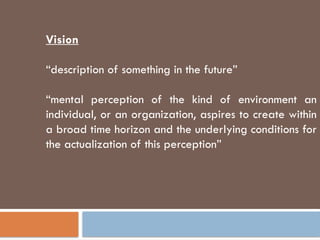
Vision
“description of somethingin the future”
“mental perception of the kind of environment an
individual, or an organization, aspires to create within
a broad time horizon and the underlying conditions for
the actualization of this perception”
3.
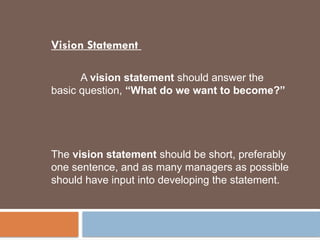
Vision Statement
A visionstatement should answer the
basic question, “What do we want to become?”
The vision statement should be short, preferably
one sentence, and as many managers as possible
should have input into developing the statement.
4.
A Visionprovides strong foundation for developing
a comprehensive mission statement .
Strategic vision addresses the ‘where are we going’
questions and explains the course and direction
chartered by management.
A strategic vision should provide a clear
understanding of what the business should look like
and provide help to take strategic decisions.
5.
Vision
•Strategic intent shouldlead to an end.
•That end is the vision of an organization or an individual.
•It is what the firm or a person would ultimately like to become.
•Should be short and specific.
•It should be based on overall purpose of organization
6.
Characteristics
1. It’s ablue print of the kind of business organization
the management is trying to create and the market
position it would occupy.
2. It should be forward looking a provide strategic
course the management will adopt to help the
company prepare the future
3. Specific and provide guidelines to managers for
making decisions and allocating resources
4. Flexible to changing environment
5. Within realm of companies hope to achieve
7.
6. Appeal toemotions and motivate employees
7. Narrow vision, can focus effort and excite people
8. May not fit to present circumstance, but contributes
to future. Shows picture of future.
9. Should be easy to explain to all stake holders and
preferably short
Benefits of havinga vision
Good visions are inspiring and exhilarating.
Help the organization to prepare for the future.
Clarifies and crystallizes the senior executives views about
the companies long term direction.
Good vision reduces risk-taking and experimentation.
Good vision help to motivate and morale boosting of
employees.
Good visions are competitive, original and unique.
Good visions represent integrity, they are truly genuine and
can be used for the benefit of people.
10.
Limitations of avision statement
Vague and incomplete
Not forward looking
Too broad
Uninspiring
Not distinctive
11.
Examples
1. BSNL VisionStatement : “To become the largest
telecom service provider in Asia.”
2. Walt Disney Vision Statement : “Make people
happy”
3. Stokes Eye Clinic, Florence, South Carolina :
“Our vision is to take care of your vision.”
12.
VISION
Our Vision isto be the world’s mobile
communication leader – enriching customers’
lives, helping individuals, businesses and
communities be more connected in a mobile
world.
Mission
Organizations relate theirexistence to satisfying a
particular need of the society. They do it in terms of
their mission.
Mission is a statement which defines the role that
an organization plays in a society.
It refers to the particular need of that society for
instance, its information needs.
15.
Defining Mission
“essential purposeof the organization, concerning
particularly why it is in existence, the nature of the
business it is in, and the customers it seeks to serve
and satisfy.”
“purpose or reason for the organization’s existence.”
“mission is an enduring statement of purpose that
distinguishes one firm from other similar firm.”
16.
Mission Statement
Missionstatement
reveals what an organization wants to be and
whom it wants to serve
Also called a creed statement, a statement of
purpose, a statement of philosophy, a statement
of beliefs, and a statement of business principles
17.
Example
Vision: WidgetManufacturing will be known worldwide as the
highest quality widget producer.
Mission: Widget Manufacturing strives to:
research and integrate the latest, most reliable widget
technology,
use the most reliable widget manufacturing processes, and
provide unparalleled customer service to every widget customer.
Note that the vision is not what they do, but where they want to be.
The mission statement outlines what Widget Manufacturing will
do. The differences are clear, and quite simple.
1) Declaration ofattitude
Not designed to specific or to have a concrete end.
Is declaration of attitude and outlook
Is meant to provide motivation, general direction, an
image and a philosophy to guide the organization
Should be flexible, even vague to provide room for
adapting to changing environments and ways of
operations
20.
2) Customer orientation
Reflects the anticipation of customer.
The operating philosophy of the organization is
to identify customer needs and then provide a
product or service that fulfill those needs.
Should define:
‘what organization is and what is aspiring to be’
‘be limited enough to exclude some exclude some
ventures and broad enough to allow for creating
growth
‘Have its own identity that distinguish it from
others’
21.
‘serve asa framework to evaluate both current and
prospective activities.
‘be stated in terms sufficiently clear to be widely
understood throughout the organization’
22.
3) Declaration ofsocial policy
Socially oriented policy suggest that the company
takes into consideration not only profit owed to shares
and what it owes to major stakeholders, but also
seriously responds to responsibilities towards
consumer, environmentalists, minorities.
23.
Mission Statement
“A missionstatement is an enduring statement of
purpose that distinguishes one business from other
similar firms. A mission statement identifies the
scope of a firm’s operations in product and market
terms.”
24.
BSNL mission
“To provideworld class state of art technology
telecom services to its customers on demand at
competitive prices.
“ To provide world class telecom infrastructure in its
area of operation and to contribute to the growth
of country’s economy.”
25.
The mission statementof an organization is normally short,
to the point, and contains the following elements:
Provides a concise statement of why the organization
exists, and what it is to achieve;
States the purpose and identity of the organization;
Defines the institution's values and philosophy; and
Describes how the organization will serve those
affected by its work.
26.
Formulating mission
1. Whatis the basic purpose of your organization?
2. What is unique about your organization?
3. What is in your company that will make it stand
out in a crowd?
4. Who are, and who should be, your principal
customers?
5. What are the basic beliefs, values and
philosophical priorities of your firm?
27.
Components of missionstatement
1. Product or service
2. Customers
3. Technology
4. Survival, growth & profitability
5. Company philosophy
6. Public image
7. employees
28.
1) Product orservice
Invariably includes mention of the product or
service the company offers to customers.
2) customers
Information in the mission statement describes the
profiles of customers and the organization it
services.
3) Technology
Components of the mission statement generally
refers to means of production, operations and
organizational functions.
It include elements such as equipments, materials,
techniques, processes, machines and tools.
29.
4) survival, growthand profitability
make a general reference to the company’s
survival and healthy functioning, which include
growth and profitability.
5) Company philosophy :
It reflects the basic believes, values,
aspirations and ethical priorities of company
that guide the employee in conditioning
organizational function.
30.
Need for anexplicit mission
To ensure unanimity of purpose within the organization.
To provide a basis for motivating the use of the
organizations resources.
To develop a basis, or standard, for allocating
organizational resources.
To establish a general tone or organization climate.
To serve as a focal point for those who can identify
with the organization’s purpose and direction.
31.
MISSION
Driving in awireless world
Vodafone is primarily a user of technology rather
than a developer of it, and this fact is reflected in the
emphasis of our work programme on enabling new
applications of mobile communications, using new
technology for new services, research for improving
operational efficiency and quality of our networks,
and providing technology vision and leadership that
can contribute directly to business decisions.
32.
The Process ofDeveloping Vision and
Mission Statements
Select several articles about these statements
and ask all managers to read these as
background information.
Ask managers themselves to prepare a vision
and mission statement for the organization.
33.
The Process ofDeveloping Vision and
Mission Statements
Merge these statements into a single
document and distribute the draft statements
to all managers
Process should create an “emotional bond”
and “sense of mission” between the
organization and its employees
34.
Importance of Visionand
Mission Statements
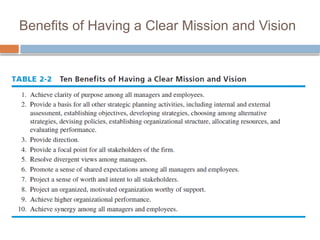
1. To ensure unanimity of purpose within the
organization
2. To provide a basis, or standard, for allocating
organizational resources
3. To establish a general tone or organizational
climate
35.
Importance of Visionand
Mission Statements
4. To serve as a focal point for individuals to
identify with the organization’s purpose and
direction
5. To facilitate the translation of objectives into a
work structure
6. To specify organizational purposes
36.
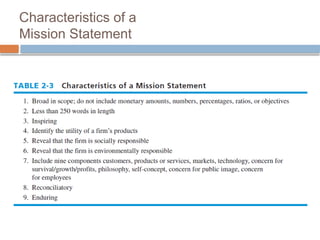
Characteristics of aMission Statement
First, a good mission statement allows for the
generation and consideration of a range of
feasible alternative objectives and strategies
without unduly stifling management creativity.
37.
Characteristics of aMission Statement
Second, a mission statement needs to be
broad to reconcile differences effectively
among, and appeal to, an organization’s
diverse stakeholders
38.
Characteristics of aMission Statement
Stakeholders
include employees, managers, stockholders,
boards of directors, customers, suppliers,
distributors, creditors, governments (local, state,
federal, and foreign), unions, competitors,
environmental groups, and the general public.
A Customer Orientation
Amission statement should:
define what the organization is and what the
organization aspires to be
be limited enough to exclude some ventures
and broad enough to allow for creative growth
distinguish a given organization from all others
41.
A Customer Orientation
Amission statement should also:
serve as a framework for evaluating both
current and prospective activities
be stated in terms sufficiently clear to be widely
understood throughout the organization
42.
A Customer Orientation
A good mission statement reflects the
anticipations of customers.
The operating philosophy of organizations
should be to identify customers’ needs and
then provide a product or service to fulfill those
needs.
43.
Mission Statement Components
1.Customers—Who are the firm’s customers?
2. Products or services—What are the firm’s
major products or services?
3. Markets—Geographically, where does the
firm compete?
4. Technology—Is the firm technologically
current?
44.
Mission Statement Components
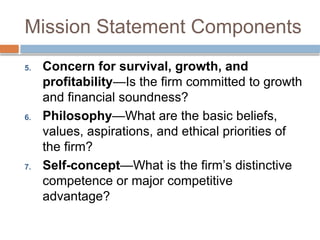
5.Concern for survival, growth, and
profitability—Is the firm committed to growth
and financial soundness?
6. Philosophy—What are the basic beliefs,
values, aspirations, and ethical priorities of
the firm?
7. Self-concept—What is the firm’s distinctive
competence or major competitive
advantage?
45.
Mission Statement Components
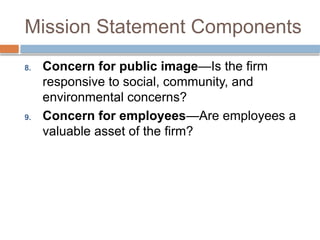
8.Concern for public image—Is the firm
responsive to social, community, and
environmental concerns?
9. Concern for employees—Are employees a
valuable asset of the firm?
L n Ttechnology, Engineering and Construction
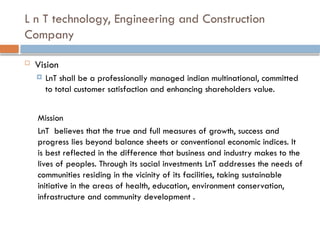
Company
Vision
LnT shall be a professionally managed indian multinational, committed
to total customer satisfaction and enhancing shareholders value.
Mission
LnT believes that the true and full measures of growth, success and
progress lies beyond balance sheets or conventional economic indices. It
is best reflected in the difference that business and industry makes to the
lives of peoples. Through its social investments LnT addresses the needs of
communities residing in the vicinity of its facilities, taking sustainable
initiative in the areas of health, education, environment conservation,
infrastructure and community development .
48.
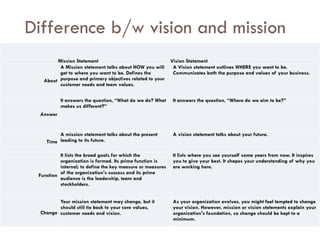
Difference b/w visionand mission
Mission Statement Vision Statement
About
A Mission statement talks about HOW you will
get to where you want to be. Defines the
purpose and primary objectives related to your
customer needs and team values.
A Vision statement outlines WHERE you want to be.
Communicates both the purpose and values of your business.
Answer
It answers the question, “What do we do? What
makes us different?”
It answers the question, “Where do we aim to be?”
Time
A mission statement talks about the present
leading to its future.
A vision statement talks about your future.
Function
It lists the broad goals for which the
organization is formed. Its prime function is
internal; to define the key measure or measures
of the organization's success and its prime
audience is the leadership, team and
stockholders.
It lists where you see yourself some years from now. It inspires
you to give your best. It shapes your understanding of why you
are working here.
Change
Your mission statement may change, but it
should still tie back to your core values,
customer needs and vision.
As your organization evolves, you might feel tempted to change
your vision. However, mission or vision statements explain your
organization's foundation, so change should be kept to a
minimum.
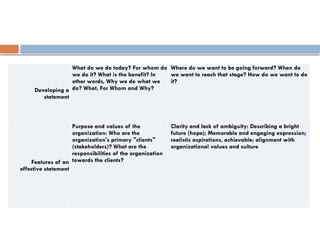
49.
Developing a
statement
What dowe do today? For whom do
we do it? What is the benefit? In
other words, Why we do what we
do? What, For Whom and Why?
Where do we want to be going forward? When do
we want to reach that stage? How do we want to do
it?
Features of an
effective statement
Purpose and values of the
organization: Who are the
organization's primary "clients"
(stakeholders)? What are the
responsibilities of the organization
towards the clients?
Clarity and lack of ambiguity: Describing a bright
future (hope); Memorable and engaging expression;
realistic aspirations, achievable; alignment with
organizational values and culture
50.
Bad Mission Statement
Overly broad mission statements, such as that of Albertson's, fail to tell people exactly
what the business does in a single statement. Albertson's lumps what the company
does into its vision instead of its mission statement by saying, "[Our vision is] to be known
as the favourite neighbourhood food and drug retailer in every market where we do
business, with helpful associates, competitive prices and high quality, fresh products."
McDonald's, for another example, failed to run a simple grammar check. McDonald's
mission statement includes the following sentence: "Our worldwide operations are
aligned around a global strategy called the Plan to Win, which center on an
exceptional customer experience — People, Products, Place, Price and Promotion." It
should have read "… a global strategy called Plan to Win, which centers on an
exceptional customer experience … ."
Here's the first sentence of Barnes & Noble's mission statement: "Our mission is to
operate the best specialty retail business in America, regardless of the product we
sell."Here's the third sentence: "To say that our mission exists independent of the product
we sell is to demean the importance and the distinction of being booksellers."
It's probably better if your mission statement doesn't contradict itself.
51.
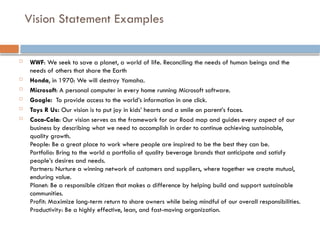
Vision Statement Examples
WWF: We seek to save a planet, a world of life. Reconciling the needs of human beings and the
needs of others that share the Earth
Honda, in 1970: We will destroy Yamaha.
Microsoft: A personal computer in every home running Microsoft software.
Google: To provide access to the world’s information in one click.
Toys R Us: Our vision is to put joy in kids’ hearts and a smile on parent’s faces.
Coca-Cola: Our vision serves as the framework for our Road map and guides every aspect of our
business by describing what we need to accomplish in order to continue achieving sustainable,
quality growth.
People: Be a great place to work where people are inspired to be the best they can be.
Portfolio: Bring to the world a portfolio of quality beverage brands that anticipate and satisfy
people’s desires and needs.
Partners: Nurture a winning network of customers and suppliers, where together we create mutual,
enduring value.
Planet: Be a responsible citizen that makes a difference by helping build and support sustainable
communities.
Profit: Maximize long-term return to share owners while being mindful of our overall responsibilities.
Productivity: Be a highly effective, lean, and fast-moving organization.
52.
Objectives
Objectives represent amanagerial commitment to
achieve specified results in a specified period, of time.
They clearly spell out the quantity and quality of
performance to be achieved, the time period, the
process and the person who is responsible for the
achievement of the objective.
53.
“Objectives are endresults of planned activity”
“Objectives state what is to be accomplished
by when and should be quantified if possible.”
54.
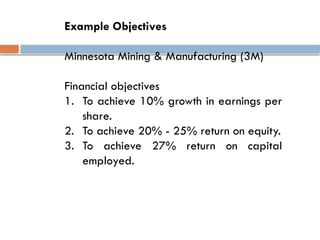
Example Objectives
Minnesota Mining& Manufacturing (3M)
Financial objectives
1. To achieve 10% growth in earnings per
share.
2. To achieve 20% - 25% return on equity.
3. To achieve 27% return on capital
employed.
55.
Characteristics
1. Objectives forma hierarchy
2. Objectives form a network
3. Multiplicity of objectives
4. Long and short range objectives
56.
Areas of objectives
1.Markets
2. Productivity
3. Innovation
4. Product
5. Profitability
6. Financial resources
7. Physical facilities
8. Organization structure and activities
9. Manager performance and development
10. Employee performance and attitude
11. Customer service
12. Social responsibility
57.
Importance of objectives
1.Objectives help to define the organization in its
environment
2. Objectives help in coordinating decisions and
decision-maker
3. Objectives help in formulating strategies
4. Objectives provide standards for assessing
organizational performance
58.
Objectives of BSNL
NationalPlan Target of 500 million subscriber base for
the country by December 2010.
Broadband customers base of 20 million in the country
by 2010 as per Broadband policy 2004.
Goal
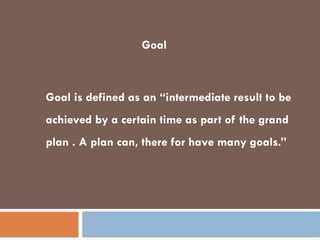
Goal is definedas an “intermediate result to be
achieved by a certain time as part of the grand
plan . A plan can, there for have many goals.”
62.
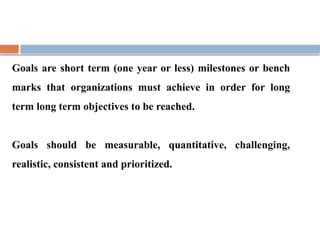
Goals are shortterm (one year or less) milestones or bench
marks that organizations must achieve in order for long
term long term objectives to be reached.
Goals should be measurable, quantitative, challenging,
realistic, consistent and prioritized.
63.
A set ofgoals is needed for each
objective that is established in an
organization.
64.
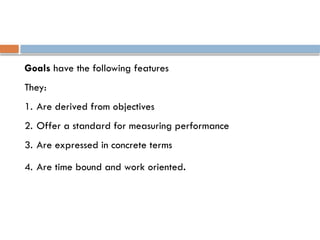
Goals have thefollowing features
They:
1. Are derived from objectives
2. Offer a standard for measuring performance
3. Are expressed in concrete terms
4. Are time bound and work oriented.
65.
Goals are importantin – Strategy
implementation
Objectives are in – strategy formulation
66.
Goals are anexpected or desired outcome of a planning
process. Goals are usually broad, general expressions of
the guiding principles and aspirations of an organization.
Objectives are precise targets that are necessary to
achieve goals. Objectives are detailed statements of
quantitatively or qualitatively measurable results the plan
hopes to accomplish.
67.
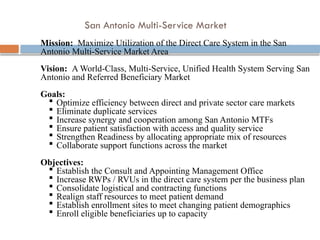
San Antonio Multi-ServiceMarket
Mission: Maximize Utilization of the Direct Care System in the San
Antonio Multi-Service Market Area
Vision: A World-Class, Multi-Service, Unified Health System Serving San
Antonio and Referred Beneficiary Market
Goals:
Optimize efficiency between direct and private sector care markets
Eliminate duplicate services
Increase synergy and cooperation among San Antonio MTFs
Ensure patient satisfaction with access and quality service
Strengthen Readiness by allocating appropriate mix of resources
Collaborate support functions across the market
Objectives:
Establish the Consult and Appointing Management Office
Increase RWPs / RVUs in the direct care system per the business plan
Consolidate logistical and contracting functions
Realign staff resources to meet patient demand
Establish enrollment sites to meet changing patient demographics
Enroll eligible beneficiaries up to capacity
Editor's Notes
#10 Vague & incomplete : the statement is not specific or clear regarding what the company is doing to prepare for the future.
Not forward looking : the statement does not indicate how the management plans to change and move from present focus to future
Too broad : the statement is too generic in nature; it appears that the company can follow any industry or market.
#25 Mission statements say why the business is unique. A mission statement is not developed exclusively by the general manager. It is a collaborative effort and is developed by the management team and line staff. In short, it is developed by those who will live by it, enforce it, and ensure its success. How the mission statement is developed is as important as the statement itself. The process seeks inclusion, values all input, and works by consensus building. The mission belongs to all employees, not just the general manager.
It should evoke some personal response. It needs to be worked on until it gets to be so clear that reminding yourself of it will keep you, on a really bad day, from walking out and quitting.
Research has shown that people who have an understanding or reason for what they are doing, do much better in times of stress. This sense of coherence or mission helps people focus and endure challenges that stand in the way of their realizing their vision. With a clear mission, people know what is important to them and can focus their activity. They can be strategic and pick priorities rather than be reactive.

![Bad Mission Statement
Overly broad mission statements, such as that of Albertson's, fail to tell people exactly
what the business does in a single statement. Albertson's lumps what the company
does into its vision instead of its mission statement by saying, "[Our vision is] to be known
as the favourite neighbourhood food and drug retailer in every market where we do
business, with helpful associates, competitive prices and high quality, fresh products."
McDonald's, for another example, failed to run a simple grammar check. McDonald's
mission statement includes the following sentence: "Our worldwide operations are
aligned around a global strategy called the Plan to Win, which center on an
exceptional customer experience — People, Products, Place, Price and Promotion." It
should have read "… a global strategy called Plan to Win, which centers on an
exceptional customer experience … ."
Here's the first sentence of Barnes & Noble's mission statement: "Our mission is to
operate the best specialty retail business in America, regardless of the product we
sell."Here's the third sentence: "To say that our mission exists independent of the product
we sell is to demean the importance and the distinction of being booksellers."
It's probably better if your mission statement doesn't contradict itself.](https://image.slidesharecdn.com/visionmissionobjectivesandgoals-251005134014-c8f391d3/85/Vision-Mission-Objectives-and-Goals-pptx-50-320.jpg)