KEY JOB ROLES IN
DOCUMENTARIES
Erin Miller
DIRECTORS
Definition of Director
‘a person who supervises the actors and other staff in a film, play, or
similar production’.
Pre-Production
Directors are involved in all of the key stages of production. In pre-
production the director makes key decisions such as; deciding on
filming locations that will help tell the story, identifying significant
events that are scheduled to occur during filming, overseeing scripts
and storyboards, recruiting a crew, developing a filming style etc.
Documentaries can also be based on historical events so it is
important that they have the correct historical documents so they are
not giving out false information. Pre production is important for
documentaries as the director needs to ensure that they have
correctly planned out how they are going to approach the different
sections of the documentary.
DIRECTORS
Filming
Directors are in charge of everything when it comes to filming. This includes
overseeing the dressing of sets, setting up cameras and angles, being ready to
change plans instantly if something unexpected arises, overseeing the safety of
all, pre-interviewing participants to be ready to emphasize significant
information, chairing daily meetings and showings of the daily filming for
discussion and ensuring that all activities and film are logged accurately for the
editing process. Some documentaries, such as nature ones, can cause changing
of plans. This may be down to weather or because a herd of animals change
direction. The director will need to make a conscious decision based on the crew
and what shot it is they are looking for what their next move is going to be.
Filming to Edit
Documentaries are usually shot for a fraction of the cost of a Hollywood feature
film and are often far less predictable. Directors need to think with an editing
mind. It is important that they do this because it will stop waste as well as
expense because editing is expensive. This is sometimes called editing in the
camera. The director develops, with the writers and art director, a loose
storyboard of the film, then frames shots and segments that follow each
thumbnail in the storyboard. That way, film can be assembled in order easily,
simplifying the editing process.
DIRECTORS
Post Production
The post production process is important for the director. They view
all of the footage with the editor which means that they ultimately
decide what stays and what goes. Additionally if the director has
made storyboards and something has changed unexpectedly they will
have to decide what they need to change within the documentary to
suit it best. The director will then view scenes assembled by the
editors and approve or disapprove them and will usually directly
oversee the final assembly of the finished film. A director may then
make a form of advertising such as a trailer ready for distribution.
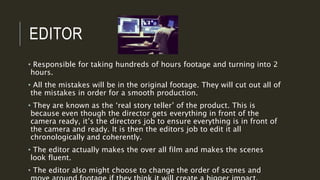
EDITOR
• Responsible for taking hundreds of hours footage and turning into 2
hours.
• All the mistakes will be in the original footage. They will cut out all of
the mistakes in order for a smooth production.
• They are known as the ‘real story teller’ of the product. This is
because even though the director gets everything in front of the
camera ready, it’s the directors job to ensure everything is in front of
the camera and ready. It is then the editors job to edit it all
chronologically and coherently.
• The editor actually makes the over all film and makes the scenes
look fluent.
• The editor also might choose to change the order of scenes and
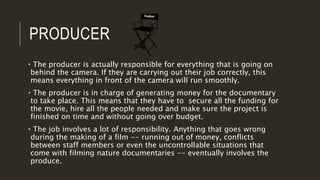
PRODUCER
• The producer is actually responsible for everything that is going on
behind the camera. If they are carrying out their job correctly, this
means everything in front of the camera will run smoothly.
• The producer is in charge of generating money for the documentary
to take place. This means that they have to secure all the funding for
the movie, hire all the people needed and make sure the project is
finished on time and without going over budget.
• The job involves a lot of responsibility. Anything that goes wrong
during the making of a film -- running out of money, conflicts
between staff members or even the uncontrollable situations that
come with filming nature documentaries -- eventually involves the
produce.
SCRIPT SUPERVISORS
• The script supervisor is in charge of making the script for the scenes, as
well as when filming is taking place, making any alterations to the script
based on the way it appears to the audience.
• The script supervisor is in charge of making sure that the finished product
makes continuous verbal and visual sense.
• during the pre-production of a documentary, they check over the script
ensuring that there have been no errors or inconsistencies made. They also
prepare the estimated running times.
• During production they work closely with the director keeping note of any
changes that have been made. They have to keep photographic evidence of
dialogue, action, costumes, props and set design, all camera and lens
details, all slate and scene number information, so that when different takes
are edited together, the fictional world of the film is not disrupted by
continuity errors.

Key job roles in documentaries

  • 1.
    KEY JOB ROLESIN DOCUMENTARIES Erin Miller
  • 2.
    DIRECTORS Definition of Director ‘aperson who supervises the actors and other staff in a film, play, or similar production’. Pre-Production Directors are involved in all of the key stages of production. In pre- production the director makes key decisions such as; deciding on filming locations that will help tell the story, identifying significant events that are scheduled to occur during filming, overseeing scripts and storyboards, recruiting a crew, developing a filming style etc. Documentaries can also be based on historical events so it is important that they have the correct historical documents so they are not giving out false information. Pre production is important for documentaries as the director needs to ensure that they have correctly planned out how they are going to approach the different sections of the documentary.
  • 3.
    DIRECTORS Filming Directors are incharge of everything when it comes to filming. This includes overseeing the dressing of sets, setting up cameras and angles, being ready to change plans instantly if something unexpected arises, overseeing the safety of all, pre-interviewing participants to be ready to emphasize significant information, chairing daily meetings and showings of the daily filming for discussion and ensuring that all activities and film are logged accurately for the editing process. Some documentaries, such as nature ones, can cause changing of plans. This may be down to weather or because a herd of animals change direction. The director will need to make a conscious decision based on the crew and what shot it is they are looking for what their next move is going to be. Filming to Edit Documentaries are usually shot for a fraction of the cost of a Hollywood feature film and are often far less predictable. Directors need to think with an editing mind. It is important that they do this because it will stop waste as well as expense because editing is expensive. This is sometimes called editing in the camera. The director develops, with the writers and art director, a loose storyboard of the film, then frames shots and segments that follow each thumbnail in the storyboard. That way, film can be assembled in order easily, simplifying the editing process.
  • 4.
    DIRECTORS Post Production The postproduction process is important for the director. They view all of the footage with the editor which means that they ultimately decide what stays and what goes. Additionally if the director has made storyboards and something has changed unexpectedly they will have to decide what they need to change within the documentary to suit it best. The director will then view scenes assembled by the editors and approve or disapprove them and will usually directly oversee the final assembly of the finished film. A director may then make a form of advertising such as a trailer ready for distribution.
  • 5.
    EDITOR • Responsible fortaking hundreds of hours footage and turning into 2 hours. • All the mistakes will be in the original footage. They will cut out all of the mistakes in order for a smooth production. • They are known as the ‘real story teller’ of the product. This is because even though the director gets everything in front of the camera ready, it’s the directors job to ensure everything is in front of the camera and ready. It is then the editors job to edit it all chronologically and coherently. • The editor actually makes the over all film and makes the scenes look fluent. • The editor also might choose to change the order of scenes and
  • 6.
    PRODUCER • The produceris actually responsible for everything that is going on behind the camera. If they are carrying out their job correctly, this means everything in front of the camera will run smoothly. • The producer is in charge of generating money for the documentary to take place. This means that they have to secure all the funding for the movie, hire all the people needed and make sure the project is finished on time and without going over budget. • The job involves a lot of responsibility. Anything that goes wrong during the making of a film -- running out of money, conflicts between staff members or even the uncontrollable situations that come with filming nature documentaries -- eventually involves the produce.
  • 7.
    SCRIPT SUPERVISORS • Thescript supervisor is in charge of making the script for the scenes, as well as when filming is taking place, making any alterations to the script based on the way it appears to the audience. • The script supervisor is in charge of making sure that the finished product makes continuous verbal and visual sense. • during the pre-production of a documentary, they check over the script ensuring that there have been no errors or inconsistencies made. They also prepare the estimated running times. • During production they work closely with the director keeping note of any changes that have been made. They have to keep photographic evidence of dialogue, action, costumes, props and set design, all camera and lens details, all slate and scene number information, so that when different takes are edited together, the fictional world of the film is not disrupted by continuity errors.