Introduction
Presented By: Yogesh Deshmukh
ESFl Waluj
ISO 22000:2018
ISO :International Organization for standardization.
The ISO Founded in 1947 by a group of delegates from 25
countries, the 67 original technical committees of ISO came
together with a unified goal of ensuring products and services
are safe, reliable, and of good quality.
Types of ISO Certifications
1. ISO 9000 - Quality Management
2. ISO 14000 – Environmental Management
3.ISO 22000 – Food Management Systems
Its version’s are
• 22000:2005
• 22000:2018
What is ISO 22000
 ISO 22000 is a version created by ISO for Food Management
system . ISO’s food safety management standards help
organizations identify and control food safety hazards, at the
same time as working together with other ISO management
standards, such as ISO 9001. Applicable to all types of
producer, ISO 22000 provides a layer of reassurance within the
global food supply chain, helping products cross borders and
bringing people food that they can trust.
• The high level structure: in order to make life easier for
businesses using more than one management system standard,
the new version of ISO 22000 will follow the same structure as all
the other ISO management system standards, the HLS.
• It makes it easier for organizations to obtain ISO certification of
multiple ISO Standards.
Difference between ISO 22000:2005 and 22000:2018
According to the ISO) the major changes to the standard include
modifications to its structure as well as clarifying key concepts
such as:
•The risk approach: the standard now includes a different approach
to understanding risk.
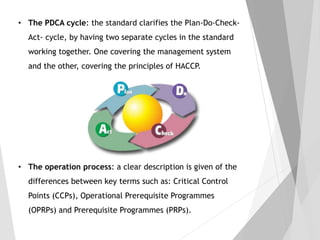
• The PDCA cycle: the standard clarifies the Plan-Do-Check-
Act- cycle, by having two separate cycles in the standard
working together. One covering the management system
and the other, covering the principles of HACCP.
• The operation process: a clear description is given of the
differences between key terms such as: Critical Control
Points (CCPs), Operational Prerequisite Programmes
(OPRPs) and Prerequisite Programmes (PRPs).
1) Changes due to the adoption of HLS
Business Context and interested parties:
• external and internal issues
• introduces new clauses for systematic determination
and monitoring of the business context.
Ref.SOP for context of organization
• Needs and expectations of interested parties,
• introduces demands to identify and understand factors
that can (potentially) affect the ability of Management
System to reach the intended results.
Ref.: List of Interested Parties
Strengthened emphasis on leadership and management
commitment
now includes new demands to actively engage and take accountability for
the effectiveness of the management system.
1.Risk management: - Now requires companies to determine, consider
and, where necessary, take action to address any risks that may impact
(either positively or negatively)
1) New product development
2) Manufacturing process improvement
3) packaging and transportation
4) New vendors development
5) Specification development
6)Wastage Management system
Strengthened focus on objectives as drivers for improvements.
I.e.
• Conformity of product and services
• Customer Satisfaction
• Quality management system performance and effectiveness
• Performance of vendors.
• Market feedback
communications: The “mechanics” of communication, including
determination of what, when and how to communicate.
• Communication
• Review Meetings
• E mails and one to one discussion
• Products and new products
• Cleaning and sanitation programme
• Less strict requirements for a food safety manual: – It is still
required to have documented information. Documented information
shall be controlled to ensure it is adequately protected (ref. 7.5.3).
The explicit requirement to have a documented procedure has been
removed.
• 2) Other changes that are specific to ISO 22000 and food safety
management.
• Some important changes in the definitions: ‘Harm’ is replaced by
‘adverse health effect’ to ensure consistency with definition of food
safety hazard. The use of ‘assurance’ highlights the relationship
between the consumer and the food product, based on the assurance
of food safety.
• In addition, there are several key changes in the ISO 22000:2018
compared to ISO 22000:2005 related to the HACCP systematics.
Thank You

Iso 220002018

  • 1.
    Introduction Presented By: YogeshDeshmukh ESFl Waluj ISO 22000:2018
  • 2.
    ISO :International Organizationfor standardization. The ISO Founded in 1947 by a group of delegates from 25 countries, the 67 original technical committees of ISO came together with a unified goal of ensuring products and services are safe, reliable, and of good quality.
  • 3.
    Types of ISOCertifications 1. ISO 9000 - Quality Management 2. ISO 14000 – Environmental Management 3.ISO 22000 – Food Management Systems Its version’s are • 22000:2005 • 22000:2018
  • 4.
    What is ISO22000  ISO 22000 is a version created by ISO for Food Management system . ISO’s food safety management standards help organizations identify and control food safety hazards, at the same time as working together with other ISO management standards, such as ISO 9001. Applicable to all types of producer, ISO 22000 provides a layer of reassurance within the global food supply chain, helping products cross borders and bringing people food that they can trust.
  • 5.
    • The highlevel structure: in order to make life easier for businesses using more than one management system standard, the new version of ISO 22000 will follow the same structure as all the other ISO management system standards, the HLS. • It makes it easier for organizations to obtain ISO certification of multiple ISO Standards. Difference between ISO 22000:2005 and 22000:2018 According to the ISO) the major changes to the standard include modifications to its structure as well as clarifying key concepts such as: •The risk approach: the standard now includes a different approach to understanding risk.
  • 6.
    • The PDCAcycle: the standard clarifies the Plan-Do-Check- Act- cycle, by having two separate cycles in the standard working together. One covering the management system and the other, covering the principles of HACCP. • The operation process: a clear description is given of the differences between key terms such as: Critical Control Points (CCPs), Operational Prerequisite Programmes (OPRPs) and Prerequisite Programmes (PRPs).
  • 7.
    1) Changes dueto the adoption of HLS Business Context and interested parties: • external and internal issues • introduces new clauses for systematic determination and monitoring of the business context. Ref.SOP for context of organization • Needs and expectations of interested parties, • introduces demands to identify and understand factors that can (potentially) affect the ability of Management System to reach the intended results. Ref.: List of Interested Parties
  • 8.
    Strengthened emphasis onleadership and management commitment now includes new demands to actively engage and take accountability for the effectiveness of the management system. 1.Risk management: - Now requires companies to determine, consider and, where necessary, take action to address any risks that may impact (either positively or negatively) 1) New product development 2) Manufacturing process improvement 3) packaging and transportation 4) New vendors development 5) Specification development 6)Wastage Management system
  • 9.
    Strengthened focus onobjectives as drivers for improvements. I.e. • Conformity of product and services • Customer Satisfaction • Quality management system performance and effectiveness • Performance of vendors. • Market feedback communications: The “mechanics” of communication, including determination of what, when and how to communicate. • Communication • Review Meetings • E mails and one to one discussion • Products and new products • Cleaning and sanitation programme
  • 10.
    • Less strictrequirements for a food safety manual: – It is still required to have documented information. Documented information shall be controlled to ensure it is adequately protected (ref. 7.5.3). The explicit requirement to have a documented procedure has been removed.
  • 11.
    • 2) Otherchanges that are specific to ISO 22000 and food safety management. • Some important changes in the definitions: ‘Harm’ is replaced by ‘adverse health effect’ to ensure consistency with definition of food safety hazard. The use of ‘assurance’ highlights the relationship between the consumer and the food product, based on the assurance of food safety. • In addition, there are several key changes in the ISO 22000:2018 compared to ISO 22000:2005 related to the HACCP systematics.
  • 12.