Presented by: Sukaina Janmohamed &Vanshika Madaan
Multicultural Diet Group Assignment
Slide 2: Introduction
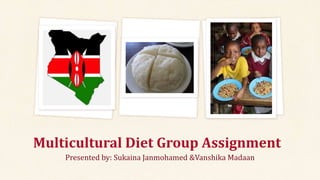
Slide 3: Location of Kenya
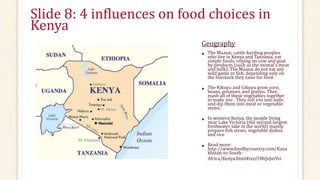
• Bordered by the countries of Ethiopia, Somalia, South Sudan, Tanzania, and Uganda, as well as the Indian
Ocean.
• The official languages of Kenya are Swahili and English.
• Traditional Kenyan foods reflect the many different lifestyles of the various groups in the country. Most
Kenyan dishes are filling and inexpensive to make. Staple foods consist mainly of corn, maize, potatoes, and
beans. Ugali (a porridge made of maize) and meat are typically eaten inland, while the coastal peoples eat a
more varied diet.
• Kenya is located in East Africa near the Equator (the imaginary line that divides the Earth into the Northern
and Southern Hemispheres). The country is approximately twice the size of Nevada. The southeast part of
Kenya borders the Indian Ocean. The land regions are varied and range from year-round snow in the Kenya
and Kilimanjaro Mountains to warm, tropical beaches. Some of the regions are desert, but most land is rolling
grasslands and forests.
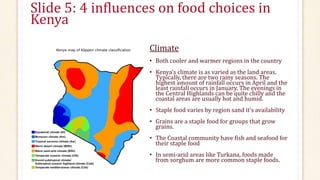
• Kenya’s climate is as varied as the land areas. Typically, there are two rainy seasons. The highest amount of
rainfall occurs in April and the least rainfall occurs in January. The evenings in the Central Highlands can be
quite chilly and the coastal areas are usually hot and humid.
4 influences on food choices
in Kenya
• Climate
• Religion
• Economics
• Geography
Slide 5: 4 influences on food choices in
Kenya
Climate
• Both cooler and warmer regions in the country
• Kenya’s climate is as varied as the land areas.
Typically, there are two rainy seasons. The
highest amount of rainfall occurs in April and the
least rainfall occurs in January. The evenings in
the Central Highlands can be quite chilly and the
coastal areas are usually hot and humid.
• Staple food varies by region sand it’s availability
• Grains are a staple food for groups that grow
grains.
• The Coastal community have fish and seafood for
their staple food
• In semi-arid areas like Turkana, foods made
from sorghum are more common staple foods.
Slide 6: 4 influences on food choices in
Kenya
Religion
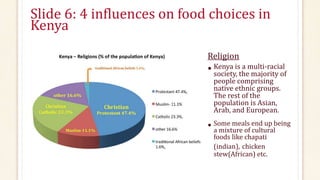
• Kenya is a multi-racial
society, the majority of
people comprising
native ethnic groups.
The rest of the
population is Asian,
Arab, and European.
• Some meals end up being
a mixture of cultural
foods like chapati
(indian), chicken
stew(African) etc.
Slide 7: 4 influences on food choices in
Kenya
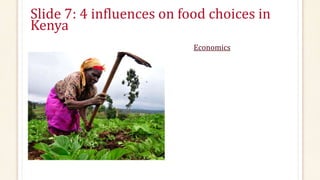
Economics
Slide 8: 4 influences on food choices in
Kenya
Geography
• The Maasai, cattle-herding peoples
who live in Kenya and Tanzania, eat
simple foods, relying on cow and goat
by-products (such as the animal’s meat
and milk). The Maasai do not eat any
wild game or fish, depending only on
the livestock they raise for food.
• The Kikuyu and Gikuyu grow corn,
beans, potatoes, and greens. They
mash all of these vegetables together
to make irio . They roll irio into balls
and dip them into meat or vegetable
stews.
• In western Kenya, the people living
near Lake Victoria (the second-largest
freshwater lake in the world) mainly
prepare fish stews, vegetable dishes,
and rice
• Read more:
http://www.foodbycountry.com/Kaza
khstan-to-South-
Africa/Kenya.html#ixzz5MQoJmYvi
Typical Breakfast foods in Kenya
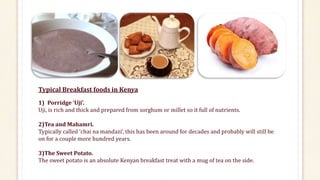
1) Porridge ‘Uji’.
Uji, is rich and thick and prepared from sorghum or millet so it full of nutrients.
2)Tea and Mahamri.
Typically called ‘chai na mandazi’, this has been around for decades and probably will still be
on for a couple more hundred years.
3)The Sweet Potato.
The sweet potato is an absolute Kenyan breakfast treat with a mug of tea on the side.
Typical lunch foods in Kenya
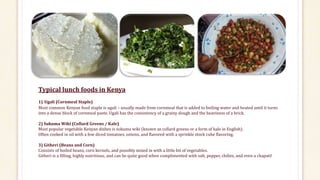
1) Ugali (Cornmeal Staple)
Most common Kenyan food staple is ugali – usually made from cornmeal that is added to boiling water and heated until it turns
into a dense block of cornmeal paste. Ugali has the consistency of a grainy dough and the heaviness of a brick.
2) Sukuma Wiki (Collard Greens / Kale)
Most popular vegetable Kenyan dishes is sukuma wiki (known as collard greens or a form of kale in English).
Often cooked in oil with a few diced tomatoes, onions, and flavored with a sprinkle stock cube flavoring.
3) Githeri (Beans and Corn)
Consists of boiled beans, corn kernels, and possibly mixed in with a little bit of vegetables.
Githeri is a filling, highly nutritious, and can be quite good when complimented with salt, pepper, chilies, and even a chapati!
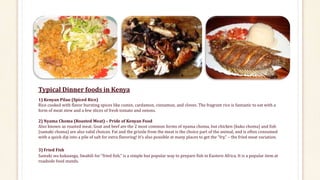
Typical Dinner foods in Kenya
1) Kenyan Pilau (Spiced Rice)
Rice cooked with flavor bursting spices like cumin, cardamon, cinnamon, and cloves. The fragrant rice is fantastic to eat with a
form of meat stew and a few slices of fresh tomato and onions.
2) Nyama Choma (Roasted Meat) – Pride of Kenyan Food
Also known as roasted meat. Goat and beef are the 2 most common forms of nyama choma, but chicken (kuku choma) and fish
(samaki choma) are also valid choices. Fat and the grizzle from the meat is the choice part of the animal, and is often consumed
with a quick dip into a pile of salt for extra flavoring! It’s also possible at many places to get the “fry,” – the fried meat variation.
3) Fried Fish
Samaki wa kukaanga, Swahili for “fried fish,” is a simple but popular way to prepare fish in Eastern Africa. It is a popular item at
roadside food stands.
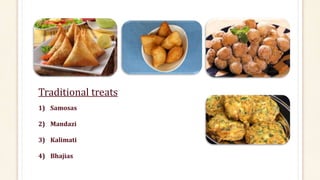
Traditional treats
1) Samosas
2) Mandazi
3) Kalimati
4) Bhajias
Food Guide Canada vs. Kenya
Food pyramids show that Kenyan pyramid has an additional food group called ‘staples’ consisting of
rice, potatoes, cassava, maize, sorghum, millet that is not present in the Canadian guide. A big
population in Kenya relies on the staple for their daily diet for it’s availability and price for low income
majority
Kenya servings size guide is not applicable.
When we compare fats and oils used. Canadians are more health conscious and use less fattening oils
such as olive oil, butter for cooking. In Kenya oils are considered a luxury and expensive to acquire
therefor a huge portion of population use margarine, sunflower oil to cook that has a higher fat
content.
Does your country’s guide include sustainable eating guidelines?
Strengths & Concerns of the country’s diet
Strengths
1. Low in carbs in terms of bread and rice as not on a country’s guide
• Staples like cassava, maize meal, potatoes are a more healthier version of the carb intake Kenyans have
compared to the Canadian food guide of bread, rice, cereal, pasta intake.
2. High in protein because lentils are a huge part of the pyramid eaten daily in large amounts.
• Items eaten such as Githeri and Sima
Concerns
1. The major Nutritional disease faced by Kenyans is Malnutrition.
1. The percentage of population of kids under age 5 from a population of 7 million which is 1.82 million children
(26 percent) are suffering from chronic malnutrition (stunting or low height-for-age).
1. Beginning twenty-first century, a prolonged drought (especially northern Kenya)
• Major cause of malnutrition, destroying food crops and forcing poorer families to live on meals of maize.
• Lack of protein- resulting deficiency diseases, especially younger children.
• Symptoms: fatigue and lethargy, poor growth with generalized swelling, protuding round stomach,
skin rashes and hair loss also common.
Reference:
https://www.usaid.gov/what-we-do/global-health/nutrition/countries/kenya-nutrition-profile
Where to find Kenyan food in Toronto
Simba Grill and Pili pili are 2 examples of restaurants located in toronto and scarborough that sell
authentic east African dishes to tickle the Eat african taste buds.

Personal Version

  • 1.
    Presented by: SukainaJanmohamed &Vanshika Madaan Multicultural Diet Group Assignment
  • 2.
  • 3.
    Slide 3: Locationof Kenya • Bordered by the countries of Ethiopia, Somalia, South Sudan, Tanzania, and Uganda, as well as the Indian Ocean. • The official languages of Kenya are Swahili and English. • The official languages of Kenya are Swahili and English. • Traditional Kenyan foods reflect the many different lifestyles of the various groups in the country. Most Kenyan dishes are filling and inexpensive to make. Staple foods consist mainly of corn, maize, potatoes, and beans. Ugali (a porridge made of maize) and meat are typically eaten inland, while the coastal peoples eat a more varied diet. • Kenya is located in East Africa near the Equator (the imaginary line that divides the Earth into the Northern and Southern Hemispheres). The country is approximately twice the size of Nevada. The southeast part of Kenya borders the Indian Ocean. The land regions are varied and range from year-round snow in the Kenya and Kilimanjaro Mountains to warm, tropical beaches. Some of the regions are desert, but most land is rolling grasslands and forests. • Kenya’s climate is as varied as the land areas. Typically, there are two rainy seasons. The highest amount of rainfall occurs in April and the least rainfall occurs in January. The evenings in the Central Highlands can be quite chilly and the coastal areas are usually hot and humid.
  • 4.
    4 influences onfood choices in Kenya • Climate • Religion • Economics • Geography
  • 5.
    Slide 5: 4influences on food choices in Kenya Climate • Both cooler and warmer regions in the country • Kenya’s climate is as varied as the land areas. Typically, there are two rainy seasons. The highest amount of rainfall occurs in April and the least rainfall occurs in January. The evenings in the Central Highlands can be quite chilly and the coastal areas are usually hot and humid. • Staple food varies by region sand it’s availability • Grains are a staple food for groups that grow grains. • The Coastal community have fish and seafood for their staple food • In semi-arid areas like Turkana, foods made from sorghum are more common staple foods.
  • 6.
    Slide 6: 4influences on food choices in Kenya Religion • Kenya is a multi-racial society, the majority of people comprising native ethnic groups. The rest of the population is Asian, Arab, and European. • Some meals end up being a mixture of cultural foods like chapati (indian), chicken stew(African) etc.
  • 7.
    Slide 7: 4influences on food choices in Kenya Economics
  • 8.
    Slide 8: 4influences on food choices in Kenya Geography • The Maasai, cattle-herding peoples who live in Kenya and Tanzania, eat simple foods, relying on cow and goat by-products (such as the animal’s meat and milk). The Maasai do not eat any wild game or fish, depending only on the livestock they raise for food. • The Kikuyu and Gikuyu grow corn, beans, potatoes, and greens. They mash all of these vegetables together to make irio . They roll irio into balls and dip them into meat or vegetable stews. • In western Kenya, the people living near Lake Victoria (the second-largest freshwater lake in the world) mainly prepare fish stews, vegetable dishes, and rice • Read more: http://www.foodbycountry.com/Kaza khstan-to-South- Africa/Kenya.html#ixzz5MQoJmYvi
  • 9.
    Typical Breakfast foodsin Kenya 1) Porridge ‘Uji’. Uji, is rich and thick and prepared from sorghum or millet so it full of nutrients. 2)Tea and Mahamri. Typically called ‘chai na mandazi’, this has been around for decades and probably will still be on for a couple more hundred years. 3)The Sweet Potato. The sweet potato is an absolute Kenyan breakfast treat with a mug of tea on the side.
  • 10.
    Typical lunch foodsin Kenya 1) Ugali (Cornmeal Staple) Most common Kenyan food staple is ugali – usually made from cornmeal that is added to boiling water and heated until it turns into a dense block of cornmeal paste. Ugali has the consistency of a grainy dough and the heaviness of a brick. 2) Sukuma Wiki (Collard Greens / Kale) Most popular vegetable Kenyan dishes is sukuma wiki (known as collard greens or a form of kale in English). Often cooked in oil with a few diced tomatoes, onions, and flavored with a sprinkle stock cube flavoring. 3) Githeri (Beans and Corn) Consists of boiled beans, corn kernels, and possibly mixed in with a little bit of vegetables. Githeri is a filling, highly nutritious, and can be quite good when complimented with salt, pepper, chilies, and even a chapati!
  • 11.
    Typical Dinner foodsin Kenya 1) Kenyan Pilau (Spiced Rice) Rice cooked with flavor bursting spices like cumin, cardamon, cinnamon, and cloves. The fragrant rice is fantastic to eat with a form of meat stew and a few slices of fresh tomato and onions. 2) Nyama Choma (Roasted Meat) – Pride of Kenyan Food Also known as roasted meat. Goat and beef are the 2 most common forms of nyama choma, but chicken (kuku choma) and fish (samaki choma) are also valid choices. Fat and the grizzle from the meat is the choice part of the animal, and is often consumed with a quick dip into a pile of salt for extra flavoring! It’s also possible at many places to get the “fry,” – the fried meat variation. 3) Fried Fish Samaki wa kukaanga, Swahili for “fried fish,” is a simple but popular way to prepare fish in Eastern Africa. It is a popular item at roadside food stands.
  • 12.
    Traditional treats 1) Samosas 2)Mandazi 3) Kalimati 4) Bhajias
  • 13.
    Food Guide Canadavs. Kenya Food pyramids show that Kenyan pyramid has an additional food group called ‘staples’ consisting of rice, potatoes, cassava, maize, sorghum, millet that is not present in the Canadian guide. A big population in Kenya relies on the staple for their daily diet for it’s availability and price for low income majority Kenya servings size guide is not applicable. When we compare fats and oils used. Canadians are more health conscious and use less fattening oils such as olive oil, butter for cooking. In Kenya oils are considered a luxury and expensive to acquire therefor a huge portion of population use margarine, sunflower oil to cook that has a higher fat content. Does your country’s guide include sustainable eating guidelines?
  • 14.
    Strengths & Concernsof the country’s diet Strengths 1. Low in carbs in terms of bread and rice as not on a country’s guide • Staples like cassava, maize meal, potatoes are a more healthier version of the carb intake Kenyans have compared to the Canadian food guide of bread, rice, cereal, pasta intake. 2. High in protein because lentils are a huge part of the pyramid eaten daily in large amounts. • Items eaten such as Githeri and Sima Concerns 1. The major Nutritional disease faced by Kenyans is Malnutrition. 1. The percentage of population of kids under age 5 from a population of 7 million which is 1.82 million children (26 percent) are suffering from chronic malnutrition (stunting or low height-for-age). 1. Beginning twenty-first century, a prolonged drought (especially northern Kenya) • Major cause of malnutrition, destroying food crops and forcing poorer families to live on meals of maize. • Lack of protein- resulting deficiency diseases, especially younger children. • Symptoms: fatigue and lethargy, poor growth with generalized swelling, protuding round stomach, skin rashes and hair loss also common. Reference: https://www.usaid.gov/what-we-do/global-health/nutrition/countries/kenya-nutrition-profile
  • 15.
    Where to findKenyan food in Toronto Simba Grill and Pili pili are 2 examples of restaurants located in toronto and scarborough that sell authentic east African dishes to tickle the Eat african taste buds.

Editor's Notes

  • #2 NOTE: To replace a picture, just select and delete it. Then use the Insert Picture icon to replace it with one of your own!