Nigeria
Part # 1
States and cities in Nigeria.
Part # 2
People who live in Nigeria.
Part # 3
Economy of Nigeria.
Part # 4
Some political aspects.
Part # 1
States and cities in Nigeria
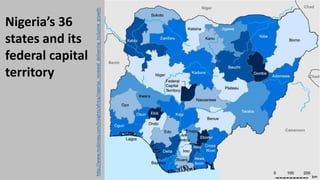
Nigeria’s 36
states and its
federal capital
territory
http://www.mckinsey.com/insights/africa/nigerias_renewal_delivering_inclusive_growth
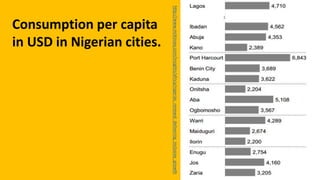
Consumption per capita
in USD in Nigerian cities.
http://www.mckinsey.com/insights/africa/nigerias_renewal_delivering_inclusive_growth
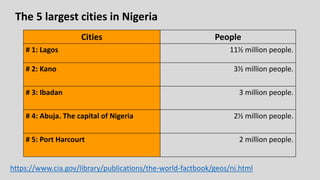
Cities People
# 1: Lagos 11½ million people.
# 2: Kano 3½ million people.
# 3: Ibadan 3 million people.
# 4: Abuja. The capital of Nigeria 2½ million people.
# 5: Port Harcourt 2 million people.
https://www.cia.gov/library/publications/the-world-factbook/geos/ni.html
The 5 largest cities in Nigeria
https://www.cia.gov/library/publications/the-world-factbook/geos/ni.html
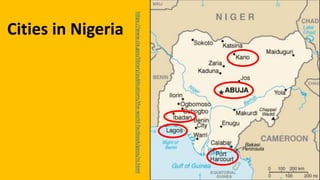
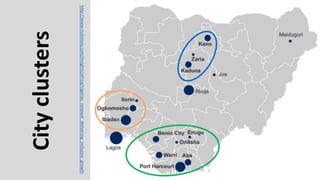
Cities in Nigeria
http://www.mckinsey.com/insights/africa/nigerias_renewal_delivering_inclusive_growth
Cityclusters
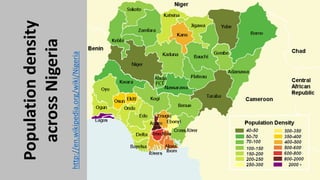
Populationdensity
acrossNigeria
http://en.wikipedia.org/wiki/Nigeria
Part # 2
People who live in Nigeria
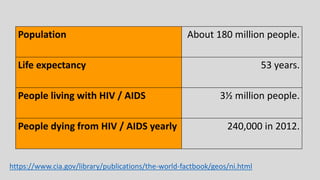
Population About 180 million people.
Life expectancy 53 years.
People living with HIV / AIDS 3½ million people.
People dying from HIV / AIDS yearly 240,000 in 2012.
https://www.cia.gov/library/publications/the-world-factbook/geos/ni.html
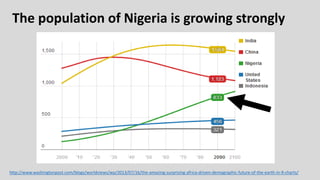
http://www.washingtonpost.com/blogs/worldviews/wp/2013/07/16/the-amazing-surprising-africa-driven-demographic-future-of-the-earth-in-9-charts/
The population of Nigeria is growing strongly
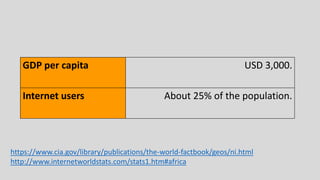
GDP per capita USD 3,000.
Internet users About 25% of the population.
https://www.cia.gov/library/publications/the-world-factbook/geos/ni.html
http://www.internetworldstats.com/stats1.htm#africa
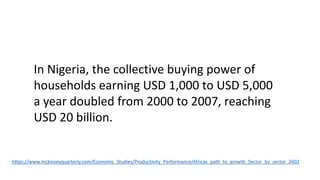
In Nigeria, the collective buying power of
households earning USD 1,000 to USD 5,000
a year doubled from 2000 to 2007, reaching
USD 20 billion.
https://www.mckinseyquarterly.com/Economic_Studies/Productivity_Performance/Africas_path_to_growth_Sector_by_sector_2602
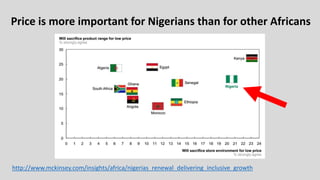
Price is more important for Nigerians than for other Africans
http://www.mckinsey.com/insights/africa/nigerias_renewal_delivering_inclusive_growth
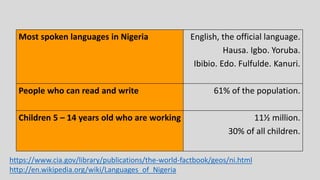
Most spoken languages in Nigeria English, the official language.
Hausa. Igbo. Yoruba.
Ibibio. Edo. Fulfulde. Kanuri.
People who can read and write 61% of the population.
Children 5 – 14 years old who are working 11½ million.
30% of all children.
https://www.cia.gov/library/publications/the-world-factbook/geos/ni.html
http://en.wikipedia.org/wiki/Languages_of_Nigeria
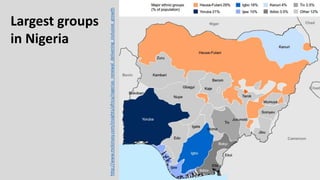
Largest groups
in Nigeria
http://www.mckinsey.com/insights/africa/nigerias_renewal_delivering_inclusive_growth
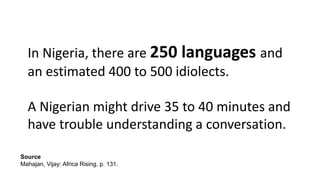
In Nigeria, there are 250 languages and
an estimated 400 to 500 idiolects.
A Nigerian might drive 35 to 40 minutes and
have trouble understanding a conversation.
Source
Mahajan, Vijay: Africa Rising, p. 131.
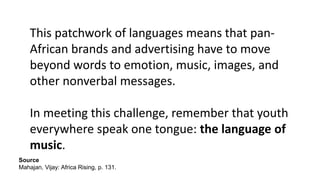
This patchwork of languages means that pan-
African brands and advertising have to move
beyond words to emotion, music, images, and
other nonverbal messages.
In meeting this challenge, remember that youth
everywhere speak one tongue: the language of
music.
Source
Mahajan, Vijay: Africa Rising, p. 131.
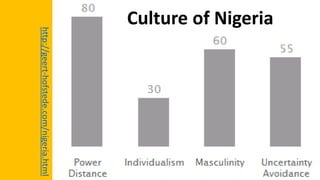
http://geert-hofstede.com/nigeria.html
Culture of Nigeria
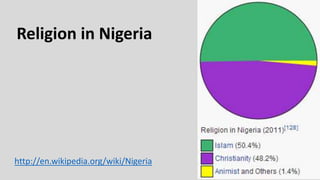
Religion in Nigeria
http://en.wikipedia.org/wiki/Nigeria
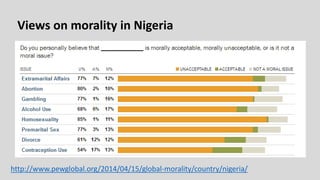
Views on morality in Nigeria
http://www.pewglobal.org/2014/04/15/global-morality/country/nigeria/
Part # 3
Economy of Nigeria
Energy and electricity
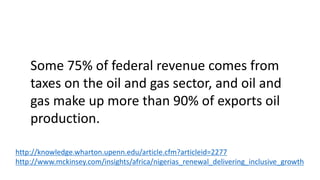
Some 75% of federal revenue comes from
taxes on the oil and gas sector, and oil and
gas make up more than 90% of exports oil
production.
http://knowledge.wharton.upenn.edu/article.cfm?articleid=2277
http://www.mckinsey.com/insights/africa/nigerias_renewal_delivering_inclusive_growth
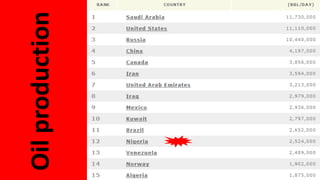
Oilproduction
https://www.cia.gov/library/publications/the-world-factbook/rankorder/2242rank.html
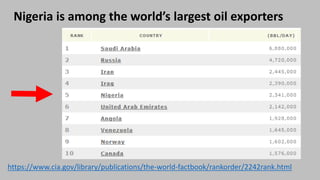
Nigeria is among the world’s largest oil exporters
In November 2010, Petrofac entered into a
strategic alliance with Seven Energy, a Nigerian
oil production and development company.
http://www.petrofac.com/regions/africa/nigeria.aspx
http://www.sevenenergy.com/
About 40% of the people living in Nigeria
have access to electricity.
For those with access to electricity, it's
available just 4 to 8 hours per day.
http://knowledge.wharton.upenn.edu/article.cfm?articleid=2277
Nigeria has almost as many citizens as
Brazil but produces just 5% as much
electricity.
http://hbr.org/2014/01/the-new-rules-of-globalization/ar/4
Retail
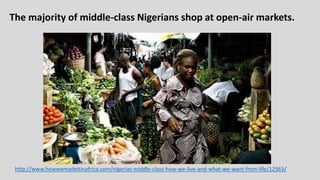
The majority of middle-class Nigerians shop at open-air markets.
http://www.howwemadeitinafrica.com/nigerias-middle-class-how-we-live-and-what-we-want-from-life/12563/
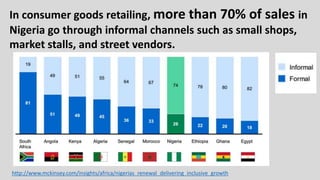
In consumer goods retailing, more than 70% of sales in
Nigeria go through informal channels such as small shops,
market stalls, and street vendors.
http://www.mckinsey.com/insights/africa/nigerias_renewal_delivering_inclusive_growth
In Nigeria, sales through modern-format stores
are growing by more than 20% per year.
http://www.mckinsey.com/insights/africa/nigerias_renewal_delivering_inclusive_growth
Sources
http://www.shoprite.com.ng/
http://sparnigeria.com/
Sources
http://www.jumia.com.ng/
http://www.konga.com/
Media
Sources
http://www.naij.com/
http://www.nollywood.com/
http://www.vanguardngr.com/
Sources
https://www.eskimi.com/
http://www.mobofree.com/
http://www.nairaland.com/
http://www.nigerianbestforum.com/
http://www.vconnect.com/
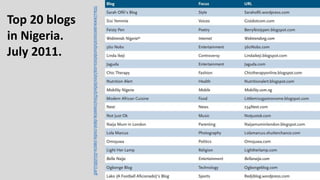
Top 20 blogs
in Nigeria.
July 2011.
http://www.opensocietyfoundations.org/sites/default/files/mapping-digial-media-nigeria-20120813.pdf
Finance
Sources
http://www.gtbank.com/
https://www.mypaga.com/
The Nigerian incubator Wennovation Hub takes
equity stakes in tech start-ups and other promising
ventures in return for facilities, mentorship, Internet
access, legal services, and funding opportunities.
http://www.wennovationhub.com/
http://voices.mckinseyonsociety.com/mckinsey-james-manyika-michael-chui-entrepreneurs-key-to-internet-growth/
Sanitation
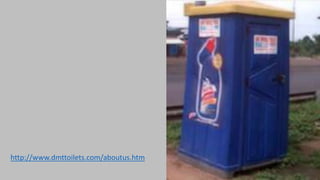
Isaac Durojaiye founded Dignified Mobile
Toilets in Lagos in 1992 when he estimated
that Nigeria had only 500 functioning public
toilets.
Source
Mahajan, Vijay: Africa Rising, p. 111.
http://www.dmttoilets.com/aboutus.htm
Transportation
In Nigeria, motorcycles called okada serve the
role of taxis.
They are becoming the most common form of
informal transportation because of their low cost
and flexibility in navigating congested city streets
and village pathways.
Source
Mahajan, Vijay: Africa Rising, p. 97.
The motorcycles can be purchased but most are
rented on a daily basis.
Chinese manufacturer Jincheng has the largest
market share with almost half the market.
Source
Mahajan, Vijay: Africa Rising, p. 97.
http://en.jincheng.com/
Nigeria shows progress in building
good road and rail links.
http://www.ventures-africa.com/2014/07/africa-in-2020-a-look-at-major-sectors-and-players/
Part # 4
Some political aspects
Nigeria privatized more than 116
enterprises between 1999 and 2006.
https://www.mckinseyquarterly.com/Economic_Studies/Productivity_Performance/Whats_driving_Africas_growth_2601
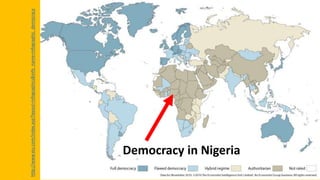
http://www.eiu.com/index.asp?layout=infographics&info_name=infographic_democracy
Democracy around the world
Democracy in Nigeria
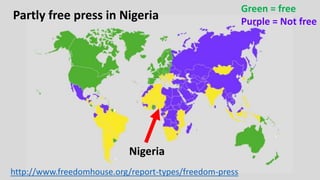
http://www.freedomhouse.org/report-types/freedom-press
Partly free press in Nigeria
Green = free
Purple = Not free
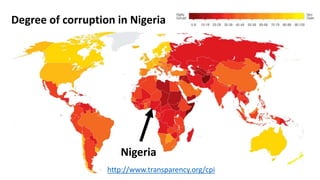
Nigeria
http://www.transparency.org/cpi
Degree of corruption in Nigeria
Nigeria
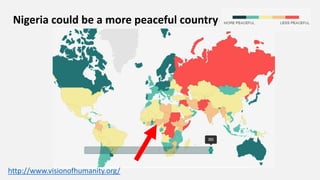
http://www.visionofhumanity.org/
Nigeria could be a more peaceful country

Nigeria