


The National Cooperative Agreement on
Clinical Workforce Development
Advancing Team-Based Care
WEBINAR 2 : Advancing the Practice of RNs
and Behavioral Health Providers
February 22, 2018
Presented by the
the Community Health Center, Inc.
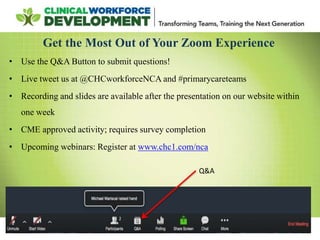
Get the Most Out of Your Zoom Experience
• Use the Q&A Button to submit questions!
• Live tweet us at @CHCworkforceNCA and #primarycareteams
• Recording and slides are available after the presentation on our website within
one week
• CME approved activity; requires survey completion
• Upcoming webinars: Register at www.chc1.com/nca
Q&A
Learning Objectives
1. Participants will be able to identify three elements of complex care
coordination that are key to improving patient outcomes.
2. Participants will be able to list three types of independent nurse
visits that might be carried out by the RN on the primary care team.
3. Participants will be able to describe a team-based approach to
screening for behavioral health disorders with timely follow-up
intervention.
4. Participants will be able to identify a core set of standing group
therapy options that a health center might offer.
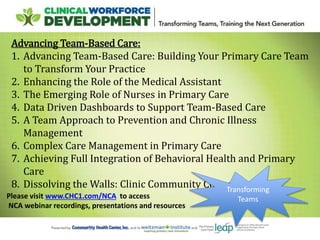
Advancing Team-Based Care:
1. Advancing Team-Based Care: Building Your Primary Care Team
to Transform Your Practice
2. Enhancing the Role of the Medical Assistant
3. The Emerging Role of Nurses in Primary Care
4. Data Driven Dashboards to Support Team-Based Care
5. A Team Approach to Prevention and Chronic Illness
Management
6. Complex Care Management in Primary Care
7. Achieving Full Integration of Behavioral Health and Primary
Care
8. Dissolving the Walls: Clinic Community ConnectionsTransforming
TeamsPlease visit www.CHC1.com/NCA to access
NCA webinar recordings, presentations and resources
Expanded Roles for RNs
2.22.18
Malia Davis, NP
Director of Nursing Services and Clinical Team
Development
Robert Wood Johnson Executive Nurse Fellow 2014-2017
Community commitment.
Uncompromising care.
Why RNs ?
IOM Future of Nursing
2010
• Who is the best person on our care team
to serve you today?
• Maximize nurse skill set / work at top of
scope
• Provide direct patient care
• Triage, intake, medication reconciliation,
patient education, culturally responsive
care to patient population, schedule
management, nursing assessment skills,
care planning, and on and on and on….
Community commitment.
Uncompromising care.
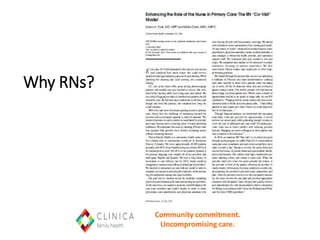
Why RNs?
Community commitment.
Uncompromising care.
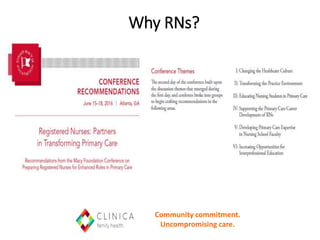
Why RNs?
Community commitment.
Uncompromising care.
RN role expansion
•Complex Care
Management
•Active
schedule
management
•Data
•Co-visits
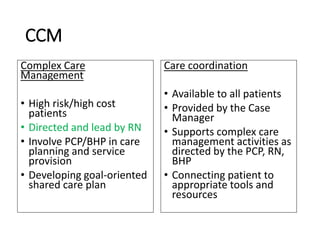
CCM
Complex Care
Management
• High risk/high cost
patients
• Directed and lead by RN
• Involve PCP/BHP in care
planning and service
provision
• Developing goal-oriented
shared care plan
Care coordination
• Available to all patients
• Provided by the Case
Manager
• Supports complex care
management activities as
directed by the PCP, RN,
BHP
• Connecting patient to
appropriate tools and
resources
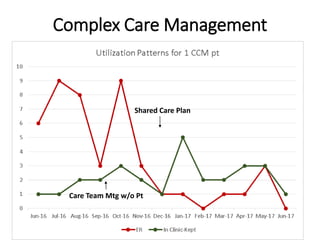
Complex Care Management
Shared Care Plan
Care Team Mtg w/o Pt
Active schedule management
Data
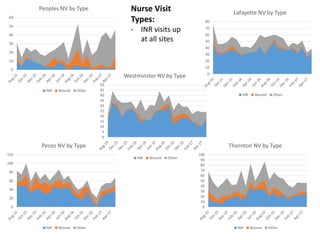
Nurse Visit
Types:
- INR visits up
at all sites
0
20
40
60
80
100
120
Pecos NV by Type
INR Wound Other
0
10
20
30
40
50
60
70
80
90
100
Thornton NV by Type
INR Wound Other
0
5
10
15
20
25
30
35
40
45
50
Westminster NV by Type
INR Wound Other
0
10
20
30
40
50
60
Peoples NV by Type
INR Wound Other
0
10
20
30
40
50
60
70
80
Lafayette NV by Type
INR Wound Other
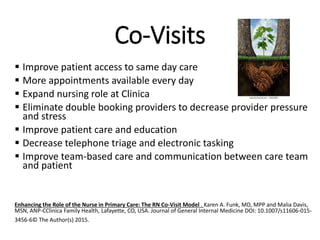
Co-Visits
 Improve patient access to same day care
 More appointments available every day
 Expand nursing role at Clinica
 Eliminate double booking providers to decrease provider pressure
and stress
 Improve patient care and education
 Decrease telephone triage and electronic tasking
 Improve team-based care and communication between care team
and patient
Enhancing the Role of the Nurse in Primary Care: The RN Co-Visit Model . Karen A. Funk, MD, MPP and Malia Davis,
MSN, ANP-CClinica Family Health, Lafayette, CO, USA. Journal of General Internal Medicine DOI: 10.1007/s11606-015-
3456-6© The Author(s) 2015.
Co-Visits
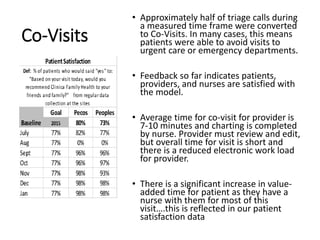
• Approximately half of triage calls during
a measured time frame were converted
to Co-Visits. In many cases, this means
patients were able to avoid visits to
urgent care or emergency departments.
• Feedback so far indicates patients,
providers, and nurses are satisfied with
the model.
• Average time for co-visit for provider is
7-10 minutes and charting is completed
by nurse. Provider must review and edit,
but overall time for visit is short and
there is a reduced electronic work load
for provider.
• There is a significant increase in value-
added time for patient as they have a
nurse with them for most of this
visit….this is reflected in our patient
satisfaction data
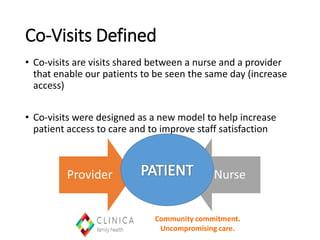
Co-Visits Defined
• Co-visits are visits shared between a nurse and a provider
that enable our patients to be seen the same day (increase
access)
• Co-visits were designed as a new model to help increase
patient access to care and to improve staff satisfaction
Community commitment.
Uncompromising care.
Provider Nurse
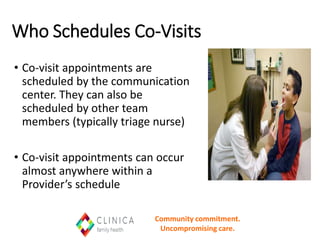
Who Schedules Co-Visits
• Co-visit appointments are
scheduled by the communication
center. They can also be
scheduled by other team
members (typically triage nurse)
• Co-visit appointments can occur
almost anywhere within a
Provider’s schedule
Community commitment.
Uncompromising care.
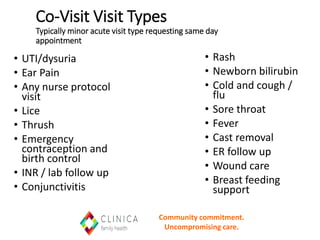
Co-Visit Visit Types
Typically minor acute visit type requesting same day
appointment
• UTI/dysuria
• Ear Pain
• Any nurse protocol
visit
• Lice
• Thrush
• Emergency
contraception and
birth control
• INR / lab follow up
• Conjunctivitis
• Rash
• Newborn bilirubin
• Cold and cough /
flu
• Sore throat
• Fever
• Cast removal
• ER follow up
• Wound care
• Breast feeding
support
Community commitment.
Uncompromising care.
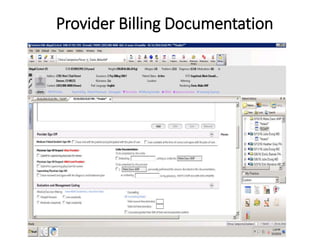
Documentation requirements:
• Nurse note
• Provider note
• Face to face (in the presence of the patient)
• Scribe box on E and M (see example later)
• Chart review from the provider
• Billing and coding
• **it is your responsibility to research your
billing and coding requirements in relation
to your electronic record to meet your
compliance standards**
Community commitment.
Uncompromising care.
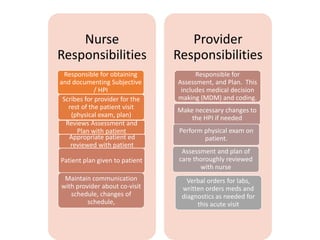
Nurse
Responsibilities
Responsible for obtaining
and documenting Subjective
/ HPI
Scribes for provider for the
rest of the patient visit
(physical exam, plan)
Reviews Assessment and
Plan with patient
Appropriate patient ed
reviewed with patient
Patient plan given to patient
Maintain communication
with provider about co-visit
schedule, changes of
schedule,
Provider
Responsibilities
Responsible for
Assessment, and Plan. This
includes medical decision
making (MDM) and coding.
Make necessary changes to
the HPI if needed
Perform physical exam on
patient.
Assessment and plan of
care thoroughly reviewed
with nurse
Verbal orders for labs,
written orders meds and
diagnostics as needed for
this acute visit
Provider Billing Documentation
Community commitment.
Uncompromising care.
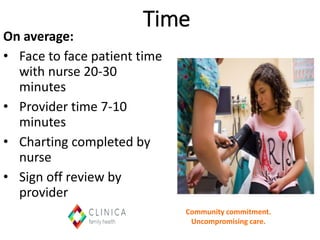
Time
On average:
• Face to face patient time
with nurse 20-30
minutes
• Provider time 7-10
minutes
• Charting completed by
nurse
• Sign off review by
provider
Community commitment.
Uncompromising care.
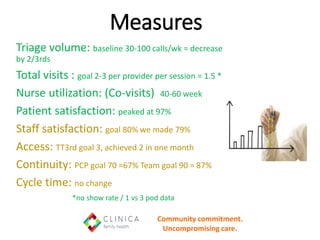
Measures
Triage volume: baseline 30-100 calls/wk = decrease
by 2/3rds
Total visits : goal 2-3 per provider per session = 1.5 *
Nurse utilization: (Co-visits) 40-60 week
Patient satisfaction: peaked at 97%
Staff satisfaction: goal 80% we made 79%
Access: TT3rd goal 3, achieved 2 in one month
Continuity: PCP goal 70 =67% Team goal 90 = 87%
Cycle time: no change
*no show rate / 1 vs 3 pod data
Community commitment.
Uncompromising care.
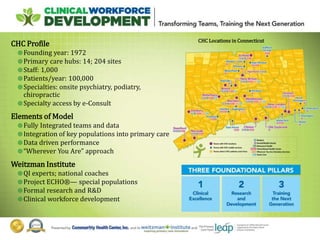
CHC Profile
Founding year: 1972
Primary care hubs: 14; 204 sites
Staff: 1,000
Patients/year: 100,000
Specialties: onsite psychiatry, podiatry,
chiropractic
Specialty access by e-Consult
Elements of Model
Fully Integrated teams and data
Integration of key populations into primary care
Data driven performance
“Wherever You Are” approach
Weitzman Institute
QI experts; national coaches
Project ECHO®— special populations
Formal research and R&D
Clinical workforce development
CHC Locations in Connecticut
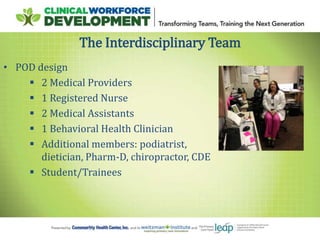
• POD design
 2 Medical Providers
 1 Registered Nurse
 2 Medical Assistants
 1 Behavioral Health Clinician
 Additional members: podiatrist,
dietician, Pharm-D, chiropractor, CDE
 Student/Trainees
The Interdisciplinary Team
Shared Communication Among the Team
2017
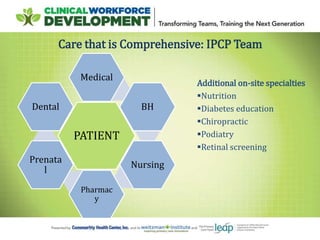
Care that is Comprehensive: IPCP Team
Additional on-site specialties
Nutrition
Diabetes education
Chiropractic
Podiatry
Retinal screening
PATIENT
Medical
BH
Nursing
Pharmac
y
Prenata
l
Dental
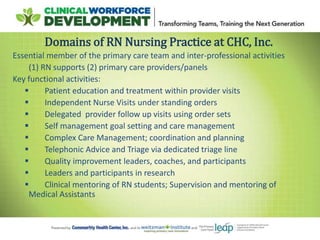
Essential member of the primary care team and inter-professional activities
(1) RN supports (2) primary care providers/panels
Key functional activities:
 Patient education and treatment within provider visits
 Independent Nurse Visits under standing orders
 Delegated provider follow up visits using order sets
 Self management goal setting and care management
 Complex Care Management; coordination and planning
 Telephonic Advice and Triage via dedicated triage line
 Quality improvement leaders, coaches, and participants
 Leaders and participants in research
 Clinical mentoring of RN students; Supervision and mentoring of
Medical Assistants
Domains of RN Nursing Practice at CHC, Inc.
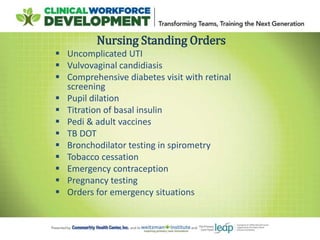
 Uncomplicated UTI
 Vulvovaginal candidiasis
 Comprehensive diabetes visit with retinal
screening
 Pupil dilation
 Titration of basal insulin
 Pedi & adult vaccines
 TB DOT
 Bronchodilator testing in spirometry
 Tobacco cessation
 Emergency contraception
 Pregnancy testing
 Orders for emergency situations
Nursing Standing Orders
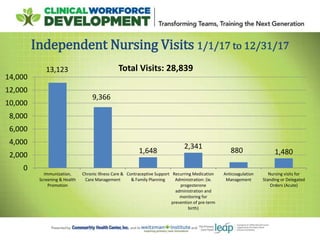
Independent Nursing Visits 1/1/17 to 12/31/17
13,123
9,366
1,648
2,341
880 1,480
0
2,000
4,000
6,000
8,000
10,000
12,000
14,000
Immunization,
Screening & Health
Promotion
Chronic Illness Care &
Care Management
Contraceptive Support
& Family Planning
Recurring Medication
Administration: (ie.
progesterone
administration and
monitoring for
prevention of pre-term
birth)
Anticoagulation
Management
Nursing visits for
Standing or Delegated
Orders (Acute)
Total Visits: 28,839
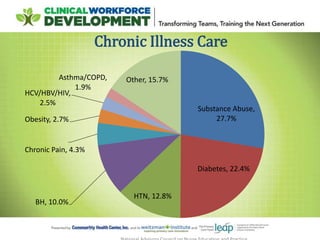
Substance Abuse,
27.7%
Diabetes, 22.4%
HTN, 12.8%
BH, 10.0%
Chronic Pain, 4.3%
Obesity, 2.7%
HCV/HBV/HIV,
2.5%
Asthma/COPD,
1.9%
Other, 15.7%
Chronic Illness Care
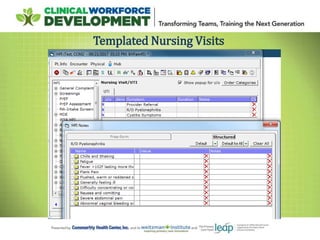
Templated Nursing Visits
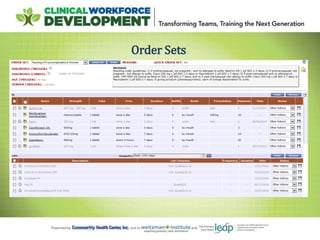
Order Sets
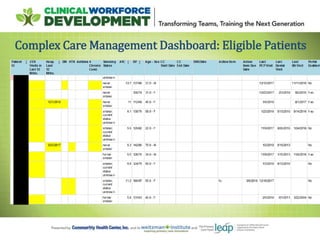
Complex Care Management Dashboard: Eligible Patients
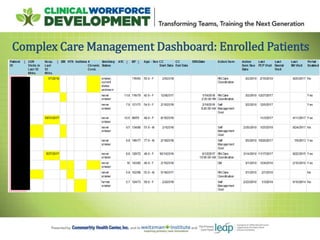
Complex Care Management Dashboard: Enrolled Patients
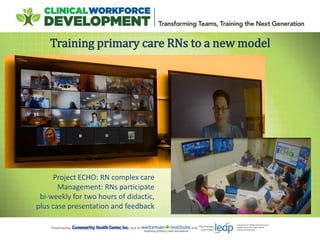
Training primary care RNs to a new model
Project ECHO: RN complex care
Management: RNs participate
bi-weekly for two hours of didactic,
plus case presentation and feedback
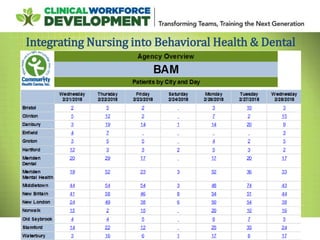
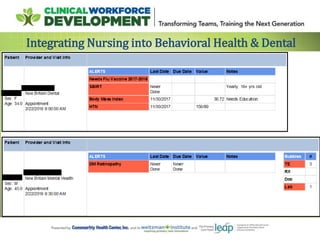
Integrating Nursing into Behavioral Health & Dental
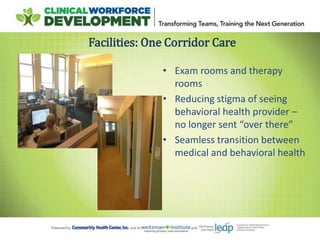
• Exam rooms and therapy
rooms
• Reducing stigma of seeing
behavioral health provider –
no longer sent “over there”
• Seamless transition between
medical and behavioral health
Facilities: One Corridor Care
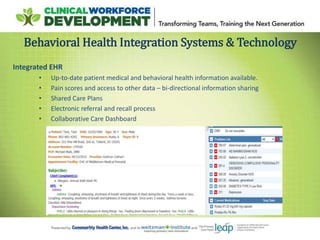
Behavioral Health Integration Systems & Technology
Integrated EHR
• Up-to-date patient medical and behavioral health information available.
• Pain scores and access to other data – bi-directional information sharing
• Shared Care Plans
• Electronic referral and recall process
• Collaborative Care Dashboard
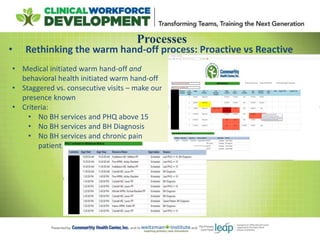
• Rethinking the warm hand-off process: Proactive vs Reactive
05/14/2014 42
Processes
• Medical initiated warm hand-off and
behavioral health initiated warm hand-off
• Staggered vs. consecutive visits – make our
presence known
• Criteria:
• No BH services and PHQ above 15
• No BH services and BH Diagnosis
• No BH services and chronic pain
patient
Screening in Medical Visits
There are many pathways to Behavioral Health care, one of the most robust and
reliable is regular screening by nurses and MA’s in Medical visits.
Nurses and MA’s can screen for multiple conditions including
• Substance abuse (DAST, AUDIT)
• Depression (PHQ-9)
• Domestic Violence (HITS and HARK)
• and more as required by grants, outside agency, or quality initiatives
All of these identify patients in need of support from Behavioral Health
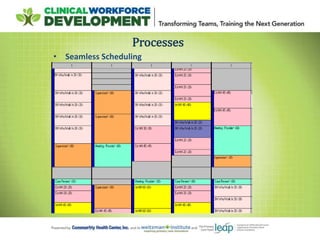
• Seamless Scheduling
Processes
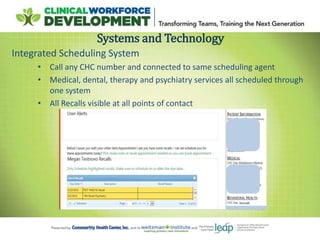
Systems and Technology
Integrated Scheduling System
• Call any CHC number and connected to same scheduling agent
• Medical, dental, therapy and psychiatry services all scheduled through
one system
• All Recalls visible at all points of contact
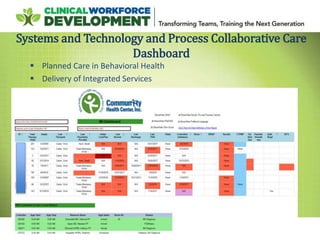
Systems and Technology and Process Collaborative Care
Dashboard
 Planned Care in Behavioral Health
 Delivery of Integrated Services
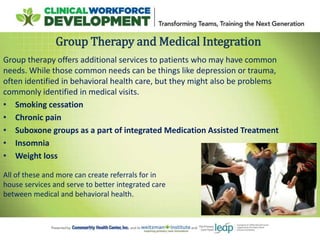
Group therapy offers additional services to patients who may have common
needs. While those common needs can be things like depression or trauma,
often identified in behavioral health care, but they might also be problems
commonly identified in medical visits.
• Smoking cessation
• Chronic pain
• Suboxone groups as a part of integrated Medication Assisted Treatment
• Insomnia
• Weight loss
Group Therapy and Medical Integration
All of these and more can create referrals for in
house services and serve to better integrated care
between medical and behavioral health.
Integrated Care Meetings
• A case review meeting conducted at each site facilitated by
a BHCC. Patients are selected from a risk stratified list and
have chronic disease as well as a BH condition.
• Goal of the meeting is to close care gaps and to reduce
preventable ER utilization
• Participants include the PCP, MA, RN, BH Clinician, and
ATC
• Seven to ten cases are discussed per session
• Cases are presented by team members who have reviewed
the record respective to their role
• Documentation in the health record is completed. (Global
Alert). Recommendations for follow up is noted in
TE’s or Action items.
Questions
Upcoming Webinars
• Beyond the Walls: Effectively Utilizing Community Health
Workers and Clinical Home Visitors as Part of the Team
March 1, 2018 | 3 p.m. EST
• Caring for Patients with Pain is a Team Sport
March 8, 2018 | 3 p.m. EST
Register at
www.chc1.com/NCA

February 22 2018 team based care webinar 2

  • 1.
    The National CooperativeAgreement on Clinical Workforce Development Advancing Team-Based Care WEBINAR 2 : Advancing the Practice of RNs and Behavioral Health Providers February 22, 2018 Presented by the the Community Health Center, Inc.
  • 2.
    Get the MostOut of Your Zoom Experience • Use the Q&A Button to submit questions! • Live tweet us at @CHCworkforceNCA and #primarycareteams • Recording and slides are available after the presentation on our website within one week • CME approved activity; requires survey completion • Upcoming webinars: Register at www.chc1.com/nca Q&A
  • 3.
    Learning Objectives 1. Participantswill be able to identify three elements of complex care coordination that are key to improving patient outcomes. 2. Participants will be able to list three types of independent nurse visits that might be carried out by the RN on the primary care team. 3. Participants will be able to describe a team-based approach to screening for behavioral health disorders with timely follow-up intervention. 4. Participants will be able to identify a core set of standing group therapy options that a health center might offer.
  • 4.
    Advancing Team-Based Care: 1.Advancing Team-Based Care: Building Your Primary Care Team to Transform Your Practice 2. Enhancing the Role of the Medical Assistant 3. The Emerging Role of Nurses in Primary Care 4. Data Driven Dashboards to Support Team-Based Care 5. A Team Approach to Prevention and Chronic Illness Management 6. Complex Care Management in Primary Care 7. Achieving Full Integration of Behavioral Health and Primary Care 8. Dissolving the Walls: Clinic Community ConnectionsTransforming TeamsPlease visit www.CHC1.com/NCA to access NCA webinar recordings, presentations and resources
  • 5.
    Expanded Roles forRNs 2.22.18 Malia Davis, NP Director of Nursing Services and Clinical Team Development Robert Wood Johnson Executive Nurse Fellow 2014-2017 Community commitment. Uncompromising care.
  • 6.
    Why RNs ? IOMFuture of Nursing 2010 • Who is the best person on our care team to serve you today? • Maximize nurse skill set / work at top of scope • Provide direct patient care • Triage, intake, medication reconciliation, patient education, culturally responsive care to patient population, schedule management, nursing assessment skills, care planning, and on and on and on…. Community commitment. Uncompromising care.
  • 7.
  • 8.
  • 9.
    RN role expansion •ComplexCare Management •Active schedule management •Data •Co-visits
  • 10.
    CCM Complex Care Management • Highrisk/high cost patients • Directed and lead by RN • Involve PCP/BHP in care planning and service provision • Developing goal-oriented shared care plan Care coordination • Available to all patients • Provided by the Case Manager • Supports complex care management activities as directed by the PCP, RN, BHP • Connecting patient to appropriate tools and resources
  • 11.
    Complex Care Management SharedCare Plan Care Team Mtg w/o Pt
  • 12.
  • 13.
  • 14.
    Nurse Visit Types: - INRvisits up at all sites 0 20 40 60 80 100 120 Pecos NV by Type INR Wound Other 0 10 20 30 40 50 60 70 80 90 100 Thornton NV by Type INR Wound Other 0 5 10 15 20 25 30 35 40 45 50 Westminster NV by Type INR Wound Other 0 10 20 30 40 50 60 Peoples NV by Type INR Wound Other 0 10 20 30 40 50 60 70 80 Lafayette NV by Type INR Wound Other
  • 15.
    Co-Visits  Improve patientaccess to same day care  More appointments available every day  Expand nursing role at Clinica  Eliminate double booking providers to decrease provider pressure and stress  Improve patient care and education  Decrease telephone triage and electronic tasking  Improve team-based care and communication between care team and patient Enhancing the Role of the Nurse in Primary Care: The RN Co-Visit Model . Karen A. Funk, MD, MPP and Malia Davis, MSN, ANP-CClinica Family Health, Lafayette, CO, USA. Journal of General Internal Medicine DOI: 10.1007/s11606-015- 3456-6© The Author(s) 2015.
  • 16.
    Co-Visits • Approximately halfof triage calls during a measured time frame were converted to Co-Visits. In many cases, this means patients were able to avoid visits to urgent care or emergency departments. • Feedback so far indicates patients, providers, and nurses are satisfied with the model. • Average time for co-visit for provider is 7-10 minutes and charting is completed by nurse. Provider must review and edit, but overall time for visit is short and there is a reduced electronic work load for provider. • There is a significant increase in value- added time for patient as they have a nurse with them for most of this visit….this is reflected in our patient satisfaction data
  • 17.
    Co-Visits Defined • Co-visitsare visits shared between a nurse and a provider that enable our patients to be seen the same day (increase access) • Co-visits were designed as a new model to help increase patient access to care and to improve staff satisfaction Community commitment. Uncompromising care. Provider Nurse
  • 18.
    Who Schedules Co-Visits •Co-visit appointments are scheduled by the communication center. They can also be scheduled by other team members (typically triage nurse) • Co-visit appointments can occur almost anywhere within a Provider’s schedule Community commitment. Uncompromising care.
  • 19.
    Co-Visit Visit Types Typicallyminor acute visit type requesting same day appointment • UTI/dysuria • Ear Pain • Any nurse protocol visit • Lice • Thrush • Emergency contraception and birth control • INR / lab follow up • Conjunctivitis • Rash • Newborn bilirubin • Cold and cough / flu • Sore throat • Fever • Cast removal • ER follow up • Wound care • Breast feeding support Community commitment. Uncompromising care.
  • 20.
    Documentation requirements: • Nursenote • Provider note • Face to face (in the presence of the patient) • Scribe box on E and M (see example later) • Chart review from the provider • Billing and coding • **it is your responsibility to research your billing and coding requirements in relation to your electronic record to meet your compliance standards** Community commitment. Uncompromising care.
  • 21.
    Nurse Responsibilities Responsible for obtaining anddocumenting Subjective / HPI Scribes for provider for the rest of the patient visit (physical exam, plan) Reviews Assessment and Plan with patient Appropriate patient ed reviewed with patient Patient plan given to patient Maintain communication with provider about co-visit schedule, changes of schedule, Provider Responsibilities Responsible for Assessment, and Plan. This includes medical decision making (MDM) and coding. Make necessary changes to the HPI if needed Perform physical exam on patient. Assessment and plan of care thoroughly reviewed with nurse Verbal orders for labs, written orders meds and diagnostics as needed for this acute visit
  • 22.
    Provider Billing Documentation Communitycommitment. Uncompromising care.
  • 23.
    Time On average: • Faceto face patient time with nurse 20-30 minutes • Provider time 7-10 minutes • Charting completed by nurse • Sign off review by provider Community commitment. Uncompromising care.
  • 24.
    Measures Triage volume: baseline30-100 calls/wk = decrease by 2/3rds Total visits : goal 2-3 per provider per session = 1.5 * Nurse utilization: (Co-visits) 40-60 week Patient satisfaction: peaked at 97% Staff satisfaction: goal 80% we made 79% Access: TT3rd goal 3, achieved 2 in one month Continuity: PCP goal 70 =67% Team goal 90 = 87% Cycle time: no change *no show rate / 1 vs 3 pod data Community commitment. Uncompromising care.
  • 25.
    CHC Profile Founding year:1972 Primary care hubs: 14; 204 sites Staff: 1,000 Patients/year: 100,000 Specialties: onsite psychiatry, podiatry, chiropractic Specialty access by e-Consult Elements of Model Fully Integrated teams and data Integration of key populations into primary care Data driven performance “Wherever You Are” approach Weitzman Institute QI experts; national coaches Project ECHO®— special populations Formal research and R&D Clinical workforce development CHC Locations in Connecticut
  • 26.
    • POD design 2 Medical Providers  1 Registered Nurse  2 Medical Assistants  1 Behavioral Health Clinician  Additional members: podiatrist, dietician, Pharm-D, chiropractor, CDE  Student/Trainees The Interdisciplinary Team
  • 27.
  • 28.
    Care that isComprehensive: IPCP Team Additional on-site specialties Nutrition Diabetes education Chiropractic Podiatry Retinal screening PATIENT Medical BH Nursing Pharmac y Prenata l Dental
  • 29.
    Essential member ofthe primary care team and inter-professional activities (1) RN supports (2) primary care providers/panels Key functional activities:  Patient education and treatment within provider visits  Independent Nurse Visits under standing orders  Delegated provider follow up visits using order sets  Self management goal setting and care management  Complex Care Management; coordination and planning  Telephonic Advice and Triage via dedicated triage line  Quality improvement leaders, coaches, and participants  Leaders and participants in research  Clinical mentoring of RN students; Supervision and mentoring of Medical Assistants Domains of RN Nursing Practice at CHC, Inc.
  • 30.
     Uncomplicated UTI Vulvovaginal candidiasis  Comprehensive diabetes visit with retinal screening  Pupil dilation  Titration of basal insulin  Pedi & adult vaccines  TB DOT  Bronchodilator testing in spirometry  Tobacco cessation  Emergency contraception  Pregnancy testing  Orders for emergency situations Nursing Standing Orders
  • 31.
    Independent Nursing Visits1/1/17 to 12/31/17 13,123 9,366 1,648 2,341 880 1,480 0 2,000 4,000 6,000 8,000 10,000 12,000 14,000 Immunization, Screening & Health Promotion Chronic Illness Care & Care Management Contraceptive Support & Family Planning Recurring Medication Administration: (ie. progesterone administration and monitoring for prevention of pre-term birth) Anticoagulation Management Nursing visits for Standing or Delegated Orders (Acute) Total Visits: 28,839
  • 32.
    Substance Abuse, 27.7% Diabetes, 22.4% HTN,12.8% BH, 10.0% Chronic Pain, 4.3% Obesity, 2.7% HCV/HBV/HIV, 2.5% Asthma/COPD, 1.9% Other, 15.7% Chronic Illness Care
  • 33.
  • 34.
  • 35.
    Complex Care ManagementDashboard: Eligible Patients
  • 36.
    Complex Care ManagementDashboard: Enrolled Patients
  • 37.
    Training primary careRNs to a new model Project ECHO: RN complex care Management: RNs participate bi-weekly for two hours of didactic, plus case presentation and feedback
  • 38.
    Integrating Nursing intoBehavioral Health & Dental
  • 39.
    Integrating Nursing intoBehavioral Health & Dental
  • 40.
    • Exam roomsand therapy rooms • Reducing stigma of seeing behavioral health provider – no longer sent “over there” • Seamless transition between medical and behavioral health Facilities: One Corridor Care
  • 41.
    Behavioral Health IntegrationSystems & Technology Integrated EHR • Up-to-date patient medical and behavioral health information available. • Pain scores and access to other data – bi-directional information sharing • Shared Care Plans • Electronic referral and recall process • Collaborative Care Dashboard
  • 42.
    • Rethinking thewarm hand-off process: Proactive vs Reactive 05/14/2014 42 Processes • Medical initiated warm hand-off and behavioral health initiated warm hand-off • Staggered vs. consecutive visits – make our presence known • Criteria: • No BH services and PHQ above 15 • No BH services and BH Diagnosis • No BH services and chronic pain patient
  • 43.
    Screening in MedicalVisits There are many pathways to Behavioral Health care, one of the most robust and reliable is regular screening by nurses and MA’s in Medical visits. Nurses and MA’s can screen for multiple conditions including • Substance abuse (DAST, AUDIT) • Depression (PHQ-9) • Domestic Violence (HITS and HARK) • and more as required by grants, outside agency, or quality initiatives All of these identify patients in need of support from Behavioral Health
  • 44.
  • 45.
    Systems and Technology IntegratedScheduling System • Call any CHC number and connected to same scheduling agent • Medical, dental, therapy and psychiatry services all scheduled through one system • All Recalls visible at all points of contact
  • 46.
    Systems and Technologyand Process Collaborative Care Dashboard  Planned Care in Behavioral Health  Delivery of Integrated Services
  • 47.
    Group therapy offersadditional services to patients who may have common needs. While those common needs can be things like depression or trauma, often identified in behavioral health care, but they might also be problems commonly identified in medical visits. • Smoking cessation • Chronic pain • Suboxone groups as a part of integrated Medication Assisted Treatment • Insomnia • Weight loss Group Therapy and Medical Integration All of these and more can create referrals for in house services and serve to better integrated care between medical and behavioral health.
  • 48.
    Integrated Care Meetings •A case review meeting conducted at each site facilitated by a BHCC. Patients are selected from a risk stratified list and have chronic disease as well as a BH condition. • Goal of the meeting is to close care gaps and to reduce preventable ER utilization • Participants include the PCP, MA, RN, BH Clinician, and ATC • Seven to ten cases are discussed per session • Cases are presented by team members who have reviewed the record respective to their role • Documentation in the health record is completed. (Global Alert). Recommendations for follow up is noted in TE’s or Action items.
  • 49.
  • 50.
    Upcoming Webinars • Beyondthe Walls: Effectively Utilizing Community Health Workers and Clinical Home Visitors as Part of the Team March 1, 2018 | 3 p.m. EST • Caring for Patients with Pain is a Team Sport March 8, 2018 | 3 p.m. EST Register at www.chc1.com/NCA