“IT REVOLUTION”
Presentation On
Content
 What is Information Technology ?
 History of IT
 What is IT Revolution
 Conclusion
 References
What is Information
Technology ?
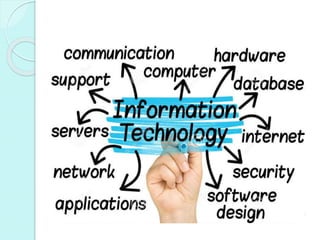
 IT stands for “INFORMATION TECHNOLOGY”.
 Information Technology (IT), as defined by the
Information Technology Association of America
(ITAA), is “the study, design, development,
implementation, support or management of
computer-based information systems, particularly
software applications and computer hardware”.
 IT deals with the use of electronic computers and
computer software to convert, store, protect,
process, transmit, and securely retrieve
information.
History of IT
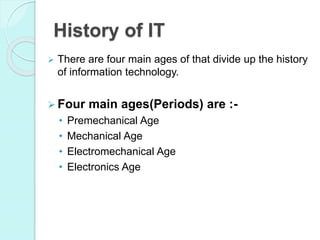
 There are four main ages of that divide up the history
of information technology.
 Four main ages(Periods) are :-
• Premechanical Age
• Mechanical Age
• Electromechanical Age
• Electronics Age
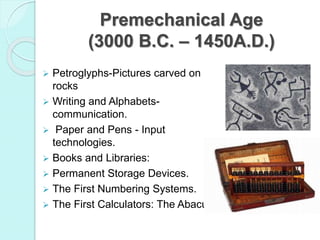
Premechanical Age
(3000 B.C. – 1450A.D.)
 Petroglyphs-Pictures carved on
rocks
 Writing and Alphabets-
communication.
 Paper and Pens - Input
technologies.
 Books and Libraries:
 Permanent Storage Devices.
 The First Numbering Systems.
 The First Calculators: The Abacus.
Mechanical Age
(1450 A.D. – 1840 A.D.)
 The First Information Explosion.
 The first general purpose “computers”
 Technologies like Slide rule was
discovered.
 Blaise Pascal invented the Pascaline.
 Charles Babbage develops difference
engine.
Difference Engine
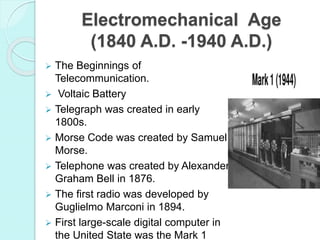
Electromechanical Age
(1840 A.D. -1940 A.D.)
 The Beginnings of
Telecommunication.
 Voltaic Battery
 Telegraph was created in early
1800s.
 Morse Code was created by Samuel
Morse.
 Telephone was created by Alexander
Graham Bell in 1876.
 The first radio was developed by
Guglielmo Marconi in 1894.
 First large-scale digital computer in
the United State was the Mark 1
Electronic Age
(1940 A.D.- Present)
 The ENIAC was developed.
 Era of vacuum tube and punch card like ENIAC and Mark
1.
 Rotating magnetic drums used for internal storage.
 High level programming languages like
FORTRAN,COBOL.
 Personal Computer was developed.
 GUI(Graphical User Interface) was developed.
What is IT Revolution ?
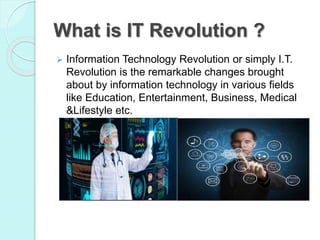
 Information Technology Revolution or simply I.T.
Revolution is the remarkable changes brought
about by information technology in various fields
like Education, Entertainment, Business, Medical
&Lifestyle etc.
 Information technology has impacted on
most aspect of our lives :
 Education
 Work
 Medicine
 Culture
 Environment
 Communication
1.Education
Advantages :
 IT complements traditional educational
technique.
 Access to more information resources.
 Distance learning.
 Invisible college network.
Disadvantage :
 Information Overload.
 Information may not be correct.
2.Work/Business
Advantages :
 Enhanced Information management.
 Telecommuting.
 Reduction in paper work since most tasks
are handled electronically.
Disadvantage :
 Unemployment
 Low productivity
3.Medicine
Advantages :
 Telemonitoring.
 Interactive Services – real time
interactions between patients and
healthcare.
 Self diagnosis.
 Enhanced the work of medical
Disadvantage :
 Sometime it is difficult to ascertain the
quality of service.
 Self medication.
4.Culture
Culture can be defined as the ideas, beliefs,
values, customs and practices(what they eat,
how they dress) of a group of people.
Advantages :
 Promotion and sharing of culture.
 Today’s societies are multicultural.
Disadvantage :
 Blind copying of the western culture.
5.Environment
Advantages :
IT has enabled the understanding of physical
and ecological processes.
Reduction in use of paper.
It is not possible to monitor and sometimes
control the effects of changes in earth
environment through satellites.
Eg. Weather forecast, disaster and natural
hazard.
Disadvantages :
 Global Warming.
 E-wastes.
 Computer and phones emit dangerous
rays and gases that are harmful to living
organism
 Disappearance of bees.
Conclusion
“India is on the cusp of Digital
Revolution”.
References
 BW BusinessWorld Magzine.
 THE INFORMATION TECHNOLOGY REVOLUTION Ms
Bentil 1.
 targetstudy.com/articles/it-revolution-in-india.html
Thank You

Information Technology revolution

  • 1.
  • 2.
    Content  What isInformation Technology ?  History of IT  What is IT Revolution  Conclusion  References
  • 3.
    What is Information Technology?  IT stands for “INFORMATION TECHNOLOGY”.  Information Technology (IT), as defined by the Information Technology Association of America (ITAA), is “the study, design, development, implementation, support or management of computer-based information systems, particularly software applications and computer hardware”.  IT deals with the use of electronic computers and computer software to convert, store, protect, process, transmit, and securely retrieve information.
  • 5.
    History of IT There are four main ages of that divide up the history of information technology.  Four main ages(Periods) are :- • Premechanical Age • Mechanical Age • Electromechanical Age • Electronics Age
  • 6.
    Premechanical Age (3000 B.C.– 1450A.D.)  Petroglyphs-Pictures carved on rocks  Writing and Alphabets- communication.  Paper and Pens - Input technologies.  Books and Libraries:  Permanent Storage Devices.  The First Numbering Systems.  The First Calculators: The Abacus.
  • 7.
    Mechanical Age (1450 A.D.– 1840 A.D.)  The First Information Explosion.  The first general purpose “computers”  Technologies like Slide rule was discovered.  Blaise Pascal invented the Pascaline.  Charles Babbage develops difference engine. Difference Engine
  • 8.
    Electromechanical Age (1840 A.D.-1940 A.D.)  The Beginnings of Telecommunication.  Voltaic Battery  Telegraph was created in early 1800s.  Morse Code was created by Samuel Morse.  Telephone was created by Alexander Graham Bell in 1876.  The first radio was developed by Guglielmo Marconi in 1894.  First large-scale digital computer in the United State was the Mark 1
  • 9.
    Electronic Age (1940 A.D.-Present)  The ENIAC was developed.  Era of vacuum tube and punch card like ENIAC and Mark 1.  Rotating magnetic drums used for internal storage.  High level programming languages like FORTRAN,COBOL.  Personal Computer was developed.  GUI(Graphical User Interface) was developed.
  • 10.
    What is ITRevolution ?  Information Technology Revolution or simply I.T. Revolution is the remarkable changes brought about by information technology in various fields like Education, Entertainment, Business, Medical &Lifestyle etc.
  • 11.
     Information technologyhas impacted on most aspect of our lives :  Education  Work  Medicine  Culture  Environment  Communication
  • 12.
    1.Education Advantages :  ITcomplements traditional educational technique.  Access to more information resources.  Distance learning.  Invisible college network.
  • 13.
    Disadvantage :  InformationOverload.  Information may not be correct.
  • 14.
    2.Work/Business Advantages :  EnhancedInformation management.  Telecommuting.  Reduction in paper work since most tasks are handled electronically.
  • 15.
  • 16.
    3.Medicine Advantages :  Telemonitoring. Interactive Services – real time interactions between patients and healthcare.  Self diagnosis.  Enhanced the work of medical
  • 17.
    Disadvantage :  Sometimeit is difficult to ascertain the quality of service.  Self medication.
  • 18.
    4.Culture Culture can bedefined as the ideas, beliefs, values, customs and practices(what they eat, how they dress) of a group of people. Advantages :  Promotion and sharing of culture.  Today’s societies are multicultural.
  • 19.
    Disadvantage :  Blindcopying of the western culture.
  • 20.
    5.Environment Advantages : IT hasenabled the understanding of physical and ecological processes. Reduction in use of paper. It is not possible to monitor and sometimes control the effects of changes in earth environment through satellites. Eg. Weather forecast, disaster and natural hazard.
  • 21.
    Disadvantages :  GlobalWarming.  E-wastes.  Computer and phones emit dangerous rays and gases that are harmful to living organism  Disappearance of bees.
  • 22.
    Conclusion “India is onthe cusp of Digital Revolution”.
  • 23.
    References  BW BusinessWorldMagzine.  THE INFORMATION TECHNOLOGY REVOLUTION Ms Bentil 1.  targetstudy.com/articles/it-revolution-in-india.html
  • 24.