Keep	Calm	and	Call	the	PMO	
	
A	common	test,	for	secondary	school’s	kids,	is:	«	In	a	pond	a	water-lily	doubles	its	
leaves	 every	 day	 and	 it	 takes	 30	 days	 for	 them	 to	 cover	 completely	 the	 pond's	
surface.	When	shall	the	root	of	the	lily	be	cut	in	order	to	save	the	half	of	the	pond	
from	being	totally	covered?	»…	The	obvious	answer	is…	at	the	29th	day.	
In-depth,	the	meaning	of	the	test,	which	also	had	the	purpose	to	introduce	the	
concept	of	exponential	trend,	is	that	certain	action	must	be	undertaken	at	a	very	
specific	point	in	time,	pending	the	possibility	to	achieve	the	task(s)	that,	through	
said	action,	is	supposed	to	be	achieved.	
In	 our	 days,	 due	 to	 financial	 constraints	 imposed	 by	 the	 need	 of	 being	
competitive,	associated	with	a	lengthier	decision	making	process,	it	often	results	
in	undertakings	which	success	is	highly	in	danger	due	to:	
• Limited	time	frame	allocated	to	the	implementation,		
• Modifications	and	changes	that	most	likely	are	to	be	made	during	the	
implementation,		
• Severe	negative	impact	due	to	budget	overruns.	
As	market	and	organizational	forces	are	unlikely	to	be	changed,	the	projects	and	
the	 whole	 quality	 portfolio,	 have	 then	 to	 be	 thoroughly	 planned	 (setting	 clear	
priorities)	 and	 the	 progress	 constantly	 and	 consistently	 monitored	 (allocating	
appropriate	 resources	 with	 their	 distinctive	 capabilities),	 thus	 the	 uncertainty	
about	their	chances	of	success	is	minimized	if	not	nullified.		
As	many	of	you	know	the	general	accepted	definition	of	Project	is:	-	A	project	is	a	
temporary	Endeavour	designed	to	produce	a	unique	product,	service	or	result	with	
a	defined	start	and	finish	date	(usually	is	time-constrained	and	often	constrained	
by	funding	or	deliverables),	undertaken	to	meet	unique	goals	and	objectives.	–	The	
logic	consequence	is	to	mandatory	ascertain	intimately:
• What	makes	up	my	entire	project?			
• What	is	my	project	time	frame?		
• How	much	the	project	is	going	to	cost?		
• What	are	risks	and/or	opportunities	that	project	is	going	to	face?	
	
To	 give	 an	 answer	 to	 these	 questions,	 any	 Organization	 should	 have	 a	 strong	
project	management	understanding	(which	is	implying	a	profound	knowledge,	at	
any	hierarchical	level,	of	the	Company’	Strategy,	embedded	in	its	Vision,	Mission	
and	 Values)	 of	 the	 applications	 of	 distinctive	 capabilities	 to	 meet	 or	 possibly	
exceed	stakeholder(s)	requirements	and	expectations.	
Therefore,	 when	 an	 Organization	 will	 be	 fully	 aware	 of	 the	 importance	 of	 the	
project	 management	 professionalism,	 and	 providentially	 this	 is	 happening	 in	
more	and	more	Companies,	this	will	lead	to	recognize	the	importance	of	having	
in	place	a	Project	Management	Office	(PMO).	Why?	Because	the	PMO	would	have	
the	 accountability	 for	 supervising	 all	 critical	 activities	 related	 to	 project	
management,	as	such:	
• Data	 standardization	 (estimating,	 planning,	 scheduling,	 control	 and	
reporting),		
• Clarification	of	PM	roles	and	responsibilities,		
• Preparation	of	job	description,		
• Preparation	of	PM	templates,		
• Develop	PM	methodologies,		
• Lessons-	Learned	data	archive,		
• Constant	PM	benchmarking,		
• Identify	PM	standards	and	best	practices,		
• Performing	strategic	planning	for	PM,		
• Establish	a	Project-Solving	channel,		
• Transferring	knowledge	through	coaching	and	mentorship,		
• Develop	a	corporate	resources	capacity/utilization	plan,		
• Assessing	project	risks,		
• Planning	for	disaster	recovery	in	projects,	and		
• Performing	and/or	participating	in	the	Portfolio	management	of	projects.	
When	these	concepts	and	the	consequent	changes	will	be	implemented	in	the	
Company	 organization,	 this	 will	 bring	 Organizations	 to	 start	 considering	 the	
PMO	as	Center	of	Excellence	(COE)	in	project	management.	The	COE	therefore,	is
becoming	 accountable	 for	 providing	 vital	 information	 to	 stakeholders	 rather	
than	executing	projects.	
The	 general	 practice	 foreseen	 the	 presence	 of	 three	 common	 types	 of	 Project	
Office	(PO):		
• Functional	 PO,	 which	 has	 the	 major	 responsibility	 to	 manage	 critical	
resources	staff	and	may	manage	project	when	required.		
• Customers	 Group	 PO,	 which	 has	 the	 responsibility	 to	 better,	 manage	
customers	and	customer	communication.		
• Finally	Corporate	or	Strategic	PO,	which	will	service	the	entire	organization	
and	 will	 focus	 on	 corporate	 and	 strategic	 matters	 rather	 than	 functional	
issues.	
Of	 course,	 Companies	 can	 establish	 more	 than	 one	 PO	 at	 the	 same	 time.	 It	 is	
common	 practice	 to	 have	 simultaneously	 both	 Functional	 PO	 and	 a	
Strategic/Corporate	 PO,	 providing	 they	 are	 working	 together	 to	 manage	
multiple/conflicting	priorities	that	would	possibly	arise.	
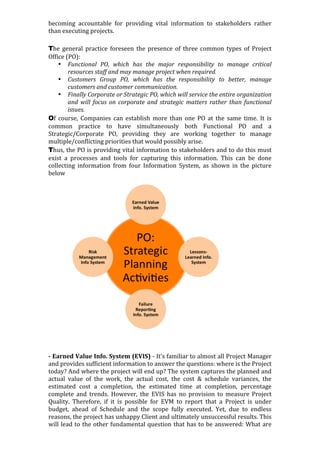
Thus,	the	PO	is	providing	vital	information	to	stakeholders	and	to	do	this	must	
exist	 a	 processes	 and	 tools	 for	 capturing	 this	 information.	 This	 can	 be	 done	
collecting	 information	 from	 four	 Information	 System,	 as	 shown	 in	 the	 picture	
below	


-	Earned	Value	Info.	System	(EVIS)	-	It’s	familiar	to	almost	all	Project	Manager	
and	provides	sufficient	information	to	answer	the	questions:	where	is	the	Project	
today?	And	where	the	project	will	end	up?	The	system	captures	the	planned	and	
actual	 value	 of	 the	 work,	 the	 actual	 cost,	 the	 cost	 &	 schedule	 variances,	 the	
estimated	 cost	 a	 completion,	 the	 estimated	 time	 at	 completion,	 percentage	
complete	 and	 trends.	 However,	 the	 EVIS	 has	 no	 provision	 to	 measure	 Project	
Quality.	 Therefore,	 if	 it	 is	 possible	 for	 EVM	 to	 report	 that	 a	 Project	 is	 under	
budget,	 ahead	 of	 Schedule	 and	 the	 scope	 fully	 executed.	 Yet,	 due	 to	 endless	
reasons,	the	project	has	unhappy	Client	and	ultimately	unsuccessful	results.	This	
will	lead	to	the	other	fundamental	question	that	has	to	be	answered:	What	are
the	 reasons	 behind	 the	 actual	 situation?	 And	 moreover,	 what	 are	 the	
recommendations	for	what	actions	should	take	to	gain	project	goals?	
	
-	Risk	Management	Info.	System	(RMIS)	–	This	system	provide	data	on	risk	
management.	 It	 stores	 and	 allows	 retrieval	 of	 risk	 related	 data	 for	 creating	
reports	 and	 serves	 as	 the	 storage	 for	 all	 current	 and	 historical	 information	
related	 to	 project	 risk.	 The	 system	 would	 include	 risk	 identification	
documentation	 (in	 a	 dedicated	 template),	 quantitative	 and	 qualitative	 risk	
assessment	 documents,	 contract	 deliverables	 if	 required	 and	 any	 other	 risk	
related	reports.	Using	Risk	Management	templates,	each	project	will	be	able	to	
produce	a	set	of	standard	reports	for	periodic	reporting	and	have	the	ability	to	
create	customized	reports,	in	response	to	special	queries.	
	
-	Performance	Failure	Info.	System	(PFIS)	–	This	system	captures	a	complete	
project	failure	or	simply	the	failure	of	certain	tasks	within	the	project.	The	PFIS	
must	identify	the	causes	of	the	failures	and	possibly	the	recommendation	for	the	
removal	of	the	causes.	As	stated	before	the	PO	has	the	responsibility	to	develop	
standards	 for	 maintaining	 the	 PFIS	 more	 than	 for	 validating	 a	 failure.	 The	
validation	 is	 the	 responsibility	 of	 the	 Team	 members	 performing	 the	 work.	
Failure	reporting	can	imply	the	discovery	of	additional	and	maybe	more	serious	
problems.	As	such:	a)	there	may	be	strong	resistance	to	report	some	failure	for	
fear	that	it	may	reflect	poorly	on	the	personnel	associated	with	the	failure,	for	
example	the	project	sponsor/leader;	b)	each	division	 of	a	large	company	may	
have	own	procedures	for	recording	failures	and	may	will	be	strongly	averse	to	
make	the	failure	visible	in	a	corporate	database;	c)	could	exist	many	different	
definitions	of	what	is	or	is	not	a	failure;	d)	the	PO	may	be	subjected	to	others	
“benevolence”	 for	 providing	 accurate,	 timely	 and	 complete	 information.	 The	
failure	report	has	to	identify	the	items	failed,	symptoms,	and	conditions	at	the	
time	 of	 the	 failure	 and	 any	 other	 pertinent	 evidence	 necessary	 for	 corrective	
actions	to	be	taken.	The	failure	analysis,	which	is	the	systematic	analysis	of	the	
consequences	 of	 a	 failure,	 cannot	 be	 completed	 until	 the	 causes	 of	 the	 failure	
have	been	completely	identified.	Therefore,	the	PO	may	simply	function	as	the	
records	 keeper	 to	 standardize	 a	 corporate-wide	 format	 and	 database	 for	
reporting	the	results	of	each	project.	
	
-	 Lessons	 Learned	 Info.	 System	 (LLIS)	 –	 This	 system	 is	 based	 on	 “post-
mortem”	 project	 analysis.	 It	 is	 important	 for	 capturing	 all	 the	 valuable	
information	 to	 be	 used	 for	 improving	 standards,	 the	 estimating	 for	 future	
bidding	and	the	way	in	which	the	business	is	been	conducted.	All	of	these	data	
must	be	captured	for	future	use.	Basically,	in	a	“post-mortem”	analysis	meeting,	
the	following	questions	must	be	answered:	First	-	What	the	project	did	it	right?	
Second	-	What	the	project	did	it	wrong?	Third	-	What	future	recommendations	
can	 be	 made?	 Fourth	 -	 How,	 when,	 and	 to	 whom	 should	 the	 information	 be	
disseminated?	
		
Let	me	close	this	article	with	some	consideration	regarding	two	aspects	that	I	
trust	very	important,	Mentoring	and	Project	Management	Benchmarking.	
	
-	Mentoring	–	Mentoring	is	a	critical	PO	activity.	Many	wise	people	believe	that	
the	best	way	to	train	someone	in	project	management	is	“hands-on-job”	training.		
Practically,	this	way	imply	for	inexperienced	project	manager,	to	work	directly	
under	 the	 guidance	 of	 a	 senior	 project	 manager,	 essentially	 on	 large	 project.	
There	is	another	choice,	maybe	less	expensive,	especially	for	those	companies,	
which	don’t	have	a	constant	flow	of	large	project;	this	choice	would	be	for	PO	to
taking	up	the	mentoring	role	whereby	inexperienced	project	manager	can	seek	
advice	and	guidance	from	more	experienced	project	manager	who	are	reporting	
to	the	PO.	In	this	way	there	are	multiple	benefits:	a)	sometimes	the	line	manager	
to	 whom	 the	 project	 manager	 is	 reporting	 administratively,	 may	 not	 have	 the	
necessary	 project	 management	 knowledge	 or	 experience	 for	 assisting	 the	
employee	in	times	of	trouble;	c)	the	project	manager	may	not	wish	to	discuss	
some	critical	issue	with	his/her	superiors	for	the	fear	of	career	implication;	d)	is	
a	matter	of	fact	that	PO	has	the	responsibility	for	maintaining	lessons-learned	
files,	the	project	mentoring	program	could	exploit	these	files	and	provide	to	the	
inexperienced	 project	 manager	 early	 warning	 indicators	 concerning	 potential	
problems	that	could	occur.	The	mentoring	program	could	be	done	on	full-time	
basis	or	on	as-needed	basis.	
	
-	 Benchmarking	 –	 Just	 like	 mentoring,	 benchmarking	 is	 a	 very	 useful,	
interesting	and	difficult	activity	assigned	to	the	PO.	It	requires	the	cooperation	of	
experienced	 project	 manager	 and	 is	 directly	 related	 to	 strategic	 planning	 for	
project	 management.	 It	 can	 have	 a	 huge	 impact	 on	 the	 corporate	 bottom	 line	
based	 upon	 how	 quickly	 the	 changes	 are	 implemented.	 It	 is	 a	 common	 use,	
especially	 for	 large	 companies,	 the	 use	 of	 third	 party	 firms,	 which	 function	 is	
entirely	 devoted	 to	 benchmarking.	 These	 organization	 conduct	 symposium	
where	project	management	best	practices	data	are	shared	and	in	addition	they	
supply	to	a	company	a	database	services	used	to	compare:	a)	other	organization	
in	 the	 same	 industry,	 b)	 other	 organizations	 in	 different	 industry	 sectors,	 c)	
other	organization	by	company	size,	d)	other	organization	by	project	size,	and	e)	
other	employee	responses	within	your	company.	Many	organizations	may	have	
strong	resistance	to	benchmarking,	because	of	fear	of	what	will	be	found	and	the	
consequent	recommended	changes	to	be	implemented	
	
-	Conclusion	–	I	believe	that	many	executives	are	facing	this	critical	question:	
“How	I	can	effectively	measure	the	ROI	(return	on	investment)	as	result	of	setting	
up	 and	 implementing	 a	 PO?”	 Well,	 I	 trust	 the	 actual	 measurement	 can	 be	
described	in	both	qualitative	and	quantitative	terms.	Qualitatively,	the	executives	
can	look	for	the	number	of	conflicts,	which	are	escalating	to	the	executive	level	
for	 resolution.	 Having	 an	 effective	 PO	 acting	 as	 filter	 very	 few	 conflicts	 would	
escalate	to	their	level.	Quantitatively,	the	executive	can	assess,	for	example,	to:	a)	
how	 through	 the	 PO	 standardization	 efforts,	 the	 Progress	 reviews	 are	 quicker	
and	more	meaningful;	b)	how	more	meaningful	are	the	decision	making	process;	
c)	with	the	PO	much	more	effective	information	are	available,	and	therefore,	the	
executives	 can	 spend	 less	 time	 in	 meeting	 and	 focusing	 on	 strategic	 matter	
rather	than	operational	issues;	d)	with	a	PO	and	standardization,	executives	will	
have	all	the	necessary	information	to	make	timely	decisions.		
I trust	I	have	made	it	clear	now	that	the	responsibility	of	middle-level	and	lower-
level	 management	 is	 to	 taking	 care	 of	 operational	 matters;	 instead	 of,	 the	
responsibility	of	the	PO	is	to	act	as	a	bridge	between	all	these	levels	and	facilitate	
for	all	company’s	levels	the	accomplishment	of	their	goals	and	objectives.		
Thus,	keep	calm	and	call	the	PMO.
About	the	Author:	
Renzo	 Streglio	 is	 Accomplished	 and	 versatile	 professional	
with	 more	 than	 30	 years	 of	 Project	 Control	 Management	
experience	on	Oil	&	Gas	mega-billion	dollar	projects.	He	has	
collaborated	 with	 major	 Oil	 &	 Gas	 Companies	 (ENI	 Group,	
ExxonMobil,	Shell,	SLNG)	as	well	with	global	Engineering	&	
Construction	Firms	(Foster	Wheeler,	Technip,	Hyundai	E&C,	
Samsung	E&C,	Tecnicas	Reunidas,	Chiyoda).

Keep calm and Call the PMO

  • 1.
    Keep Calm and Call the PMO A common test, for secondary school’s kids, is: « In a pond a water-lily doubles its leaves every day and it takes 30 days for them to cover completely the pond's surface. When shall the root of the lily be cut in order to save the half of the pond from being totally covered? »… The obvious answer is… at the 29th day. In-depth, the meaning of the test, which also had the purpose to introduce the concept of exponential trend, is that certain action must be undertaken at a very specific point in time, pending the possibility to achieve the task(s) that, through said action, is supposed to be achieved. In our days, due to financial constraints imposed by the need of being competitive, associated with a lengthier decision making process, it often results in undertakings which success is highly in danger due to: • Limited time frame allocated to the implementation, • Modifications and changes that most likely are to be made during the implementation, • Severe negative impact due to budget overruns. As market and organizational forces are unlikely to be changed, the projects and the whole quality portfolio, have then to be thoroughly planned (setting clear priorities) and the progress constantly and consistently monitored (allocating appropriate resources with their distinctive capabilities), thus the uncertainty about their chances of success is minimized if not nullified. As many of you know the general accepted definition of Project is: - A project is a temporary Endeavour designed to produce a unique product, service or result with a defined start and finish date (usually is time-constrained and often constrained by funding or deliverables), undertaken to meet unique goals and objectives. – The logic consequence is to mandatory ascertain intimately:
  • 2.
    • What makes up my entire project? • What is my project time frame? •How much the project is going to cost? • What are risks and/or opportunities that project is going to face? To give an answer to these questions, any Organization should have a strong project management understanding (which is implying a profound knowledge, at any hierarchical level, of the Company’ Strategy, embedded in its Vision, Mission and Values) of the applications of distinctive capabilities to meet or possibly exceed stakeholder(s) requirements and expectations. Therefore, when an Organization will be fully aware of the importance of the project management professionalism, and providentially this is happening in more and more Companies, this will lead to recognize the importance of having in place a Project Management Office (PMO). Why? Because the PMO would have the accountability for supervising all critical activities related to project management, as such: • Data standardization (estimating, planning, scheduling, control and reporting), • Clarification of PM roles and responsibilities, • Preparation of job description, • Preparation of PM templates, • Develop PM methodologies, • Lessons- Learned data archive, • Constant PM benchmarking, • Identify PM standards and best practices, • Performing strategic planning for PM, • Establish a Project-Solving channel, • Transferring knowledge through coaching and mentorship, • Develop a corporate resources capacity/utilization plan, • Assessing project risks, • Planning for disaster recovery in projects, and • Performing and/or participating in the Portfolio management of projects. When these concepts and the consequent changes will be implemented in the Company organization, this will bring Organizations to start considering the PMO as Center of Excellence (COE) in project management. The COE therefore, is
  • 3.
    becoming accountable for providing vital information to stakeholders rather than executing projects. The general practice foreseen the presence of three common types of Project Office (PO): • Functional PO, which has the major responsibility to manage critical resources staff and may manage project when required. • Customers Group PO, which has the responsibility to better, manage customers and customer communication. • Finally Corporate or Strategic PO, which will service the entire organization and will focus on corporate and strategic matters rather than functional issues. Of course, Companies can establish more than one PO at the same time. It is common practice to have simultaneously both Functional PO and a Strategic/Corporate PO, providing they are working together to manage multiple/conflicting priorities that would possibly arise. Thus, the PO is providing vital information to stakeholders and to do this must exist a processes and tools for capturing this information. This can be done collecting information from four Information System, as shown in the picture below - Earned Value Info. System (EVIS) - It’s familiar to almost all Project Manager and provides sufficient information to answer the questions: where is the Project today? And where the project will end up? The system captures the planned and actual value of the work, the actual cost, the cost & schedule variances, the estimated cost a completion, the estimated time at completion, percentage complete and trends. However, the EVIS has no provision to measure Project Quality. Therefore, if it is possible for EVM to report that a Project is under budget, ahead of Schedule and the scope fully executed. Yet, due to endless reasons, the project has unhappy Client and ultimately unsuccessful results. This will lead to the other fundamental question that has to be answered: What are
  • 4.
    the reasons behind the actual situation? And moreover, what are the recommendations for what actions should take to gain project goals? - Risk Management Info. System (RMIS) – This system provide data on risk management. It stores and allows retrieval of risk related data for creating reports and serves as the storage for all current and historical information related to project risk. The system would include risk identification documentation (in a dedicated template), quantitative and qualitative risk assessment documents, contract deliverables if required and any other risk related reports. Using Risk Management templates, each project will be able to produce a set of standard reports for periodic reporting and have the ability to create customized reports, in response to special queries. - Performance Failure Info. System (PFIS) – This system captures a complete project failure or simply the failure of certain tasks within the project. The PFIS must identify the causes of the failures and possibly the recommendation for the removal of the causes. As stated before the PO has the responsibility to develop standards for maintaining the PFIS more than for validating a failure. The validation is the responsibility of the Team members performing the work. Failure reporting can imply the discovery of additional and maybe more serious problems. As such: a) there may be strong resistance to report some failure for fear that it may reflect poorly on the personnel associated with the failure, for example the project sponsor/leader; b) each division of a large company may have own procedures for recording failures and may will be strongly averse to make the failure visible in a corporate database; c) could exist many different definitions of what is or is not a failure; d) the PO may be subjected to others “benevolence” for providing accurate, timely and complete information. The failure report has to identify the items failed, symptoms, and conditions at the time of the failure and any other pertinent evidence necessary for corrective actions to be taken. The failure analysis, which is the systematic analysis of the consequences of a failure, cannot be completed until the causes of the failure have been completely identified. Therefore, the PO may simply function as the records keeper to standardize a corporate-wide format and database for reporting the results of each project. - Lessons Learned Info. System (LLIS) – This system is based on “post- mortem” project analysis. It is important for capturing all the valuable information to be used for improving standards, the estimating for future bidding and the way in which the business is been conducted. All of these data must be captured for future use. Basically, in a “post-mortem” analysis meeting, the following questions must be answered: First - What the project did it right? Second - What the project did it wrong? Third - What future recommendations can be made? Fourth - How, when, and to whom should the information be disseminated? Let me close this article with some consideration regarding two aspects that I trust very important, Mentoring and Project Management Benchmarking. - Mentoring – Mentoring is a critical PO activity. Many wise people believe that the best way to train someone in project management is “hands-on-job” training. Practically, this way imply for inexperienced project manager, to work directly under the guidance of a senior project manager, essentially on large project. There is another choice, maybe less expensive, especially for those companies, which don’t have a constant flow of large project; this choice would be for PO to
  • 5.
    taking up the mentoring role whereby inexperienced project manager can seek advice and guidance from more experienced project manager who are reporting to the PO. In this way there are multiple benefits: a) sometimes the line manager to whom the project manager is reporting administratively, may not have the necessary project management knowledge or experience for assisting the employee in times of trouble; c) the project manager may not wish to discuss some critical issue with his/her superiors for the fear of career implication; d) is a matter of fact that PO has the responsibility for maintaining lessons-learned files, the project mentoring program could exploit these files and provide to the inexperienced project manager early warning indicators concerning potential problems that could occur. The mentoring program could be done on full-time basis or on as-needed basis. - Benchmarking – Just like mentoring, benchmarking is a very useful, interesting and difficult activity assigned to the PO. It requires the cooperation of experienced project manager and is directly related to strategic planning for project management. It can have a huge impact on the corporate bottom line based upon how quickly the changes are implemented. It is a common use, especially for large companies, the use of third party firms, which function is entirely devoted to benchmarking. These organization conduct symposium where project management best practices data are shared and in addition they supply to a company a database services used to compare: a) other organization in the same industry, b) other organizations in different industry sectors, c) other organization by company size, d) other organization by project size, and e) other employee responses within your company. Many organizations may have strong resistance to benchmarking, because of fear of what will be found and the consequent recommended changes to be implemented - Conclusion – I believe that many executives are facing this critical question: “How I can effectively measure the ROI (return on investment) as result of setting up and implementing a PO?” Well, I trust the actual measurement can be described in both qualitative and quantitative terms. Qualitatively, the executives can look for the number of conflicts, which are escalating to the executive level for resolution. Having an effective PO acting as filter very few conflicts would escalate to their level. Quantitatively, the executive can assess, for example, to: a) how through the PO standardization efforts, the Progress reviews are quicker and more meaningful; b) how more meaningful are the decision making process; c) with the PO much more effective information are available, and therefore, the executives can spend less time in meeting and focusing on strategic matter rather than operational issues; d) with a PO and standardization, executives will have all the necessary information to make timely decisions. I trust I have made it clear now that the responsibility of middle-level and lower- level management is to taking care of operational matters; instead of, the responsibility of the PO is to act as a bridge between all these levels and facilitate for all company’s levels the accomplishment of their goals and objectives. Thus, keep calm and call the PMO.
  • 6.
    About the Author: Renzo Streglio is Accomplished and versatile professional with more than 30 years of Project Control Management experience on Oil & Gas mega-billion dollar projects. He has collaborated with major Oil & Gas Companies (ENI Group, ExxonMobil, Shell, SLNG) as well with global Engineering & Construction Firms (Foster Wheeler, Technip, Hyundai E&C, Samsung E&C, Tecnicas Reunidas, Chiyoda).