Author: Manoj Kumar Lal
Note: The theme and diagrams are taken from the book ‘Knowledge Driven Development – Bridging Waterfall and Agile
methodologies’, related literature available online and the upcoming book on domain knowledge by the author.
KDD domain knowledge framework for business
analysts
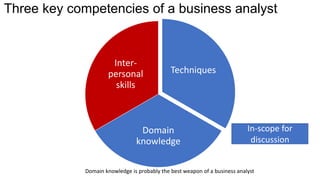
Three key competencies of a business analyst
Techniques
Domain
knowledge
Inter-
personal
skills
In-scope for
discussion
Domain knowledge is probably the best weapon of a business analyst
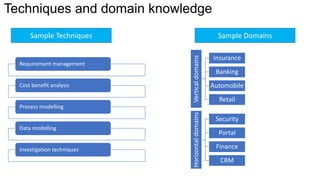
Techniques and domain knowledge
Requirement management
Cost benefit analysis
Process modelling
Data modelling
Investigation techniques
Sample Techniques Sample Domains
Vertical
domains
Insurance
Banking
Automobile
Retail
Horizontal
domains
Security
Portal
Finance
CRM
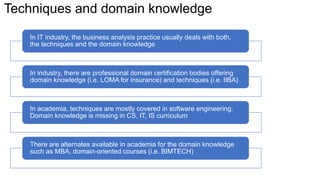
Techniques and domain knowledge
In IT industry, the business analysis practice usually deals with both,
the techniques and the domain knowledge
In industry, there are professional domain certification bodies offering
domain knowledge (i.e. LOMA for insurance) and techniques (i.e. IIBA)
In academia, techniques are mostly covered in software engineering.
Domain knowledge is missing in CS, IT, IS curriculum
There are alternates available in academia for the domain knowledge
such as MBA, domain-oriented courses (i.e. BIMTECH)
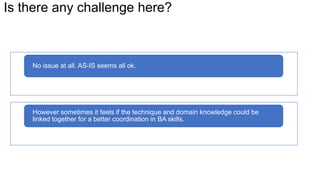
Is there any challenge here?
No issue at all. AS-IS seems all ok.
However sometimes it feels if the technique and domain knowledge could be
linked together for a better coordination in BA skills.
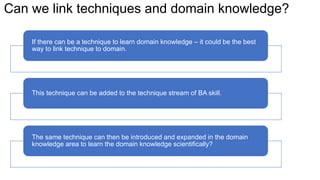
Can we link techniques and domain knowledge?
If there can be a technique to learn domain knowledge – it could be the best
way to link technique to domain.
This technique can be added to the technique stream of BA skill.
The same technique can then be introduced and expanded in the domain
knowledge area to learn the domain knowledge scientifically?
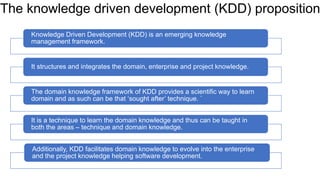
The knowledge driven development (KDD) proposition
Knowledge Driven Development (KDD) is an emerging knowledge
management framework.
It structures and integrates the domain, enterprise and project knowledge.
The domain knowledge framework of KDD provides a scientific way to learn
domain and as such can be that ‘sought after’ technique. `
It is a technique to learn the domain knowledge and thus can be taught in
both the areas – technique and domain knowledge.
Additionally, KDD facilitates domain knowledge to evolve into the enterprise
and the project knowledge helping software development.
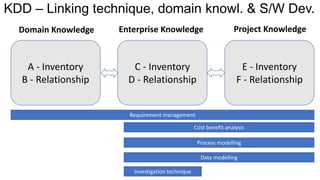
KDD – Linking technique, domain knowl. & S/W Dev.
A - Inventory
B - Relationship
C - Inventory
D - Relationship
E - Inventory
F - Relationship
Domain Knowledge Enterprise Knowledge Project Knowledge
Cost benefit analysis
Requirement management
Process modelling
Data modelling
Investigation technique
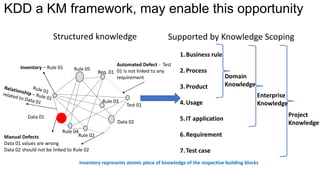
KDD a KM framework, may enable this opportunity
Structured knowledge
Domain
Knowledge
Enterprise
Knowledge
Project
Knowledge
Supported by Knowledge Scoping
Inventory – Rule 01
Manual Defects
Data 01 values are wrong
Data 02 should not be linked to Rule 02
Automated Defect - Test
01 is not linked to any
requirement
Req. 01
Test 01
Data 01
Data 02
Rule 02
Rule 03
Rule 04
Rule 05
Inventory represents atomic piece of knowledge of the respective building blocks
1.Business rule
2.Process
3.Product
4.Usage
5.IT application
6.Requirement
7.Test case
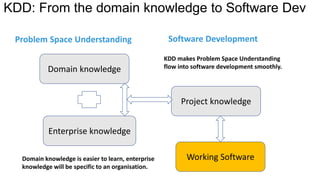
KDD: From the domain knowledge to Software Dev
Domain knowledge
Enterprise knowledge
Project knowledge
Problem Space Understanding
Working Software
Software Development
Domain knowledge is easier to learn, enterprise
knowledge will be specific to an organisation.
KDD makes Problem Space Understanding
flow into software development smoothly.
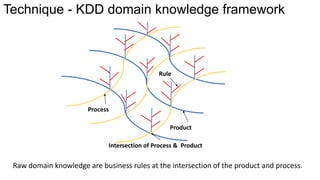
Intersection of Process & Product
Process
Rule
Product
Technique - KDD domain knowledge framework
Raw domain knowledge are business rules at the intersection of the product and process.
Influencers of the raw domain knowledge
Raw domain knowledge + the context enabled by the influencers is the KDD domain knowledge framework
Raw
domain
knowledge
Evolution
Regulation
Characteristics
Structure
Latest trends
Stakeholders
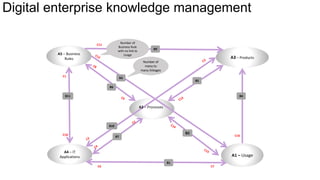
A5 – Business
Rules A3 – Products
A4 – IT
Applications
B9
B4
B5
B11
B1
B2
B6
B7
C10
C1
C6 C7
C16
A1 – Usage
Number of
many to
many linkages
Number of
Business Rule
with no link to
Usage
C11
B3
B10
A2 – Processes
Digital enterprise knowledge management
KDD: Project knowledge – expanded view
1. Business rule
2. Process
3. Process Step
4. Product
5. Non-functional attribute
6. Business data
7. Communication
8. Report
9. Screen
10.Message
11.Offline transaction
12.Application
13.Data
14.Logic
15.Requirement
16.Project test case
1. Business rule
2. Process
3. Product
4. Usage
5. Enabler
6. Requirement
7. Test case
Project knowledge for software development Knowledge specification format
7 generic building blocks are expanded 16 when customised in the
software development environment.
Sample inventory and relationship format to
structure knowledge – based on graph theory
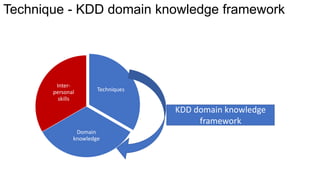
Technique - KDD domain knowledge framework
Techniques
Domain
knowledge
Inter-
personal
skills
KDD domain knowledge
framework
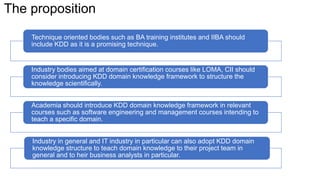
The proposition
Technique oriented bodies such as BA training institutes and IIBA should
include KDD as it is a promising technique.
Industry bodies aimed at domain certification courses like LOMA, CII should
consider introducing KDD domain knowledge framework to structure the
knowledge scientifically.
Academia should introduce KDD domain knowledge framework in relevant
courses such as software engineering and management courses intending to
teach a specific domain.
Industry in general and IT industry in particular can also adopt KDD domain
knowledge structure to teach domain knowledge to their project team in
general and to heir business analysts in particular.
Available resources
1. KDD in Cambridge University Press site
https://www.cambridge.org/in/academic/subjects/computer-science/software-engineering-and-development/knowledge-driven-
development-bridging-waterfall-and-agile-methodologies?format=HB
2. Information about KDD at a single place:
https://knowledgedrivendevelopment.com/
3. KDD in PMI Conference, Bangalore
https://pmibangalorechapter.in/pmpc/2019/pmpc-2019/papers/2019/Manoj%20Lal_PMIBC-19-1-
004_Knowledge%20Driven%20Development%20(KDD)%20-
%20Digital%20Knowledge%20Management%20for%20Digital%20Transformation.pdf
4. KDD in medium.com
https://medium.com/analysts-corner/can-structuring-knowledge-contain-the-tide-of-current-information-overload-b3f3ad1a9baa
5. KDD in SlideShare
https://www.slideshare.net/ManojKumarLal2/overview-of-knowledge-driven-development-kdd-233351211?qid=422371ae-30a1-43fc-
a0e6-21e2bf9ebf0a&v=&b=&from_search=2
6. KDD citation in a relevant thesis (page 64 of the link)
https://dspace.cvut.cz/bitstream/handle/10467/80244/F8-DP-2019-Jancovicova-Barbora-thesis.pdf?sequence=-1&isAllowed=y

Kdd domain knowledge framework for business analysts

  • 1.
    Author: Manoj KumarLal Note: The theme and diagrams are taken from the book ‘Knowledge Driven Development – Bridging Waterfall and Agile methodologies’, related literature available online and the upcoming book on domain knowledge by the author. KDD domain knowledge framework for business analysts
  • 2.
    Three key competenciesof a business analyst Techniques Domain knowledge Inter- personal skills In-scope for discussion Domain knowledge is probably the best weapon of a business analyst
  • 3.
    Techniques and domainknowledge Requirement management Cost benefit analysis Process modelling Data modelling Investigation techniques Sample Techniques Sample Domains Vertical domains Insurance Banking Automobile Retail Horizontal domains Security Portal Finance CRM
  • 4.
    Techniques and domainknowledge In IT industry, the business analysis practice usually deals with both, the techniques and the domain knowledge In industry, there are professional domain certification bodies offering domain knowledge (i.e. LOMA for insurance) and techniques (i.e. IIBA) In academia, techniques are mostly covered in software engineering. Domain knowledge is missing in CS, IT, IS curriculum There are alternates available in academia for the domain knowledge such as MBA, domain-oriented courses (i.e. BIMTECH)
  • 5.
    Is there anychallenge here? No issue at all. AS-IS seems all ok. However sometimes it feels if the technique and domain knowledge could be linked together for a better coordination in BA skills.
  • 6.
    Can we linktechniques and domain knowledge? If there can be a technique to learn domain knowledge – it could be the best way to link technique to domain. This technique can be added to the technique stream of BA skill. The same technique can then be introduced and expanded in the domain knowledge area to learn the domain knowledge scientifically?
  • 7.
    The knowledge drivendevelopment (KDD) proposition Knowledge Driven Development (KDD) is an emerging knowledge management framework. It structures and integrates the domain, enterprise and project knowledge. The domain knowledge framework of KDD provides a scientific way to learn domain and as such can be that ‘sought after’ technique. ` It is a technique to learn the domain knowledge and thus can be taught in both the areas – technique and domain knowledge. Additionally, KDD facilitates domain knowledge to evolve into the enterprise and the project knowledge helping software development.
  • 8.
    KDD – Linkingtechnique, domain knowl. & S/W Dev. A - Inventory B - Relationship C - Inventory D - Relationship E - Inventory F - Relationship Domain Knowledge Enterprise Knowledge Project Knowledge Cost benefit analysis Requirement management Process modelling Data modelling Investigation technique
  • 9.
    KDD a KMframework, may enable this opportunity Structured knowledge Domain Knowledge Enterprise Knowledge Project Knowledge Supported by Knowledge Scoping Inventory – Rule 01 Manual Defects Data 01 values are wrong Data 02 should not be linked to Rule 02 Automated Defect - Test 01 is not linked to any requirement Req. 01 Test 01 Data 01 Data 02 Rule 02 Rule 03 Rule 04 Rule 05 Inventory represents atomic piece of knowledge of the respective building blocks 1.Business rule 2.Process 3.Product 4.Usage 5.IT application 6.Requirement 7.Test case
  • 10.
    KDD: From thedomain knowledge to Software Dev Domain knowledge Enterprise knowledge Project knowledge Problem Space Understanding Working Software Software Development Domain knowledge is easier to learn, enterprise knowledge will be specific to an organisation. KDD makes Problem Space Understanding flow into software development smoothly.
  • 11.
    Intersection of Process& Product Process Rule Product Technique - KDD domain knowledge framework Raw domain knowledge are business rules at the intersection of the product and process.
  • 12.
    Influencers of theraw domain knowledge Raw domain knowledge + the context enabled by the influencers is the KDD domain knowledge framework Raw domain knowledge Evolution Regulation Characteristics Structure Latest trends Stakeholders
  • 13.
    A5 – Business RulesA3 – Products A4 – IT Applications B9 B4 B5 B11 B1 B2 B6 B7 C10 C1 C6 C7 C16 A1 – Usage Number of many to many linkages Number of Business Rule with no link to Usage C11 B3 B10 A2 – Processes Digital enterprise knowledge management
  • 14.
    KDD: Project knowledge– expanded view 1. Business rule 2. Process 3. Process Step 4. Product 5. Non-functional attribute 6. Business data 7. Communication 8. Report 9. Screen 10.Message 11.Offline transaction 12.Application 13.Data 14.Logic 15.Requirement 16.Project test case 1. Business rule 2. Process 3. Product 4. Usage 5. Enabler 6. Requirement 7. Test case Project knowledge for software development Knowledge specification format 7 generic building blocks are expanded 16 when customised in the software development environment. Sample inventory and relationship format to structure knowledge – based on graph theory
  • 15.
    Technique - KDDdomain knowledge framework Techniques Domain knowledge Inter- personal skills KDD domain knowledge framework
  • 16.
    The proposition Technique orientedbodies such as BA training institutes and IIBA should include KDD as it is a promising technique. Industry bodies aimed at domain certification courses like LOMA, CII should consider introducing KDD domain knowledge framework to structure the knowledge scientifically. Academia should introduce KDD domain knowledge framework in relevant courses such as software engineering and management courses intending to teach a specific domain. Industry in general and IT industry in particular can also adopt KDD domain knowledge structure to teach domain knowledge to their project team in general and to heir business analysts in particular.
  • 17.
    Available resources 1. KDDin Cambridge University Press site https://www.cambridge.org/in/academic/subjects/computer-science/software-engineering-and-development/knowledge-driven- development-bridging-waterfall-and-agile-methodologies?format=HB 2. Information about KDD at a single place: https://knowledgedrivendevelopment.com/ 3. KDD in PMI Conference, Bangalore https://pmibangalorechapter.in/pmpc/2019/pmpc-2019/papers/2019/Manoj%20Lal_PMIBC-19-1- 004_Knowledge%20Driven%20Development%20(KDD)%20- %20Digital%20Knowledge%20Management%20for%20Digital%20Transformation.pdf 4. KDD in medium.com https://medium.com/analysts-corner/can-structuring-knowledge-contain-the-tide-of-current-information-overload-b3f3ad1a9baa 5. KDD in SlideShare https://www.slideshare.net/ManojKumarLal2/overview-of-knowledge-driven-development-kdd-233351211?qid=422371ae-30a1-43fc- a0e6-21e2bf9ebf0a&v=&b=&from_search=2 6. KDD citation in a relevant thesis (page 64 of the link) https://dspace.cvut.cz/bitstream/handle/10467/80244/F8-DP-2019-Jancovicova-Barbora-thesis.pdf?sequence=-1&isAllowed=y