Boolean Algebra Properties
8/30/2023
@kuntaladas
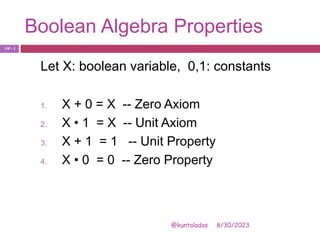
Let X: boolean variable, 0,1: constants
1. X + 0 = X -- Zero Axiom
2. X • 1 = X -- Unit Axiom
3. X + 1 = 1 -- Unit Property
4. X • 0 = 0 -- Zero Property
PJF - 1
Boolean Algebra Properties
8/30/2023
@kuntaladas
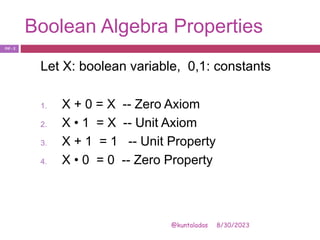
Let X: boolean variable, 0,1: constants
1. X + 0 = X -- Zero Axiom
2. X • 1 = X -- Unit Axiom
3. X + 1 = 1 -- Unit Property
4. X • 0 = 0 -- Zero Property
PJF - 2
Boolean Algebra Properties (cont.)
8/30/2023
@kuntaladas
Let X: boolean variable, 0,1: constants
5. X + X = X -- Idepotence
6. X • X = X -- Idepotence
7. X + X’ = 1 -- Complement
8. X • X’ = 0 -- Complement
9. (X’)’ = X -- Involution
PJF - 3
Duality
8/30/2023
@kuntaladas
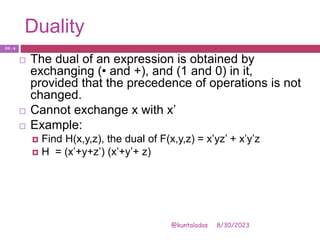
 The dual of an expression is obtained by
exchanging (• and +), and (1 and 0) in it,
provided that the precedence of operations is not
changed.
 Cannot exchange x with x’
 Example:
 Find H(x,y,z), the dual of F(x,y,z) = x’yz’ + x’y’z
 H = (x’+y+z’) (x’+y’+ z)
PJF - 4
Duality (cont’d)
8/30/2023
@kuntaladas
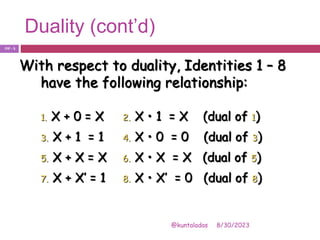
With respect to duality, Identities 1 – 8
have the following relationship:
1. X + 0 = X 2. X • 1 = X (dual of 1)
3. X + 1 = 1 4. X • 0 = 0 (dual of 3)
5. X + X = X 6. X • X = X (dual of 5)
7. X + X’ = 1 8. X • X’ = 0 (dual of 8)
PJF - 5
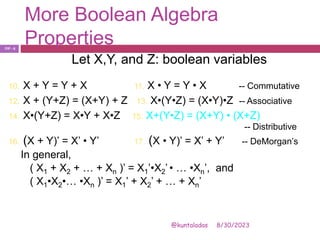
More Boolean Algebra
Properties
8/30/2023
@kuntaladas
Let X,Y, and Z: boolean variables
10. X + Y = Y + X 11. X • Y = Y • X -- Commutative
12. X + (Y+Z) = (X+Y) + Z 13. X•(Y•Z) = (X•Y)•Z -- Associative
14. X•(Y+Z) = X•Y + X•Z 15. X+(Y•Z) = (X+Y) • (X+Z)
-- Distributive
16. (X + Y)’ = X’ • Y’ 17. (X • Y)’ = X’ + Y’ -- DeMorgan’s
In general,
( X1 + X2 + … + Xn )’ = X1’•X2’ • … •Xn’, and
( X1•X2•… •Xn )’ = X1’ + X2’ + … + Xn’
PJF - 6
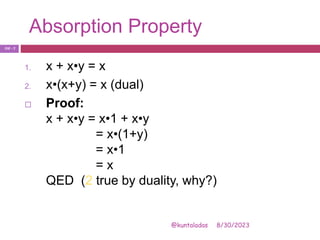
Absorption Property
8/30/2023
@kuntaladas
1. x + x•y = x
2. x•(x+y) = x (dual)
 Proof:
x + x•y = x•1 + x•y
= x•(1+y)
= x•1
= x
QED (2 true by duality, why?)
PJF - 7
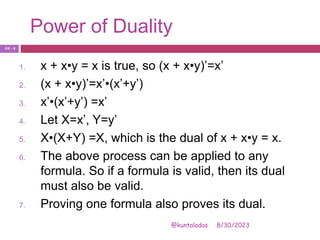
Power of Duality
8/30/2023
@kuntaladas
1. x + x•y = x is true, so (x + x•y)’=x’
2. (x + x•y)’=x’•(x’+y’)
3. x’•(x’+y’) =x’
4. Let X=x’, Y=y’
5. X•(X+Y) =X, which is the dual of x + x•y = x.
6. The above process can be applied to any
formula. So if a formula is valid, then its dual
must also be valid.
7. Proving one formula also proves its dual.
PJF - 8
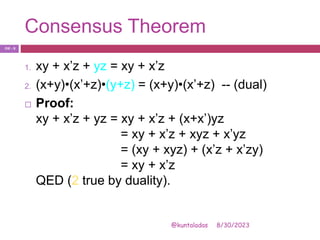
Consensus Theorem
8/30/2023
@kuntaladas
1. xy + x’z + yz = xy + x’z
2. (x+y)•(x’+z)•(y+z) = (x+y)•(x’+z) -- (dual)
 Proof:
xy + x’z + yz = xy + x’z + (x+x’)yz
= xy + x’z + xyz + x’yz
= (xy + xyz) + (x’z + x’zy)
= xy + x’z
QED (2 true by duality).
PJF - 9
Truth Tables (revisited)
8/30/2023
@kuntaladas
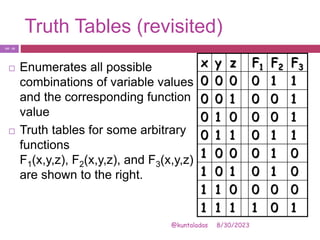
 Enumerates all possible
combinations of variable values
and the corresponding function
value
 Truth tables for some arbitrary
functions
F1(x,y,z), F2(x,y,z), and F3(x,y,z)
are shown to the right.
x y z F1 F2 F3
0 0 0 0 1 1
0 0 1 0 0 1
0 1 0 0 0 1
0 1 1 0 1 1
1 0 0 0 1 0
1 0 1 0 1 0
1 1 0 0 0 0
1 1 1 1 0 1
PJF - 10
Truth Tables (cont.)
8/30/2023
@kuntaladas
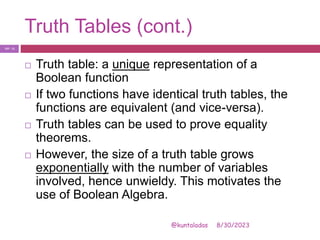
 Truth table: a unique representation of a
Boolean function
 If two functions have identical truth tables, the
functions are equivalent (and vice-versa).
 Truth tables can be used to prove equality
theorems.
 However, the size of a truth table grows
exponentially with the number of variables
involved, hence unwieldy. This motivates the
use of Boolean Algebra.
PJF - 11
Boolean expressions-NOT
unique
8/30/2023
@kuntaladas
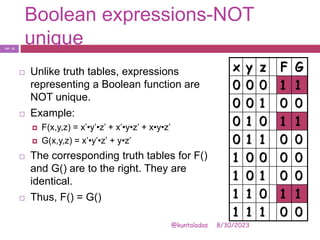
 Unlike truth tables, expressions
representing a Boolean function are
NOT unique.
 Example:
 F(x,y,z) = x’•y’•z’ + x’•y•z’ + x•y•z’
 G(x,y,z) = x’•y’•z’ + y•z’
 The corresponding truth tables for F()
and G() are to the right. They are
identical.
 Thus, F() = G()
x y z F G
0 0 0 1 1
0 0 1 0 0
0 1 0 1 1
0 1 1 0 0
1 0 0 0 0
1 0 1 0 0
1 1 0 1 1
1 1 1 0 0
PJF - 12
Algebraic Manipulation
8/30/2023
@kuntaladas
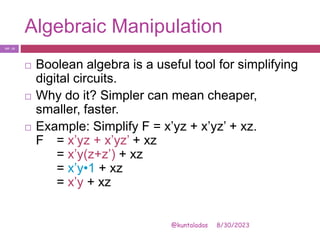
 Boolean algebra is a useful tool for simplifying
digital circuits.
 Why do it? Simpler can mean cheaper,
smaller, faster.
 Example: Simplify F = x’yz + x’yz’ + xz.
F = x’yz + x’yz’ + xz
= x’y(z+z’) + xz
= x’y•1 + xz
= x’y + xz
PJF - 13
Algebraic Manipulation (cont.)
8/30/2023
@kuntaladas
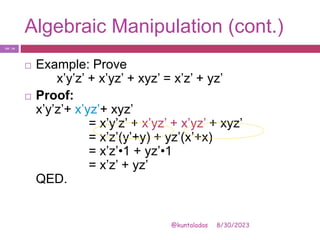
 Example: Prove
x’y’z’ + x’yz’ + xyz’ = x’z’ + yz’
 Proof:
x’y’z’+ x’yz’+ xyz’
= x’y’z’ + x’yz’ + x’yz’ + xyz’
= x’z’(y’+y) + yz’(x’+x)
= x’z’•1 + yz’•1
= x’z’ + yz’
QED.
PJF - 14
Complement of a Function
8/30/2023
@kuntaladas
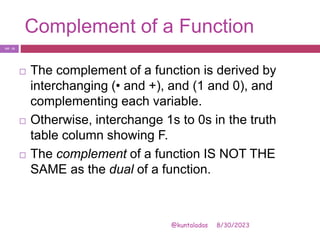
 The complement of a function is derived by
interchanging (• and +), and (1 and 0), and
complementing each variable.
 Otherwise, interchange 1s to 0s in the truth
table column showing F.
 The complement of a function IS NOT THE
SAME as the dual of a function.
PJF - 15
Complementation: Example
8/30/2023
@kuntaladas
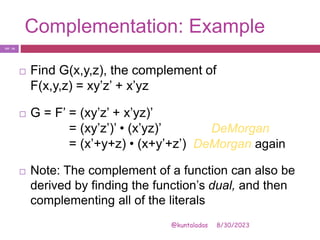
 Find G(x,y,z), the complement of
F(x,y,z) = xy’z’ + x’yz
 G = F’ = (xy’z’ + x’yz)’
= (xy’z’)’ • (x’yz)’ DeMorgan
= (x’+y+z) • (x+y’+z’) DeMorgan again
 Note: The complement of a function can also be
derived by finding the function’s dual, and then
complementing all of the literals
PJF - 16
Canonical and Standard Forms
8/30/2023
@kuntaladas
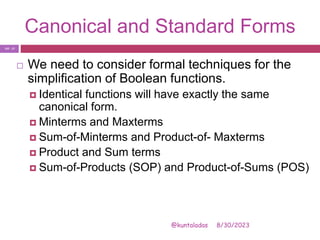
 We need to consider formal techniques for the
simplification of Boolean functions.
 Identical functions will have exactly the same
canonical form.
 Minterms and Maxterms
 Sum-of-Minterms and Product-of- Maxterms
 Product and Sum terms
 Sum-of-Products (SOP) and Product-of-Sums (POS)
PJF - 17
Complement of a Function
8/30/2023
@kuntaladas
 The complement of a function is derived by
interchanging (• and +), and (1 and 0), and
complementing each variable.
 Otherwise, interchange 1s to 0s in the truth
table column showing F.
 The complement of a function IS NOT THE
SAME as the dual of a function.
PJF - 18
Complementation: Example
8/30/2023
@kuntaladas
 Find G(x,y,z), the complement of
F(x,y,z) = xy’z’ + x’yz
 G = F’ = (xy’z’ + x’yz)’
= (xy’z’)’ • (x’yz)’ DeMorgan
= (x’+y+z) • (x+y’+z’) DeMorgan again
 Note: The complement of a function can also be
derived by finding the function’s dual, and then
complementing all of the literals
PJF - 19
Canonical and Standard Forms
8/30/2023
@kuntaladas
 We need to consider formal techniques for the
simplification of Boolean functions.
 Identical functions will have exactly the same
canonical form.
 Minterms and Maxterms
 Sum-of-Minterms and Product-of- Maxterms
 Product and Sum terms
 Sum-of-Products (SOP) and Product-of-Sums (POS)
PJF - 20
Definitions
8/30/2023
@kuntaladas
 Literal: A variable or its complement
 Product term: literals connected by •
 Sum term: literals connected by +
 Minterm: a product term in which all the
variables appear exactly once, either
complemented or uncomplemented
 Maxterm: a sum term in which all the variables
appear exactly once, either complemented or
uncomplemented
PJF - 21
8/30/2023
@kuntaladas
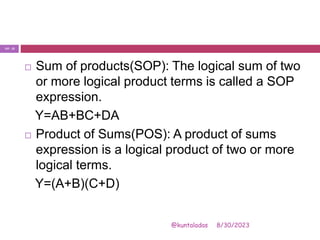
 Sum of products(SOP): The logical sum of two
or more logical product terms is called a SOP
expression.
Y=AB+BC+DA
 Product of Sums(POS): A product of sums
expression is a logical product of two or more
logical terms.
Y=(A+B)(C+D)
PJF - 22
Minterm
8/30/2023
@kuntaladas
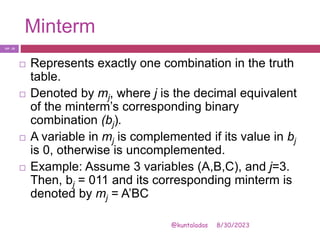
 Represents exactly one combination in the truth
table.
 Denoted by mj, where j is the decimal equivalent
of the minterm’s corresponding binary
combination (bj).
 A variable in mj is complemented if its value in bj
is 0, otherwise is uncomplemented.
 Example: Assume 3 variables (A,B,C), and j=3.
Then, bj = 011 and its corresponding minterm is
denoted by mj = A’BC
PJF - 23
Maxterm
8/30/2023
@kuntaladas
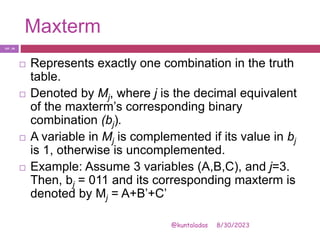
 Represents exactly one combination in the truth
table.
 Denoted by Mj, where j is the decimal equivalent
of the maxterm’s corresponding binary
combination (bj).
 A variable in Mj is complemented if its value in bj
is 1, otherwise is uncomplemented.
 Example: Assume 3 variables (A,B,C), and j=3.
Then, bj = 011 and its corresponding maxterm is
denoted by Mj = A+B’+C’
PJF - 24
Truth Table notation for Minterms
and Maxterms
8/30/2023
@kuntaladas
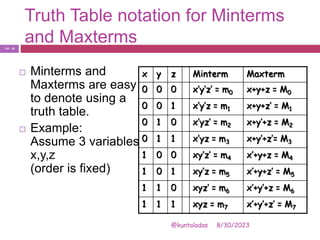
 Minterms and
Maxterms are easy
to denote using a
truth table.
 Example:
Assume 3 variables
x,y,z
(order is fixed)
x y z Minterm Maxterm
0 0 0 x’y’z’ = m0 x+y+z = M0
0 0 1 x’y’z = m1 x+y+z’ = M1
0 1 0 x’yz’ = m2 x+y’+z = M2
0 1 1 x’yz = m3 x+y’+z’= M3
1 0 0 xy’z’ = m4 x’+y+z = M4
1 0 1 xy’z = m5 x’+y+z’ = M5
1 1 0 xyz’ = m6 x’+y’+z = M6
1 1 1 xyz = m7 x’+y’+z’ = M7
PJF - 25
Canonical Forms (Unique)
8/30/2023
@kuntaladas
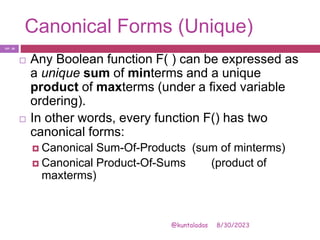
 Any Boolean function F( ) can be expressed as
a unique sum of minterms and a unique
product of maxterms (under a fixed variable
ordering).
 In other words, every function F() has two
canonical forms:
 Canonical Sum-Of-Products (sum of minterms)
 Canonical Product-Of-Sums (product of
maxterms)
PJF - 26
Canonical Forms (Unique)
8/30/2023
@kuntaladas
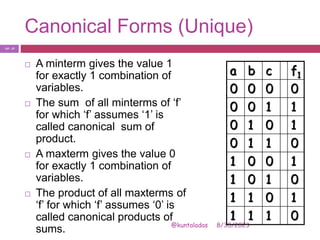
 A minterm gives the value 1
for exactly 1 combination of
variables.
 The sum of all minterms of ‘f’
for which ‘f’ assumes ‘1’ is
called canonical sum of
product.
 A maxterm gives the value 0
for exactly 1 combination of
variables.
 The product of all maxterms of
‘f’ for which ‘f’ assumes ‘0’ is
called canonical products of
sums.
a b c f1
0 0 0 0
0 0 1 1
0 1 0 1
0 1 1 0
1 0 0 1
1 0 1 0
1 1 0 1
1 1 1 0
PJF - 27
Example
8/30/2023
@kuntaladas
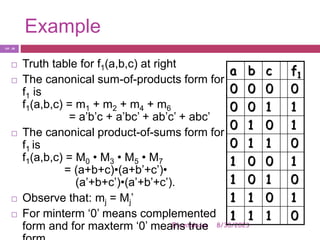
 Truth table for f1(a,b,c) at right
 The canonical sum-of-products form for
f1 is
f1(a,b,c) = m1 + m2 + m4 + m6
= a’b’c + a’bc’ + ab’c’ + abc’
 The canonical product-of-sums form for
f1 is
f1(a,b,c) = M0 • M3 • M5 • M7
= (a+b+c)•(a+b’+c’)•
(a’+b+c’)•(a’+b’+c’).
 Observe that: mj = Mj’
 For minterm ‘0’ means complemented
form and for maxterm ‘0’ means true
a b c f1
0 0 0 0
0 0 1 1
0 1 0 1
0 1 1 0
1 0 0 1
1 0 1 0
1 1 0 1
1 1 1 0
PJF - 28
Shorthand: ∑ and ∏
8/30/2023
@kuntaladas
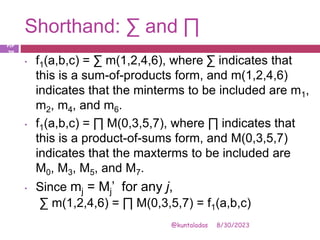
• f1(a,b,c) = ∑ m(1,2,4,6), where ∑ indicates that
this is a sum-of-products form, and m(1,2,4,6)
indicates that the minterms to be included are m1,
m2, m4, and m6.
• f1(a,b,c) = ∏ M(0,3,5,7), where ∏ indicates that
this is a product-of-sums form, and M(0,3,5,7)
indicates that the maxterms to be included are
M0, M3, M5, and M7.
• Since mj = Mj’ for any j,
∑ m(1,2,4,6) = ∏ M(0,3,5,7) = f1(a,b,c)
PJF
- 29
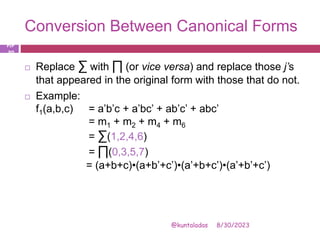
Conversion Between Canonical Forms
8/30/2023
@kuntaladas
 Replace ∑ with ∏ (or vice versa) and replace those j’s
that appeared in the original form with those that do not.
 Example:
f1(a,b,c) = a’b’c + a’bc’ + ab’c’ + abc’
= m1 + m2 + m4 + m6
= ∑(1,2,4,6)
= ∏(0,3,5,7)
= (a+b+c)•(a+b’+c’)•(a’+b+c’)•(a’+b’+c’)
PJF
- 30
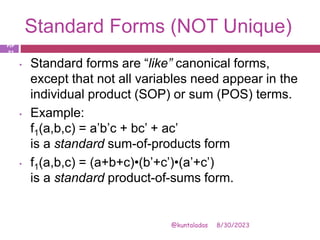
Standard Forms (NOT Unique)
8/30/2023
@kuntaladas
• Standard forms are “like” canonical forms,
except that not all variables need appear in the
individual product (SOP) or sum (POS) terms.
• Example:
f1(a,b,c) = a’b’c + bc’ + ac’
is a standard sum-of-products form
• f1(a,b,c) = (a+b+c)•(b’+c’)•(a’+c’)
is a standard product-of-sums form.
PJF
- 31
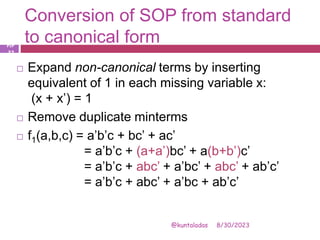
Conversion of SOP from standard
to canonical form
8/30/2023
@kuntaladas
 Expand non-canonical terms by inserting
equivalent of 1 in each missing variable x:
(x + x’) = 1
 Remove duplicate minterms
 f1(a,b,c) = a’b’c + bc’ + ac’
= a’b’c + (a+a’)bc’ + a(b+b’)c’
= a’b’c + abc’ + a’bc’ + abc’ + ab’c’
= a’b’c + abc’ + a’bc + ab’c’
PJF
- 32
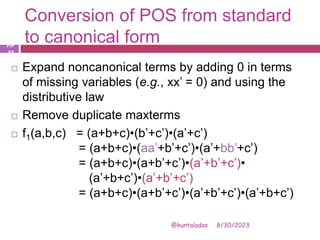
Conversion of POS from standard
to canonical form
8/30/2023
@kuntaladas
 Expand noncanonical terms by adding 0 in terms
of missing variables (e.g., xx’ = 0) and using the
distributive law
 Remove duplicate maxterms
 f1(a,b,c) = (a+b+c)•(b’+c’)•(a’+c’)
= (a+b+c)•(aa’+b’+c’)•(a’+bb’+c’)
= (a+b+c)•(a+b’+c’)•(a’+b’+c’)•
(a’+b+c’)•(a’+b’+c’)
= (a+b+c)•(a+b’+c’)•(a’+b’+c’)•(a’+b+c’)
PJF
- 33
DIGITAL SYSTEM
DESIGN
KUNTALA DAS

KDASKMAP.pptx

  • 1.
    Boolean Algebra Properties 8/30/2023 @kuntaladas LetX: boolean variable, 0,1: constants 1. X + 0 = X -- Zero Axiom 2. X • 1 = X -- Unit Axiom 3. X + 1 = 1 -- Unit Property 4. X • 0 = 0 -- Zero Property PJF - 1
  • 2.
    Boolean Algebra Properties 8/30/2023 @kuntaladas LetX: boolean variable, 0,1: constants 1. X + 0 = X -- Zero Axiom 2. X • 1 = X -- Unit Axiom 3. X + 1 = 1 -- Unit Property 4. X • 0 = 0 -- Zero Property PJF - 2
  • 3.
    Boolean Algebra Properties(cont.) 8/30/2023 @kuntaladas Let X: boolean variable, 0,1: constants 5. X + X = X -- Idepotence 6. X • X = X -- Idepotence 7. X + X’ = 1 -- Complement 8. X • X’ = 0 -- Complement 9. (X’)’ = X -- Involution PJF - 3
  • 4.
    Duality 8/30/2023 @kuntaladas  The dualof an expression is obtained by exchanging (• and +), and (1 and 0) in it, provided that the precedence of operations is not changed.  Cannot exchange x with x’  Example:  Find H(x,y,z), the dual of F(x,y,z) = x’yz’ + x’y’z  H = (x’+y+z’) (x’+y’+ z) PJF - 4
  • 5.
    Duality (cont’d) 8/30/2023 @kuntaladas With respectto duality, Identities 1 – 8 have the following relationship: 1. X + 0 = X 2. X • 1 = X (dual of 1) 3. X + 1 = 1 4. X • 0 = 0 (dual of 3) 5. X + X = X 6. X • X = X (dual of 5) 7. X + X’ = 1 8. X • X’ = 0 (dual of 8) PJF - 5
  • 6.
    More Boolean Algebra Properties 8/30/2023 @kuntaladas LetX,Y, and Z: boolean variables 10. X + Y = Y + X 11. X • Y = Y • X -- Commutative 12. X + (Y+Z) = (X+Y) + Z 13. X•(Y•Z) = (X•Y)•Z -- Associative 14. X•(Y+Z) = X•Y + X•Z 15. X+(Y•Z) = (X+Y) • (X+Z) -- Distributive 16. (X + Y)’ = X’ • Y’ 17. (X • Y)’ = X’ + Y’ -- DeMorgan’s In general, ( X1 + X2 + … + Xn )’ = X1’•X2’ • … •Xn’, and ( X1•X2•… •Xn )’ = X1’ + X2’ + … + Xn’ PJF - 6
  • 7.
    Absorption Property 8/30/2023 @kuntaladas 1. x+ x•y = x 2. x•(x+y) = x (dual)  Proof: x + x•y = x•1 + x•y = x•(1+y) = x•1 = x QED (2 true by duality, why?) PJF - 7
  • 8.
    Power of Duality 8/30/2023 @kuntaladas 1.x + x•y = x is true, so (x + x•y)’=x’ 2. (x + x•y)’=x’•(x’+y’) 3. x’•(x’+y’) =x’ 4. Let X=x’, Y=y’ 5. X•(X+Y) =X, which is the dual of x + x•y = x. 6. The above process can be applied to any formula. So if a formula is valid, then its dual must also be valid. 7. Proving one formula also proves its dual. PJF - 8
  • 9.
    Consensus Theorem 8/30/2023 @kuntaladas 1. xy+ x’z + yz = xy + x’z 2. (x+y)•(x’+z)•(y+z) = (x+y)•(x’+z) -- (dual)  Proof: xy + x’z + yz = xy + x’z + (x+x’)yz = xy + x’z + xyz + x’yz = (xy + xyz) + (x’z + x’zy) = xy + x’z QED (2 true by duality). PJF - 9
  • 10.
    Truth Tables (revisited) 8/30/2023 @kuntaladas Enumerates all possible combinations of variable values and the corresponding function value  Truth tables for some arbitrary functions F1(x,y,z), F2(x,y,z), and F3(x,y,z) are shown to the right. x y z F1 F2 F3 0 0 0 0 1 1 0 0 1 0 0 1 0 1 0 0 0 1 0 1 1 0 1 1 1 0 0 0 1 0 1 0 1 0 1 0 1 1 0 0 0 0 1 1 1 1 0 1 PJF - 10
  • 11.
    Truth Tables (cont.) 8/30/2023 @kuntaladas Truth table: a unique representation of a Boolean function  If two functions have identical truth tables, the functions are equivalent (and vice-versa).  Truth tables can be used to prove equality theorems.  However, the size of a truth table grows exponentially with the number of variables involved, hence unwieldy. This motivates the use of Boolean Algebra. PJF - 11
  • 12.
    Boolean expressions-NOT unique 8/30/2023 @kuntaladas  Unliketruth tables, expressions representing a Boolean function are NOT unique.  Example:  F(x,y,z) = x’•y’•z’ + x’•y•z’ + x•y•z’  G(x,y,z) = x’•y’•z’ + y•z’  The corresponding truth tables for F() and G() are to the right. They are identical.  Thus, F() = G() x y z F G 0 0 0 1 1 0 0 1 0 0 0 1 0 1 1 0 1 1 0 0 1 0 0 0 0 1 0 1 0 0 1 1 0 1 1 1 1 1 0 0 PJF - 12
  • 13.
    Algebraic Manipulation 8/30/2023 @kuntaladas  Booleanalgebra is a useful tool for simplifying digital circuits.  Why do it? Simpler can mean cheaper, smaller, faster.  Example: Simplify F = x’yz + x’yz’ + xz. F = x’yz + x’yz’ + xz = x’y(z+z’) + xz = x’y•1 + xz = x’y + xz PJF - 13
  • 14.
    Algebraic Manipulation (cont.) 8/30/2023 @kuntaladas Example: Prove x’y’z’ + x’yz’ + xyz’ = x’z’ + yz’  Proof: x’y’z’+ x’yz’+ xyz’ = x’y’z’ + x’yz’ + x’yz’ + xyz’ = x’z’(y’+y) + yz’(x’+x) = x’z’•1 + yz’•1 = x’z’ + yz’ QED. PJF - 14
  • 15.
    Complement of aFunction 8/30/2023 @kuntaladas  The complement of a function is derived by interchanging (• and +), and (1 and 0), and complementing each variable.  Otherwise, interchange 1s to 0s in the truth table column showing F.  The complement of a function IS NOT THE SAME as the dual of a function. PJF - 15
  • 16.
    Complementation: Example 8/30/2023 @kuntaladas  FindG(x,y,z), the complement of F(x,y,z) = xy’z’ + x’yz  G = F’ = (xy’z’ + x’yz)’ = (xy’z’)’ • (x’yz)’ DeMorgan = (x’+y+z) • (x+y’+z’) DeMorgan again  Note: The complement of a function can also be derived by finding the function’s dual, and then complementing all of the literals PJF - 16
  • 17.
    Canonical and StandardForms 8/30/2023 @kuntaladas  We need to consider formal techniques for the simplification of Boolean functions.  Identical functions will have exactly the same canonical form.  Minterms and Maxterms  Sum-of-Minterms and Product-of- Maxterms  Product and Sum terms  Sum-of-Products (SOP) and Product-of-Sums (POS) PJF - 17
  • 18.
    Complement of aFunction 8/30/2023 @kuntaladas  The complement of a function is derived by interchanging (• and +), and (1 and 0), and complementing each variable.  Otherwise, interchange 1s to 0s in the truth table column showing F.  The complement of a function IS NOT THE SAME as the dual of a function. PJF - 18
  • 19.
    Complementation: Example 8/30/2023 @kuntaladas  FindG(x,y,z), the complement of F(x,y,z) = xy’z’ + x’yz  G = F’ = (xy’z’ + x’yz)’ = (xy’z’)’ • (x’yz)’ DeMorgan = (x’+y+z) • (x+y’+z’) DeMorgan again  Note: The complement of a function can also be derived by finding the function’s dual, and then complementing all of the literals PJF - 19
  • 20.
    Canonical and StandardForms 8/30/2023 @kuntaladas  We need to consider formal techniques for the simplification of Boolean functions.  Identical functions will have exactly the same canonical form.  Minterms and Maxterms  Sum-of-Minterms and Product-of- Maxterms  Product and Sum terms  Sum-of-Products (SOP) and Product-of-Sums (POS) PJF - 20
  • 21.
    Definitions 8/30/2023 @kuntaladas  Literal: Avariable or its complement  Product term: literals connected by •  Sum term: literals connected by +  Minterm: a product term in which all the variables appear exactly once, either complemented or uncomplemented  Maxterm: a sum term in which all the variables appear exactly once, either complemented or uncomplemented PJF - 21
  • 22.
    8/30/2023 @kuntaladas  Sum ofproducts(SOP): The logical sum of two or more logical product terms is called a SOP expression. Y=AB+BC+DA  Product of Sums(POS): A product of sums expression is a logical product of two or more logical terms. Y=(A+B)(C+D) PJF - 22
  • 23.
    Minterm 8/30/2023 @kuntaladas  Represents exactlyone combination in the truth table.  Denoted by mj, where j is the decimal equivalent of the minterm’s corresponding binary combination (bj).  A variable in mj is complemented if its value in bj is 0, otherwise is uncomplemented.  Example: Assume 3 variables (A,B,C), and j=3. Then, bj = 011 and its corresponding minterm is denoted by mj = A’BC PJF - 23
  • 24.
    Maxterm 8/30/2023 @kuntaladas  Represents exactlyone combination in the truth table.  Denoted by Mj, where j is the decimal equivalent of the maxterm’s corresponding binary combination (bj).  A variable in Mj is complemented if its value in bj is 1, otherwise is uncomplemented.  Example: Assume 3 variables (A,B,C), and j=3. Then, bj = 011 and its corresponding maxterm is denoted by Mj = A+B’+C’ PJF - 24
  • 25.
    Truth Table notationfor Minterms and Maxterms 8/30/2023 @kuntaladas  Minterms and Maxterms are easy to denote using a truth table.  Example: Assume 3 variables x,y,z (order is fixed) x y z Minterm Maxterm 0 0 0 x’y’z’ = m0 x+y+z = M0 0 0 1 x’y’z = m1 x+y+z’ = M1 0 1 0 x’yz’ = m2 x+y’+z = M2 0 1 1 x’yz = m3 x+y’+z’= M3 1 0 0 xy’z’ = m4 x’+y+z = M4 1 0 1 xy’z = m5 x’+y+z’ = M5 1 1 0 xyz’ = m6 x’+y’+z = M6 1 1 1 xyz = m7 x’+y’+z’ = M7 PJF - 25
  • 26.
    Canonical Forms (Unique) 8/30/2023 @kuntaladas Any Boolean function F( ) can be expressed as a unique sum of minterms and a unique product of maxterms (under a fixed variable ordering).  In other words, every function F() has two canonical forms:  Canonical Sum-Of-Products (sum of minterms)  Canonical Product-Of-Sums (product of maxterms) PJF - 26
  • 27.
    Canonical Forms (Unique) 8/30/2023 @kuntaladas A minterm gives the value 1 for exactly 1 combination of variables.  The sum of all minterms of ‘f’ for which ‘f’ assumes ‘1’ is called canonical sum of product.  A maxterm gives the value 0 for exactly 1 combination of variables.  The product of all maxterms of ‘f’ for which ‘f’ assumes ‘0’ is called canonical products of sums. a b c f1 0 0 0 0 0 0 1 1 0 1 0 1 0 1 1 0 1 0 0 1 1 0 1 0 1 1 0 1 1 1 1 0 PJF - 27
  • 28.
    Example 8/30/2023 @kuntaladas  Truth tablefor f1(a,b,c) at right  The canonical sum-of-products form for f1 is f1(a,b,c) = m1 + m2 + m4 + m6 = a’b’c + a’bc’ + ab’c’ + abc’  The canonical product-of-sums form for f1 is f1(a,b,c) = M0 • M3 • M5 • M7 = (a+b+c)•(a+b’+c’)• (a’+b+c’)•(a’+b’+c’).  Observe that: mj = Mj’  For minterm ‘0’ means complemented form and for maxterm ‘0’ means true a b c f1 0 0 0 0 0 0 1 1 0 1 0 1 0 1 1 0 1 0 0 1 1 0 1 0 1 1 0 1 1 1 1 0 PJF - 28
  • 29.
    Shorthand: ∑ and∏ 8/30/2023 @kuntaladas • f1(a,b,c) = ∑ m(1,2,4,6), where ∑ indicates that this is a sum-of-products form, and m(1,2,4,6) indicates that the minterms to be included are m1, m2, m4, and m6. • f1(a,b,c) = ∏ M(0,3,5,7), where ∏ indicates that this is a product-of-sums form, and M(0,3,5,7) indicates that the maxterms to be included are M0, M3, M5, and M7. • Since mj = Mj’ for any j, ∑ m(1,2,4,6) = ∏ M(0,3,5,7) = f1(a,b,c) PJF - 29
  • 30.
    Conversion Between CanonicalForms 8/30/2023 @kuntaladas  Replace ∑ with ∏ (or vice versa) and replace those j’s that appeared in the original form with those that do not.  Example: f1(a,b,c) = a’b’c + a’bc’ + ab’c’ + abc’ = m1 + m2 + m4 + m6 = ∑(1,2,4,6) = ∏(0,3,5,7) = (a+b+c)•(a+b’+c’)•(a’+b+c’)•(a’+b’+c’) PJF - 30
  • 31.
    Standard Forms (NOTUnique) 8/30/2023 @kuntaladas • Standard forms are “like” canonical forms, except that not all variables need appear in the individual product (SOP) or sum (POS) terms. • Example: f1(a,b,c) = a’b’c + bc’ + ac’ is a standard sum-of-products form • f1(a,b,c) = (a+b+c)•(b’+c’)•(a’+c’) is a standard product-of-sums form. PJF - 31
  • 32.
    Conversion of SOPfrom standard to canonical form 8/30/2023 @kuntaladas  Expand non-canonical terms by inserting equivalent of 1 in each missing variable x: (x + x’) = 1  Remove duplicate minterms  f1(a,b,c) = a’b’c + bc’ + ac’ = a’b’c + (a+a’)bc’ + a(b+b’)c’ = a’b’c + abc’ + a’bc’ + abc’ + ab’c’ = a’b’c + abc’ + a’bc + ab’c’ PJF - 32
  • 33.
    Conversion of POSfrom standard to canonical form 8/30/2023 @kuntaladas  Expand noncanonical terms by adding 0 in terms of missing variables (e.g., xx’ = 0) and using the distributive law  Remove duplicate maxterms  f1(a,b,c) = (a+b+c)•(b’+c’)•(a’+c’) = (a+b+c)•(aa’+b’+c’)•(a’+bb’+c’) = (a+b+c)•(a+b’+c’)•(a’+b’+c’)• (a’+b+c’)•(a’+b’+c’) = (a+b+c)•(a+b’+c’)•(a’+b’+c’)•(a’+b+c’) PJF - 33
  • 34.

Editor's Notes