Everything You Need to Know About Monitoring Public Relationships with  KD PAINE
Monitor and track engagement: Dive deeper into analytics
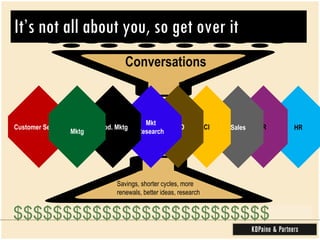
It’s not all about you, so get over it  Customer Service HR IR Sales CI R&D Mkt Research Prod. Mktg Mktg Conversations $$$$$$$$$$$$$$$$$$$$$$$$$$ Savings, shorter cycles, more renewals, better ideas, research

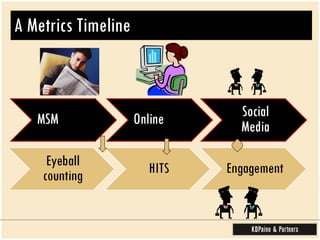
A Metrics Timeline
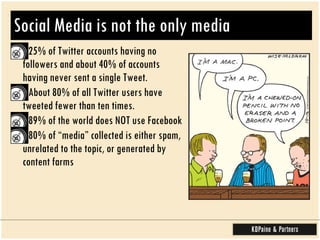
Social Media is not the only media 25% of Twitter accounts having no followers and about 40% of accounts having never sent a single Tweet. About 80% of all Twitter users have tweeted fewer than ten times. 89% of the world does NOT use Facebook 80% of “media” collected is either spam, unrelated to the topic, or generated by content farms
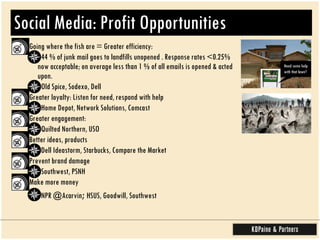
Social Media: Profit Opportunities Going where the fish are = Greater efficiency:  44 % of junk mail goes to landfills unopened . Response rates <0.25% now acceptable; on average less than 1 % of all emails is opened & acted upon. Old Spice, Sodexo, Dell  Greater loyalty: Listen for need, respond with help Home Depot, Network Solutions, Comcast Greater engagement:  Quilted Northern, USO  Better ideas, products  Dell Ideastorm, Starbucks, Compare the Market  Prevent brand damage Southwest, PSNH Make more money NPR @Acarvin ;  HSUS, Goodwill, Southwest Need some help with that lawn?
Social Media: Profit Threats  Invisibility Toshiba, Acer etc Insensitivity  Kenneth Cole Poor planning Groupon Lack of internal coordination  GoDaddy Not following the rules  Edelman/Walmart Too much screaming, not enough conversation Most marketers
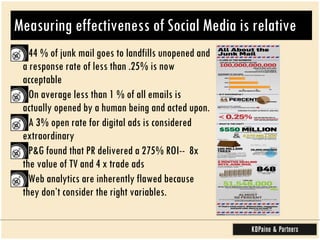
Measuring effectiveness of Social Media is relative  44 % of junk mail goes to landfills unopened and a response rate of less than .25% is now acceptable On average less than 1 % of all emails is actually opened by a human being and acted upon. A 3% open rate for digital ads is considered extraordinary  P&G found that PR delivered a 275% ROI--  8x the value of TV and 4 x trade ads Web analytics are inherently flawed because they don’t consider the right variables.
Define the “R” in your ROI  Define the “I” = investment  Establish benchmarks Define your metrics  Pick a tool  Figure out what it means, change and measure again 6 Steps to the perfect measurement system
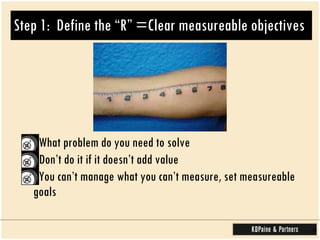
Step 1:  Define the “R” =Clear measureable objectives  What problem do you need to solve Don’t do it if it doesn’t add value You can’t manage what you can’t measure, set measureable goals
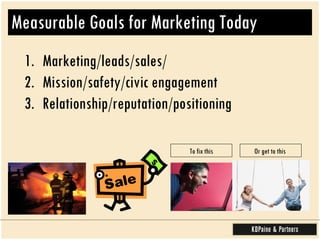
Measurable Goals for Marketing Today  Marketing/leads/sales/ Mission/safety/civic engagement Relationship/reputation/positioning  To fix this Or get to this
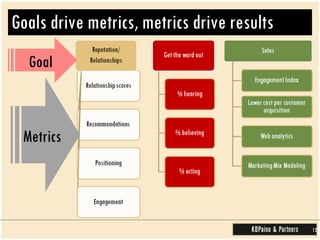
Goals drive metrics, metrics drive results  Goal Metrics
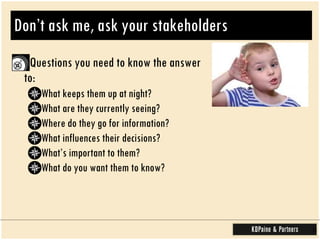
Don’t ask me, ask your stakeholders Questions you need to know the answer to:  What keeps them up at night? What are they currently seeing?  Where do they go for information? What influences their decisions? What’s important to them? What do you want them to know?
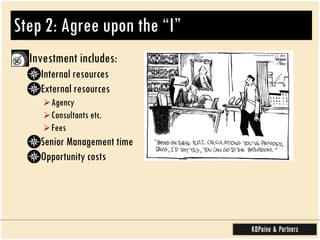
Step 2: Agree upon the “I”  Investment includes:  Internal resources  External resources Agency Consultants etc.  Fees Senior Management time  Opportunity costs
Step 3: Establish benchmarks A peer group Control groups vs. other departments Over time
Step 4: Define your Key Performance Indicators (KPIs) You become what you measure, so pick your KPI carefully You decide what’s important Benchmark against peers and/or competitors The Perfect KPI:  Gets you where you want to go (achieves corporate goals) Is actionable Continuously improves your processes Is there when you need it KPIs should be developed for:  Programs Overall objectives  Different tactics
Typical KPIs  Outcomes/Behavior  % decline in churn % increase in marketing efficiency % increase in engagement % increase in productivity  % increase in customer lifetime value % increase in marketable universe Outtakes/Perceptions Do they recommend?  Do they believe?  Has the relationship changed?  Outputs/Activities  Do they see it/read it/participate
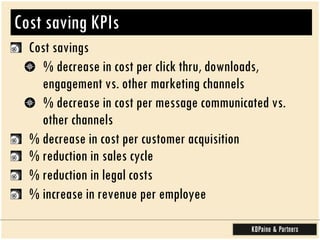
Cost saving KPIs  Cost savings % decrease in cost per click thru, downloads, engagement vs. other marketing channels % decrease in cost per message communicated vs. other channels % decrease in cost per customer acquisition  % reduction in sales cycle  % reduction in legal costs % increase in revenue per employee
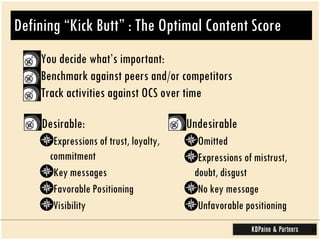
Defining “Kick Butt” : The Optimal Content Score You decide what’s important: Benchmark against peers and/or competitors Track activities against OCS over time  Desirable:  Expressions of trust, loyalty, commitment Key messages Favorable Positioning Visibility Undesirable  Omitted Expressions of mistrust, doubt, disgust No key message Unfavorable positioning
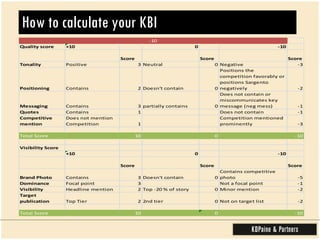
How to calculate your KBI
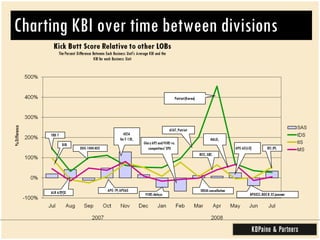
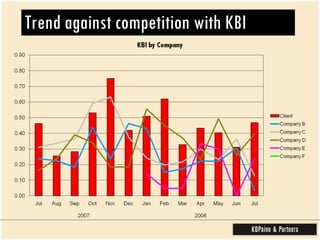
Charting KBI over time between divisions
Trend against competition with KBI
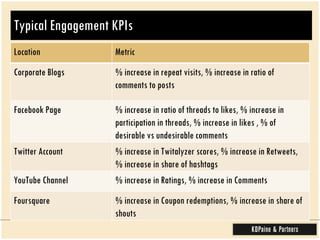
Typical Engagement KPIs  Location  Metric Corporate Blogs % increase in repeat visits, % increase in ratio of comments to posts  Facebook Page % increase in ratio of threads to likes, % increase in participation in threads, % increase in likes , % of desirable vs undesirable comments Twitter Account % increase in Twitalyzer scores, % increase in Retweets, % increase in share of hashtags  YouTube Channel  % increase in Ratings, % increase in Comments Foursquare % increase in Coupon redemptions, % increase in share of  shouts
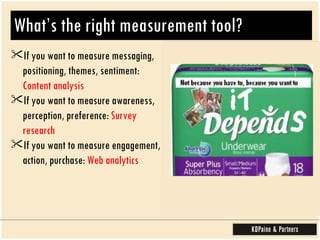
What’s the right measurement tool?  If you want to measure messaging, positioning, themes, sentiment:  Content analysis If you want to measure awareness, perception, preference:  Survey research   If you want to measure engagement, action, purchase:  Web analytics
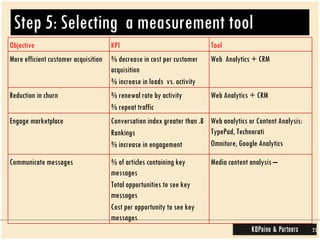
Step 5: Selecting  a measurement tool Objective KPI Tool  More efficient customer acquisition % decrease in cost per customer acquisition % increase in leads  vs. activity Web  Analytics + CRM Reduction in churn  % renewal rate by activity  % repeat traffic  Web Analytics + CRM  Engage marketplace Conversation index greater than .8 Rankings  % increase in engagement Web analytics or Content Analysis: TypePad, Technorati  Omniture, Google Analytics Communicate messages % of articles containing key messages Total opportunities to see key messages Cost per opportunity to see key messages Media content analysis –
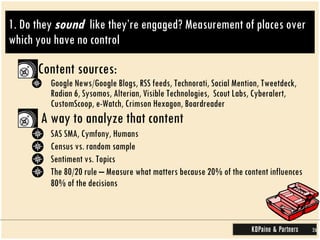
1. Do they  sound   like they’re engaged? Measurement of places over which you have no control Content sources: Google News/Google Blogs, RSS feeds, Technorati, Social Mention, Tweetdeck, Radian 6, Sysomos, Alterian, Visible Technologies,  Scout Labs, Cyberalert, CustomScoop, e-Watch, Crimson Hexagon, Boardreader A way to analyze that content  SAS SMA, Cymfony, Humans Census vs. random sample Sentiment vs. Topics The 80/20 rule – Measure what matters because 20% of the content influences 80% of the decisions
You can’t measure a fire hose: Cautionary Content Tales  “Cleveland Fed,” MIT,  Google Gamers “Not” lists The better we get at managing the flow, the better the spammers get at pushing stuff at us
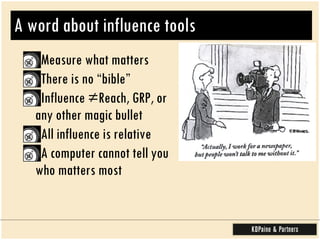
A word about influence tools Measure what matters  There is no “bible”  Influence ≠Reach, GRP, or any other magic bullet All influence is relative A computer cannot tell you who matters most
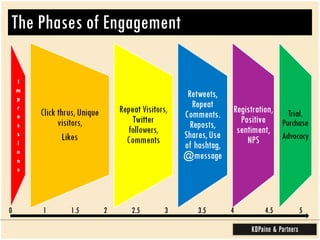
The Phases of Engagement  1 2 1.5 2.5 3.5 3 4 5 4.5 0
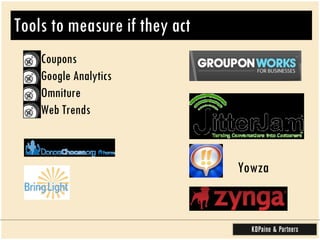
Tools to measure if they act Coupons Google Analytics Omniture  Web Trends  Yowza
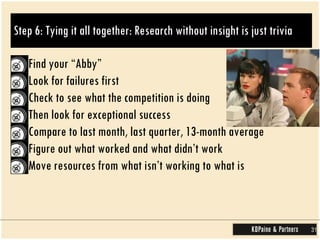
Find your “Abby” Look for failures first Check to see what the competition is doing  Then look for exceptional success Compare to last month, last quarter, 13-month average Figure out what worked and what didn’t work Move resources from what isn’t working to what is  Step 6: Tying it all together: Research without insight is just trivia
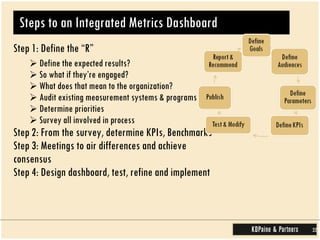
Steps to an Integrated Metrics Dashboard Step 1: Define the “R” Define the expected results?  So what if they’re engaged?  What does that mean to the organization? Audit existing measurement systems & programs Determine priorities Survey all involved in process  Step 2: From the survey, determine KPIs, Benchmarks Step 3: Meetings to air differences and achieve consensus Step 4: Design dashboard, test, refine and implement
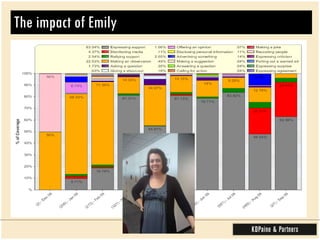
The impact of Emily
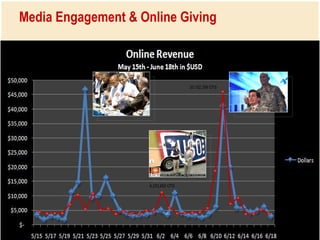
Media Engagement & Online Giving Red line indicates media impressions 35,152,789 OTS 6,253,852 OTS
Thank You! For more information on measurement, read my blog:  http:// kdpaine.blogs.com  or subscribe to The Measurement Standard:  www.themeasurementstandard.com For a copy of this presentation go to:  http:// www.kdpaine.com Follow me on Twitter: KDPaine Friend me on Facebook: Katie Paine  Or call me  at 1-603-682-0735 Email: kdpaine@kdpaine.com
Questions?
Thanks for joining us!

KD Paine Presentation

  • 1.
    Everything You Needto Know About Monitoring Public Relationships with KD PAINE
  • 2.
    Monitor and trackengagement: Dive deeper into analytics
  • 3.
    It’s not allabout you, so get over it Customer Service HR IR Sales CI R&D Mkt Research Prod. Mktg Mktg Conversations $$$$$$$$$$$$$$$$$$$$$$$$$$ Savings, shorter cycles, more renewals, better ideas, research
  • 4.
  • 5.
    Social Media isnot the only media 25% of Twitter accounts having no followers and about 40% of accounts having never sent a single Tweet. About 80% of all Twitter users have tweeted fewer than ten times. 89% of the world does NOT use Facebook 80% of “media” collected is either spam, unrelated to the topic, or generated by content farms
  • 6.
    Social Media: ProfitOpportunities Going where the fish are = Greater efficiency: 44 % of junk mail goes to landfills unopened . Response rates <0.25% now acceptable; on average less than 1 % of all emails is opened & acted upon. Old Spice, Sodexo, Dell Greater loyalty: Listen for need, respond with help Home Depot, Network Solutions, Comcast Greater engagement: Quilted Northern, USO Better ideas, products Dell Ideastorm, Starbucks, Compare the Market Prevent brand damage Southwest, PSNH Make more money NPR @Acarvin ; HSUS, Goodwill, Southwest Need some help with that lawn?
  • 7.
    Social Media: ProfitThreats Invisibility Toshiba, Acer etc Insensitivity Kenneth Cole Poor planning Groupon Lack of internal coordination GoDaddy Not following the rules Edelman/Walmart Too much screaming, not enough conversation Most marketers
  • 8.
    Measuring effectiveness ofSocial Media is relative 44 % of junk mail goes to landfills unopened and a response rate of less than .25% is now acceptable On average less than 1 % of all emails is actually opened by a human being and acted upon. A 3% open rate for digital ads is considered extraordinary P&G found that PR delivered a 275% ROI-- 8x the value of TV and 4 x trade ads Web analytics are inherently flawed because they don’t consider the right variables.
  • 9.
    Define the “R”in your ROI Define the “I” = investment Establish benchmarks Define your metrics Pick a tool Figure out what it means, change and measure again 6 Steps to the perfect measurement system
  • 10.
    Step 1: Define the “R” =Clear measureable objectives What problem do you need to solve Don’t do it if it doesn’t add value You can’t manage what you can’t measure, set measureable goals
  • 11.
    Measurable Goals forMarketing Today Marketing/leads/sales/ Mission/safety/civic engagement Relationship/reputation/positioning To fix this Or get to this
  • 12.
    Goals drive metrics,metrics drive results Goal Metrics
  • 13.
    Don’t ask me,ask your stakeholders Questions you need to know the answer to: What keeps them up at night? What are they currently seeing? Where do they go for information? What influences their decisions? What’s important to them? What do you want them to know?
  • 14.
    Step 2: Agreeupon the “I” Investment includes: Internal resources External resources Agency Consultants etc. Fees Senior Management time Opportunity costs
  • 15.
    Step 3: Establishbenchmarks A peer group Control groups vs. other departments Over time
  • 16.
    Step 4: Defineyour Key Performance Indicators (KPIs) You become what you measure, so pick your KPI carefully You decide what’s important Benchmark against peers and/or competitors The Perfect KPI: Gets you where you want to go (achieves corporate goals) Is actionable Continuously improves your processes Is there when you need it KPIs should be developed for: Programs Overall objectives Different tactics
  • 17.
    Typical KPIs Outcomes/Behavior % decline in churn % increase in marketing efficiency % increase in engagement % increase in productivity % increase in customer lifetime value % increase in marketable universe Outtakes/Perceptions Do they recommend? Do they believe? Has the relationship changed? Outputs/Activities Do they see it/read it/participate
  • 18.
    Cost saving KPIs Cost savings % decrease in cost per click thru, downloads, engagement vs. other marketing channels % decrease in cost per message communicated vs. other channels % decrease in cost per customer acquisition % reduction in sales cycle % reduction in legal costs % increase in revenue per employee
  • 19.
    Defining “Kick Butt”: The Optimal Content Score You decide what’s important: Benchmark against peers and/or competitors Track activities against OCS over time Desirable: Expressions of trust, loyalty, commitment Key messages Favorable Positioning Visibility Undesirable Omitted Expressions of mistrust, doubt, disgust No key message Unfavorable positioning
  • 20.
  • 21.
    Charting KBI overtime between divisions
  • 22.
  • 23.
    Typical Engagement KPIs Location Metric Corporate Blogs % increase in repeat visits, % increase in ratio of comments to posts Facebook Page % increase in ratio of threads to likes, % increase in participation in threads, % increase in likes , % of desirable vs undesirable comments Twitter Account % increase in Twitalyzer scores, % increase in Retweets, % increase in share of hashtags YouTube Channel % increase in Ratings, % increase in Comments Foursquare % increase in Coupon redemptions, % increase in share of shouts
  • 24.
    What’s the rightmeasurement tool? If you want to measure messaging, positioning, themes, sentiment: Content analysis If you want to measure awareness, perception, preference: Survey research If you want to measure engagement, action, purchase: Web analytics
  • 25.
    Step 5: Selecting a measurement tool Objective KPI Tool More efficient customer acquisition % decrease in cost per customer acquisition % increase in leads vs. activity Web Analytics + CRM Reduction in churn % renewal rate by activity % repeat traffic Web Analytics + CRM Engage marketplace Conversation index greater than .8 Rankings % increase in engagement Web analytics or Content Analysis: TypePad, Technorati Omniture, Google Analytics Communicate messages % of articles containing key messages Total opportunities to see key messages Cost per opportunity to see key messages Media content analysis –
  • 26.
    1. Do they sound like they’re engaged? Measurement of places over which you have no control Content sources: Google News/Google Blogs, RSS feeds, Technorati, Social Mention, Tweetdeck, Radian 6, Sysomos, Alterian, Visible Technologies, Scout Labs, Cyberalert, CustomScoop, e-Watch, Crimson Hexagon, Boardreader A way to analyze that content SAS SMA, Cymfony, Humans Census vs. random sample Sentiment vs. Topics The 80/20 rule – Measure what matters because 20% of the content influences 80% of the decisions
  • 27.
    You can’t measurea fire hose: Cautionary Content Tales “Cleveland Fed,” MIT, Google Gamers “Not” lists The better we get at managing the flow, the better the spammers get at pushing stuff at us
  • 28.
    A word aboutinfluence tools Measure what matters There is no “bible” Influence ≠Reach, GRP, or any other magic bullet All influence is relative A computer cannot tell you who matters most
  • 29.
    The Phases ofEngagement 1 2 1.5 2.5 3.5 3 4 5 4.5 0
  • 30.
    Tools to measureif they act Coupons Google Analytics Omniture Web Trends Yowza
  • 31.
    Find your “Abby”Look for failures first Check to see what the competition is doing Then look for exceptional success Compare to last month, last quarter, 13-month average Figure out what worked and what didn’t work Move resources from what isn’t working to what is Step 6: Tying it all together: Research without insight is just trivia
  • 32.
    Steps to anIntegrated Metrics Dashboard Step 1: Define the “R” Define the expected results? So what if they’re engaged? What does that mean to the organization? Audit existing measurement systems & programs Determine priorities Survey all involved in process Step 2: From the survey, determine KPIs, Benchmarks Step 3: Meetings to air differences and achieve consensus Step 4: Design dashboard, test, refine and implement
  • 33.
  • 34.
    Media Engagement &Online Giving Red line indicates media impressions 35,152,789 OTS 6,253,852 OTS
  • 35.
    Thank You! Formore information on measurement, read my blog: http:// kdpaine.blogs.com or subscribe to The Measurement Standard: www.themeasurementstandard.com For a copy of this presentation go to: http:// www.kdpaine.com Follow me on Twitter: KDPaine Friend me on Facebook: Katie Paine Or call me at 1-603-682-0735 Email: kdpaine@kdpaine.com
  • 36.
  • 37.