Bitcoin & AML Regulation:
Strategies for
Successful Compliance &
Government Relations
Inside Bitcoins Australia 2014
Melbourne, July 9, 2014
by @JuanLlanos
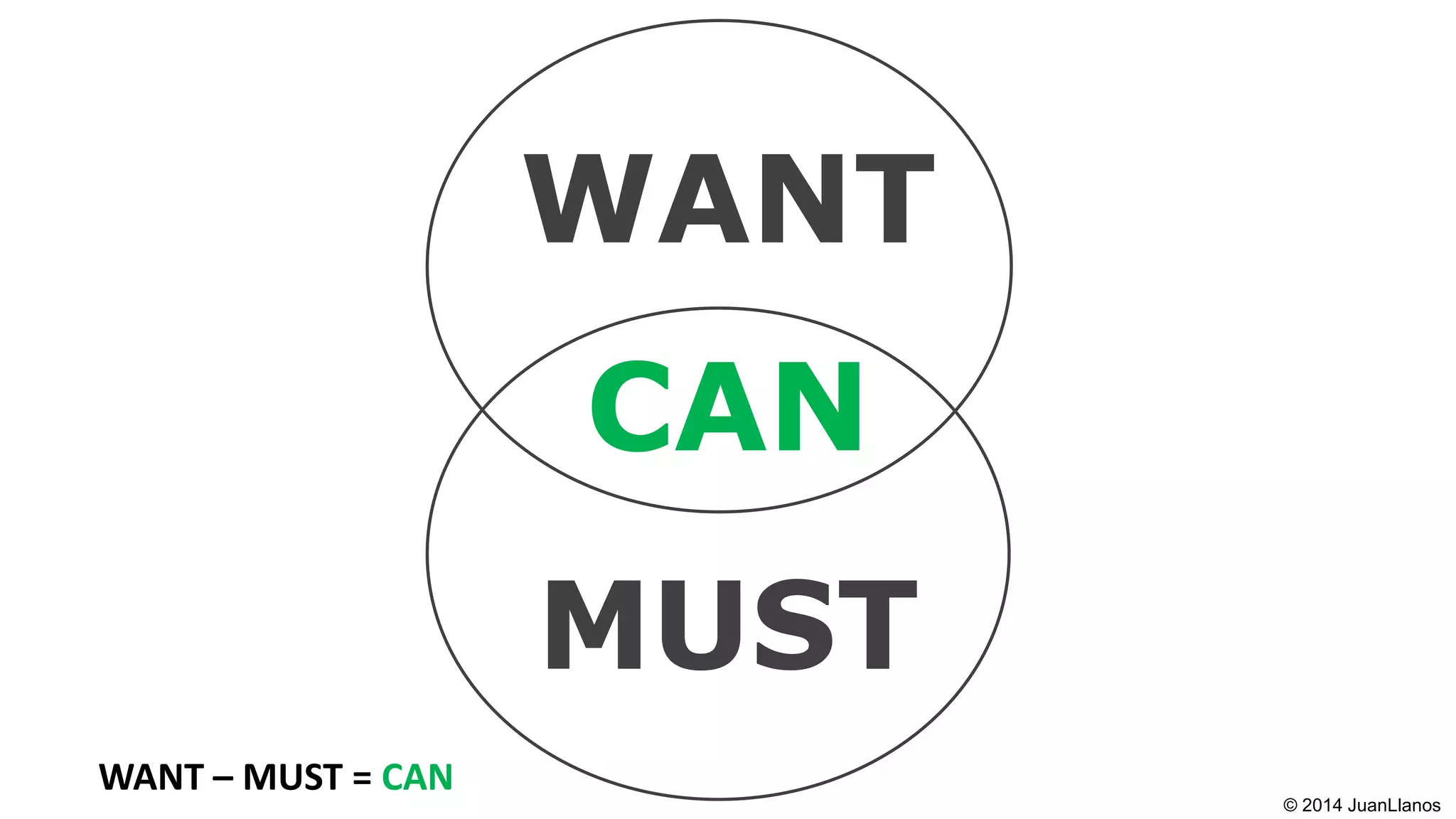
MUST
WANT
CAN
© 2014 JuanLlanos
WANT – MUST = CAN
Agenda
1. Risk identification
Risk areas  Focus on AML
2. Risk mitigation
a) Program design tips
b) Overview of corporate and product safeguards
c) Customer identification and analytics
(de-anonymization)
3. Unsolicited (contrarian) advice
© 2014 JuanLlanos
Agenda
1. Risk identification
Risk areas  Focus on AML
2. Risk mitigation
a) Program design tips
b) Overview of corporate and product safeguards
c) Customer identification and analytics
(de-anonymization)
3. Unsolicited (contrarian) advice
© 2014 JuanLlanos
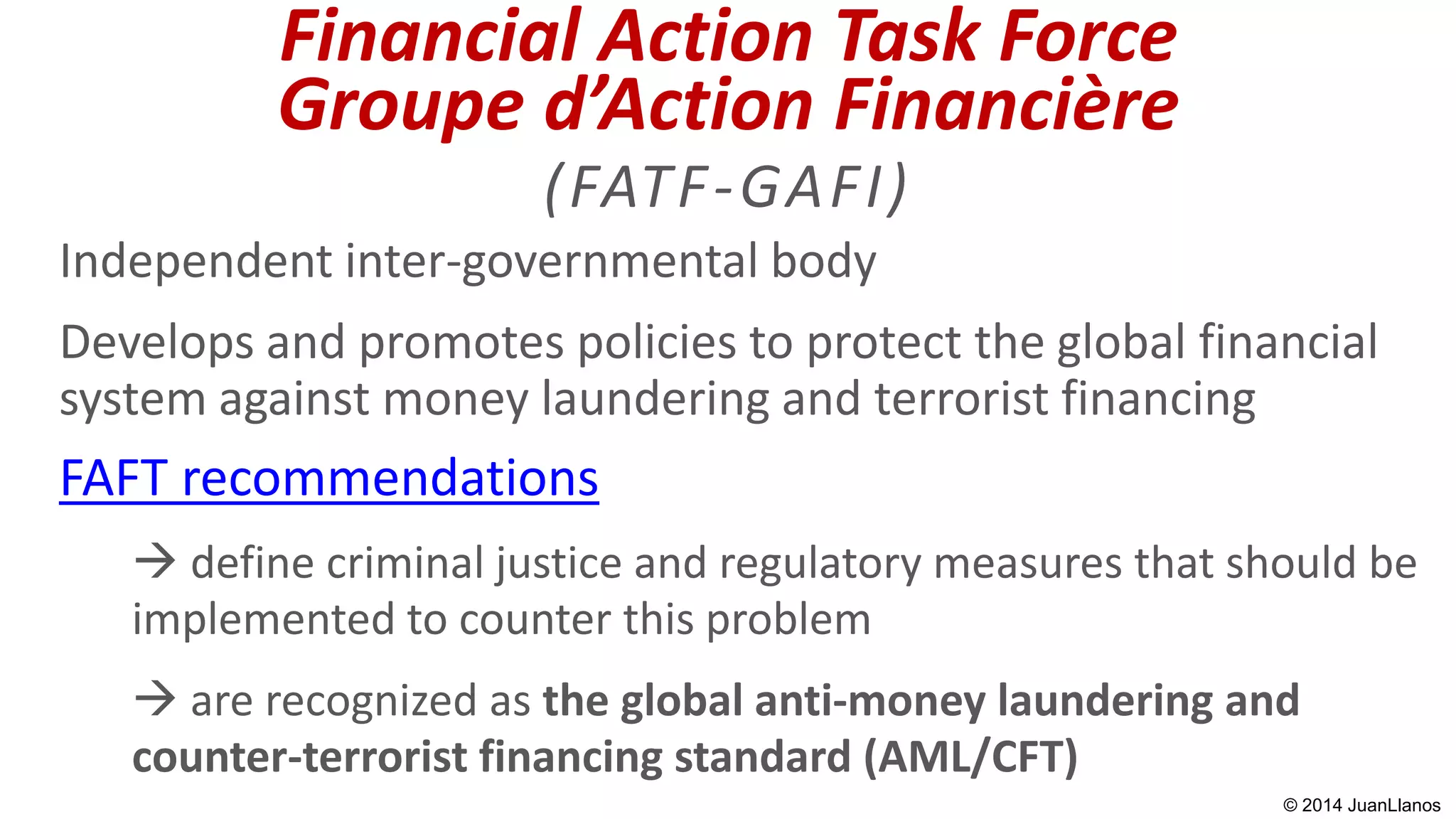
Financial Action Task Force
Groupe d’Action Financière
(FATF-GAFI)
Independent inter-governmental body
Develops and promotes policies to protect the global financial
system against money laundering and terrorist financing
FAFT recommendations
 define criminal justice and regulatory measures that should be
implemented to counter this problem
 are recognized as the global anti-money laundering and
counter-terrorist financing standard (AML/CFT)
© 2014 JuanLlanos
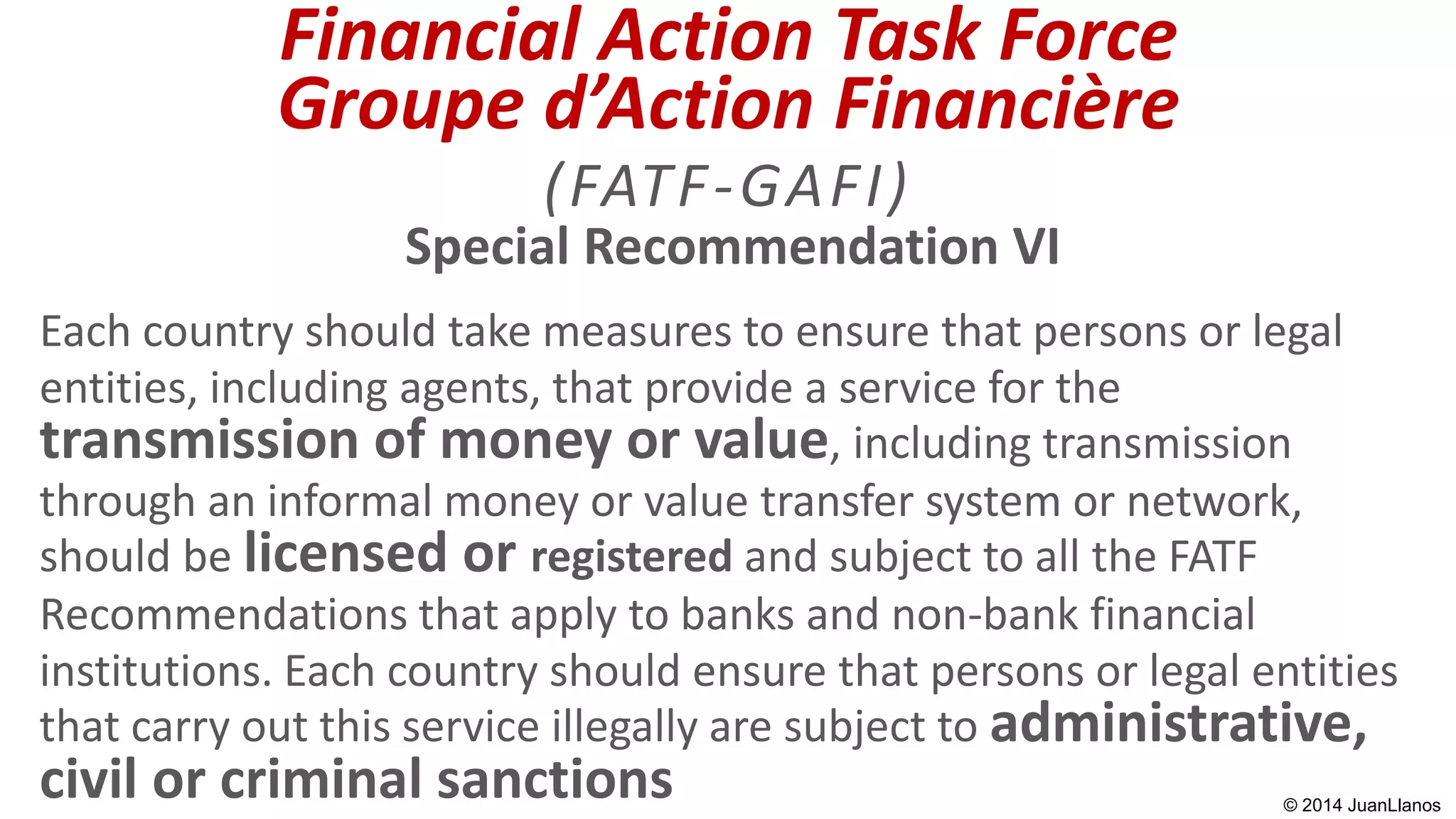
Special Recommendation VI
Each country should take measures to ensure that persons or legal
entities, including agents, that provide a service for the
transmission of money or value, including transmission
through an informal money or value transfer system or network,
should be licensed or registered and subject to all the FATF
Recommendations that apply to banks and non-bank financial
institutions. Each country should ensure that persons or legal entities
that carry out this service illegally are subject to administrative,
civil or criminal sanctions
Financial Action Task Force
Groupe d’Action Financière
(FATF-GAFI)
© 2014 JuanLlanos
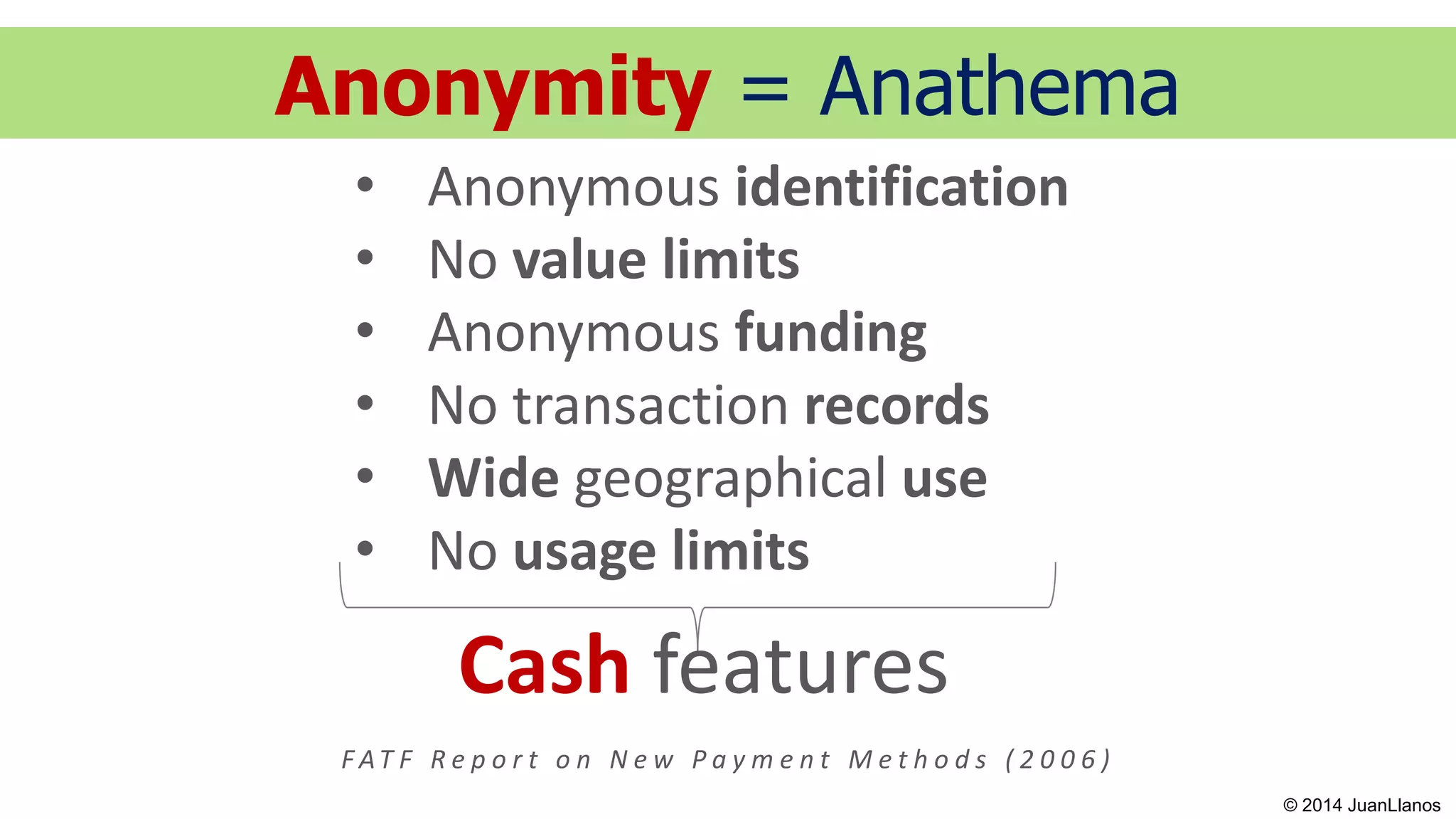
Anonymity = Anathema
• Anonymous identification
• No value limits
• Anonymous funding
• No transaction records
• Wide geographical use
• No usage limits
Cash features
F AT F R e p o r t o n N e w P a y m e n t M e t h o d s ( 2 0 0 6 )
© 2014 JuanLlanos
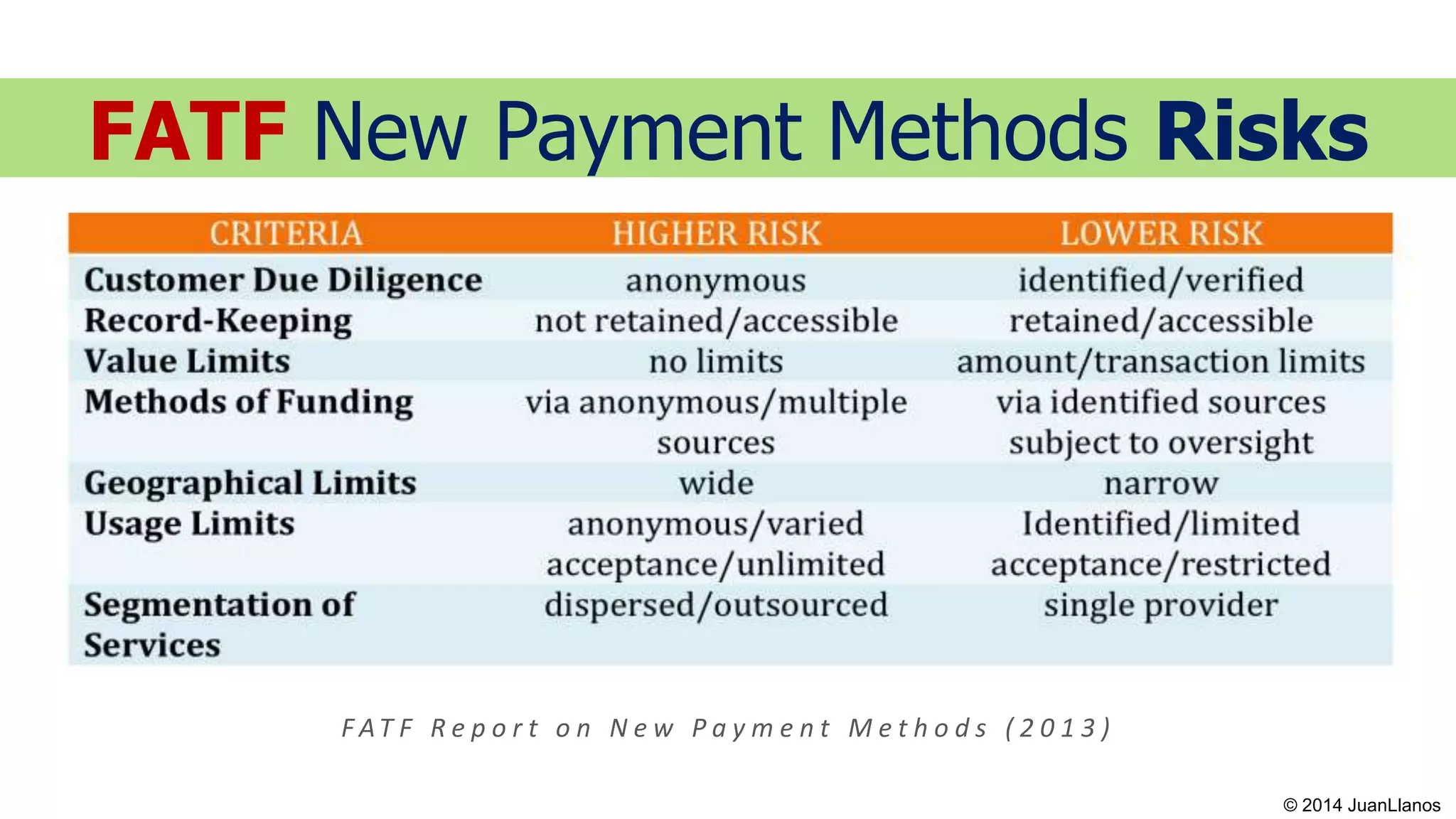
FATF New Payment Methods Risks
F AT F R e p o r t o n N e w P a y m e n t M e t h o d s ( 2 0 1 3 )
© 2014 JuanLlanos
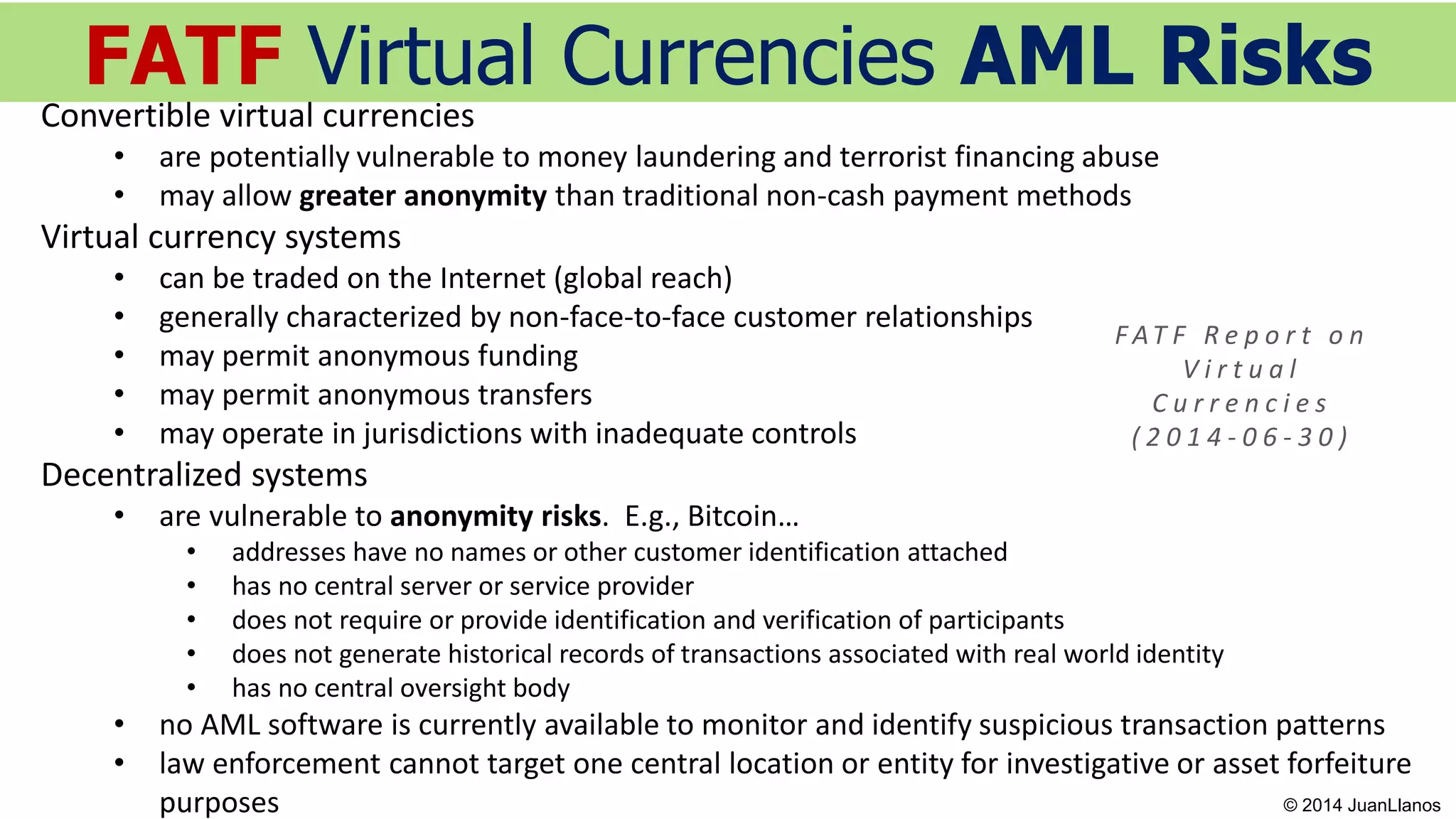
FATF Virtual Currencies AML Risks
F AT F R e p o r t o n
V i r t u a l
C u r r e n c i e s
( 2 0 1 4 - 0 6 - 3 0 )
Convertible virtual currencies
• are potentially vulnerable to money laundering and terrorist financing abuse
• may allow greater anonymity than traditional non-cash payment methods
Virtual currency systems
• can be traded on the Internet (global reach)
• generally characterized by non-face-to-face customer relationships
• may permit anonymous funding
• may permit anonymous transfers
• may operate in jurisdictions with inadequate controls
Decentralized systems
• are vulnerable to anonymity risks. E.g., Bitcoin…
• addresses have no names or other customer identification attached
• has no central server or service provider
• does not require or provide identification and verification of participants
• does not generate historical records of transactions associated with real world identity
• has no central oversight body
• no AML software is currently available to monitor and identify suspicious transaction patterns
• law enforcement cannot target one central location or entity for investigative or asset forfeiture
purposes © 2014 JuanLlanos
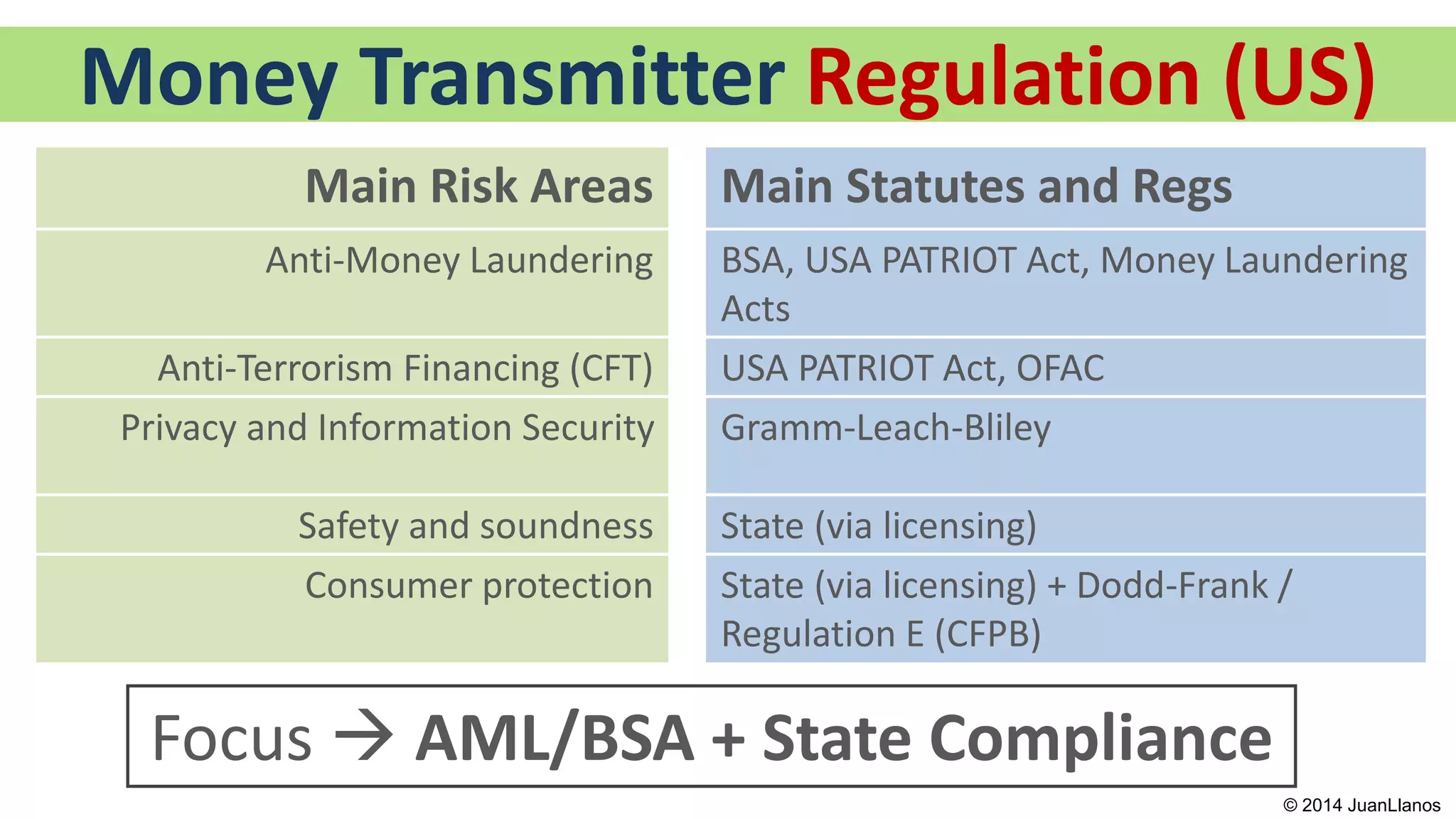
Money Transmitter Regulation (US)
Focus  AML/BSA + State Compliance
Main Risk Areas Main Statutes and Regs
Anti-Money Laundering BSA, USA PATRIOT Act, Money Laundering
Acts
Anti-Terrorism Financing (CFT) USA PATRIOT Act, OFAC
Privacy and Information Security Gramm-Leach-Bliley
Safety and soundness State (via licensing)
Consumer protection State (via licensing) + Dodd-Frank /
Regulation E (CFPB)
© 2014 JuanLlanos
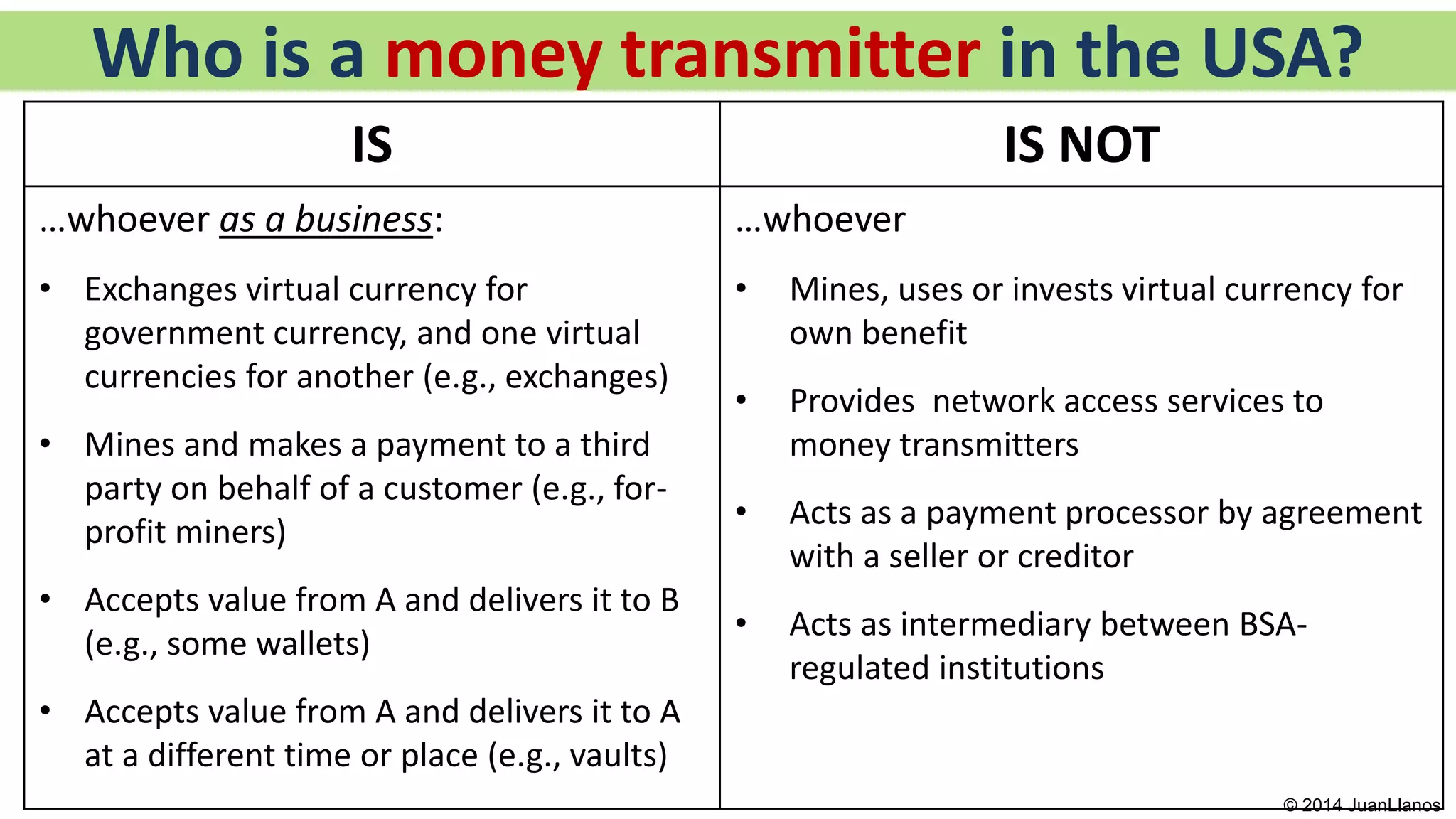
Who is a money transmitter in the USA?
IS IS NOT
…whoever as a business:
• Exchanges virtual currency for
government currency, and one virtual
currencies for another (e.g., exchanges)
• Mines and makes a payment to a third
party on behalf of a customer (e.g., for-
profit miners)
• Accepts value from A and delivers it to B
(e.g., some wallets)
• Accepts value from A and delivers it to A
at a different time or place (e.g., vaults)
…whoever
• Mines, uses or invests virtual currency for
own benefit
• Provides network access services to
money transmitters
• Acts as a payment processor by agreement
with a seller or creditor
• Acts as intermediary between BSA-
regulated institutions
© 2014 JuanLlanos
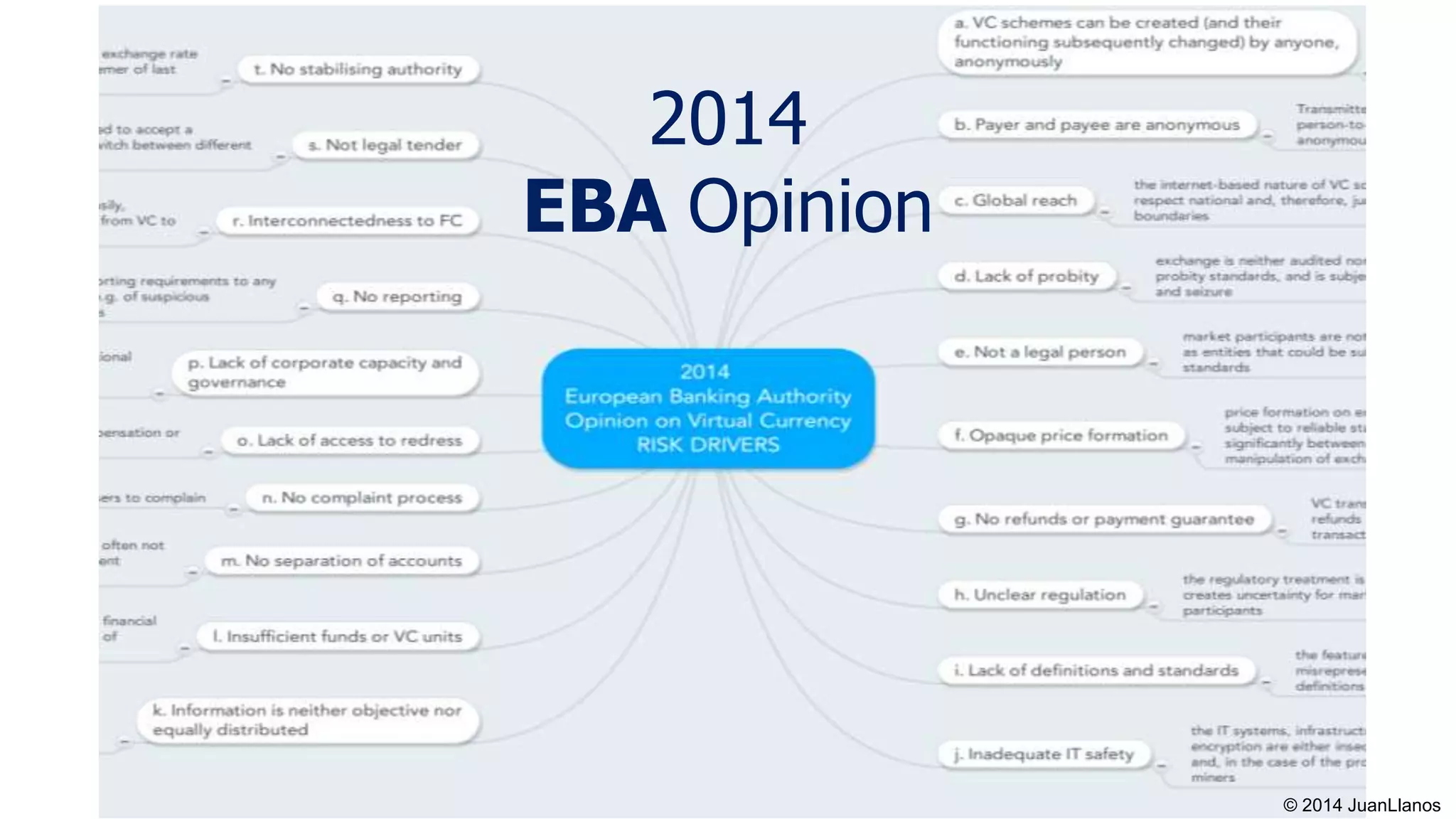
2014
EBA Opinion
© 2014 JuanLlanos
Agenda
1. Risk identification
Risk areas  Focus on AML
2. Risk mitigation
a) Program design tips
b) Overview of corporate and product safeguards
c) Customer identification and analytics
(de-anonymization)
3. Unsolicited (contrarian) advice
© 2014 JuanLlanos
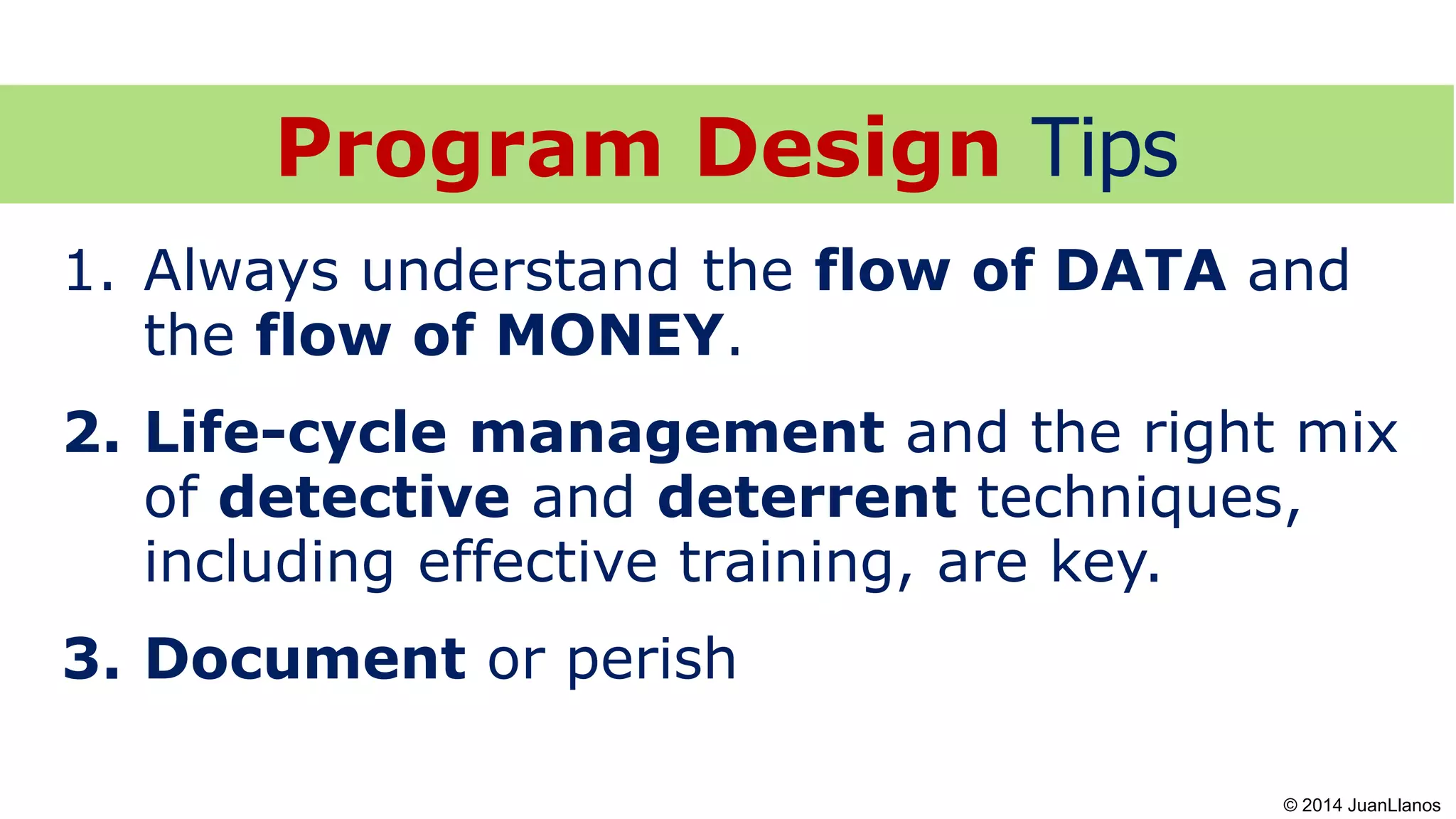
1. Always understand the flow of DATA and
the flow of MONEY.
2. Life-cycle management and the right mix
of detective and deterrent techniques,
including effective training, are key.
3. Document or perish
Program Design Tips
© 2014 JuanLlanos
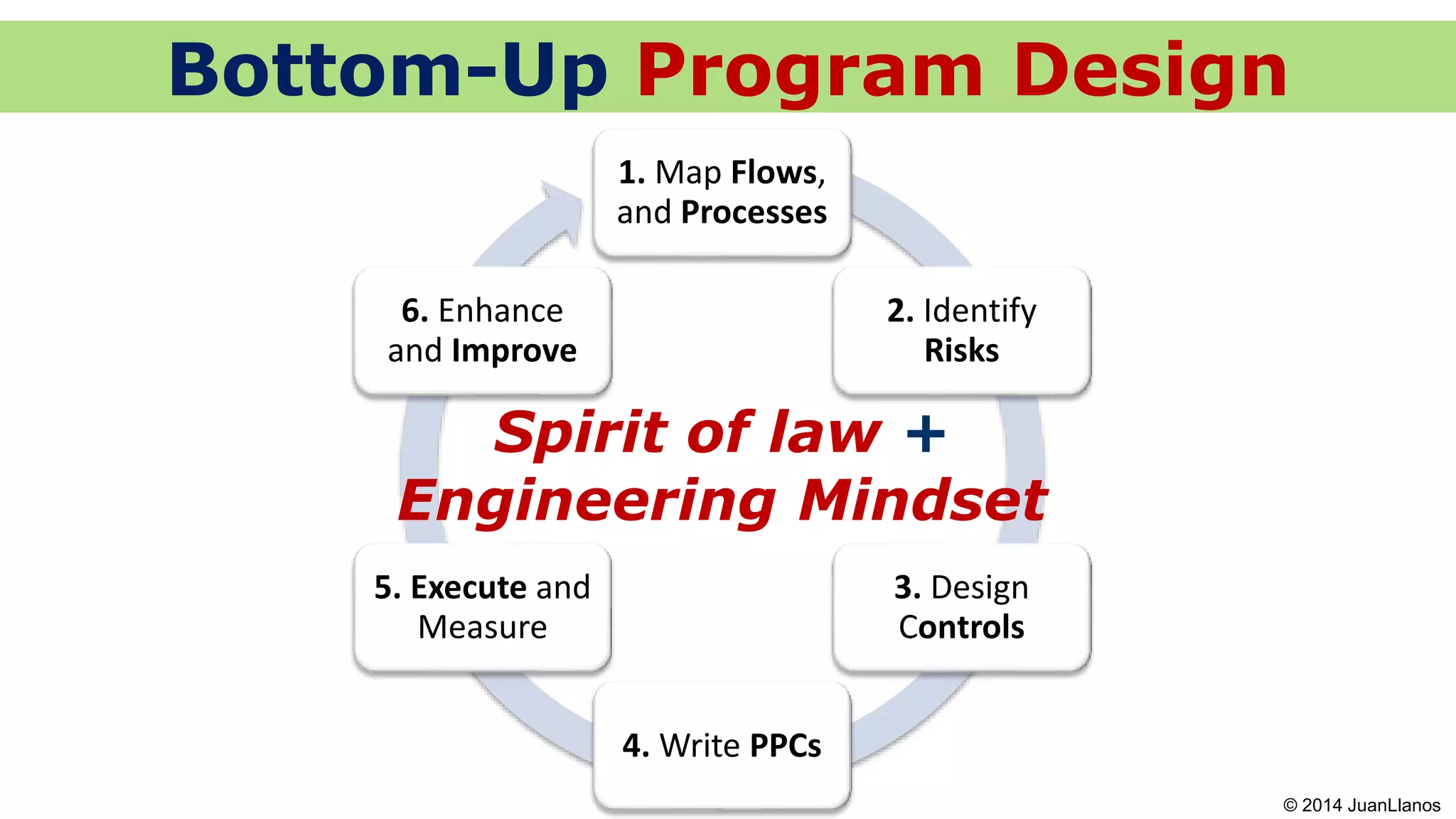
1. Map Flows,
and Processes
2. Identify
Risks
3. Design
Controls
4. Write PPCs
5. Execute and
Measure
6. Enhance
and Improve
Bottom-Up Program Design
Spirit of law +
Engineering Mindset
© 2014 JuanLlanos
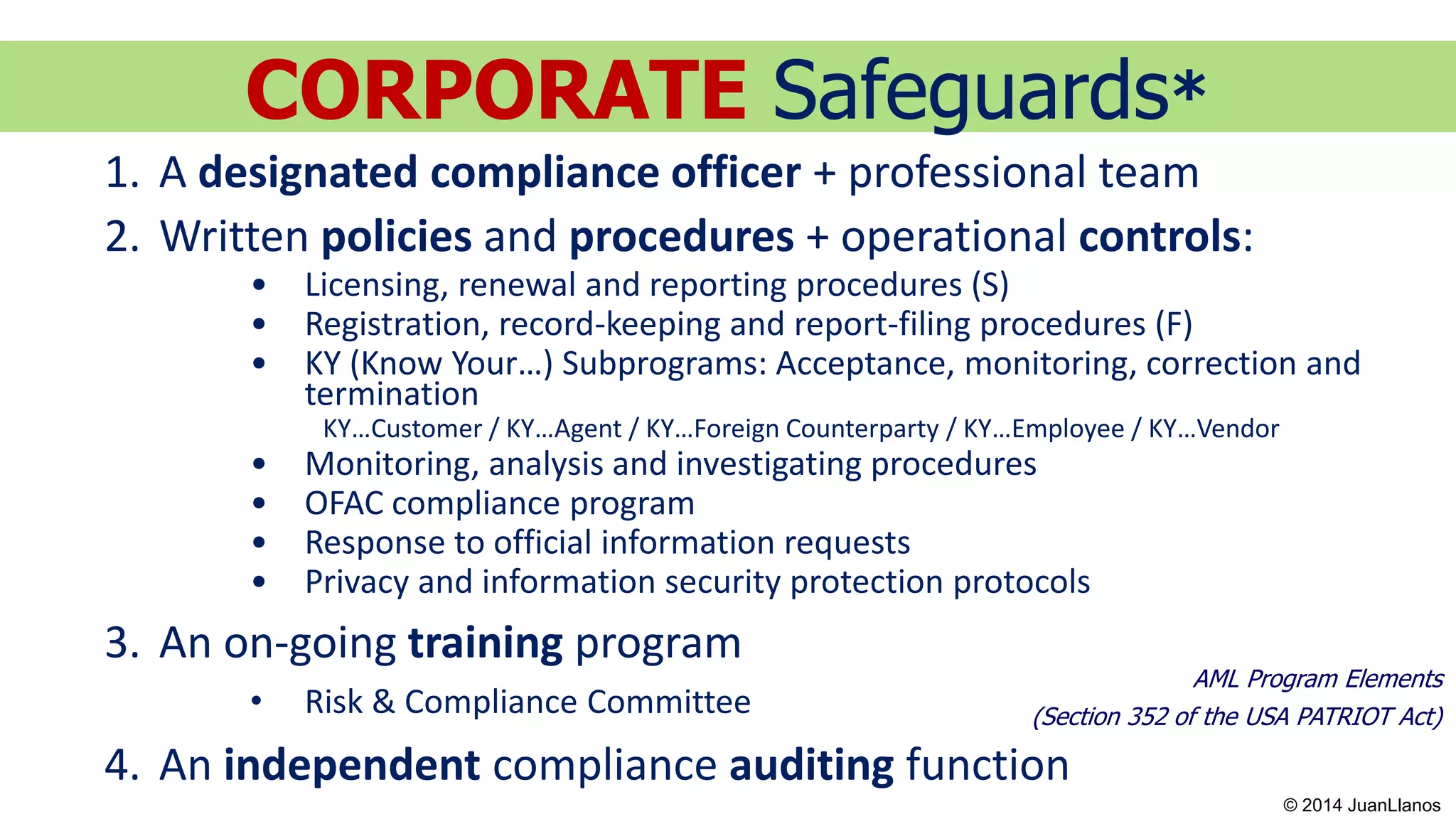
AML Program Elements
(Section 352 of the USA PATRIOT Act)
1. A designated compliance officer + professional team
2. Written policies and procedures + operational controls:
• Licensing, renewal and reporting procedures (S)
• Registration, record-keeping and report-filing procedures (F)
• KY (Know Your…) Subprograms: Acceptance, monitoring, correction and
termination
KY…Customer / KY…Agent / KY…Foreign Counterparty / KY…Employee / KY…Vendor
• Monitoring, analysis and investigating procedures
• OFAC compliance program
• Response to official information requests
• Privacy and information security protection protocols
3. An on-going training program
• Risk & Compliance Committee
4. An independent compliance auditing function
CORPORATE Safeguards*
© 2014 JuanLlanos
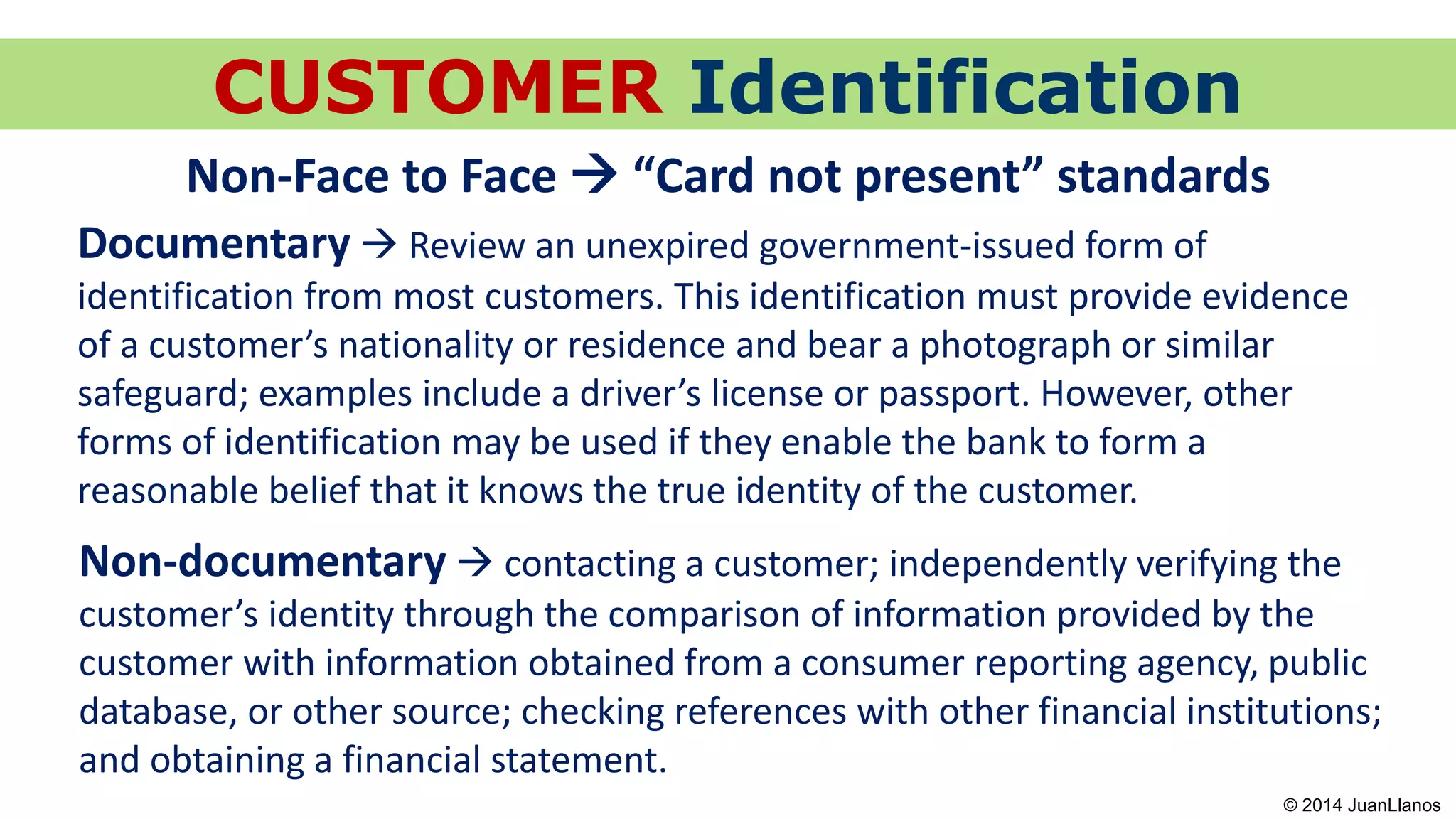
CUSTOMER Identification
Non-Face to Face  “Card not present” standards
Non-documentary  contacting a customer; independently verifying the
customer’s identity through the comparison of information provided by the
customer with information obtained from a consumer reporting agency, public
database, or other source; checking references with other financial institutions;
and obtaining a financial statement.
Documentary  Review an unexpired government-issued form of
identification from most customers. This identification must provide evidence
of a customer’s nationality or residence and bear a photograph or similar
safeguard; examples include a driver’s license or passport. However, other
forms of identification may be used if they enable the bank to form a
reasonable belief that it knows the true identity of the customer.
© 2014 JuanLlanos
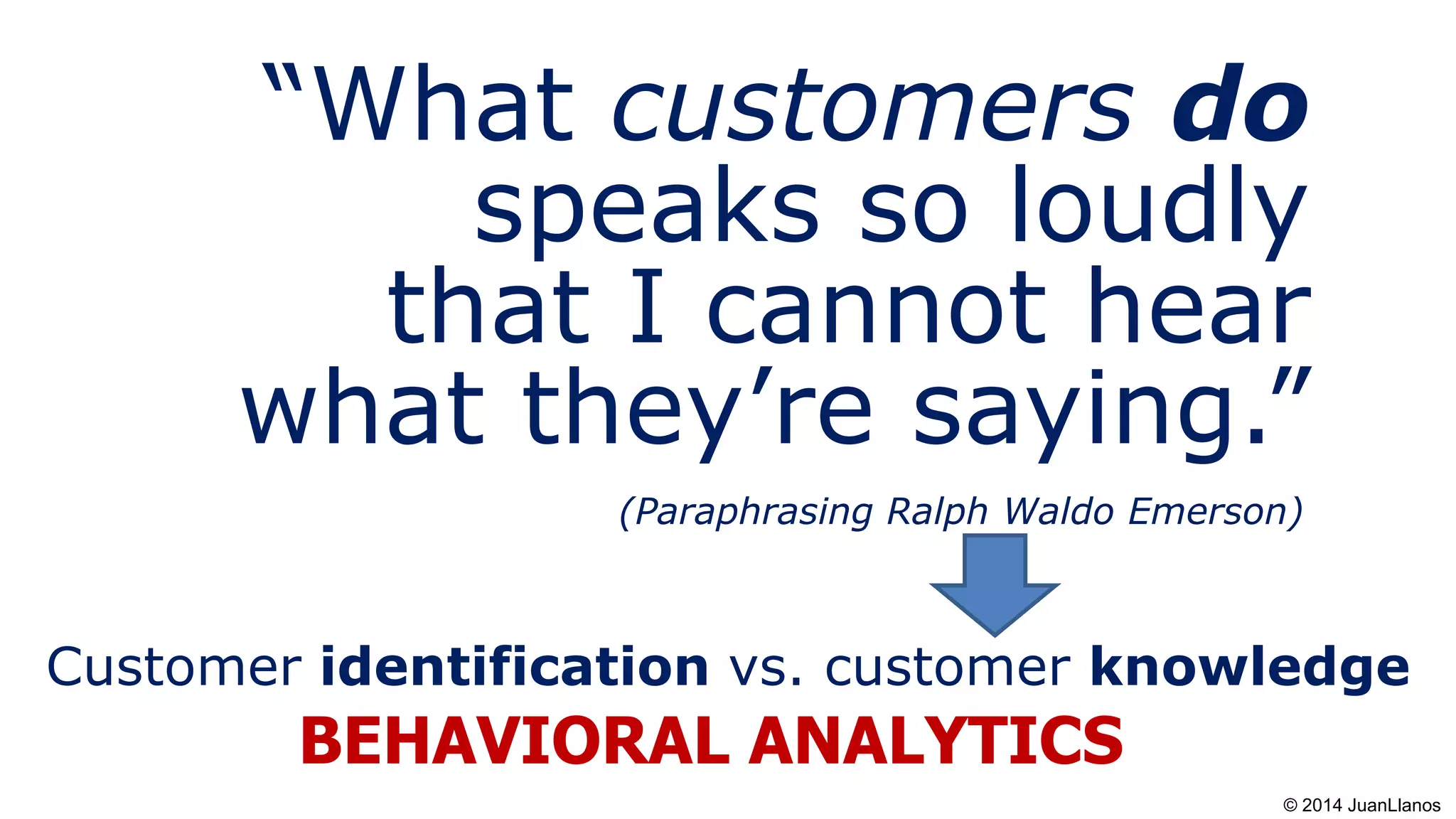
“What customers do
speaks so loudly
that I cannot hear
what they’re saying.”
(Paraphrasing Ralph Waldo Emerson)
Customer identification vs. customer knowledge
BEHAVIORAL ANALYTICS
© 2014 JuanLlanos
© 2013 Juan Llanos
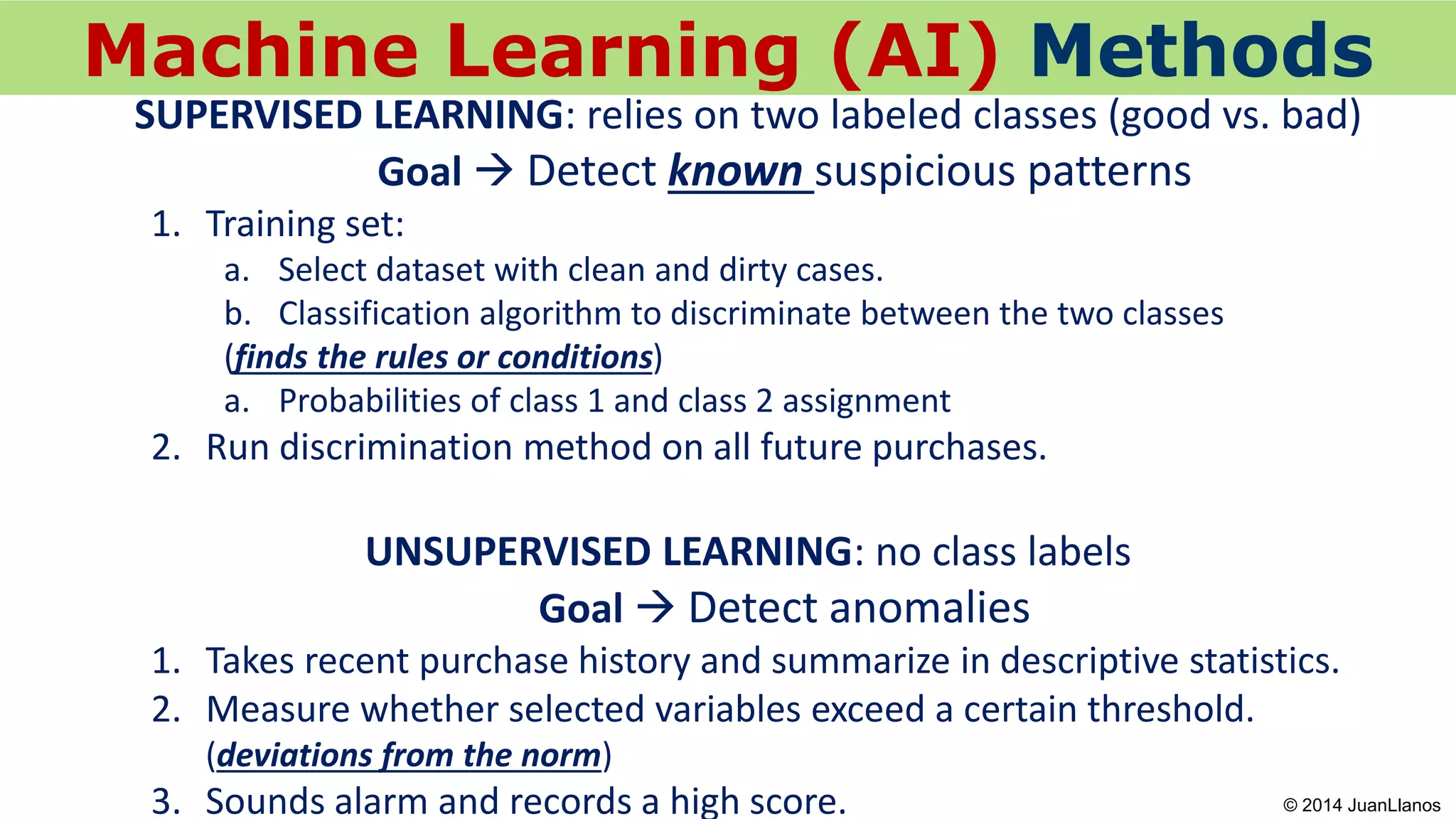
Machine Learning (AI) Methods
SUPERVISED LEARNING: relies on two labeled classes (good vs. bad)
Goal  Detect known suspicious patterns
1. Training set:
a. Select dataset with clean and dirty cases.
b. Classification algorithm to discriminate between the two classes
(finds the rules or conditions)
a. Probabilities of class 1 and class 2 assignment
2. Run discrimination method on all future purchases.
UNSUPERVISED LEARNING: no class labels
Goal  Detect anomalies
1. Takes recent purchase history and summarize in descriptive statistics.
2. Measure whether selected variables exceed a certain threshold.
(deviations from the norm)
3. Sounds alarm and records a high score. © 2014 JuanLlanos
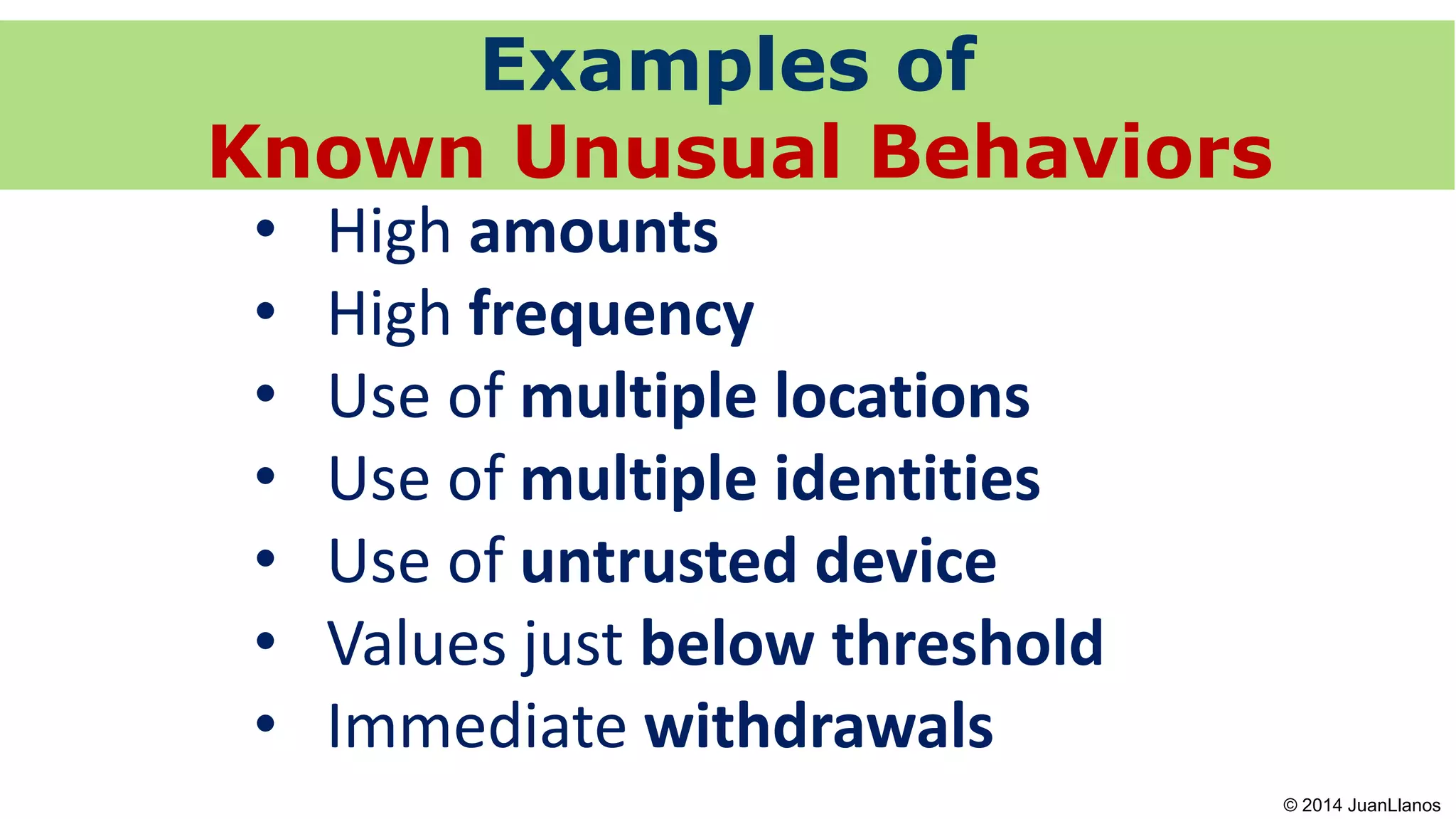
• High amounts
• High frequency
• Use of multiple locations
• Use of multiple identities
• Use of untrusted device
• Values just below threshold
• Immediate withdrawals
Examples of
Known Unusual Behaviors
© 2014 JuanLlanos
Agenda
1. Risk identification
Risk areas  Focus on AML
2. Risk mitigation
a) Program design tips
b) Overview of corporate and product safeguards
c) Customer identification and analytics
(de-anonymization)
3. Unsolicited (contrarian) advice
© 2014 JuanLlanos
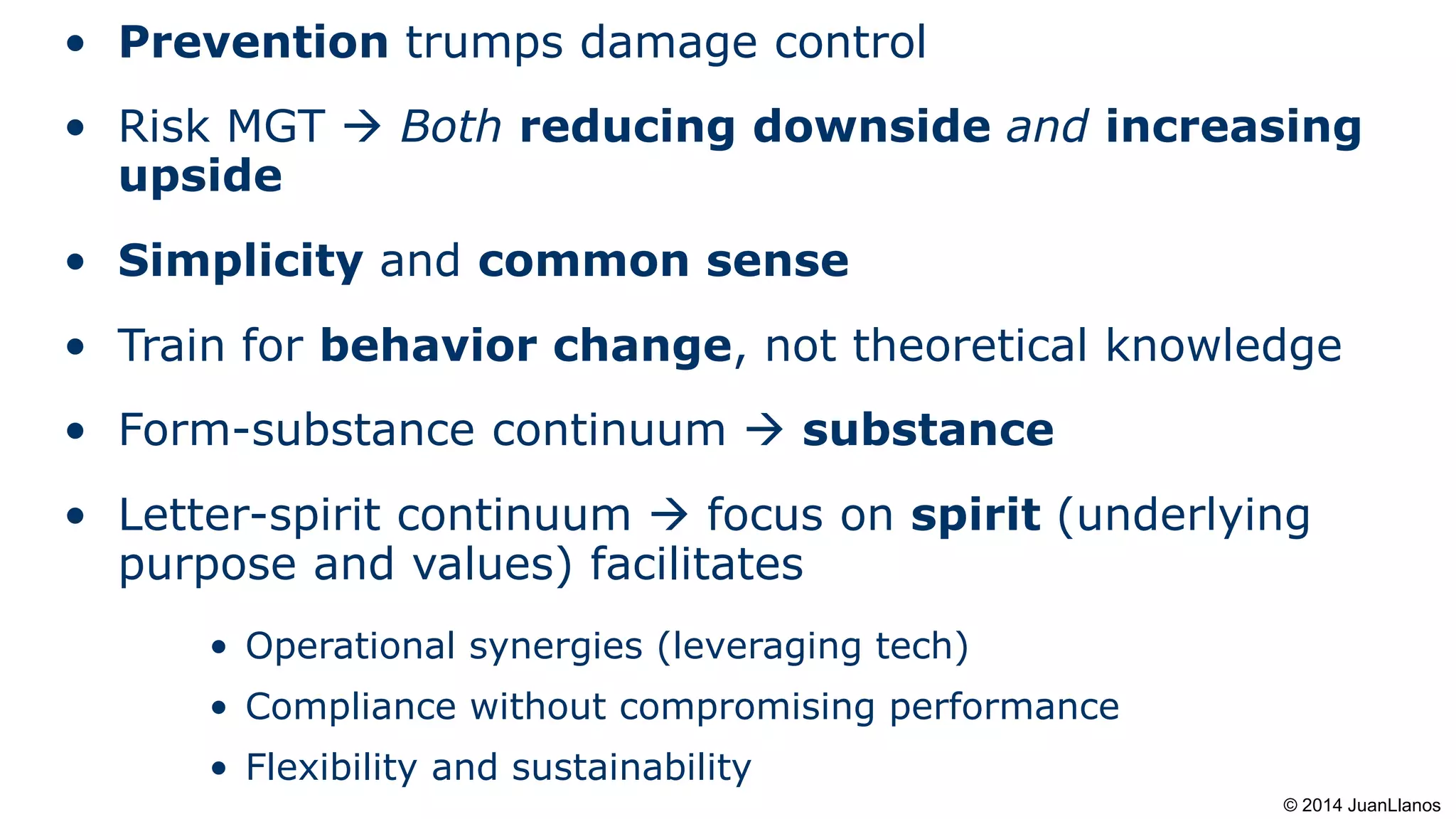
• Prevention trumps damage control
• Risk MGT  Both reducing downside and increasing
upside
• Simplicity and common sense
• Train for behavior change, not theoretical knowledge
• Form-substance continuum  substance
• Letter-spirit continuum  focus on spirit (underlying
purpose and values) facilitates
• Operational synergies (leveraging tech)
• Compliance without compromising performance
• Flexibility and sustainability
© 2014 JuanLlanos
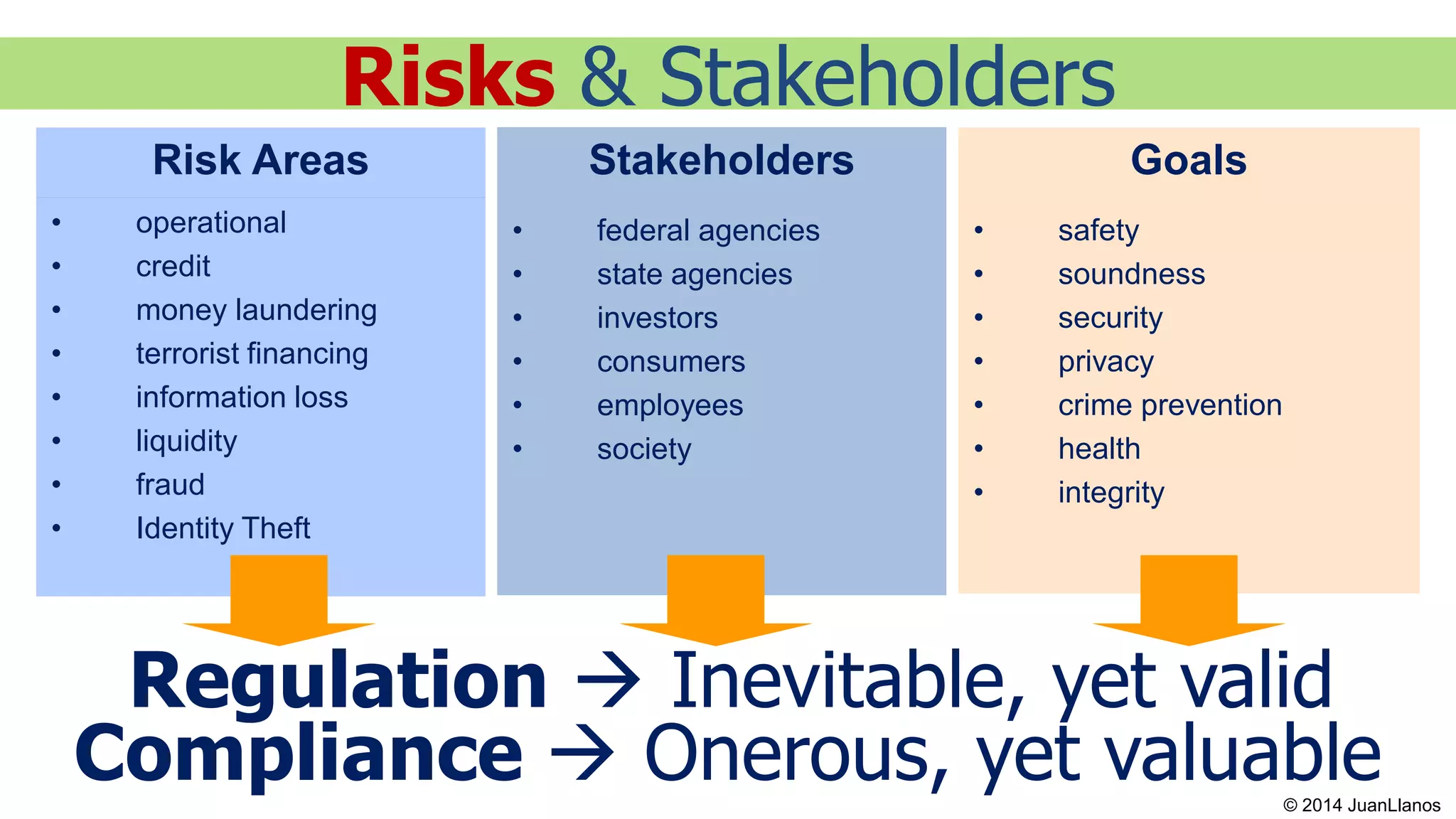
Risk Areas
• operational
• credit
• money laundering
• terrorist financing
• information loss
• liquidity
• fraud
• Identity Theft
Stakeholders
• federal agencies
• state agencies
• investors
• consumers
• employees
• society
Goals
• safety
• soundness
• security
• privacy
• crime prevention
• health
• integrity
Regulation  Inevitable, yet valid
Risks & Stakeholders
Compliance  Onerous, yet valuable© 2014 JuanLlanos
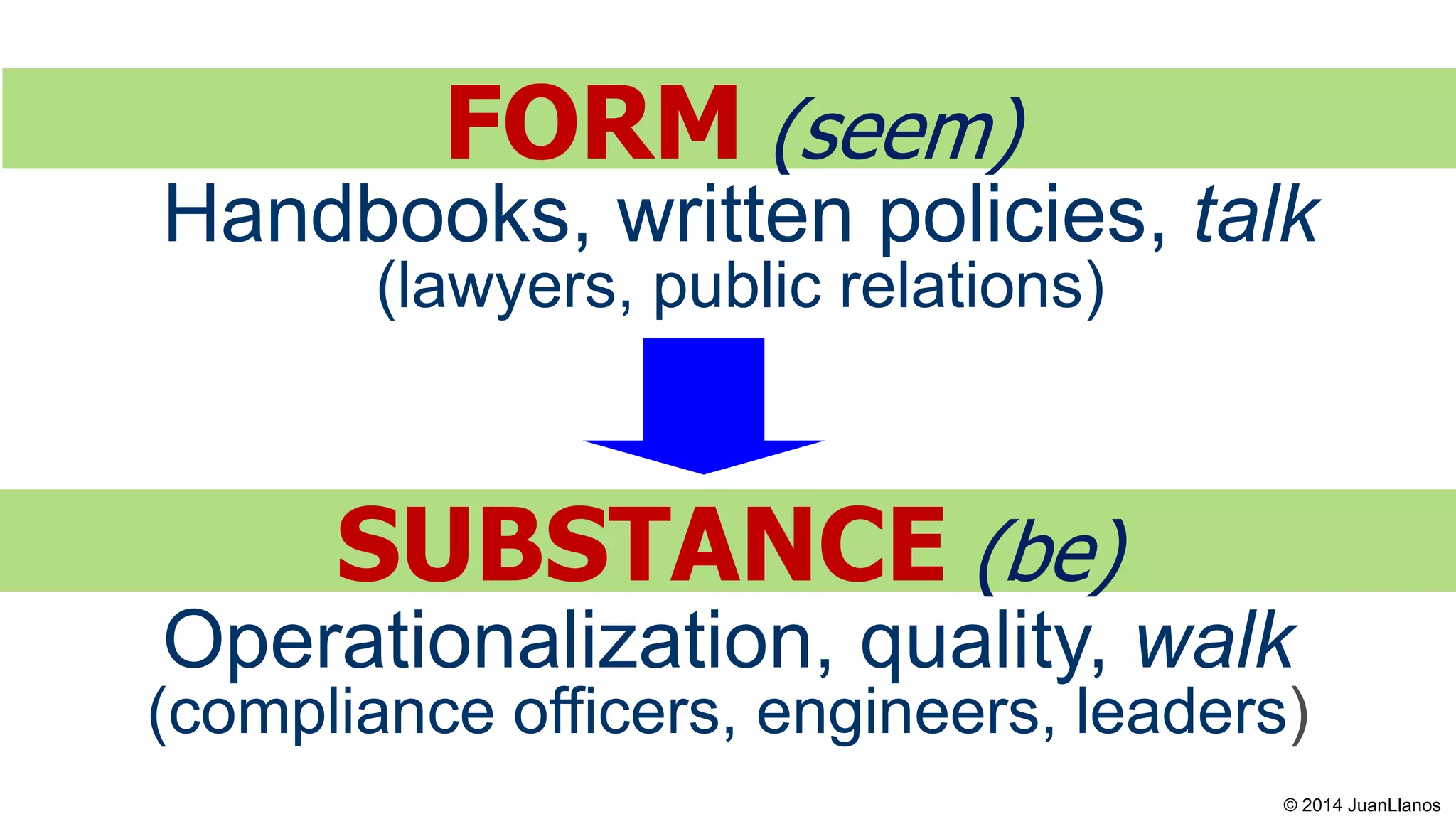
SUBSTANCE (be)
Handbooks, written policies, talk
(lawyers, public relations)
Operationalization, quality, walk
(compliance officers, engineers, leaders)
FORM (seem)
© 2014 JuanLlanos
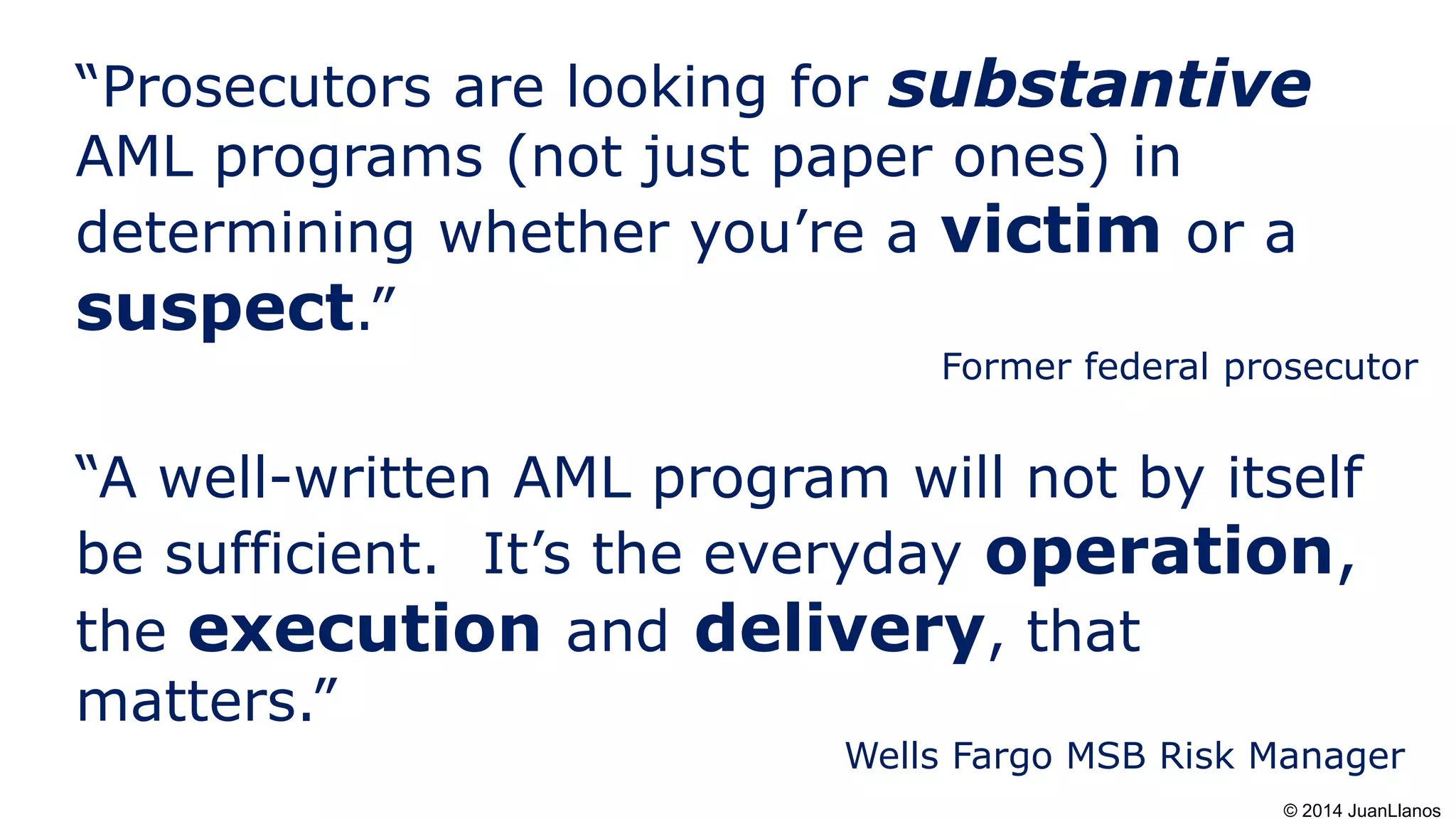
“Prosecutors are looking for substantive
AML programs (not just paper ones) in
determining whether you’re a victim or a
suspect.”
Former federal prosecutor
“A well-written AML program will not by itself
be sufficient. It’s the everyday operation,
the execution and delivery, that
matters.”
Wells Fargo MSB Risk Manager
© 2014 JuanLlanos
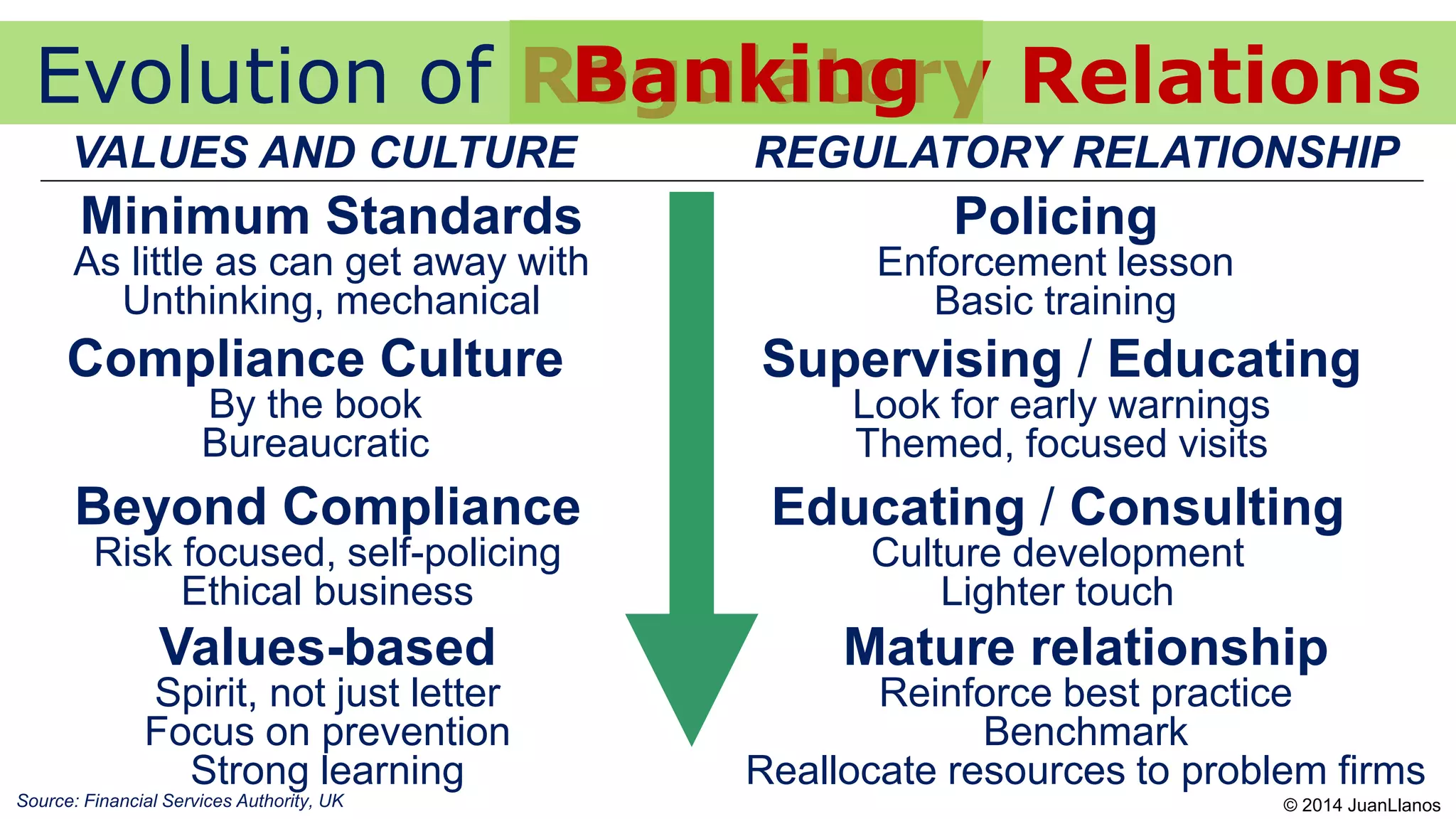
Evolution of Regulatory Relations
VALUES AND CULTURE REGULATORY RELATIONSHIP
Minimum Standards
As little as can get away with
Unthinking, mechanical
Compliance Culture
By the book
Bureaucratic
Beyond Compliance
Risk focused, self-policing
Ethical business
Values-based
Spirit, not just letter
Focus on prevention
Strong learning
Policing
Enforcement lesson
Basic training
Supervising / Educating
Look for early warnings
Themed, focused visits
Educating / Consulting
Culture development
Lighter touch
Mature relationship
Reinforce best practice
Benchmark
Reallocate resources to problem firms
Source: Financial Services Authority, UK
Banking
© 2014 JuanLlanos
INNOVATE
IMPLEMENT
INFLUENCE
© 2014 Juan Llanos
Juan Llanos
EVP, Strategic Partnerships & Chief Transparency Officer
Bitreserve, Inc.
San Francisco, CA
Mobile: (917) 684-0560
Email: juan@bitreserve.org
LinkedIn: www.linkedin.com/in/juanllanos
Twitter: @JuanLlanos
Blog: ContrarianCompliance.com
Thank you!

2014 07-09 Juan Llanos Presentation

  • 1.
    Bitcoin & AMLRegulation: Strategies for Successful Compliance & Government Relations Inside Bitcoins Australia 2014 Melbourne, July 9, 2014 by @JuanLlanos
  • 2.
  • 3.
    Agenda 1. Risk identification Riskareas  Focus on AML 2. Risk mitigation a) Program design tips b) Overview of corporate and product safeguards c) Customer identification and analytics (de-anonymization) 3. Unsolicited (contrarian) advice © 2014 JuanLlanos
  • 4.
    Agenda 1. Risk identification Riskareas  Focus on AML 2. Risk mitigation a) Program design tips b) Overview of corporate and product safeguards c) Customer identification and analytics (de-anonymization) 3. Unsolicited (contrarian) advice © 2014 JuanLlanos
  • 5.
    Financial Action TaskForce Groupe d’Action Financière (FATF-GAFI) Independent inter-governmental body Develops and promotes policies to protect the global financial system against money laundering and terrorist financing FAFT recommendations  define criminal justice and regulatory measures that should be implemented to counter this problem  are recognized as the global anti-money laundering and counter-terrorist financing standard (AML/CFT) © 2014 JuanLlanos
  • 6.
    Special Recommendation VI Eachcountry should take measures to ensure that persons or legal entities, including agents, that provide a service for the transmission of money or value, including transmission through an informal money or value transfer system or network, should be licensed or registered and subject to all the FATF Recommendations that apply to banks and non-bank financial institutions. Each country should ensure that persons or legal entities that carry out this service illegally are subject to administrative, civil or criminal sanctions Financial Action Task Force Groupe d’Action Financière (FATF-GAFI) © 2014 JuanLlanos
  • 7.
    Anonymity = Anathema •Anonymous identification • No value limits • Anonymous funding • No transaction records • Wide geographical use • No usage limits Cash features F AT F R e p o r t o n N e w P a y m e n t M e t h o d s ( 2 0 0 6 ) © 2014 JuanLlanos
  • 8.
    FATF New PaymentMethods Risks F AT F R e p o r t o n N e w P a y m e n t M e t h o d s ( 2 0 1 3 ) © 2014 JuanLlanos
  • 9.
    FATF Virtual CurrenciesAML Risks F AT F R e p o r t o n V i r t u a l C u r r e n c i e s ( 2 0 1 4 - 0 6 - 3 0 ) Convertible virtual currencies • are potentially vulnerable to money laundering and terrorist financing abuse • may allow greater anonymity than traditional non-cash payment methods Virtual currency systems • can be traded on the Internet (global reach) • generally characterized by non-face-to-face customer relationships • may permit anonymous funding • may permit anonymous transfers • may operate in jurisdictions with inadequate controls Decentralized systems • are vulnerable to anonymity risks. E.g., Bitcoin… • addresses have no names or other customer identification attached • has no central server or service provider • does not require or provide identification and verification of participants • does not generate historical records of transactions associated with real world identity • has no central oversight body • no AML software is currently available to monitor and identify suspicious transaction patterns • law enforcement cannot target one central location or entity for investigative or asset forfeiture purposes © 2014 JuanLlanos
  • 10.
    Money Transmitter Regulation(US) Focus  AML/BSA + State Compliance Main Risk Areas Main Statutes and Regs Anti-Money Laundering BSA, USA PATRIOT Act, Money Laundering Acts Anti-Terrorism Financing (CFT) USA PATRIOT Act, OFAC Privacy and Information Security Gramm-Leach-Bliley Safety and soundness State (via licensing) Consumer protection State (via licensing) + Dodd-Frank / Regulation E (CFPB) © 2014 JuanLlanos
  • 11.
    Who is amoney transmitter in the USA? IS IS NOT …whoever as a business: • Exchanges virtual currency for government currency, and one virtual currencies for another (e.g., exchanges) • Mines and makes a payment to a third party on behalf of a customer (e.g., for- profit miners) • Accepts value from A and delivers it to B (e.g., some wallets) • Accepts value from A and delivers it to A at a different time or place (e.g., vaults) …whoever • Mines, uses or invests virtual currency for own benefit • Provides network access services to money transmitters • Acts as a payment processor by agreement with a seller or creditor • Acts as intermediary between BSA- regulated institutions © 2014 JuanLlanos
  • 12.
  • 13.
    Agenda 1. Risk identification Riskareas  Focus on AML 2. Risk mitigation a) Program design tips b) Overview of corporate and product safeguards c) Customer identification and analytics (de-anonymization) 3. Unsolicited (contrarian) advice © 2014 JuanLlanos
  • 14.
    1. Always understandthe flow of DATA and the flow of MONEY. 2. Life-cycle management and the right mix of detective and deterrent techniques, including effective training, are key. 3. Document or perish Program Design Tips © 2014 JuanLlanos
  • 15.
    1. Map Flows, andProcesses 2. Identify Risks 3. Design Controls 4. Write PPCs 5. Execute and Measure 6. Enhance and Improve Bottom-Up Program Design Spirit of law + Engineering Mindset © 2014 JuanLlanos
  • 16.
    AML Program Elements (Section352 of the USA PATRIOT Act) 1. A designated compliance officer + professional team 2. Written policies and procedures + operational controls: • Licensing, renewal and reporting procedures (S) • Registration, record-keeping and report-filing procedures (F) • KY (Know Your…) Subprograms: Acceptance, monitoring, correction and termination KY…Customer / KY…Agent / KY…Foreign Counterparty / KY…Employee / KY…Vendor • Monitoring, analysis and investigating procedures • OFAC compliance program • Response to official information requests • Privacy and information security protection protocols 3. An on-going training program • Risk & Compliance Committee 4. An independent compliance auditing function CORPORATE Safeguards* © 2014 JuanLlanos
  • 17.
    CUSTOMER Identification Non-Face toFace  “Card not present” standards Non-documentary  contacting a customer; independently verifying the customer’s identity through the comparison of information provided by the customer with information obtained from a consumer reporting agency, public database, or other source; checking references with other financial institutions; and obtaining a financial statement. Documentary  Review an unexpired government-issued form of identification from most customers. This identification must provide evidence of a customer’s nationality or residence and bear a photograph or similar safeguard; examples include a driver’s license or passport. However, other forms of identification may be used if they enable the bank to form a reasonable belief that it knows the true identity of the customer. © 2014 JuanLlanos
  • 18.
    “What customers do speaksso loudly that I cannot hear what they’re saying.” (Paraphrasing Ralph Waldo Emerson) Customer identification vs. customer knowledge BEHAVIORAL ANALYTICS © 2014 JuanLlanos
  • 19.
    © 2013 JuanLlanos Machine Learning (AI) Methods SUPERVISED LEARNING: relies on two labeled classes (good vs. bad) Goal  Detect known suspicious patterns 1. Training set: a. Select dataset with clean and dirty cases. b. Classification algorithm to discriminate between the two classes (finds the rules or conditions) a. Probabilities of class 1 and class 2 assignment 2. Run discrimination method on all future purchases. UNSUPERVISED LEARNING: no class labels Goal  Detect anomalies 1. Takes recent purchase history and summarize in descriptive statistics. 2. Measure whether selected variables exceed a certain threshold. (deviations from the norm) 3. Sounds alarm and records a high score. © 2014 JuanLlanos
  • 20.
    • High amounts •High frequency • Use of multiple locations • Use of multiple identities • Use of untrusted device • Values just below threshold • Immediate withdrawals Examples of Known Unusual Behaviors © 2014 JuanLlanos
  • 21.
    Agenda 1. Risk identification Riskareas  Focus on AML 2. Risk mitigation a) Program design tips b) Overview of corporate and product safeguards c) Customer identification and analytics (de-anonymization) 3. Unsolicited (contrarian) advice © 2014 JuanLlanos
  • 22.
    • Prevention trumpsdamage control • Risk MGT  Both reducing downside and increasing upside • Simplicity and common sense • Train for behavior change, not theoretical knowledge • Form-substance continuum  substance • Letter-spirit continuum  focus on spirit (underlying purpose and values) facilitates • Operational synergies (leveraging tech) • Compliance without compromising performance • Flexibility and sustainability © 2014 JuanLlanos
  • 23.
    Risk Areas • operational •credit • money laundering • terrorist financing • information loss • liquidity • fraud • Identity Theft Stakeholders • federal agencies • state agencies • investors • consumers • employees • society Goals • safety • soundness • security • privacy • crime prevention • health • integrity Regulation  Inevitable, yet valid Risks & Stakeholders Compliance  Onerous, yet valuable© 2014 JuanLlanos
  • 24.
    SUBSTANCE (be) Handbooks, writtenpolicies, talk (lawyers, public relations) Operationalization, quality, walk (compliance officers, engineers, leaders) FORM (seem) © 2014 JuanLlanos
  • 25.
    “Prosecutors are lookingfor substantive AML programs (not just paper ones) in determining whether you’re a victim or a suspect.” Former federal prosecutor “A well-written AML program will not by itself be sufficient. It’s the everyday operation, the execution and delivery, that matters.” Wells Fargo MSB Risk Manager © 2014 JuanLlanos
  • 26.
    Evolution of RegulatoryRelations VALUES AND CULTURE REGULATORY RELATIONSHIP Minimum Standards As little as can get away with Unthinking, mechanical Compliance Culture By the book Bureaucratic Beyond Compliance Risk focused, self-policing Ethical business Values-based Spirit, not just letter Focus on prevention Strong learning Policing Enforcement lesson Basic training Supervising / Educating Look for early warnings Themed, focused visits Educating / Consulting Culture development Lighter touch Mature relationship Reinforce best practice Benchmark Reallocate resources to problem firms Source: Financial Services Authority, UK Banking © 2014 JuanLlanos
  • 27.
  • 28.
    © 2014 JuanLlanos Juan Llanos EVP, Strategic Partnerships & Chief Transparency Officer Bitreserve, Inc. San Francisco, CA Mobile: (917) 684-0560 Email: juan@bitreserve.org LinkedIn: www.linkedin.com/in/juanllanos Twitter: @JuanLlanos Blog: ContrarianCompliance.com Thank you!