KANAKA MAOLI –
 CONNECTIONS
 TO THE `ĀINA
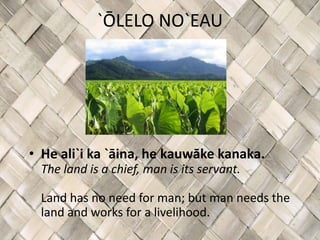
`ŌLELO NO`EAU


• He ali`i ka `āina, he kauwāke kanaka.
 The land is a chief, man is its servant.

 Land has no need for man; but man needs the
 land and works for a livelihood.
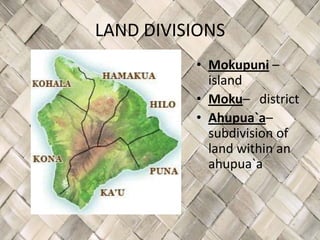
LAND DIVISIONS
          • Mokupuni –
            island
          • Moku– district
          • Ahupua`a–
            subdivision of
            land within an
            ahupua`a
HĀLOA
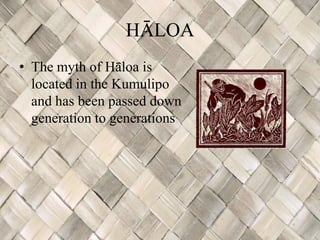
• The myth of Hāloa is
  located in the Kumulipo
  and has been passed down
  generation to generations
HĀLOA
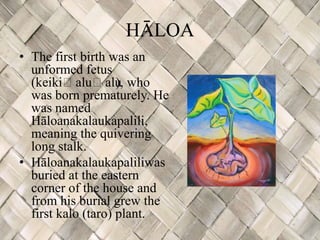
• The first birth was an
  unformed fetus
  (keikiʻaluʻalu, who
                    )
  was born prematurely. He
  was named
  Hāloanakalaukapalili,
  meaning the quivering
  long stalk.
• Hāloanakalaukapaliliwas
  buried at the eastern
  corner of the house and
  from his burial grew the
  first kalo (taro) plant.
HĀLOA
• The second birth was a
  child named Hāloa in
  honor of his elder brother.
  Hāloa was born strong and
  healthy and is believed to
  be the first kanaka maoli, or
  Hawaiian man.
• Hāloa means long breath
KULEANA
• Thus, Haloanakalaukapalil
  i, the kalo, is considered to
  be the older sibling and
  the kanaka Hawai`i
  (Hawaiian people) the
  younger sibling.
KALO
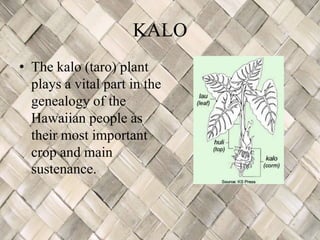
• The kalo (taro) plant
  plays a vital part in the
  genealogy of the
  Hawaiian people as
  their most important
  crop and main
  sustenance.
`OHANA
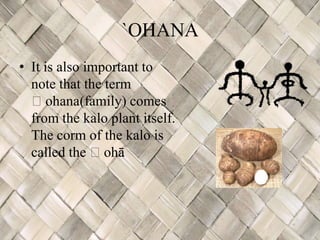
• It is also important to
  note that the term
  ʻohana(family) comes
  from the kalo plant itself.
  The corm of the kalo is
  called the ʻohā  .
SHOWING RESPECT
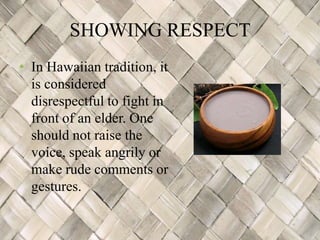
• In Hawaiian tradition, it
  is considered
  disrespectful to fight in
  front of an elder. One
  should not raise the
  voice, speak angrily or
  make rude comments or
  gestures.
Kanaka maoli

Kanaka maoli

  • 1.
    KANAKA MAOLI – CONNECTIONS TO THE `ĀINA
  • 2.
    `ŌLELO NO`EAU • Heali`i ka `āina, he kauwāke kanaka. The land is a chief, man is its servant. Land has no need for man; but man needs the land and works for a livelihood.
  • 3.
    LAND DIVISIONS • Mokupuni – island • Moku– district • Ahupua`a– subdivision of land within an ahupua`a
  • 5.
    HĀLOA • The mythof Hāloa is located in the Kumulipo and has been passed down generation to generations
  • 6.
    HĀLOA • The firstbirth was an unformed fetus (keikiʻaluʻalu, who ) was born prematurely. He was named Hāloanakalaukapalili, meaning the quivering long stalk. • Hāloanakalaukapaliliwas buried at the eastern corner of the house and from his burial grew the first kalo (taro) plant.
  • 7.
    HĀLOA • The secondbirth was a child named Hāloa in honor of his elder brother. Hāloa was born strong and healthy and is believed to be the first kanaka maoli, or Hawaiian man. • Hāloa means long breath
  • 8.
    KULEANA • Thus, Haloanakalaukapalil i, the kalo, is considered to be the older sibling and the kanaka Hawai`i (Hawaiian people) the younger sibling.
  • 9.
    KALO • The kalo(taro) plant plays a vital part in the genealogy of the Hawaiian people as their most important crop and main sustenance.
  • 10.
    `OHANA • It isalso important to note that the term ʻohana(family) comes from the kalo plant itself. The corm of the kalo is called the ʻohā .
  • 11.
    SHOWING RESPECT • InHawaiian tradition, it is considered disrespectful to fight in front of an elder. One should not raise the voice, speak angrily or make rude comments or gestures.

Editor's Notes

  • #3 Hawaiians did not own land. The concept of individual land tenure was introduced in 1845 in a major land transfer called the Mähele. Instead, Hawaiians understood that the land belonged to the akua, the gods. The chief or ali'i was responsible for the care of the land and the people. He appointed a series of lesser chiefs to manage the daily activities. The commoners, maka'äinana, were responsible for planting and harvesting, fishing, and gathering of wild foods, birds, feathers and the making of kapa, bark cloth, rope and other tools necessary for daily life and to provide support for their ali'i and their gods.
  • #4 The concept of private property was unknown to ancient Hawaiians, but they did follow a complex system of land division. All land was controlled ultimately by the highest ali`i or chief who held it in trust for the whole population. Who supervised these lands was designated by the king based on rank and standing. A whole island, or mokupuni, was divided into several moku or districts. Each moku was divided into ahupua`a and the size of the ahupua`a depended on the resources of the area with poorer agricultural regions split into larger ahupua`a to compensate for the relative lack of natural abundance. Each ahupua`a was ruled by an ali`i or local.
  • #5 Shaped by island geography, each ahupua`a was a wedge-shaped area of land running from the uplands to the sea, following the natural boundaries of the watershed. Each ahupua`a contained the resources the human community needed, from fish and salt, to fertile land for farming taro or sweet potato, to koa and other trees growing in upslope areas. Villagers from the coast traded fish for other foods or for wood to build canoes and houses.
  • #6 The Kumuiipo is the epic chant of creation according to the Hawaiian people. The Kumulipo says that Papahānaumoku (Earth Mother) & Wākea (Sky Father) came together and brought forth the birth of the Hawaiian Islands & the Hawaiian people. Papa and Wākea had a daughter named Hoʻohōkūkalani. Wākea and Hoʻohōkūkalani together conceived a child. Their union resulted in two births.
  • #7 The sun rises in the east and brings forth new life.The east signifies birth, life, and growth.
  • #8 The word Hāloa infers to the strength and endurance of the Hawaiian people. Without breath we have no life; without without we have no voice.
  • #9 It is said that if you take care of your older siblings and your mother, they will nurture and take care of you. This is the relationship that the Hawaiians have to kalo.
  • #10 It is man’s responsibility to take care of the ʻāina (land) so that the ʻāina will feed the people.
  • #11 The ʻohā is the main part of the plant that is used to feed one’s ʻohana. As the young shoot grows from the corm, people grow from the family.
  • #12 As such, when the poi bowl was open, there must be no quarreling or arguing for it was a sign of disrespect to Hāloa because Haloa (Taro) is the elder brother of humans.