Community Extension Service and Development
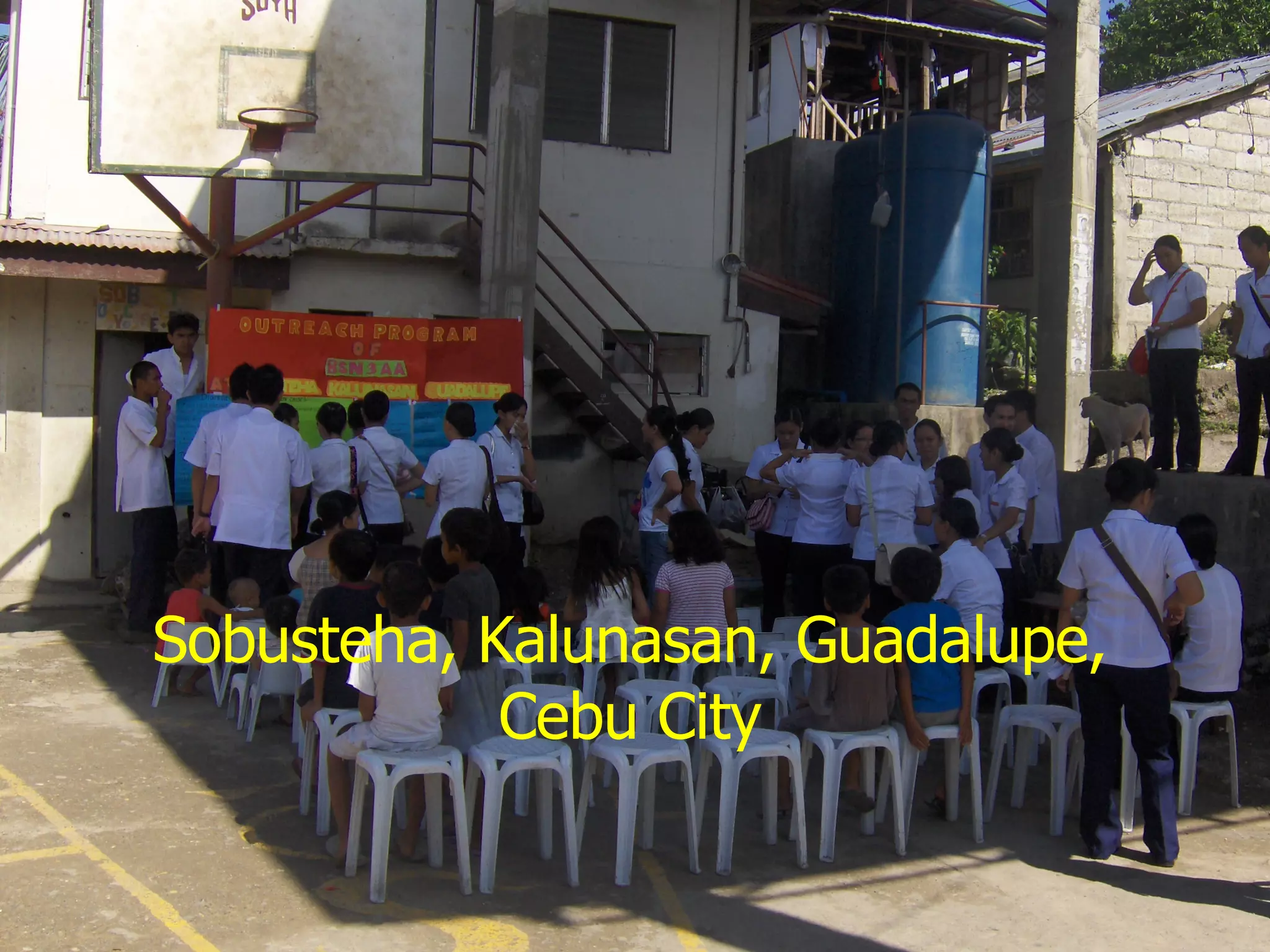
Sobusteha, Kalunasan, Guadalupe, Cebu City
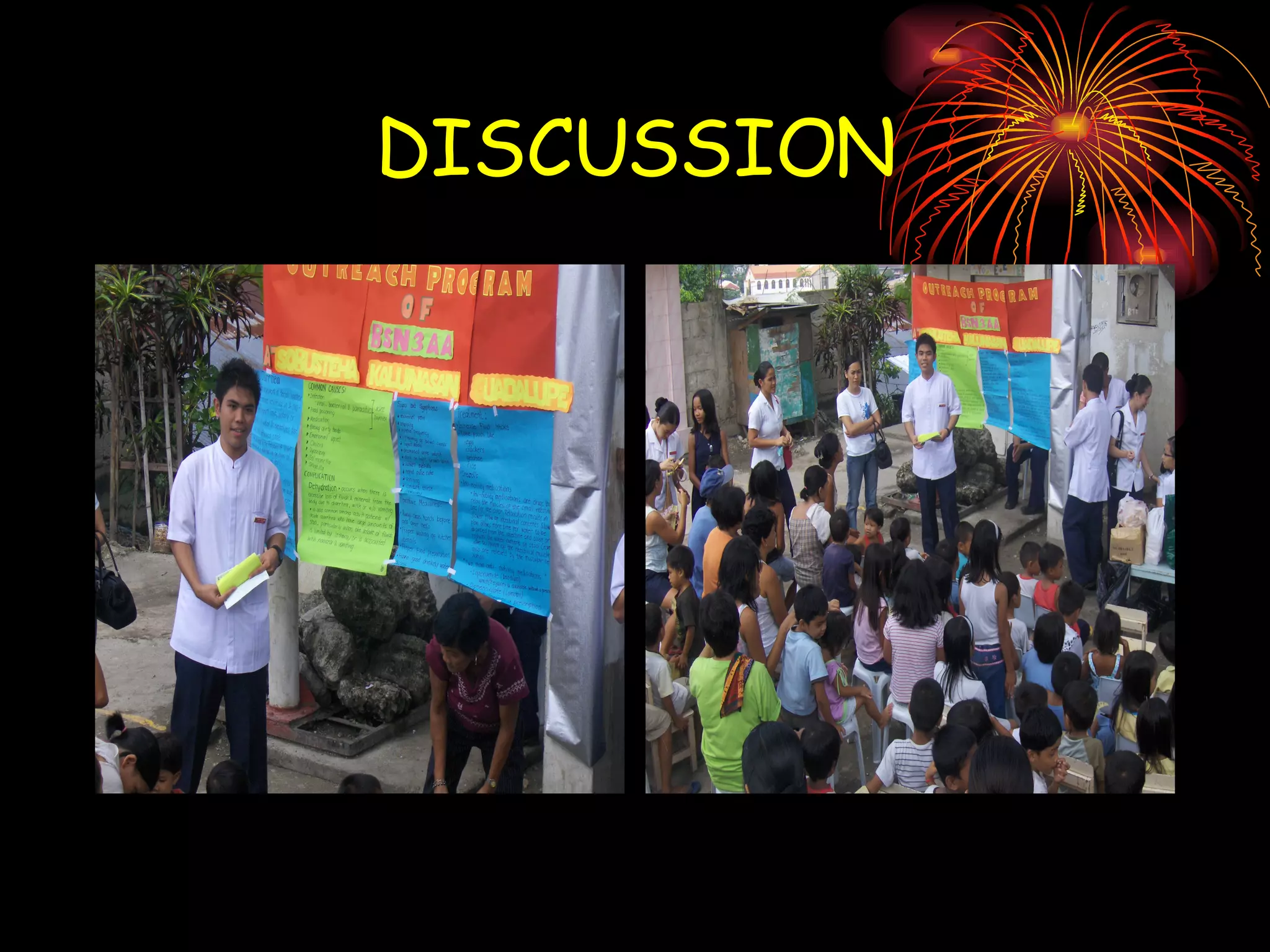
General Objective: After 4 hours of varied-teaching, the residents of Subosteha, Kalunasan, Guadalupe, Cebu City will be able to gain positive attitude and knowledge about diarrhea.
Specific Objectives: What is diarrhea? What are the types of diarrhea? What are the common causes of diarrhea? What are the symptoms of diarrhea? When to take your child to the doctor? How is the cause of diarrhea diagnosed?  How is diarrhea treated? How to prevent traveler’s diarrhea?
DIARRHEA
Diarrhea   Diarrhea describes bowel movements (stools) that are loose and watery. It is very common and usually not serious. Many people will have diarrhea once or twice each year. It typically lasts two to three days and can be treated with over-the-counter medicines. Others have diarrhea often as part of irritable bowel syndrome or other chronic diseases of the large intestine.
Types of Diarrhea Secretory Diarrhea Osmotic Diarrhea Motility-related Diarrhea Inflammatory Diarrhea
Common Causes of Diarrhea Bacterial Infections Viral Infections Food Intolerances Parasites Reactions to Medicines Intestinal Diseases Functional Bowel Disorders Stomach Surgery or Removal of the Gall bladder
Symptoms of Diarrhea Abdominal bloating or cramps Thin or loose stools Watery stool Sense of urgency to have a bowel movement Nausea and vomiting
Take your child to the doctor if there is no improvement after 24 hours or if any of the following symptoms appear: •  Stools containing blood or pus •  Black Stools •  A temperature above 102 degrees •  Signs of dehydration
Diagnostic Tests to find the cause of Diarrhea may include the following: •  Medical History and Physical Examination •  Stool Culture  •  Blood Tests •  Fasting Tests •  Sigmoidoscopy •  Colonoscopy •  Imaging Tests
How is Diarrhea Treated? In most cases of diarrhea, replacing lost fluid to prevent dehydration is the only treatment necessary. Medicines that stop diarrhea may be helpful, but they are not recommended for people whose is caused by a bacterial infection or parasite. If you stop the diarrhea before having purged the bacteria or parasite, you trap the organism in the intestines and prolong the problem. Rather, doctors usually prescribe antibiotics as a first line treatment. Viral infections are either treated with medication or left to run their course, depending on the severity or type of virus.
How to prevent Traveler's Diarrhea? •   Do not drink tap water or use it to brush your  teeth. •  Do not drink unpasteurized milk or dairy products. •  Do not use ice made from tap waters. •  Avoid all raw fruits and vegetables, including  lettuce and fruit salads,  unless they can be peeled and you peel them  yourself. •  Do not eat raw or rare meat or fish. •  Do not eat meat or shellfish that is not hot when  served. •  Do not eat food from street vendors.
DOCUMENTATION
Community Extension Service and Development
Sobusteha, Kalunasan, Guadalupe, Cebu City
THE PREPARATION FOR THE SEMINAR
DISCUSSION
 
BP TAKING
 
WOUND CARE
 
HANDWASHING
 
SNACK’S TIME
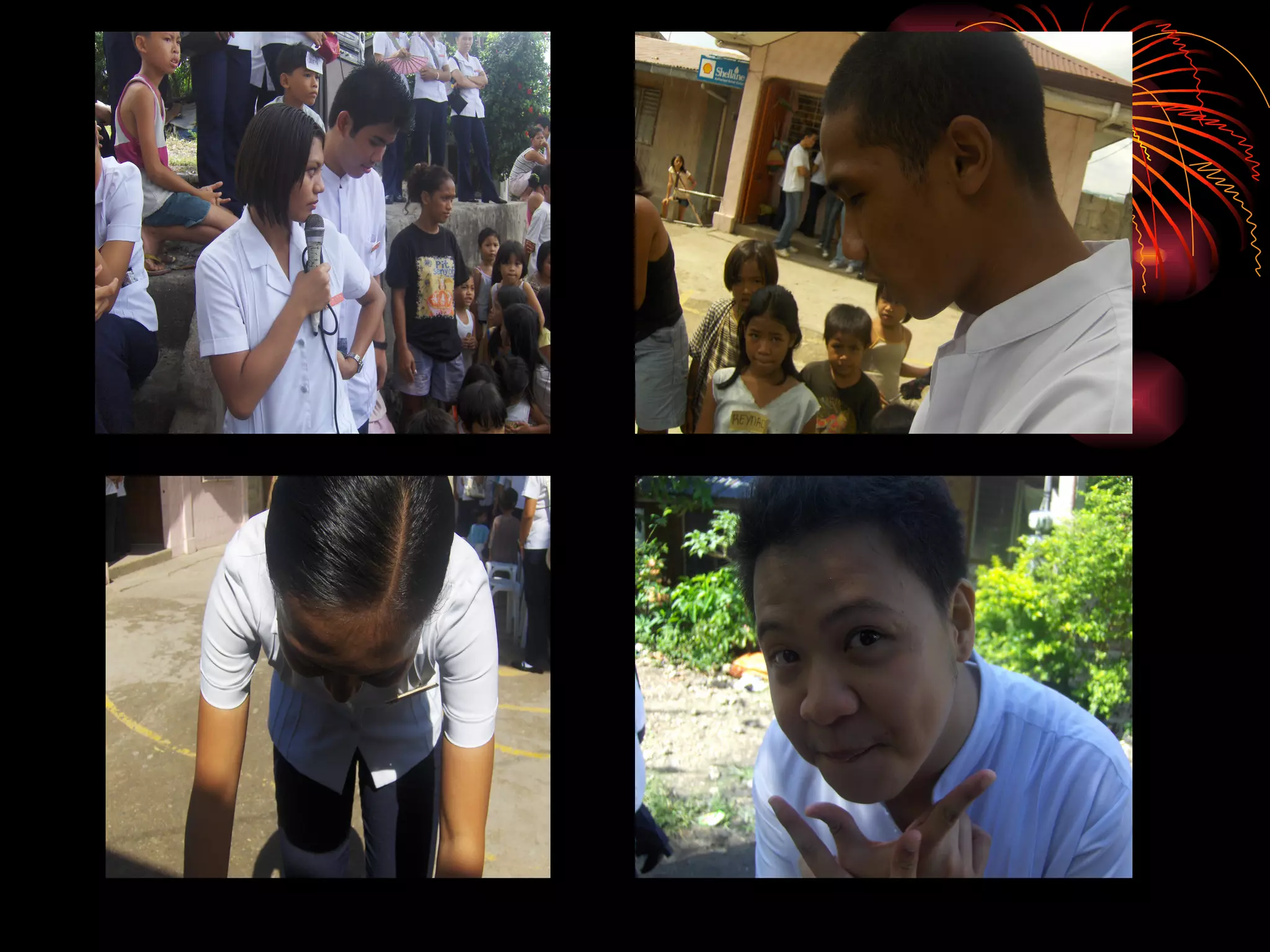
BLOOPERS


Karlpoint

  • 1.
  • 2.
  • 3.
    General Objective: After4 hours of varied-teaching, the residents of Subosteha, Kalunasan, Guadalupe, Cebu City will be able to gain positive attitude and knowledge about diarrhea.
  • 4.
    Specific Objectives: Whatis diarrhea? What are the types of diarrhea? What are the common causes of diarrhea? What are the symptoms of diarrhea? When to take your child to the doctor? How is the cause of diarrhea diagnosed? How is diarrhea treated? How to prevent traveler’s diarrhea?
  • 5.
  • 6.
    Diarrhea Diarrhea describes bowel movements (stools) that are loose and watery. It is very common and usually not serious. Many people will have diarrhea once or twice each year. It typically lasts two to three days and can be treated with over-the-counter medicines. Others have diarrhea often as part of irritable bowel syndrome or other chronic diseases of the large intestine.
  • 7.
    Types of DiarrheaSecretory Diarrhea Osmotic Diarrhea Motility-related Diarrhea Inflammatory Diarrhea
  • 8.
    Common Causes ofDiarrhea Bacterial Infections Viral Infections Food Intolerances Parasites Reactions to Medicines Intestinal Diseases Functional Bowel Disorders Stomach Surgery or Removal of the Gall bladder
  • 9.
    Symptoms of DiarrheaAbdominal bloating or cramps Thin or loose stools Watery stool Sense of urgency to have a bowel movement Nausea and vomiting
  • 10.
    Take your childto the doctor if there is no improvement after 24 hours or if any of the following symptoms appear: • Stools containing blood or pus • Black Stools • A temperature above 102 degrees • Signs of dehydration
  • 11.
    Diagnostic Tests tofind the cause of Diarrhea may include the following: • Medical History and Physical Examination • Stool Culture • Blood Tests • Fasting Tests • Sigmoidoscopy • Colonoscopy • Imaging Tests
  • 12.
    How is DiarrheaTreated? In most cases of diarrhea, replacing lost fluid to prevent dehydration is the only treatment necessary. Medicines that stop diarrhea may be helpful, but they are not recommended for people whose is caused by a bacterial infection or parasite. If you stop the diarrhea before having purged the bacteria or parasite, you trap the organism in the intestines and prolong the problem. Rather, doctors usually prescribe antibiotics as a first line treatment. Viral infections are either treated with medication or left to run their course, depending on the severity or type of virus.
  • 13.
    How to preventTraveler's Diarrhea? • Do not drink tap water or use it to brush your teeth. • Do not drink unpasteurized milk or dairy products. • Do not use ice made from tap waters. • Avoid all raw fruits and vegetables, including lettuce and fruit salads, unless they can be peeled and you peel them yourself. • Do not eat raw or rare meat or fish. • Do not eat meat or shellfish that is not hot when served. • Do not eat food from street vendors.
  • 14.
  • 15.
  • 16.
  • 17.
  • 18.
  • 19.
  • 20.
  • 21.
  • 22.
  • 23.
  • 24.
  • 25.
  • 26.
  • 27.
  • 28.
  • 29.
  • 30.
  • 31.