kamailio-tests
A testing framework for Kamailio
Giacomo Vacca - Kamailio World 2018 Workshop
Why this Workshop
kamailio-tests aims to provide reduce the need for end-to-end tests. “Test
units” target a specific core or module functionality.
It encourages contributors to the Kamailio project to build unit tests whenever
a new feature is published, or a bug fixed.
It’s an open source project published by Daniel-Constantin Mierla, with small
contributions from the presenter of this workshop.
2
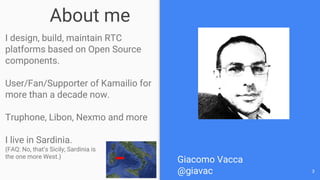
About me
I design, build, maintain RTC
platforms based on Open Source
components.
User/Fan/Supporter of Kamailio for
more than a decade now.
Truphone, Libon, Nexmo and more
I live in Sardinia.
(FAQ: No, that’s Sicily; Sardinia is
the one more West.)
3
Giacomo Vacca
@giavac
Agenda
The rationale behind this project
Project structure
The role of Docker
The current test scenarios
Future development
Q&A
https://github.com/kamailio/kamailio-tests
4
“Why do we always end up debugging?”
- Anonymous from the audience
5
Why kamailio-tests
https://github.com/kamailio/kamailio-tests
A “self-contained” environment to test:
- Modules
- Routing scripts
- DB access
- Build requirements (indirectly)
No need to setup permanent test
environments
Allow for (automated) regression testing
Reduce the need for end-to-end testing
“Adding a feature or fixing a
bug? Also add a test for it.”
6
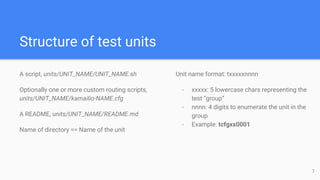
Structure of test units
A script, units/UNIT_NAME/UNIT_NAME.sh
Optionally one or more custom routing scripts,
units/UNIT_NAME/kamailio-NAME.cfg
A README, units/UNIT_NAME/README.md
Name of directory == Name of the unit
Unit name format: txxxxxnnnn
- xxxxx: 5 lowercase chars representing the
test “group”
- nnnn: 4 digits to enumerate the unit in the
group
- Example: tcfgxx0001
7
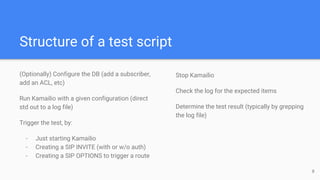
Structure of a test script
(Optionally) Configure the DB (add a subscriber,
add an ACL, etc)
Run Kamailio with a given configuration (direct
std out to a log file)
Trigger the test, by:
- Just starting Kamailio
- Creating a SIP INVITE (with or w/o auth)
- Creating a SIP OPTIONS to trigger a route
Stop Kamailio
Check the log for the expected items
Determine the test result (typically by grepping
the log file)
8
9
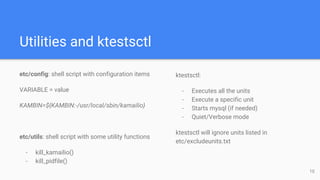
Utilities and ktestsctl
etc/config: shell script with configuration items
VARIABLE = value
KAMBIN=${KAMBIN:-/usr/local/sbin/kamailio}
etc/utils: shell script with some utility functions
- kill_kamailio()
- kill_pidfile()
ktestsctl:
- Executes all the units
- Execute a specific unit
- Starts mysql (if needed)
- Quiet/Verbose mode
ktestsctl will ignore units listed in
etc/excludeunits.txt
10
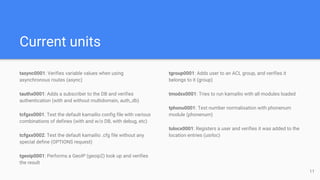
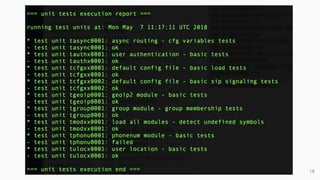
Current units
tasync0001: Verifies variable values when using
asynchronous routes (async)
tauthx0001: Adds a subscriber to the DB and verifies
authentication (with and without multidomain, auth_db)
tcfgxx0001: Test the default kamailio config file with various
combinations of defines (with and w/o DB, with debug, etc)
tcfgxx0002: Test the default kamailio .cfg file without any
special define (OPTIONS request)
tgeoip0001: Performs a GeoIP (geoip2) look up and verifies
the result
tgroup0001: Adds user to an ACL group, and verifies it
belongs to it (group)
tmodxx0001: Tries to run kamailio with all modules loaded
tphonu0001: Test number normalisation with phonenum
module (phonenum)
tulocx0001: Registers a user and verifies it was added to the
location entries (usrloc)
11
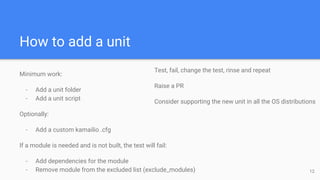
How to add a unit
Minimum work:
- Add a unit folder
- Add a unit script
Optionally:
- Add a custom kamailio .cfg
If a module is needed and is not built, the test will fail:
- Add dependencies for the module
- Remove module from the excluded list (exclude_modules) 12
Test, fail, change the test, rinse and repeat
Raise a PR
Consider supporting the new unit in all the OS distributions
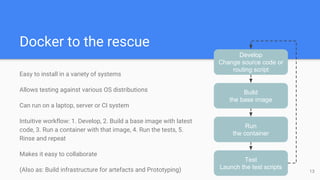
Docker to the rescue
Easy to install in a variety of systems
Allows testing against various OS distributions
Can run on a laptop, server or CI system
Intuitive workflow: 1. Develop, 2. Build a base image with latest
code, 3. Run a container with that image, 4. Run the tests, 5.
Rinse and repeat
Makes it easy to collaborate
(Also as: Build infrastructure for artefacts and Prototyping)
Develop
Change source code or
routing script
Build
the base image
Run
the container
Test
Launch the test scripts
13
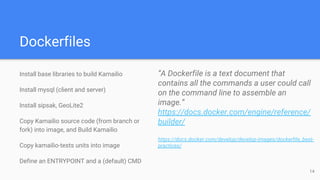
Dockerfiles
Install base libraries to build Kamailio
Install mysql (client and server)
Install sipsak, GeoLite2
Copy Kamailio source code (from branch or
fork) into image, and Build Kamailio
Copy kamailio-tests units into image
Define an ENTRYPOINT and a (default) CMD
“A Dockerfile is a text document that
contains all the commands a user could call
on the command line to assemble an
image.”
https://docs.docker.com/engine/reference/
builder/
https://docs.docker.com/develop/develop-images/dockerfile_best-
practices/
14
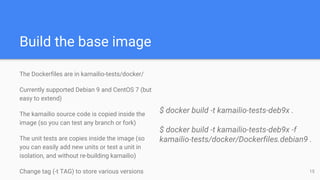
Build the base image
The Dockerfiles are in kamailio-tests/docker/
Currently supported Debian 9 and CentOS 7 (but
easy to extend)
The kamailio source code is copied inside the
image (so you can test any branch or fork)
The unit tests are copies inside the image (so
you can easily add new units or test a unit in
isolation, and without re-building kamailio)
Change tag (-t TAG) to store various versions
$ docker build -t kamailio-tests-deb9x .
$ docker build -t kamailio-tests-deb9x -f
kamailio-tests/docker/Dockerfiles.debian9 .
15
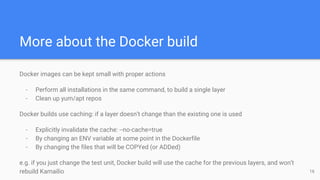
More about the Docker build
Docker images can be kept small with proper actions
- Perform all installations in the same command, to build a single layer
- Clean up yum/apt repos
Docker builds use caching: if a layer doesn’t change than the existing one is used
- Explicitly invalidate the cache: --no-cache=true
- By changing an ENV variable at some point in the Dockerfile
- By changing the files that will be COPYed (or ADDed)
e.g. if you just change the test unit, Docker build will use the cache for the previous layers, and won’t
rebuild Kamailio 16
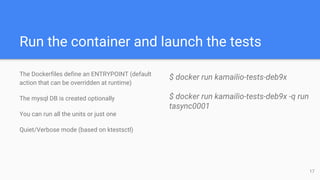
Run the container and launch the tests
The Dockerfiles define an ENTRYPOINT (default
action that can be overridden at runtime)
The mysql DB is created optionally
You can run all the units or just one
Quiet/Verbose mode (based on ktestsctl)
$ docker run kamailio-tests-deb9x
$ docker run kamailio-tests-deb9x -q run
tasync0001
17
18
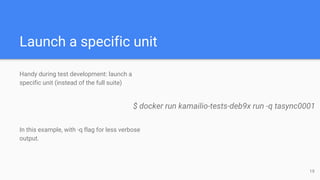
Launch a specific unit
Handy during test development: launch a
specific unit (instead of the full suite)
In this example, with -q flag for less verbose
output.
$ docker run kamailio-tests-deb9x run -q tasync0001
19
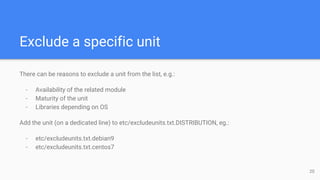
Exclude a specific unit
There can be reasons to exclude a unit from the list, e.g.:
- Availability of the related module
- Maturity of the unit
- Libraries depending on OS
Add the unit (on a dedicated line) to etc/excludeunits.txt.DISTRIBUTION, eg.:
- etc/excludeunits.txt.debian9
- etc/excludeunits.txt.centos7
20
Future
development
More unit tests
More complex scenarios (sipp
and HTTP)
Integration with Jenkins and
others
Additional OS support
<Your idea here>
21
Kamailio is a complex framework typically
interacting with complex systems.
With kamailio-tests we can reduce the
amount of end-to-end testing, by defining
proper, isolated unit tests.
22
See also...
The work done in evosip (Presentations from Paolo and Alex in
the next days)
My previous work in kamailio_ci project:
https://github.com/giavac/kamailio_ci
My workshop at Kamailio World 2016:
https://www.slideshare.net/GiacomoVacca/continuous-integrati
on-and-kamailio
23
Thanks!
Giacomo Vacca
@giavac
https://github.com/giavac
https://www.linkedin.com/in/giacomovacca/
Q&A
24

Kamailio World 2018 - Workshop: kamailio-tests

  • 1.
    kamailio-tests A testing frameworkfor Kamailio Giacomo Vacca - Kamailio World 2018 Workshop
  • 2.
    Why this Workshop kamailio-testsaims to provide reduce the need for end-to-end tests. “Test units” target a specific core or module functionality. It encourages contributors to the Kamailio project to build unit tests whenever a new feature is published, or a bug fixed. It’s an open source project published by Daniel-Constantin Mierla, with small contributions from the presenter of this workshop. 2
  • 3.
    About me I design,build, maintain RTC platforms based on Open Source components. User/Fan/Supporter of Kamailio for more than a decade now. Truphone, Libon, Nexmo and more I live in Sardinia. (FAQ: No, that’s Sicily; Sardinia is the one more West.) 3 Giacomo Vacca @giavac
  • 4.
    Agenda The rationale behindthis project Project structure The role of Docker The current test scenarios Future development Q&A https://github.com/kamailio/kamailio-tests 4
  • 5.
    “Why do wealways end up debugging?” - Anonymous from the audience 5
  • 6.
    Why kamailio-tests https://github.com/kamailio/kamailio-tests A “self-contained”environment to test: - Modules - Routing scripts - DB access - Build requirements (indirectly) No need to setup permanent test environments Allow for (automated) regression testing Reduce the need for end-to-end testing “Adding a feature or fixing a bug? Also add a test for it.” 6
  • 7.
    Structure of testunits A script, units/UNIT_NAME/UNIT_NAME.sh Optionally one or more custom routing scripts, units/UNIT_NAME/kamailio-NAME.cfg A README, units/UNIT_NAME/README.md Name of directory == Name of the unit Unit name format: txxxxxnnnn - xxxxx: 5 lowercase chars representing the test “group” - nnnn: 4 digits to enumerate the unit in the group - Example: tcfgxx0001 7
  • 8.
    Structure of atest script (Optionally) Configure the DB (add a subscriber, add an ACL, etc) Run Kamailio with a given configuration (direct std out to a log file) Trigger the test, by: - Just starting Kamailio - Creating a SIP INVITE (with or w/o auth) - Creating a SIP OPTIONS to trigger a route Stop Kamailio Check the log for the expected items Determine the test result (typically by grepping the log file) 8
  • 9.
  • 10.
    Utilities and ktestsctl etc/config:shell script with configuration items VARIABLE = value KAMBIN=${KAMBIN:-/usr/local/sbin/kamailio} etc/utils: shell script with some utility functions - kill_kamailio() - kill_pidfile() ktestsctl: - Executes all the units - Execute a specific unit - Starts mysql (if needed) - Quiet/Verbose mode ktestsctl will ignore units listed in etc/excludeunits.txt 10
  • 11.
    Current units tasync0001: Verifiesvariable values when using asynchronous routes (async) tauthx0001: Adds a subscriber to the DB and verifies authentication (with and without multidomain, auth_db) tcfgxx0001: Test the default kamailio config file with various combinations of defines (with and w/o DB, with debug, etc) tcfgxx0002: Test the default kamailio .cfg file without any special define (OPTIONS request) tgeoip0001: Performs a GeoIP (geoip2) look up and verifies the result tgroup0001: Adds user to an ACL group, and verifies it belongs to it (group) tmodxx0001: Tries to run kamailio with all modules loaded tphonu0001: Test number normalisation with phonenum module (phonenum) tulocx0001: Registers a user and verifies it was added to the location entries (usrloc) 11
  • 12.
    How to adda unit Minimum work: - Add a unit folder - Add a unit script Optionally: - Add a custom kamailio .cfg If a module is needed and is not built, the test will fail: - Add dependencies for the module - Remove module from the excluded list (exclude_modules) 12 Test, fail, change the test, rinse and repeat Raise a PR Consider supporting the new unit in all the OS distributions
  • 13.
    Docker to therescue Easy to install in a variety of systems Allows testing against various OS distributions Can run on a laptop, server or CI system Intuitive workflow: 1. Develop, 2. Build a base image with latest code, 3. Run a container with that image, 4. Run the tests, 5. Rinse and repeat Makes it easy to collaborate (Also as: Build infrastructure for artefacts and Prototyping) Develop Change source code or routing script Build the base image Run the container Test Launch the test scripts 13
  • 14.
    Dockerfiles Install base librariesto build Kamailio Install mysql (client and server) Install sipsak, GeoLite2 Copy Kamailio source code (from branch or fork) into image, and Build Kamailio Copy kamailio-tests units into image Define an ENTRYPOINT and a (default) CMD “A Dockerfile is a text document that contains all the commands a user could call on the command line to assemble an image.” https://docs.docker.com/engine/reference/ builder/ https://docs.docker.com/develop/develop-images/dockerfile_best- practices/ 14
  • 15.
    Build the baseimage The Dockerfiles are in kamailio-tests/docker/ Currently supported Debian 9 and CentOS 7 (but easy to extend) The kamailio source code is copied inside the image (so you can test any branch or fork) The unit tests are copies inside the image (so you can easily add new units or test a unit in isolation, and without re-building kamailio) Change tag (-t TAG) to store various versions $ docker build -t kamailio-tests-deb9x . $ docker build -t kamailio-tests-deb9x -f kamailio-tests/docker/Dockerfiles.debian9 . 15
  • 16.
    More about theDocker build Docker images can be kept small with proper actions - Perform all installations in the same command, to build a single layer - Clean up yum/apt repos Docker builds use caching: if a layer doesn’t change than the existing one is used - Explicitly invalidate the cache: --no-cache=true - By changing an ENV variable at some point in the Dockerfile - By changing the files that will be COPYed (or ADDed) e.g. if you just change the test unit, Docker build will use the cache for the previous layers, and won’t rebuild Kamailio 16
  • 17.
    Run the containerand launch the tests The Dockerfiles define an ENTRYPOINT (default action that can be overridden at runtime) The mysql DB is created optionally You can run all the units or just one Quiet/Verbose mode (based on ktestsctl) $ docker run kamailio-tests-deb9x $ docker run kamailio-tests-deb9x -q run tasync0001 17
  • 18.
  • 19.
    Launch a specificunit Handy during test development: launch a specific unit (instead of the full suite) In this example, with -q flag for less verbose output. $ docker run kamailio-tests-deb9x run -q tasync0001 19
  • 20.
    Exclude a specificunit There can be reasons to exclude a unit from the list, e.g.: - Availability of the related module - Maturity of the unit - Libraries depending on OS Add the unit (on a dedicated line) to etc/excludeunits.txt.DISTRIBUTION, eg.: - etc/excludeunits.txt.debian9 - etc/excludeunits.txt.centos7 20
  • 21.
    Future development More unit tests Morecomplex scenarios (sipp and HTTP) Integration with Jenkins and others Additional OS support <Your idea here> 21
  • 22.
    Kamailio is acomplex framework typically interacting with complex systems. With kamailio-tests we can reduce the amount of end-to-end testing, by defining proper, isolated unit tests. 22
  • 23.
    See also... The workdone in evosip (Presentations from Paolo and Alex in the next days) My previous work in kamailio_ci project: https://github.com/giavac/kamailio_ci My workshop at Kamailio World 2016: https://www.slideshare.net/GiacomoVacca/continuous-integrati on-and-kamailio 23
  • 24.