c
CAREER POINT UNIVE
MAJOR ASSIGNMENT
Three-dimensional flow down strem
of axial flow fans
Outline
• Lifting-surface theory
• Vortex lattice numerical method
• Three-dimensional source
• Three-dimensional doublet
• Flow over a sphere
• General three-dimensional flows: panel
techniques
Chapter 5
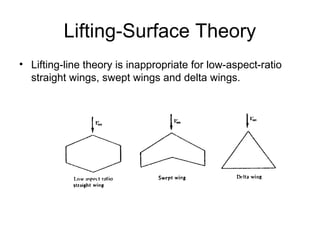
Lifting-Surface Theory
• Lifting-line theory is inappropriate for low-aspect-ratio
straight wings, swept wings and delta wings.
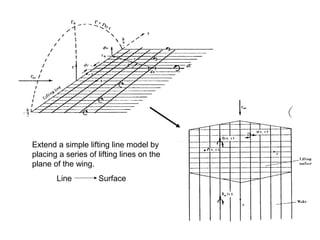
Extend a simple lifting line model by
placing a series of lifting lines on the
plane of the wing.
Line Surface
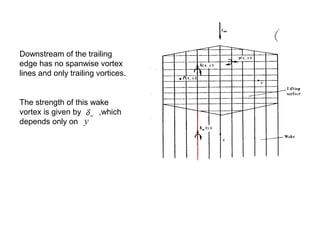
Downstream of the trailing
edge has no spanwise vortex
lines and only trailing vortices.
The strength of this wake
vortex is given by ,which
depends only on
wδ
y
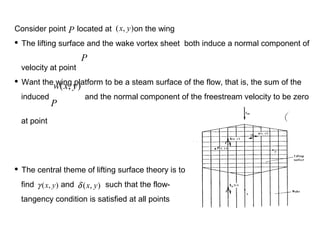
Consider point located at on the wing
 The lifting surface and the wake vortex sheet both induce a normal component of
velocity at point
 Want the wing platform to be a steam surface of the flow, that is, the sum of the
induced and the normal component of the freestream velocity to be zero
at point
P ),( yx
P
),( yxw
P
),( yxγ
 The central theme of lifting surface theory is to
find and such that the flow-
tangency condition is satisfied at all points
),( yxδ
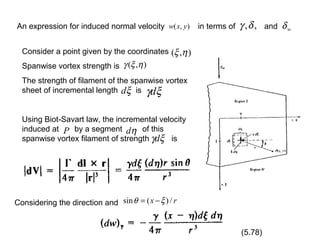
An expression for induced normal velocity in terms of and),( yxw ,,δγ wδ
Consider a point given by the coordinates
Spanwise vortex strength is
The strength of filament of the spanwise vortex
sheet of incremental length is
Using Biot-Savart law, the incremental velocity
induced at by a segment of this
spanwise vortex filament of strength is
),( ηξ
),( ηξγ
ξd ξγd
P ηd
ξγd
Considering the direction and rx /)(sin ξθ −=
(5.78)
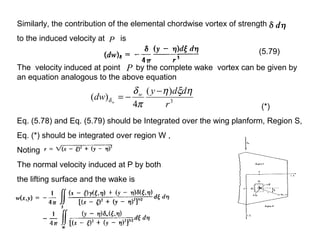
Similarly, the contribution of the elemental chordwise vortex of strength
to the induced velocity at is
The velocity induced at point by the complete wake vortex can be given by
an equation analogous to the above equation
Eq. (5.78) and Eq. (5.79) should be Integrated over the wing planform, Region S,
Eq. (*) should be integrated over region W ,
Noting
The normal velocity induced at P by both
the lifting surface and the wake is
P
P
(5.79)
3
)(
4
)(
r
ddy
dw w
w
ηξη
π
δ
δ
−
−=
(*)
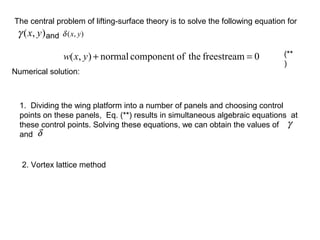
The central problem of lifting-surface theory is to solve the following equation for
and
0freestreamtheofcomponentnormal),( =+yxw
),( yxγ ),( yxδ
1. Dividing the wing platform into a number of panels and choosing control
points on these panels, Eq. (**) results in simultaneous algebraic equations at
these control points. Solving these equations, we can obtain the values of
and
(**
)
γ
δ
Numerical solution:
2. Vortex lattice method
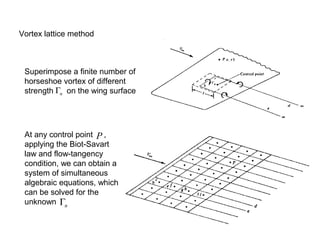
Vortex lattice method
Superimpose a finite number of
horseshoe vortex of different
strength on the wing surfacenΓ
At any control point ,
applying the Biot-Savart
law and flow-tangency
condition, we can obtain a
system of simultaneous
algebraic equations, which
can be solved for the
unknown
P
nΓ
Chapter 6
Three-Dimensional Incompressible
Flow
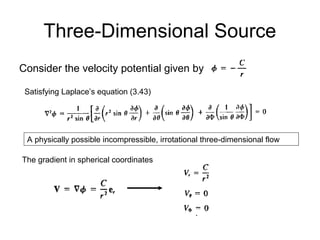
Three-Dimensional Source
Consider the velocity potential given by
Satisfying Laplace’s equation (3.43)
A physically possible incompressible, irrotational three-dimensional flow
The gradient in spherical coordinates
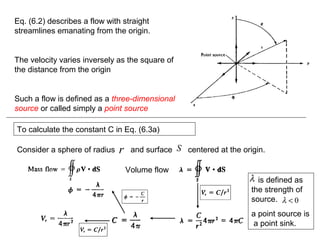
Eq. (6.2) describes a flow with straight
streamlines emanating from the origin.
The velocity varies inversely as the square of
the distance from the origin
Such a flow is defined as a three-dimensional
source or called simply a point source
To calculate the constant C in Eq. (6.3a)
Consider a sphere of radius and surface centered at the origin.r S
Volume flow
is defined as
the strength of
source.
a point source is
a point sink.
λ
0<λ
Three-Dimensional Doublet
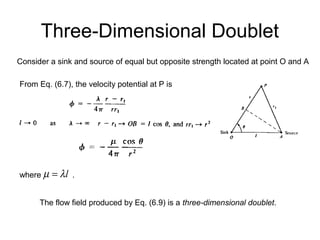
Consider a sink and source of equal but opposite strength located at point O and A
From Eq. (6.7), the velocity potential at P is
where .lλµ =
The flow field produced by Eq. (6.9) is a three-dimensional doublet.
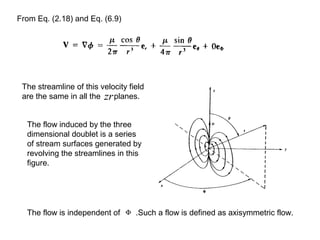
From Eq. (2.18) and Eq. (6.9)
The streamline of this velocity field
are the same in all the planes.zr
The flow induced by the three
dimensional doublet is a series
of stream surfaces generated by
revolving the streamlines in this
figure.
The flow is independent of .Such a flow is defined as axisymmetric flow.Φ
Flow over a Sphere
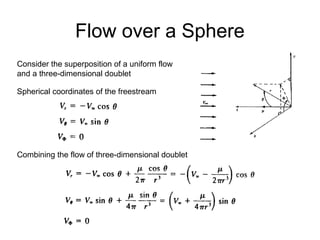
Consider the superposition of a uniform flow
and a three-dimensional doublet
Spherical coordinates of the freestream
Combining the flow of three-dimensional doublet
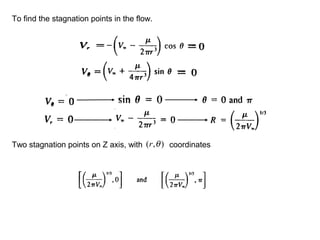
To find the stagnation points in the flow.
Two stagnation points on Z axis, with coordinates),( θr
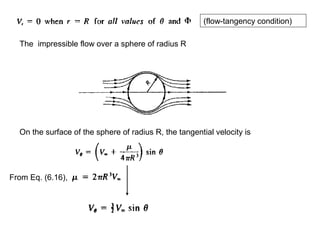
The impressible flow over a sphere of radius R
(flow-tangency condition)
On the surface of the sphere of radius R, the tangential velocity is
From Eq. (6.16),
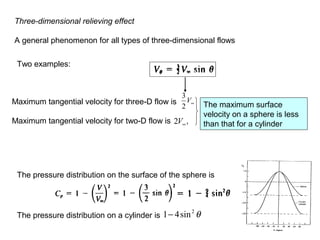
Maximum tangential velocity for three-D flow is
Maximum tangential velocity for two-D flow is ,∞V2
∞V
2
3
The maximum surface
velocity on a sphere is less
than that for a cylinder
Three-dimensional relieving effect
A general phenomenon for all types of three-dimensional flows
Two examples:
The pressure distribution on the surface of the sphere is
The pressure distribution on a cylinder is θ2
sin41−
Comments on Three-Dimensional Relieving Effect
Physical reason for the three-dimensional relieving effect
• First, visualize the two-dimensional flow over a circular cylinder. In
order to move out of the way of the cylinder, the flow has only two
ways to go: riding up-and-over and down-and-under the cylinder.
• In contrast, visualize the three-dimensional flow over a sphere. In
addition to moving up-and over and down-and-under the sphere, the
flow can now move sideways, to the left and right over the sphere.
• The sidewise movement relieves the previous constraint on the flow.
General Three-Dimensional Flows
Panel Techniques
• Calculate the three-D flow by means of numerical panel
techniques.
• General idea behind all such panel programs:
– Cover the three-dimensional body with panels
– Unknown distributions are solved through a system of
simultaneous linear algebraic equations generated by
calculating the induced velocity and applying the flow-tangency
condition
– Consider the source and vortex panels
• Geometric complexity of distributing panels
– How to get the computer to see the precise shape?
– How to distribute the panels over the body?
– How many panels do you use? And so on……….
Thank you

K12020 VARUN RAC PPT

  • 1.
    c CAREER POINT UNIVE MAJORASSIGNMENT Three-dimensional flow down strem of axial flow fans
  • 2.
    Outline • Lifting-surface theory •Vortex lattice numerical method • Three-dimensional source • Three-dimensional doublet • Flow over a sphere • General three-dimensional flows: panel techniques Chapter 5
  • 3.
    Lifting-Surface Theory • Lifting-linetheory is inappropriate for low-aspect-ratio straight wings, swept wings and delta wings.
  • 4.
    Extend a simplelifting line model by placing a series of lifting lines on the plane of the wing. Line Surface
  • 5.
    Downstream of thetrailing edge has no spanwise vortex lines and only trailing vortices. The strength of this wake vortex is given by ,which depends only on wδ y
  • 6.
    Consider point locatedat on the wing  The lifting surface and the wake vortex sheet both induce a normal component of velocity at point  Want the wing platform to be a steam surface of the flow, that is, the sum of the induced and the normal component of the freestream velocity to be zero at point P ),( yx P ),( yxw P ),( yxγ  The central theme of lifting surface theory is to find and such that the flow- tangency condition is satisfied at all points ),( yxδ
  • 7.
    An expression forinduced normal velocity in terms of and),( yxw ,,δγ wδ Consider a point given by the coordinates Spanwise vortex strength is The strength of filament of the spanwise vortex sheet of incremental length is Using Biot-Savart law, the incremental velocity induced at by a segment of this spanwise vortex filament of strength is ),( ηξ ),( ηξγ ξd ξγd P ηd ξγd Considering the direction and rx /)(sin ξθ −= (5.78)
  • 8.
    Similarly, the contributionof the elemental chordwise vortex of strength to the induced velocity at is The velocity induced at point by the complete wake vortex can be given by an equation analogous to the above equation Eq. (5.78) and Eq. (5.79) should be Integrated over the wing planform, Region S, Eq. (*) should be integrated over region W , Noting The normal velocity induced at P by both the lifting surface and the wake is P P (5.79) 3 )( 4 )( r ddy dw w w ηξη π δ δ − −= (*)
  • 9.
    The central problemof lifting-surface theory is to solve the following equation for and 0freestreamtheofcomponentnormal),( =+yxw ),( yxγ ),( yxδ 1. Dividing the wing platform into a number of panels and choosing control points on these panels, Eq. (**) results in simultaneous algebraic equations at these control points. Solving these equations, we can obtain the values of and (** ) γ δ Numerical solution: 2. Vortex lattice method
  • 10.
    Vortex lattice method Superimposea finite number of horseshoe vortex of different strength on the wing surfacenΓ At any control point , applying the Biot-Savart law and flow-tangency condition, we can obtain a system of simultaneous algebraic equations, which can be solved for the unknown P nΓ
  • 11.
  • 12.
    Three-Dimensional Source Consider thevelocity potential given by Satisfying Laplace’s equation (3.43) A physically possible incompressible, irrotational three-dimensional flow The gradient in spherical coordinates
  • 13.
    Eq. (6.2) describesa flow with straight streamlines emanating from the origin. The velocity varies inversely as the square of the distance from the origin Such a flow is defined as a three-dimensional source or called simply a point source To calculate the constant C in Eq. (6.3a) Consider a sphere of radius and surface centered at the origin.r S Volume flow is defined as the strength of source. a point source is a point sink. λ 0<λ
  • 14.
    Three-Dimensional Doublet Consider asink and source of equal but opposite strength located at point O and A From Eq. (6.7), the velocity potential at P is where .lλµ = The flow field produced by Eq. (6.9) is a three-dimensional doublet.
  • 15.
    From Eq. (2.18)and Eq. (6.9) The streamline of this velocity field are the same in all the planes.zr The flow induced by the three dimensional doublet is a series of stream surfaces generated by revolving the streamlines in this figure. The flow is independent of .Such a flow is defined as axisymmetric flow.Φ
  • 16.
    Flow over aSphere Consider the superposition of a uniform flow and a three-dimensional doublet Spherical coordinates of the freestream Combining the flow of three-dimensional doublet
  • 17.
    To find thestagnation points in the flow. Two stagnation points on Z axis, with coordinates),( θr
  • 18.
    The impressible flowover a sphere of radius R (flow-tangency condition) On the surface of the sphere of radius R, the tangential velocity is From Eq. (6.16),
  • 19.
    Maximum tangential velocityfor three-D flow is Maximum tangential velocity for two-D flow is ,∞V2 ∞V 2 3 The maximum surface velocity on a sphere is less than that for a cylinder Three-dimensional relieving effect A general phenomenon for all types of three-dimensional flows Two examples: The pressure distribution on the surface of the sphere is The pressure distribution on a cylinder is θ2 sin41−
  • 20.
    Comments on Three-DimensionalRelieving Effect Physical reason for the three-dimensional relieving effect • First, visualize the two-dimensional flow over a circular cylinder. In order to move out of the way of the cylinder, the flow has only two ways to go: riding up-and-over and down-and-under the cylinder. • In contrast, visualize the three-dimensional flow over a sphere. In addition to moving up-and over and down-and-under the sphere, the flow can now move sideways, to the left and right over the sphere. • The sidewise movement relieves the previous constraint on the flow.
  • 21.
    General Three-Dimensional Flows PanelTechniques • Calculate the three-D flow by means of numerical panel techniques. • General idea behind all such panel programs: – Cover the three-dimensional body with panels – Unknown distributions are solved through a system of simultaneous linear algebraic equations generated by calculating the induced velocity and applying the flow-tangency condition – Consider the source and vortex panels • Geometric complexity of distributing panels – How to get the computer to see the precise shape? – How to distribute the panels over the body? – How many panels do you use? And so on……….
  • 22.