Swipe
k-nearest neighbor
Algorithm
k-nearest neighbor
KNN stands for K Nearest Neighbor and is one of the
most basic machine learning algorithms. The number
K in KNN stands for the number of nearest
neighbours we utilised to categorise fresh data
points.
Ease to interpret output.
Calculation time.
Predictive Power.
KNN can be used for both classification and
regression predictive problems. However, it is more
widely used in classification problems in the industry.
To evaluate any technique we generally look at 3
important aspects:
k-nearest neighbor Algorithm
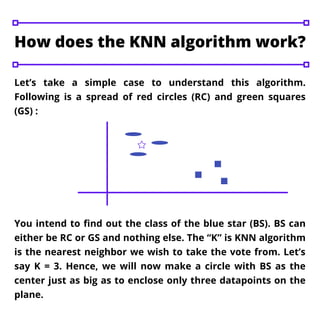
Let’s take a simple case to understand this algorithm.
Following is a spread of red circles (RC) and green squares
(GS) :
How does the KNN algorithm work?
You intend to find out the class of the blue star (BS). BS can
either be RC or GS and nothing else. The “K” is KNN algorithm
is the nearest neighbor we wish to take the vote from. Let’s
say K = 3. Hence, we will now make a circle with BS as the
center just as big as to enclose only three datapoints on the
plane.
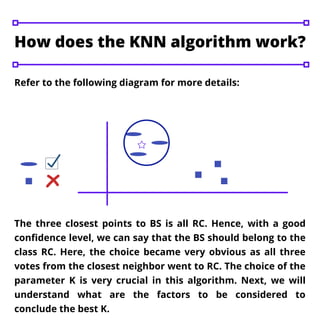
Refer to the following diagram for more details:
How does the KNN algorithm work?
The three closest points to BS is all RC. Hence, with a good
confidence level, we can say that the BS should belong to the
class RC. Here, the choice became very obvious as all three
votes from the closest neighbor went to RC. The choice of the
parameter K is very crucial in this algorithm. Next, we will
understand what are the factors to be considered to
conclude the best K.
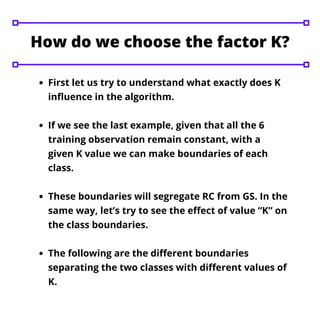
First let us try to understand what exactly does K
influence in the algorithm.
If we see the last example, given that all the 6
training observation remain constant, with a
given K value we can make boundaries of each
class.
These boundaries will segregate RC from GS. In the
same way, let’s try to see the effect of value “K” on
the class boundaries.
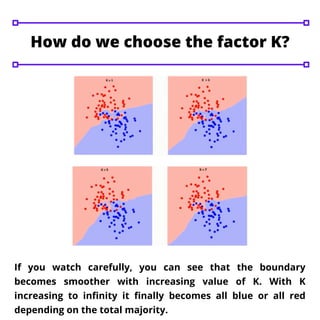
The following are the different boundaries
separating the two classes with different values of
K.
How do we choose the factor K?
If you watch carefully, you can see that the boundary
becomes smoother with increasing value of K. With K
increasing to infinity it finally becomes all blue or all red
depending on the total majority.
Implementation of kNN in R
Step 1: Importing the data
Step 2: Checking the data and calculating the data
summary
Step 3: Splitting the Data
Step 4: Calculating the Euclidean Distance
Step 5: Writing the function to predict kNN
Step 6: Calculating the label(Name) for K=1
Topics for next Post
Neural Networks
Similarity learning
Stay Tuned with

K nearest neighbor algorithm

  • 1.
  • 2.
    k-nearest neighbor KNN standsfor K Nearest Neighbor and is one of the most basic machine learning algorithms. The number K in KNN stands for the number of nearest neighbours we utilised to categorise fresh data points.
  • 3.
    Ease to interpretoutput. Calculation time. Predictive Power. KNN can be used for both classification and regression predictive problems. However, it is more widely used in classification problems in the industry. To evaluate any technique we generally look at 3 important aspects: k-nearest neighbor Algorithm
  • 4.
    Let’s take asimple case to understand this algorithm. Following is a spread of red circles (RC) and green squares (GS) : How does the KNN algorithm work? You intend to find out the class of the blue star (BS). BS can either be RC or GS and nothing else. The “K” is KNN algorithm is the nearest neighbor we wish to take the vote from. Let’s say K = 3. Hence, we will now make a circle with BS as the center just as big as to enclose only three datapoints on the plane.
  • 5.
    Refer to thefollowing diagram for more details: How does the KNN algorithm work? The three closest points to BS is all RC. Hence, with a good confidence level, we can say that the BS should belong to the class RC. Here, the choice became very obvious as all three votes from the closest neighbor went to RC. The choice of the parameter K is very crucial in this algorithm. Next, we will understand what are the factors to be considered to conclude the best K.
  • 6.
    First let ustry to understand what exactly does K influence in the algorithm. If we see the last example, given that all the 6 training observation remain constant, with a given K value we can make boundaries of each class. These boundaries will segregate RC from GS. In the same way, let’s try to see the effect of value “K” on the class boundaries. The following are the different boundaries separating the two classes with different values of K. How do we choose the factor K?
  • 7.
    How do wechoose the factor K? If you watch carefully, you can see that the boundary becomes smoother with increasing value of K. With K increasing to infinity it finally becomes all blue or all red depending on the total majority.
  • 8.
    Implementation of kNNin R Step 1: Importing the data Step 2: Checking the data and calculating the data summary Step 3: Splitting the Data Step 4: Calculating the Euclidean Distance Step 5: Writing the function to predict kNN Step 6: Calculating the label(Name) for K=1
  • 9.
    Topics for nextPost Neural Networks Similarity learning Stay Tuned with