
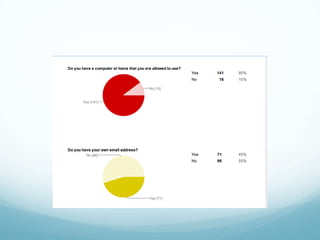
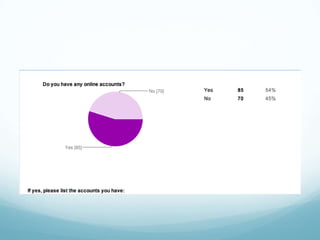
Planning Minilessons
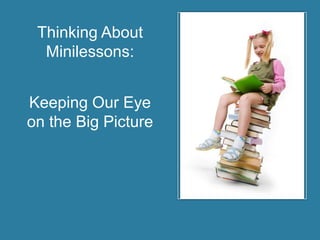
Thinking About
  Minilessons:


Keeping Our Eye
on the Big Picture
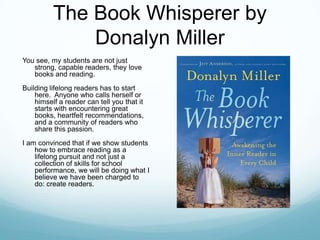
The Book Whisperer by
              Donalyn Miller
You see, my students are not just
   strong, capable readers, they love
   books and reading.
Building lifelong readers has to start
    here. Anyone who calls herself or
    himself a reader can tell you that it
    starts with encountering great
    books, heartfelt recommendations,
    and a community of readers who
    share this passion.
I am convinced that if we show students
    how to embrace reading as a
    lifelong pursuit and not just a
    collection of skills for school
    performance, we will be doing what I
    believe we have been charged to
    do: create readers.
Ohio Content Standards
 Phonemic Awareness, Word Recognition and Fluency
  Standard
 Acquisition of Vocabulary Standard
 Reading Process: Concepts of Print, Comprehension
  Strategies and Self-Monitoring Strategies Standard
 Reading Applications: Informational, Technical and
  Persuasive Text Standard
 Reading Applications: Literary Text Standard
Minilesson Cycles Can Be

 Strategies—comprehension, word work
 Behaviors and Habits—book choice, stamina
 Literary Elements—character, theme
 Genre—nonfiction, mystery, historical fiction
 Management
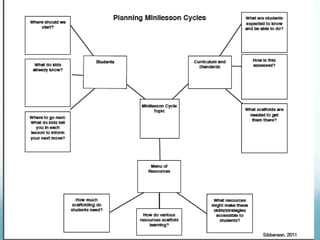
Big Questions for Planning
 Why do we teach this? How does it fit into the bigger
  picture?

 What are the big goals I have?
 Which books might I use?
 How will I provide for students to enter at own level?
 What will I be assessing? Does assessment match the
  big picture goals?
"If you only do something
 for one reason, don't do
 it.”
 Samantha Bennett, author That Workshop Book
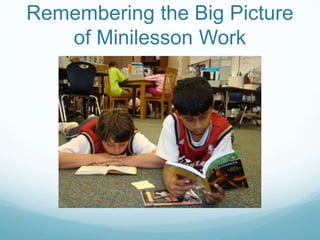
Remembering the Big Picture
   of Minilesson Work
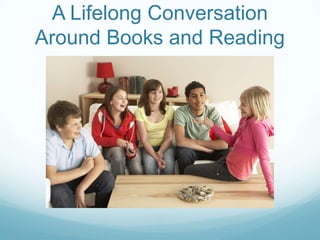
A Lifelong Conversation
Around Books and Reading
 "Learning is not about one great lesson or one great
  activity teachers design for students to do. It is about
  the little things teachers ask students to do every day
  like, read, write, and talk that add up to the big things
  like meaning from text and adding meaning and
  purpose to life,”


   Samantha Bennett, THAT WORKSHOP BOOK
Building an identity means coming to
see in ourselves the characteristics of
particular categories (and roles) of
people and developing a sense of
what it feels like to be that sort of
person and belong in certain social
spaces.
Choice Words, Peter Johnston
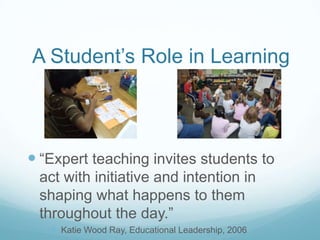
A Student’s Role in Learning


 “Expert teaching invites students to
 act with initiative and intention in
 shaping what happens to them
 throughout the day.”
    Katie Wood Ray, Educational Leadership, 2006
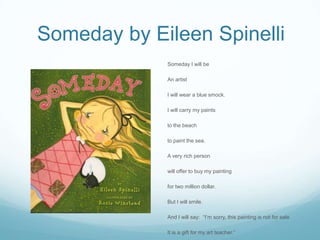
Someday by Eileen Spinelli
             Someday I will be

             An artist

             I will wear a blue smock.

             I will carry my paints

             to the beach

             to paint the sea.

             A very rich person

             will offer to buy my painting

             for two million dollar.

             But I will smile.

             And I will say: “I’m sorry, this painting is not for sale

             It is a gift for my art teacher.”
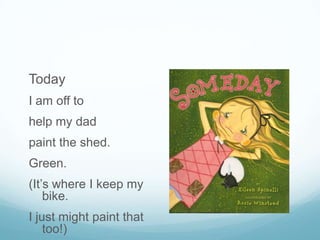
Today
I am off to
help my dad
paint the shed.
Green.
(It’s where I keep my
    bike.
I just might paint that
    too!)
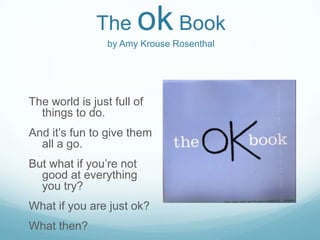
The      ok Book
                 by Amy Krouse Rosenthal


The world is just full of
  things to do.
And it’s fun to give them
  all a go.
But what if you’re not
  good at everything
  you try?
What if you are just ok?
What then?
Fiction Minilessons
What are we teaching?

 What are we assessing?

What are your beliefs about
    minilesson work?
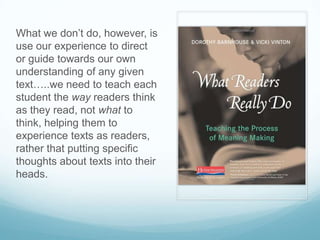
What we don’t do, however, is
use our experience to direct
or guide towards our own
understanding of any given
text…..we need to teach each
student the way readers think
as they read, not what to
think, helping them to
experience texts as readers,
rather that putting specific
thoughts about texts into their
heads.
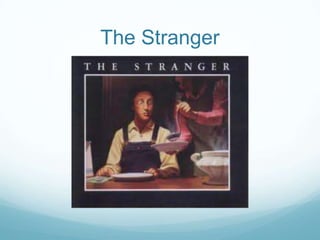
The Stranger
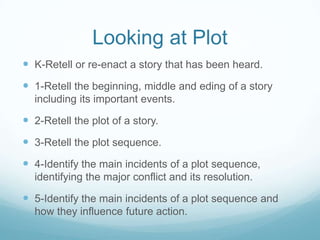
Looking at Plot
 K-Retell or re-enact a story that has been heard.
 1-Retell the beginning, middle and eding of a story
  including its important events.

 2-Retell the plot of a story.
 3-Retell the plot sequence.
 4-Identify the main incidents of a plot sequence,
  identifying the major conflict and its resolution.

 5-Identify the main incidents of a plot sequence and
  how they influence future action.
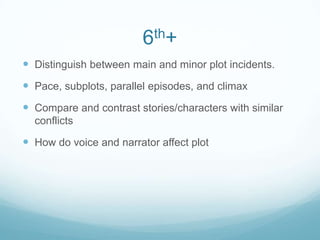
6th+
 Distinguish between main and minor plot incidents.
 Pace, subplots, parallel episodes, and climax
 Compare and contrast stories/characters with similar
  conflicts

 How do voice and narrator affect plot
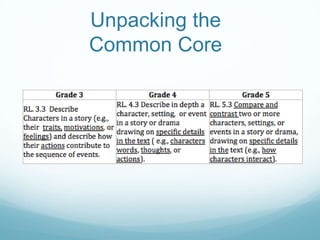
Unpacking the
Common Core
How do we create
 minilessons that
support readers of
      today?
How do we move
beyond the surface?
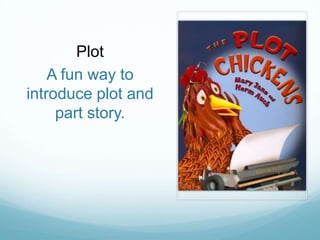
Plot
    A fun way to
introduce plot and
     part story.
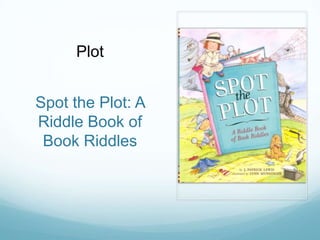
Plot


Spot the Plot: A
Riddle Book of
 Book Riddles
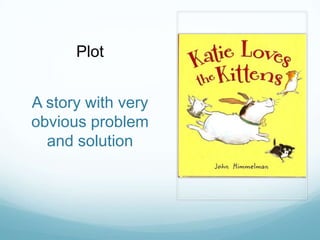
Plot


A story with very
obvious problem
  and solution
Plot

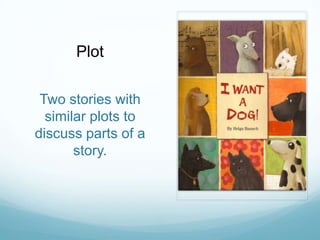
 Two stories with
  similar plots to
discuss parts of a
       story.
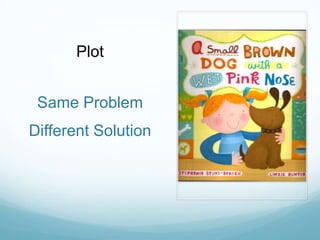
Plot


 Same Problem
Different Solution
YouTube Video Clips
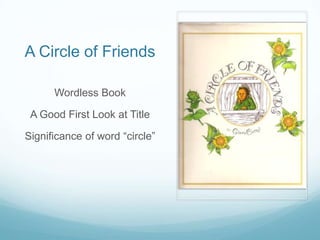
A Circle of Friends

      Wordless Book

 A Good First Look at Title

Significance of word “circle”
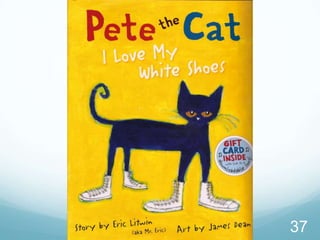
Pete the Cat


               36
37
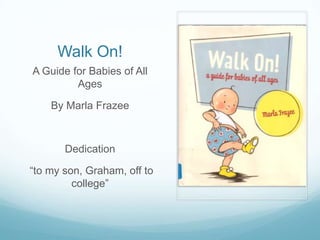
Walk On!
A Guide for Babies of All
         Ages

    By Marla Frazee


       Dedication

“to my son, Graham, off to
         college”
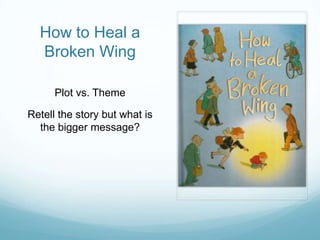
How to Heal a
  Broken Wing

      Plot vs. Theme

Retell the story but what is
  the bigger message?
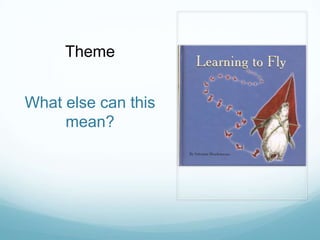
Theme


What else can this
     mean?
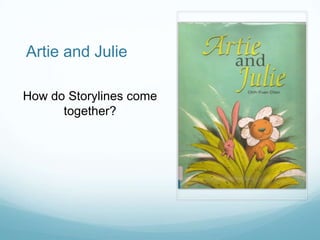
Artie and Julie

How do Storylines come
      together?
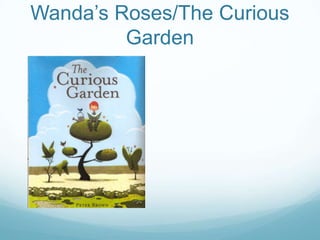
Wanda’s Roses/The Curious
         Garden
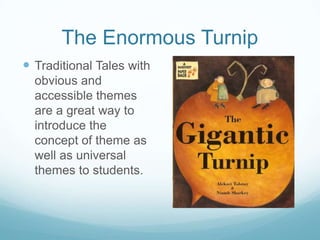
The Enormous Turnip
 Traditional Tales with
  obvious and
  accessible themes
  are a great way to
  introduce the
  concept of theme as
  well as universal
  themes to students.
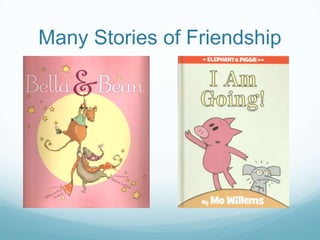
Many Stories of Friendship
Theme
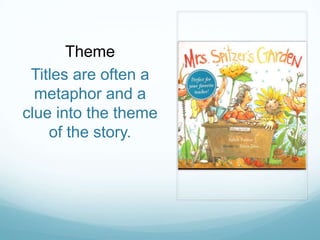
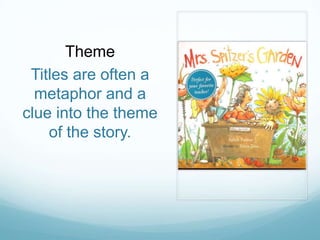
 Titles are often a
  metaphor and a
clue into the theme
    of the story.
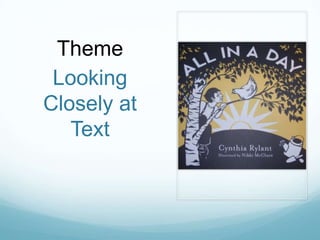
Theme
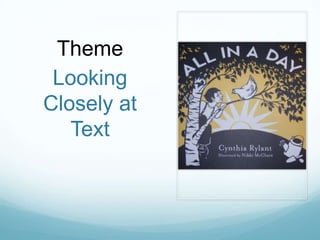
 Looking
Closely at
   Text
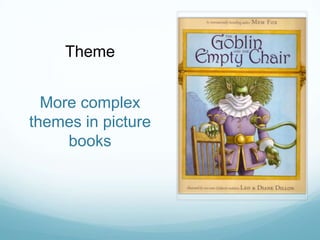
Theme


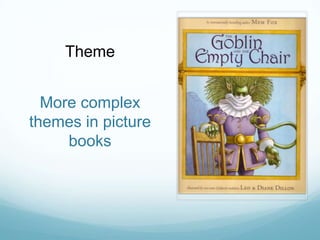
  More complex
themes in picture
     books
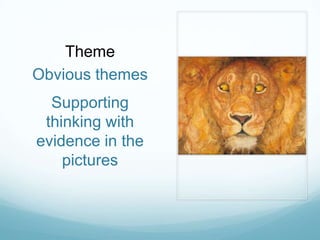
Theme
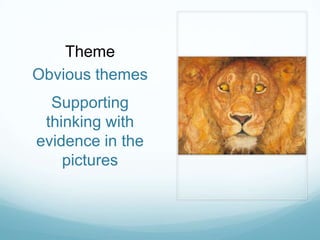
Obvious themes
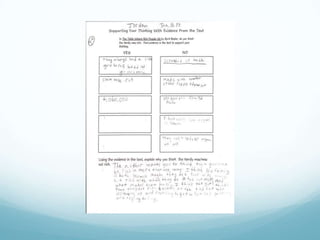
  Supporting
 thinking with
evidence in the
    pictures
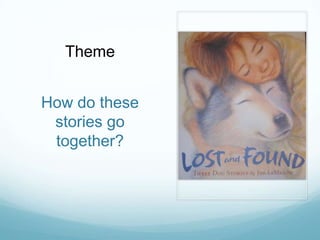
Theme


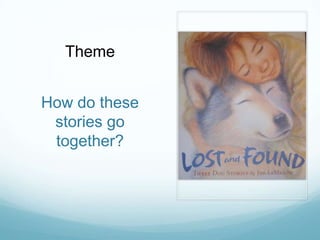
How do these
 stories go
 together?
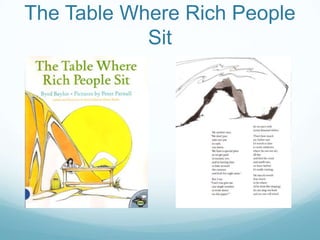
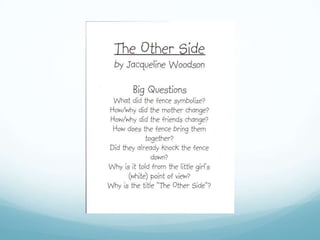
The Table Where Rich People
            Sit
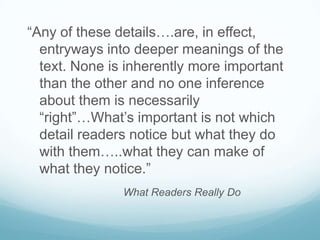
“Any of these details….are, in effect,
  entryways into deeper meanings of the
  text. None is inherently more important
  than the other and no one inference
  about them is necessarily
  “right”…What’s important is not which
  detail readers notice but what they do
  with them…..what they can make of
  what they notice.”
               What Readers Really Do
Theme
 Titles are often a
  metaphor and a
clue into the theme
    of the story.
Theme
 Looking
Closely at
   Text
Theme


  More complex
themes in picture
     books
Theme
Obvious themes
  Supporting
 thinking with
evidence in the
    pictures
Theme


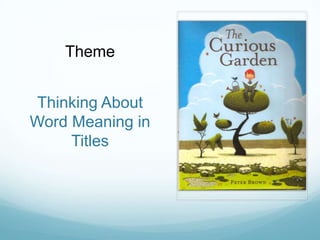
Thinking About
Word Meaning in
     Titles
Theme


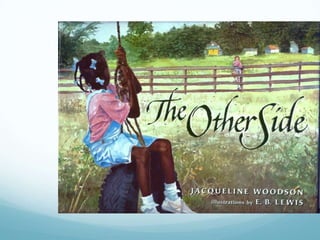
How do these
 stories go
 together?
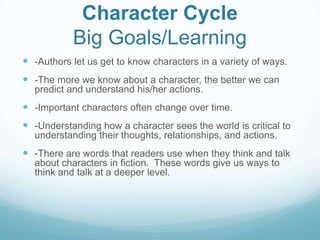
Character Cycle
           Big Goals/Learning
 -Authors let us get to know characters in a variety of ways.
 -The more we know about a character, the better we can
  predict and understand his/her actions.
 -Important characters often change over time.
 -Understanding how a character sees the world is critical to
  understanding their thoughts, relationships, and actions.
 -There are words that readers use when they think and talk
  about characters in fiction. These words give us ways to
  think and talk at a deeper level.
The Right Books
  A book that is more character-based than plot based and
  might be a good one for this cycle.
 Several books that focus on the same character/characters
 Books with 2 characters who are great friends or who are
  siblings. These often make for the best conversations about
  relationships.
 Books that include several short stories about the same
  character(s)
 Characters that the students love and talk about on their
  own.
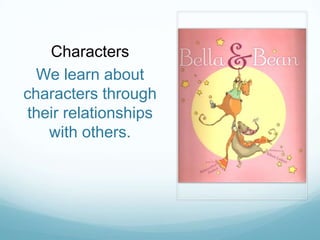
Characters
  We learn about
characters through
their relationships
   with others.
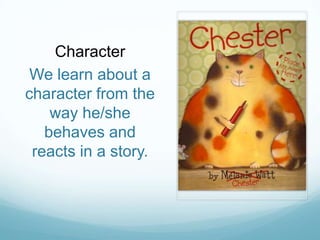
Character
 We learn about a
character from the
    way he/she
   behaves and
 reacts in a story.
Character
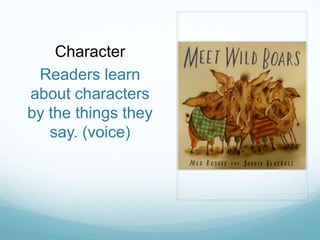
 Readers learn
about characters
by the things they
   say. (voice)
Character
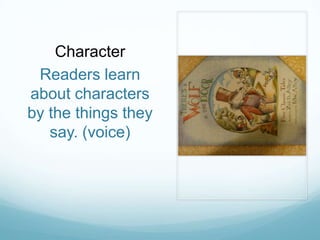
 Readers learn
about characters
by the things they
   say. (voice)
Character
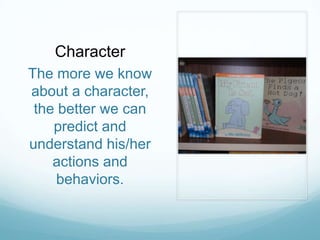
The more we know
about a character,
 the better we can
    predict and
understand his/her
    actions and
     behaviors.
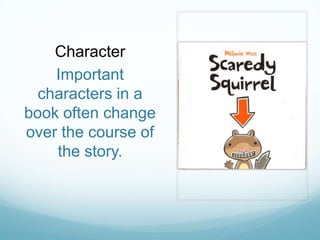
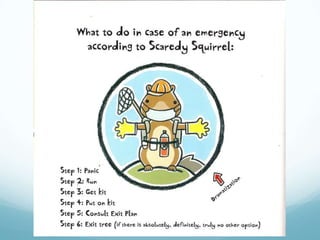
Character
    Important
  characters in a
book often change
over the course of
    the story.
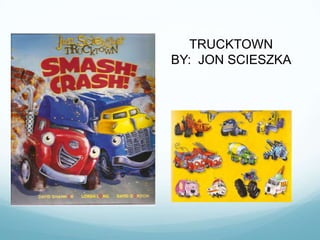
TRUCKTOWN
BY: JON SCIESZKA
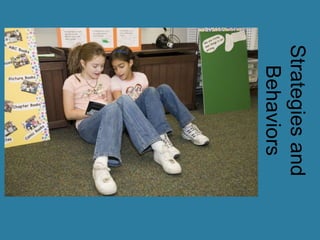
Strategies and
  Behaviors
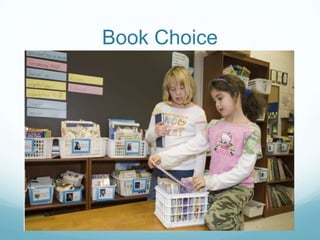
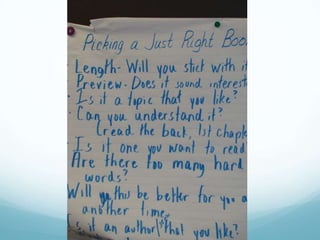
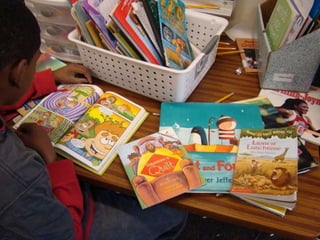
Book Choice
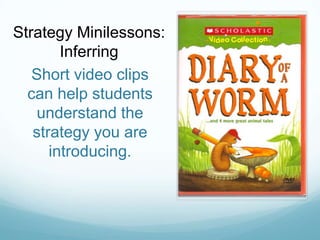
Strategy Minilessons:
        Inferring
   Short video clips
  can help students
    understand the
   strategy you are
      introducing.
How do we choose a book for reading
         comprehension and strategy work?

 We look for high-quality books about life experience. We find we
   can choose a wide range of multicultural books, because the
   themes and experiences are important and transcend culture.


 We look for high quality in both words and illustrations. We want the
   books themselves to be an aesthetic experience, with engaging
   images and poetic, interesting word choices.


 We look for story lines with a tension-one that will draw in children
   and adults, and keep the reader involved. We look for books with
   many potential entry points.

                         • Choosing New Books for Comprehension Strategy
                           Studies With Young Children by Andie Cunningham
                           and Ruth Shagoury
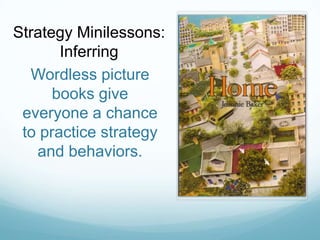
Strategy Minilessons:
       Inferring
  Wordless picture
      books give
 everyone a chance
 to practice strategy
   and behaviors.
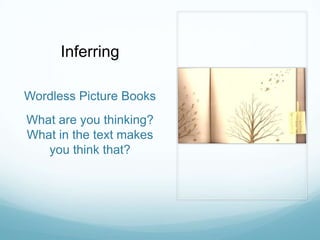
Inferring

Wordless Picture Books
What are you thinking?
What in the text makes
   you think that?
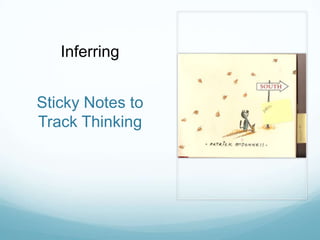
Inferring


Sticky Notes to
Track Thinking
Inferring


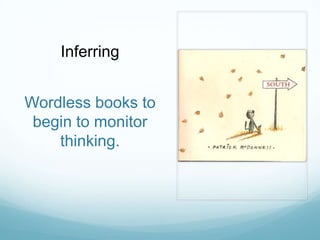
Wordless books to
 begin to monitor
    thinking.
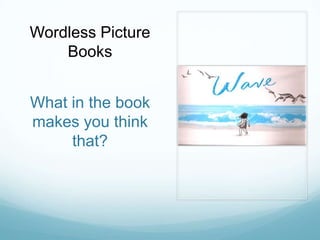
Wordless Picture
    Books


What in the book
makes you think
     that?
Inferring
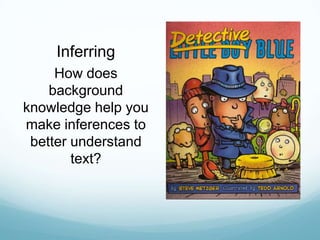
     How does
    background
knowledge help you
make inferences to
 better understand
        text?
Inferring
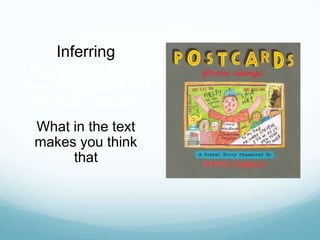
 How do you know
even though it is not
 explicitly stated?
  What in the text
  makes you think
       that
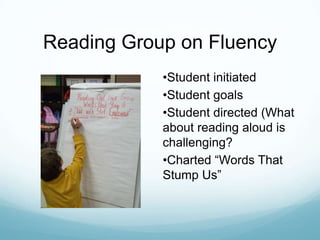
Reading Group on Fluency
            •Student initiated
            •Student goals
            •Student directed (What
            about reading aloud is
            challenging?
            •Charted “Words That
            Stump Us”
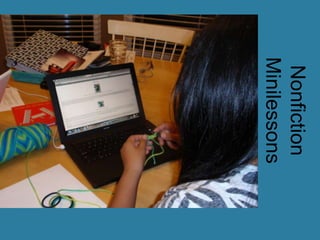
Nonfiction
Minilessons
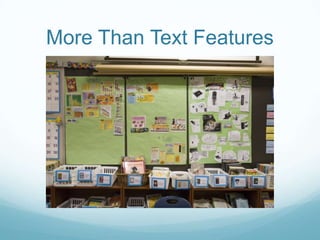
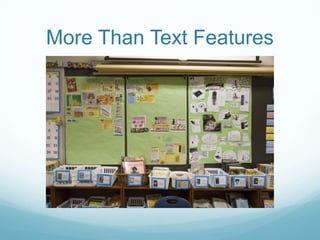
More Than Text Features
“Just get rid of the
 crappy stuff and
 focus on the
 good stuff.”
           Steve Jobs
More Than Text Features
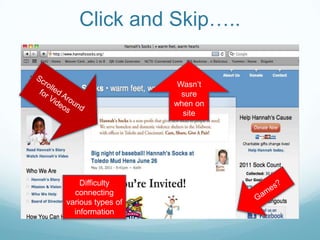
Click and Skip…..

                    Wasn’t
                     sure
                   when on
                     site


    Difficulty
  connecting
various types of
  information
Judi Morellian, #SLJ10
 "Ubiquitous information & devices give skimmers a
    false sense of comprehension."

.


 "Intellectual access is a different challenge then
    physical access. We want them to make meaning.”
 The new power of social media and networking
  technologies is perhaps the least leveraged technology
  in formal education systems today. Social networking
  technologies are powerful tools for enhancing the
  process of learning to be, of defining our identities.


       Stephen Wilmarth, "Five Socio-Technology Trends

        That Change Everything in Learning and           Teaching"
  (Curriculum 21 by Heidi Hayes Jacobs)
Questions from 4th Graders
 The words are all squished together-There are a lot of words!
 You don’t know which information to read first.
 When you are watching a video, it’s hard to concentrate on the words and
   information.

 You are looking for one thing and get distracted.
 What keeps you on the site and what doesn’t?
 How do you know which links to go to?
 Why are there little paragraphs and not big ones?
 Why are there pictures that don’t match the words?
 How do you figure out what they are saying without guessing?
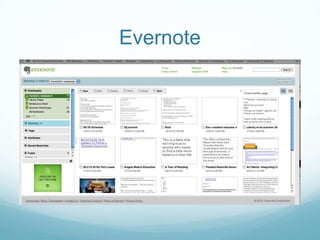
Evernote
   How does web-reading fit into the bigger picture of living life as a reader?

   What does each group/child already have in place? What can I build on?
    How do they currently approach web reading?

   How do they currently approach other nonfiction reading?

   Which needed skills cross over to other areas of reading?

   Big question—Is it right to teach web reading as a single unit of study?

   Does it stand alone?


   What was it that these kids needed right now to become better readers of nonfiction
    text? Could I do a cycle of lessons that would help them approach not only webiste
    reading differently, but all forms of nonfiction in a different way?
Questions I Asked Myself-
           Web Reading
   How does web-reading fit into the bigger picture of living life as a reader?

   What does each group/child already have in place? What can I build on?
    How do they currently approach web reading?

   How do they currently approach other nonfiction reading?

   Which needed skills cross over to other areas of reading?

   Big question—Is it right to teach web reading as a single unit of study?

   Does it stand alone?


   What was it that these kids needed right now to become better readers of nonfiction text? Could
    I do a cycle of lessons that would help them approach not only webiste reading differently, but
    all forms of nonfiction in a different way?
My Thinking-First Lessons
   Students were very interested in nonfiction topics. They are naturally curious and want to
    know interesting information.

   What concerned me

   Students were consistently making incorrect inferences when they were confused.
    Instead of digging in to find answers to their confusions, they often made things up.

   There was little connection to them between the text and the visuals. They were not
    skilled at putting information from text and images together to create information.

   Students were doing          very little cover to cover nonfiction reading

   Stamina

   When reading websites, they were eexperts at finding games and videos and unrelated
    advertisements.

   Many students immediately browsed for an activity when visiting a new site, rather than
    making sense of page

    In my professional reading on 21st Century Literacy, many experts seem to blame the
    children for the fact that they cannot read deeply but it seems to be a teaching need to
    me.
Classes Came With Different
           Things
 Building on one another’s thinking
 Track thinking on text
 Support thinking with evidence from text
 Going back into the text to talk
Nonfiction
What do our students need to know and be able to do?
-context clues for unknown words, previewing-what order will you read
it?-nonfiction can be narrative, text structure, using pictures to make
inferences, personal connections, different fonts, different types of
narrative writing, acronyms,i finding details, different sized text, some
triva-did you know? How to use the table of contents, ability to read
maps, graphs, captions, isolated information, how to read—what order?,
how to ask the right questions—Is this fiction or nonfiction? Reading a
timeline,
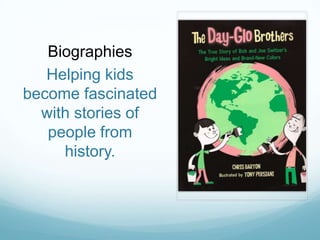
Biographies
   Helping kids
become fascinated
  with stories of
   people from
     history.
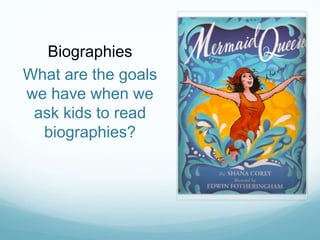
Biographies
What are the goals
we have when we
 ask kids to read
  biographies?
Nonfiction
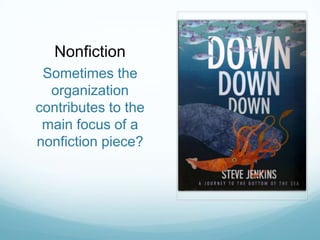
 Sometimes the
  organization
contributes to the
 main focus of a
nonfiction piece?
Nonfiction


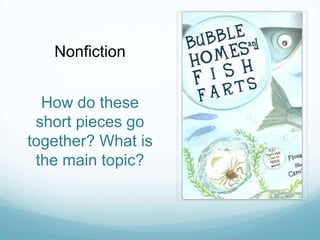
  How do these
 short pieces go
together? What is
 the main topic?
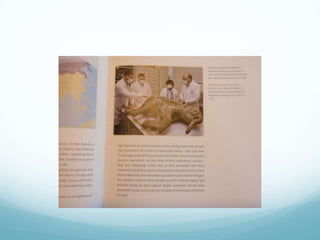
Photo Essay
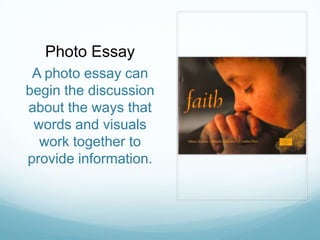
 A photo essay can
begin the discussion
about the ways that
 words and visuals
  work together to
provide information.
Nonfiction
What do our students need to know and be able to do?

Authors often provide support—lots o different features
Texts and photos support each other
Read the captions
Read the large text and think about what you know about it before you
read the small text
If the small text doesn’t make sense, how do you make it make sense?
Possibly reading a few pages at a time—linking beginning to end
Title page/acknowledgement page
Outdated/credibility
Nonfiction
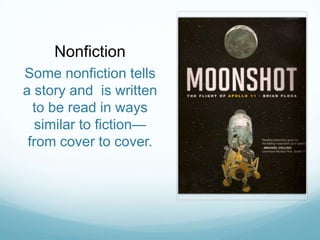
Some nonfiction tells
a story and is written
  to be read in ways
  similar to fiction—
 from cover to cover.
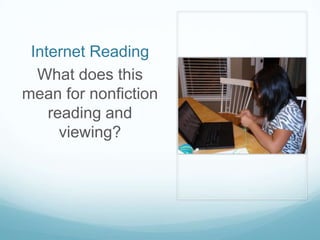
Internet Reading
  What does this
mean for nonfiction
    reading and
      viewing?
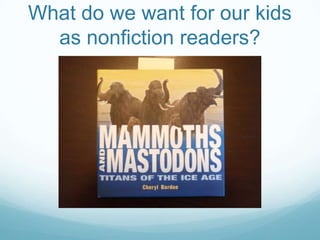
What do we want for our kids
  as nonfiction readers?
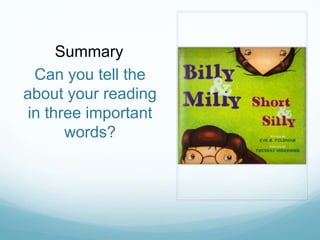
Summary
  Can you tell the
about your reading
 in three important
       words?
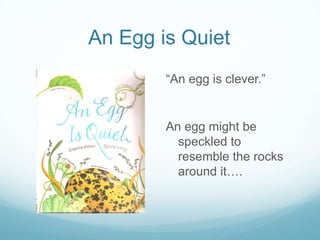
An Egg is Quiet
        “An egg is clever.”


        An egg might be
          speckled to
          resemble the rocks
          around it….
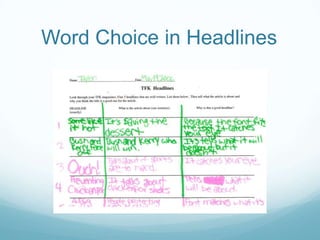
Word Choice in Headlines
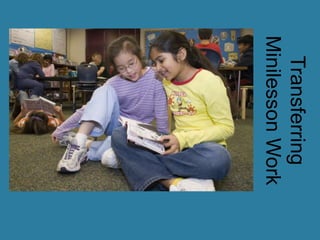
Transferring
Minilesson Work
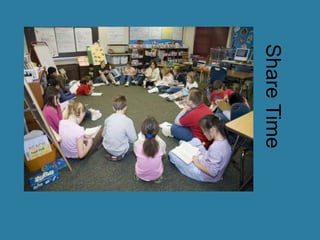
Share Timeme
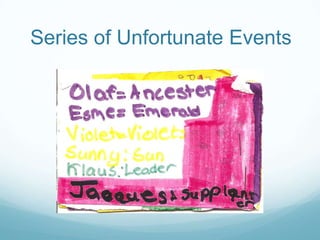
Series of Unfortunate Events
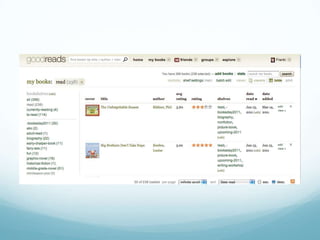
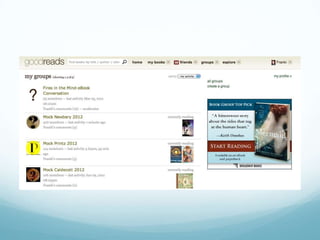
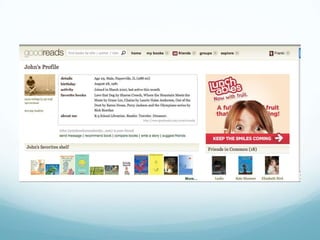
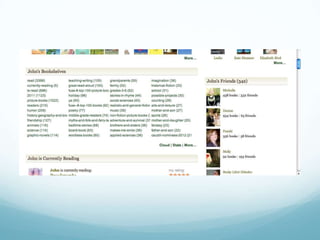
goodreads
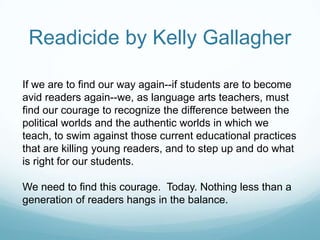
Readicide by Kelly Gallagher

If we are to find our way again--if students are to become
avid readers again--we, as language arts teachers, must
find our courage to recognize the difference between the
political worlds and the authentic worlds in which we
teach, to swim against those current educational practices
that are killing young readers, and to step up and do what
is right for our students.

We need to find this courage. Today. Nothing less than a
generation of readers hangs in the balance.

Cl Maximizing Minilessons

  • 1.
  • 3.
    Thinking About Minilessons: Keeping Our Eye on the Big Picture
  • 4.
    The Book Whispererby Donalyn Miller You see, my students are not just strong, capable readers, they love books and reading. Building lifelong readers has to start here. Anyone who calls herself or himself a reader can tell you that it starts with encountering great books, heartfelt recommendations, and a community of readers who share this passion. I am convinced that if we show students how to embrace reading as a lifelong pursuit and not just a collection of skills for school performance, we will be doing what I believe we have been charged to do: create readers.
  • 5.
    Ohio Content Standards Phonemic Awareness, Word Recognition and Fluency Standard  Acquisition of Vocabulary Standard  Reading Process: Concepts of Print, Comprehension Strategies and Self-Monitoring Strategies Standard  Reading Applications: Informational, Technical and Persuasive Text Standard  Reading Applications: Literary Text Standard
  • 6.
    Minilesson Cycles CanBe  Strategies—comprehension, word work  Behaviors and Habits—book choice, stamina  Literary Elements—character, theme  Genre—nonfiction, mystery, historical fiction  Management
  • 8.
    Big Questions forPlanning  Why do we teach this? How does it fit into the bigger picture?  What are the big goals I have?  Which books might I use?  How will I provide for students to enter at own level?  What will I be assessing? Does assessment match the big picture goals?
  • 9.
    "If you onlydo something for one reason, don't do it.” Samantha Bennett, author That Workshop Book
  • 10.
    Remembering the BigPicture of Minilesson Work
  • 12.
  • 13.
     "Learning isnot about one great lesson or one great activity teachers design for students to do. It is about the little things teachers ask students to do every day like, read, write, and talk that add up to the big things like meaning from text and adding meaning and purpose to life,”  Samantha Bennett, THAT WORKSHOP BOOK
  • 14.
    Building an identitymeans coming to see in ourselves the characteristics of particular categories (and roles) of people and developing a sense of what it feels like to be that sort of person and belong in certain social spaces. Choice Words, Peter Johnston
  • 15.
    A Student’s Rolein Learning  “Expert teaching invites students to act with initiative and intention in shaping what happens to them throughout the day.”  Katie Wood Ray, Educational Leadership, 2006
  • 16.
    Someday by EileenSpinelli Someday I will be An artist I will wear a blue smock. I will carry my paints to the beach to paint the sea. A very rich person will offer to buy my painting for two million dollar. But I will smile. And I will say: “I’m sorry, this painting is not for sale It is a gift for my art teacher.”
  • 17.
    Today I am offto help my dad paint the shed. Green. (It’s where I keep my bike. I just might paint that too!)
  • 18.
    The ok Book by Amy Krouse Rosenthal The world is just full of things to do. And it’s fun to give them all a go. But what if you’re not good at everything you try? What if you are just ok? What then?
  • 21.
  • 22.
    What are weteaching? What are we assessing? What are your beliefs about minilesson work?
  • 23.
    What we don’tdo, however, is use our experience to direct or guide towards our own understanding of any given text…..we need to teach each student the way readers think as they read, not what to think, helping them to experience texts as readers, rather that putting specific thoughts about texts into their heads.
  • 24.
  • 25.
    Looking at Plot K-Retell or re-enact a story that has been heard.  1-Retell the beginning, middle and eding of a story including its important events.  2-Retell the plot of a story.  3-Retell the plot sequence.  4-Identify the main incidents of a plot sequence, identifying the major conflict and its resolution.  5-Identify the main incidents of a plot sequence and how they influence future action.
  • 26.
    6th+  Distinguish betweenmain and minor plot incidents.  Pace, subplots, parallel episodes, and climax  Compare and contrast stories/characters with similar conflicts  How do voice and narrator affect plot
  • 27.
  • 28.
    How do wecreate minilessons that support readers of today? How do we move beyond the surface?
  • 29.
    Plot A fun way to introduce plot and part story.
  • 30.
    Plot Spot the Plot:A Riddle Book of Book Riddles
  • 31.
    Plot A story withvery obvious problem and solution
  • 32.
    Plot Two storieswith similar plots to discuss parts of a story.
  • 33.
  • 34.
  • 35.
    A Circle ofFriends Wordless Book A Good First Look at Title Significance of word “circle”
  • 36.
  • 37.
  • 38.
    Walk On! A Guidefor Babies of All Ages By Marla Frazee Dedication “to my son, Graham, off to college”
  • 39.
    How to Heala Broken Wing Plot vs. Theme Retell the story but what is the bigger message?
  • 40.
  • 41.
    Artie and Julie Howdo Storylines come together?
  • 42.
  • 43.
    The Enormous Turnip Traditional Tales with obvious and accessible themes are a great way to introduce the concept of theme as well as universal themes to students.
  • 44.
    Many Stories ofFriendship
  • 45.
    Theme Titles areoften a metaphor and a clue into the theme of the story.
  • 46.
  • 47.
    Theme Morecomplex themes in picture books
  • 48.
    Theme Obvious themes Supporting thinking with evidence in the pictures
  • 49.
    Theme How do these stories go together?
  • 50.
    The Table WhereRich People Sit
  • 54.
    “Any of thesedetails….are, in effect, entryways into deeper meanings of the text. None is inherently more important than the other and no one inference about them is necessarily “right”…What’s important is not which detail readers notice but what they do with them…..what they can make of what they notice.” What Readers Really Do
  • 63.
    Theme Titles areoften a metaphor and a clue into the theme of the story.
  • 64.
  • 65.
    Theme Morecomplex themes in picture books
  • 66.
    Theme Obvious themes Supporting thinking with evidence in the pictures
  • 67.
  • 68.
    Theme How do these stories go together?
  • 69.
    Character Cycle Big Goals/Learning  -Authors let us get to know characters in a variety of ways.  -The more we know about a character, the better we can predict and understand his/her actions.  -Important characters often change over time.  -Understanding how a character sees the world is critical to understanding their thoughts, relationships, and actions.  -There are words that readers use when they think and talk about characters in fiction. These words give us ways to think and talk at a deeper level.
  • 70.
    The Right Books A book that is more character-based than plot based and might be a good one for this cycle.  Several books that focus on the same character/characters  Books with 2 characters who are great friends or who are siblings. These often make for the best conversations about relationships.  Books that include several short stories about the same character(s)  Characters that the students love and talk about on their own.
  • 71.
    Characters Welearn about characters through their relationships with others.
  • 72.
    Character We learnabout a character from the way he/she behaves and reacts in a story.
  • 74.
    Character Readers learn aboutcharacters by the things they say. (voice)
  • 75.
    Character Readers learn aboutcharacters by the things they say. (voice)
  • 76.
    Character The more weknow about a character, the better we can predict and understand his/her actions and behaviors.
  • 77.
    Character Important characters in a book often change over the course of the story.
  • 79.
  • 80.
    Strategies and Behaviors
  • 81.
  • 84.
    Strategy Minilessons: Inferring Short video clips can help students understand the strategy you are introducing.
  • 85.
    How do wechoose a book for reading comprehension and strategy work?  We look for high-quality books about life experience. We find we can choose a wide range of multicultural books, because the themes and experiences are important and transcend culture.  We look for high quality in both words and illustrations. We want the books themselves to be an aesthetic experience, with engaging images and poetic, interesting word choices.  We look for story lines with a tension-one that will draw in children and adults, and keep the reader involved. We look for books with many potential entry points. • Choosing New Books for Comprehension Strategy Studies With Young Children by Andie Cunningham and Ruth Shagoury
  • 86.
    Strategy Minilessons: Inferring Wordless picture books give everyone a chance to practice strategy and behaviors.
  • 87.
    Inferring Wordless Picture Books Whatare you thinking? What in the text makes you think that?
  • 88.
  • 89.
    Inferring Wordless books to begin to monitor thinking.
  • 90.
    Wordless Picture Books What in the book makes you think that?
  • 91.
    Inferring How does background knowledge help you make inferences to better understand text?
  • 92.
    Inferring How doyou know even though it is not explicitly stated? What in the text makes you think that
  • 94.
    Reading Group onFluency •Student initiated •Student goals •Student directed (What about reading aloud is challenging? •Charted “Words That Stump Us”
  • 95.
  • 96.
  • 97.
    “Just get ridof the crappy stuff and focus on the good stuff.” Steve Jobs
  • 98.
  • 99.
    Click and Skip….. Wasn’t sure when on site Difficulty connecting various types of information
  • 100.
    Judi Morellian, #SLJ10 "Ubiquitous information & devices give skimmers a false sense of comprehension." .  "Intellectual access is a different challenge then physical access. We want them to make meaning.”
  • 103.
     The newpower of social media and networking technologies is perhaps the least leveraged technology in formal education systems today. Social networking technologies are powerful tools for enhancing the process of learning to be, of defining our identities. Stephen Wilmarth, "Five Socio-Technology Trends That Change Everything in Learning and Teaching" (Curriculum 21 by Heidi Hayes Jacobs)
  • 104.
    Questions from 4thGraders  The words are all squished together-There are a lot of words!  You don’t know which information to read first.  When you are watching a video, it’s hard to concentrate on the words and information.  You are looking for one thing and get distracted.  What keeps you on the site and what doesn’t?  How do you know which links to go to?  Why are there little paragraphs and not big ones?  Why are there pictures that don’t match the words?  How do you figure out what they are saying without guessing?
  • 105.
  • 106.
    How does web-reading fit into the bigger picture of living life as a reader?  What does each group/child already have in place? What can I build on? How do they currently approach web reading?  How do they currently approach other nonfiction reading?  Which needed skills cross over to other areas of reading?  Big question—Is it right to teach web reading as a single unit of study?  Does it stand alone?  What was it that these kids needed right now to become better readers of nonfiction text? Could I do a cycle of lessons that would help them approach not only webiste reading differently, but all forms of nonfiction in a different way?
  • 107.
    Questions I AskedMyself- Web Reading  How does web-reading fit into the bigger picture of living life as a reader?  What does each group/child already have in place? What can I build on? How do they currently approach web reading?  How do they currently approach other nonfiction reading?  Which needed skills cross over to other areas of reading?  Big question—Is it right to teach web reading as a single unit of study?  Does it stand alone?  What was it that these kids needed right now to become better readers of nonfiction text? Could I do a cycle of lessons that would help them approach not only webiste reading differently, but all forms of nonfiction in a different way?
  • 108.
    My Thinking-First Lessons  Students were very interested in nonfiction topics. They are naturally curious and want to know interesting information.  What concerned me  Students were consistently making incorrect inferences when they were confused. Instead of digging in to find answers to their confusions, they often made things up.  There was little connection to them between the text and the visuals. They were not skilled at putting information from text and images together to create information.  Students were doing very little cover to cover nonfiction reading  Stamina  When reading websites, they were eexperts at finding games and videos and unrelated advertisements.  Many students immediately browsed for an activity when visiting a new site, rather than making sense of page  In my professional reading on 21st Century Literacy, many experts seem to blame the children for the fact that they cannot read deeply but it seems to be a teaching need to me.
  • 109.
    Classes Came WithDifferent Things  Building on one another’s thinking  Track thinking on text  Support thinking with evidence from text  Going back into the text to talk
  • 110.
    Nonfiction What do ourstudents need to know and be able to do? -context clues for unknown words, previewing-what order will you read it?-nonfiction can be narrative, text structure, using pictures to make inferences, personal connections, different fonts, different types of narrative writing, acronyms,i finding details, different sized text, some triva-did you know? How to use the table of contents, ability to read maps, graphs, captions, isolated information, how to read—what order?, how to ask the right questions—Is this fiction or nonfiction? Reading a timeline,
  • 111.
    Biographies Helping kids become fascinated with stories of people from history.
  • 112.
    Biographies What are thegoals we have when we ask kids to read biographies?
  • 113.
    Nonfiction Sometimes the organization contributes to the main focus of a nonfiction piece?
  • 114.
    Nonfiction Howdo these short pieces go together? What is the main topic?
  • 115.
    Photo Essay Aphoto essay can begin the discussion about the ways that words and visuals work together to provide information.
  • 116.
    Nonfiction What do ourstudents need to know and be able to do? Authors often provide support—lots o different features Texts and photos support each other Read the captions Read the large text and think about what you know about it before you read the small text If the small text doesn’t make sense, how do you make it make sense? Possibly reading a few pages at a time—linking beginning to end Title page/acknowledgement page Outdated/credibility
  • 117.
    Nonfiction Some nonfiction tells astory and is written to be read in ways similar to fiction— from cover to cover.
  • 118.
    Internet Reading What does this mean for nonfiction reading and viewing?
  • 120.
    What do wewant for our kids as nonfiction readers?
  • 125.
    Summary Canyou tell the about your reading in three important words?
  • 126.
    An Egg isQuiet “An egg is clever.” An egg might be speckled to resemble the rocks around it….
  • 127.
    Word Choice inHeadlines
  • 128.
  • 129.
  • 135.
  • 140.
  • 147.
    Readicide by KellyGallagher If we are to find our way again--if students are to become avid readers again--we, as language arts teachers, must find our courage to recognize the difference between the political worlds and the authentic worlds in which we teach, to swim against those current educational practices that are killing young readers, and to step up and do what is right for our students. We need to find this courage. Today. Nothing less than a generation of readers hangs in the balance.