TEAMSTEPPS
Arthur Holly, Jr.
 The single greatest impediment to error
prevention in the medical industry is :that we
punish people for making mistakes.”
 Dr. Lucian Leape
 Professor, Harvard School of Public Health
 Testimony before Congress on Health Quality
Improvement
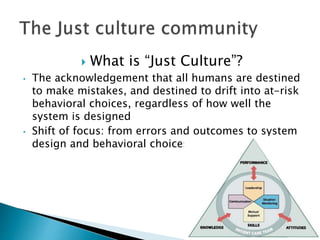
 What is “Just Culture”?
• The acknowledgement that all humans are destined
to make mistakes, and destined to drift into at-risk
behavioral choices, regardless of how well the
system is designed
• Shift of focus: from errors and outcomes to system
design and behavioral choices.
 Traditionally, health care’s culture has held individuals
accountable for all errors or mishaps that befall patients
under their care
 A just culture recognizes that individual practitioners
should not be held accountable for system failings over
which they have no control.
 A just culture also recognizes many errors represent
predictable interactions between human operators and
the systems in which they work. Recognizes that
competent professionals make mistakes.
 Acknowledges that even competent professionals will
develop unhealthy norms (shortcuts, “routine rule
violations”).
 A just culture has zero tolerance for reckless behavior.
 Create a learning culture
 Recognize risk at individual and
organizational level
 Risk is seen through events, near misses, and
observations of system design and behavioral
choices.
 Utilize FEEDBACK at an organizational level
 Debrief after team events
 Move away from overly punitive culture
 Strike a middle ground between punitive and
blame free cultures.
 Accountability
 Provide mutual support
 Utilize CUS, (concerned, uncomfortable,
safety issue)
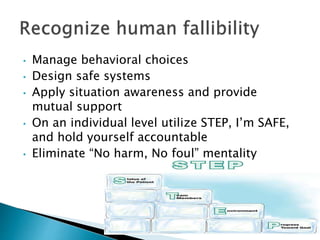
• Manage behavioral choices
• Design safe systems
• Apply situation awareness and provide
mutual support
• On an individual level utilize STEP, I’m SAFE,
and hold yourself accountable
• Eliminate “No harm, No foul” mentality
• Human error: an inadvertent action. Slip,
lapse, or mistake.
• At-Risk behavior: behavioral choice that
increases risk where risk is not recognized or
is mistakely believed to be justified.
• Reckless behavior: a behavioral choice to
consciously disregard a substantial and
unjustifiable risk
Human Error is a social label. It may be characterized as follows
Human error is a term that we use to describe our everyday behavior-
missing a turnoff on the freeway, or picking up strawberry ice cream
instead of chocolate. The threshold for labeling behavior “human
error” is very low- we make errors every day with generally minimal
consequences. In the health care profession, we make similar types of
errors- perhaps not at the frequency of those in our off-work hours,
but often with much more potential for dire consequences. We use
terms like mistake, slip and lapse to basically tell the same story-that
someone did other than what they should have done, and inadvertently
caused an undesirable outcome. When a physician prescribes the
wrong dosage, we will likely label her actions a human error. We
understand that the physician did not intend her error or its
undesirable outcome even though the consequences are potentially life
threatening.
Negligence, at least in our social dialogue, is conduct
subjectively more culpable than human error. Negligence, as a
legal term, arises from both the civil (tort) and criminal liability
systems. Negligence is the term generally used when an
individual has been harmed by the healthcare system. A basic
tenant of common law is that he who is negligent must pay for
the resulting damages. In most states, negligence is defined as
failure to exercise the skill, care, and learning expected of a
reasonably prudent health care provider. Criminal negligence,
as defined by the model penal code, involves objective
determination that a person should have been aware that they
were taking a substantial and unjustifiable risk toward causing
an undesirable outcome.
Reckless conduct, alternatively referred to as gross
negligence, involves a higher degree of culpability than
negligence. Reckless conduct in both the civil liability
and criminal systems involves conscious disregard of
risk.5 Reckless conduct differs from negligent conduct
in intent; negligence is the failure to recognize a risk
that should have been recognized, while recklessness is
a conscious disregard of a visible, significant risk.
Consider the term “reckless driving.” For most of us, it
connotes a much higher degree of culpability than mere
human error.
Most rules, procedures, and duties will require or
prohibit a specific behavior. The intentional rule
violation occurs when an individual chooses to
knowingly violate a rule while he is performing a task.
This concept is not necessarily related to risk taking,
but merely shows that an individual knew of or
intended to violate a rule, procedure, or duty in the
course of performing a task.
• Human error: Console
• AT Risk: Listen and coach – supportive
discussion with the employee on the need to
engage in safe behavioral choices.
• Reckless: Discipline – actions beyond
remedial, up to and including punitive action
or termination.
• To err is human
• To drift is human
• Risk is everywhere
• We must manage in support of our values
• We are all accountable
• Excellence
• Compassion
• Competence
• Responsibility
• Education
• Communication
• Ethics
• Teamwork
• Value
• Service
• Safety
“In many organizations, values reflect desired behavior
but are not reflected in observed behavior.”
SBAR
Situation – what is going on?
Background- what is the clinical background or
context?
Assessment- what do you think the problem is?
Recommendation-What would I do to correct it?
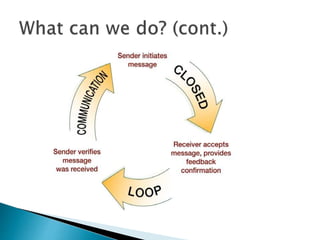
CheckBack
Close the loop as receiver accepts a message,
sender double-checks to ensure message was
received.
 Use as a safety tool
 Use to evaluate events, near misses or risky
behavior
 Use to evaluate conduct when the behavior of
the employee does not match the values of
the organization
 Use to assess system contributions and
accountability
Risk/Quality
 –Helping improve the effectiveness of the learning process
 –Providing tools to line managers
 –Helping to redesign systems
HR
 –Protecting the learning culture
 –Helping with managerial competencies
 •Consoling
 •Coaching
 •Punishing
 Takes focus off of errors and outcomes
– And puts focus on the quality of system design
and the quality behavioral choices puts it on
systems and behavioral choices
 Systematic and uniform process designed
to support practice
 A More “Just” Culture for Providers

JUST CULTURE

  • 1.
  • 2.
  • 3.
     The singlegreatest impediment to error prevention in the medical industry is :that we punish people for making mistakes.”  Dr. Lucian Leape  Professor, Harvard School of Public Health  Testimony before Congress on Health Quality Improvement
  • 4.
     What is“Just Culture”? • The acknowledgement that all humans are destined to make mistakes, and destined to drift into at-risk behavioral choices, regardless of how well the system is designed • Shift of focus: from errors and outcomes to system design and behavioral choices.
  • 5.
     Traditionally, healthcare’s culture has held individuals accountable for all errors or mishaps that befall patients under their care  A just culture recognizes that individual practitioners should not be held accountable for system failings over which they have no control.  A just culture also recognizes many errors represent predictable interactions between human operators and the systems in which they work. Recognizes that competent professionals make mistakes.  Acknowledges that even competent professionals will develop unhealthy norms (shortcuts, “routine rule violations”).  A just culture has zero tolerance for reckless behavior.
  • 6.
     Create alearning culture  Recognize risk at individual and organizational level  Risk is seen through events, near misses, and observations of system design and behavioral choices.  Utilize FEEDBACK at an organizational level  Debrief after team events
  • 7.
     Move awayfrom overly punitive culture  Strike a middle ground between punitive and blame free cultures.  Accountability  Provide mutual support  Utilize CUS, (concerned, uncomfortable, safety issue)
  • 8.
    • Manage behavioralchoices • Design safe systems • Apply situation awareness and provide mutual support • On an individual level utilize STEP, I’m SAFE, and hold yourself accountable • Eliminate “No harm, No foul” mentality
  • 9.
    • Human error:an inadvertent action. Slip, lapse, or mistake. • At-Risk behavior: behavioral choice that increases risk where risk is not recognized or is mistakely believed to be justified. • Reckless behavior: a behavioral choice to consciously disregard a substantial and unjustifiable risk
  • 10.
    Human Error isa social label. It may be characterized as follows Human error is a term that we use to describe our everyday behavior- missing a turnoff on the freeway, or picking up strawberry ice cream instead of chocolate. The threshold for labeling behavior “human error” is very low- we make errors every day with generally minimal consequences. In the health care profession, we make similar types of errors- perhaps not at the frequency of those in our off-work hours, but often with much more potential for dire consequences. We use terms like mistake, slip and lapse to basically tell the same story-that someone did other than what they should have done, and inadvertently caused an undesirable outcome. When a physician prescribes the wrong dosage, we will likely label her actions a human error. We understand that the physician did not intend her error or its undesirable outcome even though the consequences are potentially life threatening.
  • 11.
    Negligence, at leastin our social dialogue, is conduct subjectively more culpable than human error. Negligence, as a legal term, arises from both the civil (tort) and criminal liability systems. Negligence is the term generally used when an individual has been harmed by the healthcare system. A basic tenant of common law is that he who is negligent must pay for the resulting damages. In most states, negligence is defined as failure to exercise the skill, care, and learning expected of a reasonably prudent health care provider. Criminal negligence, as defined by the model penal code, involves objective determination that a person should have been aware that they were taking a substantial and unjustifiable risk toward causing an undesirable outcome.
  • 12.
    Reckless conduct, alternativelyreferred to as gross negligence, involves a higher degree of culpability than negligence. Reckless conduct in both the civil liability and criminal systems involves conscious disregard of risk.5 Reckless conduct differs from negligent conduct in intent; negligence is the failure to recognize a risk that should have been recognized, while recklessness is a conscious disregard of a visible, significant risk. Consider the term “reckless driving.” For most of us, it connotes a much higher degree of culpability than mere human error.
  • 13.
    Most rules, procedures,and duties will require or prohibit a specific behavior. The intentional rule violation occurs when an individual chooses to knowingly violate a rule while he is performing a task. This concept is not necessarily related to risk taking, but merely shows that an individual knew of or intended to violate a rule, procedure, or duty in the course of performing a task.
  • 14.
    • Human error:Console • AT Risk: Listen and coach – supportive discussion with the employee on the need to engage in safe behavioral choices. • Reckless: Discipline – actions beyond remedial, up to and including punitive action or termination.
  • 15.
    • To erris human • To drift is human • Risk is everywhere • We must manage in support of our values • We are all accountable
  • 16.
    • Excellence • Compassion •Competence • Responsibility • Education • Communication • Ethics • Teamwork • Value • Service • Safety “In many organizations, values reflect desired behavior but are not reflected in observed behavior.”
  • 17.
    SBAR Situation – whatis going on? Background- what is the clinical background or context? Assessment- what do you think the problem is? Recommendation-What would I do to correct it? CheckBack Close the loop as receiver accepts a message, sender double-checks to ensure message was received.
  • 19.
     Use asa safety tool  Use to evaluate events, near misses or risky behavior  Use to evaluate conduct when the behavior of the employee does not match the values of the organization  Use to assess system contributions and accountability
  • 20.
    Risk/Quality  –Helping improvethe effectiveness of the learning process  –Providing tools to line managers  –Helping to redesign systems HR  –Protecting the learning culture  –Helping with managerial competencies  •Consoling  •Coaching  •Punishing
  • 21.
     Takes focusoff of errors and outcomes – And puts focus on the quality of system design and the quality behavioral choices puts it on systems and behavioral choices  Systematic and uniform process designed to support practice  A More “Just” Culture for Providers