SUMMARY
 JUPITER
 ORBIT
 STRUCTURE
 MOONS
 CURIOSITIES
JUPITER
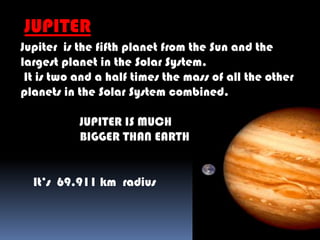
Jupiter is the fifth planet from the Sun and the
largest planet in the Solar System.
It is two and a half times the mass of all the other
planets in the Solar System combined.
JUPITER IS MUCH
BIGGER THAN EARTH
It’s 69.911 km radius
ORBIT
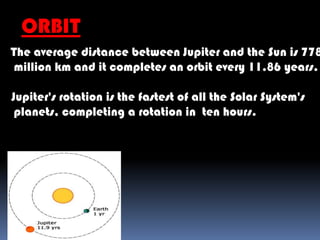
The average distance between Jupiter and the Sun is 778
million km and it completes an orbit every 11.86 years.
•Jupiter's rotation is the fastest of all the Solar System's
planets, completing a rotation in ten hours.
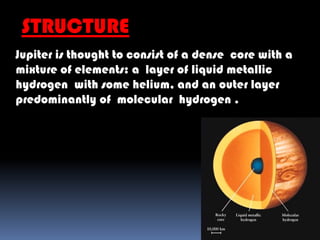
STRUCTURE
Jupiter is thought to consist of a dense core with a
mixture of elements: a layer of liquid metallic
hydrogen with some helium, and an outer layer
predominantly of molecular hydrogen .
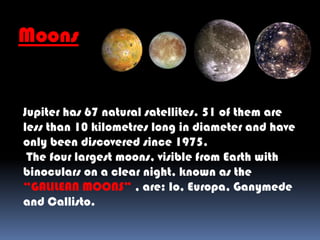
Moons
Jupiter has 67 natural satellites. 51 of them are
less than 10 kilometres long in diameter and have
only been discovered since 1975.
The four largest moons, visible from Earth with
binoculars on a clear night, known as the
“GALILEAN MOONS” , are: Io, Europa, Ganymede
and Callisto.
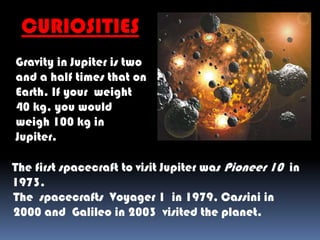
CURIOSITIES
Gravity in Jupiter is two
and a half times that on
Earth. If your weight
40 kg, you would
weigh 100 kg in
Jupiter.
The first spacecraft to visit Jupiter was Pioneer 10 in
1973.
The spacecrafts Voyager 1 in 1979, Cassini in
2000 and Galileo in 2003 visited the planet.
THE END
Realizado por los alumnos de 5º:
 Pablo Camacho Ferrer
 José Hernández Pacheco
 Lucía López Viudes
This powerpoint is carried out by:
- Lucia Lopez Viudes
- Pablo Camacho Ferrer
- Jose Hernandez Pacheco
Thank you for your attention but that concludes our presentation.

Jupiter

  • 2.
    SUMMARY  JUPITER  ORBIT STRUCTURE  MOONS  CURIOSITIES
  • 3.
    JUPITER Jupiter is thefifth planet from the Sun and the largest planet in the Solar System. It is two and a half times the mass of all the other planets in the Solar System combined. JUPITER IS MUCH BIGGER THAN EARTH It’s 69.911 km radius
  • 4.
    ORBIT The average distancebetween Jupiter and the Sun is 778 million km and it completes an orbit every 11.86 years. •Jupiter's rotation is the fastest of all the Solar System's planets, completing a rotation in ten hours.
  • 5.
    STRUCTURE Jupiter is thoughtto consist of a dense core with a mixture of elements: a layer of liquid metallic hydrogen with some helium, and an outer layer predominantly of molecular hydrogen .
  • 6.
    Moons Jupiter has 67natural satellites. 51 of them are less than 10 kilometres long in diameter and have only been discovered since 1975. The four largest moons, visible from Earth with binoculars on a clear night, known as the “GALILEAN MOONS” , are: Io, Europa, Ganymede and Callisto.
  • 7.
    CURIOSITIES Gravity in Jupiteris two and a half times that on Earth. If your weight 40 kg, you would weigh 100 kg in Jupiter. The first spacecraft to visit Jupiter was Pioneer 10 in 1973. The spacecrafts Voyager 1 in 1979, Cassini in 2000 and Galileo in 2003 visited the planet.
  • 8.
    THE END Realizado porlos alumnos de 5º:  Pablo Camacho Ferrer  José Hernández Pacheco  Lucía López Viudes This powerpoint is carried out by: - Lucia Lopez Viudes - Pablo Camacho Ferrer - Jose Hernandez Pacheco Thank you for your attention but that concludes our presentation.