TLP XP FLOW
From the TM CEM NSB team
Objectives
 A “customer-focus” when providing TL
experiences
 LCs have a standardized TLP flow
 LCs are able to individually assess what
areas they are strong in and what areas they
need to improve
 LCs capitalize on high TL satisfaction and
engagement to drive exchange goals
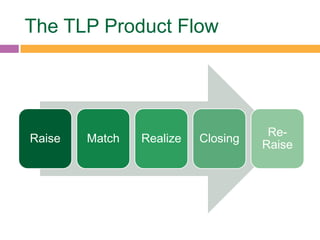
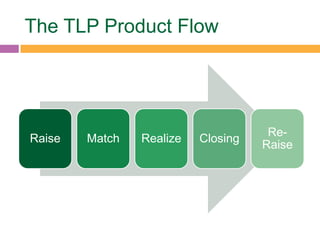
The TLP Product Flow
Raise Match Realize Closing
Re-
Raise
Why is this TLP flow Important?
 We are creating standardized experiences
so that every role is fulfilling and high quality
 Low quality EB XP  VPs who drop out
VPs who don’t meet goals
VPs who create bad team
XP
 Low quality MM XP  MM who become
disengaged
MM who don’t drive
exchange
Global Leader
TL Customer Experience Management fits
into the Global Leader Product through:
Product
Development
Organizational
Development
Participants get
hands on
experience
in developing a
product and bringing
it to the market.
Participants get
hands on
experience
in managing their
own not-for-profit.
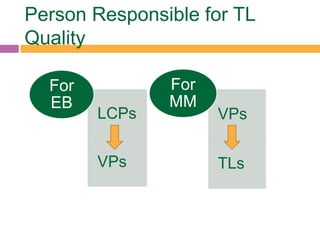
Person Responsible for TL
Quality
LCPs
VPs
For
EB
VPs
TLs
For
MM
EB XP Timeline (Year-long)
RAISIN
G
MATCHING REALIZING
CLOS
E
RE-
RAISE
-3m -2m -1m 0 1m 6m 11m 12m
MM XP Timeline (Semester-
long)
RAISIN
G
MATCHING REALIZING
CLOS
E
RE-
RAISE
-3w -2w -1w 0 2w 9w 16w 18w
•Talent Planning
•JD Creation
•Application
RAISING
Talent Planning
 TIMELINE: Before term (if possible)
 RESOURCE: LC Talent Planning Tool
 If you are a VP considering adding TLs, here
are some questions to consider
 Where could you use the extra power to drive
exchange goals?
 Are there more than 7 people underneath you?
 Do some operations need a closer eye to manage
them?
 Keep in mind that not all teams will be in a
position to require/need TLs.
JD Creation
 TIMELINE: Before term (if possible)
 RESOURCE: on podio—TM space
 Creating JDs is one of the most crucial steps
to creating a satisfying, quality role.
 Receive feedback from others to make sure
you're not delegating too much or too little.
 KPIs should reflect exchange goals that you
have created.
Application
 TIMELINE: Before term (if possible)
 To ensure the right person for the right job, it is
important to have some sort of application
process set for the role.
MATCHING
•Selection/Allocation
•Training/Transitioni
ng
•Goal Setting
•Team Formation
Selection/Allocation
 TIMELINE: EB—before term
MM—1-2nd week (or before term if
possible)
 RESOURCE: Value-Based
Selection/Allocation
 This process can range anywhere from
selection, election, etc.
Training/Transitioning
 TIMELINE: EB—before term
MM—2-3rd week (or before term if
possible)
 RESOURCE: Transition Tool
Goal Setting
 TIMELINE: EB—before term
MM—2-3rd week (or before term if
possible)
 RESOURCES: Backwards planning
Smart goals
 While the role should have KPIs from the JD
creation stage, it is important that the TL also
determines their own goals to fosters a sense
of ownership and responsibility.
Team Formation
 TIMELINE: EB—1st week (or before term if
possible)
MM—3rd week
 A TL is not a true TL unless they have a
minimum of three people underneath them.
 Therefore, before the role can be realized,
they must form a team and start building the
team dynamic through expectation setting,
reviewing team goals, and creating a team
vision or purpose.
REALIZATION
•Execution
•Midterm Analysis
•Replanning
•Driving Success
Execution
 TIMELINE: EB—1st week
MM—3rd week
 RESOURCE: Tracking Tool
 Managing the team in order to reach goals.
Midterm Analysis
 TIMELINE: EB—26th week
MM—9th week
 Midway through the role, the TL should create
a analysis report of the original KPIs, whether
or not they have been met and why.
 Can be done through one-on-one personal
development talks or a team review
 This should also be a time period for feedback
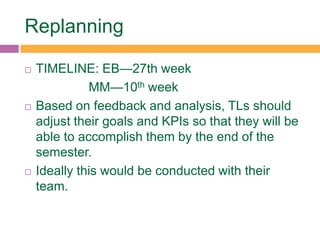
Replanning
 TIMELINE: EB—27th week
MM—10th week
 Based on feedback and analysis, TLs should
adjust their goals and KPIs so that they will be
able to accomplish them by the end of the
semester.
 Ideally this would be conducted with their
team.
Driving Success
 TIMELINE: EB—28th week
MM—11th week
 TL manages the team and inspires them to
push through to make it to the finish line and
achieve their goals.
CLOSING
•XP
Interview/Reflection
•Team Performance
Assessment
XP Interview/Reflection
 TIMELINE: EB—50th week
MM—16th week
 To end the experience, the TL should either go
through a closing interview or receive a space
to reflect.
Team Performance Assessment
 TIMELINE: EB—49th week
MM—15th week
 A review of what the team accomplished, what
challenges they had faced, and what they
think can be improved upon.
 Should be submitted to the TL's higher up and
IM to track the data and preserve information.
RE-RAISING
•Improve JD
•Re-release role
•Transition
Knowledge
Improve JD
 TIMELINE: EB—50th week
MM—16th week
 Based on feedback during the closing
interview, alter the JD to improve its design
and the experience it promises to offer.
 Promote it, along with the old TL, to the rest of
the LC.
Re-Release Role
 TIMELINE: EB—50th week
MM—16th week
 Release the role again for applications.
 Also, at this point the old TL should be
encouraged to either apply for a new TMP
experience or apply for a higher level TLP.
Transition Knowledge
 TIMELINE: EB—51th week
MM—17th week
 RESOURCE: Transition Tool
 Old TL should transition knowledge either
through one on ones or by creating a
handbook on how to perform the role and what
to expect.
FINAL REMARKS
The TLP Product Flow
Raise Match Realize Closing
Re-
Raise
Assessing the Quality of TLP
 Net Promoter Score (NPS)
 Reminder: you can only receive NPS scores if the
role is officially raised on myaiesec.net and they
fill out the survey at the end of their term
 One on ones
 Exit Interviews
QUESTIONS . . .
?
Contact Katie Crow at:
•Email: tlp.cem@aiesecus.org
•Phone: (706) 267-9481
•Book a meeting:
kcrow.youcanbook.me
Wanna know what else the team is working on?
Check out our project tracker here:
https://docs.google.com/spreadsheet/ccc?key=0ArdcKz6Io1EYdHBIN2Q4Zlk5MGY0dDRlOVRCZG9LOEE&usp=sh
aring

TLP product flow

  • 1.
    TLP XP FLOW Fromthe TM CEM NSB team
  • 2.
    Objectives  A “customer-focus”when providing TL experiences  LCs have a standardized TLP flow  LCs are able to individually assess what areas they are strong in and what areas they need to improve  LCs capitalize on high TL satisfaction and engagement to drive exchange goals
  • 3.
    The TLP ProductFlow Raise Match Realize Closing Re- Raise
  • 4.
    Why is thisTLP flow Important?  We are creating standardized experiences so that every role is fulfilling and high quality  Low quality EB XP  VPs who drop out VPs who don’t meet goals VPs who create bad team XP  Low quality MM XP  MM who become disengaged MM who don’t drive exchange
  • 5.
    Global Leader TL CustomerExperience Management fits into the Global Leader Product through: Product Development Organizational Development Participants get hands on experience in developing a product and bringing it to the market. Participants get hands on experience in managing their own not-for-profit.
  • 6.
    Person Responsible forTL Quality LCPs VPs For EB VPs TLs For MM
  • 7.
    EB XP Timeline(Year-long) RAISIN G MATCHING REALIZING CLOS E RE- RAISE -3m -2m -1m 0 1m 6m 11m 12m
  • 8.
    MM XP Timeline(Semester- long) RAISIN G MATCHING REALIZING CLOS E RE- RAISE -3w -2w -1w 0 2w 9w 16w 18w
  • 9.
  • 10.
    Talent Planning  TIMELINE:Before term (if possible)  RESOURCE: LC Talent Planning Tool  If you are a VP considering adding TLs, here are some questions to consider  Where could you use the extra power to drive exchange goals?  Are there more than 7 people underneath you?  Do some operations need a closer eye to manage them?  Keep in mind that not all teams will be in a position to require/need TLs.
  • 11.
    JD Creation  TIMELINE:Before term (if possible)  RESOURCE: on podio—TM space  Creating JDs is one of the most crucial steps to creating a satisfying, quality role.  Receive feedback from others to make sure you're not delegating too much or too little.  KPIs should reflect exchange goals that you have created.
  • 12.
    Application  TIMELINE: Beforeterm (if possible)  To ensure the right person for the right job, it is important to have some sort of application process set for the role.
  • 13.
  • 14.
    Selection/Allocation  TIMELINE: EB—beforeterm MM—1-2nd week (or before term if possible)  RESOURCE: Value-Based Selection/Allocation  This process can range anywhere from selection, election, etc.
  • 15.
    Training/Transitioning  TIMELINE: EB—beforeterm MM—2-3rd week (or before term if possible)  RESOURCE: Transition Tool
  • 16.
    Goal Setting  TIMELINE:EB—before term MM—2-3rd week (or before term if possible)  RESOURCES: Backwards planning Smart goals  While the role should have KPIs from the JD creation stage, it is important that the TL also determines their own goals to fosters a sense of ownership and responsibility.
  • 17.
    Team Formation  TIMELINE:EB—1st week (or before term if possible) MM—3rd week  A TL is not a true TL unless they have a minimum of three people underneath them.  Therefore, before the role can be realized, they must form a team and start building the team dynamic through expectation setting, reviewing team goals, and creating a team vision or purpose.
  • 18.
  • 19.
    Execution  TIMELINE: EB—1stweek MM—3rd week  RESOURCE: Tracking Tool  Managing the team in order to reach goals.
  • 20.
    Midterm Analysis  TIMELINE:EB—26th week MM—9th week  Midway through the role, the TL should create a analysis report of the original KPIs, whether or not they have been met and why.  Can be done through one-on-one personal development talks or a team review  This should also be a time period for feedback
  • 21.
    Replanning  TIMELINE: EB—27thweek MM—10th week  Based on feedback and analysis, TLs should adjust their goals and KPIs so that they will be able to accomplish them by the end of the semester.  Ideally this would be conducted with their team.
  • 22.
    Driving Success  TIMELINE:EB—28th week MM—11th week  TL manages the team and inspires them to push through to make it to the finish line and achieve their goals.
  • 23.
  • 24.
    XP Interview/Reflection  TIMELINE:EB—50th week MM—16th week  To end the experience, the TL should either go through a closing interview or receive a space to reflect.
  • 25.
    Team Performance Assessment TIMELINE: EB—49th week MM—15th week  A review of what the team accomplished, what challenges they had faced, and what they think can be improved upon.  Should be submitted to the TL's higher up and IM to track the data and preserve information.
  • 26.
  • 27.
    Improve JD  TIMELINE:EB—50th week MM—16th week  Based on feedback during the closing interview, alter the JD to improve its design and the experience it promises to offer.  Promote it, along with the old TL, to the rest of the LC.
  • 28.
    Re-Release Role  TIMELINE:EB—50th week MM—16th week  Release the role again for applications.  Also, at this point the old TL should be encouraged to either apply for a new TMP experience or apply for a higher level TLP.
  • 29.
    Transition Knowledge  TIMELINE:EB—51th week MM—17th week  RESOURCE: Transition Tool  Old TL should transition knowledge either through one on ones or by creating a handbook on how to perform the role and what to expect.
  • 30.
  • 31.
    The TLP ProductFlow Raise Match Realize Closing Re- Raise
  • 32.
    Assessing the Qualityof TLP  Net Promoter Score (NPS)  Reminder: you can only receive NPS scores if the role is officially raised on myaiesec.net and they fill out the survey at the end of their term  One on ones  Exit Interviews
  • 33.
    QUESTIONS . .. ? Contact Katie Crow at: •Email: tlp.cem@aiesecus.org •Phone: (706) 267-9481 •Book a meeting: kcrow.youcanbook.me
  • 34.
    Wanna know whatelse the team is working on? Check out our project tracker here: https://docs.google.com/spreadsheet/ccc?key=0ArdcKz6Io1EYdHBIN2Q4Zlk5MGY0dDRlOVRCZG9LOEE&usp=sh aring