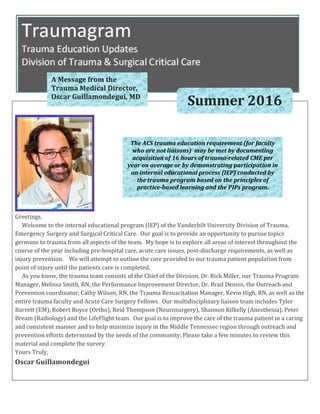
Greetings,	
					Welcome	to	the	internal	educational	program	(IEP)	of	the	Vanderbilt	University	Division	of	Trauma,	
Emergency	Surgery	and	Surgical	Critical	Care.		Our	goal	is	to	provide	an	opportunity	to	pursue	topics	
germane	to	trauma	from	all	aspects	of	the	team.		My	hope	is	to	explore	all	areas	of	interest	throughout	the	
course	of	the	year	including	pre-hospital	care,	acute	care	issues,	post-discharge	requirements,	as	well	as	
injury	prevention.				We	will	attempt	to	outline	the	care	provided	to	our	trauma	patient	population	from	
point	of	injury	until	the	patients	care	is	completed.		
					As	you	know,	the	trauma	team	consists	of	the	Chief	of	the	Division,	Dr.	Rick	Miller,	our	Trauma	Program	
Manager,	Melissa	Smith,	RN,	the	Performance	Improvement	Director,	Dr.	Brad	Dennis,	the	Outreach	and	
Prevention	coordinator,	Cathy	Wilson,	RN,	the	Trauma	Resuscitation	Manager,	Kevin	High,	RN,	as	well	as	the	
entire	trauma	faculty	and	Acute	Care	Surgery	Fellows.		Our	multidisciplinary	liaison	team	includes	Tyler	
Barrett	(EM),	Robert	Boyce	(Ortho),	Reid	Thompson	(Neurosurgery),	Shannon	Kilkelly	(Anesthesia),	Peter	
Bream	(Radiology)	and	the	LifeFlight	team.		Our	goal	is	to	improve	the	care	of	the	trauma	patient	in	a	caring	
and	consistent	manner	and	to	help	minimize	injury	in	the	Middle	Tennessee	region	through	outreach	and	
prevention	efforts	determined	by	the	needs	of	the	community.	Please	take	a	few	minutes	to	review	this	
material	and	complete	the	survey.	
Yours	Truly,	
Oscar	Guillamondegui	
The	ACS	trauma	education	requirement	(for	faculty	
who	are	not	liaisons)		may	be	met	by	documenting	
acquisition	of	16	hours	of	trauma-related	CME	per	
year	on	average	or	by	demonstrating	participation	in	
an	internal	educational	process	(IEP)	conducted	by	
the	trauma	program	based	on	the	principles	of	
practice-based	learning	and	the	PIPs	program.	
A	Message	from	the	
Trauma	Medical	Director,	
Oscar	Guillamondegui,	MD	
Summer	2016
2	 	


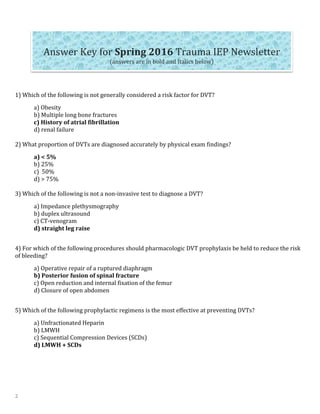
1)	Which	of	the	following	is	not	generally	considered	a	risk	factor	for	DVT?	
	 a)	Obesity	
	 b)	Multiple	long	bone	fractures	
	 c)	History	of	atrial	fibrillation	
	 d)	renal	failure	
	
2)	What	proportion	of	DVTs	are	diagnosed	accurately	by	physical	exam	findings?	
	 a)	<	5%	
	 b)	25%	
	 c)		50%	
	 d)	>	75%	
	
3)	Which	of	the	following	is	not	a	non-invasive	test	to	diagnose	a	DVT?	
	 a)	Impedance	plethysmography	
	 b)	duplex	ultrasound	
	 c)	CT-venogram	
	 d)	straight	leg	raise	
	
4)	For	which	of	the	following	procedures	should	pharmacologic	DVT	prophylaxis	be	held	to	reduce	the	risk	
of	bleeding?	
	 a)	Operative	repair	of	a	ruptured	diaphragm	
	 b)	Posterior	fusion	of	spinal	fracture		
	 c)	Open	reduction	and	internal	fixation	of	the	femur	
	 d)	Closure	of	open	abdomen	
	
5)	Which	of	the	following	prophylactic	regimens	is	the	most	effective	at	preventing	DVTs?	
	 a)	Unfractionated	Heparin	
	 b)	LMWH	
	 c)	Sequential	Compression	Devices	(SCDs)	
	 d)	LMWH	+	SCDs	
	
	
Answer	Key	for	Spring	2016	Trauma	IEP	Newsletter	
(answers	are	in	bold	and	Italics	below)
3	 	


Rich	Lesperance,	MD	 	
	
	 	
Case	Study:	A	19	year	old	male	is	arrives	at	the	trauma	center	as	a	Level	1	trauma	for	multiple	gunshot	
wounds,	approximately	one	hour	after	the	event.	In	addition	to	several	intra-abdominal	injuries,	one	projectile	
traversed	his	upper	thigh.	His	work-up	revealed	a	Superficial	Femoral	Artery	(SFA)	and	Vein	(SFV)	injury,	as	
well	as	intraabdominal	findings.	After	temporization	of	his	intra-abdominal	injuries,	he	underwent	an	
interposition	graft	repair	of	his	SFA	and	ligation	of	his	SFV.	The	operative	intervention	required	approximately	
two	hours.		In	order	to	prevent	the	occurrence	of	a	lower	extremity	compartment	syndrome	in	the	at	risk	limb,	
a	prophylactic	lower	leg	fasciotomy	was	performed.	
Introduction	
	 Extremity	compartment	syndrome	is	a	common	problem	dealt	with	by	orthopedic,	vascular	and	
trauma	surgeons,	and	failing	to	diagnose	and	treat	appropriately	can	leave	a	patient	with	severe	life-long	
disability.		When	taking	care	of	trauma	patients	we	can	encounter	“compartment	syndromes”	in	other	body	
cavities,	but	this	review	will	focus	on	acute	extremity	compartment	syndrome.		
	 Extremity	compartment	syndrome	was	first	recognized	as	a	clinical	entity	by	Richard	von	Volkmann	
in	the	late	19th	century,	identifying	tissue	ischemia	as	the	untreated	result.	The	debilitating	forearm	
contractures	from	untreated	upper	extremity	compartment	syndrome	were	named	“in	his	honor.”1	 	
	 Compartment	syndrome	of	an	extremity	is	frequently	associated	with	a	long	bone	fracture	up	to	75%	
of	the	time;	and	approximately	9%	of	all	tibial	shaft	fractures	can	be	complicated	by	compartment	
syndrome.2	Young	men	seem	to	be	at	a	higher	risk	for	developing	compartment	syndrome,	possibly	due	to	
higher	muscle	mass	in	a	non-distensible	fascial	compartment,	while	conversely	the	elderly	appear	to	have	a	
lower	risk.3	Extremity	compartment	syndrome	can	also	be	associated	with	direct	trauma	to	the	limb	in	the	
absence	of	a	fracture	(even	without	a	clinical	crush	injury),	and	this	may	be	associated	with	a	higher	
incidence	of	delay	in	treatment	and	muscle	necrosis.4	Other	causes	of	extremity	compartment	syndrome	are	
burns,	tight	casts	or	dressings,	penetrating	trauma,	and	inappropriate	positioning	in	the	operating	room	
(especially	during	lithotomy	position).2	Unusual	non-trauma	conditions	such	as	Group	A	Streptococcal	
infections	have	been	described	as	etiologies	as	well.5	
	 Vascular	injuries	can	also	cause	an	extremity	compartment	syndrome,	either	through	bleeding	into	
the	muscular	compartment	directly	or	via	edema	from	ischemia-reperfusion	syndrome.6	It	should	be	noted	
that	the	arterial	injury	does	not	need	to	be	located	in	the	compartment	at	risk;	proximal	injuries	can	
obviously	cause	ischemia	in	distal	compartments.	Combined	arterial	and	venous	injuries,	such	as	in	our	
patient,	are	at	higher	risk	than	either	alone.6	
Pathophysiology		
	 The	fascial	compartments	enclosing	major	extremity	muscle	groups	are	relatively	non-distensible,	so	
any	edema	or	inflammation	in	the	compartment	can	cause	intra-compartment	pressures	to	rise.	Ischemia	
occurs	when	compartment	pressure	exceeds	the	capillary	perfusion	pressure.		If	allowed	to	occur,	this	may	
lead	to	cellular	necrosis	promoting	inflammation	and	increased	pressures	in	a	positive-feedback	cycle.7
4	 	
Peripheral	sensory	nerves	are	the	most	sensitive	to	ischemia,	showing	signs	of	dysfunction	in	as	little	as	one	
hour,	but	after	four	to	six	hours	of	ischemia	permanent	nerve	and	muscle	damage	is	likely.2		
Clinical	presentation	
	 The	classical	physical	exam	findings	of	compartment	syndrome	are	pulselessness,	pain	(out	of	
proportion	to	injury),	paresthesias,	paresis	(muscle	weakness)	and	pain	with	passive	stretching	of	the	
muscle.8	Additionally,	palpation	of	the	limb	in	question	may	allow	the	practitioner	to	detect	a	“tense”	
compartment.	None	of	these	physical	exam	findings	have	been	found	to	be	very	accurate	for	diagnosis,	
however.		
	 The	presence	of	distal	pulses	does	not	exclude	compartment	syndrome.	As	mentioned	above,	the	
syndrome	exists	when	the	compartment	pressure	exceeds	the	capillary	perfusion	pressure;	distal	arterial	
flow	is	not	lost	until	the	pressure	exceeds	the	(much	higher)	systolic	BP,	which	means	significant	
compartment	syndrome	can	exist	even	without	distal	arterial	insufficiency.	
	 Manual	detection	of	“tense”	compartments	does	not	seem	to	be	very	accurate	either.	When	
orthopedic	surgeons	were	tested	on	a	fresh	cadaver	leg	model,	their	sensitivity	in	detecting	increased	
compartment	pressures	was	only	24%	with		specificity	a	little	better	at	55%,	but	presumably	half	of	the	
patients	undergoing	a	fasciotomy	did	not	actually	have	elevated	pressures.9			
		 A	systematic	review8	of	the	literature	evaluating	the	accuracy	of	clinical	findings	for	diagnosis	of	
compartment	syndrome	found	that	the	classical	signs	of	pain,	paresthesia,	pain	with	passive	stretch	and	
paresis	were	not	very	sensitive	(13-19%)	individually,	but	the	presence	of	two	or	more	of	the	signs	
increased	the	accuracy.	If	three	or	more	of	those	classic	signs	were	present,	the	authors	found	the	odds	of	
compartment	syndrome	being	correctly	diagnosed	rose	to	93%.	Most	of	the	studies	agreed	that	pain	is	the	
earliest	clinical	finding,	but	there	was	a	wide	variety	of	opinions	on	which	findings	were	most	significant.	
	 Pain	is	obviously	a	problematic	sign	to	rely	on	for	diagnosis.	Since	a	common	inciting	event	for	lower-
extremity	compartment	syndrome	is	a	tibial	shaft	fracture,	it	takes	an	experienced	practitioner	to	
differentiate	fracture	pain	from	that	of	compartment	syndrome.	Commonly	used	pain	control	adjuncts	such	
as	epidural	catheters	and	regional	anesthesia	may	mask	worsening	pain	from	a	developing	compartment	
syndrome,10	although	this	is	somewhat	disputed	in	the	orthopedic	literature.11	Pain	assessment	becomes	
difficult	in	the	multi-system	trauma	patient,	especially	in	ICU	settings,	with	multiple	distracting	injuries	and,	
possibly,	intubated.	However,	pain	in	an	‘uninjured’	extremity	should	raise	heavy	suspicion	if	the	limb	is	
otherwise	at	risk	(as	in	our	case	study,	above.)	
Measurement	of	Compartment	Pressures	
	 Due	to	the	difficulty	diagnosing	compartment	syndrome	clinically,	it	has	been	suggested	that	direct	
measurement	of	the	pressures	within	the	compartment	in	question	could	be	beneficial.	Different	methods	of	
measuring	pressures	have	been	described,	including	a	simple	arterial	catheter	pressure-monitoring	setup,	
side-hole	catheters,	or	a	hand-held	“Stryker”	device.	Catheters	may	be	left	in-dwelling	in	certain	
circumstances	to	allow	continuous	monitoring	of	compartment	pressures,	as	well.12	
	 Normal	compartment	pressures	are	8-15	mm	Hg.2	It	has	been	suggested	that	intra-compartment	
pressures	greater	than	30	mm	Hg	indicate	the	need	for	decompression.13	However,	as	mentioned	above,	
ischemia	results	when	the	compartment	pressure	exceeds	the	capillary	perfusion	pressure	and	higher	
systemic	blood	pressures	would	presumably	overcome	a	higher	compartment	pressure.	For	that	reason,	
other	authors	have	advocated	using	the	pressure	difference	(“Δp”)	between	the	diastolic	blood	pressure	and	
the	compartment	pressure	(capillary	perfusion	pressure	is	rather	hard	to	measure).	By	only	choosing	to	
decompress	patients	with	a	Δp	of	less	than	30	mm	Hg,	instead	of	using	an	using	the	absolute	compartment
5	 	
pressure,	one	group	found	that	they	saved	43%	of	their	patients	an	unnecessary	surgery	without	missing	
any	injuries.14	
	 It	is	difficult	to	determine	the	pressure	cutoff	for	decompression	since	there	is	no	“gold	standard”	for	
diagnosing	compartment	syndrome.	The	surgeon’s	assessment	of	whether	the	muscles	“bulged”	out	of	a	
compartment	during	fasciotomy	has	been	historically	used,	but	this	is	subjective.	If	the	syndrome	is	
properly	treated	there	are	no	sequelae,	so	there	are	no	histologic	or	laboratory	findings	to	confirm	
retrospectively.	This	may	suggest	that	compartment	syndrome	is	over-diagnosed	using	current	techniques.2	
Due	to	the	uncertainty	regarding	measurement	of	compartment	pressures,	extremity	compartment	
syndrome	remains	a	clinical	diagnosis	and	pressure	measurements	should	be	used	only	in	support.2,15	
Clinical	suspicion	should	remain	high	and	rapid	treatment	performed,	if	suspected.	
Treatment	of	Compartment	Syndrome	
	 The	treatment	of	extremity	compartment	syndrome	is	prompt	surgical	decompression	of	the	affected	
compartments.15	The	lower	leg	consists	of	4	separate	compartments	(figure),	all	of	which	will	require	
release.	This	can	be	accomplished	either	through	a	single	incision	on	the	lateral	leg,	or	a	“two-incision”	
technique	using	a	medial	incision	as	well.	General	(trauma)	and	Vascular	surgeons	tend	to	use	a	two-
incision	technique,	whereas	some	Orthopedic	surgeons	prefer	the	single-incision	technique,	which	may	miss	
the	deep	posterior	compartment	but	may	be	beneficial	for	future	fracture	repair.		As	long	as	all	four	leg	
compartments	are	appropriately	released,	however,	there	is	no	difference	in	outcomes.16,17	
	 A	delay	in	fasciotomy	increases	morbidity.	As	mentioned	above,	nerves	become	ischemic	in	
approximately	one	hour,	and	muscle	tissue	suffers	irreversible	damage	after	four	to	six	hours.	The	
compartments	should	be	decompressed	urgently	when	the	diagnosis	of	compartment	syndrome	is	made.	
Delay	in	surgical	therapy	is	associated	with	more	wound	complications,	worse	functional	outcomes,	and	
higher	rates	of	limb	loss	and	mortality.18-20	Even	with	known	deficit,	decompression	should	still	be	
performed	urgently	if	there	is	any	residual	neuromuscular	function	in	the	affected	extremity,21	although	this	
is	controversial	and	some	authors	claim	better	outcomes	if	surgery	is	not	performed	for	a	seriously	delayed	
diagnosis.22	
	 While	fasciotomy	is	necessary	to	treat	extremity	compartment	syndrome,	it	is	not	an	entirely	benign	
procedure,	even	when	done	prophylactically	before	the	onset	of	symptoms,	there	is	a	high	incidence	of	
wound	complications18,23	and	need	for	skin	grafting	for	definitive	closure.	Neurovascular	structures	can	be	
easily	injured	during	the	procedure,	the	superficial	peroneal	nerve	is	the	most	frequently	identified	injured	
structure,	occurring	in	up	to	6%	of	fasciotomies.23	In	addition,	fasciotomy	for	compartment	syndrome	has	
been	associated	with	increased	rates	of	infection	and	mal-union	of	tibial	fractures,24,25	although	presumably	
the	complications	result	from	the	compartment	syndrome	itself,	and	outcomes	would	be	worse	without	
treatment.	
Conclusion	
	 Extremity	compartment	syndrome	is	a	difficult	diagnosis	that	often	must	be	made	based	on	clinical	
prowess	in	the	at	risk	patient	population.	All	practitioners	caring	for	trauma	patients	must	be	familiar	with	
the	warning	signs.	Direct	trauma	to	the	limb	is	not	always	required	for	compartment	syndrome	to	occur;	
proximal	vascular	trauma	or	arterial	insufficiency	may	cause	the	syndrome	in	distal	extremities.	Direct	
measurement	of	compartment	pressures	is	invasive,	and	not	itself	diagnostic,	but	may	be	helpful	in	patients	
otherwise	difficult	to	examine.	Prompt	surgical	decompression	of	all	compartments	at	risk	is	the	
recommended	treatment,	although	the	procedure	carries	a	significant	complication	rate.
6	 	
																			 	
								
References:		
1.	 Dente	CJ,	Wyrzykowski	AD,	Feliciano	DV.	Fasciotomy.	Curr	Probl	Surg.	Oct	2009;46(10):779-839.	
2.	 von	Keudell	AG,	Weaver	MJ,	Appleton	PT,	et	al.	Diagnosis	and	treatment	of	acute	extremity	
compartment	syndrome.	Lancet.	Sep	26	2015;386(10000):1299-1310.	
3.	 McQueen	MM,	Gaston	P,	Court-Brown	CM.	Acute	compartment	syndrome.	Who	is	at	risk?	J	Bone	Joint	
Surg	Br.	Mar	2000;82(2):200-203.	
4.	 Hope	MJ,	McQueen	MM.	Acute	compartment	syndrome	in	the	absence	of	fracture.	J	Orthop	Trauma.	
Apr	2004;18(4):220-224.	
5.	 Kleshinski	J,	Bittar	S,	Wahlquist	M,	Ebraheim	N,	Duggan	JM.	Review	of	compartment	syndrome	due	to	
group	A	streptococcal	infection.	Am	J	Med	Sci.	Sep	2008;336(3):265-269.	
6.	 Feliciano	DV.	Management	of	peripheral	arterial	injury.	Curr	Opin	Crit	Care.	Dec	2010;16(6):602-608.	
7.	 Mauser	N,	Gissel	H,	Henderson	C,	Hao	J,	Hak	D,	Mauffrey	C.	Acute	lower-leg	compartment	syndrome.	
Orthopedics.	Aug	2013;36(8):619-624.	
8.	 Ulmer	T.	The	clinical	diagnosis	of	compartment	syndrome	of	the	lower	leg:	are	clinical	findings	
predictive	of	the	disorder?	J	Orthop	Trauma.	Sep	2002;16(8):572-577.	
9.	 Shuler	FD,	Dietz	MJ.	Physicians'	ability	to	manually	detect	isolated	elevations	in	leg	
intracompartmental	pressure.	J	Bone	Joint	Surg	Am.	Feb	2010;92(2):361-367.	
10.	 Azam	MQ,	Ali	MS,	Al	Ruwaili	M,	Al	Sayed	HN.	Compartment	syndrome	obscured	by	post-operative	
epidural	analgesia.	Clin	Pract.	Jan	1	2012;2(1):e19.	
11.	 Walker	BJ,	Noonan	KJ,	Bosenberg	AT.	Evolving	compartment	syndrome	not	masked	by	a	continuous	
peripheral	nerve	block:	evidence-based	case	management.	Reg	Anesth	Pain	Med.	Jul-Aug	2012;37(4):393-
397.	
12.	 Shadgan	B,	Menon	M,	O'Brien	PJ,	Reid	WD.	Diagnostic	techniques	in	acute	compartment	syndrome	of	
the	leg.	J	Orthop	Trauma.	Sep	2008;22(8):581-587.	
13.	 Mubarak	SJ,	Owen	CA,	Hargens	AR,	Garetto	LP,	Akeson	WH.	Acute	compartment	syndromes:	
diagnosis	and	treatment	with	the	aid	of	the	wick	catheter.	J	Bone	Joint	Surg	Am.	Dec	1978;60(8):1091-1095.	
14.	 McQueen	MM,	Court-Brown	CM.	Compartment	monitoring	in	tibial	fractures.	The	pressure	threshold	
for	decompression.	J	Bone	Joint	Surg	Br.	Jan	1996;78(1):99-104.	
15.	 Shadgan	B,	Menon	M,	Sanders	D,	et	al.	Current	thinking	about	acute	compartment	syndrome	of	the	
lower	extremity.	Canadian	journal	of	surgery.	Journal	canadien	de	chirurgie.	Oct	2010;53(5):329-334.	
16.	 Bible	JE,	McClure	DJ,	Mir	HR.	Analysis	of	single-incision	versus	dual-incision	fasciotomy	for	tibial	
fractures	with	acute	compartment	syndrome.	J	Orthop	Trauma.	Nov	2013;27(11):607-611.
7	 	
17.	 Neal	M,	Henebry	A,	Mamczak	CN,	Ruland	R.	The	Efficacy	of	a	Single-Incision	Versus	Two-Incision	
Four-Compartment	Fasciotomy	of	the	Leg:	A	Cadaveric	Model.	J	Orthop	Trauma.	May	2016;30(5):e164-168.	
18.	 Velmahos	GC,	Theodorou	D,	Demetriades	D,	et	al.	Complications	and	nonclosure	rates	of	fasciotomy	
for	trauma	and	related	risk	factors.	World	J	Surg.	Mar-Apr	1997;21(3):247-252;	discussion	253.	
19.	 Ritenour	AE,	Dorlac	WC,	Fang	R,	et	al.	Complications	after	fasciotomy	revision	and	delayed	
compartment	release	in	combat	patients.	J	Trauma.	Feb	2008;64(2	Suppl):S153-161;	discussion	S161-152.	
20.	 Williams	AB,	Luchette	FA,	Papaconstantinou	HT,	et	al.	The	effect	of	early	versus	late	fasciotomy	in	the	
management	of	extremity	trauma.	Surgery.	Oct	1997;122(4):861-866.	
21.	 Konstantakos	EK,	Dalstrom	DJ,	Nelles	ME,	Laughlin	RT,	Prayson	MJ.	Diagnosis	and	management	of	
extremity	compartment	syndromes:	an	orthopaedic	perspective.	Am	Surg.	Dec	2007;73(12):1199-1209.	
22.	 Glass	GE,	Staruch	RM,	Simmons	J,	et	al.	Managing	missed	lower	extremity	compartment	syndrome	in	
the	physiologically	stable	patient:	A	systematic	review	and	lessons	from	a	level	I	trauma	center.	J	Trauma	
Acute	Care	Surg.	May	18	2016.	
23.	 Kashuk	JL,	Moore	EE,	Pinski	S,	et	al.	Lower	extremity	compartment	syndrome	in	the	acute	care	
surgery	paradigm:	safety	lessons	learned.	Patient	Saf	Surg.	2009;3(1):11.	
24.	 Reverte	MM,	Dimitriou	R,	Kanakaris	NK,	Giannoudis	PV.	What	is	the	effect	of	compartment	syndrome	
and	fasciotomies	on	fracture	healing	in	tibial	fractures?	Injury.	Dec	2011;42(12):1402-1407.	
25.	 Blair	JA,	Stoops	TK,	Doarn	MC,	et	al.	Infection	and	Nonunion	After	Fasciotomy	for	Compartment	
Syndrome	Associated	With	Tibia	Fractures:	A	Matched	Cohort	Comparison.	J	Orthop	Trauma.	Jul	
2016;30(7):392-396.	


																																	Melissa	Smith	–	Trauma	Program	Mgr	
melissa.d.smith@vanderbilt.edu	
	
Oscar	Guillamondegui	–	Trauma	Medical	
Director	
Oscar.guillamondegui@vanderbilt.edu	
	
Brad	Dennis	–	Trauma	PI	Director	
Bradley.m.dennis@vanderbilt.edu	
	
Cathy	Wilson	–	Trauma	Outreach	&	Injury	
Prevention	Coordinator	
Catherine.s.wilson@vanderbilt.edu	
	
Rich	Lesperance–	ACS	Fellow/IEP	editor	
Richard.lesperance@vanderbilt.edu	
	
Upcoming	Courses	
2016 Courses:
ATLS	Provider:	Aug	11th	&	12th	
ASSET:	Sept	2nd	
ATLS	Provider:	Sept	22nd	&	
23rd	
ATLS	Refresher:	Oct	13th	
ATLS	Provider:	Nov	17th	&	
18th	
ATLS	Refresher:	Dec	8th		
	
Sum
m
er	2016	Contributors	
Traum
a	IEP	New
sletter
8	 	


New	Faces	
	
Dr.	Allan	Peetz	
Trauma	Faculty	
Assistant	Professor	at	Case	Western	
Trauma	and	Acute	Care	Surgery	
Fellowship	from	Brigham	and	
Woman’s	Hospital	
MD	from	University	Of	Michigan	
						 	Dr.	Callie	Thompson	
Burn/Trauma	Faculty	
Burn,	Trauma,	Critical	Care	
Fellowship	from	Washington	
MD	from	Meharry	Medical	
College	
Dr.	Bracken	Armstrong	
SCC/ACS	Fellow	2016-2018	
Residency:	Univ	of	Nevada	
MD:	Georgetown	Univ	School	
of	Medicine	
	
Dr.	Seth	Bellister	
SCC/ACS	Fellow	2016-2018	
Residency:	UT	Houston	
MD:	Univ	of	Nevada	School	of	
Medicine	
	
Dr.	Richard	Betzold	
SCC/ACS	Fellow	2016-2018	
Residency:	Arkansas	
MD:	Univ	of	Arkansas	School	
of	Medicine	
	
	
Dr.	Jill	Streams	
SCC/ACS	Fellow	2016-2018	
Residency:	Northwestern	
MD:	Vanderbilt	Univ	School	
of	Medicine
10	 	
Division of Trauma and Surgical Critical Care
For any questions in regards to the IEP or Trauma cases
please contact:
Melissa Smith: 322.6745
Oscar Guillamondegui: 936.0180
or
Brad Dennis: 936.0286

Traumagram summer 2016