Source Water
Collaborative: Protecting
Drinking Water Sources
for Generations to Come
presented by Joseph J. Lee, Jr., P.G.,
Ground Water Protection Council
Soil and Water
Conservation
Society
July 29, 2019
Pittsburgh, PA
Source Water Assessment and Protection
1996 Safe Drinking Water Act (SDWA) Reauthorization
The Act requires states to develop a Source Water
Assessment (SWA) and Protection (SWAP) Program to
assess the drinking water sources that serve public
water systems for their susceptibility to pollution
and to use this information as a basis for eventually
building voluntary, community-based barriers to
drinking water contamination.
Source Water Assessment
(1) delineate the boundaries of the areas providing
source waters for public water systems, and
(2) identify (to the extent practicable) the origins of
regulated and certain unregulated contaminants
in the delineated area to determine the
susceptibility of public water systems to such
contaminants.
Safe Drinking Water Act
•Section 1428 - Wellhead Protection
•Section 1452 - State Revolving Fund
•Section 1453 - Source Water Assessments
•Intent of Congress = Voluntary Local SWP
Source Water Protection
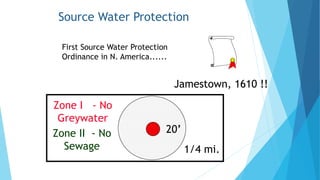
First Source Water Protection
Ordinance in N. America......
Jamestown, 1610 !!
Zone I - No
Greywater
Zone II - No
Sewage
20’
1/4 mi.
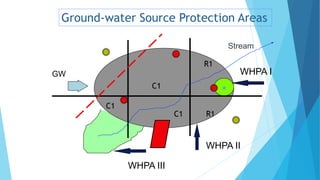
Ground-water Source Protection Areas
GW
WHPA II
WHPA I
C1
C1
R1
R1
Stream
C1
WHPA III
*
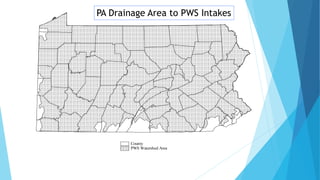
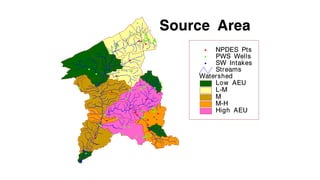
PWS Watershed Area
County
PA Drainage Area to PWS Intakes
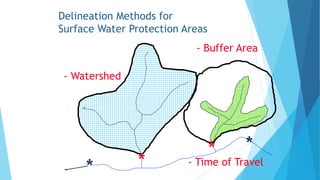
Delineation Methods for
Surface Water Protection Areas
*
**
- Buffer Area
- Watershed
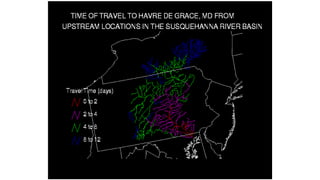
- Time of Travel
*
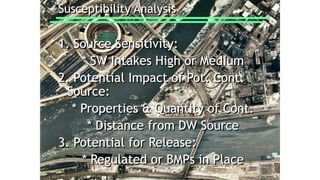
Susceptibility Analysis
1. Source Sensitivity:
* SW Intakes High or Medium
2. Potential Impact of Pot. Cont.
Source:
* Properties & Quantity of Cont.
* Distance from DW Source
3. Potential for Release:
* Regulated or BMPs in Place
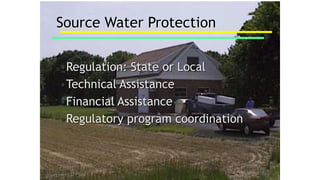
Source Water Protection
•Regulation: State or Local
•Technical Assistance
•Financial Assistance
•Regulatory program coordination
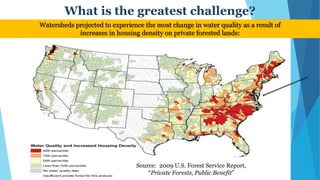
What is the greatest challenge?
Watersheds projected to experience the most change in water quality as a result of
increases in housing density on private forested lands:
Source: 2009 U.S. Forest Service Report,
“Private Forests, Public Benefit”
New England is a hot spot
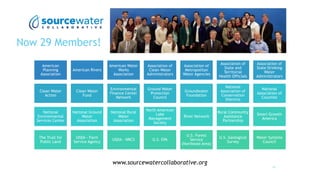
Now 29 Members!
American
Planning
Association
American Rivers
American Water
Works
Association
Association of
Clean Water
Administrators
Association of
Metropolitan
Water Agencies
Association of
State and
Territorial
Health Officials
Association of
State Drinking
Water
Administrators
Clean Water
Action
Clean Water
Fund
Environmental
Finance Center
Network
Ground Water
Protection
Council
Groundwater
Foundation
National
Association of
Conservation
Districts
National
Association of
Counties
National
Environmental
Services Center
National Ground
Water
Association
National Rural
Water
Association
North American
Lake
Management
Society
River Network
Rural Community
Assistance
Partnership
Smart Growth
America
The Trust for
Public Land
USDA - Farm
Service Agency
USDA - NRCS U.S. EPA
U.S. Forest
Service
(Northeast Area)
U.S. Geological
Survey
Water Systems
Council
14
www.sourcewatercollaborative.org
15
www.sourcewatercollaborative.org
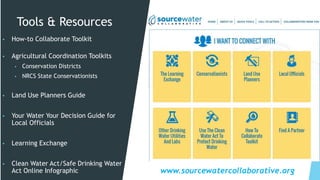
Tools & Resources
▪ How-to Collaborate Toolkit
▪ Agricultural Coordination Toolkits
▪ Conservation Districts
▪ NRCS State Conservationists
▪ Land Use Planners Guide
▪ Your Water Your Decision Guide for
Local Officials
▪ Learning Exchange
▪ Clean Water Act/Safe Drinking Water
Act Online Infographic www.sourcewatercollaborative.org
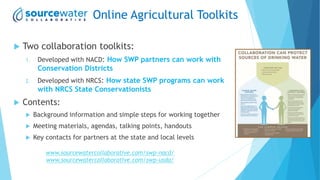
Online Agricultural Toolkits
 Two collaboration toolkits:
1. Developed with NACD: How SWP partners can work with
Conservation Districts
2. Developed with NRCS: How state SWP programs can work
with NRCS State Conservationists
 Contents:
 Background information and simple steps for working together
 Meeting materials, agendas, talking points, handouts
 Key contacts for partners at the state and local levels
www.sourcewatercollaborative.com/swp-nacd/
www.sourcewatercollaborative.com/swp-usda/
2019 Action Items/Subgroups
 Action Items
 Help plan, co-host, and promote Regional SWP workshops (i.e., GWPC)
 Share information and resources
 Identify, promote, and secure source water protection funding opportunities
 Subgroups
 Contingency Planning/Funding
 Goal: Identify and pursue near- and longer-term funding opportunities to provide
stability for SWC and encourage regional/ state/local SWP initiatives
 Conservation Programs - New 2018 Farm Bill provisions!
 Goal: Promote SWP stakeholder ability to successfully connect Farm Bill conservation
provisions with state and local SWP opportunities.
 SWC Actions: Outreach materials, presentations, updates to the SWC Agricultural
Collaboration Toolkit, and webinar on June 25th (see following slides)
 America’s Water Infrastructure Act (AWIA)
 Goal: Provide information and resources on new EPA spill notification provisions and
access to Tier II EPCRA data for chemicals stored at facilities in source water
protection areas.
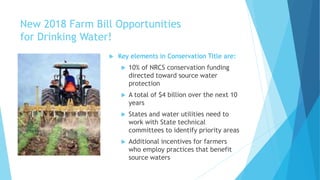
New 2018 Farm Bill Opportunities
for Drinking Water!
 Key elements in Conservation Title are:
 10% of NRCS conservation funding
directed toward source water
protection
 A total of $4 billion over the next 10
years
 States and water utilities need to
work with State technical
committees to identify priority areas
 Additional incentives for farmers
who employ practices that benefit
source waters
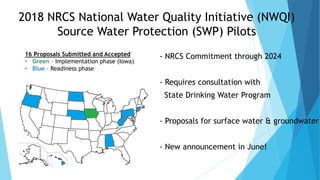
2018 NRCS National Water Quality Initiative (NWQI)
Source Water Protection (SWP) Pilots
 - NRCS Commitment through 2024
 - Requires consultation with
 State Drinking Water Program
 - Proposals for surface water & groundwater
 - New announcement in June!
 2019!
16 Proposals Submitted and Accepted
• Green – Implementation phase (Iowa)
• Blue – Readiness phase
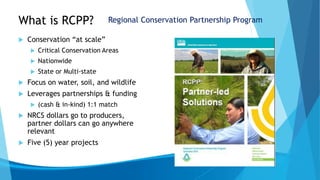
What is RCPP?
 Conservation “at scale”
 Critical Conservation Areas
 Nationwide
 State or Multi-state
 Focus on water, soil, and wildlife
 Leverages partnerships & funding
 (cash & in-kind) 1:1 match
 NRCS dollars go to producers,
partner dollars can go anywhere
relevant
 Five (5) year projects
Regional Conservation Partnership Program
June 25th Webinar: Partnering on NRCS
Conservation Projects for Drinking Water
 Presentations
 NRCS National Water Quality Initiative (NWQI) –
Martin Lowenfish and Dee Carlson, USDA/NRCS
 NRCS Regional Conservation Partnership Program (RCPP) –
Kari Cohen, USDA/NRCS
 Locally Led Source Water Collaboratives in Oregon
Jay Gibbs, Oregon, Acting NRCS State Conservationist
 Nutrient reduction and SWP – Adam Schneiders, Iowa DNR
 AWWA water utility source water project (NWQI) –
Jenn Heymann, Pennsylvania American Water
Recent Examples with Utility Involvement (RCPP)
Location
Total
Value
Primary Source Water
Protection Target(s)
Arkansas
(White River) $8 million Sediment and phosphorus
Georgia (Savannah
River Basin) $3.3 million Land conservation to protect quality
Illinois (Otter
Lake)
$1.7
million Nutrients and sediment
Iowa (Middle
Cedar) $4 million Nitrate reduction
Kansas (Milford
Lake) $8 million Cyanobacterial bloom risk
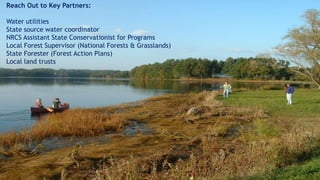
Reach Out to Key Partners:
Water utilities
State source water coordinator
NRCS Assistant State Conservationist for Programs
Local Forest Supervisor (National Forests & Grasslands)
State Forester (Forest Action Plans)
Local land trusts
Questions?
Source Water Collaborative:
www.sourcewatercollaborative.org
www.gwpc.org
Contact: Sylvia Malm, Senior Advisor
for Source Water Protection
Ground Water Protection Council,
smalm@gwpc.org or 703-532-6181

July 29-210-Joe Lee

  • 1.
    Source Water Collaborative: Protecting DrinkingWater Sources for Generations to Come presented by Joseph J. Lee, Jr., P.G., Ground Water Protection Council Soil and Water Conservation Society July 29, 2019 Pittsburgh, PA
  • 2.
    Source Water Assessmentand Protection 1996 Safe Drinking Water Act (SDWA) Reauthorization The Act requires states to develop a Source Water Assessment (SWA) and Protection (SWAP) Program to assess the drinking water sources that serve public water systems for their susceptibility to pollution and to use this information as a basis for eventually building voluntary, community-based barriers to drinking water contamination.
  • 3.
    Source Water Assessment (1)delineate the boundaries of the areas providing source waters for public water systems, and (2) identify (to the extent practicable) the origins of regulated and certain unregulated contaminants in the delineated area to determine the susceptibility of public water systems to such contaminants.
  • 4.
    Safe Drinking WaterAct •Section 1428 - Wellhead Protection •Section 1452 - State Revolving Fund •Section 1453 - Source Water Assessments •Intent of Congress = Voluntary Local SWP
  • 5.
    Source Water Protection FirstSource Water Protection Ordinance in N. America...... Jamestown, 1610 !! Zone I - No Greywater Zone II - No Sewage 20’ 1/4 mi.
  • 6.
    Ground-water Source ProtectionAreas GW WHPA II WHPA I C1 C1 R1 R1 Stream C1 WHPA III *
  • 7.
    PWS Watershed Area County PADrainage Area to PWS Intakes
  • 8.
    Delineation Methods for SurfaceWater Protection Areas * ** - Buffer Area - Watershed - Time of Travel *
  • 11.
    Susceptibility Analysis 1. SourceSensitivity: * SW Intakes High or Medium 2. Potential Impact of Pot. Cont. Source: * Properties & Quantity of Cont. * Distance from DW Source 3. Potential for Release: * Regulated or BMPs in Place
  • 12.
    Source Water Protection •Regulation:State or Local •Technical Assistance •Financial Assistance •Regulatory program coordination
  • 13.
    What is thegreatest challenge? Watersheds projected to experience the most change in water quality as a result of increases in housing density on private forested lands: Source: 2009 U.S. Forest Service Report, “Private Forests, Public Benefit” New England is a hot spot
  • 14.
    Now 29 Members! American Planning Association AmericanRivers American Water Works Association Association of Clean Water Administrators Association of Metropolitan Water Agencies Association of State and Territorial Health Officials Association of State Drinking Water Administrators Clean Water Action Clean Water Fund Environmental Finance Center Network Ground Water Protection Council Groundwater Foundation National Association of Conservation Districts National Association of Counties National Environmental Services Center National Ground Water Association National Rural Water Association North American Lake Management Society River Network Rural Community Assistance Partnership Smart Growth America The Trust for Public Land USDA - Farm Service Agency USDA - NRCS U.S. EPA U.S. Forest Service (Northeast Area) U.S. Geological Survey Water Systems Council 14 www.sourcewatercollaborative.org
  • 15.
  • 16.
    Tools & Resources ▪How-to Collaborate Toolkit ▪ Agricultural Coordination Toolkits ▪ Conservation Districts ▪ NRCS State Conservationists ▪ Land Use Planners Guide ▪ Your Water Your Decision Guide for Local Officials ▪ Learning Exchange ▪ Clean Water Act/Safe Drinking Water Act Online Infographic www.sourcewatercollaborative.org
  • 17.
    Online Agricultural Toolkits Two collaboration toolkits: 1. Developed with NACD: How SWP partners can work with Conservation Districts 2. Developed with NRCS: How state SWP programs can work with NRCS State Conservationists  Contents:  Background information and simple steps for working together  Meeting materials, agendas, talking points, handouts  Key contacts for partners at the state and local levels www.sourcewatercollaborative.com/swp-nacd/ www.sourcewatercollaborative.com/swp-usda/
  • 18.
    2019 Action Items/Subgroups Action Items  Help plan, co-host, and promote Regional SWP workshops (i.e., GWPC)  Share information and resources  Identify, promote, and secure source water protection funding opportunities  Subgroups  Contingency Planning/Funding  Goal: Identify and pursue near- and longer-term funding opportunities to provide stability for SWC and encourage regional/ state/local SWP initiatives  Conservation Programs - New 2018 Farm Bill provisions!  Goal: Promote SWP stakeholder ability to successfully connect Farm Bill conservation provisions with state and local SWP opportunities.  SWC Actions: Outreach materials, presentations, updates to the SWC Agricultural Collaboration Toolkit, and webinar on June 25th (see following slides)  America’s Water Infrastructure Act (AWIA)  Goal: Provide information and resources on new EPA spill notification provisions and access to Tier II EPCRA data for chemicals stored at facilities in source water protection areas.
  • 19.
    New 2018 FarmBill Opportunities for Drinking Water!  Key elements in Conservation Title are:  10% of NRCS conservation funding directed toward source water protection  A total of $4 billion over the next 10 years  States and water utilities need to work with State technical committees to identify priority areas  Additional incentives for farmers who employ practices that benefit source waters
  • 20.
    2018 NRCS NationalWater Quality Initiative (NWQI) Source Water Protection (SWP) Pilots  - NRCS Commitment through 2024  - Requires consultation with  State Drinking Water Program  - Proposals for surface water & groundwater  - New announcement in June!  2019! 16 Proposals Submitted and Accepted • Green – Implementation phase (Iowa) • Blue – Readiness phase
  • 21.
    What is RCPP? Conservation “at scale”  Critical Conservation Areas  Nationwide  State or Multi-state  Focus on water, soil, and wildlife  Leverages partnerships & funding  (cash & in-kind) 1:1 match  NRCS dollars go to producers, partner dollars can go anywhere relevant  Five (5) year projects Regional Conservation Partnership Program
  • 22.
    June 25th Webinar:Partnering on NRCS Conservation Projects for Drinking Water  Presentations  NRCS National Water Quality Initiative (NWQI) – Martin Lowenfish and Dee Carlson, USDA/NRCS  NRCS Regional Conservation Partnership Program (RCPP) – Kari Cohen, USDA/NRCS  Locally Led Source Water Collaboratives in Oregon Jay Gibbs, Oregon, Acting NRCS State Conservationist  Nutrient reduction and SWP – Adam Schneiders, Iowa DNR  AWWA water utility source water project (NWQI) – Jenn Heymann, Pennsylvania American Water
  • 23.
    Recent Examples withUtility Involvement (RCPP) Location Total Value Primary Source Water Protection Target(s) Arkansas (White River) $8 million Sediment and phosphorus Georgia (Savannah River Basin) $3.3 million Land conservation to protect quality Illinois (Otter Lake) $1.7 million Nutrients and sediment Iowa (Middle Cedar) $4 million Nitrate reduction Kansas (Milford Lake) $8 million Cyanobacterial bloom risk
  • 24.
    Reach Out toKey Partners: Water utilities State source water coordinator NRCS Assistant State Conservationist for Programs Local Forest Supervisor (National Forests & Grasslands) State Forester (Forest Action Plans) Local land trusts
  • 26.
    Questions? Source Water Collaborative: www.sourcewatercollaborative.org www.gwpc.org Contact:Sylvia Malm, Senior Advisor for Source Water Protection Ground Water Protection Council, smalm@gwpc.org or 703-532-6181

Editor's Notes

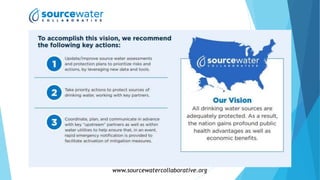
  • #15 ASDWA also co-chairs the Source Water Collaborative with the GWPC We are a group of 27 associations, organizations and Federal Agencies that work together, and with our members and stakeholders to integrate source water protection into key decision-making processes at the local level. NACD – Eric Hansen and NRCS are members Also EPA and AWWA
  • #16 ASDWA also co-chairs the Source Water Collaborative with the GWPC We are a group of 27 associations, organizations and Federal Agencies that work together, and with our members and stakeholders to integrate source water protection into key decision-making processes at the local level. NACD – Eric Hansen and NRCS are members Also EPA and AWWA
  • #17 Here is a list of helpful tools and resources developed by the National Source Water Collaborative for working with a variety of different partners This picture on the right is a screen capture of the website where you can find them.
  • #24 Shown here are six examples of Regional Conservation Partnership Program (RCPP) projects that include at least one (and in several cases, more than one) utility partner. In RCPP, partners can focus NRCS resources on a particular problem or set of problems and combine the federal resources with their collective local resources (which include not only funding but also expertise, outreach, and others) to most effectively address the issues. Most of the successful RCPP projects have roughly a 1:1 match of federal to local resources, but the benefit to the utility can be several times that. For example, Beaver Water District (Arkansas) is getting to benefit from $8 of source water protection spending for every $1 that they put in. Keep in mind that in almost all NRCS programs, the federal dollars go directly to the agricultural producers to implement conservation practices.