Silvia Fernanda López Meléndez
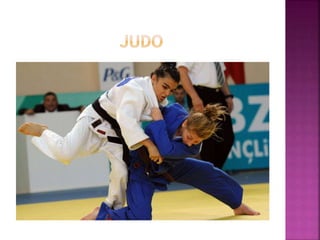
 It is a martial art and combat sport of
Japanese origin.
 The Japanese term can be translated as
"Path to flexibility", or "Path of gentleness,
courtesy", influencing mental and emotional
development through practice.
 People who practice this martial art are
called «judokas»
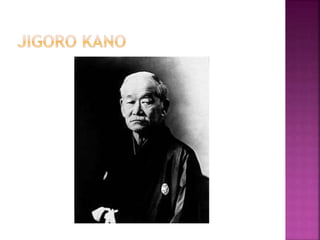
 Judo was created by Japanese master Jigorō Kanō in
1882. Master Kano compiled the technical essence
(throws, dislocations, immobilizations,
strangulations, disarms and blows) and tactics
(displacements, positioning, transitions, breathing
methods, etc.). two of the old classic schools of
Japanese melee or Jiujitsu, adapting them to real-
time training. That is to say, at the end of the 19th
century these techniques were taught without
entering into active combat, as many were
considered too dangerous. Jigoro Kano selected the
ones that could be applied in a real combat, for
being intuitive and simple, as well as practicing in
real combat with the companion without risk of
injuries. This gave the judokas an unrivaled
advantage over other Japanese styles.
 In the study of judo, non-resistance
constitutes a primordial technical principle.
A judoka must yield to the strength of his
opponent according to whether he is pushed
or brought, since by doing so, not only the
opposite effort is canceled and the
expenditure of the energy itself is optimized,
but it also facilitates the preservation of the
balance of what would be achieved by
offering resistance, while weakening the
balance of the opponent. In a word, it is the
way of accepting things as they arise to
advantageously change them.
 It is my hobby because since I was a child I
begin to practice this sport, and I love judo,
it’s my passion and I sure that always I’ll love
it.
I have a lot of reasons to love this sport.
 One of them is because I want to travel to
another countries to compete, win and also
for being a good example to the people that
think that everything is impossible just
because I’m a woman.

judo presentation.pptx

  • 1.
  • 4.
     It isa martial art and combat sport of Japanese origin.  The Japanese term can be translated as "Path to flexibility", or "Path of gentleness, courtesy", influencing mental and emotional development through practice.  People who practice this martial art are called «judokas»
  • 5.
     Judo wascreated by Japanese master Jigorō Kanō in 1882. Master Kano compiled the technical essence (throws, dislocations, immobilizations, strangulations, disarms and blows) and tactics (displacements, positioning, transitions, breathing methods, etc.). two of the old classic schools of Japanese melee or Jiujitsu, adapting them to real- time training. That is to say, at the end of the 19th century these techniques were taught without entering into active combat, as many were considered too dangerous. Jigoro Kano selected the ones that could be applied in a real combat, for being intuitive and simple, as well as practicing in real combat with the companion without risk of injuries. This gave the judokas an unrivaled advantage over other Japanese styles.
  • 6.
     In thestudy of judo, non-resistance constitutes a primordial technical principle. A judoka must yield to the strength of his opponent according to whether he is pushed or brought, since by doing so, not only the opposite effort is canceled and the expenditure of the energy itself is optimized, but it also facilitates the preservation of the balance of what would be achieved by offering resistance, while weakening the balance of the opponent. In a word, it is the way of accepting things as they arise to advantageously change them.
  • 7.
     It ismy hobby because since I was a child I begin to practice this sport, and I love judo, it’s my passion and I sure that always I’ll love it. I have a lot of reasons to love this sport.  One of them is because I want to travel to another countries to compete, win and also for being a good example to the people that think that everything is impossible just because I’m a woman.