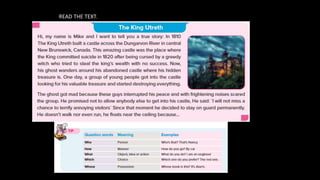
READ THE TEXT.
ANSWER THE QUESTIONS ABOUT THE STORY.
1) Who told the story?
2) How old is the castle?
3) What happened in 1820?
4) Which is the Ghost decisión?
5) Who is the treasure´s owner?
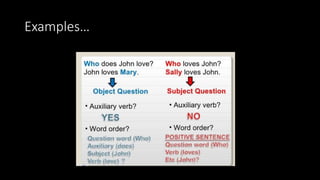
Examples…
Watch the video…
https://www.youtube.com/watch?v=7ziSfFqy2yg
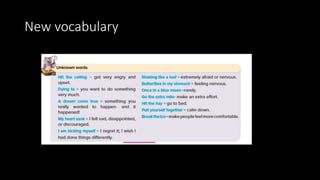
New vocabulary
Go back to the Story and try to create the end
of the story.
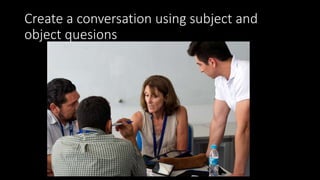
Create a conversation using subject and
object quesions
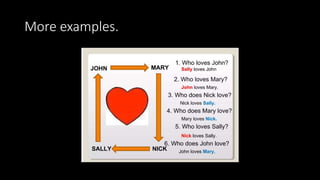
More examples.
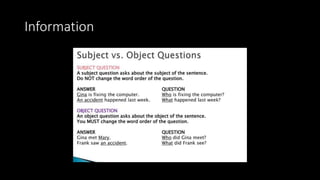
Information
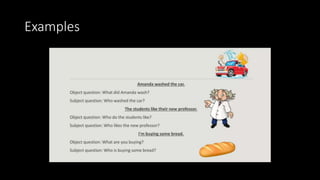
Examples
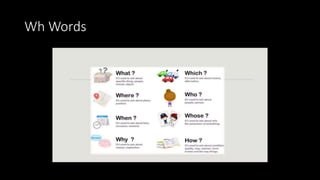
Wh Words
Watch the video.
https://www.youtube.com/watch?v=x_4AjSwTXdc
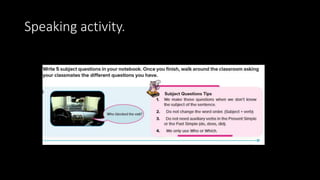
Speaking activity.
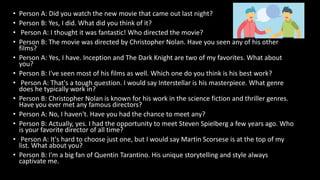
• Person A: Did you watch the new movie that came out last night?
• Person B: Yes, I did. What did you think of it?
• Person A: I thought it was fantastic! Who directed the movie?
• Person B: The movie was directed by Christopher Nolan. Have you seen any of his other
films?
• Person A: Yes, I have. Inception and The Dark Knight are two of my favorites. What about
you?
• Person B: I've seen most of his films as well. Which one do you think is his best work?
• Person A: That's a tough question. I would say Interstellar is his masterpiece. What genre
does he typically work in?
• Person B: Christopher Nolan is known for his work in the science fiction and thriller genres.
Have you ever met any famous directors?
• Person A: No, I haven't. Have you had the chance to meet any?
• Person B: Actually, yes. I had the opportunity to meet Steven Spielberg a few years ago. Who
is your favorite director of all time?
• Person A: It's hard to choose just one, but I would say Martin Scorsese is at the top of my
list. What about you?
• Person B: I'm a big fan of Quentin Tarantino. His unique storytelling and style always
captivate me.
Comments
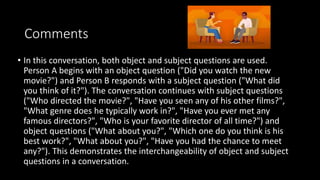
• In this conversation, both object and subject questions are used.
Person A begins with an object question ("Did you watch the new
movie?") and Person B responds with a subject question ("What did
you think of it?"). The conversation continues with subject questions
("Who directed the movie?", "Have you seen any of his other films?",
"What genre does he typically work in?", "Have you ever met any
famous directors?", "Who is your favorite director of all time?") and
object questions ("What about you?", "Which one do you think is his
best work?", "What about you?", "Have you had the chance to meet
any?"). This demonstrates the interchangeability of object and subject
questions in a conversation.

Subject and object questions Unit 1 lesson 1.pptx

  • 2.
  • 3.
    ANSWER THE QUESTIONSABOUT THE STORY. 1) Who told the story? 2) How old is the castle? 3) What happened in 1820? 4) Which is the Ghost decisión? 5) Who is the treasure´s owner?
  • 4.
  • 5.
  • 6.
  • 8.
    Go back tothe Story and try to create the end of the story.
  • 9.
    Create a conversationusing subject and object quesions
  • 10.
  • 11.
  • 12.
  • 13.
  • 14.
  • 15.
  • 16.
    • Person A:Did you watch the new movie that came out last night? • Person B: Yes, I did. What did you think of it? • Person A: I thought it was fantastic! Who directed the movie? • Person B: The movie was directed by Christopher Nolan. Have you seen any of his other films? • Person A: Yes, I have. Inception and The Dark Knight are two of my favorites. What about you? • Person B: I've seen most of his films as well. Which one do you think is his best work? • Person A: That's a tough question. I would say Interstellar is his masterpiece. What genre does he typically work in? • Person B: Christopher Nolan is known for his work in the science fiction and thriller genres. Have you ever met any famous directors? • Person A: No, I haven't. Have you had the chance to meet any? • Person B: Actually, yes. I had the opportunity to meet Steven Spielberg a few years ago. Who is your favorite director of all time? • Person A: It's hard to choose just one, but I would say Martin Scorsese is at the top of my list. What about you? • Person B: I'm a big fan of Quentin Tarantino. His unique storytelling and style always captivate me.
  • 17.
    Comments • In thisconversation, both object and subject questions are used. Person A begins with an object question ("Did you watch the new movie?") and Person B responds with a subject question ("What did you think of it?"). The conversation continues with subject questions ("Who directed the movie?", "Have you seen any of his other films?", "What genre does he typically work in?", "Have you ever met any famous directors?", "Who is your favorite director of all time?") and object questions ("What about you?", "Which one do you think is his best work?", "What about you?", "Have you had the chance to meet any?"). This demonstrates the interchangeability of object and subject questions in a conversation.