Brief Introduction of what Judo is
History and Culture Impact
Olympics and Foreign Impact
How the sport is played & techniques
Translates to “The Gentle Way”
Motto: Maximum efficiency, minimum effort for the mutual
welfare and benefit for all
 Confucian/Buddhist influence
Resembles wrestling
More of a way of life than a sport
Born to an affluent family
Sent to study the four confusion texts
Experienced bullying at a boarding school
in Tokyo
Sought out a Ju-Jutsu instructor
Took 2 years to find
Fukude Hachinosuke (1828-1880)
 Teacher of Tenjin Shinyo-ryu Ju-jutsu
 Fukude placed an emphasis on Randori(technique)
Iso Masatomo (1820–1881)
 More emphasis on Kata (formal training)
 Entrusted Randori practice to assistants (especially Kano)
Iikubo Tsunetoshi (1835–1889)
 Teacher of Kitō-ryū Ju-jutsu
 Emphasized Randori
Founded by Kano in February 1882
Taught Judo
Means “Place for studying the way”
At the Eisho-ji Buddhist temple in Tokyo
Small beginning
Used “ranks” or grades for the first time in any martial art
Eisho-ji – The birthplace of Judo
 Maximum efficiency, minimum effort (seiryoku zen'yo)
 Concept of softness controls hardness (ju yoku go o seisu )
 Initially a jujutsu idea
 Coupled with Confucian philosophy
 Wider application to life
 Changed jutsu (technique) to do (way)
 Mutual welfare and benefit (jita kyōei)
 Kano rejected any Jujutsu practice that did not conform to these beliefs
 Kano traveled across the world spreading
Judo
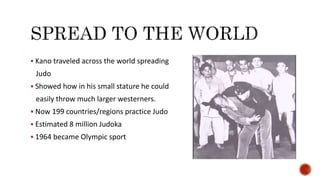
 Showed how in his small stature he could
easily throw much larger westerners.
 Now 199 countries/regions practice Judo
 Estimated 8 million Judoka
 1964 became Olympic sport
 Nowadays in 184 countries
 France
 58,000 Judokas
 Vladimir Putin has black belt
 International Judo Federation
 AJU
 PJC
 JUA
 EJU
 OJU
 Originally for health, safety, and looks
 1893- Miss Sueko Ashiya
 1949- Ruth Gardner (Kodokan Institute)
 1992- Barcelona Olympics
 2008- First US female olympic medalist
 Ronda Rousey
 2011- First female to received 10th dan
 Keiko Fukudan
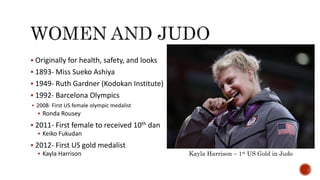
 2012- First US gold medalist
 Kayla Harrison Kayla Harrison – 1st US Gold in Judo
 Lead to the creation of two new martial arts
 Brazilian jiu-jitsu
 Russian Sambo
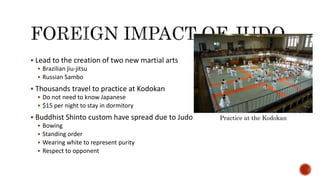
 Thousands travel to practice at Kodokan
 Do not need to know Japanese
 $15 per night to stay in dormitory
 Buddhist Shinto custom have spread due to Judo
 Bowing
 Standing order
 Wearing white to represent purity
 Respect to opponent
Practice at the Kodokan
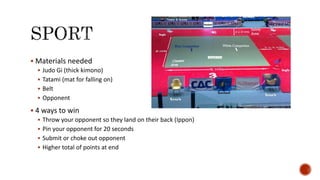
 Materials needed
 Judo Gi (thick kimono)
 Tatami (mat for falling on)
 Belt
 Opponent
 4 ways to win
 Throw your opponent so they land on their back (Ippon)
 Pin your opponent for 20 seconds
 Submit or choke out opponent
 Higher total of points at end
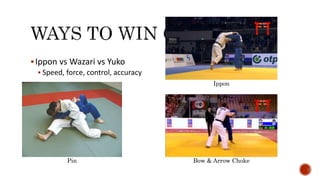
Ippon vs Wazari vs Yuko
 Speed, force, control, accuracy
Ippon
Bow & Arrow ChokePin
Game Play (Randori and Shiai)
 Matches are 5 minutes long
 Start on feet
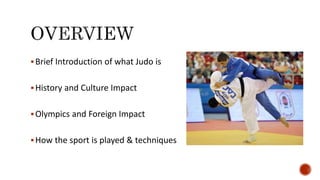
 Consist of trying to throw opponent onto back
 No Striking
 No grabbing below the waste (hansoku make)
 No stalling (shido)
Video of match and I’ll explain what happened
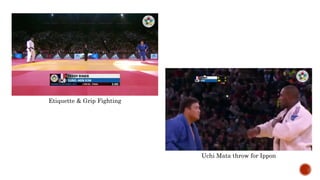
Etiquette & Grip Fighting
Uchi Mata throw for Ippon
Techniques can be broken into 3 major aspects
 Nage-waza (Throwing Techniques)
 Tachi-waza (standing techniques)
 Sutemi-waza (sacrifice techniques)
 Katame-waza (Grappling Techniques)
 Osaekomi-waza (pinning techniques)
 Shime-waza (strangulation techniques)
 Kansetsu-waza (joint locks)
 Atemi-waza (Striking Techniques)
 Illegal in competition
Sutemi-waza – Ura Nage (Supplex)
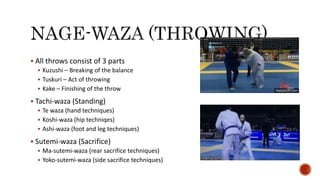
 All throws consist of 3 parts
 Kuzushi – Breaking of the balance
 Tuskuri – Act of throwing
 Kake – Finishing of the throw
 Tachi-waza (Standing)
 Te waza (hand techniques)
 Koshi-waza (hip techniqes)
 Ashi-waza (foot and leg techniques)
 Sutemi-waza (Sacrifice)
 Ma-sutemi-waza (rear sacrifice techniques)
 Yoko-sutemi-waza (side sacrifice techniques)
 Osaekomi-waza (Pinning)
 Trapping opponents back on the ground while being past his legs
 Shime-waza (Strangulation)
 Blood chokes – Cut off blood to the brain (Feels like you are going to sleep)
 Wind Pipe Chokes – Block the windpipe (Much more painful!!)
 Kansetsu-waza (Joint locks)
 Juji-gatame (arm bar) is most common
 Sankaku jime (triangle choke)
 Volunteers?
 References
 http://web-japan.org/kidsweb/virtual/judo/judo01.html
 http://www.intjudo.eu/main.php
 http://www.usja-judo.org/history/
 http://www.worldjudoday.com/en/JudoHistory-55.html

Judo presentation 1

  • 2.
    Brief Introduction ofwhat Judo is History and Culture Impact Olympics and Foreign Impact How the sport is played & techniques
  • 3.
    Translates to “TheGentle Way” Motto: Maximum efficiency, minimum effort for the mutual welfare and benefit for all  Confucian/Buddhist influence Resembles wrestling More of a way of life than a sport
  • 4.
    Born to anaffluent family Sent to study the four confusion texts Experienced bullying at a boarding school in Tokyo Sought out a Ju-Jutsu instructor Took 2 years to find
  • 5.
    Fukude Hachinosuke (1828-1880) Teacher of Tenjin Shinyo-ryu Ju-jutsu  Fukude placed an emphasis on Randori(technique) Iso Masatomo (1820–1881)  More emphasis on Kata (formal training)  Entrusted Randori practice to assistants (especially Kano) Iikubo Tsunetoshi (1835–1889)  Teacher of Kitō-ryū Ju-jutsu  Emphasized Randori
  • 6.
    Founded by Kanoin February 1882 Taught Judo Means “Place for studying the way” At the Eisho-ji Buddhist temple in Tokyo Small beginning Used “ranks” or grades for the first time in any martial art Eisho-ji – The birthplace of Judo
  • 7.
     Maximum efficiency,minimum effort (seiryoku zen'yo)  Concept of softness controls hardness (ju yoku go o seisu )  Initially a jujutsu idea  Coupled with Confucian philosophy  Wider application to life  Changed jutsu (technique) to do (way)  Mutual welfare and benefit (jita kyōei)  Kano rejected any Jujutsu practice that did not conform to these beliefs
  • 8.
     Kano traveledacross the world spreading Judo  Showed how in his small stature he could easily throw much larger westerners.  Now 199 countries/regions practice Judo  Estimated 8 million Judoka  1964 became Olympic sport
  • 9.
     Nowadays in184 countries  France  58,000 Judokas  Vladimir Putin has black belt  International Judo Federation  AJU  PJC  JUA  EJU  OJU
  • 10.
     Originally forhealth, safety, and looks  1893- Miss Sueko Ashiya  1949- Ruth Gardner (Kodokan Institute)  1992- Barcelona Olympics  2008- First US female olympic medalist  Ronda Rousey  2011- First female to received 10th dan  Keiko Fukudan  2012- First US gold medalist  Kayla Harrison Kayla Harrison – 1st US Gold in Judo
  • 11.
     Lead tothe creation of two new martial arts  Brazilian jiu-jitsu  Russian Sambo  Thousands travel to practice at Kodokan  Do not need to know Japanese  $15 per night to stay in dormitory  Buddhist Shinto custom have spread due to Judo  Bowing  Standing order  Wearing white to represent purity  Respect to opponent Practice at the Kodokan
  • 12.
     Materials needed Judo Gi (thick kimono)  Tatami (mat for falling on)  Belt  Opponent  4 ways to win  Throw your opponent so they land on their back (Ippon)  Pin your opponent for 20 seconds  Submit or choke out opponent  Higher total of points at end
  • 13.
    Ippon vs Wazarivs Yuko  Speed, force, control, accuracy Ippon Bow & Arrow ChokePin
  • 14.
    Game Play (Randoriand Shiai)  Matches are 5 minutes long  Start on feet  Consist of trying to throw opponent onto back  No Striking  No grabbing below the waste (hansoku make)  No stalling (shido) Video of match and I’ll explain what happened
  • 15.
    Etiquette & GripFighting Uchi Mata throw for Ippon
  • 16.
    Techniques can bebroken into 3 major aspects  Nage-waza (Throwing Techniques)  Tachi-waza (standing techniques)  Sutemi-waza (sacrifice techniques)  Katame-waza (Grappling Techniques)  Osaekomi-waza (pinning techniques)  Shime-waza (strangulation techniques)  Kansetsu-waza (joint locks)  Atemi-waza (Striking Techniques)  Illegal in competition Sutemi-waza – Ura Nage (Supplex)
  • 17.
     All throwsconsist of 3 parts  Kuzushi – Breaking of the balance  Tuskuri – Act of throwing  Kake – Finishing of the throw  Tachi-waza (Standing)  Te waza (hand techniques)  Koshi-waza (hip techniqes)  Ashi-waza (foot and leg techniques)  Sutemi-waza (Sacrifice)  Ma-sutemi-waza (rear sacrifice techniques)  Yoko-sutemi-waza (side sacrifice techniques)
  • 18.
     Osaekomi-waza (Pinning) Trapping opponents back on the ground while being past his legs  Shime-waza (Strangulation)  Blood chokes – Cut off blood to the brain (Feels like you are going to sleep)  Wind Pipe Chokes – Block the windpipe (Much more painful!!)  Kansetsu-waza (Joint locks)  Juji-gatame (arm bar) is most common  Sankaku jime (triangle choke)
  • 19.
     Volunteers?  References http://web-japan.org/kidsweb/virtual/judo/judo01.html  http://www.intjudo.eu/main.php  http://www.usja-judo.org/history/  http://www.worldjudoday.com/en/JudoHistory-55.html

Editor's Notes

  • #4  wrestling in that it is close combat no weapons in competition Motto and name show how the “do” or way is a more philosophical aspect from religion in Judo than just a martial art Ippon (mostly in Japan) focus on fast efficient throws landing on back. Religious influence makes it more of a way of life than a just a sport and is focused on benefit for you and society
  • #5 Today he is considered by many as the Father of Japanese organized sports Kano Jigoro was the creator of Judo Born of an affluent family and married into another Even became an official in the shogunal government Growing up he studied the four Confucian texts and Calligraphy By age 14 he ended up in a boarding school that had a large amount of bullying To protect himself Kano searched for an instructor in Ju-Jutsu Since the Meiji restoration (1868) was already well under way at this point it made it difficult to find a ju-jutsu instructor many people were unwilling to teach or were being driven out by the government. took 2 years to find an instructor
  • #6 Tenjin Shinyo-ryu is considered a traditional school focused on strikes used to throw balance of opponents Ju-jutsu is at its cor a martial art used to gain advantage in a battle for life and death used by samurai Ju-Jutsu means soft-technique This is partly why the Ippon is so sought after by Japanese judoka, putting your enemy on his back give you the opportunity to deal a killing blow technique like practicing throws and increasing efficiency and quality of these throws (Symbolic now) Kano was one of the best students of Fukude in both Randori and Kata The scrolls contained the Kata of the Fukude dojo Iso masatomo only lived for a year of teaching Kano but entrusted Kano to Randori practice in his dojo Iikubo Tsunetoshi was Kano’s last teaher was of the kito-ryu school of jujutsu that focused on throwing techniques
  • #7 Assisted in teaching by Iikubo Tsunetoshi Small beginning with only about 12 mat sized dojo Taught both residents and nonresidents of the temple First two students  Tsunejiro Tomita and Shiro Saigo were granted first grade rank (shodan) by august the 1883
  • #8 In short, resisting a more powerful opponent will result in your defeat, whilst adjusting to and evading your opponent's attack will cause him to lose his balance, his power will be reduced, and you will defeat him. This can apply whatever the relative values of power, thus making it possible for weaker opponents to beat significantly stronger ones. This is the theory of ju yoku go o seisu. This is again part of JuJutsu was combined with Confucian ideas because Kano believed they combined had a wide application to society and would help improve society Because of these changes Kano did not think the term JuJutsu accurately described his art any more and so change the name to Judo He was also aware that because of the meiji reforms the Jujutsu had a negative connotation and thought judo would be better received. Kano discouraged dangerous thrusts and kicks common in jujutsu Kano emphasized the Ippon and the clean and efficient Throw (quality)
  • #10 AJU- African Judo Union PJC- Pan-American Judo Confederation JUA- Judo Union of Asia EJU- Europe Judo Union OJU- Oceanian Judo Union
  • #12 Judo is more dynamic (more action) vs BJJ is slow developing sport Brazilian- More focused on the ground (already on the ground) Russian- Judo with striking Respect to opponent – No emotions are to be shown win or lose. Also, there is no arguing with the referees.