Moving Toward Monotheism
AP World History Notes
Chapter 5
Eurasian Cultural Traditions
Moving toward Monotheism
●Zoroastrianism = emerged in the Persian
Empire around the 6th
or 7th
century BCE
●Followed the teachings of prophet named
Zoroaster
● Said there was a struggle between good
and evil in the world
● Ahura Mazda vs. Angra Mainyu
● Humans caught in the middle of this
struggle and had to choose sides
● Humans who chose good would get
eternal life
● Humans who chose evil would get
darkness & misery after death
● Big emphasis on the free will of
humankind
Zoroastrianism
●Did not spread widely beyond the Middle East
because it was not an active missionary religion
●Invasions of Alexander the Great devastated
Zoroastrianism temples destroyed, priests
→
slaughtered, sacred writings burned
●Arrival of Islam in the Middle East also led to the
final decline of Zoroastrianism
Zoroastrianism
●Elements that remain within Judaism and
Christianity:
●Good versus evil
●God versus an evil counterpart
●Idea of a last judgment & resurrected bodies
●Belief in final defeat of evil
●Arrival of a savior (Messiah)
●Remaking of the world at the end of time
The Israelites
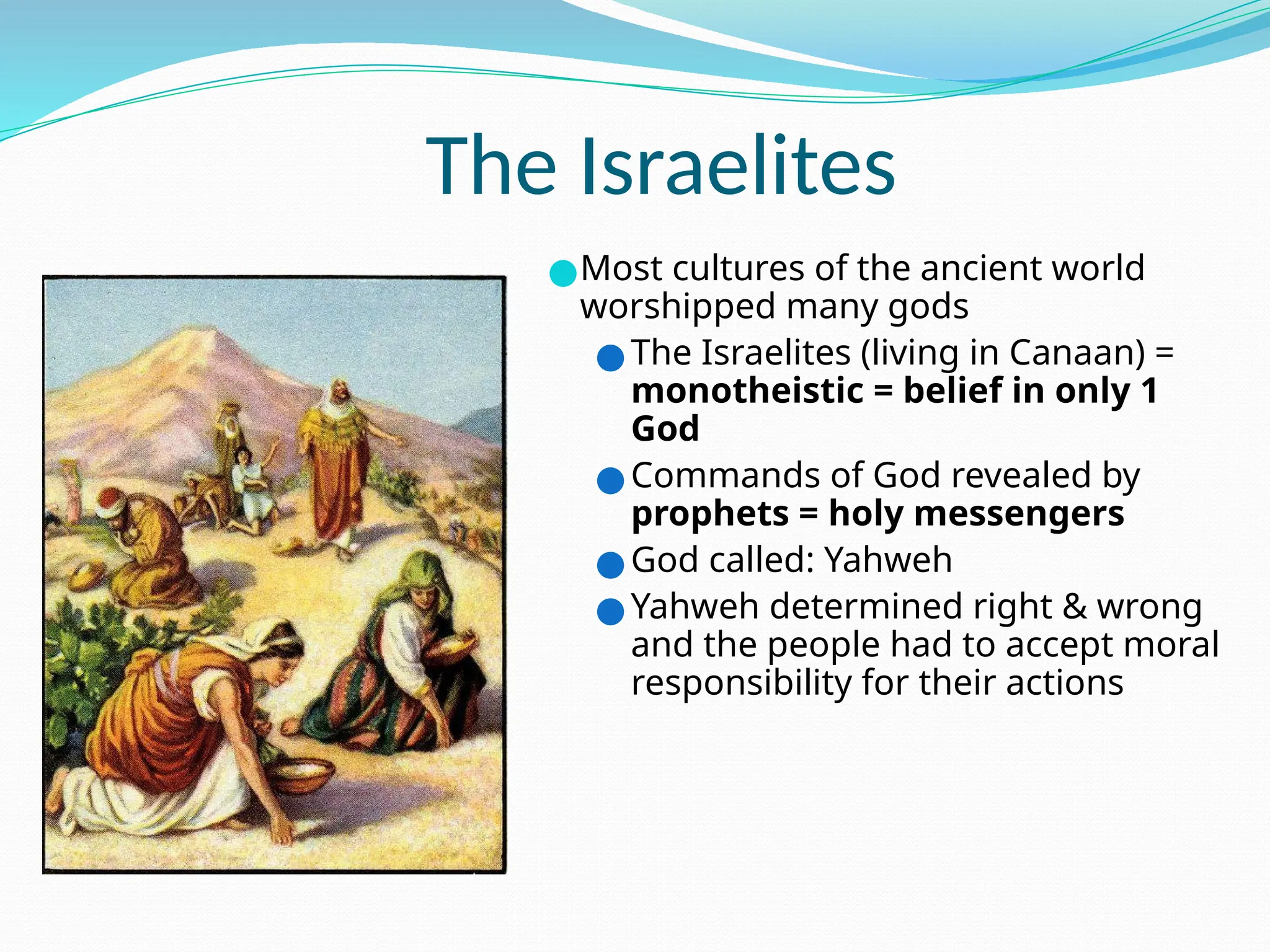
●Most cultures of the ancient world
worshipped many gods
●The Israelites (living in Canaan) =
monotheistic = belief in only 1
God
●Commands of God revealed by
prophets = holy messengers
●God called: Yahweh
●Yahweh determined right & wrong
and the people had to accept moral
responsibility for their actions
The Israelites
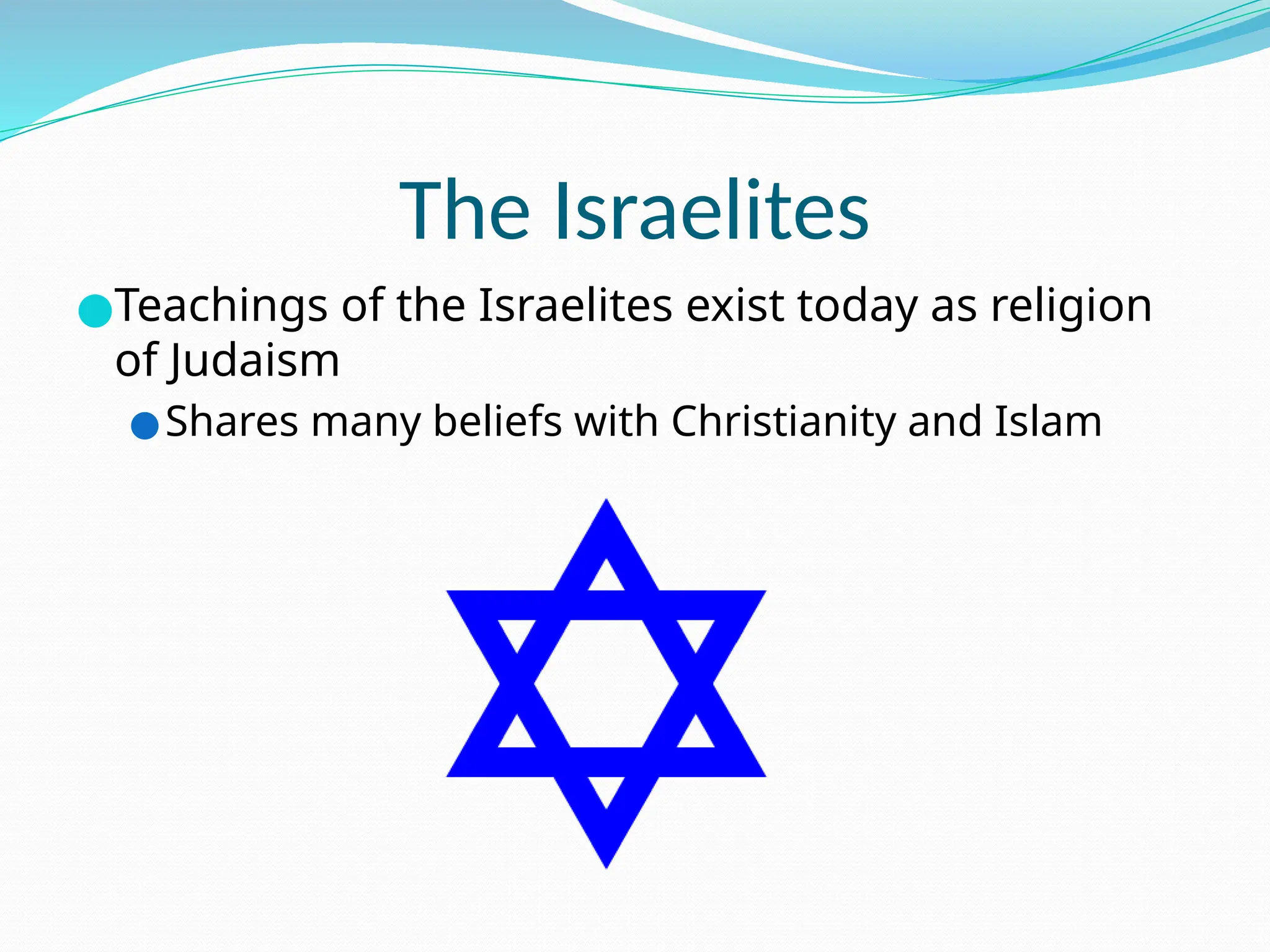
●Teachings of the Israelites exist today as religion
of Judaism
●Shares many beliefs with Christianity and Islam
The Land of Canaan
●Bible remains one of the main
sources of ancient history in
Fertile Crescent
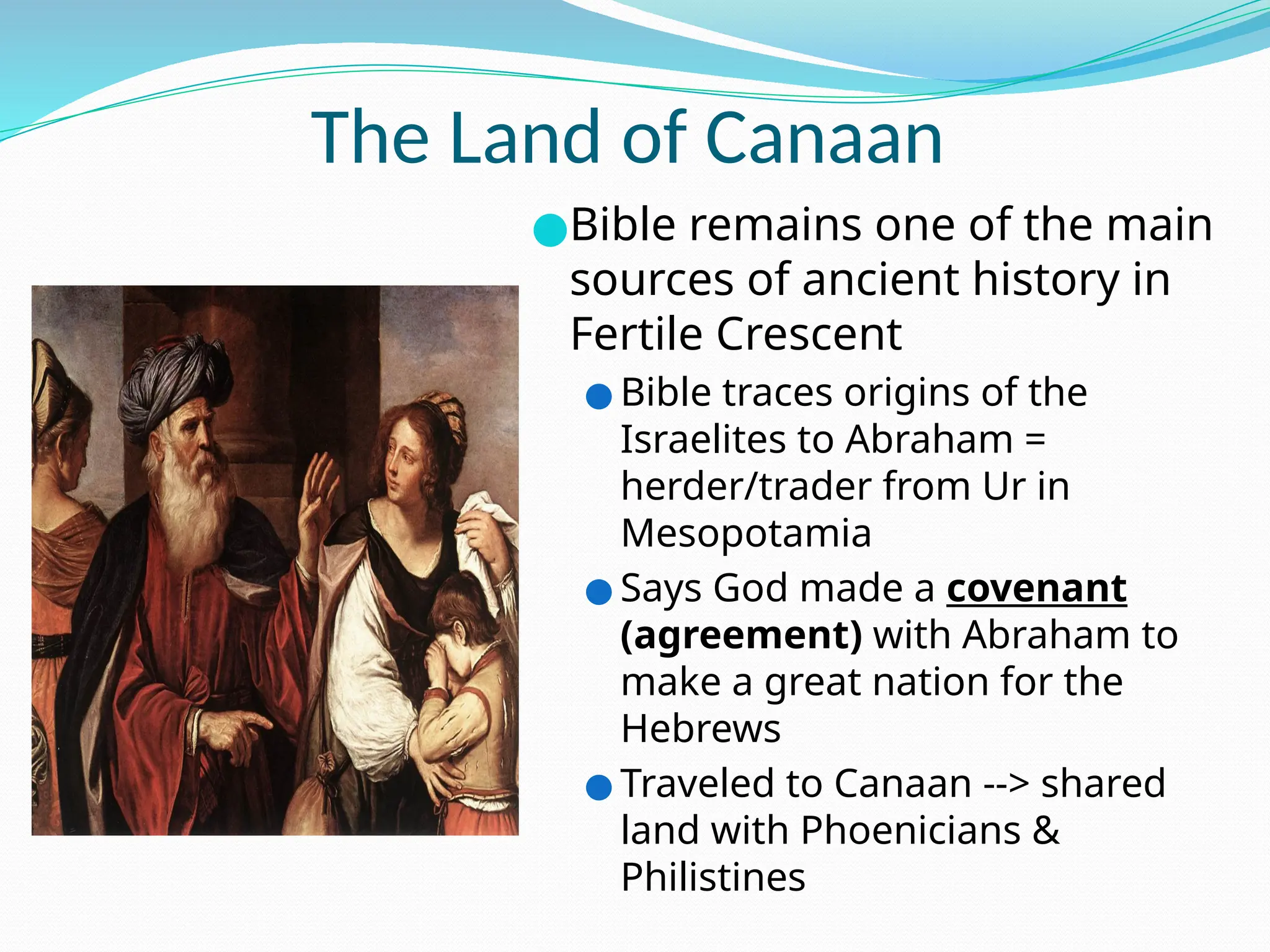
● Bible traces origins of the
Israelites to Abraham =
herder/trader from Ur in
Mesopotamia
● Says God made a covenant
(agreement) with Abraham to
make a great nation for the
Hebrews
● Traveled to Canaan --> shared
land with Phoenicians &
Philistines
The Land of Canaan
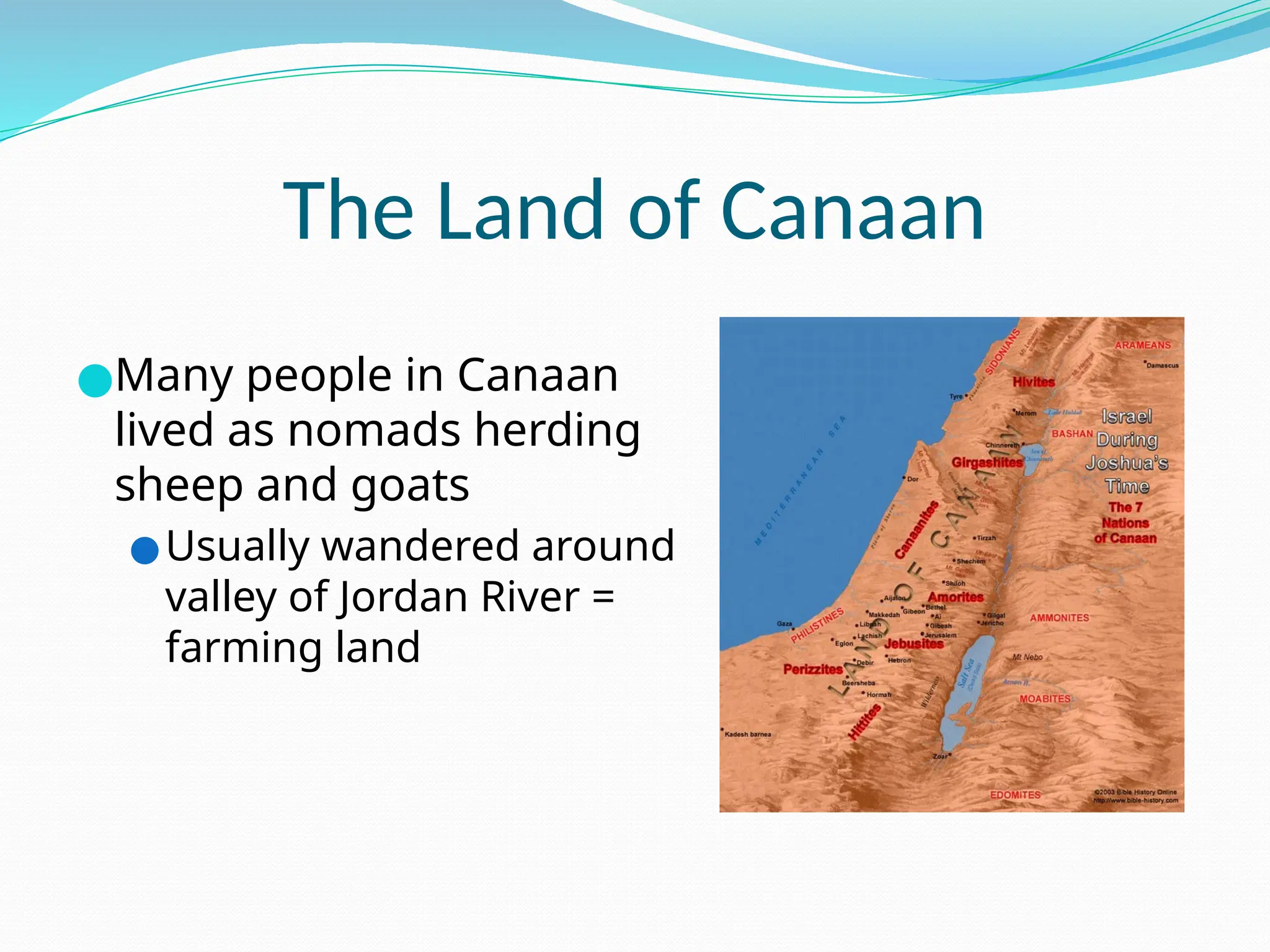
●Many people in Canaan
lived as nomads herding
sheep and goats
●Usually wandered around
valley of Jordan River =
farming land
The Exodus from Egypt
●Abraham’s grandson
Jacob raised 12 sons in
Canaan
●Each son led a separate
tribe = family group
●12 tribes migrated to
Egypt to escape famine
--> eventually were
enslaved by the
Egyptians
The Exodus from
Egypt
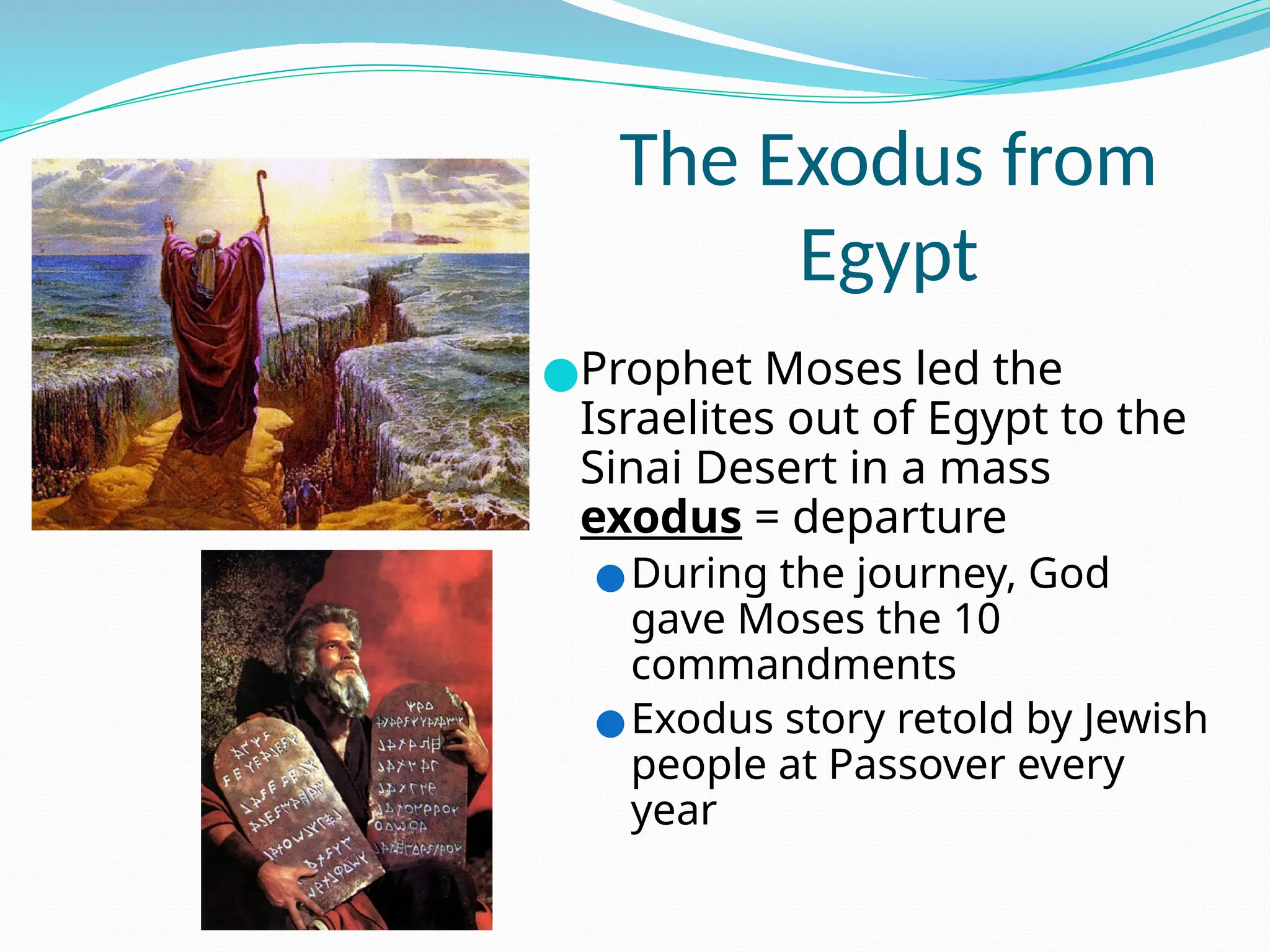
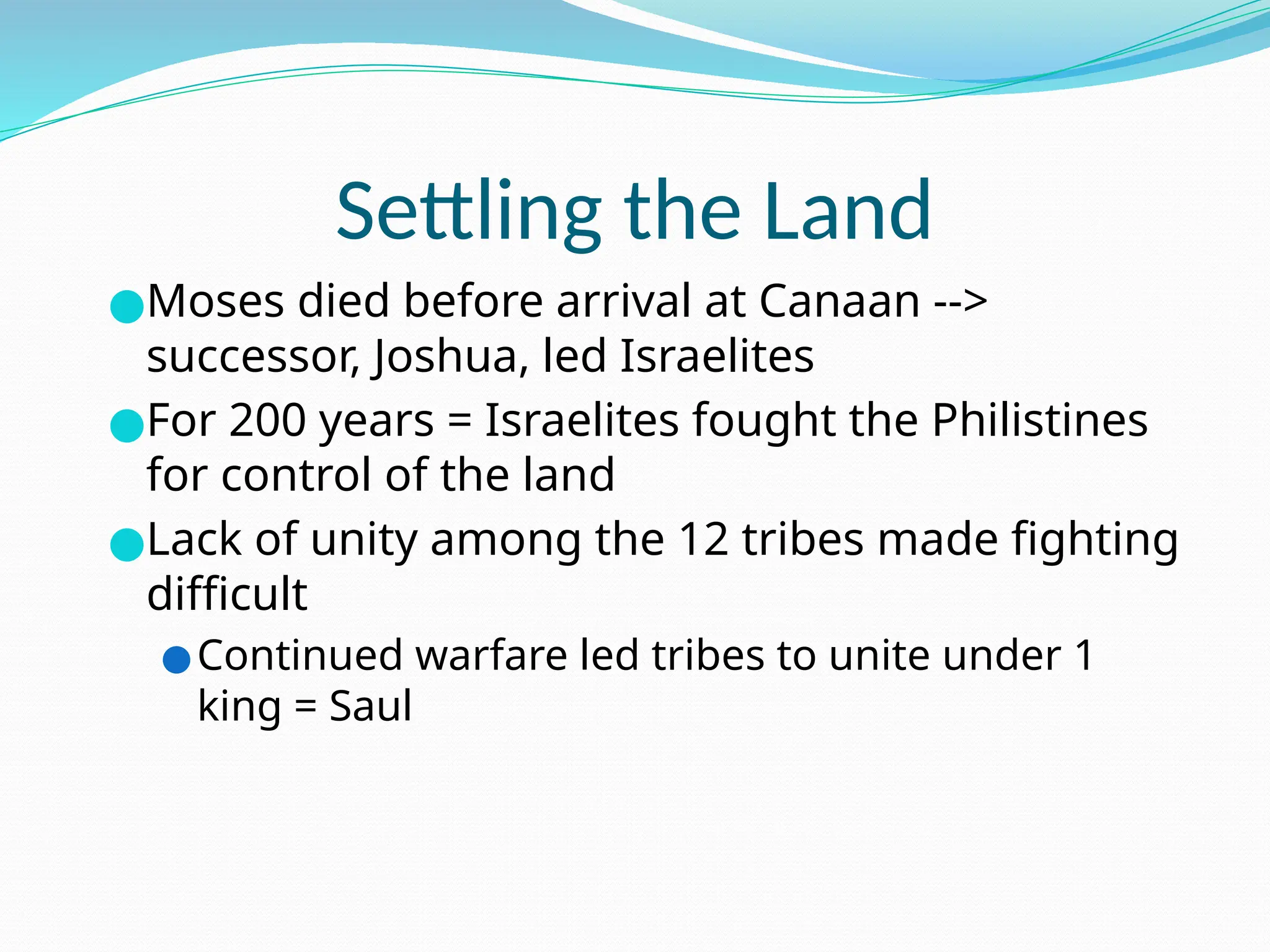
●Prophet Moses led the
Israelites out of Egypt to the
Sinai Desert in a mass
exodus = departure
●During the journey, God
gave Moses the 10
commandments
●Exodus story retold by Jewish
people at Passover every
year
Settling the Land
●Moses died before arrival at Canaan -->
successor, Joshua, led Israelites
●For 200 years = Israelites fought the Philistines
for control of the land
●Lack of unity among the 12 tribes made fighting
difficult
●Continued warfare led tribes to unite under 1
king = Saul
Settling the Land
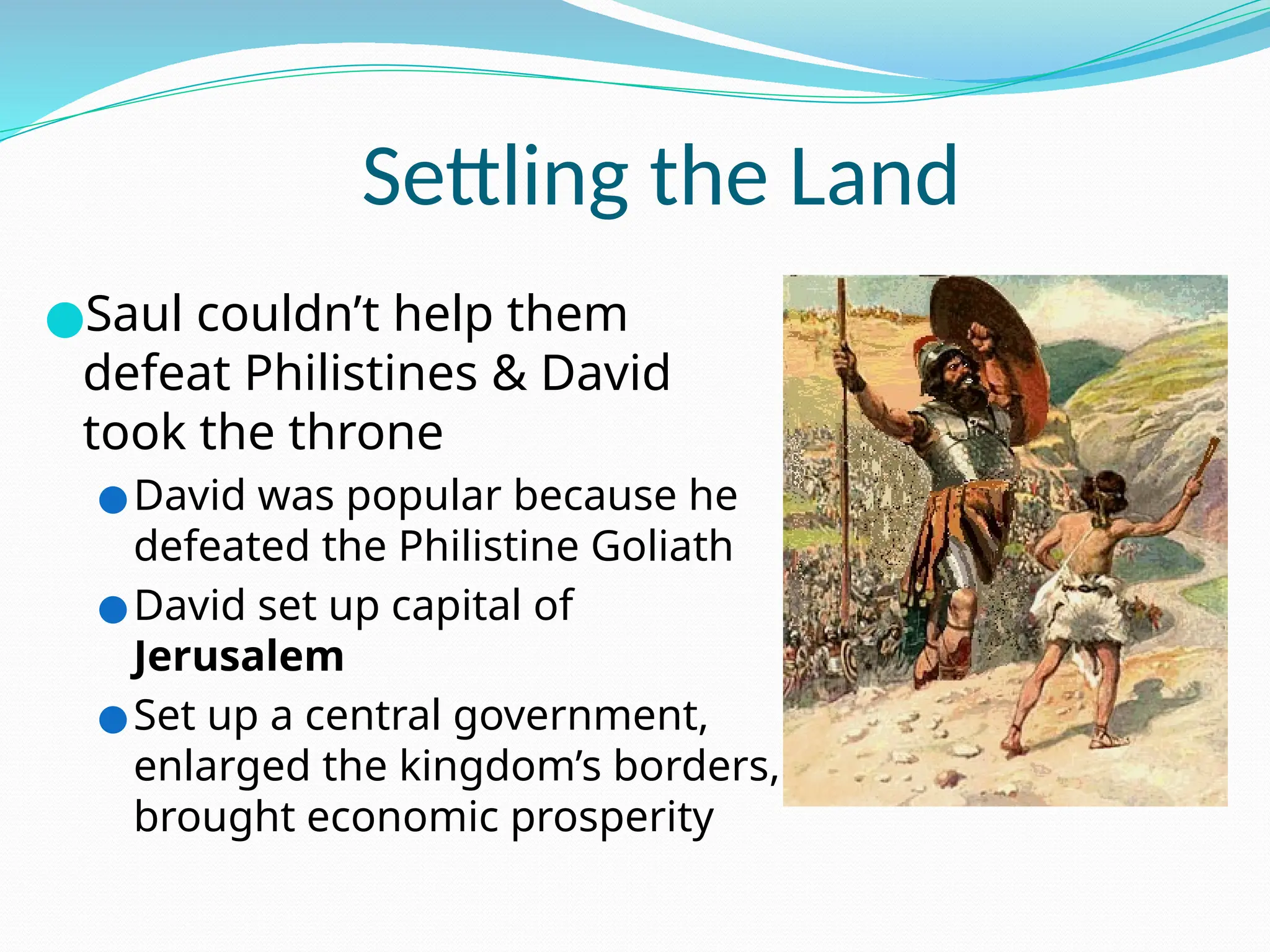
●Saul couldn’t help them
defeat Philistines & David
took the throne
●David was popular because he
defeated the Philistine Goliath
●David set up capital of
Jerusalem
●Set up a central government,
enlarged the kingdom’s borders,
brought economic prosperity
Settling the Land
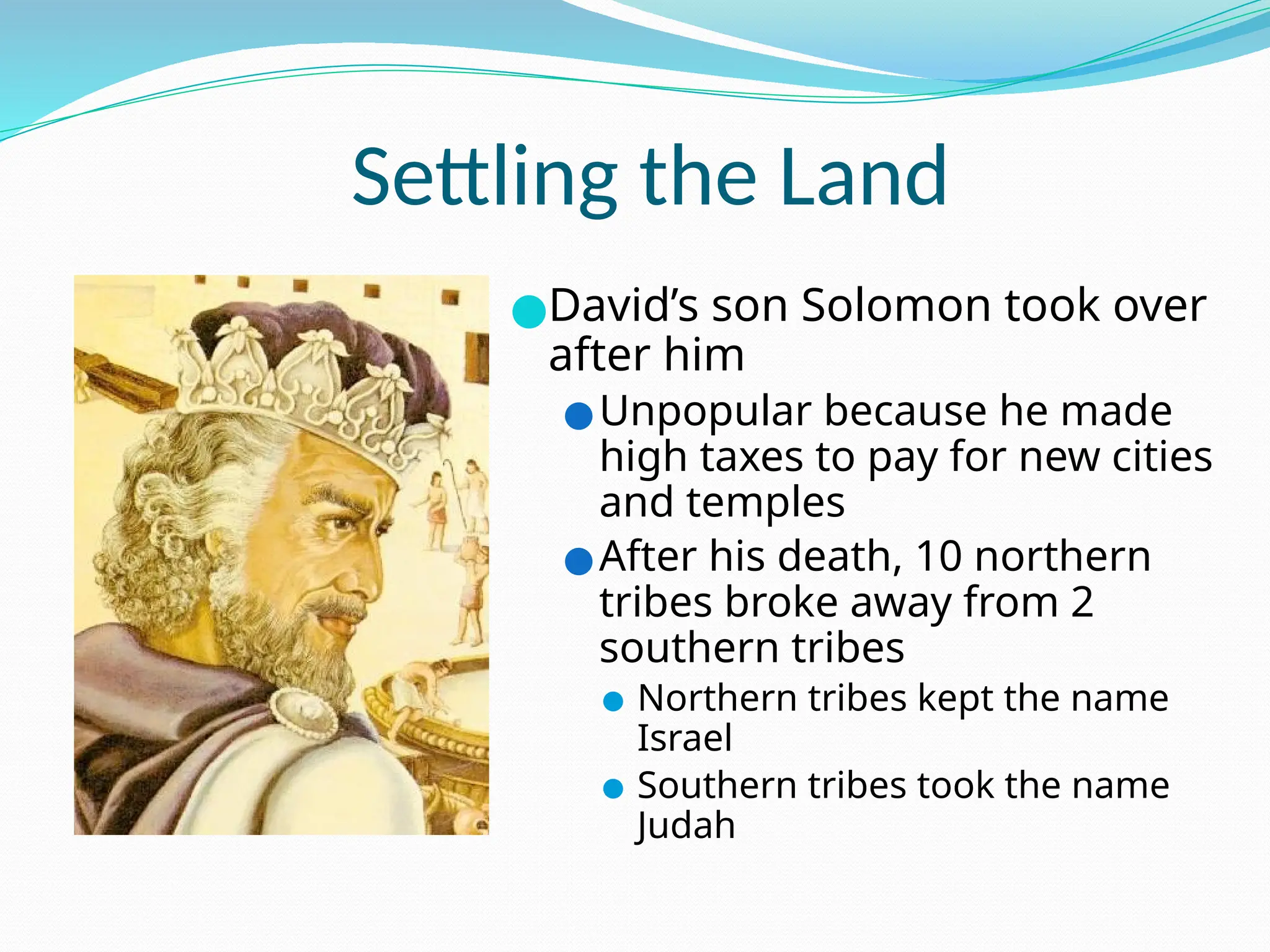
●David’s son Solomon took over
after him
●Unpopular because he made
high taxes to pay for new cities
and temples
●After his death, 10 northern
tribes broke away from 2
southern tribes
● Northern tribes kept the name
Israel
● Southern tribes took the name
Judah
Exile and Return
●2 kingdoms were too weak to
resist invaders
●722 BCE = Assyrians (from
Mesopotamia) conquered
Israel
●586 BCE = Chaldeans (from
Mesopotamia) gained control
of Judah
Exile and Return
●Israelites were enslaved and exiled to Babylon
●During this time, the Jews had no temple so they
met on the holy day of rest together for study and
prayer
●Rise of synagogues developed from these
gatherings
Exile and Return
●539 BCE = Persians conquered the Chaldeans
●Persian king allowed the Jews to return to Judah
and to rebuild the temple
Exile and Return
●400s BCE = Jewish holy writings organized into
the Torah = made up the first 5 books of the
Bible
●Since this time, Jewish communities have
existed outside their homeland = called Jewish
Diaspora
A Lasting Legacy
●Jews recorded their history & examined it for
meaning
●Prophets recorded their teachings
●Jewish religious beliefs & principles helped shape
Christianity in the future
Recap of Religion in Ancient Rome
●Early Romans
worshipped nature
spirits
●Romans then adopted
Greek religion and gave
gods Roman names
●Under Augustus: people
expected to honor the
emperor as Rome’s chief
priest
Jupiter
Bacchus
Minerva
Recap of Religion in Ancient Rome
●But empire’s people allowed to
worship freely
●Many religions existed in the
Roman Empire
●Some Jews began practicing a
new religion called Christianity
●Considered a sect (group) within
Judaism at first
●Became a separate religion
Judaism & the Empire
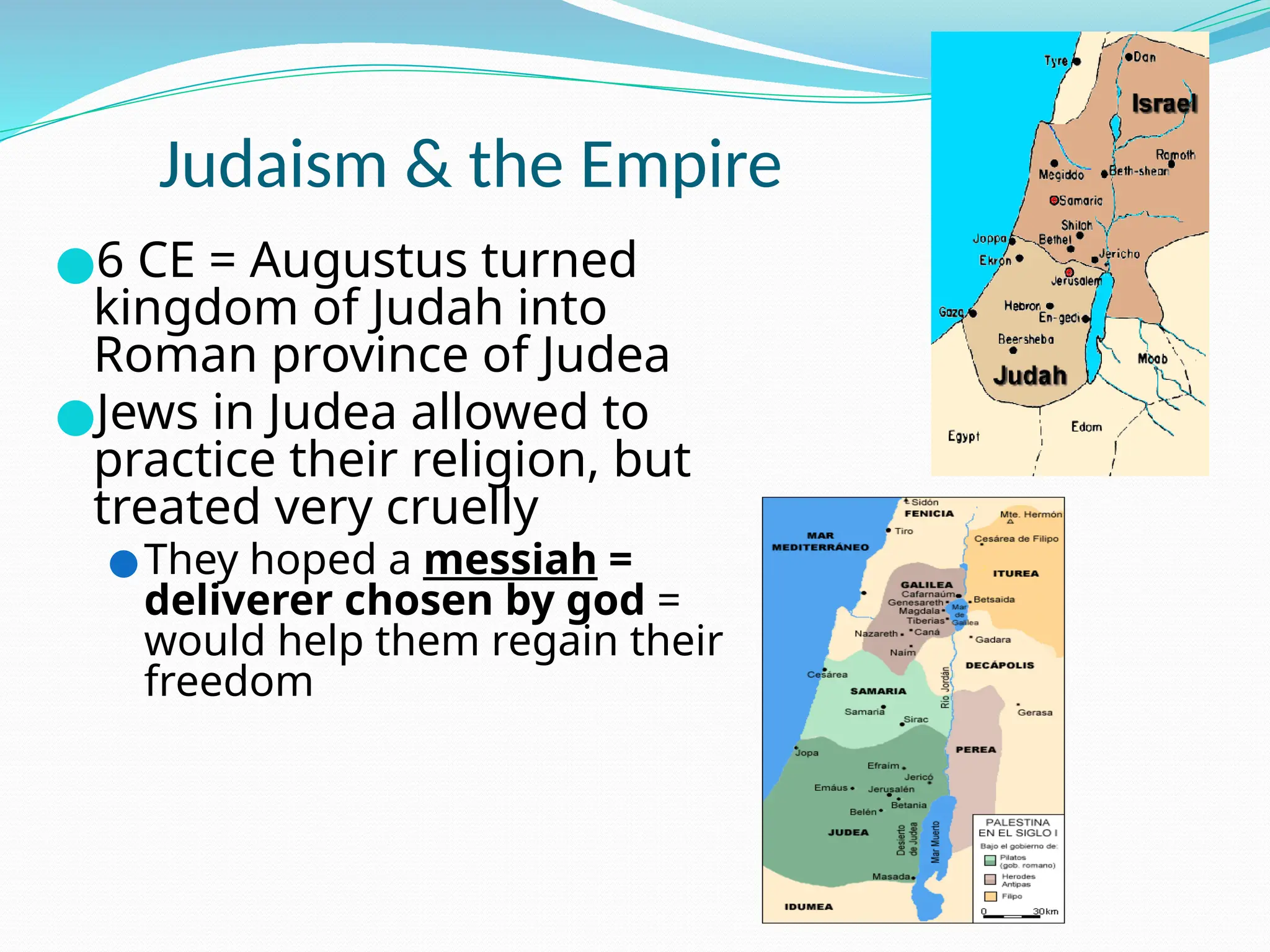
●6 CE = Augustus turned
kingdom of Judah into
Roman province of Judea
●Jews in Judea allowed to
practice their religion, but
treated very cruelly
●They hoped a messiah =
deliverer chosen by god =
would help them regain their
freedom
Judaism & the Empire
●66 CE = Jews rebelled
against Romans & took
over Jerusalem
●4 years later = Romans
retook Jerusalem,
destroyed the Temple,
and killed thousands of
Jews
●Romans banned the
Jews from living in
Jerusalem
Judaism & the Empire
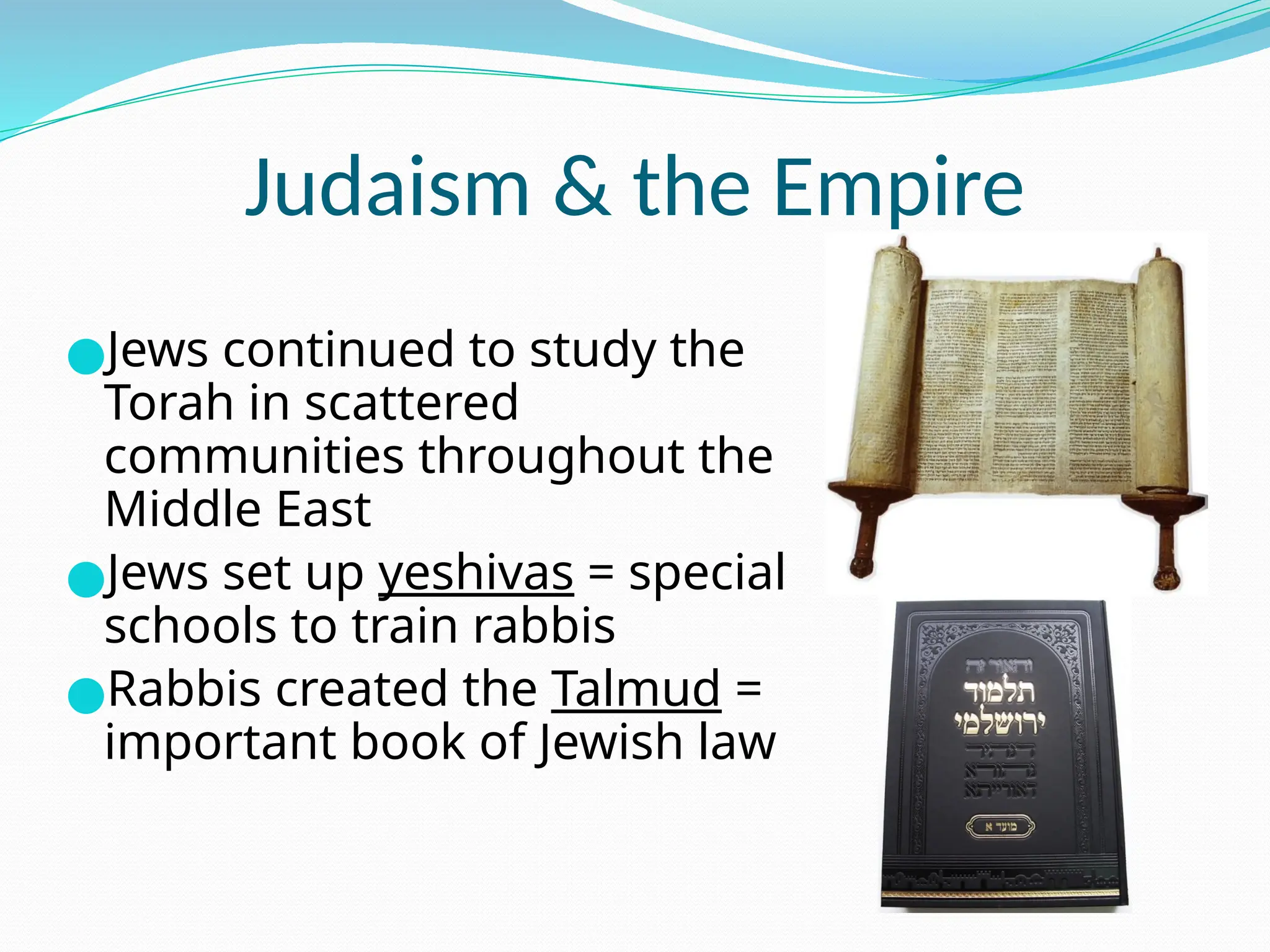
●Jews continued to study the
Torah in scattered
communities throughout the
Middle East
●Jews set up yeshivas = special
schools to train rabbis
●Rabbis created the Talmud =
important book of Jewish law
Jesus of Nazareth
●Jesus preached a new
message to his fellow Jews
●Traveled throughout Galilee and
Judea
●Gained disciples = followers
●Said God was loving and
forgiving
●Often used parables = symbolic
stories
Jesus of Nazareth
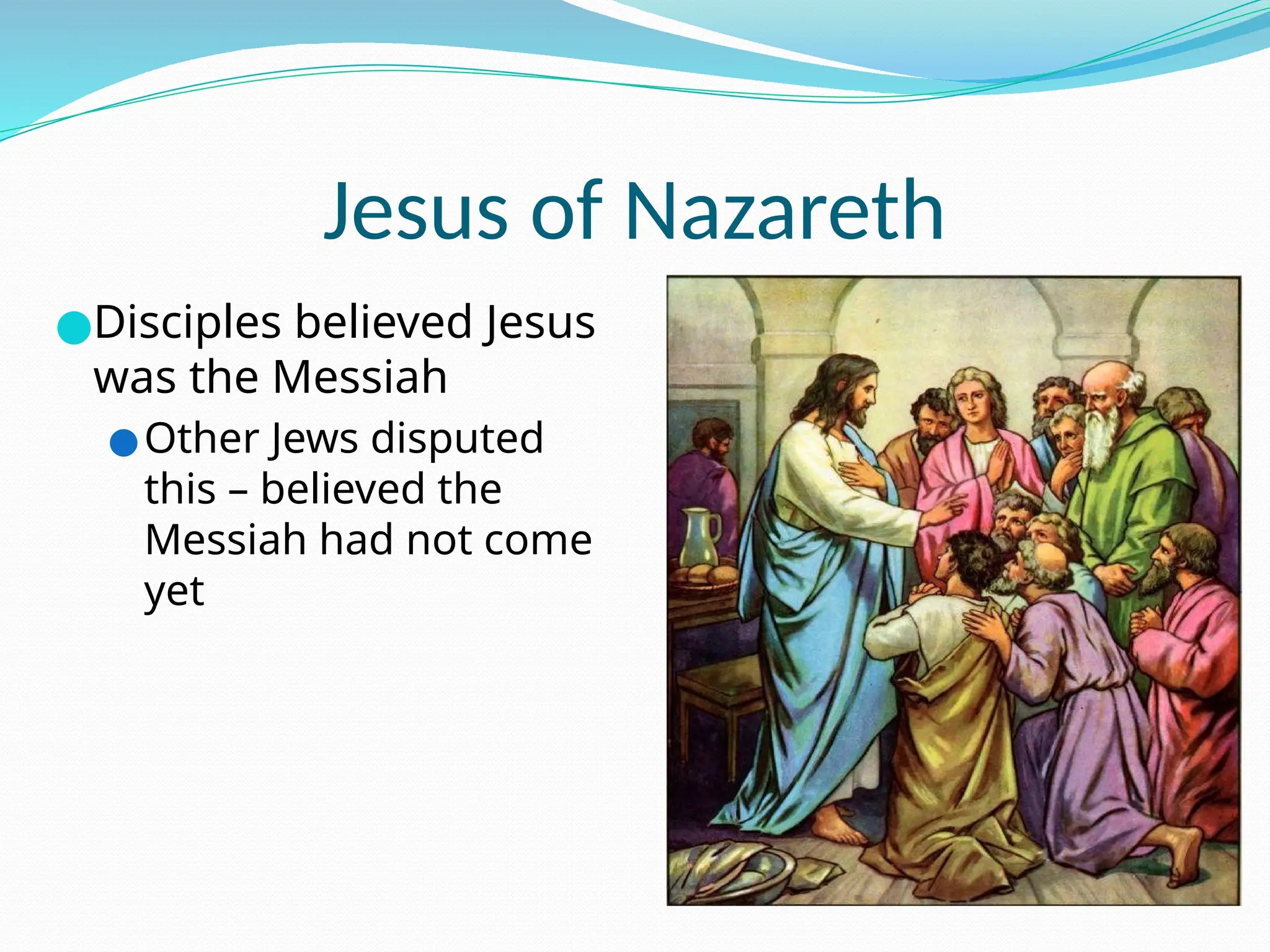
●Disciples believed Jesus
was the Messiah
●Other Jews disputed
this – believed the
Messiah had not come
yet
Jesus of Nazareth
●Roman officials were
troubled by the
controversy over Jesus
●Roman governor
Pontius Pilate arrested
Jesus & ordered that
he be crucified
The Spread of Christianity
●After Jesus' death, his
disciples said he had risen
from the dead
●They began preaching that
Jesus was the Son of God
●Those who accepted this
message = called Christians
●Christians formed own
churches for worship,
fellowship, and instruction
The Spread of Christianity
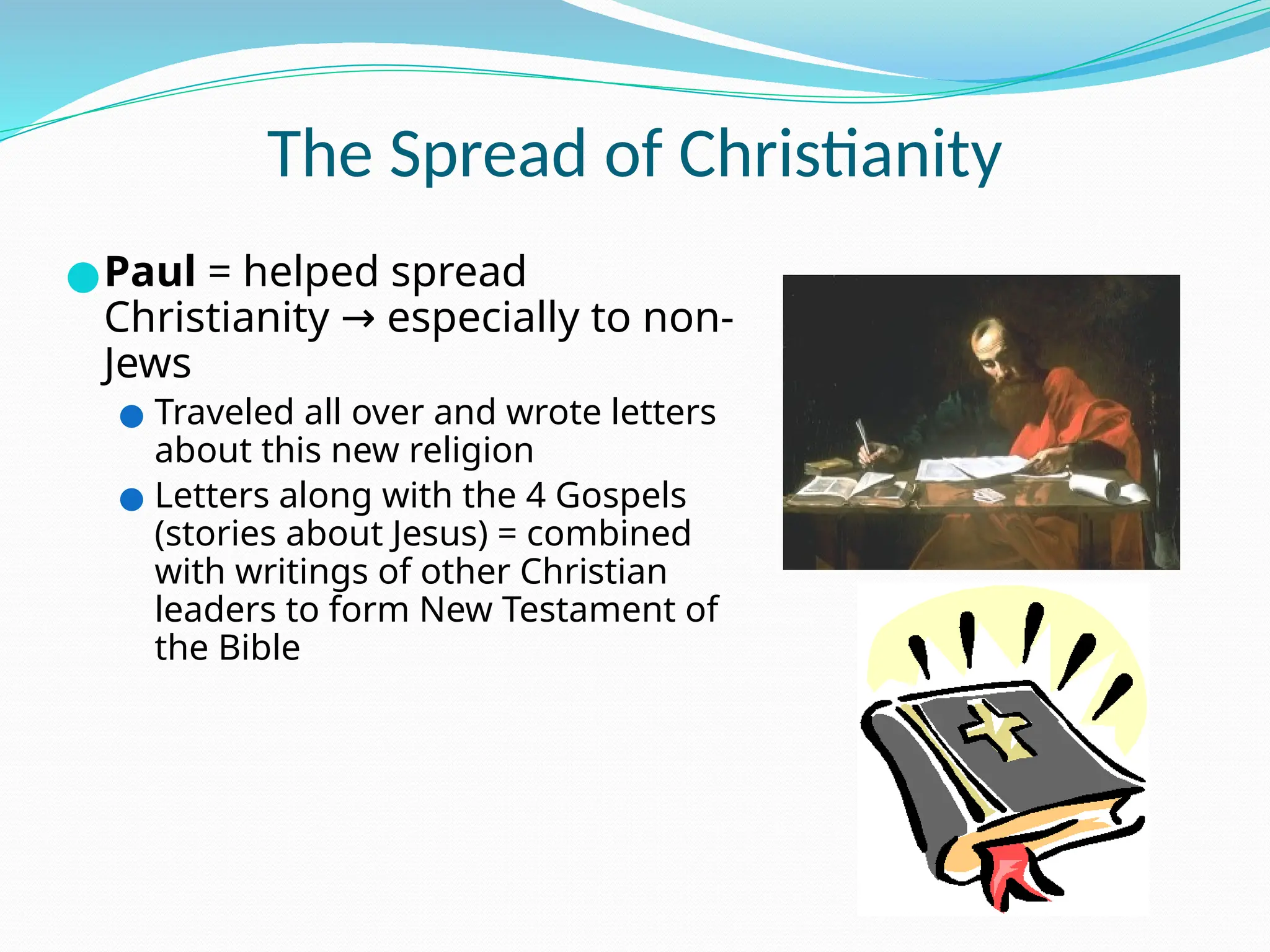
●Paul = helped spread
Christianity especially to non-
→
Jews
● Traveled all over and wrote letters
about this new religion
● Letters along with the 4 Gospels
(stories about Jesus) = combined
with writings of other Christian
leaders to form New Testament of
the Bible
The Spread of Christianity
●Apostles = Christian
missionaries that
spread Christianity in
Roman world
●Peter = leader of the
apostles founded a
→
church in Rome
Persecution & Competition
●Christians refused to honor the Roman emperor as a
god & rejected military service --> many Romans
accused them of treason
●Christians seen as causing trouble could be killed
●Christian martyrs = people who died for their
beliefs - were often killed by wild beasts in front of
cheering crowds
Persecution & Competition
● Mainly a religion of the cities (so was Judaism)
● Traditional Roman religion = had a stronghold in
the countryside
▪ Problems for Christians:
1. Hard to get followers because followers often
persecuted
2. Had to compete with other polytheistic &
mythical religions, as well as Judaism, for
followers
Romans Adopt Christianity
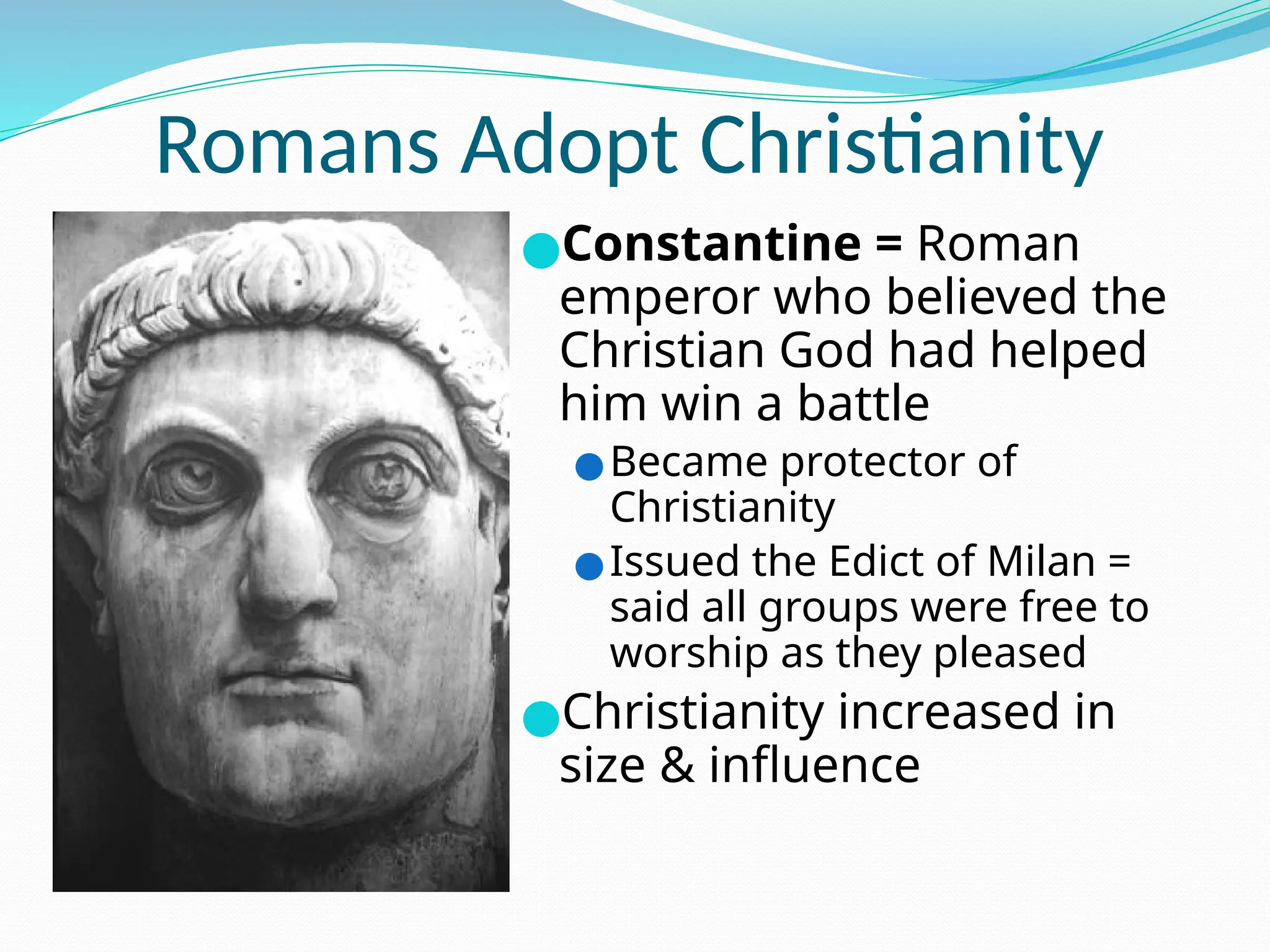
●Constantine = Roman
emperor who believed the
Christian God had helped
him win a battle
●Became protector of
Christianity
●Issued the Edict of Milan =
said all groups were free to
worship as they pleased
●Christianity increased in
size & influence
Romans Adopt Christianity
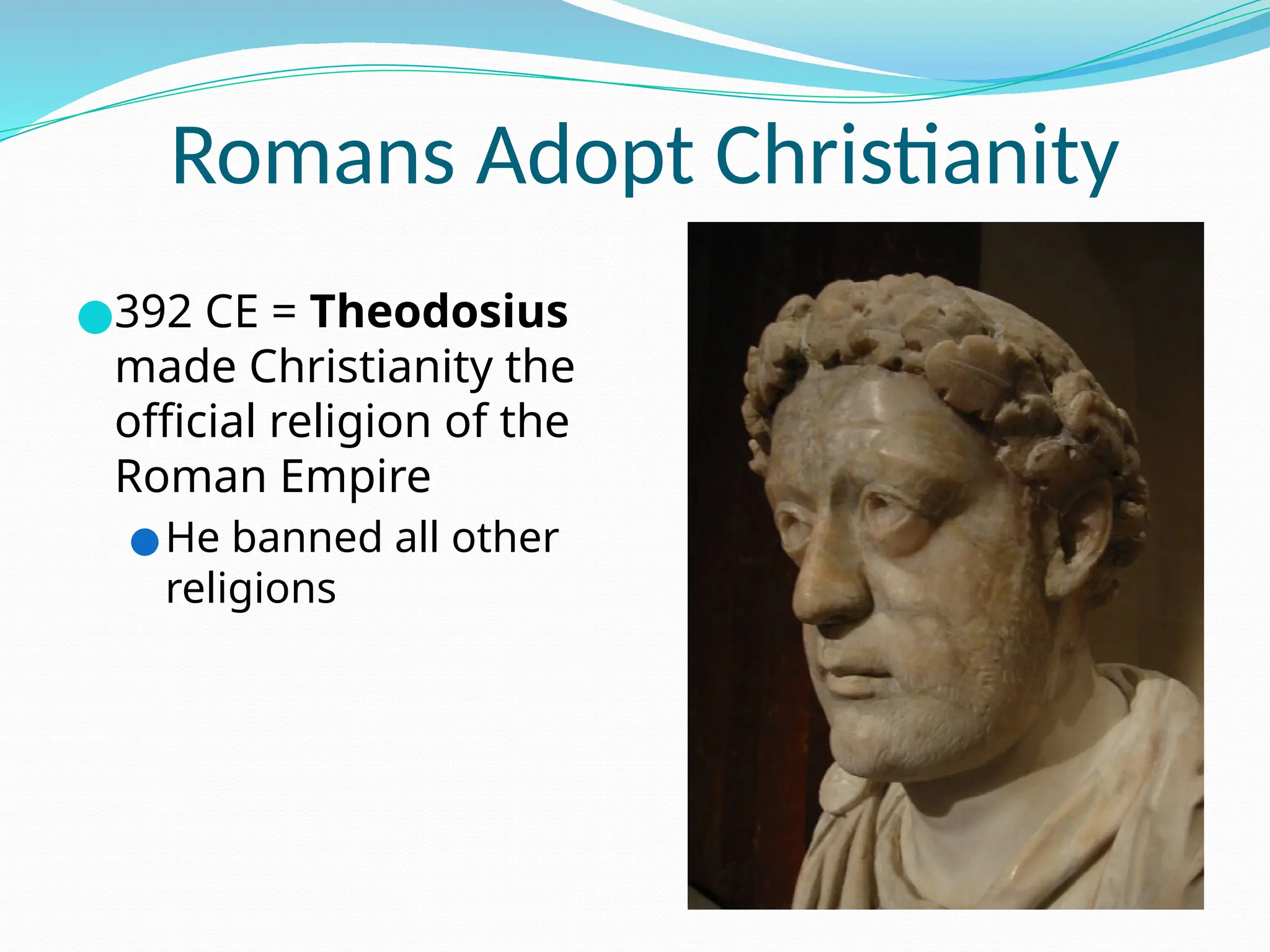
●392 CE = Theodosius
made Christianity the
official religion of the
Roman Empire
●He banned all other
religions
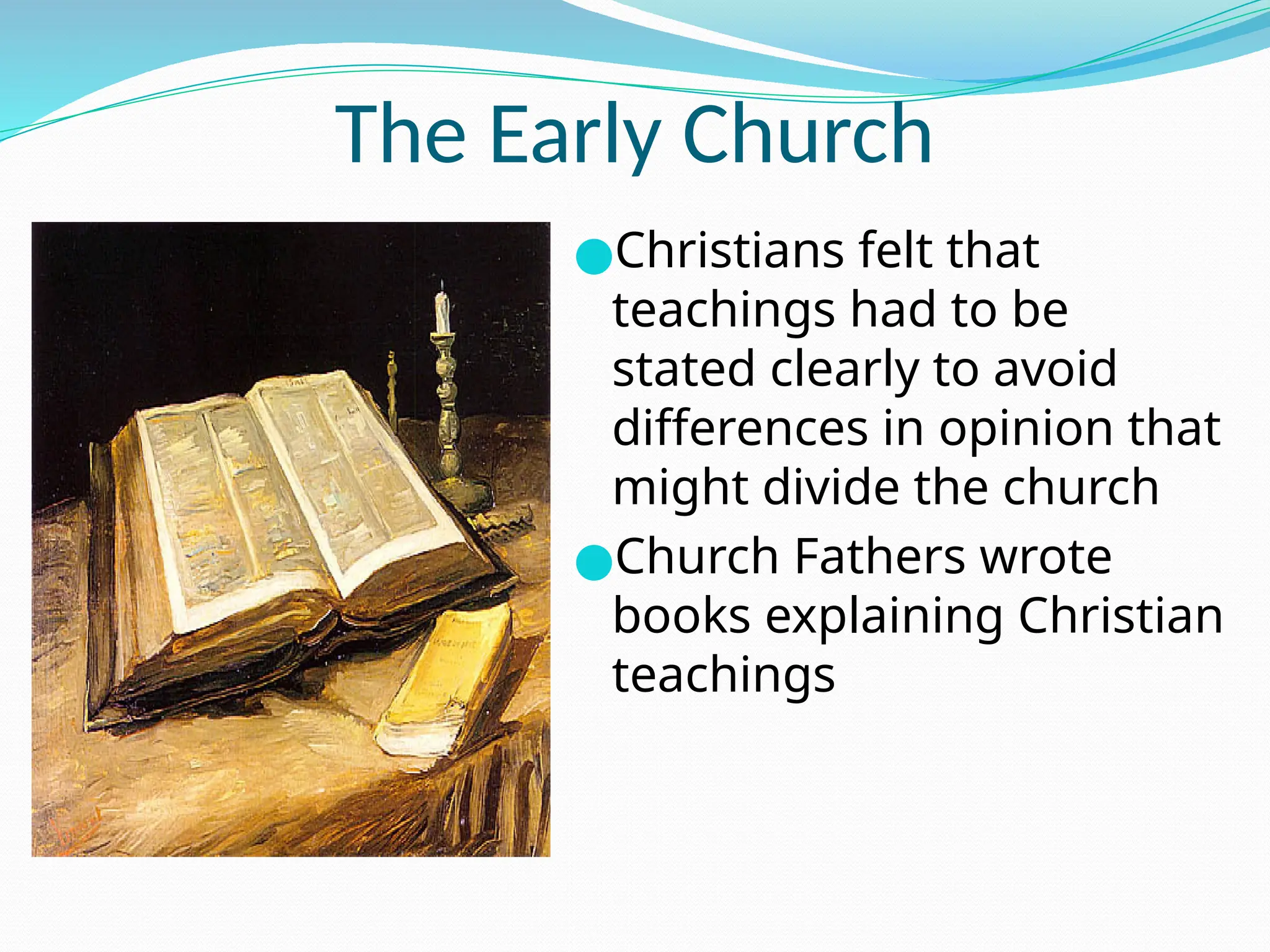
The Early Church
●Christians felt that
teachings had to be
stated clearly to avoid
differences in opinion that
might divide the church
●Church Fathers wrote
books explaining Christian
teachings
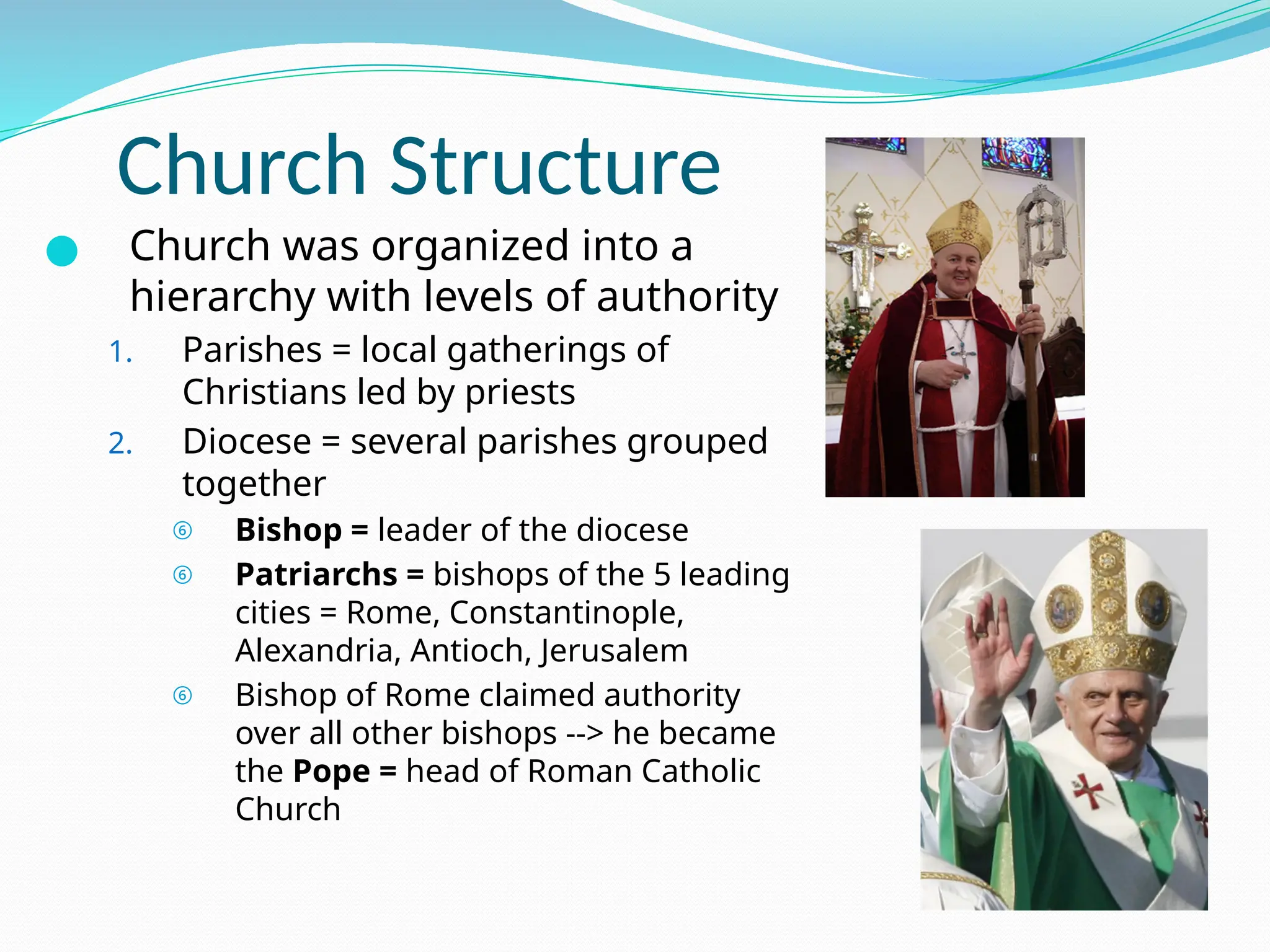
Church Structure
● Church was organized into a
hierarchy with levels of authority
1. Parishes = local gatherings of
Christians led by priests
2. Diocese = several parishes grouped
together
⑥ Bishop = leader of the diocese
⑥ Patriarchs = bishops of the 5 leading
cities = Rome, Constantinople,
Alexandria, Antioch, Jerusalem
⑥ Bishop of Rome claimed authority
over all other bishops --> he became
the Pope = head of Roman Catholic
Church
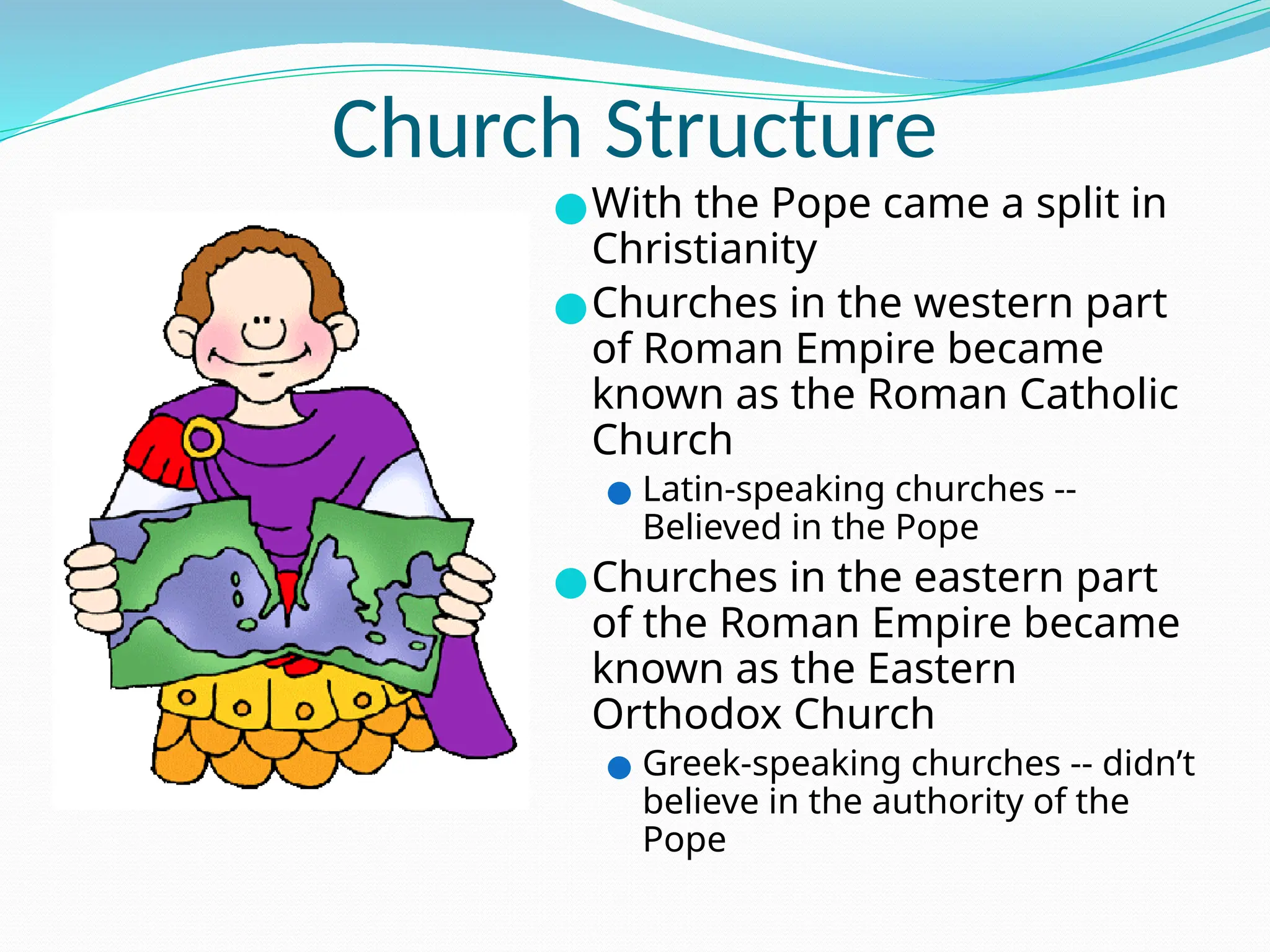
Church Structure
●With the Pope came a split in
Christianity
●Churches in the western part
of Roman Empire became
known as the Roman Catholic
Church
● Latin-speaking churches --
Believed in the Pope
●Churches in the eastern part
of the Roman Empire became
known as the Eastern
Orthodox Church
● Greek-speaking churches -- didn’t
believe in the authority of the
Pope

Moving towards Monotheism AP World History

  • 1.
    Moving Toward Monotheism APWorld History Notes Chapter 5 Eurasian Cultural Traditions
  • 2.
    Moving toward Monotheism ●Zoroastrianism= emerged in the Persian Empire around the 6th or 7th century BCE ●Followed the teachings of prophet named Zoroaster ● Said there was a struggle between good and evil in the world ● Ahura Mazda vs. Angra Mainyu ● Humans caught in the middle of this struggle and had to choose sides ● Humans who chose good would get eternal life ● Humans who chose evil would get darkness & misery after death ● Big emphasis on the free will of humankind
  • 3.
    Zoroastrianism ●Did not spreadwidely beyond the Middle East because it was not an active missionary religion ●Invasions of Alexander the Great devastated Zoroastrianism temples destroyed, priests → slaughtered, sacred writings burned ●Arrival of Islam in the Middle East also led to the final decline of Zoroastrianism
  • 4.
    Zoroastrianism ●Elements that remainwithin Judaism and Christianity: ●Good versus evil ●God versus an evil counterpart ●Idea of a last judgment & resurrected bodies ●Belief in final defeat of evil ●Arrival of a savior (Messiah) ●Remaking of the world at the end of time
  • 5.
    The Israelites ●Most culturesof the ancient world worshipped many gods ●The Israelites (living in Canaan) = monotheistic = belief in only 1 God ●Commands of God revealed by prophets = holy messengers ●God called: Yahweh ●Yahweh determined right & wrong and the people had to accept moral responsibility for their actions
  • 6.
    The Israelites ●Teachings ofthe Israelites exist today as religion of Judaism ●Shares many beliefs with Christianity and Islam
  • 7.
    The Land ofCanaan ●Bible remains one of the main sources of ancient history in Fertile Crescent ● Bible traces origins of the Israelites to Abraham = herder/trader from Ur in Mesopotamia ● Says God made a covenant (agreement) with Abraham to make a great nation for the Hebrews ● Traveled to Canaan --> shared land with Phoenicians & Philistines
  • 8.
    The Land ofCanaan ●Many people in Canaan lived as nomads herding sheep and goats ●Usually wandered around valley of Jordan River = farming land
  • 9.
    The Exodus fromEgypt ●Abraham’s grandson Jacob raised 12 sons in Canaan ●Each son led a separate tribe = family group ●12 tribes migrated to Egypt to escape famine --> eventually were enslaved by the Egyptians
  • 10.
    The Exodus from Egypt ●ProphetMoses led the Israelites out of Egypt to the Sinai Desert in a mass exodus = departure ●During the journey, God gave Moses the 10 commandments ●Exodus story retold by Jewish people at Passover every year
  • 11.
    Settling the Land ●Mosesdied before arrival at Canaan --> successor, Joshua, led Israelites ●For 200 years = Israelites fought the Philistines for control of the land ●Lack of unity among the 12 tribes made fighting difficult ●Continued warfare led tribes to unite under 1 king = Saul
  • 12.
    Settling the Land ●Saulcouldn’t help them defeat Philistines & David took the throne ●David was popular because he defeated the Philistine Goliath ●David set up capital of Jerusalem ●Set up a central government, enlarged the kingdom’s borders, brought economic prosperity
  • 13.
    Settling the Land ●David’sson Solomon took over after him ●Unpopular because he made high taxes to pay for new cities and temples ●After his death, 10 northern tribes broke away from 2 southern tribes ● Northern tribes kept the name Israel ● Southern tribes took the name Judah
  • 14.
    Exile and Return ●2kingdoms were too weak to resist invaders ●722 BCE = Assyrians (from Mesopotamia) conquered Israel ●586 BCE = Chaldeans (from Mesopotamia) gained control of Judah
  • 15.
    Exile and Return ●Israeliteswere enslaved and exiled to Babylon ●During this time, the Jews had no temple so they met on the holy day of rest together for study and prayer ●Rise of synagogues developed from these gatherings
  • 16.
    Exile and Return ●539BCE = Persians conquered the Chaldeans ●Persian king allowed the Jews to return to Judah and to rebuild the temple
  • 17.
    Exile and Return ●400sBCE = Jewish holy writings organized into the Torah = made up the first 5 books of the Bible ●Since this time, Jewish communities have existed outside their homeland = called Jewish Diaspora
  • 18.
    A Lasting Legacy ●Jewsrecorded their history & examined it for meaning ●Prophets recorded their teachings ●Jewish religious beliefs & principles helped shape Christianity in the future
  • 19.
    Recap of Religionin Ancient Rome ●Early Romans worshipped nature spirits ●Romans then adopted Greek religion and gave gods Roman names ●Under Augustus: people expected to honor the emperor as Rome’s chief priest Jupiter Bacchus Minerva
  • 20.
    Recap of Religionin Ancient Rome ●But empire’s people allowed to worship freely ●Many religions existed in the Roman Empire ●Some Jews began practicing a new religion called Christianity ●Considered a sect (group) within Judaism at first ●Became a separate religion
  • 21.
    Judaism & theEmpire ●6 CE = Augustus turned kingdom of Judah into Roman province of Judea ●Jews in Judea allowed to practice their religion, but treated very cruelly ●They hoped a messiah = deliverer chosen by god = would help them regain their freedom
  • 22.
    Judaism & theEmpire ●66 CE = Jews rebelled against Romans & took over Jerusalem ●4 years later = Romans retook Jerusalem, destroyed the Temple, and killed thousands of Jews ●Romans banned the Jews from living in Jerusalem
  • 23.
    Judaism & theEmpire ●Jews continued to study the Torah in scattered communities throughout the Middle East ●Jews set up yeshivas = special schools to train rabbis ●Rabbis created the Talmud = important book of Jewish law
  • 24.
    Jesus of Nazareth ●Jesuspreached a new message to his fellow Jews ●Traveled throughout Galilee and Judea ●Gained disciples = followers ●Said God was loving and forgiving ●Often used parables = symbolic stories
  • 25.
    Jesus of Nazareth ●Disciplesbelieved Jesus was the Messiah ●Other Jews disputed this – believed the Messiah had not come yet
  • 26.
    Jesus of Nazareth ●Romanofficials were troubled by the controversy over Jesus ●Roman governor Pontius Pilate arrested Jesus & ordered that he be crucified
  • 27.
    The Spread ofChristianity ●After Jesus' death, his disciples said he had risen from the dead ●They began preaching that Jesus was the Son of God ●Those who accepted this message = called Christians ●Christians formed own churches for worship, fellowship, and instruction
  • 28.
    The Spread ofChristianity ●Paul = helped spread Christianity especially to non- → Jews ● Traveled all over and wrote letters about this new religion ● Letters along with the 4 Gospels (stories about Jesus) = combined with writings of other Christian leaders to form New Testament of the Bible
  • 29.
    The Spread ofChristianity ●Apostles = Christian missionaries that spread Christianity in Roman world ●Peter = leader of the apostles founded a → church in Rome
  • 30.
    Persecution & Competition ●Christiansrefused to honor the Roman emperor as a god & rejected military service --> many Romans accused them of treason ●Christians seen as causing trouble could be killed ●Christian martyrs = people who died for their beliefs - were often killed by wild beasts in front of cheering crowds
  • 31.
    Persecution & Competition ●Mainly a religion of the cities (so was Judaism) ● Traditional Roman religion = had a stronghold in the countryside ▪ Problems for Christians: 1. Hard to get followers because followers often persecuted 2. Had to compete with other polytheistic & mythical religions, as well as Judaism, for followers
  • 32.
    Romans Adopt Christianity ●Constantine= Roman emperor who believed the Christian God had helped him win a battle ●Became protector of Christianity ●Issued the Edict of Milan = said all groups were free to worship as they pleased ●Christianity increased in size & influence
  • 33.
    Romans Adopt Christianity ●392CE = Theodosius made Christianity the official religion of the Roman Empire ●He banned all other religions
  • 34.
    The Early Church ●Christiansfelt that teachings had to be stated clearly to avoid differences in opinion that might divide the church ●Church Fathers wrote books explaining Christian teachings
  • 35.
    Church Structure ● Churchwas organized into a hierarchy with levels of authority 1. Parishes = local gatherings of Christians led by priests 2. Diocese = several parishes grouped together ⑥ Bishop = leader of the diocese ⑥ Patriarchs = bishops of the 5 leading cities = Rome, Constantinople, Alexandria, Antioch, Jerusalem ⑥ Bishop of Rome claimed authority over all other bishops --> he became the Pope = head of Roman Catholic Church
  • 36.
    Church Structure ●With thePope came a split in Christianity ●Churches in the western part of Roman Empire became known as the Roman Catholic Church ● Latin-speaking churches -- Believed in the Pope ●Churches in the eastern part of the Roman Empire became known as the Eastern Orthodox Church ● Greek-speaking churches -- didn’t believe in the authority of the Pope