COGNITIVE WIRELESS
COMMUNICATIONS ON
SOFTWARE-DEFINED RADIOS
JONATHAN BRESSLER, GEORGE SKLIVANITIS, DR. STELLA BATALAMA
UNIVERSITY AT BUFFALO
DEPARTMENT OF ELECTRICAL ENGINEERING
SIGNALS, COMMUNICATIONS, AND NETWORKING GROUP
PROBLEMS WITH CURRENT WIRELESS
COMMUNICATIONS
OVERABUNDANCE OF DEVICES
• An overcrowded electromagnetic spectrum causes slow wireless
communication speeds, dropped signals, and energy waste [1]
• ≈8 billion wireless devices in circulation in 2015 with ≈50
billion wireless devices projected to be in circulation by 2020
[2]
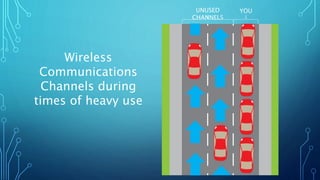
UNUSED
CHANNELS
YOU
Wireless
Communications
Channels during
times of heavy use
HARDWARE - DEFINED
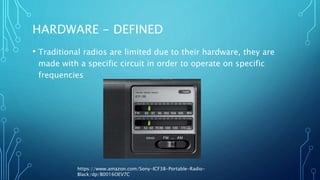
• Traditional radios are limited due to their hardware, they are
made with a specific circuit in order to operate on specific
frequencies
https://www.amazon.com/Sony-ICF38-Portable-Radio-
Black/dp/B0016OEV7C
WASTED POTENTIAL
• Current wireless communication systems/networks do not take
advantage of unused spectrum
• According to the FCC and other wireless communications
companies, large bands of radio waves assigned to wireless
devices are often unused while other bands are slowed down
due to overcrowding [3]
WHY SOFTWARE-DEFINED COGNITIVE
RADIOS?
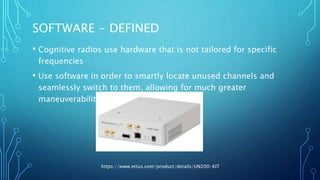
SOFTWARE - DEFINED
• Cognitive radios use hardware that is not tailored for specific
frequencies
• Use software in order to smartly locate unused channels and
seamlessly switch to them, allowing for much greater
maneuverability and adaptability
https://www.ettus.com/product/details/UN200-KIT
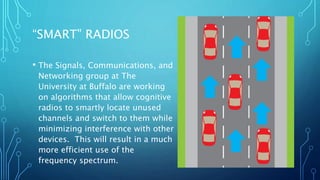
“SMART” RADIOS
• The Signals, Communications, and
Networking group at The
University at Buffalo are working
on algorithms that allow cognitive
radios to smartly locate unused
channels and switch to them while
minimizing interference with other
devices. This will result in a much
more efficient use of the
frequency spectrum.
BASIC PRINCIPLES
Digital Communications Theory
• Provides understanding of cognitive radio operations (data transmission,
digital modulation/demodulation techniques, pulse shaping, etc.)
Software Simulation Tools
• GNU Radio
• MATLAB
Hardware Tools
• External RF hardware integration (USRP-B210 and USRP-N210)
METHOD
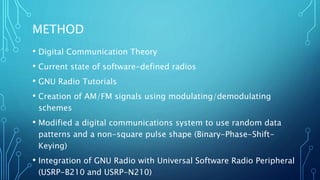
• Digital Communication Theory
• Current state of software-defined radios
• GNU Radio Tutorials
• Creation of AM/FM signals using modulating/demodulating
schemes
• Modified a digital communications system to use random data
patterns and a non-square pulse shape (Binary-Phase-Shift-
Keying)
• Integration of GNU Radio with Universal Software Radio Peripheral
(USRP-B210 and USRP-N210)
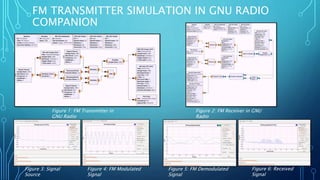
FM TRANSMITTER SIMULATION IN GNU RADIO
COMPANION
Figure 1: FM Transmitter in
GNU Radio
Figure 2: FM Receiver in GNU
Radio
Figure 3: Signal
Source
Figure 4: FM Modulated
Signal
Figure 5: FM Demodulated
Signal
Figure 6: Received
Signal
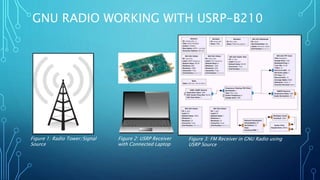
GNU RADIO WORKING WITH USRP-B210
Figure 1: Radio Tower/Signal
Source
Figure 2: USRP Receiver
with Connected Laptop
Figure 3: FM Receiver in GNU Radio using
USRP Source
FUTURE CHALLENGES
FREQUENCY SWITCHING AND THE FCC
• The Federal Communications Commission of The United States
of America does not allow most devices to switch from one
frequency spectrum to another [4]
• This is to enforce spectrum regulation so that devices do not
interfere with other devices (ex. commercial radio systems
interfering with Naval communications) and allocated the
remaining spectrum on the basis of “public interest,
convenience, or necessity.”
AIRBORNE NETWORKS
• Variable network dynamics across geographically or
hierarchically dispersed and mobile wireless nodes [5]
• SDR architecture with self-reconfigurable functionalities that
can be controlled through a program [5]
UNDERWATER ACOUSTIC NETWORKS
• Sound waves are used due to radio waves not working well in
underwater environments [3]
• Suffer from high path loss, long propagation delay and Doppler
[3]
• Lack in standardization and energy efficiency [5]
• Software-defined acoustic modems that intelligently evaluate
and adapt their communication parameters to maximize
spectral efficiency [5]
REFERENCES
• [1] C. Nealon, "Making wireless 10 times faster - University at Buffalo",
Buffalo.edu, 2014. [Online]. Available:
https://www.buffalo.edu/news/releases/2014/05/004.html. [Accessed: 07-
Jul- 2016].
• [2] http://www.cisco.com/c/en/us/solutions/collateral/service-
provider/visual-networking-index-vni/mobile-white-paper-c11-
520862.html
• [3] https://www.buffalo.edu/news/releases/2014/05/004.html
• [4] http://people.eecs.berkeley.edu/~sahai/Theses/Kristen_MSThesis.pdf
• [5] G. Sklivanitis, A. Gannon, S. N. Batalama, and D. A. Pados, "Addressing
next-generation wireless challenges with commercial software-defined
radio platforms," in IEEE Communications Magazine, vol.54, no.1, pp.59-67,
Jan. 2016.
ACKNOWLEDGEMENTS
I would like to thank George Sklivanitis, Dr. Stella Batalama, and
the graduate students in the Signals, Communications and
Networking group at the University at Buffalo for helping me
throughout this research project. Also, thanks to the UB LSAMP
program for giving me the opportunity to perform research this
summer.
QUESTIONS?

JonathanBressler_OralPresentation

  • 1.
    COGNITIVE WIRELESS COMMUNICATIONS ON SOFTWARE-DEFINEDRADIOS JONATHAN BRESSLER, GEORGE SKLIVANITIS, DR. STELLA BATALAMA UNIVERSITY AT BUFFALO DEPARTMENT OF ELECTRICAL ENGINEERING SIGNALS, COMMUNICATIONS, AND NETWORKING GROUP
  • 2.
    PROBLEMS WITH CURRENTWIRELESS COMMUNICATIONS
  • 3.
    OVERABUNDANCE OF DEVICES •An overcrowded electromagnetic spectrum causes slow wireless communication speeds, dropped signals, and energy waste [1] • ≈8 billion wireless devices in circulation in 2015 with ≈50 billion wireless devices projected to be in circulation by 2020 [2]
  • 4.
  • 5.
    HARDWARE - DEFINED •Traditional radios are limited due to their hardware, they are made with a specific circuit in order to operate on specific frequencies https://www.amazon.com/Sony-ICF38-Portable-Radio- Black/dp/B0016OEV7C
  • 6.
    WASTED POTENTIAL • Currentwireless communication systems/networks do not take advantage of unused spectrum • According to the FCC and other wireless communications companies, large bands of radio waves assigned to wireless devices are often unused while other bands are slowed down due to overcrowding [3]
  • 7.
  • 8.
    SOFTWARE - DEFINED •Cognitive radios use hardware that is not tailored for specific frequencies • Use software in order to smartly locate unused channels and seamlessly switch to them, allowing for much greater maneuverability and adaptability https://www.ettus.com/product/details/UN200-KIT
  • 9.
    “SMART” RADIOS • TheSignals, Communications, and Networking group at The University at Buffalo are working on algorithms that allow cognitive radios to smartly locate unused channels and switch to them while minimizing interference with other devices. This will result in a much more efficient use of the frequency spectrum.
  • 10.
    BASIC PRINCIPLES Digital CommunicationsTheory • Provides understanding of cognitive radio operations (data transmission, digital modulation/demodulation techniques, pulse shaping, etc.) Software Simulation Tools • GNU Radio • MATLAB Hardware Tools • External RF hardware integration (USRP-B210 and USRP-N210)
  • 11.
    METHOD • Digital CommunicationTheory • Current state of software-defined radios • GNU Radio Tutorials • Creation of AM/FM signals using modulating/demodulating schemes • Modified a digital communications system to use random data patterns and a non-square pulse shape (Binary-Phase-Shift- Keying) • Integration of GNU Radio with Universal Software Radio Peripheral (USRP-B210 and USRP-N210)
  • 12.
    FM TRANSMITTER SIMULATIONIN GNU RADIO COMPANION Figure 1: FM Transmitter in GNU Radio Figure 2: FM Receiver in GNU Radio Figure 3: Signal Source Figure 4: FM Modulated Signal Figure 5: FM Demodulated Signal Figure 6: Received Signal
  • 13.
    GNU RADIO WORKINGWITH USRP-B210 Figure 1: Radio Tower/Signal Source Figure 2: USRP Receiver with Connected Laptop Figure 3: FM Receiver in GNU Radio using USRP Source
  • 14.
  • 15.
    FREQUENCY SWITCHING ANDTHE FCC • The Federal Communications Commission of The United States of America does not allow most devices to switch from one frequency spectrum to another [4] • This is to enforce spectrum regulation so that devices do not interfere with other devices (ex. commercial radio systems interfering with Naval communications) and allocated the remaining spectrum on the basis of “public interest, convenience, or necessity.”
  • 16.
    AIRBORNE NETWORKS • Variablenetwork dynamics across geographically or hierarchically dispersed and mobile wireless nodes [5] • SDR architecture with self-reconfigurable functionalities that can be controlled through a program [5]
  • 17.
    UNDERWATER ACOUSTIC NETWORKS •Sound waves are used due to radio waves not working well in underwater environments [3] • Suffer from high path loss, long propagation delay and Doppler [3] • Lack in standardization and energy efficiency [5] • Software-defined acoustic modems that intelligently evaluate and adapt their communication parameters to maximize spectral efficiency [5]
  • 18.
    REFERENCES • [1] C.Nealon, "Making wireless 10 times faster - University at Buffalo", Buffalo.edu, 2014. [Online]. Available: https://www.buffalo.edu/news/releases/2014/05/004.html. [Accessed: 07- Jul- 2016]. • [2] http://www.cisco.com/c/en/us/solutions/collateral/service- provider/visual-networking-index-vni/mobile-white-paper-c11- 520862.html • [3] https://www.buffalo.edu/news/releases/2014/05/004.html • [4] http://people.eecs.berkeley.edu/~sahai/Theses/Kristen_MSThesis.pdf • [5] G. Sklivanitis, A. Gannon, S. N. Batalama, and D. A. Pados, "Addressing next-generation wireless challenges with commercial software-defined radio platforms," in IEEE Communications Magazine, vol.54, no.1, pp.59-67, Jan. 2016.
  • 19.
    ACKNOWLEDGEMENTS I would liketo thank George Sklivanitis, Dr. Stella Batalama, and the graduate students in the Signals, Communications and Networking group at the University at Buffalo for helping me throughout this research project. Also, thanks to the UB LSAMP program for giving me the opportunity to perform research this summer.
  • 20.