I.C.T
INTRODUCTION TO TELECOMMUNICATION
CHAPTER 02
INTRODUCTION TO TELECOMMUNICATION
TELECOMMUNICATIONS
TERMINOLOGY
CHAPTER 02
INTRODUCTION TO TELECOMMUNICATION
2.1 RADIO FREQUENCY (RF)
Agenda
 Introduction to wireless communications
 Wireless link implications
 Medium: the radio spectrum
 The three main parameters that define radio–frequency:
 Over-the-air data rate
 Receive Sensitivity
 Transmit power
 Other Considerations
 Barriers to Future Growth
Introduction
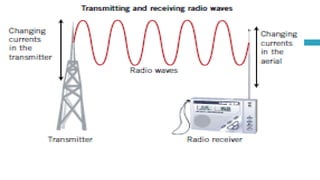
 Wireless Communication System: Any electrical communication
system that uses a naturally occurring communication channel,
such as air, water, earth.
 Examples:
 Sonar
 Broadcast: Radio, TV, pagers, satellite TV, etc.
 Two Way: walkie talkie, cell phones, satellite phones,
 Wireless Local Area Networks, etc.
Wireless link implications
 Communications channel is natural (air)
 Medium regulated by governments
 frequency allocation, licensing, etc.
 Security issues
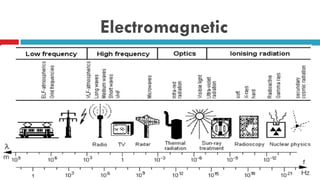
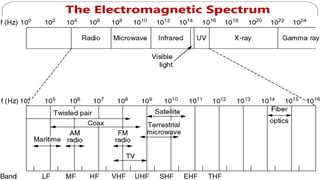
Medium: the radio spectrum
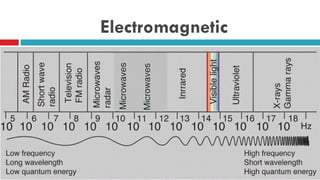
 Wireless communications use the electromagnetic
spectrum, which is regulated by government
institutions such as the Federal Communications
Commission (FCC) in USA.
Electromagnetic
Electromagnetic
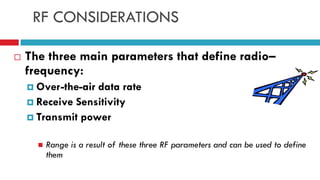
RF CONSIDERATIONS
 The three main parameters that define radio–
frequency:
 Over-the-air data rate
 Receive Sensitivity
 Transmit power
 Range is a result of these three RF parameters and can be used to define
them
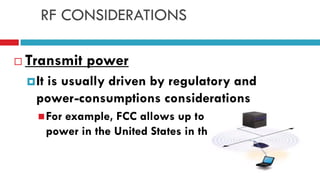
RF CONSIDERATIONS
 Transmit power
It is usually driven by regulatory and
power-consumptions considerations
For example, FCC allows up to 1 W of transmit
power in the United States in the 2.4 Ghz band
Other Considerations
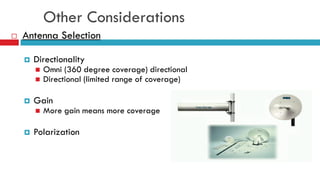
 Antenna Selection
 Directionality
 Omni (360 degree coverage) directional
 Directional (limited range of coverage)
 Gain
 More gain means more coverage
 Polarization
Other Considerations
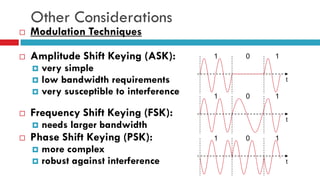
 Modulation Techniques
 Amplitude Shift Keying (ASK):
 very simple
 low bandwidth requirements
 very susceptible to interference
 Frequency Shift Keying (FSK):
 needs larger bandwidth
 Phase Shift Keying (PSK):
 more complex
 robust against interference
1 0 1
t
1 0 1
t
1 0 1
t
Range Depends On...
 Frequency
 Transmit power
 Radio sensitivity
 Processing gain from access technique and
redundancy
 Interference effects
Barriers to Future Growth
 Irreducible size of antennas
 Rising level of RF emissions -
interference problems and safety concerns
 Finite spectrum
 Lack of standards and interoperability of hardware
MICROWAVE
COMMUNICATION
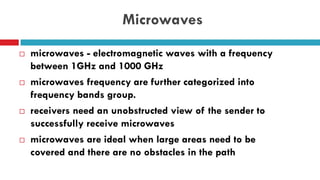
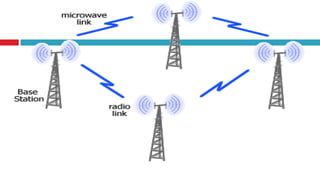
Microwaves
 microwaves - electromagnetic waves with a frequency
between 1GHz and 1000 GHz
 microwaves frequency are further categorized into
frequency bands group.
 receivers need an unobstructed view of the sender to
successfully receive microwaves
 microwaves are ideal when large areas need to be
covered and there are no obstacles in the path
Electromagnetic
Advantages of microwaves over radio waves
 because of high frequency, more data can be sent through
microwaves -> increased bandwidth, higher speeds
 because of their short wave length, microwaves use smaller
antennas
 smaller antennas produce a more focused beam which is
difficult to intercept
Disadvantages of microwave communication
 they require no obstacle is present in the transmission path
 the cost of implementing the communication infrastructure is
high
 microwaves are susceptible to rain, snow, electromagnetic
interference
Microwaves usages
 carrier waves in satellite communications
 cellular communication
 wireless local area network
 GPS (Global Positioning System)
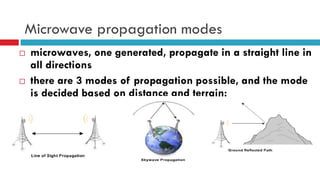
Microwave propagation modes
 microwaves, one generated, propagate in a straight line in
all directions
 there are 3 modes of propagation possible, and the mode
is decided based on distance and terrain:
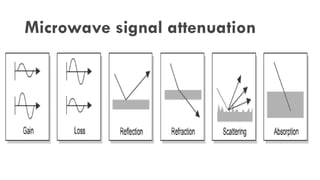
Microwave signal attenuation
SATELLITE
COMMUNICATION
Overview
 Satellite is a microwave repeater in the space.
 There are about 750 satellite in the space, most
of them are used for communication.
 They are:
 Wide area coverage of the earth’s surface.
 Transmission delay is about 0.3 sec.
 Transmission cost is independent of distance.
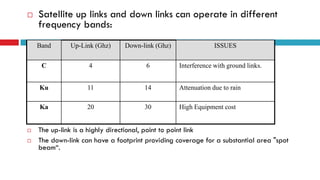
 Satellite up links and down links can operate in different
frequency bands:
 The up-link is a highly directional, point to point link
 The down-link can have a footprint providing coverage for a substantial area "spot
beam“.
Band Up-Link (Ghz) Down-link (Ghz) ISSUES
C 4 6 Interference with ground links.
Ku 11 14 Attenuation due to rain
Ka 20 30 High Equipment cost
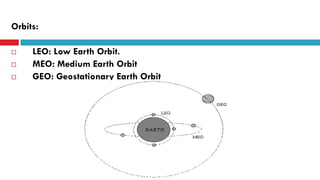
Orbits:
 LEO: Low Earth Orbit.
 MEO: Medium Earth Orbit
 GEO: Geostationary Earth Orbit
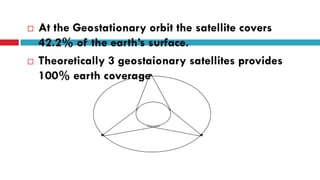
 At the Geostationary orbit the satellite covers
42.2% of the earth’s surface.
 Theoretically 3 geostaionary satellites provides
100% earth coverage
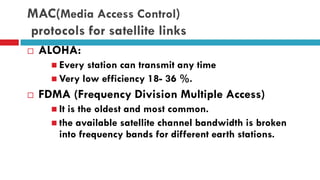
MAC(Media Access Control)
protocols for satellite links
 ALOHA:
 Every station can transmit any time
 Very low efficiency 18- 36 %.
 FDMA (Frequency Division Multiple Access)
 It is the oldest and most common.
 the available satellite channel bandwidth is broken
into frequency bands for different earth stations.
 TDMA (Time Division Multiple Access)
 channels are time multiplexed sequentially
 Each earth station gets to transmit in a fixed time slot
only.
 More than one time slot can be assigned to stations with
more bandwidth requirements.
 Requires time synchronization between the Earth
Stations.
 CDMA : (Code Division Multiple Access)
 Combination of time/frequency multiplexing
( a form of spread spectrum modulation).
 It provides a decentralized way of providing separate
channels without timing synchronization. It is a
relatively new scheme but is expected to be more
common in future satellites.
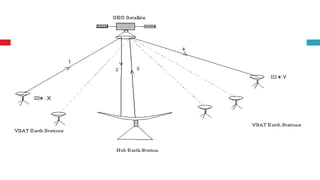
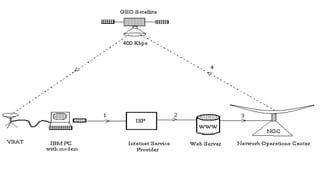
VSAT Network
 At the Very Small Aperture Terminal a lower performance
microwave transceiver and lower gain dish antenna
(smaller size) is used.
 VSAT networks are arranged in a star based topology.
 Ideal for centralized networks with a central host (Banking
institutions with branches all over the country).
 Use the S-ALOHA and TDMA
THANK YOU FOR YOUR TIME

Ch 02 telecommunications terminology

  • 1.
  • 2.
    CHAPTER 02 INTRODUCTION TOTELECOMMUNICATION TELECOMMUNICATIONS TERMINOLOGY
  • 3.
    CHAPTER 02 INTRODUCTION TOTELECOMMUNICATION 2.1 RADIO FREQUENCY (RF)
  • 4.
    Agenda  Introduction towireless communications  Wireless link implications  Medium: the radio spectrum  The three main parameters that define radio–frequency:  Over-the-air data rate  Receive Sensitivity  Transmit power  Other Considerations  Barriers to Future Growth
  • 5.
    Introduction  Wireless CommunicationSystem: Any electrical communication system that uses a naturally occurring communication channel, such as air, water, earth.  Examples:  Sonar  Broadcast: Radio, TV, pagers, satellite TV, etc.  Two Way: walkie talkie, cell phones, satellite phones,  Wireless Local Area Networks, etc.
  • 6.
    Wireless link implications Communications channel is natural (air)  Medium regulated by governments  frequency allocation, licensing, etc.  Security issues
  • 7.
    Medium: the radiospectrum  Wireless communications use the electromagnetic spectrum, which is regulated by government institutions such as the Federal Communications Commission (FCC) in USA.
  • 8.
  • 9.
  • 10.
    RF CONSIDERATIONS  Thethree main parameters that define radio– frequency:  Over-the-air data rate  Receive Sensitivity  Transmit power  Range is a result of these three RF parameters and can be used to define them
  • 11.
    RF CONSIDERATIONS  Transmitpower It is usually driven by regulatory and power-consumptions considerations For example, FCC allows up to 1 W of transmit power in the United States in the 2.4 Ghz band
  • 12.
    Other Considerations  AntennaSelection  Directionality  Omni (360 degree coverage) directional  Directional (limited range of coverage)  Gain  More gain means more coverage  Polarization
  • 13.
    Other Considerations  ModulationTechniques  Amplitude Shift Keying (ASK):  very simple  low bandwidth requirements  very susceptible to interference  Frequency Shift Keying (FSK):  needs larger bandwidth  Phase Shift Keying (PSK):  more complex  robust against interference 1 0 1 t 1 0 1 t 1 0 1 t
  • 14.
    Range Depends On... Frequency  Transmit power  Radio sensitivity  Processing gain from access technique and redundancy  Interference effects
  • 15.
    Barriers to FutureGrowth  Irreducible size of antennas  Rising level of RF emissions - interference problems and safety concerns  Finite spectrum  Lack of standards and interoperability of hardware
  • 16.
  • 17.
    Microwaves  microwaves -electromagnetic waves with a frequency between 1GHz and 1000 GHz  microwaves frequency are further categorized into frequency bands group.  receivers need an unobstructed view of the sender to successfully receive microwaves  microwaves are ideal when large areas need to be covered and there are no obstacles in the path
  • 18.
  • 21.
    Advantages of microwavesover radio waves  because of high frequency, more data can be sent through microwaves -> increased bandwidth, higher speeds  because of their short wave length, microwaves use smaller antennas  smaller antennas produce a more focused beam which is difficult to intercept
  • 22.
    Disadvantages of microwavecommunication  they require no obstacle is present in the transmission path  the cost of implementing the communication infrastructure is high  microwaves are susceptible to rain, snow, electromagnetic interference
  • 23.
    Microwaves usages  carrierwaves in satellite communications  cellular communication  wireless local area network  GPS (Global Positioning System)
  • 24.
    Microwave propagation modes microwaves, one generated, propagate in a straight line in all directions  there are 3 modes of propagation possible, and the mode is decided based on distance and terrain:
  • 25.
  • 26.
  • 27.
    Overview  Satellite isa microwave repeater in the space.  There are about 750 satellite in the space, most of them are used for communication.  They are:  Wide area coverage of the earth’s surface.  Transmission delay is about 0.3 sec.  Transmission cost is independent of distance.
  • 28.
     Satellite uplinks and down links can operate in different frequency bands:  The up-link is a highly directional, point to point link  The down-link can have a footprint providing coverage for a substantial area "spot beam“. Band Up-Link (Ghz) Down-link (Ghz) ISSUES C 4 6 Interference with ground links. Ku 11 14 Attenuation due to rain Ka 20 30 High Equipment cost
  • 29.
    Orbits:  LEO: LowEarth Orbit.  MEO: Medium Earth Orbit  GEO: Geostationary Earth Orbit
  • 30.
     At theGeostationary orbit the satellite covers 42.2% of the earth’s surface.  Theoretically 3 geostaionary satellites provides 100% earth coverage
  • 31.
    MAC(Media Access Control) protocolsfor satellite links  ALOHA:  Every station can transmit any time  Very low efficiency 18- 36 %.  FDMA (Frequency Division Multiple Access)  It is the oldest and most common.  the available satellite channel bandwidth is broken into frequency bands for different earth stations.
  • 32.
     TDMA (TimeDivision Multiple Access)  channels are time multiplexed sequentially  Each earth station gets to transmit in a fixed time slot only.  More than one time slot can be assigned to stations with more bandwidth requirements.  Requires time synchronization between the Earth Stations.  CDMA : (Code Division Multiple Access)  Combination of time/frequency multiplexing ( a form of spread spectrum modulation).  It provides a decentralized way of providing separate channels without timing synchronization. It is a relatively new scheme but is expected to be more common in future satellites.
  • 33.
    VSAT Network  Atthe Very Small Aperture Terminal a lower performance microwave transceiver and lower gain dish antenna (smaller size) is used.  VSAT networks are arranged in a star based topology.  Ideal for centralized networks with a central host (Banking institutions with branches all over the country).  Use the S-ALOHA and TDMA
  • 36.
    THANK YOU FORYOUR TIME