Warm-Up


• Read page 71.
Chapter 2: Variations

Sections 2.1 and 2.2
    Direct and Inverse Variation
Essential Question:


• What are the differences between direct
  and inverse variation?
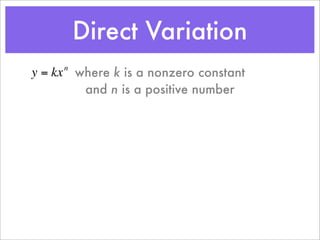
Direct Variation
Direct Variation
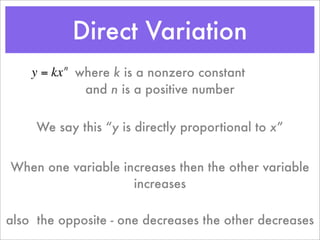
y = kx where k is a nonzero constant
     n


        and n is a positive number
Direct Variation
y = kx where k is a nonzero constant
     n


        and n is a positive number


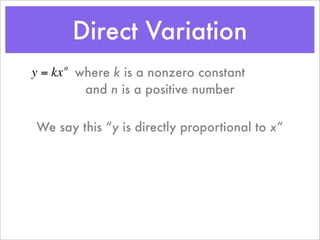
We say this “y is directly proportional to x”
Direct Variation
   y = kx where k is a nonzero constant
         n


           and n is a positive number


    We say this “y is directly proportional to x”


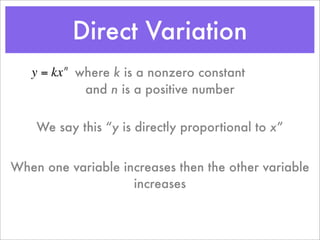
When one variable increases then the other variable
                    increases
Direct Variation
    y = kx where k is a nonzero constant
          n


            and n is a positive number


     We say this “y is directly proportional to x”


When one variable increases then the other variable
                    increases

also the opposite - one decreases the other decreases
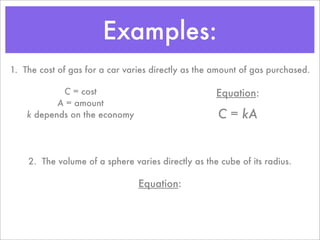
Examples:
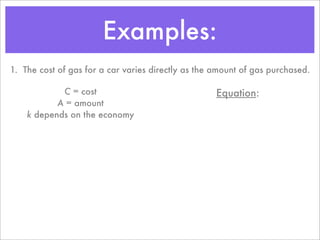
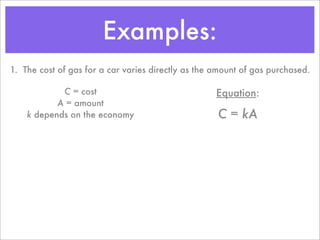
1. The cost of gas for a car varies directly as the amount of gas purchased.

            C = cost                                Equation:
           A = amount
    k depends on the economy
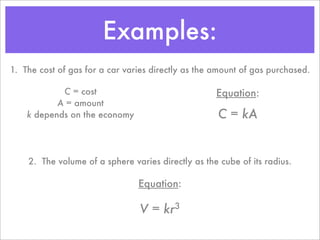
Examples:
1. The cost of gas for a car varies directly as the amount of gas purchased.

            C = cost                                Equation:
           A = amount
    k depends on the economy                        C = kA
Examples:
1. The cost of gas for a car varies directly as the amount of gas purchased.

            C = cost                                Equation:
           A = amount
    k depends on the economy                         C = kA


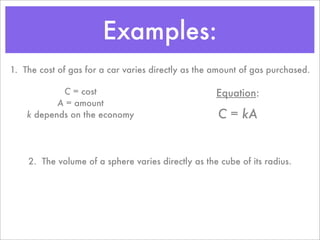
    2. The volume of a sphere varies directly as the cube of its radius.
Examples:
1. The cost of gas for a car varies directly as the amount of gas purchased.

            C = cost                                Equation:
           A = amount
    k depends on the economy                         C = kA


    2. The volume of a sphere varies directly as the cube of its radius.

                                Equation:
Examples:
1. The cost of gas for a car varies directly as the amount of gas purchased.

            C = cost                                Equation:
           A = amount
    k depends on the economy                         C = kA


    2. The volume of a sphere varies directly as the cube of its radius.

                                Equation:

                                V = kr3
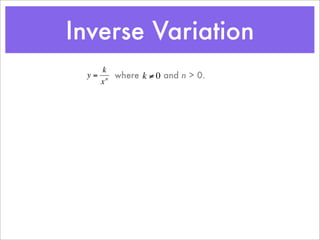
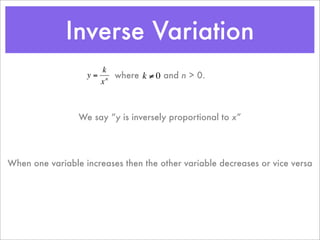
Inverse Variation
Inverse Variation
         k
     y = n where k ≠ 0 and n > 0.
        x


€        €
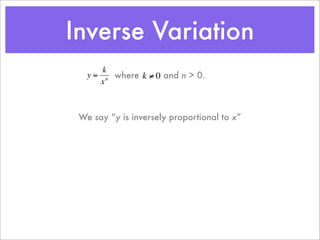
Inverse Variation
           k
       y = n where k ≠ 0 and n > 0.
          x


€         € “y is inversely proportional to x”
     We say
Inverse Variation
                       k
                   y = n where k ≠ 0 and n > 0.
                      x


          €           € “y is inversely proportional to x”
                 We say


When one variable increases then the other variable decreases or vice versa
Examples
Examples
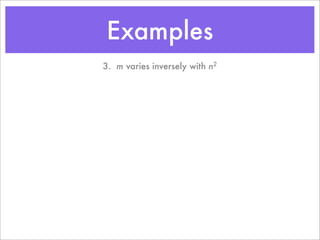
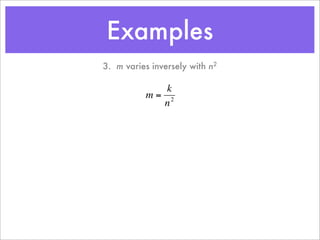
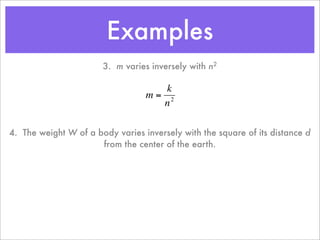
3. m varies inversely with n2
Examples
3. m varies inversely with n2

             k
          m= 2
            n


€
Examples
                       3. m varies inversely with n2

                                     k
                                  m= 2
                                    n

4. The weight W of a body varies inversely with the square of its distance d
                      € the center of the earth.
                      from
Examples
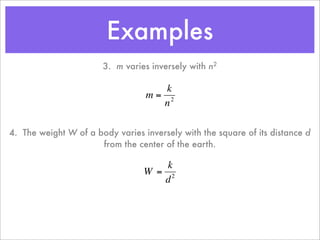
                       3. m varies inversely with n2

                                     k
                                  m= 2
                                    n

4. The weight W of a body varies inversely with the square of its distance d
                      € the center of the earth.
                      from

                                     k
                                 W = 2
                                    d


                       €
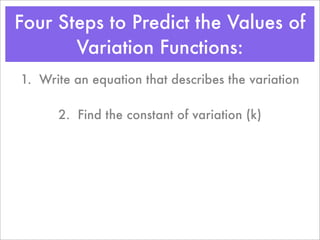
Four Steps to Predict the Values of
       Variation Functions:
Four Steps to Predict the Values of
       Variation Functions:
1. Write an equation that describes the variation
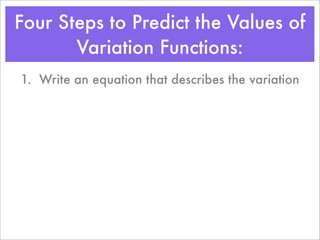
Four Steps to Predict the Values of
       Variation Functions:
1. Write an equation that describes the variation

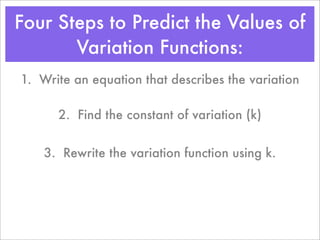
      2. Find the constant of variation (k)
Four Steps to Predict the Values of
       Variation Functions:
1. Write an equation that describes the variation

      2. Find the constant of variation (k)


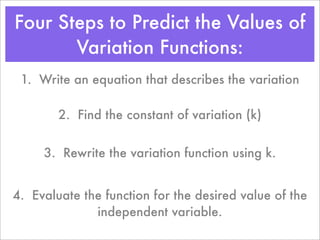
    3. Rewrite the variation function using k.
Four Steps to Predict the Values of
       Variation Functions:
 1. Write an equation that describes the variation

        2. Find the constant of variation (k)


     3. Rewrite the variation function using k.


4. Evaluate the function for the desired value of the
              independent variable.
Examples:
Examples:
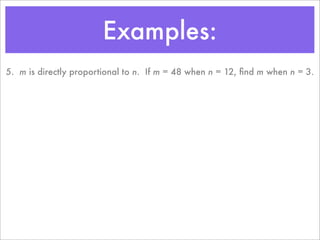
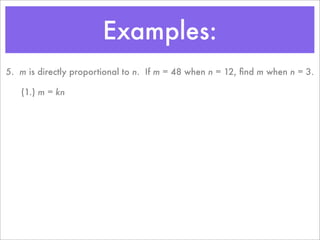
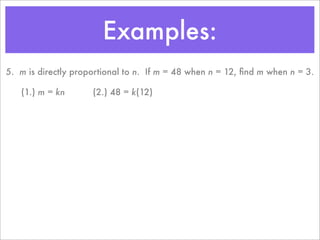
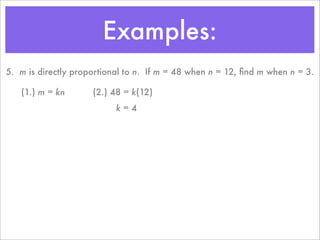
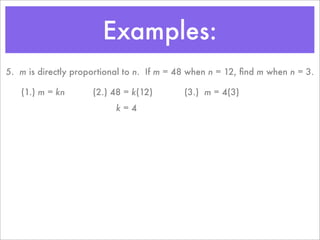
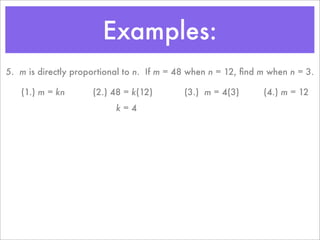
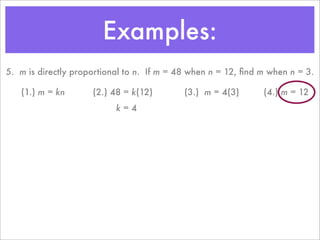
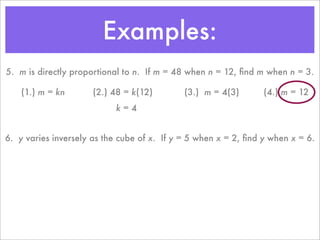
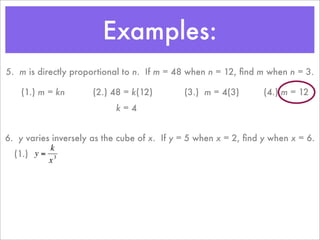
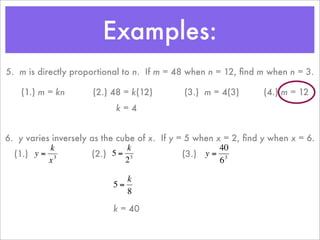
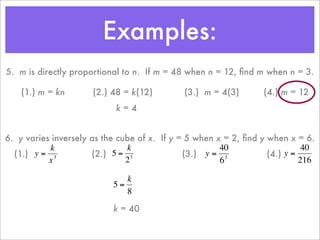
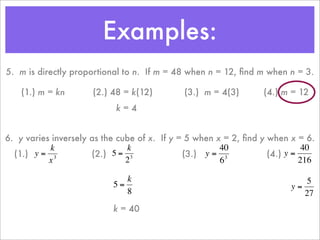
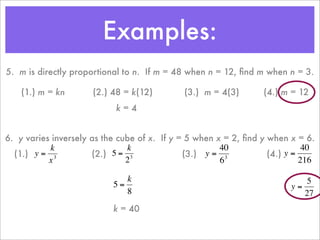
5. m is directly proportional to n. If m = 48 when n = 12, find m when n = 3.
Examples:
5. m is directly proportional to n. If m = 48 when n = 12, find m when n = 3.

   (1.) m = kn
Examples:
5. m is directly proportional to n. If m = 48 when n = 12, find m when n = 3.

   (1.) m = kn       (2.) 48 = k(12)
Examples:
5. m is directly proportional to n. If m = 48 when n = 12, find m when n = 3.

   (1.) m = kn       (2.) 48 = k(12)
                           k=4
Examples:
5. m is directly proportional to n. If m = 48 when n = 12, find m when n = 3.

   (1.) m = kn       (2.) 48 = k(12)        (3.) m = 4(3)
                           k=4
Examples:
5. m is directly proportional to n. If m = 48 when n = 12, find m when n = 3.

   (1.) m = kn       (2.) 48 = k(12)        (3.) m = 4(3)      (4.) m = 12
                           k=4
Examples:
5. m is directly proportional to n. If m = 48 when n = 12, find m when n = 3.

   (1.) m = kn       (2.) 48 = k(12)        (3.) m = 4(3)      (4.) m = 12
                           k=4
Examples:
5. m is directly proportional to n. If m = 48 when n = 12, find m when n = 3.

    (1.) m = kn       (2.) 48 = k(12)        (3.) m = 4(3)       (4.) m = 12
                           k=4


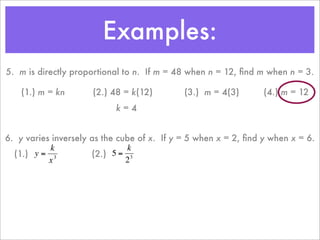
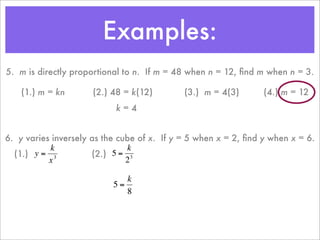
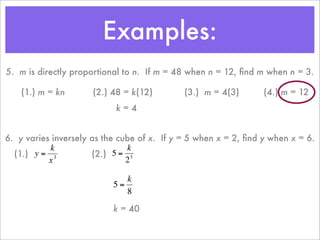
6. y varies inversely as the cube of x. If y = 5 when x = 2, find y when x = 6.
Examples:
    5. m is directly proportional to n. If m = 48 when n = 12, find m when n = 3.

        (1.) m = kn       (2.) 48 = k(12)        (3.) m = 4(3)       (4.) m = 12
                               k=4


    6. y varies inversely as the cube of x. If y = 5 when x = 2, find y when x = 6.
               k
      (1.) y = 3
               x


€
Examples:
    5. m is directly proportional to n. If m = 48 when n = 12, find m when n = 3.

        (1.) m = kn       (2.) 48 = k(12)        (3.) m = 4(3)       (4.) m = 12
                               k=4


    6. y varies inversely as the cube of x. If y = 5 when x = 2, find y when x = 6.
               k                   k
      (1.) y = 3          (2.) 5 = 3
               x                   2


€                     €
Examples:
    5. m is directly proportional to n. If m = 48 when n = 12, find m when n = 3.

        (1.) m = kn       (2.) 48 = k(12)        (3.) m = 4(3)       (4.) m = 12
                               k=4


    6. y varies inversely as the cube of x. If y = 5 when x = 2, find y when x = 6.
               k                   k
      (1.) y = 3          (2.) 5 = 3
               x                   2

                                  k
                               5=
                      €
                                  8
€


                      €
Examples:
    5. m is directly proportional to n. If m = 48 when n = 12, find m when n = 3.

        (1.) m = kn       (2.) 48 = k(12)        (3.) m = 4(3)       (4.) m = 12
                               k=4


    6. y varies inversely as the cube of x. If y = 5 when x = 2, find y when x = 6.
               k                   k
      (1.) y = 3          (2.) 5 = 3
               x                   2

                                  k
                               5=
                      €
                                  8
€
                               k = 40

                      €
Examples:
    5. m is directly proportional to n. If m = 48 when n = 12, find m when n = 3.

        (1.) m = kn       (2.) 48 = k(12)        (3.) m = 4(3)       (4.) m = 12
                               k=4


    6. y varies inversely as the cube of x. If y = 5 when x = 2, find y when x = 6.
               k                   k                       40
      (1.) y = 3          (2.) 5 = 3              (3.) y = 3
               x                   2                       6

                                  k
                               5=
                      €
                                  8
€                                           €
                               k = 40

                      €
Examples:
    5. m is directly proportional to n. If m = 48 when n = 12, find m when n = 3.

        (1.) m = kn       (2.) 48 = k(12)        (3.) m = 4(3)       (4.) m = 12
                                k=4


    6. y varies inversely as the cube of x. If y = 5 when x = 2, find y when x = 6.
               k                   k                       40                    40
      (1.) y = 3          (2.) 5 = 3              (3.) y = 3           (4.) y =
               x                   2                       6                    216

                                  k
                               5=
                      €
                                  8
€                                            €                   €
                               k = 40

                      €
Examples:
    5. m is directly proportional to n. If m = 48 when n = 12, find m when n = 3.

        (1.) m = kn       (2.) 48 = k(12)        (3.) m = 4(3)           (4.) m = 12
                                k=4


    6. y varies inversely as the cube of x. If y = 5 when x = 2, find y when x = 6.
               k                   k                       40                    40
      (1.) y = 3          (2.) 5 = 3              (3.) y = 3           (4.) y =
               x                   2                       6                    216

                                  k                                                5
                               5=                                              y=
                      €
                                  8                                               27
€                                            €                   €
                               k = 40

                      €                                              €
Examples:
    5. m is directly proportional to n. If m = 48 when n = 12, find m when n = 3.

        (1.) m = kn       (2.) 48 = k(12)        (3.) m = 4(3)           (4.) m = 12
                                k=4


    6. y varies inversely as the cube of x. If y = 5 when x = 2, find y when x = 6.
               k                   k                       40                    40
      (1.) y = 3          (2.) 5 = 3              (3.) y = 3           (4.) y =
               x                   2                       6                    216

                                  k                                                5
                               5=                                              y=
                      €
                                  8                                               27
€                                            €                   €
                               k = 40

                      €                                              €
Last ONE!
Last ONE!
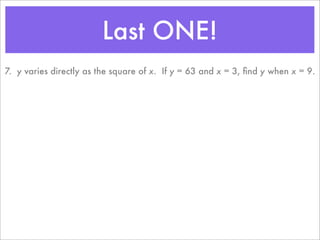
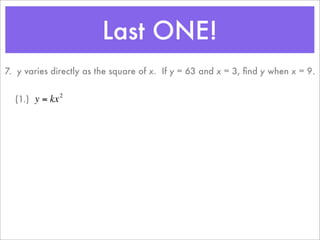
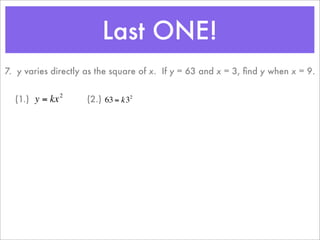
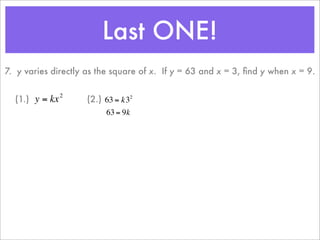
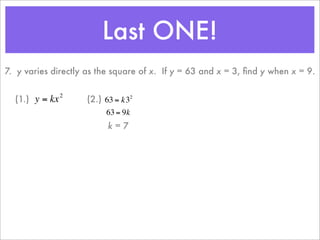
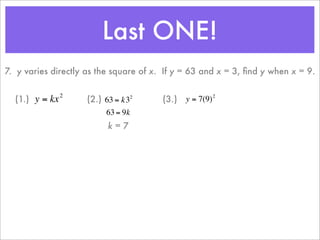
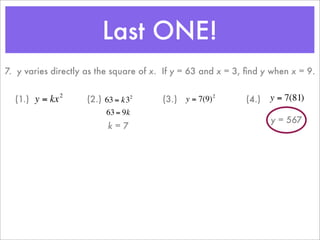
7. y varies directly as the square of x. If y = 63 and x = 3, find y when x = 9.
Last ONE!
    7. y varies directly as the square of x. If y = 63 and x = 3, find y when x = 9.

                    2
      (1.) y = kx


€
Last ONE!
    7. y varies directly as the square of x. If y = 63 and x = 3, find y when x = 9.

                    2
      (1.) y = kx           (2.) 63 = k32


                        €
€
Last ONE!
    7. y varies directly as the square of x. If y = 63 and x = 3, find y when x = 9.

                    2
      (1.) y = kx           (2.) 63 = k32
                                 63 = 9k

                        €
€                       €
Last ONE!
    7. y varies directly as the square of x. If y = 63 and x = 3, find y when x = 9.

                    2
      (1.) y = kx           (2.) 63 = k32
                                 63 = 9k
                                  k=7
                        €
€                       €
Last ONE!
    7. y varies directly as the square of x. If y = 63 and x = 3, find y when x = 9.

                    2
      (1.) y = kx           (2.) 63 = k32       (3.) y = 7(9)
                                                              2


                                 63 = 9k
                                  k=7
                        €                   €
€                       €
Last ONE!
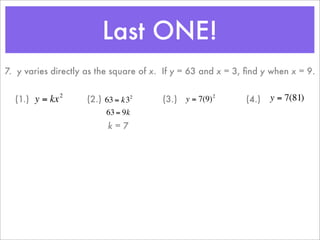
    7. y varies directly as the square of x. If y = 63 and x = 3, find y when x = 9.

                    2
      (1.) y = kx           (2.) 63 = k32       (3.) y = 7(9)         (4.)   y = 7(81)
                                                              2


                                 63 = 9k
                                  k=7
                        €                   €
€                                                                 €
                        €
Last ONE!
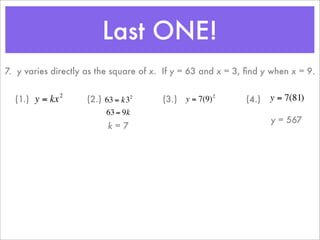
    7. y varies directly as the square of x. If y = 63 and x = 3, find y when x = 9.

                    2
      (1.) y = kx           (2.) 63 = k32       (3.) y = 7(9)         (4.)   y = 7(81)
                                                              2


                                 63 = 9k
                                                                             y = 567
                                  k=7
                        €                   €
€                                                                 €
                        €
Last ONE!
    7. y varies directly as the square of x. If y = 63 and x = 3, find y when x = 9.

                    2
      (1.) y = kx           (2.) 63 = k32       (3.) y = 7(9)         (4.)   y = 7(81)
                                                              2


                                 63 = 9k
                                                                             y = 567
                                  k=7
                        €                   €
€                                                                 €
                        €
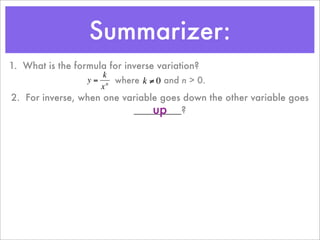
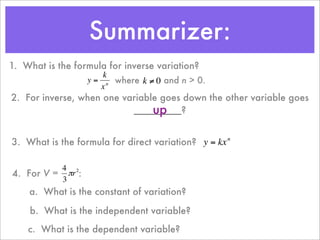
Summarizer:
Summarizer:
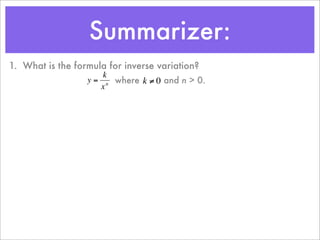
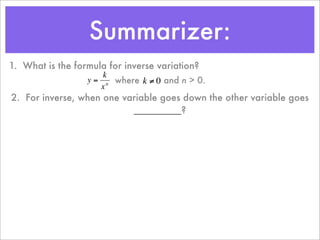
1. What is the formula for inverse variation?
Summarizer:
1. What is the formula for inverse variation?
                      k
                  y = n where k ≠ 0 and n > 0.
                     x


          €           €
Summarizer:
1. What is the formula for inverse variation?
                      k
                  y = n where k ≠ 0 and n > 0.
                     x
2. For inverse, when one variable goes down the other variable goes
                           _________?
         €           €
Summarizer:
1. What is the formula for inverse variation?
                      k
                  y = n where k ≠ 0 and n > 0.
                     x
2. For inverse, when one variable goes down the other variable goes
                                up
                           _________?
         €           €
Summarizer:
1. What is the formula for inverse variation?
                      k
                  y = n where k ≠ 0 and n > 0.
                     x
2. For inverse, when one variable goes down the other variable goes
                                up
                           _________?
         €           €

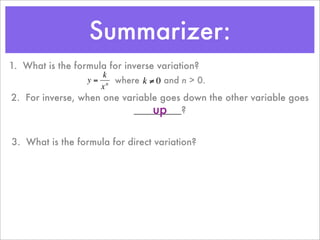
3. What is the formula for direct variation?
Summarizer:
1. What is the formula for inverse variation?
                      k
                  y = n where k ≠ 0 and n > 0.
                     x
2. For inverse, when one variable goes down the other variable goes
                                up
                           _________?
         €           €

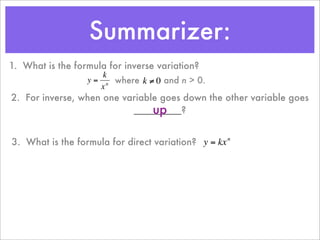
3. What is the formula for direct variation? y = kx n


                                    €
Summarizer:
1. What is the formula for inverse variation?
                      k
                  y = n where k ≠ 0 and n > 0.
                     x
2. For inverse, when one variable goes down the other variable goes
                                up
                           _________?
         €           €

3. What is the formula for direct variation? y = kx n

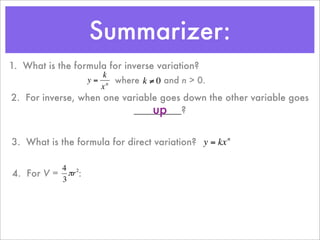
          4 2
4. For V = πr :
          3
                                    €


    €
Summarizer:
1. What is the formula for inverse variation?
                      k
                  y = n where k ≠ 0 and n > 0.
                     x
2. For inverse, when one variable goes down the other variable goes
                                up
                           _________?
         €           €

3. What is the formula for direct variation? y = kx n

          4 2
4. For V = πr :
          3
                                    €
    a. What is the constant of variation?

    € What is the independent variable?
    b.
    c. What is the dependent variable?
Summarizer:
1. What is the formula for inverse variation?
                      k
                  y = n where k ≠ 0 and n > 0.
                     x
2. For inverse, when one variable goes down the other variable goes
                                up
                           _________?
         €           €

3. What is the formula for direct variation? y = kx n

          4 2
4. For V = πr :
          3
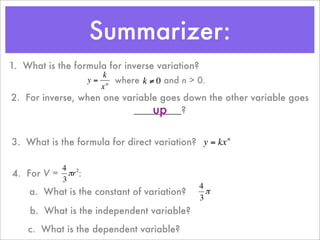
                                    €           4
    a. What is the constant of variation?         π
                                                3
    € What is the independent variable?
    b.
    c. What is the dependent variable?
                                  €
Summarizer:
1. What is the formula for inverse variation?
                      k
                  y = n where k ≠ 0 and n > 0.
                     x
2. For inverse, when one variable goes down the other variable goes
                                up
                           _________?
         €           €

3. What is the formula for direct variation? y = kx n

          4 2
4. For V = πr :
          3
                                    €           4
    a. What is the constant of variation?         π
                                                3
    € What is the independent variable?
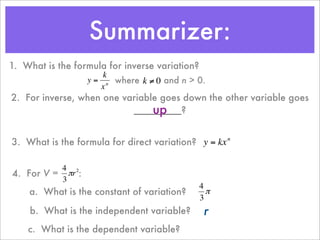
    b.                                           r
    c. What is the dependent variable?
                                  €
Summarizer:
1. What is the formula for inverse variation?
                      k
                  y = n where k ≠ 0 and n > 0.
                     x
2. For inverse, when one variable goes down the other variable goes
                                up
                           _________?
         €           €

3. What is the formula for direct variation? y = kx n

          4 2
4. For V = πr :
          3
                                    €           4
    a. What is the constant of variation?         π
                                                3
    € What is the independent variable?
    b.                                          r
    c. What is the dependent variable?
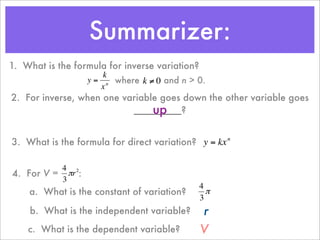
                                  €             V
Homework:

 2.1 A Worksheet
       and
 2.2 A Worksheet

Advanced Algebra 2.1&2.2

  • 1.
  • 2.
    Chapter 2: Variations Sections2.1 and 2.2 Direct and Inverse Variation
  • 3.
    Essential Question: • Whatare the differences between direct and inverse variation?
  • 4.
  • 5.
    Direct Variation y =kx where k is a nonzero constant n and n is a positive number
  • 6.
    Direct Variation y =kx where k is a nonzero constant n and n is a positive number We say this “y is directly proportional to x”
  • 7.
    Direct Variation y = kx where k is a nonzero constant n and n is a positive number We say this “y is directly proportional to x” When one variable increases then the other variable increases
  • 8.
    Direct Variation y = kx where k is a nonzero constant n and n is a positive number We say this “y is directly proportional to x” When one variable increases then the other variable increases also the opposite - one decreases the other decreases
  • 9.
    Examples: 1. The costof gas for a car varies directly as the amount of gas purchased. C = cost Equation: A = amount k depends on the economy
  • 10.
    Examples: 1. The costof gas for a car varies directly as the amount of gas purchased. C = cost Equation: A = amount k depends on the economy C = kA
  • 11.
    Examples: 1. The costof gas for a car varies directly as the amount of gas purchased. C = cost Equation: A = amount k depends on the economy C = kA 2. The volume of a sphere varies directly as the cube of its radius.
  • 12.
    Examples: 1. The costof gas for a car varies directly as the amount of gas purchased. C = cost Equation: A = amount k depends on the economy C = kA 2. The volume of a sphere varies directly as the cube of its radius. Equation:
  • 13.
    Examples: 1. The costof gas for a car varies directly as the amount of gas purchased. C = cost Equation: A = amount k depends on the economy C = kA 2. The volume of a sphere varies directly as the cube of its radius. Equation: V = kr3
  • 14.
  • 15.
    Inverse Variation k y = n where k ≠ 0 and n > 0. x € €
  • 16.
    Inverse Variation k y = n where k ≠ 0 and n > 0. x € € “y is inversely proportional to x” We say
  • 17.
    Inverse Variation k y = n where k ≠ 0 and n > 0. x € € “y is inversely proportional to x” We say When one variable increases then the other variable decreases or vice versa
  • 18.
  • 19.
    Examples 3. m variesinversely with n2
  • 20.
    Examples 3. m variesinversely with n2 k m= 2 n €
  • 21.
    Examples 3. m varies inversely with n2 k m= 2 n 4. The weight W of a body varies inversely with the square of its distance d € the center of the earth. from
  • 22.
    Examples 3. m varies inversely with n2 k m= 2 n 4. The weight W of a body varies inversely with the square of its distance d € the center of the earth. from k W = 2 d €
  • 23.
    Four Steps toPredict the Values of Variation Functions:
  • 24.
    Four Steps toPredict the Values of Variation Functions: 1. Write an equation that describes the variation
  • 25.
    Four Steps toPredict the Values of Variation Functions: 1. Write an equation that describes the variation 2. Find the constant of variation (k)
  • 26.
    Four Steps toPredict the Values of Variation Functions: 1. Write an equation that describes the variation 2. Find the constant of variation (k) 3. Rewrite the variation function using k.
  • 27.
    Four Steps toPredict the Values of Variation Functions: 1. Write an equation that describes the variation 2. Find the constant of variation (k) 3. Rewrite the variation function using k. 4. Evaluate the function for the desired value of the independent variable.
  • 28.
  • 29.
    Examples: 5. m isdirectly proportional to n. If m = 48 when n = 12, find m when n = 3.
  • 30.
    Examples: 5. m isdirectly proportional to n. If m = 48 when n = 12, find m when n = 3. (1.) m = kn
  • 31.
    Examples: 5. m isdirectly proportional to n. If m = 48 when n = 12, find m when n = 3. (1.) m = kn (2.) 48 = k(12)
  • 32.
    Examples: 5. m isdirectly proportional to n. If m = 48 when n = 12, find m when n = 3. (1.) m = kn (2.) 48 = k(12) k=4
  • 33.
    Examples: 5. m isdirectly proportional to n. If m = 48 when n = 12, find m when n = 3. (1.) m = kn (2.) 48 = k(12) (3.) m = 4(3) k=4
  • 34.
    Examples: 5. m isdirectly proportional to n. If m = 48 when n = 12, find m when n = 3. (1.) m = kn (2.) 48 = k(12) (3.) m = 4(3) (4.) m = 12 k=4
  • 35.
    Examples: 5. m isdirectly proportional to n. If m = 48 when n = 12, find m when n = 3. (1.) m = kn (2.) 48 = k(12) (3.) m = 4(3) (4.) m = 12 k=4
  • 36.
    Examples: 5. m isdirectly proportional to n. If m = 48 when n = 12, find m when n = 3. (1.) m = kn (2.) 48 = k(12) (3.) m = 4(3) (4.) m = 12 k=4 6. y varies inversely as the cube of x. If y = 5 when x = 2, find y when x = 6.
  • 37.
    Examples: 5. m is directly proportional to n. If m = 48 when n = 12, find m when n = 3. (1.) m = kn (2.) 48 = k(12) (3.) m = 4(3) (4.) m = 12 k=4 6. y varies inversely as the cube of x. If y = 5 when x = 2, find y when x = 6. k (1.) y = 3 x €
  • 38.
    Examples: 5. m is directly proportional to n. If m = 48 when n = 12, find m when n = 3. (1.) m = kn (2.) 48 = k(12) (3.) m = 4(3) (4.) m = 12 k=4 6. y varies inversely as the cube of x. If y = 5 when x = 2, find y when x = 6. k k (1.) y = 3 (2.) 5 = 3 x 2 € €
  • 39.
    Examples: 5. m is directly proportional to n. If m = 48 when n = 12, find m when n = 3. (1.) m = kn (2.) 48 = k(12) (3.) m = 4(3) (4.) m = 12 k=4 6. y varies inversely as the cube of x. If y = 5 when x = 2, find y when x = 6. k k (1.) y = 3 (2.) 5 = 3 x 2 k 5= € 8 € €
  • 40.
    Examples: 5. m is directly proportional to n. If m = 48 when n = 12, find m when n = 3. (1.) m = kn (2.) 48 = k(12) (3.) m = 4(3) (4.) m = 12 k=4 6. y varies inversely as the cube of x. If y = 5 when x = 2, find y when x = 6. k k (1.) y = 3 (2.) 5 = 3 x 2 k 5= € 8 € k = 40 €
  • 41.
    Examples: 5. m is directly proportional to n. If m = 48 when n = 12, find m when n = 3. (1.) m = kn (2.) 48 = k(12) (3.) m = 4(3) (4.) m = 12 k=4 6. y varies inversely as the cube of x. If y = 5 when x = 2, find y when x = 6. k k 40 (1.) y = 3 (2.) 5 = 3 (3.) y = 3 x 2 6 k 5= € 8 € € k = 40 €
  • 42.
    Examples: 5. m is directly proportional to n. If m = 48 when n = 12, find m when n = 3. (1.) m = kn (2.) 48 = k(12) (3.) m = 4(3) (4.) m = 12 k=4 6. y varies inversely as the cube of x. If y = 5 when x = 2, find y when x = 6. k k 40 40 (1.) y = 3 (2.) 5 = 3 (3.) y = 3 (4.) y = x 2 6 216 k 5= € 8 € € € k = 40 €
  • 43.
    Examples: 5. m is directly proportional to n. If m = 48 when n = 12, find m when n = 3. (1.) m = kn (2.) 48 = k(12) (3.) m = 4(3) (4.) m = 12 k=4 6. y varies inversely as the cube of x. If y = 5 when x = 2, find y when x = 6. k k 40 40 (1.) y = 3 (2.) 5 = 3 (3.) y = 3 (4.) y = x 2 6 216 k 5 5= y= € 8 27 € € € k = 40 € €
  • 44.
    Examples: 5. m is directly proportional to n. If m = 48 when n = 12, find m when n = 3. (1.) m = kn (2.) 48 = k(12) (3.) m = 4(3) (4.) m = 12 k=4 6. y varies inversely as the cube of x. If y = 5 when x = 2, find y when x = 6. k k 40 40 (1.) y = 3 (2.) 5 = 3 (3.) y = 3 (4.) y = x 2 6 216 k 5 5= y= € 8 27 € € € k = 40 € €
  • 45.
  • 46.
    Last ONE! 7. yvaries directly as the square of x. If y = 63 and x = 3, find y when x = 9.
  • 47.
    Last ONE! 7. y varies directly as the square of x. If y = 63 and x = 3, find y when x = 9. 2 (1.) y = kx €
  • 48.
    Last ONE! 7. y varies directly as the square of x. If y = 63 and x = 3, find y when x = 9. 2 (1.) y = kx (2.) 63 = k32 € €
  • 49.
    Last ONE! 7. y varies directly as the square of x. If y = 63 and x = 3, find y when x = 9. 2 (1.) y = kx (2.) 63 = k32 63 = 9k € € €
  • 50.
    Last ONE! 7. y varies directly as the square of x. If y = 63 and x = 3, find y when x = 9. 2 (1.) y = kx (2.) 63 = k32 63 = 9k k=7 € € €
  • 51.
    Last ONE! 7. y varies directly as the square of x. If y = 63 and x = 3, find y when x = 9. 2 (1.) y = kx (2.) 63 = k32 (3.) y = 7(9) 2 63 = 9k k=7 € € € €
  • 52.
    Last ONE! 7. y varies directly as the square of x. If y = 63 and x = 3, find y when x = 9. 2 (1.) y = kx (2.) 63 = k32 (3.) y = 7(9) (4.) y = 7(81) 2 63 = 9k k=7 € € € € €
  • 53.
    Last ONE! 7. y varies directly as the square of x. If y = 63 and x = 3, find y when x = 9. 2 (1.) y = kx (2.) 63 = k32 (3.) y = 7(9) (4.) y = 7(81) 2 63 = 9k y = 567 k=7 € € € € €
  • 54.
    Last ONE! 7. y varies directly as the square of x. If y = 63 and x = 3, find y when x = 9. 2 (1.) y = kx (2.) 63 = k32 (3.) y = 7(9) (4.) y = 7(81) 2 63 = 9k y = 567 k=7 € € € € €
  • 55.
  • 56.
    Summarizer: 1. What isthe formula for inverse variation?
  • 57.
    Summarizer: 1. What isthe formula for inverse variation? k y = n where k ≠ 0 and n > 0. x € €
  • 58.
    Summarizer: 1. What isthe formula for inverse variation? k y = n where k ≠ 0 and n > 0. x 2. For inverse, when one variable goes down the other variable goes _________? € €
  • 59.
    Summarizer: 1. What isthe formula for inverse variation? k y = n where k ≠ 0 and n > 0. x 2. For inverse, when one variable goes down the other variable goes up _________? € €
  • 60.
    Summarizer: 1. What isthe formula for inverse variation? k y = n where k ≠ 0 and n > 0. x 2. For inverse, when one variable goes down the other variable goes up _________? € € 3. What is the formula for direct variation?
  • 61.
    Summarizer: 1. What isthe formula for inverse variation? k y = n where k ≠ 0 and n > 0. x 2. For inverse, when one variable goes down the other variable goes up _________? € € 3. What is the formula for direct variation? y = kx n €
  • 62.
    Summarizer: 1. What isthe formula for inverse variation? k y = n where k ≠ 0 and n > 0. x 2. For inverse, when one variable goes down the other variable goes up _________? € € 3. What is the formula for direct variation? y = kx n 4 2 4. For V = πr : 3 € €
  • 63.
    Summarizer: 1. What isthe formula for inverse variation? k y = n where k ≠ 0 and n > 0. x 2. For inverse, when one variable goes down the other variable goes up _________? € € 3. What is the formula for direct variation? y = kx n 4 2 4. For V = πr : 3 € a. What is the constant of variation? € What is the independent variable? b. c. What is the dependent variable?
  • 64.
    Summarizer: 1. What isthe formula for inverse variation? k y = n where k ≠ 0 and n > 0. x 2. For inverse, when one variable goes down the other variable goes up _________? € € 3. What is the formula for direct variation? y = kx n 4 2 4. For V = πr : 3 € 4 a. What is the constant of variation? π 3 € What is the independent variable? b. c. What is the dependent variable? €
  • 65.
    Summarizer: 1. What isthe formula for inverse variation? k y = n where k ≠ 0 and n > 0. x 2. For inverse, when one variable goes down the other variable goes up _________? € € 3. What is the formula for direct variation? y = kx n 4 2 4. For V = πr : 3 € 4 a. What is the constant of variation? π 3 € What is the independent variable? b. r c. What is the dependent variable? €
  • 66.
    Summarizer: 1. What isthe formula for inverse variation? k y = n where k ≠ 0 and n > 0. x 2. For inverse, when one variable goes down the other variable goes up _________? € € 3. What is the formula for direct variation? y = kx n 4 2 4. For V = πr : 3 € 4 a. What is the constant of variation? π 3 € What is the independent variable? b. r c. What is the dependent variable? € V
  • 67.
    Homework: 2.1 AWorksheet and 2.2 A Worksheet