CYBER ENGAGE CHILDREN & TEENS ACTIVITY:
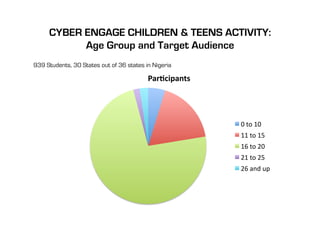
           Age Group and Target Audience
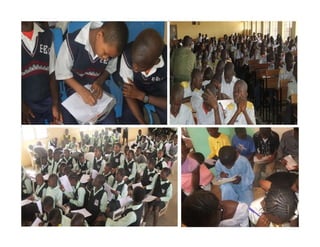
939 Students, 30 States out of 36 states in Nigeria

                                          Par$cipants	


                                                            0	
  to	
  10	
  
                                                            11	
  to	
  15	
  
                                                            16	
  to	
  20	
  
                                                            21	
  to	
  25	
  
                                                            26	
  and	
  up	
  
CYBER ENGAGE CHILDREN & TEENS ACTIVITY:
             Outcome and Feedback
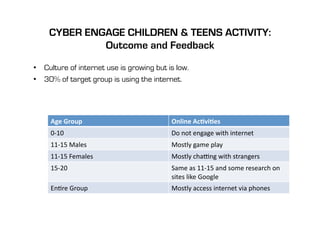
•  Culture of internet use is growing but is low.
•  30% of target group is using the internet.


     Age	
  Group	
                        Online	
  Ac$vi$es	
  
     0-­‐10	
                              Do	
  not	
  engage	
  with	
  internet	
  
     11-­‐15	
  Males	
                    Mostly	
  game	
  play	
  
     11-­‐15	
  Females	
                  Mostly	
  cha=ng	
  with	
  strangers	
  
     15-­‐20	
                             Same	
  as	
  11-­‐15	
  and	
  some	
  research	
  on	
  
                                           sites	
  like	
  Google	
  
     EnBre	
  Group	
                      Mostly	
  access	
  internet	
  via	
  phones	
  
CYBER ENGAGE CHILDREN & TEENS ACTIVITY:
              Outcome and Feedback

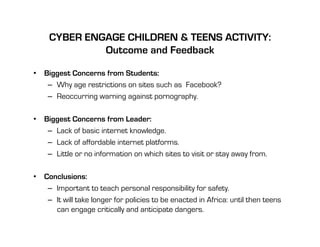
•  Biggest Concerns from Students:
    –  Why age restrictions on sites such as Facebook?
    –  Reoccurring warning against pornography.

•  Biggest Concerns from Leader:
    –  Lack of basic internet knowledge.
    –  Lack of affordable internet platforms.
    –  Little or no information on which sites to visit or stay away from.

•  Conclusions:
    –  Important to teach personal responsibility for safety.
    –  It will take longer for policies to be enacted in Africa: until then teens
       can engage critically and anticipate dangers.
CYBER ENGAGE CHILDREN & TEENS ACTIVITY:
            What is Digital Citizenship?

•  Taking ownership of the space.
•  Making positive contributions and conducting oneself in a manner that
   allows other people to engage in the space and also make their
   contributions. That way we maximize all the knowledge made available by
   everyone’s contribution.
•  One student said: “I have learnt to use the internet to help others around
   me also to develop my creativity and technological sense”.


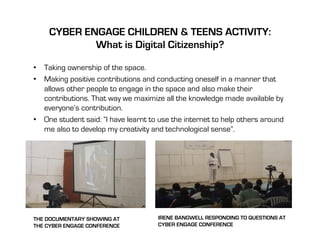
THE DOCUMENTARY SHOWING AT            IRENE BANGWELL RESPONDING TO QUESTIONS AT
THE CYBER ENGAGE CONFERENCE           CYBER ENGAGE CONFERENCE
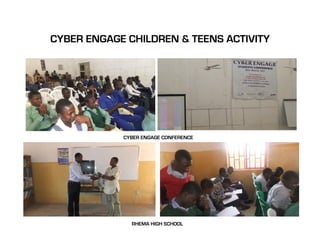
CYBER ENGAGE CHILDREN & TEENS ACTIVITY


            CYBER ENGAGE CONFERENCE


              RHEMA HIGH SCHOOL
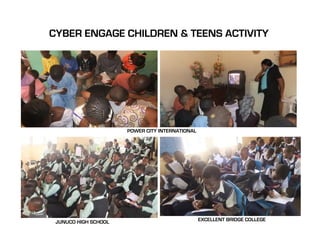
CYBER ENGAGE CHILDREN & TEENS ACTIVITY


                      POWER CITY INTERNATIONAL


 JUNUCO HIGH SCHOOL                              EXCELLENT BRIDGE COLLEGE
CYBER ENGAGE CHILDREN & TEENS ACTIVITY:
                  Conclusion


•  DID anticipate that Mobile
   Phones would be the primary
   platform: did NOT anticipate the
   lack of internet know how.
•  Lack of productive or proactive
   use of the internet: more than
   70% engagement on only
   games.
•  Need to showcase and
   encourage social change
   initiatives. (encouraged by a
   young person who wants to build
   a social networking site for
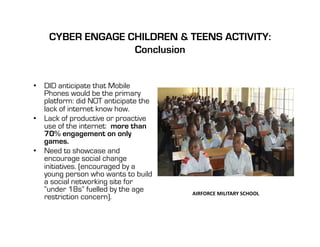
   “under 18s” fuelled by the age     AIRFORCE	
  MILITARY	
  SCHOOL	
  
   restriction concern).
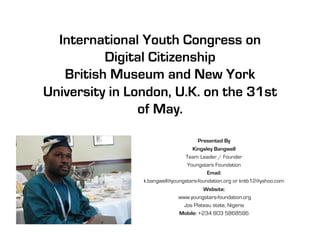
International Youth Congress on
          Digital Citizenship
   British Museum and New York
University in London, U.K. on the 31st
                of May. 

                                      Presented By
                                   Kingsley Bangwell
                                Team Leader / Founder
                                 Youngstars Foundation
                                          Email:
                k.bangwell@youngstars-foundation.org or kntb12@yahoo.com
                                       Website:
                             www.youngstars-foundation.org
                               Jos Plateau state, Nigeria
                             Mobile: +234 803 5868586
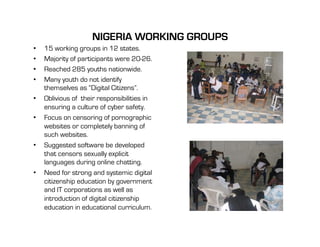
NIGERIA WORKING GROUPS
•    15 working groups in 12 states.
•    Majority of participants were 20-26.
•    Reached 285 youths nationwide.
•    Many youth do not identify
     themselves as “Digital Citizens”.
•    Oblivious of their responsibilities in
     ensuring a culture of cyber safety.
•    Focus on censoring of pornographic
     websites or completely banning of
     such websites.
•    Suggested software be developed
     that censors sexually explicit
     languages during online chatting.
•    Need for strong and systemic digital
     citizenship education by government
     and IT corporations as well as
     introduction of digital citizenship
     education in educational curriculum.
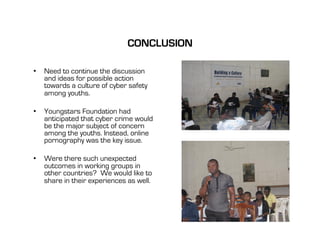
CONCLUSION

•  Need to continue the discussion
   and ideas for possible action
   towards a culture of cyber safety
   among youths.

•  Youngstars Foundation had
   anticipated that cyber crime would
   be the major subject of concern
   among the youths. Instead, online
   pornography was the key issue.

•  Were there such unexpected
   outcomes in working groups in
   other countries? We would like to
   share in their experiences as well.

Joint nigerian preso email

  • 2.
    CYBER ENGAGE CHILDREN& TEENS ACTIVITY: Age Group and Target Audience 939 Students, 30 States out of 36 states in Nigeria Par$cipants   0  to  10   11  to  15   16  to  20   21  to  25   26  and  up  
  • 3.
    CYBER ENGAGE CHILDREN& TEENS ACTIVITY: Outcome and Feedback •  Culture of internet use is growing but is low. •  30% of target group is using the internet. Age  Group   Online  Ac$vi$es   0-­‐10   Do  not  engage  with  internet   11-­‐15  Males   Mostly  game  play   11-­‐15  Females   Mostly  cha=ng  with  strangers   15-­‐20   Same  as  11-­‐15  and  some  research  on   sites  like  Google   EnBre  Group   Mostly  access  internet  via  phones  
  • 4.
    CYBER ENGAGE CHILDREN& TEENS ACTIVITY: Outcome and Feedback •  Biggest Concerns from Students: –  Why age restrictions on sites such as Facebook? –  Reoccurring warning against pornography. •  Biggest Concerns from Leader: –  Lack of basic internet knowledge. –  Lack of affordable internet platforms. –  Little or no information on which sites to visit or stay away from. •  Conclusions: –  Important to teach personal responsibility for safety. –  It will take longer for policies to be enacted in Africa: until then teens can engage critically and anticipate dangers.
  • 5.
    CYBER ENGAGE CHILDREN& TEENS ACTIVITY: What is Digital Citizenship? •  Taking ownership of the space. •  Making positive contributions and conducting oneself in a manner that allows other people to engage in the space and also make their contributions. That way we maximize all the knowledge made available by everyone’s contribution. •  One student said: “I have learnt to use the internet to help others around me also to develop my creativity and technological sense”. THE DOCUMENTARY SHOWING AT IRENE BANGWELL RESPONDING TO QUESTIONS AT THE CYBER ENGAGE CONFERENCE CYBER ENGAGE CONFERENCE
  • 6.
    CYBER ENGAGE CHILDREN& TEENS ACTIVITY CYBER ENGAGE CONFERENCE RHEMA HIGH SCHOOL
  • 7.
    CYBER ENGAGE CHILDREN& TEENS ACTIVITY POWER CITY INTERNATIONAL JUNUCO HIGH SCHOOL EXCELLENT BRIDGE COLLEGE
  • 8.
    CYBER ENGAGE CHILDREN& TEENS ACTIVITY: Conclusion •  DID anticipate that Mobile Phones would be the primary platform: did NOT anticipate the lack of internet know how. •  Lack of productive or proactive use of the internet: more than 70% engagement on only games. •  Need to showcase and encourage social change initiatives. (encouraged by a young person who wants to build a social networking site for “under 18s” fuelled by the age AIRFORCE  MILITARY  SCHOOL   restriction concern).
  • 9.
    International Youth Congresson Digital Citizenship British Museum and New York University in London, U.K. on the 31st of May.  Presented By Kingsley Bangwell Team Leader / Founder Youngstars Foundation Email: k.bangwell@youngstars-foundation.org or kntb12@yahoo.com Website: www.youngstars-foundation.org Jos Plateau state, Nigeria Mobile: +234 803 5868586
  • 10.
    NIGERIA WORKING GROUPS •  15 working groups in 12 states. •  Majority of participants were 20-26. •  Reached 285 youths nationwide. •  Many youth do not identify themselves as “Digital Citizens”. •  Oblivious of their responsibilities in ensuring a culture of cyber safety. •  Focus on censoring of pornographic websites or completely banning of such websites. •  Suggested software be developed that censors sexually explicit languages during online chatting. •  Need for strong and systemic digital citizenship education by government and IT corporations as well as introduction of digital citizenship education in educational curriculum.
  • 11.
    CONCLUSION •  Need tocontinue the discussion and ideas for possible action towards a culture of cyber safety among youths. •  Youngstars Foundation had anticipated that cyber crime would be the major subject of concern among the youths. Instead, online pornography was the key issue. •  Were there such unexpected outcomes in working groups in other countries? We would like to share in their experiences as well.