
DIGITAL
DIV IDE
Daryll.Disa
Enna.Seah
Nurul.Shahidah
Nadiah.Mohd
Sophie.Hong
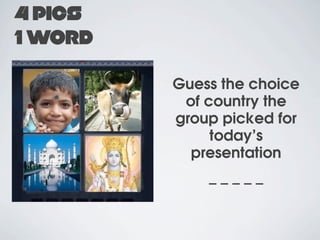
Guess the choice
of country the
group picked for
todayÊs
presentation
_ _ _ _ _
4 PICS
1 WORD
INDIA
WORLDÊS FASTEST-GROWING
MOBILE MARKET WITH 771
MILLION SUBSCRIBERS
BUT
WORST PERFORMING
COUNTRIES IN THE WORLD FOR
DIGITAL INCLUSION
ICTs
IN MUMBAI, DELHI AND
KOLKATTA ARE ON PAR WITH
DEVELOPED NATIONS
BUT
EASTERN BIHAR AND ORISSA ARE
WORSE OFF THAN SEVERAL OF
THE LEAST DEVELOPED COUNTRIES
BANGALORE
SILICON VALLEY,HUB OF
TECHNOLOGY FOR ENTREPRENEURS
AND HOME TO SOME OF THE
WORLDÊS TOP GLOBAL SOFTWARE
COMPANIES
BUT
MANY OF ITS RESIDENTS HAVE
NEVER SURFED THE WEB.
VIEW
OVER
1 Statement of Issue: Rural-urban Digital Divide
2
key issues & THE NEED TO TACKLE THE ISSUE OF
Rural- urban Digital Divide in bangalore, india
3
4
Target audience & Strategic proposed solutions
conclusion
DIGITAL
DIV IDE
Economic, social
or cultural
deprivation
generated by
missing ICT
access and
skills
Refers to "the gap between individuals, households, businesses and geographic areas at
the different socio-economic levels with regard to their opportunities to access ICTs and
their use of Internet. It reflects differences among and within countries." (Organisation for
Economic Co-operation and Development)
DEFINITION
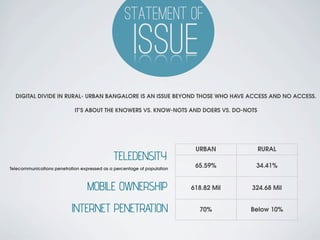
TELEDENSITY
INTERNET PENETRATION
MOBILE OWNERSHIP
DIGITAL DIVIDE IN RURAL- URBAN BANGALORE IS AN ISSUE BEYOND THOSE WHO HAVE ACCESS AND NO ACCESS.
ITÊS ABOUT THE KNOWERS VS. KNOW-NOTS AND DOERS VS. DO-NOTS
Telecommunications penetration expressed as a percentage of population
URBAN RURAL
65.59% 34.41%
618.82 Mil 324.68 Mil
70% Below 10%
ISSUE
STATEMENT OF
The next part of
the presentation
will take us to the
ISSUES of Digital
Divide that needs
to be
_ _ _ _ _ _ _ed
4 PICS
1 WORD
KEY
ISSUES
LACK OF FUNDING & GOVERNMENT SUPPORT
Inadequate funding and excessive red tape
hinders the process of bridging the digital divide.
ICTs unaffordable for low-income earners in
Bangalore
New computer = close to INR 30,000 (SGD 683)
10 mbps connection = INR 999/month (SGD 23)
Income of those who fall below the poverty line =
INR 2500 (SGD 56)
PS: In Singapore, 150mbps = $49.90/month
INADEQUATE INFRASTRUCTURE
Inadequate infrastructure in the poorer areas of
Bangalore
(According to a 2012 report submitted to the World
Bank by Karnataka Slum Clearance Board,
Bangalore has 862 slums from total of around
2000 slums in Karnataka. It is estimated that about
20% of Bangalore population reside in urban
slums.)
WHY THE
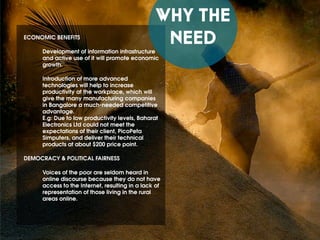
NEEDECONOMIC BENEFITS
Development of information infrastructure
and active use of it will promote economic
growth.
Introduction of more advanced
technologies will help to increase
productivity at the workplace, which will
give the many manufacturing companies
in Bangalore a much-needed competitive
advantage.
E.g: Due to low productivity levels, Baharat
Electronics Ltd could not meet the
expectations of their client, PicoPeta
Simputers, and deliver their technical
products at about $200 price point.
DEMOCRACY & POLITICAL FAIRNESS
Voices of the poor are seldom heard in
online discourse because they do not have
access to the Internet, resulting in a lack of
representation of those living in the rural
areas online.
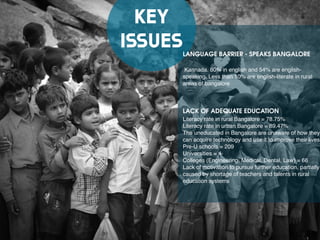
LANGUAGE BARRIER - SPEAKS BANGALORE
Kannada. 80% in english and 54% are english-
speaking. Less than 10% are english-literate in rural
areas of bangalore
LACK OF ADEQUATE EDUCATION
Literacy rate in rural Bangalore = 78.75%
Literacy rate in urban Bangalore = 89.47%
The uneducated in Bangalore are unaware of how they
can acquire technology and use it to improve their lives
Pre-U schools = 209
Universities = 4
Colleges (Engineering, Medical, Dental, Law) = 66
Lack of motivation to pursue further education, partially
caused by shortage of teachers and talents in rural
education systems
KEY
ISSUES
WHY THE
NEED
SOCIAL WELL-BEING
Crisis management (especially in the rural areas) will
be vastly improved if more people are trained and
equipped with ICTs.
Information regarding public health issues can be
better disseminated and medical help can be better
administered.
E.g: Increasing cases of dengue, gastroenteritis, food
poisoning and Hepatitis A and E in rural Bangalore.
Such illnesses and diseases are not registered in high
numbers in developed countries as the public is better
educated on how to avoid them.
Better opportunities for employment with computer
literacy. 6/10 new jobs will be in professional and
service-related occupations with basic level of
proficiency in computers (e.g: computer literacy and
secretarial jobs etc.)
Existing efforts by
the government,
non-governmental
organisations and
individuals need to
_ _ _ _ _ _ in order
to narrow the gap
of digital divide.
4 PICS
1 WORD
?SO WHAT ARE THE SOLUTIONS
INTERNATIONAL EFFORTS
GLOCALIZATION
GOVERNMENT EFFORTS
DEVELOPMENT & ENHANCEMENT
NON-GOVERNMENTAL EFFORTS
CSR & FUNDS
INDIVIDUALS
INITIATIVES
INTERNATIONAL
EFFORTS
GLOCALIZATION
Provide avenues to bring global initiatives to narrow
the gap of digital divide to Bangalore
One Laptop per Child
Create educational opportunities for the world's poorest
children by providing each child with a rugged, low-
cost, low-power, connected laptop with content and
software designed for collaborative, joyful, self-
empowered learning.
Overseas CIP programmes (E.g. Singapore)
Rural areas to teach or provide basic infrastructure and
technology
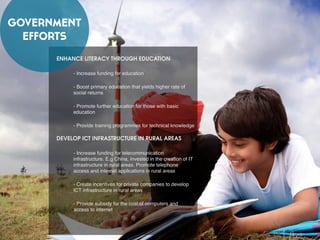
GOVERNMENT
EFFORTS
ENHANCE LITERACY THROUGH EDUCATION
- Increase funding for education
- Boost primary education that yields higher rate of
social returns
- Promote further education for those with basic
education
- Provide training programmes for technical knowledge
DEVELOP ICT INFRASTRUCTURE IN RURAL AREAS
- Increase funding for telecommunication
infrastructure. E.g China, invested in the creation of IT
infrastructure in rural areas. Promote telephone
access and internet applications in rural areas
- Create incentives for private companies to develop
ICT infrastructure in rural areas
- Provide subsidy for the cost of computers and
access to internet
NON-
GOVERNMENT
EFFORTS
CSR INITIATIVES - COMPUTER LITERACY
PROGRAMMES
- Greater attention should be paid to ICT training
in order to overcome the digital divide gap
- Mass computer literacy drive through the
'Akshaya' project. At least one member of each
of the 6.4 million families across the state
computer literate
CSR INITIATIVES - FUNDING & AVENUES OF
EDUCATION
- Private companies within Bangalore could act
as a catalyst to kickstart the continuous
education of its citizens.
- Facilitate in the introduction of new innovative
programmes, setting up of new institutions,
development of inexpensive devices and kits for
use by all including rural institutions and schools
INDIVIDUALS
BREAKDOWN LANGUAGE BARRIER
With the dominance of English Language being used in
software and on the Internet, there is a need for the
population to pick up the language and provision of local
language and english on key websites so as to not be
'excluded' from the use of ICTs
MOTIVATION FOR PERSONAL IMPROVEMENT
Individuals should take steps/measures to continuously
improve their personal education levels. Teachers can
also help to aide in the process.
CONCLUSION
DEVELOPMENT OF BASIC INFRASTRUCTURE WITH GREATER SUPPORT FROM THE
GOVERNMENT, NON-GOVERNMENTAL ORGANISATIONS AND INTERNATIONAL
COUNTERPARTS.
explore the endless possibilities ICTs have to offer to fully harness the
use of technology for better employability opportunities, education,
efficiency in disseminating information about health AND having THE
ABILITY to communicate with the rest of the world.
INDIVIDUALS WILL BE motivated to further their education, upgradE their
skill sets. In the long run, they will be able to give back to the economy
via means of knowledge, skills AND EXPERTISE.
Not only will the digital divide gap be narrowed, BUT IT empowers the individual to
obtain better job prospects and as a result they will be contributing to the
economy, helping the country to prosper in the long run.
DIGITAL
DIV IDE
Daryll.Disa
Enna.Seah
Nurul.Shahidah
Nadiah.Mohd
Sophie.Hong
THANK YOU

Presentation Slides Template - Digital Divide

  • 1.
  • 2.
    Guess the choice ofcountry the group picked for todayÊs presentation _ _ _ _ _ 4 PICS 1 WORD
  • 3.
    INDIA WORLDÊS FASTEST-GROWING MOBILE MARKETWITH 771 MILLION SUBSCRIBERS BUT WORST PERFORMING COUNTRIES IN THE WORLD FOR DIGITAL INCLUSION
  • 4.
    ICTs IN MUMBAI, DELHIAND KOLKATTA ARE ON PAR WITH DEVELOPED NATIONS BUT EASTERN BIHAR AND ORISSA ARE WORSE OFF THAN SEVERAL OF THE LEAST DEVELOPED COUNTRIES
  • 5.
    BANGALORE SILICON VALLEY,HUB OF TECHNOLOGYFOR ENTREPRENEURS AND HOME TO SOME OF THE WORLDÊS TOP GLOBAL SOFTWARE COMPANIES BUT MANY OF ITS RESIDENTS HAVE NEVER SURFED THE WEB.
  • 6.
    VIEW OVER 1 Statement ofIssue: Rural-urban Digital Divide 2 key issues & THE NEED TO TACKLE THE ISSUE OF Rural- urban Digital Divide in bangalore, india 3 4 Target audience & Strategic proposed solutions conclusion
  • 7.
    DIGITAL DIV IDE Economic, social orcultural deprivation generated by missing ICT access and skills Refers to "the gap between individuals, households, businesses and geographic areas at the different socio-economic levels with regard to their opportunities to access ICTs and their use of Internet. It reflects differences among and within countries." (Organisation for Economic Co-operation and Development) DEFINITION
  • 8.
    TELEDENSITY INTERNET PENETRATION MOBILE OWNERSHIP DIGITALDIVIDE IN RURAL- URBAN BANGALORE IS AN ISSUE BEYOND THOSE WHO HAVE ACCESS AND NO ACCESS. ITÊS ABOUT THE KNOWERS VS. KNOW-NOTS AND DOERS VS. DO-NOTS Telecommunications penetration expressed as a percentage of population URBAN RURAL 65.59% 34.41% 618.82 Mil 324.68 Mil 70% Below 10% ISSUE STATEMENT OF
  • 9.
    The next partof the presentation will take us to the ISSUES of Digital Divide that needs to be _ _ _ _ _ _ _ed 4 PICS 1 WORD
  • 10.
    KEY ISSUES LACK OF FUNDING& GOVERNMENT SUPPORT Inadequate funding and excessive red tape hinders the process of bridging the digital divide. ICTs unaffordable for low-income earners in Bangalore New computer = close to INR 30,000 (SGD 683) 10 mbps connection = INR 999/month (SGD 23) Income of those who fall below the poverty line = INR 2500 (SGD 56) PS: In Singapore, 150mbps = $49.90/month INADEQUATE INFRASTRUCTURE Inadequate infrastructure in the poorer areas of Bangalore (According to a 2012 report submitted to the World Bank by Karnataka Slum Clearance Board, Bangalore has 862 slums from total of around 2000 slums in Karnataka. It is estimated that about 20% of Bangalore population reside in urban slums.)
  • 11.
    WHY THE NEEDECONOMIC BENEFITS Developmentof information infrastructure and active use of it will promote economic growth. Introduction of more advanced technologies will help to increase productivity at the workplace, which will give the many manufacturing companies in Bangalore a much-needed competitive advantage. E.g: Due to low productivity levels, Baharat Electronics Ltd could not meet the expectations of their client, PicoPeta Simputers, and deliver their technical products at about $200 price point. DEMOCRACY & POLITICAL FAIRNESS Voices of the poor are seldom heard in online discourse because they do not have access to the Internet, resulting in a lack of representation of those living in the rural areas online.
  • 12.
    LANGUAGE BARRIER -SPEAKS BANGALORE Kannada. 80% in english and 54% are english- speaking. Less than 10% are english-literate in rural areas of bangalore LACK OF ADEQUATE EDUCATION Literacy rate in rural Bangalore = 78.75% Literacy rate in urban Bangalore = 89.47% The uneducated in Bangalore are unaware of how they can acquire technology and use it to improve their lives Pre-U schools = 209 Universities = 4 Colleges (Engineering, Medical, Dental, Law) = 66 Lack of motivation to pursue further education, partially caused by shortage of teachers and talents in rural education systems KEY ISSUES
  • 13.
    WHY THE NEED SOCIAL WELL-BEING Crisismanagement (especially in the rural areas) will be vastly improved if more people are trained and equipped with ICTs. Information regarding public health issues can be better disseminated and medical help can be better administered. E.g: Increasing cases of dengue, gastroenteritis, food poisoning and Hepatitis A and E in rural Bangalore. Such illnesses and diseases are not registered in high numbers in developed countries as the public is better educated on how to avoid them. Better opportunities for employment with computer literacy. 6/10 new jobs will be in professional and service-related occupations with basic level of proficiency in computers (e.g: computer literacy and secretarial jobs etc.)
  • 14.
    Existing efforts by thegovernment, non-governmental organisations and individuals need to _ _ _ _ _ _ in order to narrow the gap of digital divide. 4 PICS 1 WORD
  • 15.
    ?SO WHAT ARETHE SOLUTIONS
  • 16.
    INTERNATIONAL EFFORTS GLOCALIZATION GOVERNMENT EFFORTS DEVELOPMENT& ENHANCEMENT NON-GOVERNMENTAL EFFORTS CSR & FUNDS INDIVIDUALS INITIATIVES
  • 17.
    INTERNATIONAL EFFORTS GLOCALIZATION Provide avenues tobring global initiatives to narrow the gap of digital divide to Bangalore One Laptop per Child Create educational opportunities for the world's poorest children by providing each child with a rugged, low- cost, low-power, connected laptop with content and software designed for collaborative, joyful, self- empowered learning. Overseas CIP programmes (E.g. Singapore) Rural areas to teach or provide basic infrastructure and technology
  • 18.
    GOVERNMENT EFFORTS ENHANCE LITERACY THROUGHEDUCATION - Increase funding for education - Boost primary education that yields higher rate of social returns - Promote further education for those with basic education - Provide training programmes for technical knowledge DEVELOP ICT INFRASTRUCTURE IN RURAL AREAS - Increase funding for telecommunication infrastructure. E.g China, invested in the creation of IT infrastructure in rural areas. Promote telephone access and internet applications in rural areas - Create incentives for private companies to develop ICT infrastructure in rural areas - Provide subsidy for the cost of computers and access to internet
  • 19.
    NON- GOVERNMENT EFFORTS CSR INITIATIVES -COMPUTER LITERACY PROGRAMMES - Greater attention should be paid to ICT training in order to overcome the digital divide gap - Mass computer literacy drive through the 'Akshaya' project. At least one member of each of the 6.4 million families across the state computer literate CSR INITIATIVES - FUNDING & AVENUES OF EDUCATION - Private companies within Bangalore could act as a catalyst to kickstart the continuous education of its citizens. - Facilitate in the introduction of new innovative programmes, setting up of new institutions, development of inexpensive devices and kits for use by all including rural institutions and schools
  • 20.
    INDIVIDUALS BREAKDOWN LANGUAGE BARRIER Withthe dominance of English Language being used in software and on the Internet, there is a need for the population to pick up the language and provision of local language and english on key websites so as to not be 'excluded' from the use of ICTs MOTIVATION FOR PERSONAL IMPROVEMENT Individuals should take steps/measures to continuously improve their personal education levels. Teachers can also help to aide in the process.
  • 21.
    CONCLUSION DEVELOPMENT OF BASICINFRASTRUCTURE WITH GREATER SUPPORT FROM THE GOVERNMENT, NON-GOVERNMENTAL ORGANISATIONS AND INTERNATIONAL COUNTERPARTS. explore the endless possibilities ICTs have to offer to fully harness the use of technology for better employability opportunities, education, efficiency in disseminating information about health AND having THE ABILITY to communicate with the rest of the world. INDIVIDUALS WILL BE motivated to further their education, upgradE their skill sets. In the long run, they will be able to give back to the economy via means of knowledge, skills AND EXPERTISE. Not only will the digital divide gap be narrowed, BUT IT empowers the individual to obtain better job prospects and as a result they will be contributing to the economy, helping the country to prosper in the long run.
  • 22.