JOHN TELLER EFFECT IN
OCTAHEDRAL COMPLEX
PRESENTED BY
Ashwini Vishwakarma
M.Sc. Chemistry 1st
Sem
UIT, BU BHOPAL
JOHN TELLER DISTORTION
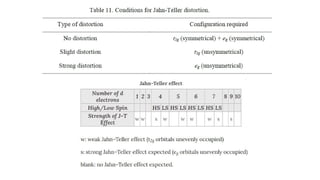
The John-Teller effect is a geometric distortion of a non-linear molecular
system that reduces its symmetry and energy. This distortion is typically
observed among octahedral complexes where the two axial bonds can be
shorter or longer than those of the equatorial bonds. This effect can also be
observed in tetrahedral compounds. This effect is dependent on the
electronic state of the system. We can understand this effect in the context of
octahedral metal complexes by considering d-electron configurations in
which the eg orbital set contains one or three electrons. The most common
of these are high spin d4
, low spin d7
and d9
(e.g., Cu2+
)
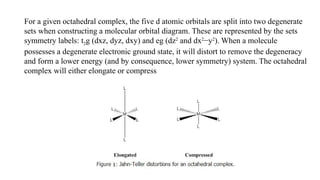
For a given octahedral complex, the five d atomic orbitals are split into two degenerate
sets when constructing a molecular orbital diagram. These are represented by the sets
symmetry labels: t2g (dxz, dyz, dxy) and eg (dz2
and dx2
−y2
). When a molecule
possesses a degenerate electronic ground state, it will distort to remove the degeneracy
and form a lower energy (and by consequence, lower symmetry) system. The octahedral
complex will either elongate or compress
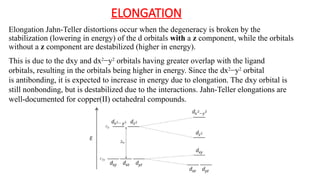
ELONGATION
Elongation Jahn-Teller distortions occur when the degeneracy is broken by the
stabilization (lowering in energy) of the d orbitals with a z component, while the orbitals
without a z component are destabilized (higher in energy).
This is due to the dxy and dx2
−y2
orbitals having greater overlap with the ligand
orbitals, resulting in the orbitals being higher in energy. Since the dx2
−y2
orbital
is antibonding, it is expected to increase in energy due to elongation. The dxy orbital is
still nonbonding, but is destabilized due to the interactions. Jahn-Teller elongations are
well-documented for copper(II) octahedral compounds.
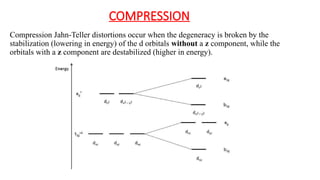
COMPRESSION
Compression Jahn-Teller distortions occur when the degeneracy is broken by the
stabilization (lowering in energy) of the d orbitals without a z component, while the
orbitals with a z component are destabilized (higher in energy).
Distortions in Octahedral
Geometry
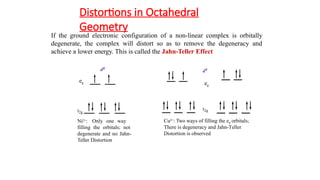
If the ground electronic configuration of a non-linear complex is orbitally
degenerate, the complex will distort so as to remove the degeneracy and
achieve a lower energy. This is called the Jahn-Teller Effect
d8
d9
eg
eg
Ni2+: Only one way
of
Cu2+: Two ways of filling the eg orbitals;
t2g
t2g
filling the orbitals; not
degenerate and no Jahn-
Teller Distortion
There is degeneracy and Jahn-Teller
Distortion is observed
John-Teller Distortion in Cu(II)
Complexes
dx2-y2
eg
energy
dz2
dxy
t2g
Cu(II) in regular octa-
hedral environment
dxz dyz
Cu(II) after John teller
distortion
6
[CuF ]4-
Distortions in Strong Field Ligand
  

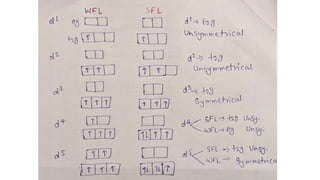
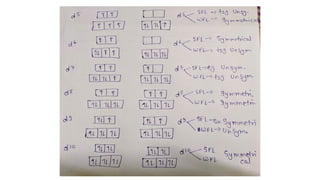
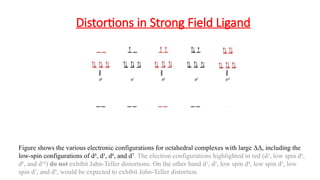
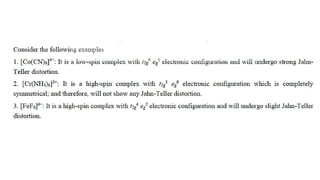
Figure shows the various electronic configurations for octahedral complexes with large ΔΔ, including the
low-spin configurations of d4
, d5
, d6
, and d7
. The electron configurations highlighted in red (d3
, low spin d6
,
d8
, and d10
) do not exhibit Jahn-Teller distortions. On the other hand d1
, d2
, low spin d4
, low spin d5
, low
spin d7
, and d9
, would be expected to exhibit John-Teller distortion.
Distortions in Weak Field Ligand


 
Figure shows the various electronic configurations for octahedral complexes with small ΔΔ,
including the high-spin configurations of d4
, d5
, d6
, and d7
. The electron configurations highlighted in
red (d3
, high spin d5
, d8
, and d10
) do not exhibit Jahn-Teller distortions
THANKYOU

John_Teller effect in octahedral complexs.pptx

  • 1.
    JOHN TELLER EFFECTIN OCTAHEDRAL COMPLEX PRESENTED BY Ashwini Vishwakarma M.Sc. Chemistry 1st Sem UIT, BU BHOPAL
  • 2.
    JOHN TELLER DISTORTION TheJohn-Teller effect is a geometric distortion of a non-linear molecular system that reduces its symmetry and energy. This distortion is typically observed among octahedral complexes where the two axial bonds can be shorter or longer than those of the equatorial bonds. This effect can also be observed in tetrahedral compounds. This effect is dependent on the electronic state of the system. We can understand this effect in the context of octahedral metal complexes by considering d-electron configurations in which the eg orbital set contains one or three electrons. The most common of these are high spin d4 , low spin d7 and d9 (e.g., Cu2+ )
  • 3.
    For a givenoctahedral complex, the five d atomic orbitals are split into two degenerate sets when constructing a molecular orbital diagram. These are represented by the sets symmetry labels: t2g (dxz, dyz, dxy) and eg (dz2 and dx2 −y2 ). When a molecule possesses a degenerate electronic ground state, it will distort to remove the degeneracy and form a lower energy (and by consequence, lower symmetry) system. The octahedral complex will either elongate or compress
  • 4.
    ELONGATION Elongation Jahn-Teller distortionsoccur when the degeneracy is broken by the stabilization (lowering in energy) of the d orbitals with a z component, while the orbitals without a z component are destabilized (higher in energy). This is due to the dxy and dx2 −y2 orbitals having greater overlap with the ligand orbitals, resulting in the orbitals being higher in energy. Since the dx2 −y2 orbital is antibonding, it is expected to increase in energy due to elongation. The dxy orbital is still nonbonding, but is destabilized due to the interactions. Jahn-Teller elongations are well-documented for copper(II) octahedral compounds.
  • 5.
    COMPRESSION Compression Jahn-Teller distortionsoccur when the degeneracy is broken by the stabilization (lowering in energy) of the d orbitals without a z component, while the orbitals with a z component are destabilized (higher in energy).
  • 8.
    Distortions in Octahedral Geometry Ifthe ground electronic configuration of a non-linear complex is orbitally degenerate, the complex will distort so as to remove the degeneracy and achieve a lower energy. This is called the Jahn-Teller Effect d8 d9 eg eg Ni2+: Only one way of Cu2+: Two ways of filling the eg orbitals; t2g t2g filling the orbitals; not degenerate and no Jahn- Teller Distortion There is degeneracy and Jahn-Teller Distortion is observed
  • 9.
    John-Teller Distortion inCu(II) Complexes dx2-y2 eg energy dz2 dxy t2g Cu(II) in regular octa- hedral environment dxz dyz Cu(II) after John teller distortion 6 [CuF ]4-
  • 10.
    Distortions in StrongField Ligand     Figure shows the various electronic configurations for octahedral complexes with large ΔΔ, including the low-spin configurations of d4 , d5 , d6 , and d7 . The electron configurations highlighted in red (d3 , low spin d6 , d8 , and d10 ) do not exhibit Jahn-Teller distortions. On the other hand d1 , d2 , low spin d4 , low spin d5 , low spin d7 , and d9 , would be expected to exhibit John-Teller distortion.
  • 11.
    Distortions in WeakField Ligand     Figure shows the various electronic configurations for octahedral complexes with small ΔΔ, including the high-spin configurations of d4 , d5 , d6 , and d7 . The electron configurations highlighted in red (d3 , high spin d5 , d8 , and d10 ) do not exhibit Jahn-Teller distortions
  • 14.