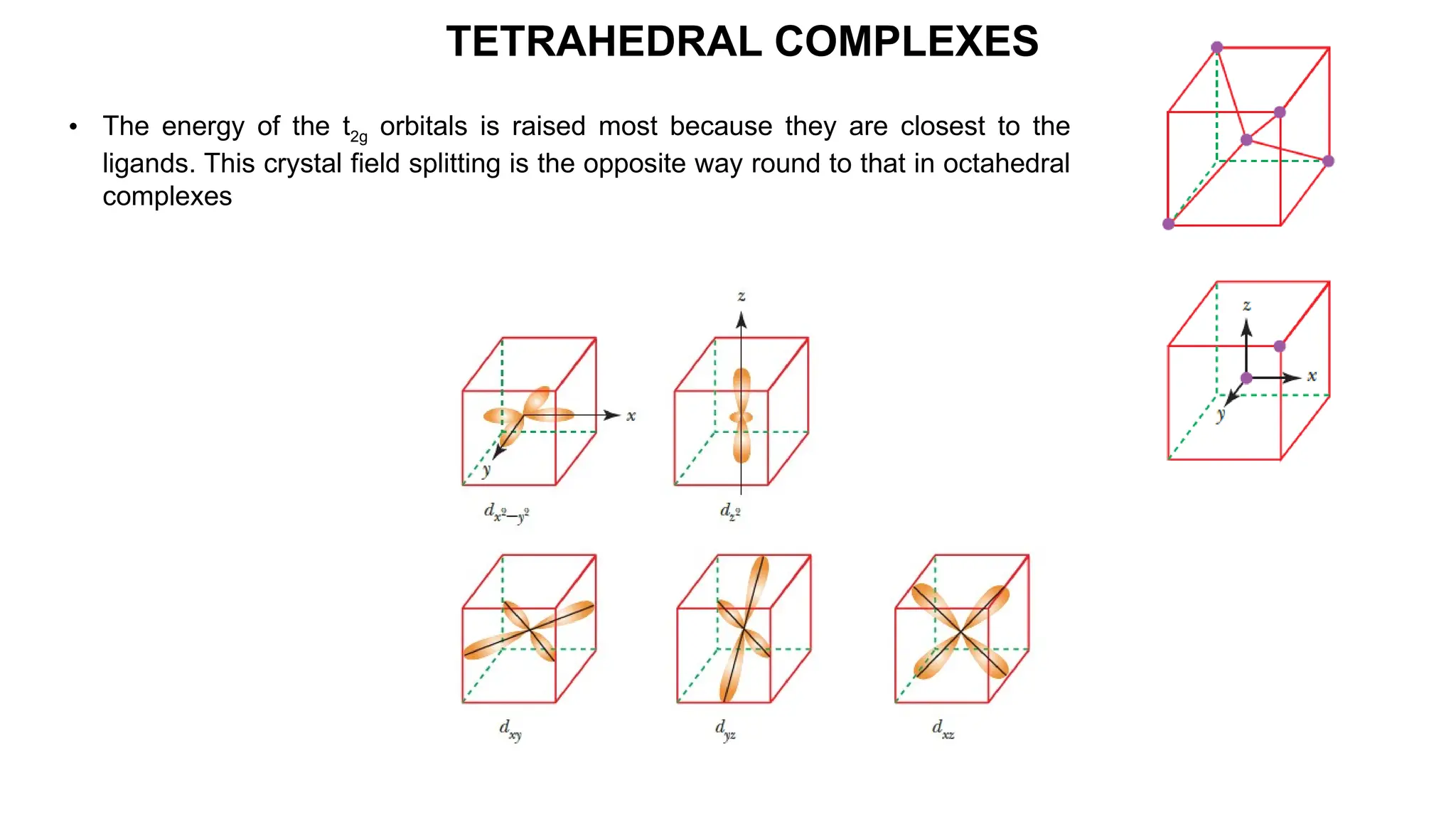
TETRAHEDRAL COMPLEXES
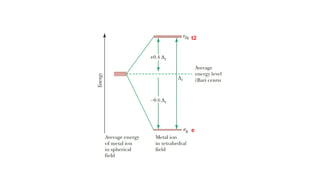
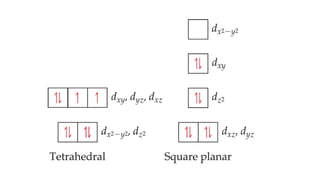
• Theenergy of the t2g orbitals is raised most because they are closest to the
ligands. This crystal field splitting is the opposite way round to that in octahedral
complexes
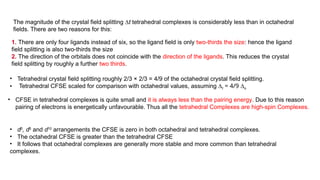
The magnitude ofthe crystal field splitting ∆t tetrahedral complexes is considerably less than in octahedral
fields. There are two reasons for this:
• CFSE in tetrahedral complexes is quite small and it is always less than the pairing energy. Due to this reason
pairing of electrons is energetically unfavourable. Thus all the tetrahedral Complexes are high-spin Complexes.
• d0
, d5
and d10
arrangements the CFSE is zero in both octahedral and tetrahedral complexes.
• The octahedral CFSE is greater than the tetrahedral CFSE
• It follows that octahedral complexes are generally more stable and more common than tetrahedral
complexes.
1. There are only four ligands instead of six, so the ligand field is only two-thirds the size: hence the ligand
field splitting is also two-thirds the size
2. The direction of the orbitals does not coincide with the direction of the ligands. This reduces the crystal
field splitting by roughly a further two thirds.
• Tetrahedral crystal field splitting roughly 2/3 × 2/3 = 4/9 of the octahedral crystal field splitting.
• Tetrahedral CFSE scaled for comparison with octahedral values, assuming ∆t = 4/9 ∆o
9.
The value ofcrystal field splitting parameter in [CoCl6]4–
ion is 18000 cm–1
. Calculate the value
of CFSE in [CoCl4]2–
10.
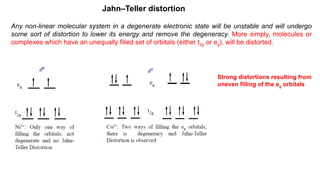
Any non-linear molecularsystem in a degenerate electronic state will be unstable and will undergo
some sort of distortion to lower its energy and remove the degeneracy. More simply, molecules or
complexes which have an unequally filled set of orbitals (either t2g or eg), will be distorted.
Jahn–Teller distortion
Strong distortions resulting from
uneven filling of the eg orbitals
13.
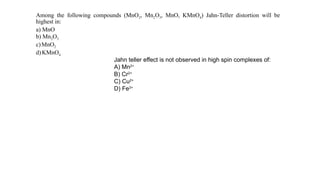
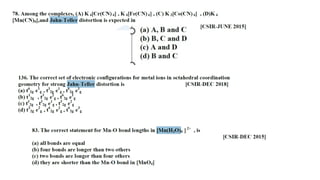
Among the followingcompounds (MnO2, Mn2O3, MnO, KMnO4) Jahn-Teller distortion will be
highest in:
a) MnO
b) Mn2O3
c) MnO2
d)KMnO4
Jahn teller effect is not observed in high spin complexes of:
A) Mn2+
B) Cr2+
C) Cu2+
D) Fe3+
15.
TETRAGONAL DISTORTION OFOCTAHEDRAL COMPLEXES
(JAHN-TELLER DISTORTION)
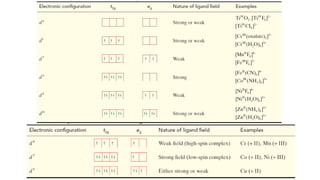
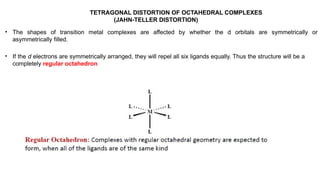
• The shapes of transition metal complexes are affected by whether the d orbitals are symmetrically or
asymmetrically filled.
• If the d electrons are symmetrically arranged, they will repel all six ligands equally. Thus the structure will be a
completely regular octahedron
16.
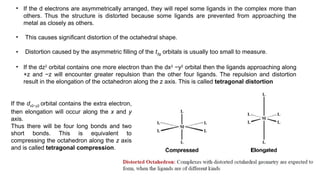
• If thed electrons are asymmetrically arranged, they will repel some ligands in the complex more than
others. Thus the structure is distorted because some ligands are prevented from approaching the
metal as closely as others.
• This causes significant distortion of the octahedral shape.
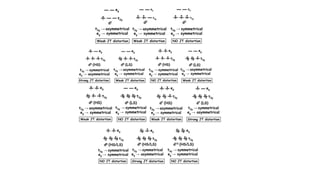
• Distortion caused by the asymmetric filling of the t2g orbitals is usually too small to measure.
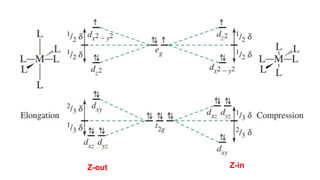
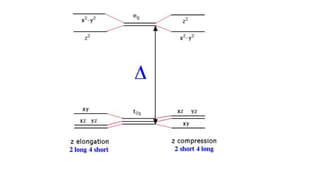
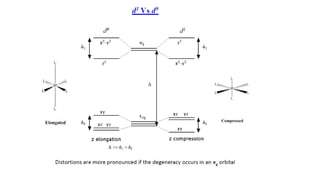
• If the dz2
orbital contains one more electron than the dx2
−y2
orbital then the ligands approaching along
+z and −z will encounter greater repulsion than the other four ligands. The repulsion and distortion
result in the elongation of the octahedron along the z axis. This is called tetragonal distortion
If the dx2−y2 orbital contains the extra electron,
then elongation will occur along the x and y
axis.
Thus there will be four long bonds and two
short bonds. This is equivalent to
compressing the octahedron along the z axis
and is called tetragonal compression.
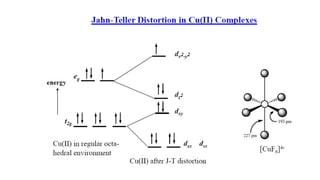
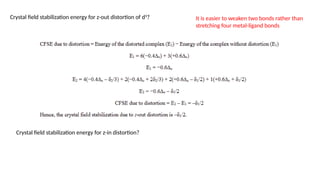
Crystal field stabilizationenergy for z-in distortion?
Crystal field stabilization energy for z-out distortion of d9
? It is easier to weaken two bonds rather than
stretching four metal-ligand bonds
21.
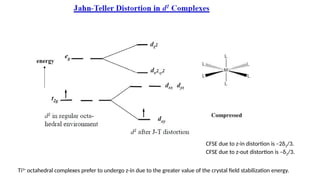
Ti3+
octahedral complexes preferto undergo z-in due to the greater value of the crystal field stabilization energy.
CFSE due to z-in distortion is –2δ2/3.
CFSE due to z-out distortion is –δ2/3.
23.
Coordinatively labile natureof [Cr(H2O)6]2+
: The [Cr(H2O)6]2+
undergoes substitution easily since the Cr(II)
ion is a high spin d4
system with one electron in the eg orbital. Hence it is electronically degenerate and shows
Jahn-Teller distortion. Hence the hydrated Cr(II) ion is coordinatively labile.
• [Cu(en)3]2+
is unstable since JT distortion brings strain into the ethylene diamine molecule that is added along
the z-axis. Hence only [Cu(en)2(H2O)2]2+
is formed.
• Au(II) ion is less stable and undergoes disproportionation to Au(I) and Au(III) even though the Cu(II) and
Ag(II) ions are comparatively more stable. Why?
The Δ value increase down the group. Hence, in Au(II) ion, it reaches a maximum, which causes high
destabilization of the last electron, which is now occupying the dx2-y2. This makes Au(II) reactive, which may
undergo either oxidation to Au(III), a d8
system or reduction to Au(I), a d10
system.
Identify the correctstatement about [Ni(H O)
₂ 6]+2
and [Cu(H O)
₂ 6]+2
(b) Ni-O(equatorial) and Cu-O(equatorial)
(c) All Ni-O bond lengths are equal whereas Cu-O (equatorial) bonds are shorter than Cu-O(axial)
bonds
(d) All Cu-O bond lengths are equal whereas Ni-O(equatorial) bonds are shorter than Ni-O(axial)bonds
Editor's Notes
#1 CFSE = energy change relative to a hypothetical crystal field.

![The value of crystal field splitting parameter in [CoCl6]4–
ion is 18000 cm–1
. Calculate the value
of CFSE in [CoCl4]2–](https://image.slidesharecdn.com/jtdtdandsp-250831185126-cdf753bb/85/JTD-Td-and-SP-notes-for-chemistry-higher-level-9-320.jpg)
![Coordinatively labile nature of [Cr(H2O)6]2+
: The [Cr(H2O)6]2+
undergoes substitution easily since the Cr(II)
ion is a high spin d4
system with one electron in the eg orbital. Hence it is electronically degenerate and shows
Jahn-Teller distortion. Hence the hydrated Cr(II) ion is coordinatively labile.
• [Cu(en)3]2+
is unstable since JT distortion brings strain into the ethylene diamine molecule that is added along
the z-axis. Hence only [Cu(en)2(H2O)2]2+
is formed.
• Au(II) ion is less stable and undergoes disproportionation to Au(I) and Au(III) even though the Cu(II) and
Ag(II) ions are comparatively more stable. Why?
The Δ value increase down the group. Hence, in Au(II) ion, it reaches a maximum, which causes high
destabilization of the last electron, which is now occupying the dx2-y2. This makes Au(II) reactive, which may
undergo either oxidation to Au(III), a d8
system or reduction to Au(I), a d10
system.](https://image.slidesharecdn.com/jtdtdandsp-250831185126-cdf753bb/85/JTD-Td-and-SP-notes-for-chemistry-higher-level-23-320.jpg)
![Jahn-Teller distortion on [Cu(en)3]2+](https://image.slidesharecdn.com/jtdtdandsp-250831185126-cdf753bb/85/JTD-Td-and-SP-notes-for-chemistry-higher-level-24-320.jpg)
![Jahn-Teller distortion on [Cu(en)2(H2O)2]2+](https://image.slidesharecdn.com/jtdtdandsp-250831185126-cdf753bb/85/JTD-Td-and-SP-notes-for-chemistry-higher-level-25-320.jpg)
![Identify the correct statement about [Ni(H O)
₂ 6]+2
and [Cu(H O)
₂ 6]+2
(b) Ni-O(equatorial) and Cu-O(equatorial)
(c) All Ni-O bond lengths are equal whereas Cu-O (equatorial) bonds are shorter than Cu-O(axial)
bonds
(d) All Cu-O bond lengths are equal whereas Ni-O(equatorial) bonds are shorter than Ni-O(axial)bonds](https://image.slidesharecdn.com/jtdtdandsp-250831185126-cdf753bb/85/JTD-Td-and-SP-notes-for-chemistry-higher-level-26-320.jpg)