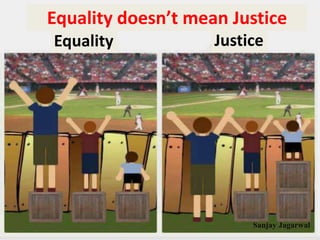
Equality doesn’t mean Justice
Equality            Justice


                         Sanjay Jagarwal
Moral Reasoning
• Consequentialist
         locates morality in the consequences
         of an act

• Categorical
           locate morality in certain duties and
           rights
Animals can tell right from wrong…
  Animals possess a sense of morality that allows them to tell the
  difference between right and wrong.

  Just as in humans, the moral nuances of a particular culture or
  group will be different from another, but they are certainly there.

  Moral codes are species specific.

  Recent neurology work has also revealed that distantly related
  mammals such as whales and dolphins have the same structures
  in their brains that are thought to be responsible for empathy in
  humans.
WOLVES:
During play, dominant wolves will "handicap" themselves by engaging in
roll reversal with lower ranking wolves, showing submission and
allowing them to bite.
without a moral code governing their actions, this kind of behaviour
would not be possible. If an animal bites too hard, it will initiate a
"play bow" to ask forgiveness before play resumes.

RODENTS:
• Experiments with rats have shown that they will not take food if
  they know their actions will cause pain to another rat. In lab tests,
  rats were given food which then caused a second group of rats to
  receive an electric shock.
• The rats with the food stopped eating rather than see another rat
  receive a shock. Similarly, mice react more strongly to pain when
  they have seen another mouse in pain.
BATS:
Vampire bats need to drink blood every night but it is common
for some not to find any food. Those who are successful in
foraging for blood will share their meal with bats who are not
successful.


WHALES:
Whales have been found to have spindle cells in their
brains. These very large and specialised cells were thought
to be restricted to humans and other great apes and appear
to play a role in empathy and understanding the feelings of
others.
Emotions
Contents
• Definition
• Understandings of justice
I.     Justice as harmony
II.    Justice as divine command
III.   Justice as natural law
IV.    Justice as human creation
V.     Justice as a subordinate value
• Types of justice
• Problems and there solutions
• References
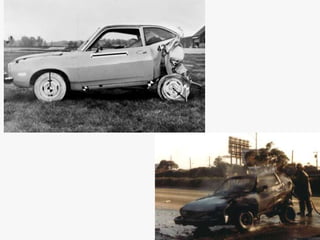
FORD Pinto
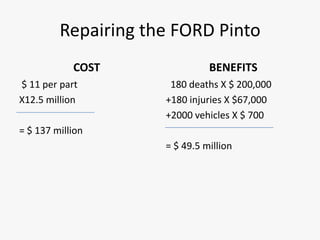
Repairing the FORD Pinto
            COST               BENEFITS
$ 11 per part         180 deaths X $ 200,000
X12.5 million        +180 injuries X $67,000
                     +2000 vehicles X $ 700
= $ 137 million
                     = $ 49.5 million
Justice


          John Rawls
Modified Definition of Just
Justice is a concept of moral rightness based on ethics,
rationality, law, natural law, religion, equity or fairness, as well
as the administration of the law, taking into account the
inalienable and inborn rights of all human beings and citizens,
the right of all people and individuals to equal protection before
the law of their civil rights, without discrimination on the basis
of race, gender, sexual orientation, gender identity, national
origin, color, ethnicity, religion, disability, age, or other
characteristics, and is further regarded as being inclusive of
social justice.
the progress of any
   country depends on 4
things: Idea, Liberty, Trust
         & Freedom.
              Abraham Lincoln
Understandings of justice

Justice differ in every culture, as cultures are usually dependent
upon a shared history, mythology and/or religion.

Each culture's ethics create values which influence the notion of
justice.

There can be found some justice principles that are one and the
same in all or most of the cultures, these are insufficient to
create a unitary justice apprehension.
Justice as harmony
Plato's definition of justice is that justice is the having and doing of
what is one's own. A just man is a man in just the right place, doing his
best and giving the precise equivalent of what he has received.
This applies both at the individual level and at the universal level.

Socrates uses the parable of the chariot to illustrate his point: a chariot
works as a whole because the two horses’ power is directed by the
charioteer.
 Lovers of wisdom philosophers, in one sense of the term should
rule because only they understand what is good.
If one is ill, one goes to a doctor rather than a psychologist, because
the doctor is expert in the subject of health.
The unjust city is like a ship in open ocean, crewed by a powerful but
drunken captain (the common people), a group of untrustworthy
advisors who try to manipulate the captain into giving them power
over the ship's course (the politicians), and a navigator (the
philosopher) who is the only one who knows how to get the ship to
port. For Socrates, the only way the ship will reach its destination – the
good – is if the navigator takes charge.
Justice as divine command
Justice as a divine law is commanding, and indeed the whole of
morality, is the authoritative command.

Killing is wrong and therefore must be punished and if not punished
what should be done?
Euthyphro dilemma essentially asks: is something right because God
commands it, or does God command it because it's right?

If the former, then justice is arbitrary; if the latter, then morality exists
on a higher order than God, who becomes little more than a passer-on
of moral knowledge.
 The dilemma is however claimed to be false by some religious
apologists, who claim that goodness is the very nature of God and is
necessarily expressed in His commands. God embodies these laws and
is therefore neither higher nor lower than the law. He sets an
example for the good people among men to follow His way and also
become an embodiment of the highest principles and morals
Justice as natural law
It involves the system of consequences that naturally derives
from any action or choice.

In this, it is similar to the laws of physics: in the same way as the
Third of Newton's laws of Motion requires that for every action
there must be an equal and opposite reaction.

 Justice requires according individuals or groups what they
actually deserve, merit, or are entitled to. Justice, on this
account, is a universal and absolute concept: laws, principles,
religions, etc., are merely attempts to codify that concept,
sometimes with results that entirely contradict the true nature
of justice.
Justice as human creation:
In contrast to the understandings canvassed so far, justice may
be understood as a human creation, rather than a discovery of
harmony, divine command, or natural law.
This claim can be understood in a number of ways, with the
fundamental division being between those who argue that
justice is the creation of some humans, and those who argue
that it is the creation of all humans.


Justice as mutual agreement:
justice is derived from the mutual agreement of everyone
concerned; or, in many versions, from what they would agree to
under hypothetical conditions including equality and absence of
bias. This account is considered further below, under ‘Justice as
fairness’.
Justice as a subordinate value
Justice is not as fundamental as we often think. Rather, it is derived
from the more basic standard of rightness, consequentialism: what
is right is what has the best consequences.
                                                    John Stuart Mill


The proper principles of justice are those that tend to have the best
consequences. These rules may turn out to be familiar ones such as
keeping contracts; but equally, they may not, depending on the facts
about real consequences.
Either way, what is important is those consequences, and justice
is important, if at all, only as derived from that fundamental
standard.
Mill tries to explain our mistaken belief that justice is
overwhelmingly important by arguing that it derives from two
natural human tendencies:
1.our desire to retaliate against those who hurt us
2.our ability to put ourselves imaginatively in another's place.

So, when we see someone harmed, we project ourselves into
her situation and feel a desire to retaliate on her behalf. If this
process is the source of our feelings about justice, that ought to
undermine our confidence in them.
Types of justice
Distributive justice
Distributive justice, also known as economic justice, is about fairness in
what people receive, from goods to attention. Its roots are in social
order and it is at the roots of Communism, where equality is a
fundamental principle.
If people do not thing that they are getting their fair share of
something, they will seek first to gain what they believe they deserve.
They may well also seek other forms of justice.

Procedural justice
The principle of fairness is also found in the idea of fair play (as
opposed to the fair share of distributive justice).
If people believe that a fair process was used in deciding what it to be
distributed, then they may well accept an imbalance in what they
receive in comparison to others. If they see both procedural and
distributive injustice, they will likely seek restorative and/or retributive
justice.
Restorative justice
The first thing that the betrayed person may seek from the betrayer is
some form of restitution, putting things back as they should be.
The simplest form of restitution is a straightforward apology.
Restoration means putting things back as they were, so it may include
some act of contrition to demonstrate one is truly sorry. This may
include action and even extra payment to the offended party.
Restorative justice is also known as corrective justice.

Retributive justice
Restoration may well not be enough for the betrayed person and they
may seek revenge of some sort, whereby they can feel the satisfaction
of seeing the other person suffer in the way that they have suffered.
Revenge can be many times more severe than reparation as the hurt
party seeks to make the other person suffer in return.
Theories of distributive justice
need to answer three questions:
1.What goods are to be distributed?
 Is it to be wealth, power, respect, some combination of these
things?

2.Between what entities are they to be distributed?
 Humans (dead, living, future), sentient beings, the members of a
single society, nations?

3.What is the proper distribution?
Equal, meritocratic, according to social status, according to need,
based on property rights and non-aggression?
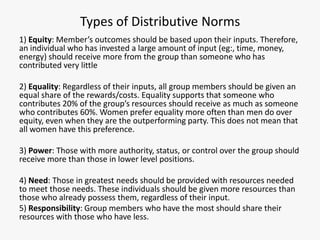
Types of Distributive Norms
1) Equity: Member’s outcomes should be based upon their inputs. Therefore,
an individual who has invested a large amount of input (eg:, time, money,
energy) should receive more from the group than someone who has
contributed very little

2) Equality: Regardless of their inputs, all group members should be given an
equal share of the rewards/costs. Equality supports that someone who
contributes 20% of the group’s resources should receive as much as someone
who contributes 60%. Women prefer equality more often than men do over
equity, even when they are the outperforming party. This does not mean that
all women have this preference.

3) Power: Those with more authority, status, or control over the group should
receive more than those in lower level positions.

4) Need: Those in greatest needs should be provided with resources needed
to meet those needs. These individuals should be given more resources than
those who already possess them, regardless of their input.
5) Responsibility: Group members who have the most should share their
resources with those who have less.
Theories of sentencing
In criminal law, a sentence forms the final explicit act of a judge-
ruled process, and also the symbolic principal act connected to
his function.

The sentence can generally involve a decree of imprisonment, a
fine and/or other punishments against a defendant convicted of
a crime.

 Laws may specify the range of penalties that can be imposed for
various offenses, and sentencing guidelines sometimes regulate
what punishment within those ranges can be imposed given a
certain set of offense and offender characteristics.
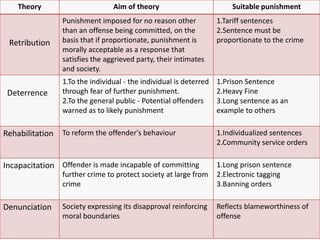
Theory                       Aim of theory                          Suitable punishment
                 Punishment imposed for no reason other             1.Tariff sentences
                 than an offense being committed, on the            2.Sentence must be
 Retribution     basis that if proportionate, punishment is         proportionate to the crime
                 morally acceptable as a response that
                 satisfies the aggrieved party, their intimates
                 and society.
                 1.To the individual - the individual is deterred   1.Prison Sentence
 Deterrence      through fear of further punishment.                2.Heavy Fine
                 2.To the general public - Potential offenders      3.Long sentence as an
                 warned as to likely punishment                     example to others

Rehabilitation   To reform the offender's behaviour                 1.Individualized sentences
                                                                    2.Community service orders

Incapacitation Offender is made incapable of committing             1.Long prison sentence
                 further crime to protect society at large from     2.Electronic tagging
                 crime                                              3.Banning orders

Denunciation     Society expressing its disapproval reinforcing     Reflects blameworthiness of
                 moral boundaries                                   offense
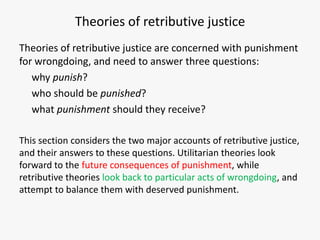
Theories of retributive justice
Theories of retributive justice are concerned with punishment
for wrongdoing, and need to answer three questions:
   why punish?
   who should be punished?
   what punishment should they receive?

This section considers the two major accounts of retributive justice,
and their answers to these questions. Utilitarian theories look
forward to the future consequences of punishment, while
retributive theories look back to particular acts of wrongdoing, and
attempt to balance them with deserved punishment.
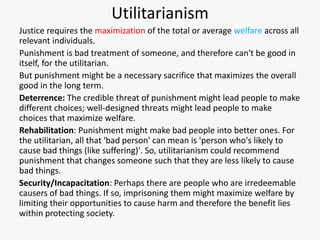
Utilitarianism
Justice requires the maximization of the total or average welfare across all
relevant individuals.
Punishment is bad treatment of someone, and therefore can't be good in
itself, for the utilitarian.
But punishment might be a necessary sacrifice that maximizes the overall
good in the long term.
Deterrence: The credible threat of punishment might lead people to make
different choices; well-designed threats might lead people to make
choices that maximize welfare.
Rehabilitation: Punishment might make bad people into better ones. For
the utilitarian, all that 'bad person' can mean is 'person who's likely to
cause bad things (like suffering)'. So, utilitarianism could recommend
punishment that changes someone such that they are less likely to cause
bad things.
Security/Incapacitation: Perhaps there are people who are irredeemable
causers of bad things. If so, imprisoning them might maximize welfare by
limiting their opportunities to cause harm and therefore the benefit lies
within protecting society.
Means…
So, the reason for punishment is the maximization of welfare,
and punishment should be of whomever, and of whatever form
and severity, are needed to meet that goal.

Worryingly, this may sometimes justify punishing the innocent,
or inflicting disproportionately severe punishments, when that
will have the best consequences overall (perhaps executing a few
suspected shoplifters live on television would be an effective
deterrent to shoplifting, for instance).

It also suggests that punishment might turn out never to be
right, depending on the facts about what actual consequences it
has
Problems…
                          14.Kidnapping
1. Arson                  15.Money Laundering
2. Assault                16.Murder
3. Burglary               17.Perjury
4. Child Abuse            18.Prostitution
5. Child Pornography      19.Public Intoxication
6. Computer Crime         20.Rape
7. Conspiracy             21.Robbery
8. Credit Card Fraud      22.Sexual Assault
9. Disorderly Conduct     23.Shoplifting
10.Disturbing the Peace   24.Solicitation
11.Domestic Violence      25.Stalking
12.Extortion              26.Statutory Rape
13.Forgery                27.Theft
References…
http://lilt.ilstu.edu/pefranc/default.htm
http://en.wikipedia.org/wiki/Justice
http://crime.about.com/od/Crime_101/a/Crimes-
A-To-Z.htm
http://www.ohchr.org/Documents/Publications/tr
aining9chapter13en.pdf
http://ec.europa.eu/justice/discrimination/index_
en.htm

Justice

  • 1.
    Equality doesn’t meanJustice Equality Justice Sanjay Jagarwal
  • 2.
    Moral Reasoning • Consequentialist locates morality in the consequences of an act • Categorical locate morality in certain duties and rights
  • 3.
    Animals can tellright from wrong… Animals possess a sense of morality that allows them to tell the difference between right and wrong. Just as in humans, the moral nuances of a particular culture or group will be different from another, but they are certainly there. Moral codes are species specific. Recent neurology work has also revealed that distantly related mammals such as whales and dolphins have the same structures in their brains that are thought to be responsible for empathy in humans.
  • 4.
    WOLVES: During play, dominantwolves will "handicap" themselves by engaging in roll reversal with lower ranking wolves, showing submission and allowing them to bite. without a moral code governing their actions, this kind of behaviour would not be possible. If an animal bites too hard, it will initiate a "play bow" to ask forgiveness before play resumes. RODENTS: • Experiments with rats have shown that they will not take food if they know their actions will cause pain to another rat. In lab tests, rats were given food which then caused a second group of rats to receive an electric shock. • The rats with the food stopped eating rather than see another rat receive a shock. Similarly, mice react more strongly to pain when they have seen another mouse in pain.
  • 5.
    BATS: Vampire bats needto drink blood every night but it is common for some not to find any food. Those who are successful in foraging for blood will share their meal with bats who are not successful. WHALES: Whales have been found to have spindle cells in their brains. These very large and specialised cells were thought to be restricted to humans and other great apes and appear to play a role in empathy and understanding the feelings of others.
  • 6.
  • 7.
    Contents • Definition • Understandingsof justice I. Justice as harmony II. Justice as divine command III. Justice as natural law IV. Justice as human creation V. Justice as a subordinate value • Types of justice • Problems and there solutions • References
  • 9.
  • 12.
    Repairing the FORDPinto COST BENEFITS $ 11 per part 180 deaths X $ 200,000 X12.5 million +180 injuries X $67,000 +2000 vehicles X $ 700 = $ 137 million = $ 49.5 million
  • 13.
    Justice John Rawls
  • 14.
    Modified Definition ofJust Justice is a concept of moral rightness based on ethics, rationality, law, natural law, religion, equity or fairness, as well as the administration of the law, taking into account the inalienable and inborn rights of all human beings and citizens, the right of all people and individuals to equal protection before the law of their civil rights, without discrimination on the basis of race, gender, sexual orientation, gender identity, national origin, color, ethnicity, religion, disability, age, or other characteristics, and is further regarded as being inclusive of social justice.
  • 15.
    the progress ofany country depends on 4 things: Idea, Liberty, Trust & Freedom. Abraham Lincoln
  • 16.
    Understandings of justice Justicediffer in every culture, as cultures are usually dependent upon a shared history, mythology and/or religion. Each culture's ethics create values which influence the notion of justice. There can be found some justice principles that are one and the same in all or most of the cultures, these are insufficient to create a unitary justice apprehension.
  • 17.
    Justice as harmony Plato'sdefinition of justice is that justice is the having and doing of what is one's own. A just man is a man in just the right place, doing his best and giving the precise equivalent of what he has received. This applies both at the individual level and at the universal level. Socrates uses the parable of the chariot to illustrate his point: a chariot works as a whole because the two horses’ power is directed by the charioteer. Lovers of wisdom philosophers, in one sense of the term should rule because only they understand what is good. If one is ill, one goes to a doctor rather than a psychologist, because the doctor is expert in the subject of health. The unjust city is like a ship in open ocean, crewed by a powerful but drunken captain (the common people), a group of untrustworthy advisors who try to manipulate the captain into giving them power over the ship's course (the politicians), and a navigator (the philosopher) who is the only one who knows how to get the ship to port. For Socrates, the only way the ship will reach its destination – the good – is if the navigator takes charge.
  • 18.
    Justice as divinecommand Justice as a divine law is commanding, and indeed the whole of morality, is the authoritative command. Killing is wrong and therefore must be punished and if not punished what should be done? Euthyphro dilemma essentially asks: is something right because God commands it, or does God command it because it's right? If the former, then justice is arbitrary; if the latter, then morality exists on a higher order than God, who becomes little more than a passer-on of moral knowledge. The dilemma is however claimed to be false by some religious apologists, who claim that goodness is the very nature of God and is necessarily expressed in His commands. God embodies these laws and is therefore neither higher nor lower than the law. He sets an example for the good people among men to follow His way and also become an embodiment of the highest principles and morals
  • 19.
    Justice as naturallaw It involves the system of consequences that naturally derives from any action or choice. In this, it is similar to the laws of physics: in the same way as the Third of Newton's laws of Motion requires that for every action there must be an equal and opposite reaction. Justice requires according individuals or groups what they actually deserve, merit, or are entitled to. Justice, on this account, is a universal and absolute concept: laws, principles, religions, etc., are merely attempts to codify that concept, sometimes with results that entirely contradict the true nature of justice.
  • 20.
    Justice as humancreation: In contrast to the understandings canvassed so far, justice may be understood as a human creation, rather than a discovery of harmony, divine command, or natural law. This claim can be understood in a number of ways, with the fundamental division being between those who argue that justice is the creation of some humans, and those who argue that it is the creation of all humans. Justice as mutual agreement: justice is derived from the mutual agreement of everyone concerned; or, in many versions, from what they would agree to under hypothetical conditions including equality and absence of bias. This account is considered further below, under ‘Justice as fairness’.
  • 21.
    Justice as asubordinate value Justice is not as fundamental as we often think. Rather, it is derived from the more basic standard of rightness, consequentialism: what is right is what has the best consequences. John Stuart Mill The proper principles of justice are those that tend to have the best consequences. These rules may turn out to be familiar ones such as keeping contracts; but equally, they may not, depending on the facts about real consequences.
  • 22.
    Either way, whatis important is those consequences, and justice is important, if at all, only as derived from that fundamental standard. Mill tries to explain our mistaken belief that justice is overwhelmingly important by arguing that it derives from two natural human tendencies: 1.our desire to retaliate against those who hurt us 2.our ability to put ourselves imaginatively in another's place. So, when we see someone harmed, we project ourselves into her situation and feel a desire to retaliate on her behalf. If this process is the source of our feelings about justice, that ought to undermine our confidence in them.
  • 23.
    Types of justice Distributivejustice Distributive justice, also known as economic justice, is about fairness in what people receive, from goods to attention. Its roots are in social order and it is at the roots of Communism, where equality is a fundamental principle. If people do not thing that they are getting their fair share of something, they will seek first to gain what they believe they deserve. They may well also seek other forms of justice. Procedural justice The principle of fairness is also found in the idea of fair play (as opposed to the fair share of distributive justice). If people believe that a fair process was used in deciding what it to be distributed, then they may well accept an imbalance in what they receive in comparison to others. If they see both procedural and distributive injustice, they will likely seek restorative and/or retributive justice.
  • 24.
    Restorative justice The firstthing that the betrayed person may seek from the betrayer is some form of restitution, putting things back as they should be. The simplest form of restitution is a straightforward apology. Restoration means putting things back as they were, so it may include some act of contrition to demonstrate one is truly sorry. This may include action and even extra payment to the offended party. Restorative justice is also known as corrective justice. Retributive justice Restoration may well not be enough for the betrayed person and they may seek revenge of some sort, whereby they can feel the satisfaction of seeing the other person suffer in the way that they have suffered. Revenge can be many times more severe than reparation as the hurt party seeks to make the other person suffer in return.
  • 25.
    Theories of distributivejustice need to answer three questions: 1.What goods are to be distributed? Is it to be wealth, power, respect, some combination of these things? 2.Between what entities are they to be distributed? Humans (dead, living, future), sentient beings, the members of a single society, nations? 3.What is the proper distribution? Equal, meritocratic, according to social status, according to need, based on property rights and non-aggression?
  • 26.
    Types of DistributiveNorms 1) Equity: Member’s outcomes should be based upon their inputs. Therefore, an individual who has invested a large amount of input (eg:, time, money, energy) should receive more from the group than someone who has contributed very little 2) Equality: Regardless of their inputs, all group members should be given an equal share of the rewards/costs. Equality supports that someone who contributes 20% of the group’s resources should receive as much as someone who contributes 60%. Women prefer equality more often than men do over equity, even when they are the outperforming party. This does not mean that all women have this preference. 3) Power: Those with more authority, status, or control over the group should receive more than those in lower level positions. 4) Need: Those in greatest needs should be provided with resources needed to meet those needs. These individuals should be given more resources than those who already possess them, regardless of their input. 5) Responsibility: Group members who have the most should share their resources with those who have less.
  • 27.
    Theories of sentencing Incriminal law, a sentence forms the final explicit act of a judge- ruled process, and also the symbolic principal act connected to his function. The sentence can generally involve a decree of imprisonment, a fine and/or other punishments against a defendant convicted of a crime. Laws may specify the range of penalties that can be imposed for various offenses, and sentencing guidelines sometimes regulate what punishment within those ranges can be imposed given a certain set of offense and offender characteristics.
  • 28.
    Theory Aim of theory Suitable punishment Punishment imposed for no reason other 1.Tariff sentences than an offense being committed, on the 2.Sentence must be Retribution basis that if proportionate, punishment is proportionate to the crime morally acceptable as a response that satisfies the aggrieved party, their intimates and society. 1.To the individual - the individual is deterred 1.Prison Sentence Deterrence through fear of further punishment. 2.Heavy Fine 2.To the general public - Potential offenders 3.Long sentence as an warned as to likely punishment example to others Rehabilitation To reform the offender's behaviour 1.Individualized sentences 2.Community service orders Incapacitation Offender is made incapable of committing 1.Long prison sentence further crime to protect society at large from 2.Electronic tagging crime 3.Banning orders Denunciation Society expressing its disapproval reinforcing Reflects blameworthiness of moral boundaries offense
  • 29.
    Theories of retributivejustice Theories of retributive justice are concerned with punishment for wrongdoing, and need to answer three questions: why punish? who should be punished? what punishment should they receive? This section considers the two major accounts of retributive justice, and their answers to these questions. Utilitarian theories look forward to the future consequences of punishment, while retributive theories look back to particular acts of wrongdoing, and attempt to balance them with deserved punishment.
  • 30.
    Utilitarianism Justice requires themaximization of the total or average welfare across all relevant individuals. Punishment is bad treatment of someone, and therefore can't be good in itself, for the utilitarian. But punishment might be a necessary sacrifice that maximizes the overall good in the long term. Deterrence: The credible threat of punishment might lead people to make different choices; well-designed threats might lead people to make choices that maximize welfare. Rehabilitation: Punishment might make bad people into better ones. For the utilitarian, all that 'bad person' can mean is 'person who's likely to cause bad things (like suffering)'. So, utilitarianism could recommend punishment that changes someone such that they are less likely to cause bad things. Security/Incapacitation: Perhaps there are people who are irredeemable causers of bad things. If so, imprisoning them might maximize welfare by limiting their opportunities to cause harm and therefore the benefit lies within protecting society.
  • 31.
    Means… So, the reasonfor punishment is the maximization of welfare, and punishment should be of whomever, and of whatever form and severity, are needed to meet that goal. Worryingly, this may sometimes justify punishing the innocent, or inflicting disproportionately severe punishments, when that will have the best consequences overall (perhaps executing a few suspected shoplifters live on television would be an effective deterrent to shoplifting, for instance). It also suggests that punishment might turn out never to be right, depending on the facts about what actual consequences it has
  • 32.
    Problems… 14.Kidnapping 1. Arson 15.Money Laundering 2. Assault 16.Murder 3. Burglary 17.Perjury 4. Child Abuse 18.Prostitution 5. Child Pornography 19.Public Intoxication 6. Computer Crime 20.Rape 7. Conspiracy 21.Robbery 8. Credit Card Fraud 22.Sexual Assault 9. Disorderly Conduct 23.Shoplifting 10.Disturbing the Peace 24.Solicitation 11.Domestic Violence 25.Stalking 12.Extortion 26.Statutory Rape 13.Forgery 27.Theft
  • 33.