Renewable Portfolio Standard and Energy Efficiency Procurement Cliff Ginn Co-Director Opportunity Maine
Why Renewable Energy? Stabilize costs over long term Many renewables competitive or close to it, lack volatility of fossil fuels. Greater efficiency when generation is close to consumption. Merit order effect - crowding out expensive peak generators. Create jobs by harnessing indigenous resources Wind, solar, biomass, hydropower, geothermal, [efficiency]. Construction & operation. Critical mass of research, development and deployment leads to new manufacturing industries Public health, climate benefits of clean energy
Barriers to Renewable Development Cost barriers for any new generation Renewables have high concentration of up-front costs. Subsidies More generous for fossil fuels, history of public funded basic research Fossil fuel generators do not internalize health and environmental costs Economies of scale Lower cost of materials, construction, operation More efficiency siting, operation Siting challenges Density of production. Resources in areas with competing values. All lead to limited access to capital
Policies To Overcome Barriers Simplified siting and permitting  reduces costs and uncertainty. Speed and predictability of decisionmaking, uniformity of processes. Subsidies  lower costs. Tax incentives, grants, public benefit funds Federal production tax credit – 2.2 cents/kWh over 10 years. Cost recovery Loan subsidies (loan funds, guarantees, bonds) Net metering  provides elevated return for distributed generation. Feed-in Tariff  ensures predictable return. Lower cost of materials, construction, operation More efficiency siting, operation Successful in European market transformation – limited use in U.S.
Renewable Energy Standard Require utilities to purchase a certain amount of renewable energy or Renewable Energy Credits (RECs) to account for a percentage of sales RECs are traded in the market, alternative compliance payment is set by legislature or public utilities commission to place a ceiling on REC prices. Some states have  “carve-out” or “set-aside” for certain resources, such as distributed generation, solar, etc. 29 States Plus DC Range from 10% by 2015 (MI) to 40% by 2017 (ME).
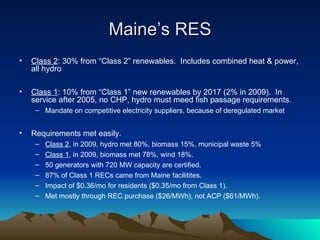
Maine ’s RES Class 2 : 30% from  “Class 2” renewables.  Includes combined heat & power, all hydro Class 1 : 10% from  “Class 1” new renewables by 2017 (2% in 2009).  In service after 2005, no CHP, hydro must meed fish passage requirements.  Mandate on competitive electricity suppliers, because of deregulated market Requirements met easily. Class 2 , in 2009, hydro met 80%, biomass 15%, municipal waste 5% Class 1 , in 2009, biomass met 78%, wind 18%. 50 generators with 720 MW capacity are certified. 87% of Class 1 RECs came from Maine facilitites. Impact of $0.36/mo for residents ($0.35/mo from Class 1). Met mostly through REC purchase ($26/MWh), not ACP ($61/MWh).
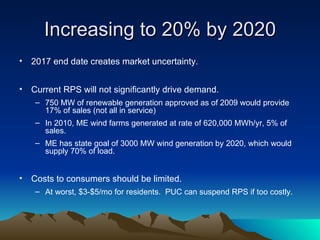
Increasing to 20% by 2020 2017 end date creates market uncertainty. Current RPS will not significantly drive demand. 750 MW of renewable generation approved as of 2009 would provide 17% of sales (not all in service) In 2010, ME wind farms generated at rate of 620,000 MWh/yr, 5% of sales. ME has state goal of 3000 MW wind generation by 2020, which would supply 70% of load. Costs to consumers should be limited. At worst, $3-$5/mo for residents.  PUC can suspend RPS if too costly.
Questions Before Discussing Energy Efficiency?
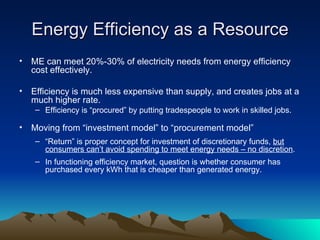
Energy Efficiency as a Resource ME can meet 20%-30% of electricity needs from energy efficiency cost effectively. Efficiency is much less expensive than supply, and creates jobs at a much higher rate. Efficiency is  “procured” by putting tradespeople to work in skilled jobs. Moving from  “investment model” to “procurement model” “ Return” is proper concept for investment of discretionary funds,  but consumers can’t avoid spending to meet energy needs – no discretion . In functioning efficiency market, question is whether consumer has purchased every kWh that is cheaper than generated energy.
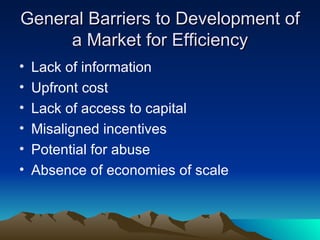
General Barriers to Development of a Market for Efficiency Lack of information Upfront cost Lack of access to capital Misaligned incentives Potential for abuse Absence of economies of scale
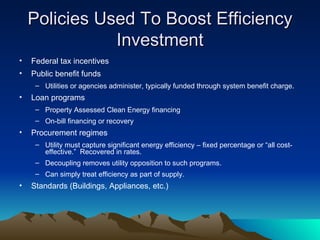
Policies Used To Boost Efficiency Investment Federal tax incentives Public benefit funds Utilities or agencies administer, typically funded through system benefit charge. Loan programs  Property Assessed Clean Energy financing On-bill financing or recovery Procurement regimes Utility must capture significant energy efficiency – fixed percentage or  “all cost-effective.”  Recovered in rates. Decoupling removes utility opposition to such programs. Can simply treat efficiency as part of supply. Standards (Buildings, Appliances, etc.)
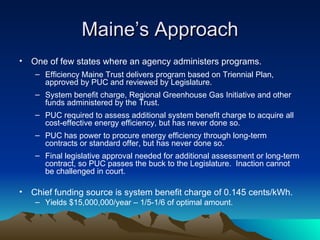
Maine ’s Approach One of few states where an agency administers programs. Efficiency Maine Trust delivers program based on Triennial Plan, approved by PUC and reviewed by Legislature. System benefit charge, Regional Greenhouse Gas Initiative and other funds administered by the Trust. PUC required to assess additional system benefit charge to acquire all cost-effective energy efficiency, but has never done so. PUC has power to procure energy efficiency through long-term contracts or standard offer, but has never done so. Final legislative approval needed for additional assessment or long-term contract, so PUC passes the buck to the Legislature.  Inaction cannot be challenged in court. Chief funding source is system benefit charge of 0.145 cents/kWh. Yields $15,000,000/year – 1/5-1/6 of optimal amount.
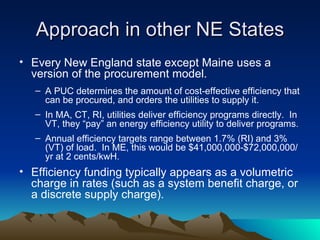
Approach in other NE States Every New England state except Maine uses a version of the procurement model. A PUC determines the amount of cost-effective efficiency that can be procured, and orders the utilities to supply it. In MA, CT, RI, utilities deliver efficiency programs directly.  In VT, they  “pay” an energy efficiency utility to deliver programs. Annual efficiency targets range between 1.7% (RI) and 3% (VT) of load.  In ME, this would be $41,000,000-$72,000,000/yr at 2 cents/kwH. Efficiency funding typically appears as a volumetric charge in rates (such as a system benefit charge, or a discrete supply charge).
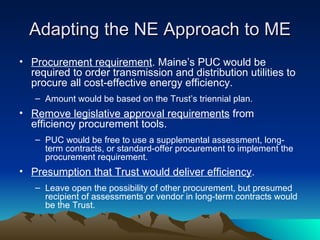
Adapting the NE Approach to ME Procurement requirement . Maine ’s PUC would be required to order transmission and distribution utilities to procure all cost-effective energy efficiency. Amount would be based on the Trust ’s triennial plan. Remove legislative approval requirements  from efficiency procurement tools. PUC would be free to use a supplemental assessment, long-term contracts, or standard-offer procurement to implement the procurement requirement. Presumption that Trust would deliver efficiency . Leave open the possibility of other procurement, but presumed recipient of assessments or vendor in long-term contracts would be the Trust.
Effect of the Changes Remove specter of Legislative veto Subject PUC efficiency decisions to judicial review Make efficiency procurement more like supply procurement – least cost resource Higher levels of efficiency investment, tied to long-term planning, with rigorous measurement and verification of savings.
Questions? Opportunity Maine 237 Oxford Street, Suite 22 Portland, ME 04101 (207) 699-5880 www.opportunitymaine.org

Opportunity Maine Policy Webinar

  • 1.
    Renewable Portfolio Standardand Energy Efficiency Procurement Cliff Ginn Co-Director Opportunity Maine
  • 2.
    Why Renewable Energy?Stabilize costs over long term Many renewables competitive or close to it, lack volatility of fossil fuels. Greater efficiency when generation is close to consumption. Merit order effect - crowding out expensive peak generators. Create jobs by harnessing indigenous resources Wind, solar, biomass, hydropower, geothermal, [efficiency]. Construction & operation. Critical mass of research, development and deployment leads to new manufacturing industries Public health, climate benefits of clean energy
  • 3.
    Barriers to RenewableDevelopment Cost barriers for any new generation Renewables have high concentration of up-front costs. Subsidies More generous for fossil fuels, history of public funded basic research Fossil fuel generators do not internalize health and environmental costs Economies of scale Lower cost of materials, construction, operation More efficiency siting, operation Siting challenges Density of production. Resources in areas with competing values. All lead to limited access to capital
  • 4.
    Policies To OvercomeBarriers Simplified siting and permitting reduces costs and uncertainty. Speed and predictability of decisionmaking, uniformity of processes. Subsidies lower costs. Tax incentives, grants, public benefit funds Federal production tax credit – 2.2 cents/kWh over 10 years. Cost recovery Loan subsidies (loan funds, guarantees, bonds) Net metering provides elevated return for distributed generation. Feed-in Tariff ensures predictable return. Lower cost of materials, construction, operation More efficiency siting, operation Successful in European market transformation – limited use in U.S.
  • 5.
    Renewable Energy StandardRequire utilities to purchase a certain amount of renewable energy or Renewable Energy Credits (RECs) to account for a percentage of sales RECs are traded in the market, alternative compliance payment is set by legislature or public utilities commission to place a ceiling on REC prices. Some states have “carve-out” or “set-aside” for certain resources, such as distributed generation, solar, etc. 29 States Plus DC Range from 10% by 2015 (MI) to 40% by 2017 (ME).
  • 6.
    Maine ’s RESClass 2 : 30% from “Class 2” renewables. Includes combined heat & power, all hydro Class 1 : 10% from “Class 1” new renewables by 2017 (2% in 2009). In service after 2005, no CHP, hydro must meed fish passage requirements. Mandate on competitive electricity suppliers, because of deregulated market Requirements met easily. Class 2 , in 2009, hydro met 80%, biomass 15%, municipal waste 5% Class 1 , in 2009, biomass met 78%, wind 18%. 50 generators with 720 MW capacity are certified. 87% of Class 1 RECs came from Maine facilitites. Impact of $0.36/mo for residents ($0.35/mo from Class 1). Met mostly through REC purchase ($26/MWh), not ACP ($61/MWh).
  • 7.
    Increasing to 20%by 2020 2017 end date creates market uncertainty. Current RPS will not significantly drive demand. 750 MW of renewable generation approved as of 2009 would provide 17% of sales (not all in service) In 2010, ME wind farms generated at rate of 620,000 MWh/yr, 5% of sales. ME has state goal of 3000 MW wind generation by 2020, which would supply 70% of load. Costs to consumers should be limited. At worst, $3-$5/mo for residents. PUC can suspend RPS if too costly.
  • 8.
    Questions Before DiscussingEnergy Efficiency?
  • 9.
    Energy Efficiency asa Resource ME can meet 20%-30% of electricity needs from energy efficiency cost effectively. Efficiency is much less expensive than supply, and creates jobs at a much higher rate. Efficiency is “procured” by putting tradespeople to work in skilled jobs. Moving from “investment model” to “procurement model” “ Return” is proper concept for investment of discretionary funds, but consumers can’t avoid spending to meet energy needs – no discretion . In functioning efficiency market, question is whether consumer has purchased every kWh that is cheaper than generated energy.
  • 10.
    General Barriers toDevelopment of a Market for Efficiency Lack of information Upfront cost Lack of access to capital Misaligned incentives Potential for abuse Absence of economies of scale
  • 11.
    Policies Used ToBoost Efficiency Investment Federal tax incentives Public benefit funds Utilities or agencies administer, typically funded through system benefit charge. Loan programs Property Assessed Clean Energy financing On-bill financing or recovery Procurement regimes Utility must capture significant energy efficiency – fixed percentage or “all cost-effective.” Recovered in rates. Decoupling removes utility opposition to such programs. Can simply treat efficiency as part of supply. Standards (Buildings, Appliances, etc.)
  • 12.
    Maine ’s ApproachOne of few states where an agency administers programs. Efficiency Maine Trust delivers program based on Triennial Plan, approved by PUC and reviewed by Legislature. System benefit charge, Regional Greenhouse Gas Initiative and other funds administered by the Trust. PUC required to assess additional system benefit charge to acquire all cost-effective energy efficiency, but has never done so. PUC has power to procure energy efficiency through long-term contracts or standard offer, but has never done so. Final legislative approval needed for additional assessment or long-term contract, so PUC passes the buck to the Legislature. Inaction cannot be challenged in court. Chief funding source is system benefit charge of 0.145 cents/kWh. Yields $15,000,000/year – 1/5-1/6 of optimal amount.
  • 13.
    Approach in otherNE States Every New England state except Maine uses a version of the procurement model. A PUC determines the amount of cost-effective efficiency that can be procured, and orders the utilities to supply it. In MA, CT, RI, utilities deliver efficiency programs directly. In VT, they “pay” an energy efficiency utility to deliver programs. Annual efficiency targets range between 1.7% (RI) and 3% (VT) of load. In ME, this would be $41,000,000-$72,000,000/yr at 2 cents/kwH. Efficiency funding typically appears as a volumetric charge in rates (such as a system benefit charge, or a discrete supply charge).
  • 14.
    Adapting the NEApproach to ME Procurement requirement . Maine ’s PUC would be required to order transmission and distribution utilities to procure all cost-effective energy efficiency. Amount would be based on the Trust ’s triennial plan. Remove legislative approval requirements from efficiency procurement tools. PUC would be free to use a supplemental assessment, long-term contracts, or standard-offer procurement to implement the procurement requirement. Presumption that Trust would deliver efficiency . Leave open the possibility of other procurement, but presumed recipient of assessments or vendor in long-term contracts would be the Trust.
  • 15.
    Effect of theChanges Remove specter of Legislative veto Subject PUC efficiency decisions to judicial review Make efficiency procurement more like supply procurement – least cost resource Higher levels of efficiency investment, tied to long-term planning, with rigorous measurement and verification of savings.
  • 16.
    Questions? Opportunity Maine237 Oxford Street, Suite 22 Portland, ME 04101 (207) 699-5880 www.opportunitymaine.org